Seeding on the Synthesis of MCM-22 (MWW) Zeolite
by Dry-Gel Conversion Method and its Catalytic Properties
on the Skeleton Isomerization and the Cracking of Hexane
Shyamal Kumar Saha, Pusparatu, Kenichi Komura, Yoshihiro Kubota
*1and Yoshihiro Sugi
*2Department of Materials Science and Technology, Faculty of Engineering, Gifu University, Gifu 501-1193, Japan
The effects of seeding on synthesis of MCM-22 (MWW) have been studied by the dry gel conversion (DGC) method. Highly reproducible crystalline MWW zeolite could be obtained by DGC method, using seeds of calcined sodium MWW with SiO2/Al2O3¼31. Crystallization of MWW phase was completed in the presence of seeds (2 mass% against SiO2) at 150C within two days. The small amount of seed (0.25 mass% against SiO2) was sufficient for the required phase formation of MWW. The MWW with SiO2/Al2O3ratio from 35 to 66 was obtained as pure phase; however, the crystallinity of MWW decreased with further increase in the ratio: products were contaminated with impurities.
The catalytic properties of MWW were examined in the skeleton isomerization and the cracking of hexane, and compared to zeolites such as BEA, MFI, and MOR. The catalytic activities were in the order: MFI>BEA>MWWMOR; however, the selectivity for the isomerization were in the order: BEA>MWW>MFI. These catalytic properties were due to the differences of structures and acid strength of zeolites.
(Received June 21, 2005; Accepted September 20, 2005; Published December 15, 2005)
Keywords: MCM-22 (MWW), dry-gel conversion (DGC), seeds, skeleton isomerization of hexane, cracking
1. Introduction
MCM-22 (MWW) is a family of high silica zeolite, which was found by Mobil Oil Corporation in 1990.1) It has a similar structure as PSH-3,2)SSZ-25,3)borosilicate zeolites ERB,4)and pure silica zeolite ITQ-1.5)It has been claimed to be useful for a variety of hydrocarbon conversion reactions such as alkylation, disproportionation, isomerization,
crack-ing, etc.6–10) MWW has been successfully synthesized by
static condition, and compared its morphology with the rotating condition by Gu¨ray and his co-workers.11)It has also been reported that the formation of MWW by static condition depends on the SiO2/Al2O3by Cheng and his co-workers.12)
Mochida and his co-workers reported that the addition of seeds could greatly accelerate the crystallization and reduce the synthesis time by hydrothermal synthesis (HTS).13)
New methods of zeolite synthesis, such as a dry-gel conversion (DGC) method and solid transformation have been well documented by some research groups.14–29) In comparison with the hydrothermal synthesis method, these new methods have the advantages such as expansion of the chemical compositions, the reduction of the structure direct-ing agent (SDA) concentration, high conversion of the gel, fine particles with high crystallization,etc. Recently, Matsu-kata and his co-workers have successfully synthesized MWW by DGC method, and compared the morphologies of products synthesized by the DGC and HTS methods.30,31) However, effects of seeds on the crystallization of MWW by DGC method have not been published so far to our knowledge. In the present study, an attempt has been made to synthesize MWW by DGC method, and to elucidate the effect of seeds, crystallization time, temperature, and SiO2/
Al2O3 ratios on the synthesis. The characterization of the
zeolite and the isomerization and the cracking of hexane were also examined to know their properties.
2. Experimental
2.1 Synthesis of MWW
Vapor phase transport (VPT) method, which is a method of ‘‘dry-gel conversion (DGC) method’’,16,21) was used as a typical synthesis procedure: 0.266 g of NaAlO2 (42.8%
Al2O3, 33.2% Na2O and 23.5% H2O; Nakalai Tesque) was
mixed with 3.1 g of NaOH (4 mass% solution) and 8.0 g H2O.
The mixture was stirred for 10 min. The fumed silica of 2.403 g (Cab-O-Sil M5) and the rest of water (20.68 g) were added to the mixture, and the stirring was continued for 2 h. Then, the gel was dried at 80C over an oil bath with continuous stirring to evaporate water (2–2.5 h) until the gel became thick and viscous, and the gel was homogenized by hand using a Teflon rod till dried. The white solid thus obtained was grounded into a fine powder. The powder was poured into a small Teflon cup, and then, kept into a Teflon-lined autoclave containing water (ca. 0.2 g per 1.0 g of dry gel) and hexamethyleneimine 2.086 g (95% TCI, Tokyo, Japan), where the dry gel should not directly contact with water. The crystallization of the dry gel was carried out at desired temperature and time under the autogenous pressure. The autoclave was quenched in the cold water after the definite time. The solid product was separated by filtration, and repeatedly washed with distilled water, and dried at 110C overnight. The addition of seeds (MWW (sodium form); SiO2/Al2O3¼31) was carried out by two different
ways:
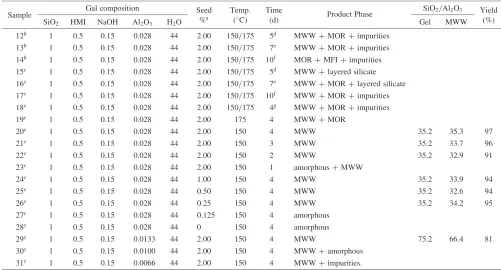
(1) Seeds were added to the gel and then they were dried (Table 2, entries 12–14).
(2) Seeds were added after drying the gel (Table 2, entries 15–31).
The calcination of synthesized zeolite was carried out in a
*1Present address: Department of Materials Science and Engineering, Graduate School of Engineering, Yokohama National University, Yokohama 240-8501, Japan
*2Corresponding author, E-mail: [email protected]
muffle furnace to remove the organic template occluded inside the zeolite pores by heating the furnace from room temperature to 550C over a period of 8.4 h in a flow of air (flow of air: 50 mL/min). The sample was kept at the same temperature for the period of another 8.0 h, and finally, the sample was cooled to room temperature.
The calcined sample was refluxed with ammonium nitrate solution at 80C for 12 h under constant stirring. The amount of nitrate used was the same as the zeolite, and the ratio of H2O and zeolite was 50:1 (w=w). The zeolite was then
filtered. This process was repeated two more times, and then the sample was filtered, washed thoroughly with water, and dried overnight at 100C. Finally, NH
4-form of the zeolite
was calcined under air flow for 8 h at 550C to obtain the H-form.
2.2 Characterization of MWW
Phase purity and crystallinity of the as-synthesized sample were determined by powder X-ray diffraction (XRD) (XRD-6000, Shimadzu Corporation) with Cu K radiation (¼
0:15418nm). Crystal size and morphology of the sample were determined by scanning electron microscopy (SEM) using a TOPCON ABT-60 microscope. Elemental analyses were performed by inductively coupled plasma atomic emission spectroscopy (ICP) (JICP-PS-1000 UV, Leeman Labs Inc.). Thermal analyses of the as-synthesized samples were performed on a Shimadzu DTG-51 analyzer. Nitrogen adsorption measurements were carried on a Belsorp 28SA (Bel Japan Inc.) apparatus. The acidic properties were measured by ammonia temperature programmed desorption (NH3-TPD) using BEL TPD-66 (Bel Japan Inc.) using
H-form of MWW: the zeolite was evacuated at 500C for 1 h, exposed to ammonia at 100C for adsorption, and then, evacuated for a further 1 h. The sample was heated from 100 to 710C at 10C/min under constant helium flow.
2.3 Catalytic isomerization of hexane 2.3.1 Catalysts
MWW (Table 2, entry 20) was used as the catalyst. BEA(30) was synthesized by DGC method in the
litera-ture.33) MFI(29) 840NHA) and MOR(30)
(HSZ-670HOA) were obtained from Tosoh corporation Ltd. Tokyo, Japan. All zeolites were used as catalysts as H-form.
2.3.2 Catalytic experiments
Catalytic isomerization and cracking of hexane were carried out using a 9 mm (OD) quartz tubular down flow reactor. The zeolite (1 g; 18/32 meshes) was placed between two layers of quartz wool, and heated in a stream of 20 mL/ min of nitrogen at 550C for 1 h before introducing hexane. The reaction was performed at a temperature of 350–650C. The products were analyzed with on-line gas chromatographs using fused silica capillary columns with FID detector. The capillary columns were CP-Al2O3/KCl (Varian, 50m
0:53mm, 10mm film thickness) for the analysis of C1–C6
hydrocarbons, and HR-1 column (Shinwa Chem. Ind., 30m0:53mm, 5mmfilm thickness) for Cþ7 hydrocarbons, benzene, toluene, and xylenes.
The conversion of hexane and the selectivity for the products were calculated on carbon basis:
Fed hexane (mol/min)¼XAreaiCiFi=Ni
Conversion (%)
¼ðFed hexaneAreaoCoFo=NoÞ
Total amount 100
Yieldiof each component (%)
¼ðAreaiCiFi=NiÞ
Fed hexane 100
Selectivity for each component (%)
¼(Yieldi/Conversion)100
Abbrevations in formula are expresserd as Areai= GC area of each component; Areao = GC area of hexane; Fi = Repsonse factor of each component; Fo = Response factor of hexane, Ni= concentration of each component; No = concentration of hexane; Co = carbon numbe of hexane; Ci = carbon number of each component.
Methylpentanes (2- and 3-methylpentanes and 2,2-di-methylbutane), methylbutanes (2- and 3-methylbutanes and 2,2-dimethylpropane), and 2-methylpropane were abbreviated asb-C6,b-C5, andb-C4, respectively. Combined selectivity for the isomerization is sum ofb-C6,b-C5, andb-C4.
3. Results and Discussion
3.1 Synthesis of MWW by DGC method
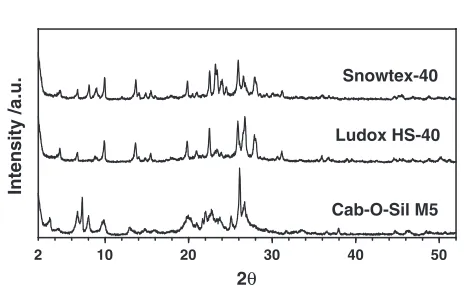
[image:2.595.325.528.74.203.2]The synthesis conditions and the products obtained by DGC method with different gel compositions are listed in Table 1. Table 1 shows the effects of NaOH concentration and silica source on the synthesis of MWW using DGC method. Figure 1 shows the XRD patterns for the products. The effects of molar concentration of NaOH on the synthesis of MWW were thoroughly studied from 0.07–0.27 mol/L using fumed silica Cabo-O-Sil M5 (Table 1, entries 1–9). Only 0.15 mol/L concentration of NaOH gave MWW phase although trace amounts of impurities were accompanied. MWW phase appeared at lower than 0.15 mol/L of the NaOH concentration although MOR was also co-crystallized. The formation of MWW disappeared at a concentration of NaOH higher than 0.17 mol/L: MOR and/or MFI phases were produced. These results clearly show that the molar concentration of NaOH played a critical role in the formation of MWW phases.
The influence of silica source has been studied for the synthesis of MWW. Cab-O-Sil M5 as silica source gave MWW phase although trace impurities were accompanied; however, colloidal silica sources such as Ludox HS-40 and Snowtex-40 did not afford MWW phase, but MOR and MFI phases appeared from them as shown in Fig. 2 (Table 1, entries 10 and 11). The reasons for these differences are not clear currently; however, one of the reasons is due to change in the NaOH concentration. The synthesis of MWW was studied without seeds by changing NaOH concentration and silica sources; however, MWW with trace impurities (Table 1, entry 4) and mixture of MWW and MOR was obtained, although Matsukata and his co-workers found pure
MWW by DGC method without seeds.30,31) We tried to
the formation of different phases with good reproducibility through our studies. From these discussions, fumed silica was the best silica source to obtain MWW phase by DGC method, and we chose Cab-O-Sil M5 as silica source for further studies.
[image:3.595.43.548.84.246.2]3.2 Seeding on the synthesis of MWW
Table 2 summarizes the influence of seeding on the synthesis of MWW by DGC method. The seeds were calcined sodium MWW with SiO2/Al2O3¼31, and used
on the basis of mass% against SiO2 in the gel composition.
The addition of seeds in the synthesis was carried out by two different ways:
(1) The seeds were added to the gel and then they were dried.
(2) The seeds were added after drying the starting gel, and mixed well with the gel.
The addition of seeds to the starting gel increases NaOH concentration,i.e., the pH of gel composition, to result in the formation of MOR and MFI phases. As shown in Table 1, MWW appeared as principal products at the NaOH concen-tration of 0.15 mL/L; however, the formation of impurities and MOR was enhanced by the addition of seeds (Table 2, entries 12–14). However, the formation of MWW was enhanced by the addition of seeds to dry gel, and MWW was formed although a layered silicate was accompanied (Table 2, entry 15). Hence, we focused on the addition of the seeds to dry gel. Stepwise increase in temperature from 150C (for initial 2 to 3 d) to 175C (3 or 4 d to 2 or 7 d) led to the formation of MWW; however, it accompanied the formation of MOR and impure phases (Table 2, entries 15–18).
We examined the isothermal synthesis to know the effect of temperature. Although the MWW and MOR phases were co-crystallized at 175C, the pure MWW phase appeared by the isothermal synthesis at 150C, (Table 2, entries 19 and 20). These results clearly indicate that synthesis temperature plays a key role for the selective formation of MWW by DGC method: the synthesis at 150C is optimal for the crystal-lization of pure MWW phase. The crystalcrystal-lization was failed even under identical gel conditions when the gel was heated slightly higher than optimal temperature.
The effects of synthesis time on the crystallinity of MWW
2 10 20 30 40 50
0.27
0.19
0.17
0.15
0.12
0.07 NaOH/SiO2
2θ
Intensity /a.u.
[image:3.595.294.539.85.409.2] [image:3.595.311.543.264.407.2]Fig. 1 Effects of NaOH concentration on the crystallization of MWW. Synthesis conditions: gel composition: SiO2:HMI:NaOH:Al2O3:H2O = 1:0.5:(0.07–0.27):0.028:44; temperature: 175C. Samples: entries 1–9 in Table 1.
Table 1 Effects of MaOH concentration and silica source for the synthesis of MCM-22 by DGC method.
Gal composition Temperature Time Product
Entry
SiO2a HMI NaOH Al2O3 H2O
C (d) Phase
1 1 0.5 0.07 0.028 44 175 7 amorphous
2 1 0.5 0.09 0.028 44 175 7 MWW + MOR
3 1 0.5 0.12 0.028 44 175 7 MWW + MOR
4 1 0.5 0.15 0.028 44 175 7 MWW + impurity (trace)
5 1 0.5 0.17 0.028 44 175 7 MWW + MOR
6 1 0.5 0.19 0.028 44 175 7 MOR + MFI
7 1 0.5 0.21 0.028 44 175 7 MOR + MFI + layerd silicate
8 1 0.5 0.25 0.028 44 175 7 MOR + MFI + impurity
9 1 0.5 0.27 0.028 44 175 7 MOR + impurity
10 1b 0.5 0.15 0.028 44 175 7 MOR + impurity
11 1c 0.5 0.15 0.028 44 175 7 MOR + MFI
aCab-O-Sil M5;bLudox HF-40;cSnowtex-40.
2 10 20 30 40 50
Cab-O-Sil M5 Ludox HS-40 Snowtex-40
2θ
Intensity /a.u.
[image:3.595.56.284.277.512.2]phase were examined at the same gel composition using 2.0 mass% seeds against SiO2. Typical results are listed in the
Table 2 (entries 20–23), and their XRD patterns are shown in Fig. 3. The crystallization of MWW phase was started after 1 d among amorphous phase. Amorphous phase was com-pletely converted to MWW phase after two days, and the pure MWW was obtained after crystallization for 4 d.
The amount of seeds was varied from 0.125 to 2.0 mass% against SiO2in the synthesis of MWW as in Table 2 (entries
20, 24–28), and the XRD patterns are shown in Fig. 4. The pure phase of MWW appeared by adding seeds from
0.25 to 2.0 mass% against SiO2. However, MWW phase
along with amorphous phase was observed by the addition of 0.125 mass% seeds (Table 2, entry 27). These results indicate that 0.25 mass% seeds against SiO2are minimal for complete
crystallization of MWW, and the addition of 0.125 mass% seeds is not sufficient for the nucleation of MWW phase.
The effects of SiO2/Al2O3ratio on the synthesis of MWW
were examined at 150C by varying the SiO2/Al2O3 ratio
2 12 22 32 42 52
1d 2d 3d 4d
2θ
Intensity (a.u.)
[image:4.595.45.546.84.354.2]Fig. 3 Effects of heating time on XRD patterns of as-synthesized and calcined MWW. Synthesis conditions: gel composition: SiO2: HMI:NaOH:Al2O3:H2O = 1:0.5:0.15:0.028:44; seed, MWW(Na form) (SiO2/Al2O3¼31) 2 mass% against SiO2. temperature: 150C. Samples: entries 20–23 in Table 2.
Table 2 Effects of seeds and temperature on the synthesis of MWW by DGC method.
Gal composition Seed Temp. Time
Product Phase SiO2/Al2O3 Yield Sample
SiO2 HMI NaOH Al2O3 H2O %
a (C) (d)
Gel MWW (%)
12b 1 0.5 0.15 0.028 44 2.00 150/175 5d MWW + MOR + impurities 13b 1 0.5 0.15 0.028 44 2.00 150/175 7e MWW + MOR + impurities 14b 1 0.5 0.15 0.028 44 2.00 150/175 10f MOR + MFI + impurities 15c 1 0.5 0.15 0.028 44 2.00 150/175 5d MWW + layered silicate 16c 1 0.5 0.15 0.028 44 2.00 150/175 7e MWW + MOR + layered silicate 17c 1 0.5 0.15 0.028 44 2.00 150/175 10f MWW + MOR + impurities 18c 1 0.5 0.15 0.028 44 2.00 150/175 4g MWW + MOR + impurities
19c 1 0.5 0.15 0.028 44 2.00 175 4 MWW + MOR
20c 1 0.5 0.15 0.028 44 2.00 150 4 MWW 35.2 35.3 97
21c 1 0.5 0.15 0.028 44 2.00 150 3 MWW 35.2 33.7 96
22c 1 0.5 0.15 0.028 44 2.00 150 2 MWW 35.2 32.9 91
23c 1 0.5 0.15 0.028 44 2.00 150 1 amorphous + MWW
24c 1 0.5 0.15 0.028 44 1.00 150 4 MWW 35.2 33.9 94
25c 1 0.5 0.15 0.028 44 0.50 150 4 MWW 35.2 32.6 94
26c 1 0.5 0.15 0.028 44 0.25 150 4 MWW 35.2 34.2 95
27c 1 0.5 0.15 0.028 44 0.125 150 4 amorphous
28c 1 0.5 0.15 0.028 44 0 150 4 amorphous
29c 1 0.5 0.15 0.0133 44 2.00 150 4 MWW 75.2 66.4 81
30c 1 0.5 0.15 0.0100 44 2.00 150 4 MWW + amorphous 31c 1 0.5 0.15 0.0066 44 2.00 150 4 MWW + impurities.
amass% against SiO
2.bSeed was added in the starting gel;cSeed was added to dry gel (in powder);d2 d at 150C then 3 d at 175C;e3 d at 150C then 4 d at 175C;f3 d at 150C and then, 7 d at 175C;g2 d at 150C, and then, 2 d at 175C.
2 10 20 30 40 50
0.125 0.25 0.50 1.00 2.00 Seed (wt.%)
0
2θ
Intensity (a.u.)
[image:4.595.314.541.397.616.2] [image:4.595.57.285.398.570.2]from 35 to 150 (Table 2, entries 20, 29–31). XRD patterns are shown in Fig. 5. The pure MWW phase appeared only at SiO2/Al2O3 ratios from 35 to 75. However, MWW phase
was formed with trace of amorphous materials and/or impurities at SiO2/Al2O3 of 100 and 150. These results
indicate that the SiO2/Al2O3ratio from 35 to 75 is optimal
for pure MWW phase by DGC method.
The yields of MWW were quantitative (97%) on the synthesis at SiO2/Al2O3 ¼35(Table 2, entry 20): the SiO2/
Al2O3ratio in the MWW by the ICP analysis is very close to
the ratio in the gels. However, the yield of MWW decreased with the decrease in aluminum content of the gel, and SiO2/
Al2O3ratio of the resultant MWW was lower than the ratio in
the gel (Table 2, entry 29). This shows that the optimal amounts of aluminum was essential for the crystallization of MWW, and the some of excess of the SiO2 did not take part
in the synthesis of MWW.
Figure 6 shows the calcination of MWW with 35.2 and
66.4 of SiO2/Al2O3 ratio (Table 2, entries 20 and 29) at
550C for 8 h under air stream. Both MWW zeolites gave typical clear MWW patterns.
3.3 Characterization of MWW
The SEM images of MWW prepared by DGC method are shown in Fig. 7. The shape of the sample (Table 1, entry 4) obtained without seeds was aggregated sphere with a diameter of about 15mm, which are formed by aggregation of the leaflets into lamellar particles. This type of crystals was also found for HTS method under static conditions.13)MWW crystals by DGC method (Table 1, entries 20 and 29) were
2 10 20 30 40 50
SiO2/Al2O3a
35.2 75.2 100 150
2θ
Intensity (a.u.)
Fig. 5 Effects of SiO2/Al2O3of gel composition on XRD patterns of as-synthesized MWW. Synthesis conditions: gel composition: SiO2:HMI: NaOH:Al2O3:H2O = 1:0.5:0.15:(0.0066–0.028):44. temperature: 150C. seeds, MWW(Na form) (SiO2/Al2O3¼31), 2 mass% against SiO2. Samples: entries 20, 29–31 in Table 2. SiO2/Al2O3ratios are expressed as in starting gel composition.
2 10 20 30 40 50
(a) (b) (c) (d)
2θ
Intensity (a.u.)
Fig. 6 XRD pattern of calcined MWW. Sample: entry 20 in Table 2 (SiO2/Al2O3¼35:2), (a) as-synthesized, (b) calcined. Sample: entry 29 in Table 2 (SiO2/Al2O3¼66:4), (c) as-synthesized, (d) calcined.
(a)
(c) (b)
10 µµm
[image:5.595.319.548.70.569.2] [image:5.595.56.285.70.245.2] [image:5.595.56.284.342.508.2]small leaflets. These types of crystal resemble to the crystals of MWW by DGC method by Matsukataet al.30,31)
Typical results of thermal analysis of MWW (SiO2/
Al2O3 = 35.2, Table 2, entry 20) are shown in Fig. 8. The
TG profile showed that the total weight loss of a sample up to 800C was 21.2 mass%: the 2.9 mass% loss to 150C is assigned to the loss of water and volatile organics, and the 18.4 mass% loss from 150 to 800C is assigned to the decomposition of organic template occluded in the zeolite channels. The DTA pattern showed four stages,viz. 50–100, 100–350, 350–500, and 500–700C.10) The first step is assigned to an endothermic process by desorption of water, the second and third steps are assigned to exothermic processes by the oxidation of the organic template. The last step is assigned to an exothermic process by the combustion of residual coke formed from organic template. These observations indicate that the organic template is strongly retained inside the zeolite pores.
The N2-adsorption isotherm of the calcined samples of
MWW (SiO2/Al2O3¼35:2 and 66.4; Table 2, entries 20
and 29) is shown in Fig. 9. The pore volume 0.1397 cm3/g
and high surface area 479 m2/g indicate that the sample had excellent crystallinity and that the pores were not blocked by any non-removable occluded material. However, pore vol-ume and surface area decreased with increasing SiO2/Al2O3
ratio: pore volume 0.1381 cm3/g, and surface area 367 m2/g with SiO2/Al2O3 ratio of 66.4.
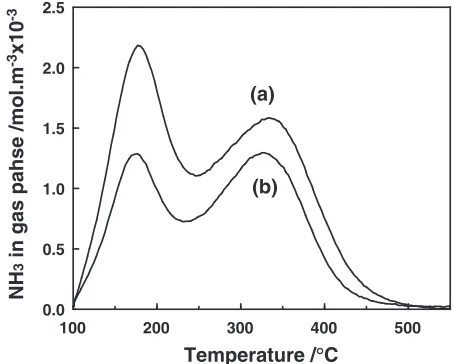
The acidic properties of H-MWW were measured by temperature programmed desorption of ammonia (NH3
-TPD). The profiles of MWW with different SiO2/Al2O3
ratios (SiO2/Al2O3¼35:2and 66.4; Table 2, entries 20 and
29) are shown in Fig. 10. The two broad desorption peaks were observed in the profile. The first peak (l-peak) was observed at the lower temperature region (100–240C): these peaks are assigned to desorption from weak van der Waals adsorption. The second peak (h-peak) at the higher temper-ature region (240–500C) is due to desorption of chemisor-bed NH3, and assigned to strong acid sites in the MWW,
which are effective for the acid catalysis. The peak area of h-peak of MWW with the ratio of 35.2 was larger than that of MWW with the ratio of 66.2: the acid amounts are related to
the amount of aluminum, because appearance of acid sites is due to aluminum substitution with SiO2. However, the peak
temperatures of NH3 desorption were almost identical for
both samples: acid strength of MWW is not changed by the aluminum contents.
3.4 Skeleton Isomerization and Cracking of Hexane over Zeolites
MWW zeolites synthesized by DGC method were used in the skeleton isomerization of hexane to elucidate the catalytic properties. Figure 11 shows the time on stream on the skeleton isomerization and cracking of hexane over zeolites. Table 3 shows the typical products distribution of MWW, BEA, MFI and MOR in the reaction. The order of catalytic activity after 2 h reaction time was in the order: MFI> BEA>MWWMOR. The selectivity of the isomerization of hexane was in the order: BEA>MWW>MFI. The difference 25
20 15 10 5 0
0 20 40 60
10 200 400 600 800
Temperature /°C
Mass loss /%
DTA /
µ
V
Ex
Fig. 8 TG and DTA analyses of MWW. Sample: SiO2/Al2O3¼35:2
(Sample: entry 20 in Table 2). 0
100 200 300
0 0.5 1
P/Po
(a)
(b)
N2
adsorption /cm
3 g -1 (STP)
Fig. 9 N2adsorption isotherm of calcined MWW. (a) Sample: entry 20 in Table 2 (SiO2/Al2O3¼35:2); (b) Sample: entry 29 in Table 2 (SiO2/ Al2O3= 66.4).
0.0 0.5 1.0 1.5 2.0 2.5
100 200 300 400 500
(a)
(b)
Temperature /°C
NH
3
in gas pahse /mol.m
-3x10
[image:6.595.56.282.71.243.2]-3
[image:6.595.332.521.72.294.2] [image:6.595.314.541.351.533.2]of coke formation feature between zeolites is due to their pore structure.32)MFI showed the highest stable activity for the cracking of hexane; however, BEA, synthesized by DGC method with 30 of SiO2/Al2O3 ratio, also had high activity
[image:7.595.306.547.84.450.2]although the deactivation occurred during the reaction. Although the activities of MWW were lower than those of MFI and BEA, the deactivation of MWW was not significant compared with BEA. The deactivation of these zeolites is caused by coking of the pores. MWW and MFI are more tolerant than BEA: polynuclear aromatics, precursor of coke cannot accommodate in MFI and MWW pores.33)
Figure 12 shows the selectivity of branched alkanes in the isomerization of hexane over typical zeolites. The selectivity for the isomerization (combined selectivity for branched alkanes which are sum of isomerization products including the lower alkane after the isomerization) was decreased in
MFI
BEA
MWW MOR
0 20 40 60 80 100
0 50 100 150 200 250
Time on stream /min
[image:7.595.57.284.290.469.2]Conversion /%
Fig. 11 Time-on-stream of catalytic activity over typical zeolites. Reaction conditions: catalyst: 1 g; temperature, 350C, fed hexane, 2.29 mmol/min; carrier gas (N2), 0.89 mmol/min; W/F, 8.17 gh/mol.
Table 3 Product distribution of the isomerization of hexane.a,b)
Zeolite BEA MWW MFI MOR
Conversion 54.2 12.8 82.4 1.0
Methane 0.0 0.0 0.0 0.0
C2
Ethane 0.1 0.1 0.2 0.0
Ethene 0.4 1.0 0.1 1.6
C3
Propane 14.0 29.6 27.4 0.3
Propene 1.3 5.7 0.5 2.4
C4
2-Methylpropane 19.3 16.0 10.6 0.5
2-Methylpropene 0.0 0.0 0.0 0.0
Butane 5.8 10.2 24.7 0.0
Butene-1 and -2 3.9 3.9 0.9 10.6
C5
2-Methylbutane 12.2 6.5 8.1 0.0
2-Methylbutenes 0.0 0.0 0.0 0.0
Pentabe 3.5 2.7 6.4 0.0
Pentenes 1.0 3.2 0.5 0.7
C6
2-Methylpentane 20.1 7.4 2.0 3.0
3-Methylpentane 10.2 3.3 0.8 3.5
2,3-Dimethylbutane 1.6 1.5 0.7 10.2 2,2-Dimethylbutane 0.2 0.6 0.0 7.5
Hexenes 1.3 2.2 0.2 57.5
Aromatics
Benzene 0.2 0.1 5.2 0.0
Xylene 2.3 2.1 6.0 0.4
Toluene 0.4 0.8 3.4 0.8
Other 2.2 3.1 2.3 1.0
aConversion and product distribution are expressed by pecentages. bReaction conditions: Catalyst 1 g; temperature, 350C; fed hexane, 2.29 mmol/min; carrier gas (N2), 0.89 mmol/min; W/F, 8.17 gh/mol. Data were taken after 1 h reaction started.
BEA MFI
0 20 40 60 80
0 20 40 60 80 100
BEA MFI
0 20 40 60 80
0 3 6 9 12 15
(a)
(b)
Coke-deposition Conversion
Conversion /%
Selectivity for isomerization /%
Conversion and coke-deposition /%
MWW MWW
Fig. 12 The selectivity of branched alkanes in the isomerizration of hexane over zeolites. (a) in initial stage and (b) in similar conversion level. Reaction conditions: temperature 350C (a) fed hexane, 2.29 mmol/min; N
[image:7.595.139.462.531.737.2]the following order: BEA>MWWMFI at initial stages [Fig. 12(a)]. However, there is a possibility that the selec-tivity depends on the conversion; it is necessary to compare the selectivity at the similar level of the conversion to discuss their catalytic behaviors. Figure 12(b) shows selectivity for skeleton isomerization atca. 13% of hexane conversion over BEA, MWW, and MFI by adjusting W/F, where data were taken after 60 min from starting: the similar change of the selectivities was observed in the similar conversion level. From these results, the selectivity for branched alkanes decreased in the order: BEA>MWWMFI.
These catalytic properties of MWW in comparison with MFI and BEA are due to its pore structure and acid strength. MFI has the narrowest channels among the zeolites to result in the cracking as principal reaction. Because BEA has the largest channel and the weakest acid strength,33)the skeleton isomerization was predominant over cracking, and the deactivation occurs gradually by coke-formation. MWW has intermediate character of acid strength, and the space in the channels between MFI and BEA.
4. Conclusions
The crystallization of MCM-22 (MWW) zeolite was successfully enhanced by seeding in dry gel conversion (DGC) method. The phase selection depends on the gel composition during the synthesis, mainly OH/SiO2ratio and
synthesis temperature. The addition of seeds accelerated the crystallization of MWW by DGC method: a small amount of seeds (0.25 mass% against SiO2) enhances the formation of
MWW to reduce the impurities and other phase, and the reduction of the crystallization time. The optimal SiO2/
Al2O3 ratio for the crystallization of MWW are around 30,
and excess SiO2 in higher gel composition with higher
aluminum contents did not participate in the formation of MWW. The morphology of MWW by DGC method are aggregates sphere like crystal. The MWW obtained from optimal SiO2/Al2O3ratio gave higher surface area. The acid
amounts also decreased with the SiO2/Al2O3ratio; however
acid strength was almost in the same level for the MWW samples in this study.
The catalytic properties of MWW by DGC method were examined in the isomerization and the cracking of hexane, and compared with BEA, MFI, and MOR zeolites. The catalytic activities were in the order: MFI>BEA>
MWWMOR; however, the selectivity for the
isomer-ization were in the order: BEA>MWW>MFIMOR. These catalytic properties are due to the differences of structures and acid strength of zeolites.
Seeding is one of the effective methods for synthesis of MWW by DGC method, and it can also be applied for other zeolite synthesis.
Acknowledgement
A part of this work was financially supported by a Grant-in-Aid for Scientific Research (B), 15350093 and 16310056, the Japan Society for the Promotion of Science (JSPS). S. K.
Saha is grateful to the Ministry of Education, Culture, Sports, Science and Technology for the grant of a Japanese Govern-ment Scholarship.
REFERENCES
1) M. K. Rubin and P. Chu: U.S. Patent 4,954,325 (1990). 2) L. Puppe and J. Weisser: U.S. Patent 4,439,409 (1984).
3) S. I. Zones, D. I. Holtermann, R. A. Innes, T. A. Pecoraro, D. S. Santilli and J. N. Ziemer: U.S. Patent 4,826,667 (1989).
4) G. Bellussi, G. Perego, M. G. Clerici and A. Giusti: E.P. Patent application 293,032 (1988).
5) M. A. Camblor, A. Corma, M. J. Diaz-Cabanas and Ch. Baerlocher: J. Phy. Chem. B.102(1998) 44–51.
6) J. C. Cheng, T. F. Degnan, J. S. beck, Y. Y. Huang, M. Kalyanaraman, J. A. Kowalski, C. A. Loehr and D. N. Mazzone: Stud. Surf. Sci. Catal.
121(1999) 53–60.
7) P. Wu, T. Kamatsu and T. Yashima: Mciropor. Mesopror. Mater.22
(1998) 343–356.
8) D. Meloni, D. Martin and M. Guisnet: Appl. Catal. A: General215
(2001) 67–79.
9) A. Corma, V. Gonza`lex-Alfaro and A. V. Orchilo`s: Appl. Catal. A: General129(1995) 203–215.
10) M. A. Asensi, A. Corma and A. Martı´nez: J. Catal.158(1996) 561– 569.
11) I. Gu¨ray, J. Warzywoda, N. Bac and A. Sacco, Jr.: Micropor. Mesopor. Mater.31(1999) 241–251.
12) M. Cheng, D. Tan, X. Liu, X. Han, X. Bao and L. Lin: Micropor. Mesopor. Mater.42(2001) 307–316.
13) I. Mochida, S. Eguchi, M. Hironaka, S. Nagao, K. Sakanishi and D. D. Whitehurst: Zeolites18(1997) 142–151.
14) W. Xu, J. Dong, J. Li and F. Wu: J. Chem. Soc. Chem. Commun. (1990) 755–756.
15) J. Dong, T. Dao, X. Zhao and L. Gao: J. Chem. Soc. Chem. Commun. (1992) 1056–1058.
16) M. H. Kim, H. X. Li and M. E. Davis: Micropor. Mater.1(1993) 191– 200.
17) M. Matsukata, N. Nishiyama and K. Ueyama: Micropor. Mater. 1
(1993) 219–222.
18) M. Matsukata, N. Nishiyama and K. Ueyama: Micropor. Mater. 7
(1996) 109–117.
19) M. Matsukata, N. Nishiyama and K. Ueyama: J. Chem. Soc. Chem. Commun. (1994) 339–340.
20) N. Nishiyama, K. Ueyama and M. Matsukata: J. Chem. Soc. Chem. Commun. (1995) 1967–1968.
21) N. Nishiyama, K. Ueyama and M. Matsukata: Micropor. Mater. 7
(1996) 299–308.
22) P. R. H. P. Rao and M. Matsukata: Chem. Commun. (1996) 1441–1442. 23) P. R. H. P. Rao, K. Ueyama and M. Matsukata: Appl. Catal. A: General
166(1998) 97–103.
24) P. R. H. P. Rao, K. Ueyama, E. Kikuchi and M. Matsukata: Chem. Lett. (1998) 311–312.
25) M. Ogura, S. Nakata, E. Kikuchi and M. Matsukata: J. Catal. 199
(2001) 41–47.
26) S. Shimizu, Y. Kiyozumi, K. Maeda, F. Mizukami, G. Pal-Borbely, R. M. Mihalyi and H. K. Beyer: Adv. Mater.8(1996) 759–762. 27) M. Salou, Y. Kiyozumi, F. Mizukami, P. Nair and S. Niwa: J. Mater.
Chem.8(1998) 2125–1998.
28) I. Kiricsi, S. Shimizu, Y. Kiyozumi, M. Toba and F. Mizukami: Micropor. Mesopor. Mater.21(1998) 453–459.
29) T. Tatsumi, Q. Xia and N. Jappar: Chem. Lett. (1997) 677–678. 30) S. Inagaki, M. Hoshino, E. Kikuchi and M. Matsukata: Stud. Surf. Sci.
Catal.142(2002) 53–60.
31) S. Inagaki, K. Kamino, M. Hoshino, E. Kikuchi and M. Matsukata: Bull. Chem. Soc. Jpn.77(2004) 1249–1254.
32) A. Corma, C. Corell and J. Perez-Pariente: Zeolites15(1995) 2–8. 33) Pusparatu, Y. Haga, K. Komura, Y. Kubota, Y. Nishimura and Y. Sugi: