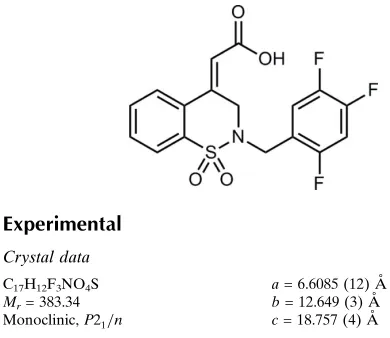
2-[(
Z
)-1,1-Dioxo-2-(2,4,5-trifluorobenz-yl)-3,4-dihydro-2
H
-1,2-benzothiazin-4-ylidene]acetic acid
Shagufta Parveen, Saghir Hussain, Shaojuan Zhu, Xin Hao and Changjin Zhu*
School of Chemical Engineering and Environment, Beijing Institute of Technology, Beijing 100081, People’s Republic of China
Correspondence e-mail: [email protected] Received 1 April 2014; accepted 18 April 2014
Key indicators: single-crystal X-ray study;T= 153 K; mean(C–C) = 0.003 A˚;
Rfactor = 0.049;wRfactor = 0.130; data-to-parameter ratio = 17.3.
In the title compound, C17H12F3NO4S, the heterocyclic
thiazine ring adopts a half-chair conformation and the dihedral angle between the benzene rings is 43.28 (9). The
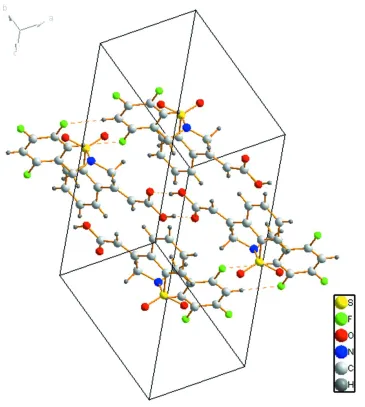
,-unsaturated C C group is inclined at an angle of 21.0 (3) to the benzene ring of the benzothiazine moiety. In the crystal, inversion dimers linked by pairs of carboxylic acid O—H O hydrogen bonds generate R2
2
(8) loops. Each of the F atoms accepts a Ca—H F (a = aromatic) hydrogen bond from an
adjacent molecule, resulting in (001) sheets.
Related literature
For pharmaceuticals properties of 1,2-benzothiazines, see: Lombardinoet al.(1971); Turcket al.(1996); Zia-ur-Rehman
et al.(2005). For the biological properties and synthetic details of the title compound, see: Parveenet al. (2014). For related structures, see: Ahmad et al. (2008); Zia-ur-Rehman et al.
(2008); Yanget al.(2012). For graph-set analysis, see: Etteret al.(1990).
Experimental
V= 1545.9 (5) A˚
Z= 4
MoKradiation
T= 153 K
0.310.210.07 mm
Data collection
Rigaku AFC10/Saturn724+ CCD-detector diffractometer Absorption correction: multi-scan
(CrystalClear; Rigaku, 2008)
Tmin= 0.910,Tmax= 0.970
13553 measured reflections 4123 independent reflections 3594 reflections withI> 2(I)
Rint= 0.033
Refinement
R[F2> 2(F2)] = 0.049
wR(F2) = 0.130
S= 1.00 4123 reflections 239 parameters
H atoms treated by a mixture of independent and constrained refinement
max= 0.30 e A˚
3
min=0.46 e A˚
[image:1.610.44.239.582.751.2]3
Table 1
Hydrogen-bond geometry (A˚ ,).
D—H A D—H H A D A D—H A
O3—H3O O4i
0.95 (3) 1.71 (3) 2.6454 (19) 170 (3) C12—H12 F3ii 0.95 2.50 3.448 (2) 178 C15—H15 F1iii
0.95 2.48 3.430 (2) 179 C5—H5 F2iv
0.95 2.49 3.269 (2) 140
Symmetry codes: (i)x;y;z; (ii)xþ1;y;z; (iii)x1;y;z; (iv)x;y1;z.
Data collection: CrystalClear (Rigaku, 2008); cell refinement: CrystalClear; data reduction:CrystalClear; program(s) used to solve structure:SHELXS97(Sheldrick, 2008); program(s) used to refine structure: SHELXL97 (Sheldrick, 2008); molecular graphics: DIAMOND(Brandenburg, 1998); software used to prepare material for publication:CrystalStructure(Rigaku, 2008).
This work was supported by the National Natural Science Foundation of China (grant No. 21272025), the Research Fund for the Doctoral Program of Higher Education of China (grant No. 20111101110042) and the Science and Technology Commission of Beijing (China) (grant No. Z131100004013003).
Supporting information for this paper is available from the IUCr electronic archives (Reference: ZS2294).
References
Ahmad, M., Latif Siddiqui, H., Zia-ur-Rehman, M., Tizzard, G. J. & Ahmad, S. (2008).Acta Cryst.E64, o1392.
Brandenburg, K. (1998).DIAMOND. Crystal Impact GbR, Bonn, Germany. Etter, M. C., MacDonald, J. C. & Bernstein, J. (1990).Acta Cryst.B46, 256–262. Lombardino, J. G., Wiseman, E. H. & Mclamore, W. (1971).J. Med. Chem.14,
1171–1175.
Parveen, S., Hussain, S., Zhu, S., Qin, X., Hao, X., Zhang, S., Lu, J. & Zhu, C. (2014).Roy. Soc. Chem. Adv.doi:10.1039/C4RA01016G.
Rigaku (2008).CrystalClearandCrystalStructure. Rigaku Inc., Tokyo, Japan. Sheldrick, G. M. (2008).Acta Cryst.A64, 112–122.
Turck, D., Busch, U., Heinzel, G., Narjes, H. & Nehmiz, G. (1996).J. Clin. Pharmacol.36, 79–84.
Yang, Y., Yu, Y. & Zhu, C. (2012).Acta Cryst.E68, o1364.
Structure Reports Online
supporting information
Acta Cryst. (2014). E70, o627 [doi:10.1107/S1600536814008903]
2-[(
Z
)-1,1-Dioxo-2-(2,4,5-trifluorobenzyl)-3,4-dihydro-2
H
-1,2-benzothiazin-4-ylidene]acetic acid
Shagufta Parveen, Saghir Hussain, Shaojuan Zhu, Xin Hao and Changjin Zhu
S1. Comment
Benzothiazine derivatives have been found to posses versatile biological activities such as anti-inflammatory, antioxidant
and anti-bacterial (Lombardino et al., 1971; Zia-ur-Rehman et al., 2005). Derivatives of 1,2-benzothiazine-1,1-dioxide also reported as aldose reductase inhibitors (Parveen et al., 2014). We report here the structure of the title compound, C17H12F3NO4S, as an extension of this study. In this compound, (Fig. 1) the heterocyclic thiazine ring adopts a half chair
conformation and the dihedral angle between the two benzene rings is 43.28 (9)°. The α,β-unsaturated C═C is inclined at an angle of 21.0 (3)° (torsion angle C5—C6—C7—C16) to the mean plane of the benzene ring (C1–C6). In the crystal,
the molecules form centrosymmetric cyclic dimers through duplex intermolecular carboxylic acid O—H···O hydrogen
bonds [graph set R2
2(8) (Etter et al., 1990)] (Table 1) while all of the fluorine atoms on the benzyl ring are involved in
intermolecular aromatic C—H···F hydrogen-bonding interactions, giving a two-dimensional network structure lying
parallel to (001) (Fig. 3).
S2. Experimental
A mixture of Z-2-[2-(2,4,5-trifluorobenzyl)-1,1-dioxido-2H-1,2-benzothiazin- 4(3H)-ylidene]acetic acid methyl ester (0.5 mmol), 1,4-dioxane (5 mL) and 10M hydrochloric acid (8 mL) was refluxed at 80°C for 12 h. The precipitate formed was then filtered and washed with cold water. The crude product was purified by flash chromatography. Crystals suitable for
X-ray crystallography were obtained by slow evaporation of a solution of the title compound in ethanol (yield = 70%).
S3. Refinement
The H atom bonded to O1 was located from a difference-Fourier map and refined freely. The remaining H atoms were
positioned geometrically, with C—H = 0.95 and 0.99 Å for aromatic and methylene H, respectively, and constrained to
Figure 1
The molecular structure of the title compound with the atom numbering scheme. Displacement ellipsoids are drawn at the
Figure 2
A view of the O—H···O and C—H···F hydrogen-bonding interactions (dotted lines) in the crystal structure of the title
compound. H atoms non-participating in hydrogen-bonding are omitted for clarity.
2-[(Z)-1,1-Dioxo-2-(2,4,5-trifluorobenzyl)-3,4-dihydro-2H-1,2-benzothiazin-4-ylidene]acetic acid
Crystal data
C17H12F3NO4S
Mr = 383.34
Monoclinic, P21/n
a = 6.6085 (12) Å
b = 12.649 (3) Å
c = 18.757 (4) Å
β = 99.601 (2)°
V = 1545.9 (5) Å3
Z = 4
F(000) = 784
Dx = 1.647 Mg m−3
Mo Kα radiation, λ = 0.71073 Å Cell parameters from 5016 reflections
θ = 2.2–29.1°
µ = 0.27 mm−1
Rigaku AFC10/Saturn724+ CCD-detector diffractometer
Radiation source: Rotating Anode Graphite monochromator
Detector resolution: 28.5714 pixels mm-1
φ and ω scans
Absorption correction: multi-scan (CrystalClear; Rigaku, 2008)
Tmin = 0.910, Tmax = 0.970
13553 measured reflections 4123 independent reflections 3594 reflections with I > 2σ(I)
Rint = 0.033
θmax = 29.1°, θmin = 3.1°
h = −7→9
k = −17→17
l = −24→25
Refinement
Refinement on F2
Least-squares matrix: full
R[F2 > 2σ(F2)] = 0.049
wR(F2) = 0.130
S = 1.00 4123 reflections 239 parameters 0 restraints
Primary atom site location: structure-invariant direct methods
Secondary atom site location: difference Fourier map
Hydrogen site location: inferred from neighbouring sites
H atoms treated by a mixture of independent and constrained refinement
w = 1/[σ2(F
o2) + (0.0691P)2 + 0.960P]
where P = (Fo2 + 2Fc2)/3
(Δ/σ)max = 0.001
Δρmax = 0.30 e Å−3
Δρmin = −0.46 e Å−3
Special details
Geometry. All esds (except the esd in the dihedral angle between two l.s. planes) are estimated using the full covariance matrix. The cell esds are taken into account individually in the estimation of esds in distances, angles and torsion angles; correlations between esds in cell parameters are only used when they are defined by crystal symmetry. An approximate (isotropic) treatment of cell esds is used for estimating esds involving l.s. planes.
Refinement. Refinement of F2 against ALL reflections. The weighted R-factor wR and goodness of fit S are based on F2,
conventional R-factors R are based on F, with F set to zero for negative F2. The threshold expression of F2 > 2sigma(F2) is
used only for calculating R-factors(gt) etc. and is not relevant to the choice of reflections for refinement. R-factors based on F2 are statistically about twice as large as those based on F, and R- factors based on ALL data will be even larger.
Fractional atomic coordinates and isotropic or equivalent isotropic displacement parameters (Å2)
x y z Uiso*/Ueq
S1 0.77960 (7) 0.24006 (4) 0.22711 (2) 0.01907 (13) F1 1.19907 (18) 0.38684 (10) 0.09496 (7) 0.0309 (3) F2 0.9333 (2) 0.73151 (9) 0.06966 (8) 0.0356 (3) F3 0.5560 (2) 0.65732 (11) 0.07640 (9) 0.0451 (4) O1 0.6212 (2) 0.21803 (12) 0.26843 (8) 0.0274 (3) O2 0.9255 (2) 0.32226 (11) 0.24924 (8) 0.0278 (3) O3 0.2021 (2) −0.09741 (11) 0.02713 (8) 0.0225 (3) O4 0.1809 (2) 0.07828 (11) 0.04036 (8) 0.0236 (3) N1 0.6674 (2) 0.26344 (12) 0.14388 (8) 0.0179 (3) C1 0.9094 (3) 0.12210 (15) 0.21459 (9) 0.0184 (4) C2 1.1103 (3) 0.10765 (16) 0.24959 (10) 0.0231 (4)
H2 1.1782 0.1613 0.2800 0.028*
H4 1.1748 −0.1295 0.1901 0.027* C5 0.9114 (3) −0.04731 (15) 0.15816 (10) 0.0195 (4)
H5 0.8469 −0.1005 0.1265 0.023*
C6 0.8059 (3) 0.04668 (14) 0.16672 (9) 0.0156 (3) C7 0.5982 (3) 0.06696 (14) 0.12487 (9) 0.0161 (3) C8 0.5169 (3) 0.18039 (14) 0.11740 (11) 0.0193 (4)
H8A 0.4635 0.1941 0.0657 0.023*
H8B 0.4000 0.1863 0.1440 0.023*
C9 0.8116 (3) 0.29315 (15) 0.09448 (11) 0.0208 (4)
H9A 0.7563 0.2682 0.0450 0.025*
H9B 0.9449 0.2576 0.1103 0.025*
C10 0.8449 (3) 0.41109 (14) 0.09298 (10) 0.0182 (4) C11 1.0366 (3) 0.45337 (15) 0.09093 (10) 0.0195 (4) C12 1.0725 (3) 0.56021 (16) 0.08396 (10) 0.0230 (4)
H12 1.2068 0.5864 0.0829 0.028*
C13 0.9075 (3) 0.62708 (15) 0.07861 (10) 0.0236 (4) C14 0.7142 (3) 0.58847 (16) 0.08163 (12) 0.0262 (4) C15 0.6818 (3) 0.48208 (16) 0.08880 (12) 0.0252 (4)
H15 0.5477 0.4567 0.0909 0.030*
C16 0.4816 (3) −0.01466 (14) 0.09595 (10) 0.0186 (4)
H16 0.5364 −0.0838 0.1045 0.022*
C17 0.2763 (3) −0.00501 (15) 0.05225 (10) 0.0184 (4) H3O 0.064 (4) −0.083 (2) 0.0060 (15) 0.043 (8)*
Atomic displacement parameters (Å2)
U11 U22 U33 U12 U13 U23
C14 0.0244 (10) 0.0178 (9) 0.0365 (11) 0.0035 (8) 0.0056 (8) 0.0022 (8) C15 0.0179 (9) 0.0194 (9) 0.0387 (11) −0.0026 (7) 0.0059 (8) 0.0009 (8) C16 0.0185 (9) 0.0151 (8) 0.0220 (9) −0.0002 (7) 0.0030 (7) −0.0009 (7) C17 0.0172 (8) 0.0185 (8) 0.0194 (8) −0.0038 (7) 0.0028 (7) −0.0011 (7)
Geometric parameters (Å, º)
S1—O1 1.4302 (15) C5—C6 1.401 (2)
S1—O2 1.4316 (14) C5—H5 0.9500
S1—N1 1.6395 (16) C6—C7 1.485 (2)
S1—C1 1.7562 (19) C7—C16 1.347 (2)
F1—C11 1.356 (2) C7—C8 1.530 (2)
F2—C13 1.346 (2) C8—H8A 0.9900
F3—C14 1.352 (2) C8—H8B 0.9900
O3—C17 1.323 (2) C9—C10 1.509 (2)
O3—H3O 0.95 (3) C9—H9A 0.9900
O4—C17 1.229 (2) C9—H9B 0.9900
N1—C8 1.475 (2) C10—C11 1.381 (3)
N1—C9 1.484 (2) C10—C15 1.395 (3)
C1—C2 1.392 (3) C11—C12 1.382 (3)
C1—C6 1.407 (2) C12—C13 1.371 (3)
C2—C3 1.390 (3) C12—H12 0.9500
C2—H2 0.9500 C13—C14 1.377 (3)
C3—C4 1.383 (3) C14—C15 1.373 (3)
C3—H3 0.9500 C15—H15 0.9500
C4—C5 1.386 (3) C16—C17 1.468 (3)
C4—H4 0.9500 C16—H16 0.9500
O1—S1—O2 120.19 (9) N1—C8—H8B 108.4
O1—S1—N1 107.19 (9) C7—C8—H8B 108.4
O2—S1—N1 108.70 (9) H8A—C8—H8B 107.5
O1—S1—C1 108.97 (9) N1—C9—C10 111.90 (15)
O2—S1—C1 109.60 (9) N1—C9—H9A 109.2
N1—S1—C1 100.32 (8) C10—C9—H9A 109.2
C17—O3—H3O 104.8 (17) N1—C9—H9B 109.2
C8—N1—C9 115.93 (15) C10—C9—H9B 109.2
C8—N1—S1 111.38 (12) H9A—C9—H9B 107.9
C9—N1—S1 113.89 (12) C11—C10—C15 116.92 (17) C2—C1—C6 122.42 (17) C11—C10—C9 121.38 (17) C2—C1—S1 119.82 (14) C15—C10—C9 121.57 (17) C6—C1—S1 117.72 (14) F1—C11—C10 118.64 (17) C3—C2—C1 119.01 (18) F1—C11—C12 117.72 (17)
C3—C2—H2 120.5 C10—C11—C12 123.64 (18)
C1—C2—H2 120.5 C13—C12—C11 117.60 (18)
C4—C3—C2 119.67 (17) C13—C12—H12 121.2
C3—C4—C5 121.01 (18) F2—C13—C14 119.38 (19)
C3—C4—H4 119.5 C12—C13—C14 120.68 (18)
C5—C4—H4 119.5 F3—C14—C15 120.48 (19)
C4—C5—C6 121.01 (17) F3—C14—C13 118.68 (18)
C4—C5—H5 119.5 C15—C14—C13 120.83 (19)
C6—C5—H5 119.5 C14—C15—C10 120.32 (18)
C5—C6—C1 116.76 (16) C14—C15—H15 119.8
C5—C6—C7 121.31 (16) C10—C15—H15 119.8
C1—C6—C7 121.89 (16) C7—C16—C17 125.05 (17)
C16—C7—C6 119.77 (16) C7—C16—H16 117.5
C16—C7—C8 120.87 (16) C17—C16—H16 117.5 C6—C7—C8 119.33 (15) O4—C17—O3 122.95 (17) N1—C8—C7 115.47 (15) O4—C17—C16 124.81 (16)
N1—C8—H8A 108.4 O3—C17—C16 112.24 (16)
C7—C8—H8A 108.4
D—H···A D—H H···A D···A D—H···A
O3—H3O···O4i 0.95 (3) 1.71 (3) 2.6454 (19) 170 (3)
C12—H12···F3ii 0.95 2.50 3.448 (2) 178
C15—H15···F1iii 0.95 2.48 3.430 (2) 179
C5—H5···F2iv 0.95 2.49 3.269 (2) 140