A Syntactic Analysis Method of Long
Japanese Sentences Based on the
Detection of Conjunctive Structures
Sadao Kurohashi"
Kyoto University
Makoto Nagao"
Kyoto University
This paper presents a syntactic analysis method that first detects conjunctive structures in a sentence by checking parallelism of two series of words and then analyzes the dependency structure of the sentence with the help of the information about the conjunctive structures. Analysis of long sentences is one of the most difficult problems in natural language processing. The main reason for this difficulty is the structural ambiguity that is common for conjunctive structures that appear in long sentences. Human beings can recognize conjunctive structures because of a certain, but sometimes subtle, similarity that exists between conjuncts. Therefore, we have developed an algorithm for calculating a similarity measure between two arbitrary series of words from the left and the right of a conjunction and selecting the two most similar series of words that can reasonably be considered as composing a conjunctive structure. This is realized using a dynamic programming technique. A long sentence can be reduced into a shorter form by recognizing conjunctive structures. Consequently, the total dependency structure of a sentence can be obtained by relatively simple head-dependent rules. A serious problem concerning conjunctive structures, besides the ambiguity of their scopes, is the ellipsis of some of their components. Through our dependency analysis process, we can find the ellipses and recover the omitted components. We report the results of analyzing 150Japanese sentences to illustrate the effectiveness of this method.
1. Introduction
Machine translation systems are gradually being accepted by a wider range of people, and accordingly the improvement of machine translation systems is becoming an ur- gent requirement by manufacturers. There are many difficult problems that cannot be solved by the current efforts of many researchers. Analysis of long Japanese sentences is one of them. It is difficult to get a proper analysis of a sentence whose length is more than 50 Japanese characters, and almost all the current analysis methods fail for sentences composed of more than 80 characters. By analysis failure we mean the following:
that no correct analysis is included in the multiple analysis results that are derived from the intrinsic ambiguity of a sentence or by inaccurate grammatical rules;
that the analysis fails in the middle of the anaIysis process because an unacceptably large number of parses for a sentence is produced.
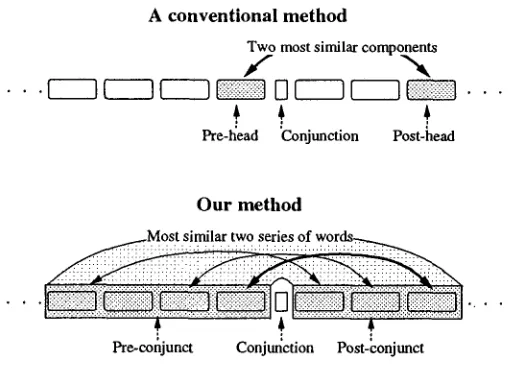
A conventional method
T w o most similar components
f
. [ ~ l t I I ~ l ~ [31 I [ - - l ~ • • •
Pre-head Conjunction Post-head
Our method
~
Most similar two series of w o r d s ~Pre-eonjunet Conjunction Post-conjunct
Figure 1
Comparison between a conventional method and our method.
Some researchers have attributed the difficulties to the numerous possibilities of head- dependent relations between phrases in long sentences. But no deeper consideration has ever been given to the reasons for the analysis failure.
A long sentence, particularly in Japanese, very often contains conjunctive struc- tures. These may be either conjunctive noun phrases or conjunctive predicative clauses. Among the latter, those made by the
renyoh forms
of predicates (the ending forms that mean connection to another right predicate) are calledrenyoh chuushi-ho
(see example sentence (iv) of Table 1). A renyoh chuushi-ho appears in an embedded sentence to modify nouns and is also used to connect two or more sentences. This form is used frequently in Japanese and is a major cause of structural ambiguity. Many major sen- tential components are omitted in the posterior part of renyoh chuushi expressions, thus complicating the analysis. For the successful analysis of long sentences, these conjunctive phrases and clauses, including renyoh chuushi-ho, must be recognized correctly. Nevertheless, most work in this area (e.g., Dahl and McCord 1983; Fong and Berwick 1985; Hirschman 1986; Kaplan and Maxwell 1988; Sag et al. 1985; Sedogbo 1985; Steedman 1990; Woods 1973) has concerned the problem of creating candidate conjunctive structures or explaining correct conjunctive structures, and not the method for selecting correct structures among many candidates. A method proposed by some researchers (Agarwal and Boggess 1992; Nagao et al. 1983) for selecting the correct structure is, in outline, that the two most similar components to the left side and to the right side of a conjunction are detected as twoconjoined heads
in a conjunctive struc- ture. For example, in "John enjoyed the book and liked the play" we call the verbs "enjoyed" and "liked" conjoined heads; "enjoyed" is thepre-head,
and "liked" thepost-
head.
We also call "enjoyed the book"pre-conjunct,
and "liked the play"post-conjunct.
[image:2.468.109.365.60.243.2]Sadao Kurohashi and Makoto Nagao Syntactic Analysis Method
However, two conjoined heads are sometimes far apart in a long sentence, making this simple method clearly inadequate.
H u m a n beings can recognize conjunctive structures because of a certain, but some- times subtle, similarity that exists between conjuncts. Not only the conjoined heads, but also other components in conjuncts, have some similarity, and furthermore, the pre- and post-conjuncts have a structural parallelism. A computational method needs to recognize this subtle similarity in order to detect the correct conjunctive structures. In this investigation, we have developed an algorithm for calculating a similarity mea- sure between two arbitrary series of words from the left and the right of a conjunction and selecting the two most similar series of words that can reasonably be considered as composing a conjunctive structure (see the lower part of Figure 1). This procedure is realized using a dynamic programming technique.
In our syntactic analysis method, the first step is the detection of conjunctive structures by the above-mentioned algorithm. Since two or more conjunctive structures sometimes exist in a sentence with very complex interrelations, the second step is to adjust tangled relations that may exist between two or more conjunctive structures in the sentence. In this step conjunctive structures with incorrect overlapping relations, if they exist, are found and retrials of detecting their scopes are done. The third step of our syntactic analysis is a very common operation. Japanese sentences can best be explained by
kakari-uke,
which is essentially a dependency structure. Therefore our third step, after identifying all the conjunctive structures, is to perform dependency analyses for each phrase/clause of the conjunctive structures and the dependency analysis for the whole sentence after all the conjunctive structures have been reduced into single nodes. The dependency analysis of Japanese is rather simple. A component depends on a component to its right (not necessarily the adjacent component), and the suffix (postposition) of a component indicates what kind of element it can depend on. More than one head-dependent relation may exist between components, but by introducing some heuristics, we can easily get a unique dependency analysis result that is correct for a high percentage of cases. A serious problem regarding conjunctive structures, in addition to the ambiguity of their scopes, is the ellipses in some of their components. Through the dependency analysis process outlined, we are able to find the ellipses occurring in the conjunctive structures and supplement them with the omitted components.2. Types of Conjunctive Structures and Their Ambiguities
In Japanese,
bunsetsu
is the smallest meaningful sequence consisting of an indepen- dent word (IW; nouns, verbs, adjectives, etc.) and accompanying words (AW; copulas, postpositions, auxiliary verbs, and so on)~ A bunsetsu whose IW is a verb or an adjec- tive, or whose AW is a copula, functions as a predicate and thus is called a predicative bunsetsu (PB). A bunsetsu whose IW is a noun is called a nominal bunsetsu (NB).Conjunctive structures (CSs) that appear in Japanese are classified into three types (Shudo et al. 1986). The first type is the
conjunctive noun phrase.
We can find these phrases by the words listed in Table 1-a. Each conjunctive noun can have adjectival modifiers (Table 1-ii) or clausal modifiers (Table 1-iii).The second type is the
conjunctive predicative clause,
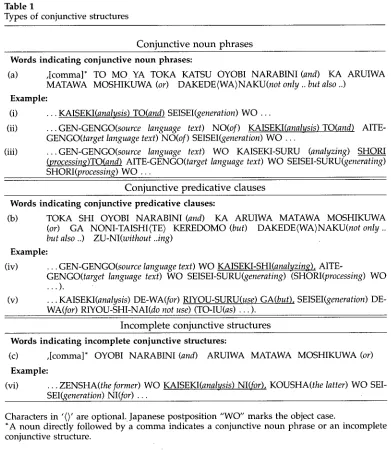
in which two or more predicates in a sentence form a coordination. We can find these clauses by the renyoh forms of predicates (Table 1-iv) or by the predicates accompanying one of the words in Table 1-b (Table l-v).Table 1
Types of conjunctive structures
Conjunctive n o u n p h r a s e s Words indicating conjunctive noun phrases:
(a) ,[comma]* TO M O YA TOKA KATSU OYOBI NARABINI (and) KA ARUIWA
MATAWA MOSHIKUWA (or) DAKEDEIWA}NAKU(not only .. but also ..)
Example:
(i) ... KAISEKI(analysis) TO(and) SEISEI(generation) WO ...
( i i ) ...GEN-GENGO(source language text) NO(of) KAISEKI(analysis) TO(and) AITE-
GENGO(target language text) NO(of) SEISEI(generation) WO ...
(iii) ...GEN-GENGO(source language text) WO KAISEKI-SURU (analyzing) SHORI
(processing)TO(and) AITE-GENGO(target language text) WO SEISEI-SURU(generating) SHORI(processing) WO ...
C o n j u n c t i v e p r e d i c a t i v e clauses Words indicating conjunctive predicative clauses:
(b) TOKA SHI OYOBI NARABINI (and) KA ARUIWA MATAWA MOSHIKUWA
(or) GA NONI-TAISHI/TE / KEREDOMO (but) DAKEDEIWAINAKU(not only ..
but also..) ZU-NI(without ..ing)
Example:
(iv) ... GEN-GENGO(source language text) WO KAISEKI-SHI(analyzing), AITE-
GENGO(target language text) WO SEISEI-SURU(generating) (SHORI(processing) WO
(v) ... KAISEKI(analysis) DE-WA(for) RIYOU-SURU(use) GA(but), SEISEI(generation) DE-
WA(for) RIYOU-SHI-NAI(do not use) (TO-IU(as) ... ). I n c o m p l e t e conjunctive structures Words indicating incomplete conjunctive structures:
(c) ,[comma] ~ OYOBI NARABINI (and) ARUIWA MATAWA MOSHIKUWA (or)
Example:
(vi) ... ZENSHA(the former) WO KAISEKI(analysis) NI(for), KOUSHA(the latter) WO SEI-
SEI(generation) NI(for) ...
Characters in '//' are optional. Japanese postposition "WO" marks the object case.
~A noun directly followed by a comma indicates a conjunctive noun phrase or an incomplete conjunctive structure.
c o r r e s p o n d e n c e of c a s e - m a r k i n g p o s t p o s i t i o n s (Table 1-vi: ".. W O .. NI, .. W O .. NI"). H o w e v e r , s o m e t i m e s the last b u n s e t s u of the pre-conjunct h a s no c a s e - m a r k i n g post- position (e.g., " N I " can be o m i t t e d in the b u n s e t s u " K A I S E K I - N I " in Table 1-vi), just f o l l o w e d b y o n e of the w o r d s listed in Table 1-c. In s u c h cases w e c a n n o t distinguish this t y p e of CS f r o m conjunctive n o u n p h r a s e s b y seeing the last b u n s e t s u of the pre-conjunct. H o w e v e r , this d o e s not matter, as o u r m e t h o d h a n d l e s the three t y p e s of CSs in a l m o s t the s a m e w a y in the stage of detecting their scopes, a n d it exactly distinguishes i n c o m p l e t e conjunctive structures in the stage of d e p e n d e n c y analysis.
[image:4.468.46.437.61.511.2]Sadao Kurohashi and Makoto Nagao Syntactic Analysis Method
Table 1). A KB lies last in the pre-conjunct and is a pre-head. However, it is difficult to determine which bunsetsu sequences on both sides of the KB constitute pre- and post-conjuncts. That is, it is not easy to determine which bunsetsu to the left of a KB is the leftmost bunsetsu of the pre-conjunct (we call this starting bunsetsu SB) and which bunsetsu to the right of a KB is the rightmost bunsetsu of the post-conjunct (this ending bunsetsu is called EB and is a post-head). The bunsetsus between these two extreme bunsetsus constitute the scope of the CS. In detecting a CS, it is most important to find the post-head (that is, the EB) among many candidates in a sentence; e.g., in a conjunctive noun phrase, all NBs after a KB are candidates (we call such a candidate bunsetsu a CB). However, our method searches not only for the most plausible EB, but also for the most plausible scope of the CS.
3. Detection of Conjunctive Structures
We detect the scope of CSs by using a wide range of information before and after a KB. An input sentence is first divided into bunsetsus by conventional morphological analysis. Then we calculate similarities in all pairs of bunsetsus in the sentence. After that, we calculate the similarities between two series of bunsetsus on the left and right of the KB by combining the similarity scores for pairs of bunsetsus. Then, as a final result, we choose the two most similar series of bunsetsus that can reasonably be considered as composing a CS. We will explain this process in detail in the following sections.
In detecting CSs, it is necessary to take many factors into consideration, and it is important to give the proper weight to each factor. The scoring system described hereafter was first hypothesized and then manually adjusted through experiments on 30 training sentences containing CSs. These parameters would not be the best, and statistical investigations of large corpora would be preferable. However, these parameters are good enough to get reasonably good analysis results, as shown in the experiments section, and to show the appropriateness of our method.
3.1 Similarities between Bunsetsus
First, we calculate similarities for all pairs of bunsetsus in the sentence. An appropriate similarity value between two bunsetsus is given by the following process:
.
.
.
.
If the parts of speech of IWs are equal, give 2 points as the similarity value, and go to step 2. When the parts of speech of IWs are not equal and both bunsetsus are PBs, give 2 points, but do not add other points (i.e., end the scoring process).
If IWs match (by character level) each other exactly, add 10 points and go to step 5. If IWs are conjugated, infinitives are compared.
If both IWs are nouns and they match partially at the character level, add the number of matching characters x 2 points.
Add points for semantic similarities by using the thesaurus Bunrui Goi
Hyou (BGH; National Language Research Institute 1964). The BGH has a
.
b r o a d e r sense. The m a x i m u m s u m of similarity values that can be a d d e d b y step 3 a n d this step is 10 points.
If some of the AWs match, a d d the n u m b e r of matching AWs x 3 points.
For example, the similarity value b e t w e e n "TEISEI(revision)SHI(do)," a n d "KEN- SHUTSU(detection)SURU(do)" is calculated as
2(match of parts of speech) + 2(match b y BGH) + 3(match of one AW) = 7 points.
The similarity v a l u e b e t w e e n "TEI-SUIJUN-GENGO(low level language)," a n d "KOU- SUIJUN-GENGO(high level language)TO(and)" is
2(match of parts of speech) + 8(match of four kanji characters: " S U I J U N - G E N G O ' ) = 10 points.
Since the BGH does not contain technical terms, similarity points c a n n o t be given to t h e m b y the BGH. H o w e v e r , technical terms are often c o m p o u n d words, a n d those h a v i n g similar m e a n i n g s often contain the same words. For such technical terms, some similarity points can be given according to the degree of partial character m a t c h i n g b y step 3, as for the latter example.
3.2 Similarities b e t w e e n Two Series of Bunsetsus
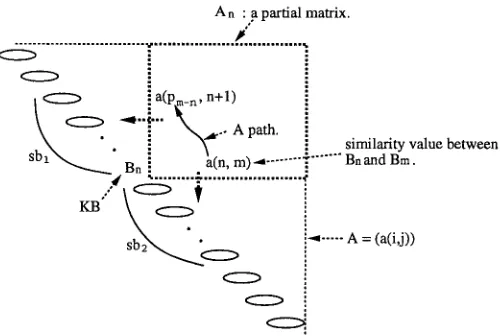
O u r m e t h o d detects the scope of a CS b y finding the t w o series of bunsetsus from before a n d after the KB that h a v e the greatest similarity. To m e a s u r e the similarity score b e t w e e n two series of bunsetsus, w e have d e v e l o p e d a m e t h o d using a triangular matrix, A, as s h o w n in Figure 2 (Figure 7 and Figure 8 are concrete examples):
A = (a(i,j)) (O <_ i ~_ l; i ~_ j ~_ l),
w h e r e 1 is the n u m b e r of b u n s e t s u s in a sentence. Here, each diagonal e l e m e n t a(i, i) is the ith b u n s e t s u in a sentence (hereafter d e n o t e d Bi) and e v e r y other e l e m e n t a(i,j) (i < j) is the similarity value b e t w e e n b u n s e t s u Bi a n d b u n s e t s u By calculated b y the process just described.
In detecting a CS w h o s e KB is the nth b u n s e t s u (Bn), we consider only a partial matrix ( d e n o t e d An) that is the u p p e r right part of Bn (Figure 2):
An = (a(i,j)) (O < i < n; n + l ~_ j <_ l).
For specifying c a n d i d a t e pre- a n d post-conjuncts and m e a s u r i n g their similarity, w e define a path in An (Figure 2):
p a t h ::= (a(pl,m),a(p2,m - 1 ) , . . . ,a(pm-n,n + 1)),
w h e r e n + 1 <_ m ~_ l, a(pl,m) • 0, Pl = n, Pi ~ Pi+1(1 < i < m - n - 1).
Sadao Kurohashi and Makoto Nagao Syntactic Analysis Method
An : apartial malyix.
[image:7.468.104.354.62.230.2] [image:7.468.71.384.65.413.2]#
... .~ ...<ZZ~ .: =
t ~ ! a(pra_n, n+l)
C~ -,,..~... ~( ""
) . k " - - " i x ~ "~''" A path' similarity value between s b l ~ _ ~ Bn! . a ( n , m ) 4 ... "r ... BnandBm.
K<'
1
1
Figure 2
A method using a triangular matrix.
" " " B i ... i----~- ( ~
""",,,, .,.
B j-I, i "", ,.! lj'-,,
"',, (.)
Bi-l.~ ...
"-.,,, ,,. =
~j-2
B j-1
(b) Bj.,
"
B'/-I,.: ... i.---~
" ""Bi: ... i ...
B j-1.
(c) Bj.
Figure 3
The way of calculating path scores.
c o r r e s p o n d e n c e of a KB to a CB (note the first process giving the similarity b e t w e e n t w o bunsetsus).
We calculate a path score, w h i c h s h o w s the similarity b e t w e e n t w o c a n d i d a t e con- juncts specified b y the path, u s i n g the following five criteria:
.
.
. . . . . . , ° , ° ° ° ° ° ° ° . , . . . .
... : i t ...
... ~ ... :,_..~ ... ~ ...
... 3v+.',...~ , ... ~ ...
"i \ \
i
(~.
i ' , \ \
i
. . . } . . . o , 1 . ~ . . ; V . ~ , ° ~ , . . , t . . .
... r ... [ ... i ...
~ . . . ° . . . ° ° . . . ° ° . o ° , ° ° . ° . ~
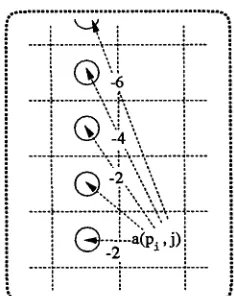
Figure 4
Penalty points.
.
.
insertion in pre-conjunct a n d that in post-conjunct symmetrically, w h e n a p a r t of the p a t h is h o r i z o n t a l ( a ( i , j ) , a ( i , j - 1)), the e l e m e n t ' s points
a ( i , j - 1) are not a d d e d to the p a t h score (Figures 3b a n d 3c). 1
Since a p a i r of conjunctive p h r a s e s / c l a u s e s often exhibit structural similarity, w e h y p o t h e s i z e that a n a l y s e s of CSs w h i c h m a x i m i z e c o r r e s p o n d i n g b u n s e t s u s t e n d to lead to a correct resolution of the conjunctive scope. By this h y p o t h e s i s , w e i m p o s e p e n a l t y points on the pairs of e l e m e n t s in the p a t h that cause o n e to m u l t i p l e b u n s e t s u c o r r e s p o n d e n c e , giving p r i o r i t y to CSs that are c o n s t r u c t e d of c o m p o n e n t s of the s a m e size. P e n a l t y points for (a(pi~j)~ a ( p i + l , j - 1)) calculated b y the following f o r m u l a are s u b t r a c t e d f r o m the p a t h score (Figure 4):
JPi - Pi+l - 11 x 2.
N o t e that these p e n a l t y points are also s y m m e t r i c a l , as s h o w n in Figures 3b a n d 3c.
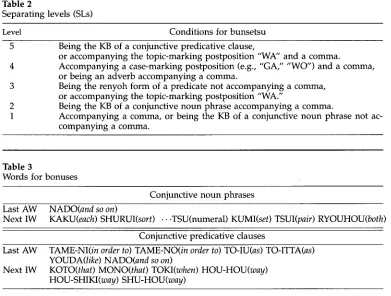
Since each p h r a s e in the CS h a s a certain coherence of m e a n i n g , special w o r d s that s e p a r a t e different m e a n i n g s in a sentence often limit the s c o p e of a CS. If c a n d i d a t e conjuncts specified b y a p a t h include such w o r d s , w e i m p o s e p e n a l t y points o n the p a t h so that the possibility of selecting such a p a t h is r e d u c e d . We define five s e p a r a t i n g levels (SLs) for b u n s e t s u s , w h i c h express the strength of s e p a r a t i n g m e a n i n g s in a sentence (Table 2; see Table 1), b y o b s e r v i n g sentences containing CSs. If c a n d i d a t e conjuncts contain a b u n s e t s u w h o s e SL is equal to the KB's SL or higher, w e r e d u c e the p a t h score b y
(SL of the b u n s e t s u - KB's SL + 1) x 7.
Sadao Kurohashi and Makoto Nagao Syntactic Analysis Method
Table 2
Separating levels (SLs)
Level Conditions for bunsetsu
Being the KB of a conjunctive predicative clause,
or accompanying the topic-marking postposition "WA" and a comma.
Accompanying a case-marking postposition (e.g., "GA," "WO") and a comma, or being an adverb accompanying a comma.
Being the renyoh form of a predicate not accompanying a comma, or accompanying the topic-marking postposition "WA."
Being the KB of a conjunctive noun phrase accompanying a comma.
Accompanying a comma, or being the KB of a conjunctive noun phrase not ac- companying a comma.
Table 3
Words for bonuses
Conjunctive noun phrases Last AW NADO(and so on)
Next IW KAKU(each) SHURUI(sort) ...TSU(numeral) KUMI(set) TSUI(pair) RYOUHOU(both) Conjunctive predicative clauses
Last AW TAME-NI(in order to) TAME-NO(in order to) TO-IU(as) TO-ITTA(as) YOUDA(like) NADO(and so on)
Next IW KOTO(that) MONO(that) TOKI(when) HOU-HOU(way)
HOU-SHIKI(way) SHU-HOU(way)
.
H o w e v e r , t w o h i g h SL b u n s e t s u s c o r r e s p o n d i n g to each other often exist in a CS, a n d these d o not limit the scope of the CS, like "X TO-SHITE WA(As to X) . . . . DE-ARI(be), Y TO-SHITE WA(as to Y) . . . . DE-ARU(be)." To take this into consideration, p e n a l t y points for c o r r e s p o n d i n g h i g h SL b u n s e t s u s are not g i v e n to paths. For h i g h SL bunsetsus, Bi a n d By, to be c o r r e s p o n d i n g , t h e y h a v e to be of the same type, a n d the p a t h contains the e l e m e n t a(i~j). We define t w o b u n s e t s u s to be of the s a m e t y p e if:
their IWs are of the s a m e p a r t of speech;
w h e n t h e y are conjugated, they h a v e the identical form; w h e n t h e y contain AWs, their AWs are identical.
For e x a m p l e , "KARE(he)-WA" a n d "KANOJO(she)-WA" are of the s a m e t y p e ( n o u n + p o s t p o s i t i o n "WA"). So are "HASHIREBA(ifrun)" a n d "ARUKEBA(ifwalk)" (conditional f o r m of verb). These p e n a l t y points can be i m p o s e d on pairs of e l e m e n t s in a path, namely, extension steps of a p a t h s e p a r a t e l y b e c a u s e each extension step of a p a t h takes s o m e b u n s e t s u s in c a n d i d a t e conjuncts.
[image:9.468.36.427.67.363.2]N o w calculating
-'" i n t h i s c o l u m n .
~i"~':q::"~~"1
i ' " ~ ~
beit P~th'[
~....3. . . , . . . + . ~ . + . . . + . . , ~ ~- .. . . +--- ,'-+---+---+-.-4. . . . 2-~-'4.-- ~-.-4 ,~...+_.+... ' ... L. ~ ----",-.--4 C h o o s e i ' , " , , , , the greatest.[...L~,~'.:'.'6..~:~b.. 4 : ~ - . ~ - - 4 - - - 4
score p a t h . i ], @ - - ' , ' - " - " - ~ ' . d " _ . i ~ 4 i 0 i
...'...t._K....~ . . . . ~ t. n e s t a r t i n g ---.,-.---,--.---.--.---, e l e m e n t .
Figure 5
The best path from an element.
3.3 F i n d i n g t h e C o n j u n c t i v e S t r u c t u r e S c o p e
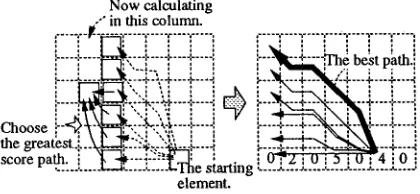
As described in the preceding subsection, a path score is composed of points for its elements, penalty points for every path extension, and bonus points for its starting position. The key aspect is that these points can be calculated for every extension step of a path independently. For this reason, the greatest score path can be searched for by using dynamic programming method.
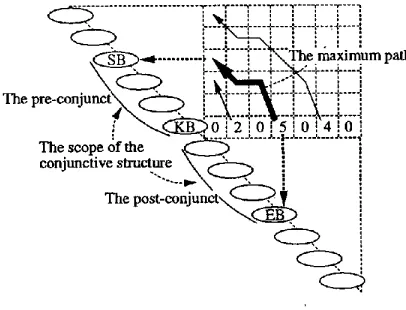
Calculation is performed column by column going left from a non-zero element in the lowest row in A, to the leftmost column in An. For each element in a column, the best partial path reaching it is found by extending the partial paths from the previous column and choosing the greatest score path (the left part of Figure 5). In extending partial paths, elements' points and penalty points are given to paths step by step. Then, among the paths to the leftmost column, the path that has the greatest score becomes the best path from the starting non-zero element (the right part of Figure 5). Of all the best paths from all the non-zero lowest row elements, the path that has the greatest path score (the maximum path) is chosen as defining the scope of the CS; i.e., the series of bunsetsus on the left side of the maximum path (pre-conjunct) and the series of bunsetsus under it (post-conjunct) are conjunctive (Figure 6).
An EB (the last bunsetsu in the post-conjunct) corresponds to a KB (the last bun- setsu in the pre-conjunct), and it follows from the definition of a path that the EB has a certain similarity to the KB. On the other hand, when there are modifiers in both conjuncts, an SB shows where the leftmost modifier starts in its pre-conjunct. Since the modifiers in the pre-conjunct and those in the post-conjunct usually do not corre- spond exactly, an SB is determined mainly on the basis of the balance between pre- and post-conjuncts and is not always detected precisely. This problem is managed in the next stages when the relations between CSs in a sentence are adjusted and when a dependency structure is constructed (described in Section 4.1 and Section 5.2).
3.4 E x a m p l e s o f D e t e c t i o n o f C o n j u n c t i v e S t r u c t u r e s
Two examples of detecting CSs are shown in Figures 7 and 8. A chain of matrix elements with the same letters shows the maximum path for the KB marked with this letter and '>.'
In the example sentence in Figure 7, the conjunctive predicative clause is de- tected correctly owing to the penalty points for the SL of the topic-marking post- position "WA" and the comma in the bunsetsu "KAISHOU-SURU-TAME-NI-WA(in
order to solve),"
which is outside of the CS, and owing to the bonus points for the IW [image:10.468.138.348.66.163.2]Sadao Kurohashi and Makoto Nagao Syntactic Analysis Method
... ;i Z KXiXKXi
. ~ . ~ ... ~ ' ~ N , . T h e . m a x i m u m path
i ~ i-'"'i i i i
T e o-oonjuno \ O
The scope of the ~ ... { ... '¢
conjun tives e \--C_Z:> i
'
F i g u r e 6
The maximum path specifying a conjunctive structure.
KORERA-NO 0 0 2 0 0 0 i0 0 0 0 0 0 0 (these) AIMAISEI-WO 0 0 2 5 0 i2 0 5 0 2 2 2 (ambiguities) KAISHOU-SURU-TAME-NI-WA, 0 0 0 8 i0 2 0 5 0 0 2 (in order to solve)
m
SONO 0 0 0 10 0 0 0 0 0 0 (the) ~SUBEI'E-NO 2 0 (~'.,0 2 0 2 7 2 (all)
OUSEI-WO 0 i~;'-.0~'5~'0 2 2 2 (possibility) HYOUKA.S HI,! _0...14~]]~]. 5 ~ 0...0 ...2.. (evaluate) t SAITEKI-TO 0 2 0 2 2 2 (to beoptimum)
KB" \ OMOWA-RERU 0 2 0 0 0 (bethought)
KAI-WO 0 2 2 2 (the answer) ~ D O U S H U T S U - S U R U 0 0 0 (derive)
KOTO-MO 2 2 (that) HrroTSU-NO 2 (one) HOUHOU-DEARU. (be way)
(57characters)
In order to solve these ambiguities, one way is to evaluate all the possibility
and to derive the answer which is thought to be optimum.
F i g u r e 7
An example of detecting conjunctive structures.
GUTAI-TEKI-NI-WA, 0 0 ]0 i0 0 0 2 i0, 0 2 (concretely)
BUNKEN-JOUHOU-WO 2 i2 i2 2 6 0 ,12 2 0 (doeumentinformafion) . . . ~-J,-a>HYOUDAI ~ 4 2 2 0 14 2 0 (atitle)
~ , - , ,_..~,~.... ... ! ...
. ~ ...~...~,~ b>CHOSHA,,~2~ 2 2 0 !2 2 0 (an au~or) K.I~ .... " ~ ... r~:~ ...
~ S H U D A I - N A D O - N O 2 2 0 !5c"2 0 (such as a theme) ZOKUSEI-NI-KANSURU 2 0 17L',,,2d',O (concerning an attribute) ~2-JI-JOUHOU-TO-SHITE 0 i2 ~ ~ (as the secondary information) .._ ~ c>SAI-HENSEI-SHI, !0 0 ",,5~! (be reorganized)
KB ... -~ SAKUIN-NO'"2""0" (of an index) KATACHI-DE 0 (in the form) KIROKU-SH1TE-OKU. (be recorded)
(52characters)
Concretely, document information is reorganized as the secondary information concerning
[image:12.468.95.385.66.199.2]an attribute such as a title, an author, a theme, and is recorded in the form of an index.
Figure 8
An example of detecting conjunctive structures.
4. Reduction of a Long Sentence with Conjunctive Structures
In a long Japanese sentence two or more CSs often exist, overlapping with each other. In such cases, we have to adjust their relations in a sentence after their scopes have been detected. This adjustment is done by checking relations in all pairs of CSs and merging all the relations. Through this adjustment process, CSs consisting of three or more conjuncts are detected. Furthermore, CSs with incorrect relations, if they exist, are found, and retrials of detecting their scopes are done. As a result of this adjustment process, we get a reduced sentence form. The details of these processes will be given in the following section.
4.1 Relations between Two Conjunctive Structures
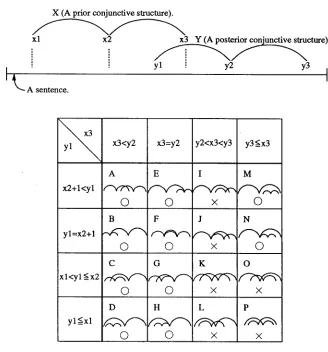
The scope of a CS is represented by a three-tuple: {position of SB, position of KB, position of EB}. Let us suppose that two CSs exist in a sentence; the prior one, X, has a scope represented by {xl, x2, x3}, and the posterior one, Y, has a scope represented by {yl, y2, y3} (see Figure 9). When two CSs are detected by the previously described dynamic programming method as overlapping each other, in this case y l < x3, there is a variety of possible cases according to the relation among xl, x2, and y l and that among y2, y3, and x3 as shown in Figure 9. These 16 possible cases of two CSs overlapping each other are classified into three different relations, and the correction of CSs is performed for each relation in the following way:
Sadao Kurohashi and Makoto Nagao Syntactic Analysis Method
X (A prior conjunctive structure).
x,
x2
t uno ctu e,.
yl y2 y3
L A sentence. I
x2+l<yl
yl=x2+l
xl<yl~x2
y l < x l
x3<y2
A
©
B
©
c
©
D
©
x3=y2
E
©
F
©
G
©
H
©
y2<x3<y3
I
X
J
X
K
×
L
×
y3 K_ x3
M
©
N
©
O
×
P
X
Figure 9
A relation between two conjunctive structures.
M, and N illustrate this relation. Cases A, B, C, a n d G fall into this category w h e n a pre-conjunct of a posterior CS (Y) is e x t e n d e d to the left to include a prior CS (X), because X is considered to be a modifier in Y's pre-conjunct. 2 Case E also falls into the p a r e n t - c h i l d category b y
extending X's post-conjunct to the right to include Y. This is because the EB of the e x t e n d e d X (that is, Y's EB) can c o r r e s p o n d to X's KB t h r o u g h the EB of the original X (that is, Y's KB). A p a r t from case E, a
post-conjunct is not e x t e n d e d to the right. Therefore, cases I a n d J d o not c o m e into this relation.
Incorrect r e l a t i o n (cases I, J, K, L, O, and P in Figure 9): These relations d o not exist in actual sentences and are caused only b y incorrect detection of CSs. Therefore, a retrial of detecting their scopes is d o n e in the w a y described in the following section.
[image:13.468.63.391.59.411.2]Incorrect conjunctive structure.
Incorrect relation K. f
...IPROGRAM, ]DATA-DAKE-DE_NAKU jFILa iDATABASE-WO-MO IDourrsu-KUUKAN-NIIKAKUNOU-SURU • (programs)" (not only data) '(files)' (but also database) (in a common (store)
address space)
4 5 6 7 8 9
Result of incorrect detection.
NEBI
SBN,,] 7 8 9 "
1
~1 Oxx
X X X X X X
Restriction on SB and EB.
::::::::::::::::::::::::::::::::::::::::::::::::::::::::::::::::::
... iPROGRAM, iDATA-DAKE-DE_NAKU iFILE, iDATABASE-WO-MO IDOUITSU-KUUKAN-NIiKAKUNOU-SURU
t i t
(programs) (not only data) t(files) : (but also database) (in a common (store) a d d r e s s s p a c e )
4 5 6 7 8 9
[image:14.468.58.406.67.295.2]Result of re-detection.
Figure 10
An example of redetecting a conjunctive structure under an incorrect relation between conjunctive structures.
4.2 Retrial of D e t e c t i n g O v e r l a p p i n g C o n j u n c t i v e Structures w i t h Incorrect Inter- relations
If t w o CSs have a incorrect relation in a sentence as described earlier, a retrial is c o n d u c t e d to get the p r o p e r CSs. In this case, the CS that has the larger CS score is r e g a r d e d as correct, a n d a n e w CS concerning the KB w h o s e old CS had a smaller score is detected so that the n e w CS does not h a v e an incorrect relation with the other CS. For example, w h e n the CSs X and Y (X precedes Y) have an incorrect relation a n d Y has a smaller score than X, the r a n g e of y l a n d y3, w h i c h will give a correct relation with xl, x2, x3, a n d y2, is d e t e r m i n e d from the relations in Figure 9. 3 Then, the n e w CS is identified w h o s e similarity score is the greatest in this restricted range of y l a n d y3, ignoring p a t h s that start from a n d e n d with elements outside the restricted r a n g e in the d y n a m i c p r o g r a m m i n g m e t h o d . An e x a m p l e of redetecting a CS is s h o w n in Figure 10. In this e x a m p l e only a pair of y l a n d y3, (6, 7), gives a correct relation so that the scope of the CS is d e t e r m i n e d u n i q u e l y w i t h o u t the d y n a m i c p r o g r a m m i n g m e t h o d .
If there exist two or m o r e CS pairs in a sentence that all have incorrect relations, the redetection is d o n e on the pair w h o s e difference of scores is the greatest. W h e n e v e r the redetection is d o n e on one pair of CSs, the relations of all pairs of CSs in a sentence are checked a n d c o n t r a d i c t o r y relations are corrected b y the p r e v i o u s l y described process. This continues till no pair of CSs with an incorrect relation exists in the sentence.
Sadao Kurohashi and Makoto Nagao Syntactic Analysis Method
( 3 U T A I - T E K I - N I - W A , B U N K E N - J O U H O U - W O
(cor, oze~ly) ( d o c : ~ m information)
= ~ 4 ] q T i ' : ! T T :'TT~:TiT--Ti':TT: vT"T-:i i i ... i ! .... i ! .!.! i ! !.,
! ' ~ : ~ H Y O U D A I :::::::::::::::::::::::::::] : : : : : : : ' : : : ' : : : : : ' : : : : : ' : : : : : : : : : : : : ' : : ' : : : ' : ' : ' : : : ' : : : : : ' : : : : : : : : : ' : : : : : : : ' : : : ' : : : : : : : : : '{
::::::::::::::::::::::::::::::::::::::::::::::::::::::::::::::::::::::::::::::::::::::::::::::::::::::::::::::::::::::::::::::::::::::::::::::::::::::::::::::::::::::::::::::::::::::::::::::::~
[image:15.468.45.422.63.158.2][G~-.G: : ~ G : ~ . ` ' a ~ : - ~ G L ~ G ~ : G ~ ` G : ~ : G:~:G : ~-G:2:GL~G:2:G~G:~2L~-: G G 2 ~ a 2 ~ G ~ G 2 : G ~ G 2 ~
Figure 11
An example of a reduced sentence.
4.3 An Example of Reduction of a Sentence
As for the sentence in Figure 8, the following CSs are detected:
CSI: [HYOUDAI(a title),]-[CHOSHA(an author),] ( ' a > ' in Figure 8) CS2: [ C H O S H A ( a n author),]-[SHUDAI-NADO-NO(such as a theme)] ( ' b > ' in Figure 8)
CS3: [SHUDAI-NADO-NO(such as a theme) ...SAI-HENSEI-SHI(be
reorganized),]-
[SAKUIN-NO(of an index)..-KIROKU-SHITE-OKU(be recorded).] ( ' c > ' in
Figure 8)
Because CS1 a n d CS2 are f o u n d to be in a b r o t h e r relation b y checking their over- lap relation, t h e y are m e r g e d into o n e CS (CS1-2: [HYOUDAI(a title),]-[CHOSHA(an author),]- [SHUDAI-NADO-NO(such as a theme)]). Then, b e c a u s e CS3 is f o u n d to be a p a r e n t CS of CS2, that is, a p a r e n t CS of CS1-2, its pre-conjunct is e x t e n d e d to contain CS1-2. As a result of this process, the r e d u c e d f o r m of a sentence is o b t a i n e d as s h o w n in Figure 11.
5. Dependency Analysis of a Sentence and Supplementing for Ellipses
As described in the p r e c e d i n g sections, i n f o r m a t i o n a b o u t CSs can be u s e d to r e d u c e a sentence into a s i m p l e r form. Consequently, a d e p e n d e n c y structure of an entire sentence can be o b t a i n e d b y a p p l y i n g relatively s i m p l e h e a d - d e p e n d e n t rules to CSs a n d the sentence. A n o t h e r serious p r o b l e m r e g a r d i n g CSs, in a d d i t i o n to the a m b i g u i t y of scope, is the ellipses that m a y occur in the c o m p o n e n t s of CSs. We recover the o m i t t e d c o m p o n e n t s in the stage of d e p e n d e n c y analysis. We will explain this process in the following.
5.1 Dependency Analysis
First, each conjunct of the CSs is analyzed. If there are two or m o r e CSs in a nested structure in a sentence (i.e., having p a r e n t - c h i l d relations), each CS is a n a l y z e d from the i n n e r m o s t CS in the o r d e r of nesting level. T h e n finally, the main sentential c o m p o n e n t is analyzed. Because the pre- a n d post-conjuncts have their o w n consistent structures a n d meanings, they are p a r s e d i n d e p e n d e n t l y into d e p e n d e n c y trees. The root n o d e s of these trees are the KB and the EB (the last b u n s e t s u of each conjunct). 4 After analyzing a CS, a n e w node, called the CS node, is created that has two child nodes, KB and EB. The CS n o d e inherits the p r o p e r t y of the EB w h e n it d e p e n d s on a b u n s e t s u to the right of it, a n d it inherits the p r o p e r t y of the KB a n d the EB w h e n it g o v e r n s a b u n s e t s u to the left of it. In the next level analysis (the t e r m w e give to the analysis of its p a r e n t CS or of the w h o l e sentence if no p a r e n t CS exists), the CS n o d e is h a n d l e d as a symbol. This m e a n s that bunsetsus outside a CS can no longer d e p e n d on bunsetsus in it, except the KB a n d the EB. Even in the case of a CS that consists of m o r e than t w o conjuncts, the same analysis takes place, except that the d e p e n d e n c y tree of the CS is c o m p o s e d of m o r e than two sub-trees into w h i c h each conjunct is parsed.
Parsing a series of bunsetsus in a certain r a n g e (conjuncts of CSs, or a w h o l e sentence after m e r g i n g all the CSs into CS nodes) is p e r f o r m e d in the following way. The head b u n s e t s u is d e t e r m i n e d f r o m right to left for each b u n s e t s u in the r a n g e of bunsetsus to the right of it with a no-cross condition, s The type of b u n s e t s u as a h e a d is classified into two types, NB and PB. 6 W h e t h e r a b u n s e t s u d e p e n d s on NB or PB is d e t e r m i n e d b y the conjugation of its IW or b y the type of its AW. For example, an NB with a postposition " N O " can d e p e n d on an NB, a n d a conditional f o r m of a PB (ending with "BA") can d e p e n d on a PB. W h e n a b u n s e t s u can d e p e n d on two or m o r e bunsetsus in the range, its head is d e t e r m i n e d b y the following heuristics:
• In most cases a b u n s e t s u d e p e n d s o n its nearest h e a d in Japanese. Therefore, a b u n s e t s u is r e g a r d e d as d e p e n d i n g on its nearest h e a d except in following two cases.
• Because the postposition "WA" marks the topic of a sentence, a b u n s e t s u a c c o m p a n y i n g it usually d e p e n d s on the last predicate that is the main predicate in a sentence. Thus, such a b u n s e t s u is r e g a r d e d as d e p e n d i n g on the last h e a d in the analysis range.
• A c o m m a in a sentence shows a separation of meaning, and the
b u n s e t s u a c c o m p a n y i n g a c o m m a usually d e p e n d s on a b u n s e t s u farther a w a y than the nearest one. Based on o u r observation w e consider such a b u n s e t s u to d e p e n d o n t h e second nearest head.
These rules are rather simple, b u t they are still useful w h e n applied to the r e d u c e d f o r m of a sentence, as s h o w n in the discussion of the experiments.
We illustrate this process for the sentence in Figure 12. At first, the CS [HYOUDAI(a
title),]-[CHOSHA(an author),]- [SHUDAI-NADO-NO(such as a theme)] is analyzed; be-
cause each conjunct consists of only one bunsetsu, the analysis results only in creating
4 In the case of i n c o m p l e t e conjunctive structures, s u c h as in Table 1-vi, neither conjunct can be p a r s e d into a d e p e n d e n c y tree, as it c o n t a i n s n o predicate that s h o u l d b e c o m e the root n o d e of a d e p e n d e n c Y tree. A w a y of d e a l i n g w i t h this p r o b l e m is described in Section 5.3.
5 In Japanese, h e a d - d e p e n d e n t relations d o not cross each other, that is, w h e n Bi d e p e n d s o n Bj, Bk
(k ~ i) c a n n o t d e p e n d o n b u n s e t s u s f r o m Bi+l to Bj_ 1.
Sadao Kurohashi and Makoto Nagao Syntactic Analysis Method
GUTAI-TEKI-NI-WA
(concretely)
...~.~'~SVV;r?.U':7~"r':~.,... BUNKEN-JOUHOU-WO - - ,,~:~:i:i:i:i:~:i:~:~:~z;:i:i:i:!:~:~:i:i:i:i'~'~r,.... (document information)i i i i[::!::ii!::!::iiiii::iiiiiii::iiiiiiiiiiii!i!iiiiii~i~!
i i ii i~illililil, !~:~:~:i:::::.:::.
i:::::: :~! i:,.,.
';. :::::::::::::::::::::::::::::::: !-(eoneerMng.anlatt~ibute)!-~ i ~ ].! i.i ~.~ i:::i:i?~,
"',:ii:!:i i ] :iiii!:i!::i:i:i:ii:!::ilililili!i!!i!iiiii!iiiiii~$M~NsEi4sHl,!iii~ii ~ !i: ::'~, "-.. : ::::::::::::::::::::::::::::::::::::::::::::::::::::::::::::::::::::::: !:i:i",
::::::::::::::::::::::::::::::::::::::::::::::::::::::::::::::::::::::::::::::::::::::::::::::::::::::: !:i:i:i': "~4:j :: :::::: :::::::Of:::::::::::::::::::::::::::::::::::::::::::::::::::::::::::: ~:~:;:~:"
======================================================================== :: ::! (b)
... ~:Li:2~:i: i: i:::i ~:r~ot~le. :::::::::::::::::::::::::::::::::::::
Figure 12
An example of analyzing a long sentence into a dependency structure.
a CS n o d e a n d assigning each b u n s e t s u to it (Figure 12a: 'PARA' is the CS node, and the n o d e s a c c o m p a n y i n g ' < P > ' are the root n o d e s of the d e p e n d e n c y trees for con- juncts). Next, the pre- a n d post-conjuncts [HYOUDAI(a title),...SAI-HENSEI-SHI(be
reorganized),]- [SAKUIN-NO(of an index)...KIROKU-SHITE-OKU(be recorded).] are ana-
lyzed and t r a n s f o r m e d into d e p e n d e n c y trees, a n d a n o t h e r CS n o d e is created (Fig- ure 12b). Finally, the w h o l e sentence is analyzed, a n d its d e p e n d e n c y tree is obtained.
5.2 Extension of Conjunctive Structures and Recovering Omitted Modifiers
O u r m e t h o d of detecting a CS cannot find w h e r e the pre-conjunct begins with complete certainty. For this reason, it is necessary to check w h e t h e r some modifiers 7 (bunsetsus) to the left of the detected SB can be included in the CS in the stage of d e p e n d e n c y analysis. This left-side extension is p e r f o r m e d only on CSs containing PBs. This is because modifiers to the left of a CS containing no PB rarely d e p e n d on the pre- conjunct alone; usually they d e p e n d on the entire CS (this h e a d - d e p e n d e n t relation is h a n d l e d as the relation to the CS n o d e in the next level analysis) or on a b u n s e t s u after the CS. W h e n a CS contains PBs, the analysis of its pre-conjunct does not stop at the detected SB, b u t continues to the bunsetsus to the left of the SB as follows:
If the b u n s e t s u d e p e n d s o n a certain b u n s e t s u apart from the KB in the pre-conjunct, the b u n s e t s u is r e g a r d e d as a part of the CS, and the extension operation is c o n t i n u e d (Figure 13). Otherwise the extension operation is stopped. The KB is excluded from the candidates for a head, because the h e a d - d e p e n d e n t relation to the KB is h a n d l e d as the relation to the CS n o d e in the next level analysis.
[image:17.468.95.367.62.238.2]Conjunctive structure.
F i g u r e 1 3
Extension of conjunctive structures.
(c) "X' modifies the KB and the EB.
Q O , • • .
(a) An original CS.
• • • l---k---] I ~ ; ~ ! ~ : ~ ! : I ~ 4 i ' ... i ~ r - ~ l • • •
Co) A C$ with the ellipsis of 'X'.
Correspondence
(d) Recovery of the ellipsis of 'X'.
F i g u r e 1 4
A modifier ellipsis.
• H o w e v e r , if the b u n s e t s u a c c o m p a n i e s the p o s t p o s i t i o n "WA" or a c o m m a , the b u n s e t s u is not i n c l u d e d into the CS a n d the extension o p e r a t i o n is stopped• This is b e c a u s e a b u n s e t s u of this k i n d causes a s e p a r a t i o n in a sentence a n d u s u a l l y d e p e n d s on the entire CS (that is, KB a n d EB) or a n o t h e r b u n s e t s u to the right of the CS, not a b u n s e t s u in the pre-conjunct.
In the sentence in Figure 7, the b u n s e t s u "SONO(the)," w h i c h can d e p e n d on " K A N - OUSEI-WO(possibility)," is r e g a r d e d as c o n t a i n e d in the CS, b u t the b u n s e t s u "KAI- S H O U - S U R U - T A M E - N I - W A ( i n order to solve)," w h i c h a c c o m p a n i e s "WA" a n d a c o m m a , is not c o n t a i n e d in the CS, a n d the extension of the CS thus e n d s here.
[image:18.468.77.402.65.142.2] [image:18.468.84.391.232.395.2]S a d a o K u r o h a s h i a n d M a k o t o N a g a o S y n t a c t i c A n a l y s i s M e t h o d
M O C H I R O N , 0 0 0 0 0 0 0 0 0 0 0 0 0 0 0 0 0 0 0 0 0 0 0 (of com'se) M O N D A I - N O 2 0 2 0 0 2 2 0 0 2 54 2 0 5 2 0 2 0 2 0 2 0 (of flle problem) DAI-BUBUN.WA, 0 2 0 0 2 2 0 0 5 2 2a 0 2 2 0 2 0 2 0 2 0 (a majoz part)
ARU 0 0 8 0 0 0 0 0 0 0 8a 0 0 0 0 0 0 0 0 0 (ac~tain) GENSHOU-WO 0 0 2 5 0 0 2 2 2 0 2a 2 0 2 0 2 0 2 0 (phenomenon) SHIRABERU-NONI 0 0 0 0 6 0 0 0 0 0 0a 2 0 2 0 2 0 2 (to check)
D O N ' N A 0 0 0 0 0 0 0 8 0 0 0a 0 0 0 0 0 0 (wh40 A R G O R I T H M - G A 2 0 0 5 2 7 0 2 2 0 2a 0 2 0 2 0 (algorithm) H I T S U Y O U - K A . W O 0 0 2 2 2 0 2 2 0 2 0a 2 0 2 0 (be n~,:.essa.~)
SEIKAKU-NI 0 0 0 0 0 0 0 0 0 0 0a 0 0 0 (accurately)
~ S ~ A ~ U 0 0 0 0 0 0 2 0 2 0 ~ 0 2 ( t o a s c e ¢ ~ ) a> K O T ~ - ~ U ~ 0 0 0 0 0 2 0 2 0 2 04 ~ ( ~ , ~ t )
--\ . , , ~ 5 ~ : ~ . . ~ . , 0 5 2 0 2 0 2 0 2 0 (of a computer)
\ i ~ C H ~ A " ~ 2 2 0 2 0 2 0 2 0 ( ~ a r c ~ t e c ~ ¢ )
\ "% S O N O "~ 0 0 0 0 0 0 0 0 (its)
~ X ... :-a .. . . KAIHATSU-NO) 2 0 2 0 2 0 2 0 (to development)
\ _ _ / ... ('v~st~,~-m 0 2 0 7b 0 2 0 (,he~p)
~ / : \ NARU 0 2 0 12b0 2 (be)
'~:N-- \ N K O T O - M O 0 2 0 15b 0 (that)
// x ~ x ~ b> AREBA, 0 2 0 12b(some~mesbe)
.// ~ / 4 ~X SAMATAGE.NI 0 2 0 (an obstacle)
.... ' ~ ~ NARU o 2(be>
'
, / ~
zorO-MO 0 (at)Slxong-CS. ~ ARU. (sometimes be)
(95 charact~s) M ~ O N ,
(of course) M O ~ A I - N O
i (of the problem) {
DAI-BUBUN-WA, - -
i (a major part)
! ARU
(a ce~*. ~
i G E N S H ~ - W O
(phenomenon) { S H I ~ U - N O N I
(to check) D O N ' N A
'.. (wh~t)-~
'~ ARGORITHM-GA (algorithm) .
[image:19.468.109.361.63.555.2]", ~ S U Y O U - ~ - W O
... (be necessary) l
..~- . . . ~... SEIKAKU-NI ---1 / ' ~ O ~ - N O "I" (accurately) 1 /" (of a computer) I "\ M I S ~ U
• ' " (to asccxtsin)
; ARCHITECTURE- GA
f (the architecture) ! { KOTO-DE-ARU-GA,
S O N O ~ : l (be, but)
",,. (its) l / I
"., KAIHATSU-NO ,-:
... (to d c v e l o p m e ~ I
(a h e l p ) { N ~ U
(be) [
KOTO-MO ---1 Supplcmentcd modifiers (that) l
... AREBA, < F > - . . . -. (sometimes be) ./COMPUTER-NO " ' -
/" (ot'a computer) ~ - - I ",.
: ARCHITECrURE-GA \ i (architecture) i
S O N O ---3
Cits) { .:
"... KAIHATSU-NO ~ , "
"-,~Lto development).../" I . . . SaM~aT,~GE.NI
(an obstacle)
KOTO-MO
(that) [
ARU. ~ - P.WRA<F-~ PARA (sometimes be)
Of course, a n~ior part of the problem is to ascertain accurately what algorithm is necessary to check a certain
phenomenctl, but the architecture of a computer is sometimes 4 help and sometimes au obstacle to its developmelaL
Figure 15
An example of analyzing a long sentence into a dependency structure.
contain not only similar bunsetsus, KB and EB, but also very similar bunsetsus that originally governed the same modifier X. Therefore, we can detect the possibility of modifier ellipsis by checking the similarity score of the CS obtained when detecting its scope. When the extension operation is performed on the pre-conjunct of a CS that is
a strong CS,
we recover the omitted modifiers by interpreting a bunsetsu that depends on a bunsetsu (Bi) in its pre-conjunct as also depending on the bunsetsu (By) in its post-conjunct corresponding to Bi (Figure 14d) (we think Bi corresponds to By when the path specifying these conjuncts contains an elementa(i~j)). A CS that satisfies the
following two conditions is called a strong CS:• The number of bunsetsus in its pre-conjunct (nl) and the number of bunsetsus in its post-conjunct (n2) are about the same, satisfying the equation (nl/1.3) < n2 < (nl x 1.3).
• The score of the path specifying the CS is greater than (nl + n2) x 4.
For example, in the sentence in Figure 15, the detected CS [TASUKE-NI(a help)...
ARE-BA(sometimes be),]- [SAMATAGE-NI(an obstacle)...ARU(sometimes be).] satisfies the
above two conditions. Thus, by checking the relation between the CS and the outside modifier phrase "SONO KAIHATSU-NO(to its development)" the phrase is considered to depend on both of the bunsetsus "TASUKE-NI(a help)" and "SAMATAGE-NI(anobstacle)." In the same way, "COMPUTER-NO ARCHITECTURE-GA(the architecture of
a computer)"
is again thought to depend on both the bunsetsu "NARU(be)" in the pre- conjunct and the bunsetsu "NARU(be)" in the post-conjunct. The dependency tree of this sentence that is supplemented correctly with the omitted modifiers is shown in Figure 15.5.3 Handling of Analysis Failure and Recovering Omitted Predicates
Another type of ellipsis in CSs that is a serious problem is the omission of predicates in incomplete conjunctive structures. This type of ellipsis can be found by examining the failures of dependency analysis. The failure of dependency analysis here means that a head bunsetsu cannot be found for a certain bunsetsu in a certain range of analysis.
When two predicates in a conjunctive predicative clause are the same, the first predicate is sometimes omitted and the remaining part constitutes the incomplete con- junctive structure (Figures 16a and 16b). In these structures, neither conjunct can be parsed into a dependency tree, because there is no predicate in it that should become the root node of a dependency tree. For this reason, by checking dependency analysis failures, we find incomplete conjunctive structures and start the process of supple- menting the CSs with omitted predicates. The conditions for incomplete conjunctive structures are the following (Figure 16c):
• Dependency analysis failure occurs both in the pre- and post-conjuncts.
• The bunsetsus whose heads cannot be found (called FB) contain identical AWs.
Sadao Kurohashi and Makoto Nagao Syntactic Analysis Method
• • ::~:::::~::: ,: :::4::::::~::: : : :
(a) A c o n j u n c t i v e p r e d i c a t i v e clause.
Co) An incomplete conjunctive s ~ a c ~ t r e .
H e a d c a n n o t b e f o u n d .
• " . . . . I d e n t i c a l A W s are c o n t a i n e d . . . . . ",
• -. }iiiiiiiii}i i !ililiiiiii ,!i i l liiiiiiiiiii} ! iii!iiil} iii ! l
(c) C o n d i t i o n s f o r a n i n c o m p l e t e c o n j u n c t i v e structure.
...•..1o. .°° . . . ~ " ' ' - .
t
- L!iii!iiiii!i !i !l Iiii!iiiii!i! i! J c--n
•
(d) A n i n c o r r e c t c o n j u n c t i v e n o u n p h r a s e .
(e) A d e p e n d e n c y t r e e o f a n i n c o m p l e t e c o n j u n c t i v e structure.
I,,
11
,
t
(f) Recove~'ing t h e o m i t t e d predicate.
Figure 16
A predicate ellipsis.
pre- a n d post-conjuncts that contain the case c o m p o n e n t s of the same predicate• That is, the detection of a CS based on the similarity m e a s u r e s m o o t h l y leads to the o m i t t e d predicate being recovered• A m e t h o d that m e r e l y searches for the EB as the most similar b u n s e t s u for the KB m i g h t detect an incorrect scope, and in this case the predicate ellipsis cannot be detected, as s h o w n in Figure 16d.
[image:21.468.34.406.61.472.2]ZU-NI 0 5 2 5 2 0 2 2 2 2 2 2 0 ('m the figure) SHIMESU-YOU-NI, 0 0 0 0 5 0 0 0 0 0 0 2 (as is shown) J
/ ( o ~ , n ~ v o - G ~ - ~ 2 5a 2 o 2 2 2 2 2 2 0 (as current source)
~ a> PNP-TRANSISTOR, 2 12a0 1266 12 2 2 4 0 (the pnp transistor)
....~,-
~ , _ _ ,
s w r r c a ~ G - ~ 2 o 2 2b 2 2 2 2 0 (as swltching).." ~ "~NPN-TRANSISTOR-WO 0 12 6 1262 2 2 0 (the npntransistor) ~ b> SHIYOU-SHI, 0 0 0 0b 0b 0b 5b(be treed)
1[ PNP-TRANSlSTOR-NO 6 15c2 5 4 0 (of the pnp transistor) Incornplete conjunctive structures
! \x...~ c.> COLLECTOR-TO 6 2e 2 2 0 (thecolleetor) \ k. NPN-TRANSISTOR-NO 2 5 2 0 (of the npn transistor)
. . . \ ~ BASE-GA 2 2 0(thebase) .-'DENRYU-GEN-NI . . . '
.... - aso en, sour )
... i
\
PNP-TRANSISTOR-WO. .a,> ---I "... ~ P-RYOUIKI-DE 0 (to p layer) (the pnp transistor) ".,
swrrCHING_~/~r) __~ "",,, ~ SETS UZOKU-S ARErE-IRU. 0oe connected)
(as switching) | '- (92 characters)
"NPN-TRANSISTOR-WO ,a,> --PAR^
(the npn transistor) [ ZU-NI
(in the figure) [
" . .
SHIYOU-SIK SHIMESU-YOU-NI. - -
(be used) (as shown)
. . . . . - " DENRYU-GEN-NI "---'7 • .." . . . (as current source) [
",, PNP-TRANSISTOR-WO.
',, (the pnp transistor)
",,.. SHIYOU-SHI, ,v, - ~
"-. (be used)
" " ' - - i ~ - swrrcHING-NI (as switching) ~ NPN-TRANSISTOR-WO
(the npn transistor)
SHIYOU-SHI~ < V > - P A R A < P > - -
(be used)
PNP-TRANSlSTOR-NO - - "1 (of the pnp transistor) [
COLLECTOR-TO cP. (collector)~ NPN-TRANSISTOR-NO - -
(of the npn transistor) [ BASE-GA < P > - - P A R A
(base) KYOU'I~UU-NO
(common) I
P-RYOUIKI-DE ('mp layer)
SETSUZOKU-SARETE-IRU. ¢P> - - P A R A
(be connected)
[image:22.468.65.400.63.414.2]As is shown in the figure, the pnp transistor is used as current source and the npn transistor as switching, and the collector of the pnp transistor and the base of the npn transistor are connected to comn~n p layer.
Figure 17
An example of analyzing a long sentence into a dependency structure.
the KB is also omitted (in Figure 16b, p2 is omitted in the KB), the KB is supplemented with the postposition of the EB.
For example, in the sentence in Figure 17, the CS [DENRYU-GEN-NI(as current
source) PNP-TRANSISTOR(the pnp transistor),]- [SWITCHING-NI(as switching) NPN-
TRANSISTOR-WO(the npn transistor)] is recognized as an incomplete conjunctive struc-
Sadao Kurohashi and Makoto Nagao Syntactic Analysis Method
,..,..---Head cannot be found.
I KONO [~HORI-NI I TSUZUKU iIMI-SHORI-YA ~ ' ~ ' A I ~ U - S H O R I ,"SHIZEN-GENGO ,,frAME-NO iSHORI-NO ~CHIBU-WO ~qASU l
: : ~TO-TOMONI ~-RIKAI-NO i ! ~ :
(this) (proce~ing) (following) (s~mamic (with contextual (natural language (for) (of processing) (a part) (constitute)
processing) processing) processing)
I 2 3 4 5 6 7 8 9 I0
Result of incorrect dctectiorL
S B ~ 5 6 7 8 9 1 0
i O x x x x O
O x x x x O
O x x x x O
O x x x x O
Restriction on SB and EB.
!KONO !SHORI-NI [TSUZUKU !IMI-SHORI-YA [BUNMYAKU-SHORI iSHIZEN-GENGO kAME-NO SHORI-NOkCHIBU-WO
~ASU I
! ~ :-TO-TOMONI LRIKAI-NO ! i ! t )
(this) (processing) (following) (semantic (with contextual (natural language (for) (of pi'oce~ing) (a part) (constitute)
processing) processing) processing)
1 2 3 4 5 6 7 8 9 10
[image:23.468.54.407.68.289.2]Result of re-detection.
Figure 18
An example of redetecting a conjunctive structure under a failure of analyzing a dependency structure.
tive n o u n p h r a s e a n d a conjunctive p r e d i c a t i v e clause, a n d all of t h e m are a n a l y z e d correctly).
O n the other h a n d , if the d e p e n d e n c y analysis of a CS fails a n d the conditions for i n c o m p l e t e conjunctive structures are not satisfied, w e p o s t u l a t e that the detected scope of a CS is incorrect a n d start the detection of a n e w CS for the KB. To find a n e w CS w h o s e pre- a n d post-conjuncts can be a n a l y z e d successfully, the positions of the SB a n d EB are restricted as follows:
SB: We e x a m i n e h e a d - d e p e n d e n t relations in a series of b u n s e t s u s f r o m the first b u n s e t s u in a sentence to the KB. If there exists a b u n s e t s u in that r a n g e w h o s e h e a d is not found, the analysis m u s t fail for a CS w h o s e pre-conjunct contains this bunsetsu. Therefore, the SB is restricted to be to the right of this bunsetsu.
EB: We e x a m i n e h e a d - d e p e n d e n t relations in all series of b u n s e t s u s that can be a post-conjunct. If the analysis of a certain series of b u n s e t s u s fails, the last b u n s e t s u of this series c a n n o t b e c o m e an EB of a n e w CS.
After reanalysis of the CS, the analysis returns to the r e d u c t i o n of a sentence b y checking the relations b e t w e e n all pairs of CSs. A n e x a m p l e of redetecting a CS is s h o w n in Figure 18.
6. Experiments and Discussion
usage and consist of 50 sentences composed of 30 to 50 characters, 50 sentences of 50 to 80 characters, and 50 sentences of over 80 characters. 8 All the example sentences shown in this paper belong to these test sentences.
6.1 Experimental Evaluation
We evaluated the results of analyzing 150 Japanese sentences.
First, as shown in Table 4, we classified all the bunsetsus in the 150 sentences into five types: KBs of conjunctive noun phrases, KBs of conjunctive predicative clauses, KBs of incomplete conjunctive structures, bunsetsus that depend on NBs, and bunset- sus that depend on PBs. Then we manually checked these KBs to see whether their corresponding EBs were analyzed correctly; for other bunsetsus, we manually checked whether their heads were analyzed correctly. Table 4 shows a high success ratio for the detection of CSs and a very high success ratio of the dependency analysis on bun- setsu level. These results suggest that the simple heuristic rules for head-dependent relations are good enough to analyze each phrase/clause of the CSs internally and the sentence in which CSs are merged into nodes, respectively.
Second, as shown in the upper part of Table 5, we classified the 150 sentences by their length and according to whether they contain CSs or not. We manually checked whether CSs in each sentence were detected correctly, if they exit, and whether their dependency structures were analyzed correctly. The table shows that CSs are generally well recognized, but the total success ratio of getting proper dependency structures is 65% (97/150). To determine how well a conventional method (described in the introduction) works on such long sentences, we parsed the same test sentences by another method simulating a conventional one. This method uses a simple rule, instead of our dynamic programming method, that a KB depends on the most similar CB (calculated by the process in Section 3.1). It parses a sentence, determining the head bunsetsu from right to left for each bunsetsu in the sentence with this simple rule for CSs, heuristic rules for head-dependent relations (described in Section 5.1), and the no-cross condition. The result of this method (the lower part of Table 5) clearly shows the superiority of our method over the conventional method.
Third, we report the results of the redetection of CSs and the recovery of omitted components.
• The redetection of CSs was activated only for incorrect CSs, so we can conclude that the conditions for performing redetection are reasonable. Out of 215 CSs, 180 were obtained correctly by the first CS detection (the success ratio is 84%). Five CSs were redetected because of incorrect relation to other CSs, and all of them were analyzed correctly. Eight CSs were redetected because of the failure in obtaining a dependency structure, and five out of them were recognized correctly. Finally, 190 CSs out of 215 were obtained correctly (the success ratio is 88%). • Eleven out of 215 detected CSs satisfied the conditions for a strong CS.
One strong CS was an incorrectly detected CS, and this problem is mentioned in the following section. For two of the ten correctly detected strong CSs, the omitted components that depend on one of the bunsetsus
8 Test sentences are collected at random from the following three sources: 30 sentences from the