421
©IJRASET: All Rights are Reserved
A
Study of Solid Waste Management (SWM)
Practices in the Capital City - Srinagar of J&K
State
M.A Lone1, Haris Wajeeh2, Shahiq Ahmad Wani 3
1, 2, 3
Department of Civil Engineering, NIT Srinagar-190006
Abstract: The abysmal state and challenges confronted in the Municipal Solid Waste Management of Srinagar city is the motivation of the present study. In this study an attempt has been made to evaluate the practices of MSWM in Srinagar City, in addition to a review of SWM generation, its characterization, collection and treatment. Solid waste management of the City has become an acute problem due to diversified economic activities & extensive urbanization. These factors in addition to the ever-escalating rise in population have not only increased the quantity of the solid waste but have considerably changed its quality. The inappropriate management of the waste generated has become a potential threat to the health of inhabitants and has a serious effect on the scenic beauty of this tourist attraction i.e Srinagar. called The City of Lakes.
The present study is an attempt to arrive at viable solution to the above menace. As a first measure, study of present practices being adopted for MSW management has been made in this paper including the analysis of waste production & characteristics. Subsequently, the most suitable technology of waste management for the City vis-a vis to its quality, quantity and utilization of its bi-products is recommended.
Keywords:Srinagar,Solid Waste Generation, Urbanization, SWM, Population, ULBs, Composting, Incineration
I. INTRODUCTION
In the present scenario, with the growing lifestyle and rapid population growth, we witness humongous quantity of waste generation in cities, Srinagar city being no exception. Solid waste management is one of the most important issues confronting the present world. Most of the populace lack access to the proper and routine removal of garbage. Municipal solid waste can be defined as non-air and sewage emission created within and disposed of by a municipality (local government), including household garbage, commercial refuse, construction and demolition debris, & dead animals. The majority of constituents in MSW include paper, vegetable matter, plastics, metals, textiles, rubber and glass. The waste generated in communities is the reflection of their lifestyles, wealth, geography and culture. Waste management incorporates the collection, transportation, processing, treatment, recycling or
disposal of waste materials to reduce their adverse effects on human health and amenities. Solid waste management is defined as the
collecting, treating and disposing of solid material that is degraded because it has served its purpose or is no longer useful. The lack of governance and inadequate infrastructures for waste collection, transportation and management are the major constrains in designing a suitable MSW management plan in the city. Apart to that, unplanned urban settlement and encroachments are also responsible for poor waste collection and disposal system.
A. Srinagar city- An overview
Srinagar is the largest city and the summer capital of the Indian state of Jammu and Kashmir. It is the northernmost city of India which lies in Kashmir Valley on the banks of Jhelum River and Dal and Anchaar lakes. The city is known for its natural
environment, gardens, water fronts and houseboats. The city sprawls between 34°5′24″N & 74°47′24″E with an area of 294 sq. km.
It is situated at an average elevation of about 1585 meters above the mean sea level. Due to its advantage of being located in the heart of Kashmir valley, it has acquired greater degree of centrality despite the constraints which the surroundings and physiography of the region pose to the physical growth of the city. Being the city capital & largest urban settlement, it has become a hub of major administrative, political, economic, commercial, tourist and other activities. (1)
Srinagar has a humid subtropical climate. The valley is surrounded by Himalayas on all the four sides. Winters are cool with a day
time temperature averaging to 2.5 0Cand drops below freezing point at night. Moderate to heavy snowfall occurs in winter.
Summers are warm with a July daytime temperature of 24.1 0C. The average annual rainfall is around 720mm.Spring is the wettest
422
©IJRASET: All Rights are Reserved
Srinagar city is a conglomeration of high-income groups, low income groups and mixed people. The waste generated thus is of varied nature. In the city, SWM services fall short of the desired level due to outdated and inefficient systems, institutional weaknesses, shortage of human and financial resources improper choice of technology, inadequate coverage and lack of long and short-term planning. The majority of waste is Organic in nature. There is a low proportion of Non-biodegradable and Hazardous waste is barely minimum.
Fig.1 Pictures showing the scenic Beauty of Srinagar city.
In India, MSWM is governed by MSW (Management and Handling rules) 2016. MSWR and the implementation of MSWR is a major concern of urban local bodies across the country. Due to its peculiarity, the problem of Solid waste is much more adverse in the Srinagar City. Our study presents a critical and comprehensive view of nature/ composition of waste, techniques adopted in past, addressing the weaknesses in the present system, the management practices that need to be adopted and the overall impact of a perfect solid waste management in the Srinagar City. (3,4)
II. STATUS OF SWM IN SRINAGAR CITY
423
©IJRASET: All Rights are Reserved
inefficient primary collection, the transportation facilities are outdated and inconducive for proper transportation of the waste, which adds up to the miseries. There is no adequate waste processing and treatment system in the city. All the fore mentioned inefficiencies in the management of solid waste have resulted in severe environmental impacts which have been further exacerbated by bad odour and dog menace in Srinagar city. Adding to these shortcomings no surveys have been conducted on practical grounds by the respective ULBs and institutions for ascertaining the authenticity of claims regarding the estimated waste generation in the city. This makes it a necessity to look for the characterization of MSW, various avenues and ways to the address the dire need of SWM in the city. In this pretext the recommended technique must show reliance with the SWMR 2016 and should be environmentally, economically and practicably sustainable.
III.CHARACTERISTICS SOLID WASTE IN SRINAGAR
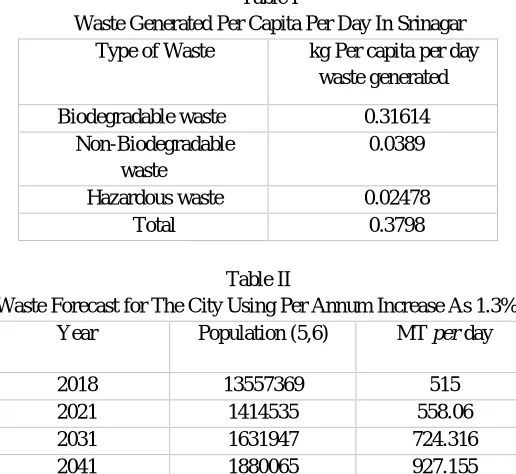
[image:3.612.177.435.305.542.2]The characteristics of MSW are critical in planning, designing, operating or upgrading the SWM systems. Physical composition, moisture content and density are the most important MSW characteristics to be considered in planning a system. The prior aim of this study is to give a characterization and quantification of the municipal solid waste in the Srinagar city. The waste generation in Indian cities increases at the rate of 1 to 1.3% annually (3). This study was carried out after extensive surveys and sampling in a selected sample area., which was followed by various tests and data analysis. The characterization of MSM based on this study can be summed up as: In Srinagar waste generation is a menace with over 515 MT of waste generated per day which accounts to 0.3798 kg per capita per day.
Table I
Waste Generated Per Capita Per Day In Srinagar
Type of Waste kg Per capita per day
waste generated
Biodegradable waste 0.31614
Non-Biodegradable waste
0.0389
Hazardous waste 0.02478
Total 0.3798
Table II
Waste Forecast for The City Using Per Annum Increase As 1.3%.
Year Population (5,6) MT per day
2018 13557369 515
2021 1414535 558.06
2031 1631947 724.316
2041 1880065 927.155
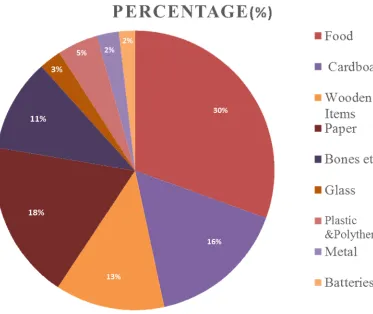
Based on the characterization of collected samples, the varied composition of waste generated in Srinagar city is shown in the pie chart (Fig. 2).
The various properties that govern the suitability of a technology for specific waste type includes composition, density, moisture content, pH, calorific value and the CN ratio. From the various tests and data analysis, the compacted density of the waste is 427 kg/m3 and that of the uncompacted waste was 157 kg/m3 the moisture content of solid waste in Srinagar city is 47.56% which is unsuitable for direct incineration for which the moisture content should be less than 40%. The major composition of the waste generated in the city as mentioned in table1 is biodegradable, which chiefly is organic in nature. The pH of waste is 6.3 which is in range suitable for composting (5 - 8.5). The calorific value obtained is 2090.11 kcal/kg which is less for efficient energy recovery
424
[image:4.612.134.507.88.402.2]©IJRASET: All Rights are Reserved
Fig. 2 Composition of the waste generated in Srinagar.
IV.SUITABLE TECHNIQUES & PRACTICES
The adequacy for implementing the most suitable technique shall only come about by careful introspection. The technique should be environment friendly, cost efficient and should be suitable for the type and nature of the waste generated in the city. The method should fit in with the local conditions of the city. The various techniques and methods like Reduce, Reuse & Recycle, Composting, Incineration, Sanitary Land filling, Gasification, Pyrolysis, Bio Methanation, Waste to Energy etc. Subsequently the study will be taken up for recommending the most suitable technology of the waste management for Srinagar vis-a vis to its quality, quantity and utilization of its bi-products.
V. RECOMMENDATION
In Srinagar city for the implementation of the worthy waste management practices the whole chain ranging from segregation at source, primary collection, transportation and processing needs to be evolved in a manner that adopts the SWMR 2016 guidelines while ensuring that the practices are accompanied in the backstage by the principle of 3 Rs. The transportation facilities in the city need to be mechanized and enhanced to reserve three separate compartments for biodegradable, non-biodegradable and hazardous waste respectively. The primary collection vehicles should consist of handcarts for narrow lanes and auto tippers for wider roads. All these improvements need to be clubbed with an increased skilled labour force for ensuring cent percent coverage across the Srinagar city. Based on our study of the nature and characteristics of waste, it is important to adopt an integrated approach. This paper will be followed with a subsequent paper with focus on the suggestion of a technique(s) suited for the Srinagar city.
VI.CONCLUSIONS
425
©IJRASET: All Rights are Reserved
in mitigating the growing waste concerns, while also ensuring ancillary benefits to the community. This study envisages the
characterization and quantification of the municipal solid waste in Srinagar city. An efficient waste management in the city shall
require proper collection mechanisms, evolved scientific transportation facility, suitable treatment techniques and most importantly a sound disposal technique. The study will be followed by a paper which shall suggest for a technique in Srinagar city.
VII. ACKNOWLEDGMENT
We express our gratitude to NIT Srinagar especially Prof. M.A Lone and the staff involved in the research for their continuous support and help.
REFERENCES
[1] http://planningcommission.gov.in/plans/stateplan/sdr_jandk/sdr_jkch2.pdf [2] https://smcsite.org/cms/tenders/tender_for_solid_waste_managment1283460291.pdf
[3] MoUD, Municipal Solid Waste Management Manual, CPHEEO 2016
[4] Akolkar, A.B. (2005). Status of Solid Waste Management in India, Implementation Status of Municipal Solid Wastes. [5] P.N Modi, Water Supply Engineering, Rajsons Publications PVT.LTD ,2010,3rd ed.
[6] P.N Modi, Sewage Treatment Disposal and Waste Water Engineering, Rajsons Publications PVT.LTD ,2010,4rd ed.
AUTHOR DETAILS
Prof. (Dr) M.A Lone, Head Water Resources Engineering, Department of Civil Engineering, National Institute of Technology, Srinagar
Email: [email protected]
Haris Wajeeh Mir, B. Tech Civil Engineering, NIT Srinagar
Email: [email protected]
Shahiq Ahmad Wani, B. Tech Civil Engineering, NIT Srinagar