Securing ATM Transactions using Raspberry PI
Processor
Taha Ayesha1, Pallavi B V2, Dr. Baswaraj Gadgay3 1
PG Student Dept. Of VLSI Design & Embedded Systems VTU Centre for PG studies Kalaburagi 2
Assistant Professor VTU Centre for PG Studies Kalaburagi, Karnataka, India 3
Reasearch Guide & Professor VTU Centre for PG Studies Kalaburagi, Karnataka, India
Abstract: This paper proposes the implementation of the securing ATM transactions using Raspberry pi processor. The Raspberry Pi is interfaced with the Global System for Mobile communication (GSM), RFID module, Keypad, monitor, USB 2.0 Camera. In order to provide reliable security solution to the people, the concept of smart ATM security system based on Embedded Linux platform is suggested in this project. The study is focused on Design and Implementation of the project Securing ATM transaction Using Raspberry Pi Processor based on Embedded Linux Platform. The system is implemented on the credit card size Raspberry Pi board which is used for Image processing operation. Security mechanism is provided by the consecutive actions such as when the ATM user swipe the card , person’s captured image and SMS of alert is sent to the ATM card holder using the raspberry pi processor and GSM module and depending upon the card holders decision, either the access will be given to the user or the access will be denied and depending upon the entered amount by the user through keypad and the money dispense unit will work thereby providing advance security during the withdrawal of the money from the ATM. Keywords: Raspberry Pi, ATM, email, SMS, GSM, RFID module.
I. INTRODUCTION
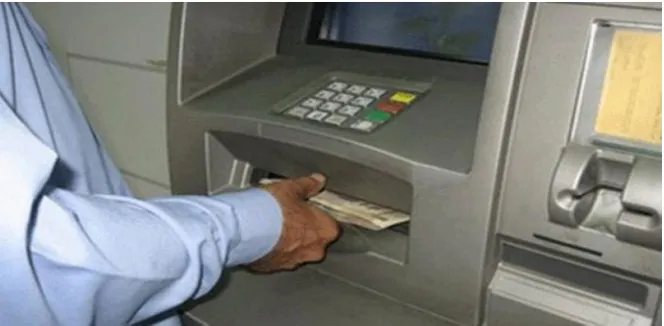
[image:1.612.149.481.558.721.2]An Automatic Teller Machine (ATM) is a computerized machine that uses to withdraw the cash from customer’s respective bank account. As financial user prefer ATM for cash withdrawals, cash deposits & many other transaction, the banks are focusing a lot over the security of ATMs. ATM should be protected properly from the criminal activities or from any unwanted things. Automated Teller Machines ATMs are used for different ways, mostly cash withdrawals. ATM users utilize many services on ATM and they will do some billions of transactions. Meanwhile robberies occurring in the ATMs are also high with the lack of security. The main objective of our study is to minimize the robberies occurring in the ATM’s. For that we have to implement a low cost standalone Embedded Web Server based on Raspberry Pi processor and Linux operating system. This setup is proposed for ATM security, comprising of the modules namely web access Wi-Fi, GSM Modem, RFID Reader, RFID card as ATM card, camera. Whenever the RFID tag that is used as an ATM card is brought near the RFID Reader its captured image and SMS of alert is sent to the ATM card holder using the raspberry pi processor and in turn depending upon the image the card holder’s will send a reply through email by composing GRANTED or DENIED decision in subject area of the email to the processors email id, then either the access will be given to the user or the access is denied to the user thereby providing advance security during the withdraw of the money from the ATM.
II. RELATED WORK
In [1] the main objective of this paper is to minimize the robberies occurring in the ATM’s. For that we have to implement a low cost standalone Embedded Web Server based on ARM11 processor and Linux operating system using Raspberry Pi. This setup is proposed for ATM security, comprising of the modules namely Door lock, web access Wi-Fi, GSM Modem, sensors and camera. Whenever robbery occurs, Vibration sensor, Fire sensor is used here which senses vibration and heat produced from ATM machine and takes necessary action. In [2] the project aims at the solutions that provide multiple points of protection against physical and electronic theft from ATMs and protecting their installations. From anti-skimming defend systems to silent indicate systems, integrated ATM video surveillance cameras and ATM monitoring options, security specialists are ready to help the people get more out of the ATM security and ATM loss prevention systems. The implementation is achieved with the use of Machine-to-machine.
III. PROPOSED DESIGN METHODOLOGY
A. Block diagram
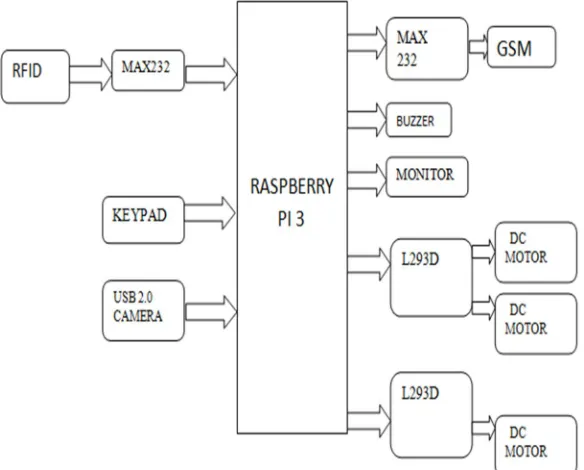
[image:2.612.178.470.254.489.2]Fig. 2 The block diagram of proposed method at host side
The proposed method for the securing ATM transaction using Raspberry Pi processor is illustrated in fig 2. The supply of 5Volt DC is given to the system which is converted from 230Volt AC supply. Firstly, the step down transformer will be used here for converting 230Volt AC into 12Volt AC. The microcontroller will support only the Direct Current supply, so the Alternating Current supply will be converted into DC using the bridge rectifier. The output of rectifier will have some ripples so we are using the 2200uf capacitor for filtering those ripples. The output from the filter is given to the 7805 voltage regulator which will convert the 12V Direct Current into 5V DC. The output from the regulator will be filtered using the 1000uf capacitor, so the pure 5Volt DC is getting as the output from the power supply unit. Here we can use the ARM 11 processor which will be capable of getting the supply of 5 Volt DC so we have to convert the 230Volt AC supply into 5V DC supply. The Raspberry Pi is the heart of the project that will operate at 5V. The power supply required by RFID and GSM is 9 V and the power supply required by motor driver is 12V.RFID tag that is use as an ATM card that consists of unique number that is assign to a one particular user. GSM is used for communication that is used to send the alert SMS to the ATM user, Web or internet is used to send the image of the person that wants to access the ATM through email. In this project two L293D motor driver IC’s arrangement is used to drive the gear DC motors that will dispense the money that is 2000,500 or 200 rupees depending upon the entered amount using keypad and the monitor is used to display all the consecutive actions of this project.
IV. HARDWARE IMPLEMENTATION
A. Components required
1) Power Supply: The power supply must deliver a constant output regulated supply. A 230V/0-12V (1mA) transformer is used for this purpose. The primary of the transformer is connected through switch for protection. The secondary is connected to the diodes to convert 12V AC to 12V DC voltage. And filtered by the capacitors, which is further regulated to +5v, by using IC 7805.
2) GSM: Global System for Mobile Communications system is the most popular standard for mobile telephony systems in the global. The GSM is one the wireless networks which has low power and low cost communication device.
3) RFID : RFID stands for Radio Frequency Identification that uses radio waves for automatic data capture and contactless
identification of the objects. It mainly consists of three components RFID Reader, tag and controller or processor.
4) MAX232: MAX 232 is a voltage level converter chip mainly for the purpose of microcontroller boards. It provides two channel RS232 port. It is a serial port interface device. In asynchronous transmission when there is no transfer the signal is high, transmission begins with the start (low) bit LSB first. Finally one stop bit (high).
5) Raspberry Pi 3 model B: The Raspberry Pi is a credit-card-sized computer that plugs into your TV and a keyboard. It is a capable little computer which can be used in electronics projects, and for many of the things that your desktop PC does, like spreadsheets, word processing, browsing the internet, and playing games.
6) Driver Circuit: L293D is a dual H-Bridge motor driver, with one IC we can interface two DC motors which can be controlled in both clockwise and counter clockwise direction and if you have motor with fix direction of motion the you can make use of all the four I/Os to connect up to four DC motors. L293D has output current of 600mA and peak output current of 1.2A per channel. Moreover for protection of circuit from back EMF output diodes are included within the IC. The output supply (VCC2) has a wide range from 4.5V to 36V, which has made L293D a best choice for DC motor driver
7) Keypad: This 12-button keypad provides a useful human interface component for projects. Convenient adhesive backing provides a simple way to mount the keypad in a variety of applications. The Keypad 4x3 features a total of 12 buttons in Matrix form.
8) USB Camera: USB Cameras are imaging cameras that use USB 2.0 or USB 3.0 technology to transfer image data. USB Cameras are designed to easily interface with dedicated computer systems by using the same USB technology that is found on most computers. The accessibility of USB technology in computer systems as well as the 480 Mb/s transfer rate of USB 2.0 makes USB Cameras ideal for many imaging applications.
9) Gear DC Motor: The gear DC motor is the extension of the DC motor that converts mechanical energy into electrical energy and the speed of the motor is reduced by the arrangement of gears that is present inside the plastic casing.
V. EXPERIMENTAL SETUP AND RESULT
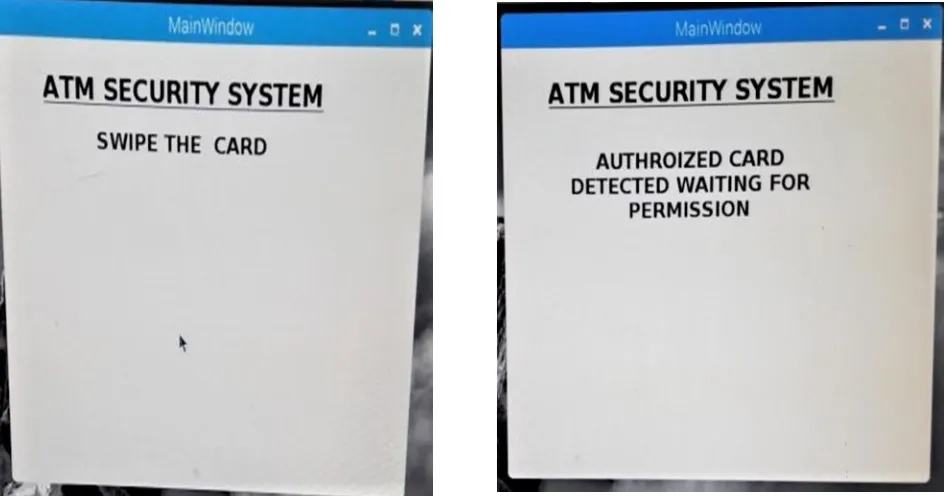
A. In this advanced system, The RFID tag that is used as an ATM card is brought near the RFID Reader, person’s captured image
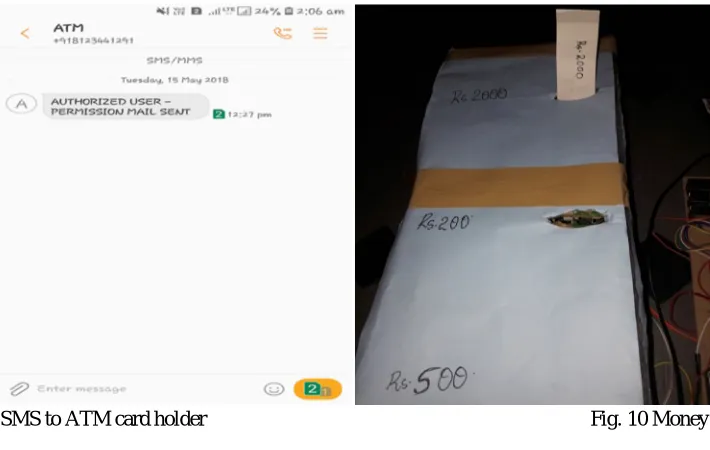
processors email id, then either the access will be given to the user or the access is denied to the user. If the access is given to the user then the user is able to withdraw 2000, 500, or 200 rupees depending upon the amount that the person has entered using the keypad thereby providing advance security during the withdrawal of the money from the ATM.
Fig. 4 Experimental setup of the project
[image:4.612.71.545.470.718.2]
Fig. 7 email from ATM card holder to grant or deny Fig. 8 email to ATM card holder with image
Fig. 9 Alert SMS to ATM card holder Fig. 10 Money withdrawal
VI. CONCLUSION
The Securing ATM transaction Using Raspberry Pi Processor project is used to alert the user whenever the usage of ATM is done for money withdrawal by the unknown person. All the hardware and software components designed and implemented successfully and the project outcome is carried out accurately and thus highly securing ATM card holder’s transactions with the help of Raspberry Pi Processor.
REFERENCES
[1] Sivakumar T “Design and Implementation of Security Based ATM theft Monitoring system” International Journal of Engineering Inventions Volume 3, August 2013.
[2] Kulkarni Ramchandra “ARM7 Based Smart ATM Access & Security System Using Fingerprint Recognition & GSM Technology” Assistant Prof. at Pravara Rural engineering college, loni, Maharashtra,India, 2, February 2014.
[3] Raj M M.E, Embedded System Technologies TIFAC-CORE in Pervasive Computing Technologies “Design and Implementation of Anti-theft ATM Machine using Embedded Systems”, Chennai, India 9, August 2015.
[4] G. Jakeer HussainPG Scholar (Embedded Systems), Department of ECE, “Advanced Anti-Theft ATM Security using Raspberry Pi” International Research Journal of Engineering and Technology (IRJET) Hyderabad, India August 2016
[image:5.612.130.485.277.502.2]