International Doctorate School in Information and Communication Technologies
DISI - University of Trento
Privacy elicitation and utilization in distributed
data exchange systems
Annamaria Chiasera
Co-Advisor:
Prof. Fabio Casati
Universit`a degli Studi di Trento
Co-Advisor:
Prof. Yannis Velegrakis
Universit`a degli Studi di Trento
Recently we are assisting to the advent of many data integration projects to allow the cooperation of systems in the more disparate fields (healthcare, finance, education, public security). This trend responds to the increasing needs of data to monitor, compare, corre-late and analyse the distributed business processes managed by different institutions and companies for different purposes. As the availability of data in electronic form increases, the risk of improper use of sensitive information is raising also.
In this thesis work we focus on the problem of realising an infrastructure for the data and application integration of systems in the healthcare domain. Our solution is compliant with the privacy regulations, reconciling the visibility requirements of the institutional data consumers with the needs of control and protection of the data subjects. It is an event-based solution which allows to capture the processes going on between the systems to be integrated in a way that is flexible, decoupled and adherent to reality. Our solution enables the sharing of very fine-grained pieces of information to a wide range of consumers still allowing the producers to control who can see what and for what purposes. The architecture minimizes the transit of sensitive information and controls the distribution of events and of their content at a very fine-grained level. In this thesis work we take into account also the impact of the proposed solution on the existing systems ensuring to minimize the effort of companies and institutions in adopting the infrastructure.
I want to thank my advisors Yannis and Fabio for their guidance and support during this long journey. Without them I would have never completed this work. I am also gratefully to Giampaolo for his patience and his guidance. He teaches me a lot about work and life and I hope in a long collaboration. I want to thank also Fausto and Marco for giving me the opportunity to pursue my PhD with a joint company-university program. Thanks to Dario, Cesare, Cristiana, Cristina, Gloria, Ioana, Jovan, Juan, Leandro, Manuela, Massimo, Michele, Tao and Tefo for being good colleagues, and most impor-tantly, good friends. I want to thank the GPI company, the University of Trento, FBK and the welfare and healthcare unit of the Province of Trento and in particular Alberto, Angelo, Anna, Cinzia, Daniela, Gabriella, Giovanna, Florian and Loredana for giving me the opportunity to work with them on research as also on real projects.
Thanks to Ida, Anelia, Angela, Salvatore and Sucheta for their wise suggestions and support in all these years.
A special thank to my family, my father Tarcisio, Alessandro, Albina, Jan Philipp, Antonietta, Mariano and Sandra for being with me also in the most difficult moments. I will never say thank enough to Mario for his support and his faith in me, my partner in life and strongest supporter of this work. Without him I will never find the motivation and the commitment to arrive at that point.
1 Introduction 1
1.1 Motivation . . . 1
1.1.1 Context . . . 4
1.2 Research Issues and Contributions . . . 5
1.2.1 Privacy-aware EHR Design . . . 6
1.2.2 Privacy Policy Definition . . . 7
1.3 Structure of the Thesis . . . 8
1.3.1 List of Publications . . . 9
2 State of the Art 11 2.1 Electronic Health Record . . . 11
2.2 Data and Application Integration Patterns for Healthcare . . . 18
2.3 Privacy-Enhancing Technologies . . . 24
2.4 Conclusions . . . 38
3 Privacy-Preserving EHR 41 3.1 EHR Architecture . . . 41
3.2 Incremental Privacy on Events . . . 54
3.3 Privacy Policy Elicitation . . . 57
3.4 Privacy Policy Enforcement . . . 59
3.5 Conclusions . . . 62
4 Privacy Compliance Checking 63 4.1 Motivation . . . 63
4.2 Preliminaries . . . 67
4.3 Problem . . . 72
4.3.1 Privacy Constraints elicitation . . . 72
4.3.2 Privacy Constraints Specification . . . 77
4.5 Experiments . . . 86
4.6 Conclusions . . . 90
5 Case Study: CSS and SIS-H 93 5.1 CSS Project . . . 93
5.1.1 Assistance and Medical Process Analysis . . . 95
5.1.2 The Prototype System . . . 100
5.1.3 Privacy Requirements Compliance . . . 106
5.1.4 Lessons Learned . . . 112
5.2 SIS-H: Adapt Italian EHR to Mozambique context . . . 113
5.2.1 The Challenges . . . 114
5.2.2 EHR for Developing Countries . . . 116
5.2.3 Lessons Learned . . . 122
6 Conclusion 125 6.1 Key Contributions . . . 125
6.1.1 Architecture for EHR . . . 125
6.1.2 Privacy constraints elicitation and specification . . . 126
6.2 Future Work . . . 127
6.2.1 The role of “roles” . . . 127
6.2.2 Event structure design . . . 127
6.2.3 Data and privacy constraints evolution . . . 128
6.2.4 Outlier coverage and sample dimension . . . 128
6.2.5 Conflict resolution . . . 129
6.2.6 Performance improvement . . . 129
Bibliography 131
A Socio-Healthcare Data Warehouse Design 147
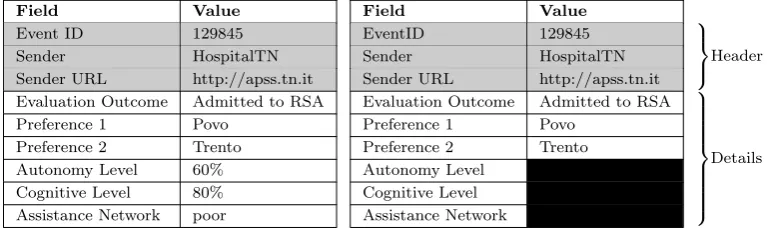
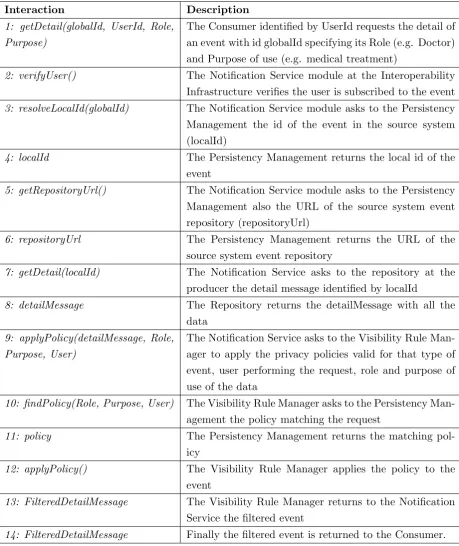
3.1 Interactions for event notification and details retrieval (Figure 3.6). . . 50
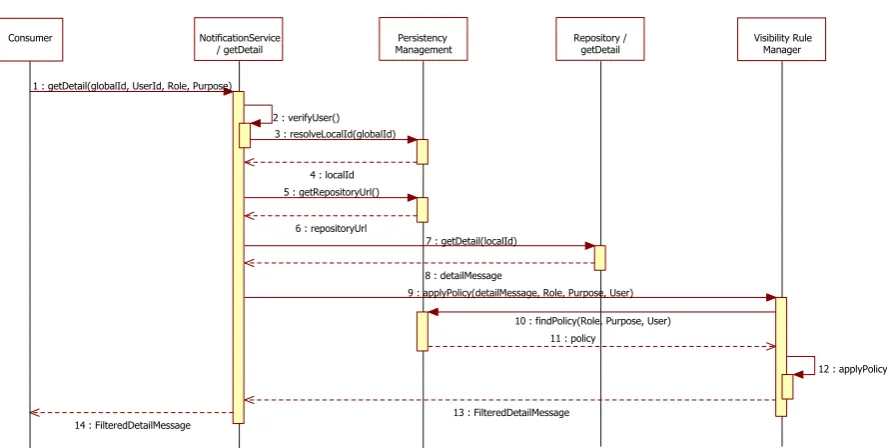
3.2 Interactions performed by the data processor’s modules to retrieve and filter a detail message (Figure 3.7). . . 51
4.1 Privacy violation indications. . . 64
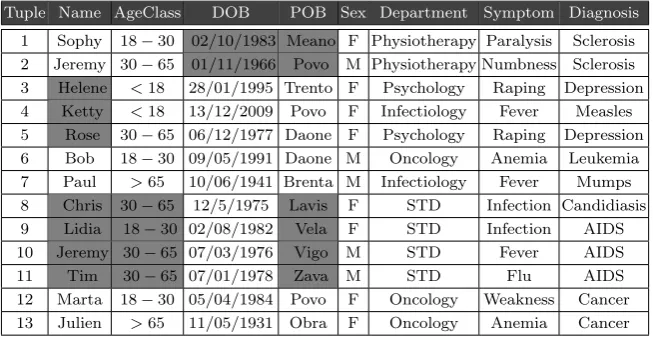
4.2 Example of Sample Table. . . 64
4.3 Privacy Constraints Conditions. . . 68
4.4 Views satisfying the privacy constraints indicated by the user. . . 68
4.5 Privacy constraints minimization on violations in sample table. . . 88
5.1 KPIs required by organizations delivering socio-assistive services. . . 99
5.2 Estimation of the number of events and data exchanged yearly. . . 105
5.3 Laws from Guidelines on EHR [88] and Personal Data Protection Code [57]. . . 107
5.4 Argumentations. . . 108
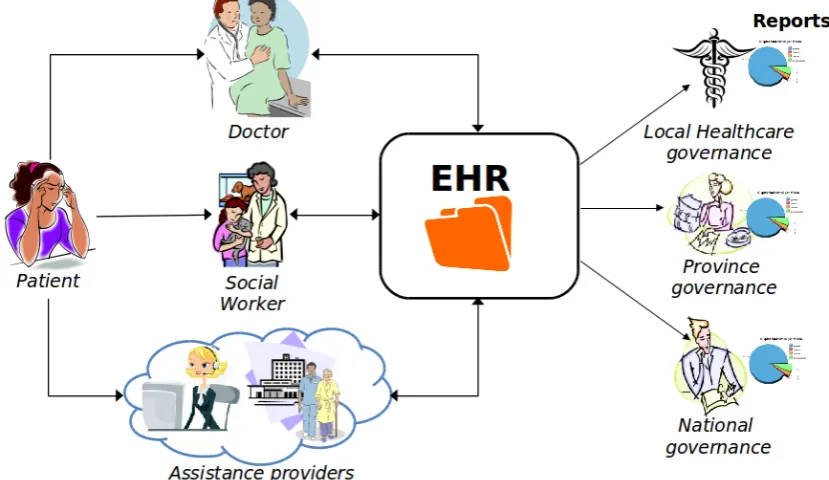
1.1 Health and Social services interoperability: the EHR. . . 2
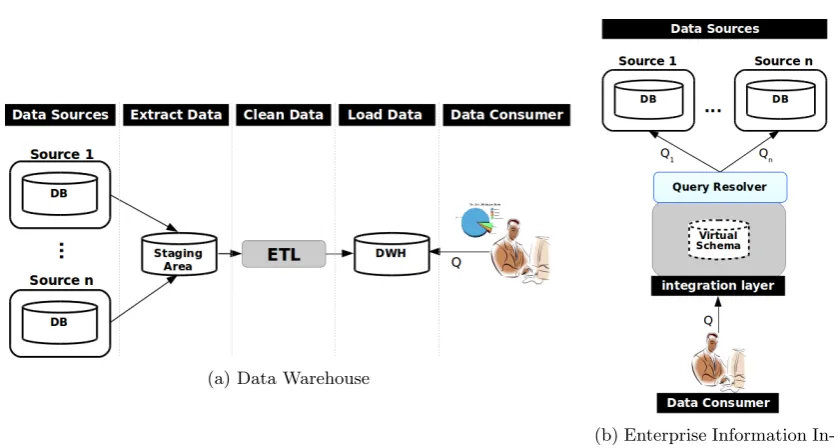
2.1 Data Integration patterns. . . 20
2.2 Example of basic publish/subscribe system from [68]. . . 22
3.1 General event-based architecture for the cooperation of healthcare and socio-assistive systems. . . 42
3.2 Example of notify message. . . 46
3.3 Example of detail message. . . 46
3.4 Detailed event-based architecture for the cooperation of healthcare and socio-assistive systems. . . 47
3.5 Filtering of details message by privacy policies at the Visibility Rule Manger. 47 3.6 Interactions among the EHR modules for event publication, notification and details retrieval. . . 49
3.7 Internal details of the getDetail operation. . . 49
3.8 Subscription process of a new partner. . . 55
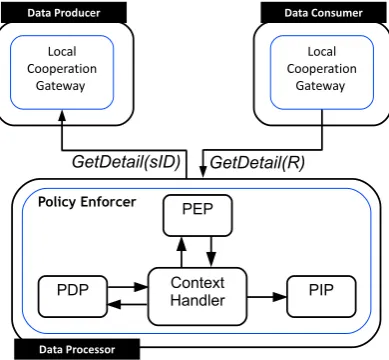
3.9 Detail request resolution and privacy policy enforcement. . . 60
3.10 Mapping in XACML request notation. . . 60
4.1 Constraint violations indicated on a relation R and an illustration of those constraints that are also applying on a sample of it. . . 67
4.2 Example of FP-Tree of DB table. . . 74
4.3 The sampling approach selects first the tuples with higher benefit and then the attributes giving higher coverage. . . 77
4.4 Overlapping valid and invalid patterns. . . 81
4.5 Example of sampling of Table 4.1. . . 83
4.6 Example of sample on Table 4.5a . . . 85
tuples. . . 90
4.9 Constraints Minimization applied on 15 attributes and 100 tuples. . . 91
5.1 Excerpt of request,evaluation and provision process of Rest Home Service. 97 5.2 Dashboard of the Privacy Rules Manager. . . 101
5.3 Privacy Policy definition tool. . . 102
5.4 Example of Privacy Policy. . . 103
5.5 Example user interface for information system in an elderly house. . . 105
5.6 An excerpt of the compliance for the EHR actor, expressed by means of a N`omos model. . . 109
5.7 Attacks modeling. The existing N`omos model and the set of arguments attacking model entities and other arguments. . . 110
5.8 Extended model. The evolution of the model on the bases of the arguments related to the existing N`omos model. . . 111
5.9 Interoperability architecture based on EDA for healthcare plan monitoring. 117 5.10 EHR modules at super-peer nodes. Grey modules are deployed also at the peers. . . 119
5.11 Quality improvement with user feedback. . . 121
A.1 Data structure design of DWH for the EHR of the CSS project in the Social and Healthcare domains. . . 148
Introduction
Modern healthcare relies on computerized means to share data among different organiza-tions and instituorganiza-tions with the intent to create a complete medical history of the patients. This poses also concerns on the sharing of sensitive data and the rights patients can exer-cise on their data that falls under the umbrella of privacy law [88]. This thesis considers different aspects related to privacy in healthcare systems and proposes an architecture for the integration of healthcare systems and tools to automate the generation and compli-ance checking of privacy policies.
In Section 1.1 we present the problem and why current information integration approaches are not enough. We present a case study in which the developments of this thesis was applied and its challenging aspects. In Section 1.2 we show the research areas and our contributions. Finally Section 1.3 outlines the structure of the whole thesis.
1.1
Motivation
Recently we are assisting to a strong commitment of the public administrations toward e-government projects focused mainly on the dematerialization of the administrative pro-cesses, to monitor, control and trace the clinical and assistive processes [18]. Initially, the computerization in healthcare was limited to a single data controller (e.g. a hospital or a nursing home) developing their own management systems for medical data called Health Files (HFs) [88]. Even if there are many healthcare professionals involved (e.g. doctors, nurses, social workers) they belonged to one single healthcare body acting as data controller.
of integration to cooperate and exchange information among multiple IT systems is nec-essary.
Electronic Health Records (EHR) have been introduced to overcome this limitation (Fig-ure 1.1). An EHR combines the medical data distributed in many health files at different healthcare bodies typically in the same region o geographical area. An EHR is accessed by healthcare professionals of different institutions and the data has different data controllers. As defined in [88] EHR’s data is “generated by the various health care professionals and/or bodies providing medical care to that individual over time”. An EHR greatly improves the quality of care [13] as the medical staff can easily access all the past clinical events of the user (e.g. diagnosis, hospitalization records, emergency care).
When sensitive information (about health and economical state of a person, habits, polit-ical and religious opinions) are distributed, accessed, stored and used to develop reports like in an EHR, privacy becomes one of the most important properties that need to be preserved.
Figure 1.1: Health and Social services interoperability: the EHR.
regulations, they lack flexibility and they are too monolithic for a distributed, dynamic and continuously changing environment like with an EHR. We propose an EHR system based on Service Oriented Architecture (SOA) and on Event Driven Architecture (EDA) that proves to reduce the effort to understand and model the data dependencies among institutions and their data needs abstracting from their internal data structures. We exploit the potentiality of the pub/sub approach to guarantee full visibility on the data to all the EHR’s partners still preserving the privacy of the individuals with privacy constraints enforced at the event broker level.
Notice how for an HF, privacy is - in most cases - an issue of limited importance as data stays within a single organization for healthcare purpose. But for EHR, multiple data controllers and many users co-exists with different roles and purpose of access. In addition to “common sense” rules in managing sensitive data, companies have to obey to laws, more or less precisely stating the obligations and restrictions in handling sensitive data. Conservative solutions with a coarse grained access control to the patients data are too restrictive as they tend to hide too much to the medical staff, even data that in the end are not so sensitive. The problem is that, in order to define the right procedures to manage and protect the data, a certain knowledge on the privacy regulations, on what the data represents and on which data should be considered sensitive or not is required. Developers does not have such knowledge that instead is expertise of the user.
In our work we want to exploit the knowledge of the users in understanding which data in a database should be protected thought they cannot work directly on the database, nor use formal languages to express constraints on it. Furthermore, the database is usually a complex one, comprising millions of records, and it is not feasible for the user to go through all of it and tell us what is wrong.
find privacy violations. Our system guarantees that only the necessary information is accessed by authorized users by filtering out the data that is sensitive according to some privacy constraints defined directly by the data controllers. In order to be approved by the institutions in charge of verifying the correct application of the privacy regulations all the design decisions and the protocols employed in an EHR solution should be properly documented and motivated. In this thesis work we applied also some modelling formalisms to trace which requirements have been implemented in the system to answer to specific privacy laws.
1.1.1 Context
The solutions presented in this thesis have been applied and validated in a large integration project called CSS (Cartella Socio-Sanitaria1, Social and Health Record) undertaken by
the Autonomous Province of Trento (Italy) with a dozen of partners from the IT sector, the public administration and the healthcare services. The project aimed at monitoring healthcare and social processes across the different government and healthcare institutions in the region of Trentino, Italy. Trentino was used as a pilot region in Italy, and the results will next be applied at the national level.
In this scenario users are required to provide documents containing almost the same information to different offices, even if they belong to the same administration (e.g. the financial and welfare departments) [18]. This is obviously quite frustrated for citizens as well as for the caregivers since they need to spend precious working hours to re-type (almost the same) data taken from documents generated by other entities into their IT systems, which also increases the risk to do mistakes.
The complexity of the processes involved and the lack of coordination badly affect the quality of the services delivered as perceived by the stakeholders:
• patients experience delays and lack of visibility on the progress of their requests; • organizations waste time to enter information from documents to their IT systems; • the governance lacks a comprehensive interoperability infrastructure to monitor ser-vices delivered and resources consumed analyzed by temporal, demographic, and territorial dimensions, to identify needs and trends in social, economical and medi-cal phenomena.
The last point is particularly relevant for the governance as it does not have visibility on the whole business processes going on along the different systems. It has only a partial vision on the single systems sending periodically accounting information and statistical
1
data but at a very low rate (typically each 3 months). Furthermore, it takes time also to analyse the data in order to combine the partial results obtained from a single source into a global perspective covering the province as a whole. What happens is that the final reports are available one month (or even more) after the data is sent from the sources and they are typically incomplete or they contain mistakes as they are collected manually. The consequence is that the governance will plan the investments in healthcare and welfare services with unreliable data and reports that are at least 4 months old.
In addition to that, an agreed privacy management procedure among the institutions involved is missing, and when data is moved from a system to another, they end up in a sort of “no mans’ land” in which it is not clear which privacy constraints to enforce. This prevents the sharing of data, unless in sporadic circumstances, which requires further effort to compensate for the lack of a systematic way to prove the adherence to the privacy regulations.
In this scenario it is easy to have unintentional privacy breaches, as the data owners (doctors, social workers and third party assistance providers) that collect the data from the patients do not have any fine-grained control on the data they exchange or send to the governing body [18]. Very often, either they make the data inaccessible (over-constraining approach) or they release to the others more data than what is needed in conflict with the principle of minimal usage [57].
Furthermore, as there is no central controller of the data access requests there is no way to trace how data is used by whom and for what purpose and to be able to answer to auditing inquiry by the privacy guarantor or by the data subjects.
In this thesis we show how to devised an interoperability solution to collect, share and distribute in a more timely way the data on healthcare and social services with a tight control on the sharing of sensitive data. Specifically the goal is to allow the
cooperationof applications from different agencies (both public and private) to provide high quality clinical and socio-assistive services to the citizens in compliance with the privacy protection code.
1.2
Research Issues and Contributions
Application Integration poses many well-known problems in terms of bridging the different protocols and data models of the various systems involved.
institutions.
From a data privacy perspective, these kinds of scenarios present tough challenges, such as:
• how to make it simple for all the various data sources to define the privacy constraints and enforce them. Simplicity here is the key as otherwise the complexity of the information system, and in some cases also of the law, make the problem already hard to tackle, and unless the privacy model remains really simple it is very hard to understand which information is protected and to what extent.
• how to achieve patient/citizen empowerment by supporting consent collection at data source level (opt-in, opt-out options to share the events and their content)
• how to allow monitoring and tracing of the access requests (who did the request and why/for which purpose?)
• how to support the testability and auditability of privacy requirements: owners of data sources often require that the privacy rules they are asked to define can be tested and audited so that they can be relieved of the responsibility of privacy breaches.
All the above cases involve 1) the adoption of data and application integration techniques, 2) the definition of contracts, as precise as needed, that define the work to be done and the expected results, and 3) information flowing across several organizations, with significant privacy issues involved (which also need to be subject to contractual agreements). In this thesis we study the application integration problems from a privacy perspective and particularly we focus on two problems. One is to find an architecture for the lightweight integration of IT systems in the social and medical domains that is compliant to privacy regulations. The other problem is in enabling the users to control their data by defining in a simple way which data is private and which is not. In the rest of the section we show the complexity of these problems and why current solutions are not applicable.
1.2.1 Privacy-aware EHR Design
full control in deciding which data can be seen by whom and for which purposes.
A comprehensive EHR solution satisfying the requirements mentioned above is not avail-able in literature.
The challenges are not only technical but are also related to the domain complexity and heterogeneity of the different institutions and actors involved (see Figure 1.1). It is difficult to keep all of them focused in a short-term joint effort as they have different expectations, goals and backgrounds from sociology, medicine, financial management, IT. In these cases, the traditional data warehouse approach does not work: it is already lengthy and hard to integrate a few systems in a single organization, let alone integrate dozens of them, developed and managed by different institutions.
If we go for a more flexible integration patterns based on SOA and EDA we have to guarantee that the data dissemination capability of the system due to the use of these technologies is controlled and customized according to the needs of the data producers to avoid uncontrolled privacy leaks.
Another challenge is to identify which data can be shared electronically among different systems, and then, how to make these systems interoperable requiring minimal effort and limited changes to existing solutions, a feature which could benefit especially small com-panies and organizations (since they usually lack the economical and technical resources to do the integration on their own).
1.2.2 Privacy Policy Definition
Even if the system is designed in compliance with the privacy regulations, it may be possible that sensitive information is exposed (even by fault) in a report derived from the integrated data or an event released by a source system. The problem is to understand which data can be released without violating any privacy regulations, and to understand it hopefully before the reports are published to avoid to compromise the privacy of the data owner and the reputation of the publishing institution.
Solutions existing in literature to deal with the modeling and the enforcement of privacy constraints take typically the point of view of the database administrator or the report designer. However, there is no easy way for developers to collect from the owners of the data and the data subjects indications on which data should be considered sensitive and should be protected.
constraints (e.g. the size of the screen).
This requires to answer the following question: once the privacy expert has reported all the cases in which a privacy violation occurs, how can we express in a concise form the privacy constraints inferred? In addition, as we gather notifications of privacy violations from the user in an iterative way, we need to find the best way to show the sample data according to a certain order which facilitates the work of the user and which converges to the final set of constraints as quickly as possible and without loosing any privacy constraints.
1.3
Structure of the Thesis
The thesis is divided in the following chapters:
Chapter 2 surveys related works in the research area connected to this thesis and in particular on the design of EHR, on the available architectural solutions for the design of data and application integration systems and on the management of sensitive information with Privacy-Enhancing Technologies. From this analysis we saw the lack of a compre-hensive solution covering all our research and operative goals.
Chapter 3 presents an architectural solution for an EHR in which privacy is first class citizen. It presents an application integration solution balancing the needs of visibility achieved with an event-based system with the desiderata of control and protection re-quired in an healthcare scenario.
Chapter 4 provides a theoretical analysis of the privacy constraints definition problem. It presents an elicitation approach based on sampling for the generation of concise pri-vacy constraints minimizing the effort of the user. The constraints produced are directly enforceable in a relational database. An analysis of the effectiveness of the approach on test data is also provided.
Chapter 5 presents the application of the architectural solution of EHR proposed in the previous chapters to real scenarios. We highlight the approach used to analyse the current systems and the effort required to adapt the research solution into the specificities and complexity of real systems. We present the approach used to interact with the user to collect the system requirements in response also to the constraints imposed by the privacy regulations. Finally we test the applicability of our solutions in a particular challenging environment to realize an EHR in Mozambique.
1.3.1 List of Publications
The results of this thesis and part of its content have been published in the paper listed below. The activity related to the CSS (Cartella Socio Sanitaria) project described in this thesis was supported in part by the Autonomous Province of Trento and FBK-Bruno Kessler Foundation and as a joint work of GPI 2 and the Department of Information
Engineering and Computer Science (DISI3) of the University of Trento.
1. Annamaria Chiasera, Fabio Casati, Florian Daniel and Yannis Vele-grakis,Engineering Privacy Requirements in Business Intelligence Applications, Proceedings of the 5th VLDB workshop on Secure Data Management, SDM ’08, Auckland, New Zealand, pp. 219–228, Springer-Verlag
2. Manuela Corradi, Annamaria Chiasera, Giampaolo Armellin, Jovan Stevovic, Un-derstanding how people work: experiences in improving healthcare practices in Italy, Workshop on Coordination, Collaboration and Ad-hoc Processes (COCOA’10), HP Labs, Palo Alto, CA.
3. Giampaolo Armellin, Leandro Paolo Bogoni, Annamaria Chiasera, Tefo James Toai, Gianpaolo Zanella, Enabling Business Intelligence Functions over Loosely Coupled Environment, 2nd International ICST Conference on e-Infrastructure and e-Services for Developing Countries (Africomm’10), Cape Town, South Africa
4. Giampaolo Armellin, Dario Betti, Fabio Casati, Annamaria Chiasera, Gloria Mar-tinez, Jovan Stevovic, Privacy Preserving Event Driven Integration for Interoperat-ing Social and Health Systems, 7th VLDB Workshop on Secure Data Management, SDM 2010, Lecture Notes in Computer Science, Volume 6358/2010, pp. 54-69
5. Giampaolo Armellin, Dario Betti, Fabio Casati, Annamaria Chiasera, Gloria Mar-tinez, Jovan Stevovic, Tefo Toai, Event-Driven Privacy Aware Infrastructure for Social and Health Systems Interoperability: CSS Platform, 8th International Con-ference on Service Oriented Computing, ICSOC 2010, San Francisco, CA, USA, pp. 708-710
6. Giampaolo Armellin, Dario Betti, Annamaria Chiasera,Il referto (ri)trovato. Ap-punti per l’architettura dell’informazione di un Fascicolo Sanitario Elettronico, IV Summit Italiano Architettura dell’Informazione, Pisa, Italy, 2010
2
http://www.gpi.it/ 3
7. Giampaolo Armellin, Dario Betti, Stefano Bussolon, Annamaria Chiasera, Manuela Corradi, Jovan Stevovic, From PHR to NHR ? An UCD challenge, International workshop on Personal Health Record, Trento, Italy, 2011
8. Giampaolo Armellin, Annamaria Chiasera, Ivan Jureta, Alberto Siena, Angelo Susi, Establishing information system compliance: An argumentation-based framework, Fifth IEEE International Conference on Research Challenges in Information Science, Guadeloupe - French West Indies, France, 2011, pp. 1–9,
9. Annamaria Chiasera, Tefo James Toai, Leandro Paolo Bogoni, Giampaolo Armellin, Juan Jos Jara, Federated EHR: how to improve data quality maintaining privacy, IST-Africa, Gabarone, Botswana, 2011
10. Giampaolo Armellin, Annamaria Chiasera, Ganna Frankova, Liliana Pasquale, Francesco Torelli, Gabriele Zacco,The eGovernment Use Case Scenario, Book Chap-ter: Service Level Agreements for Cloud Computing, Wieder, P.; Butler, J.M.; Theil-mann, W.; Yahyapour, R. (Eds.), Springer New York, 2011
State of the Art
The design of privacy compliant interoperability infrastructures in healthcare touches many research fields to properly answer to stakeholders’ needs and to legal, organiza-tional and technological constraints.
This section analyses the solutions in literature that can be exploited in devising a privacy-aware Electronic Health Record (EHR) system. They are divided in the areas: Electronic Health Record, an overview of emerging health information technologies, their main func-tionalities, benefits and experiences from existing implementations; data and application integration patterns that can be used in the design of an EHR solution; approaches to capture privacy requirements from regulations; compliance and provenance management techniques, to monitor the behavior of the system and to support the auditors in com-pliance checking using provenance as a way to grant visibility of the data management flow; modeling and specification of privacy policies, to express, refine and manage privacy requirements; access control mechanisms, to implement purpose based data management restrictions; privacy preserving in databases and information management, to analyze and integrate data still preserving the privacy of their data sources and data providers.
2.1
Electronic Health Record
Recently, the interest in eHealth systems is increasing [85, 79] as a way to minimize costs induced by a reduction of patient’s stay in hospital, an optimization of the work of medical staff in sharing information and an improvement of care quality (e.g. improved control of adverse drug events [107]). Healthcare providers are gradually moving from paper-based medical records to Electronic Medical Record (EMR) and to even more evolved eHealth systems to maintain patient’s data.
The European Commission [66] defines an EMR and its evolutions as follows:
physi-cians office or clinic, which is typically in one setting and is provider-centric;
• Electronic Patient Record (EPR): the electronic record of an individual in a hospital or health care facility, which is typically in one “organisation” and is facility-centric;
• Electronic Health Record (EHR): the longitudinal electronic record of an individual that contains or virtually interlinks data in multiple EMRs and EPRs, which is to be shared and/or interoperable across healthcare settings (inter-institutional) and is patient-centric.
An EHR allows to share patient’s information in form of EMR among different in-stitutions. Recently the trend is toward the adoption of Personal Health Record (PHR) [148] enriching EHR with information provided by the patients themselves.
This poses even more stringent privacy issues as also problems in certifying the quality of the data. According to the DataLossDB 1 statistics 20% of the violations of Personally
Identifiable Information (PII) in United States occurs in the medical sector.
In this thesis we focus on EHR as it is a prerequisite to build more evolved eHealth systems and particularly to create a national and international level Health Information Exchange (HIE) infrastructure.
The Institute of Medicine identifies the following functionalities of an EHR [134, 36]:
• Health information and data: the capability of construct, maintain and evolve a comprehensive profile of the patient core information (e.g. a patient summary) with allergies and diagnosis, previous laboratory tests and medication list;
• Results management: enable the sharing of medical results in electronic form for a prompt and quicker consultation among caregivers of different institutions;
• Order entry/management: allows the informatization and standardization of medical procedures and instructions for the medical staff;
• Decision support: helps the caregivers to evaluate the effectiveness of medical pro-cedures and treatments, facilitates the diagnosis process and identifies possible risks for the patients;
• Electronic communication and connectivity: improves the communication among the medical team members belonging to the same division and also to different care providers;
1
• Patient support: facilitate the patient empowerment in managing his healthcare data autonomously and the continuity of care with treatments performed directly at home improving the efficiency of the care and of preventive protocols;
• Administrative processes: relieves the medical staff from purely administrative task like invoice management, prescription and admissions management and scheduling;
• Reporting and population health management: provides a comprehensive set of information to monitor Key Performance Indicators (KPI) on the quality and per-formances of healthcare processes distributed in many institutions and the trends in patient’s needs.
Indeed the use of EHR to exchange EMRs (Electronic Medical Records) has many advantages: it allows to exchange quicker patient’s information, it is more reliable than paper records that can be lost or deteriorate, it improves the accessibility to historical medical data of chronic patients, finally it facilitate the exchange of EHRs with other hospitals and avoids in this way expensive duplicate tests [117].
Full benefits of an EHR are achieved if all the hospitals involved in patient’s care adopt it to share information. As shown in [117], privacy regulations [36] may be an obstacle to the adoption of an EHR solution for two main reasons: on one side patients are reluctant to share information and they should be reassured with the adoption of suitable privacy protection mechanisms, on the other side privacy protection makes the exchange of information more expensive increasing the effort to adopt EHR solutions. This motivates us in devising an EHR solution capable to protect patients’ privacy minimizing the effort for its adoption.
The American Institute of Certified Public Accountants (AICPA2) and the Canadian Institute of Chartered Accountants (CICA) define privacy in the Generally Accepted Privacy Principles (GAPP [12]) as “the rights and obligations of individuals and organi-zations with respect to the collection, use, retention, disclosure and disposal of personal information.” This definition covers all the aspects of the data life-cycle and in particular [115]: who owns or is responsible of the data generated by a data source; how the data owner can lawfully use the data and release them to an external third party entity; how to transfer data to another party under the same or different jurisdiction of the data owner and control data access according to specific roles and purposes of use; how to transform the data to produce statistical analysis without exposing the identity of an individual; how to store and archive the data for a long time guaranteeing access only to the authorized information; how to destroy the data when the retention period expires. In this thesis we do not deal with the data transformation and data retention problems but we focus on
2
the other issues listed above according to the Italian privacy regulations at national and regional level [88, 57, 25, 26, 121, 120, 6] which impact on the technological solutions adopted to develop an health information system.
One of the first issue privacy regulations are dealing with is how to guarantee access to sensitive information only to the data subjects the data refers to and to the users entitled by law, or by the data subjects themselves, to use such data (e.g. caregivers, relatives or governing bodies). In some countries like in Netherland [61] and in some Italian regions (e.g. Lombardia3, Friuli Venezia Giulia4 and in the near future also Trentino5) patients and caregivers are identified to the EHR by means of a smartcard. Smartcards are usually combined with a password or PIN and a certificate used to encrypt the information stored in a microchip realizing a strong authentication mechanisms. The smartcards released at national level allow to identify and authenticate the user at national level, to sign to PHR systems and certificate the authenticity of documents.
Alhaqbani in his thesis [13] highlights the importance of guaranteeing to patients full control on which health records can be accessed by whom. In our EHR system we delegate the definition of the privacy policies to the data collectors (hospitals, nursing homes and municipalities) as they already got from the patient the consent and the set of information she allows to share. Our focus is on guaranteeing that the data collector can enforce the privacy policies on the collected data. However, this assumption will be no longer valid when the patients themselves will enter information in the ehealth system by means of a PHR. In this case, the user should be able to define his own privacy policies and new mechanisms to interact with the patients and to share the data among the caregivers should be devised.
The management of user’s roles and authentication in an healthcare scenario could be very complex. In the eHealth system of an hospital patients are usually associated to a department (e.g. medicine, orthopedic unit) and inside this to a medical branch. Doctors belonging only to the department and branch in which the patient is hospitalized can access her data. Nurses, instead, are not associated to specific branches but they need to work on all the patients in the department and they should be able to see the data of all the department regardless the branch.
The access rights are not static but they may change and there are exceptions to manage. For example, doctors working in the night and during week-ends should work on all the department even if they belong to a different department and branch in the normal working days. This makes the roles dynamic and hierarchical. Recently some work has been done in trying to represent context-dependent roles [73, 74] but they are not
3http://www.crs.lombardia.it/ 4
http://cartaservizi.regione.fvg.it/CrsCentralService/ 5
yet capable to fully model a complex EHR scenario with different institutions involved. What happens in practice is that the administrative and IT departments of the hospital maintains an LDAP (Lightweight Directory Access Protocol) directory with the users to manage the authentication procedure but not user’s roles. Roles are managed separately from the LDAP system using authentication systems like CAS6 (Central Authentication
Service) or Shibboleth 7 using also a workflow engine to manage the dynamicity in the
roles. In fact, roles could be very complex and change dynamically based on what the employee is doing at the moment.
In literature there are many standards for managing data representation and data ex-change in EHR. An example is OpenEHR8 [145] that is quite generic and defines template and archetype for the design of EHR systems and for the exchange of health data.
IHE, Integrating the Healthcare Enterprise consortium [87] proposes a solution to create
and manage EHR based on Cross-Enterprise Document Sharing (XDS). This solution is based on a central Document Registry (based on ebXML9 technology) with meta-data to
search and retrieve documents from Document Repository at the source systems. The Canada Health Infoway system [39], the AORTA Dutch national infrastructure [128] and NHS Connecting for Health in UK [124] are based on the IHE interoperability solution. A similar architecture is proposed in Italy with IBSE [150] for the interoperability of healthcare systems by means of distributed registries for the sharing of clinical data regard-less where they are produced (e.g. by institutions with different administrative domains at different regions). These specifications together with the ICAR project [49] funded by the CNIPA (Centro Nazionale per l’Informatica nella Pubblica Amministrazione, now DigitPA - Ente nazionale per la digitalizzazione della pubblica amministrazione) aim at defining a public system of cooperation (SPCoop specification) for the operative cooper-ation of public administrcooper-ations. Our solution extends SPCoop specificcooper-ation with a more fine grained control on sensitive data and a simplified approach to manage the definition of the contracts among data producers and consumers regarding privacy control of sensi-tive data. In particular, the privacy constraints are not included in the contract signed between a producer and consumer but are managed with detailed policies that further specify the run-time behaviour of the participants in sharing and using data. This relieves us to create and manage specific contracts among pairs of data producer and consumer for each type of data and purpose of use in a P2P style as data access control is managed at the application level.
The experience in Netherlands with the basic cooperation infrastructure AORTA and the
6
http://www.jasig.org/cas 7http://shibboleth.internet2.edu/ 8
http://www.openehr.org 9
work on realizing an EHR at national level [127] confirms that developing a nation-wide EHR with a central repository is not feasible. Instead, a more conservative approach should be employed where data remains at the information systems of the care providers so that they can continue working with their own specific information systems to request additional data when needed. This is also the approach followed in our EHR solution. Recently there is also the willingness to integrate national-wide healthcare systems to guarantee continuity of care to patients moving around Europe. The epSOS10(European Patients, Smart Open Services) project tries to standardize common healthcare services like the drug prescription and to define a minimal set of information describing the health status of the patient (Patient Summary). The Patient Summary allows healthcare pro-fessional to know core information on the patient (e.g. allergies, recent surgeries, medical problems) all over Europe. epSOS uses the IHE specification to define the structure of the documents in such a way that title and header of documents are uniform among different systems and countries and the single fields in the documents can be accessed directly.
The work in [69] by Eze et al. is very similar to our idea of EHR. They analyse typical interoperability solutions based on ERP and SOA showing these are not suitable for eHealth processes. ERP Web portal systems introduce duplication and they force users to search for the data on their own. SOA (Service Oriented Architecture) frameworks avoids duplication but imposes a synchronous interaction mode based on request/response point-to-point invocations. In contrast, eHealth processes have multiple parties concurring in their execution with a point-to-many interaction style over asynchronous and long-running processes. Eze et al. propose an event-driven data integration infrastructure for the palliative care unit at the local health authority in Ottawa with a message broker managing the subscription and delivery of event topics related to the clinical status of patients. The architecture is interesting for our work under many aspects: it uses an event-driven architecture like in our case; it allows to control the way events are routed to the subscribers and to filter the data content with XACML [118] similar to what we do with our privacy policies [18]; it allows to monitor and analyse the inter-department business processes by means of a web portal subscribed to all the events generated, analogously to what our event-feed data warehouse does. The solution is interesting but it cannot be applied as-is in our system since it maintains also sensitive information in the notification messages. Even if they are persisted in the service broker only for the sake of reliable notification they may still contain sensitive data. The solution is perfectly suitable for integrating healthcare systems inside the same institution but is not applicable to integrate different organizations with different privacy requirements and without a shared trusted party (like the web portal) to store potentially sensitive data.
10
In [112] is presented Indivo, a personally controlled health records PCHR (named PING in a previous work [142]) which allows patients to manage and annotate electronic copies (XML documents) about their clinical history, to share them with caregivers from different points of care or with other people (relatives, friends, school and research staff). Data sources can share documents by means of a subscription agent which deals with the synchronization among the data source and the document repository and with translating the documents from the source format to a PCHR-specific format. We used a similar solution also in our EHR system by providing a wrapper module to be applied to the data producers acting as an adapter between the legacy system and the EHR system. The main difference of Indivo from our approach is that Indivo is basically a point-to-point interoperability platform acting between the sources and a centralize data repository while in our case we applied a loosely coupled integration with a message broker distributing the updates of patient’s data to the interested parties. This makes the Indivo approach not applicable in our scenario as it duplicates the data even if they are stored in an encrypted data store.
Another PHR based on Indivo is MyOSCAR11, an electronic medical record which allows
patients to control and upload data about their health status on their own, and decide who can see what.
Malamateniou and Vassilacopoulos [111] propose a virtual patient records (VPR) with workflows running among different healthcare providers to exchange patient’s data in form of XML documents. Authorization policies are specified to control “which roles (e.g. physician) are allowed to perform what operations on what data objects and under what conditions” [111]. Authorizations are defined on the DTD of the XML documents and are used to enforce access control at a global level, for all the healthcare organizations involved, or at a local level inside a single healthcare organization. The idea to integrate the operative work of healthcare organizations by means of a workflow management system is possible also in our EHR as the interoperability infrastructure is equipped with an ESB (Enterprise Service Bus). An application of this approach could be the execution of operations in response to the occurrence of certain events: for example when the record of a patient is modified, a notification message is sent to the family doctor and to the relatives.
Another project worth to mention is the OpenMRS12project aiming at providing an EHR
for developing countries. It is realized as a client-server application with patient’s data stored in a central database exposed by APIs. A web application is also provided to administer and access the data with common functionalities (e.g. search for a patient,
11
http://myoscar.org/myoscar/ 12
edit the health profile). This solution is not applicable in our scenario due to the privacy regulations that will not allow the construction of a centralized database. But its approach is similar to what we used to adapt the EHR system for developing countries: a modular architecture with simple data entry and export functionalities.
In the medical domain there are various standards for representing data and docu-ments like for example the HL7 Clinical Document Architecture [64]. Another important standard to mention is DICOM [122], Digital Imaging and Communications in Medicine, for the interoperability of digital medical images and to realize picture archiving and com-munication systems (PACS) [100]. In our implementation of EHR we used plain XML documents to exchange data to further limit the complexity of the infrastructure for the data sources joining the system. However, the architecture is fully compatible with more advanced standards for the medical domain like HL7.
2.2
Data and Application Integration Patterns for Healthcare
Business Intelligence technologies are being increasingly used by companies and institu-tions for detecting problems and inefficiencies in the execution of their business operainstitu-tions and for identifying opportunities for improvement. The reason for the recent success of BI solutions and their fast adoption13 are due to both improvements in BI technology and its key ingredients (ETL, warehousing, reporting, and mining) and in the increased availability of digital information that makes business operation analysis feasible.
Interoperability solutions commonly used for medium and large integration projects that are based on data warehousing (DWH), Enterprise Information Integration (EII) or Ser-vice Oriented Architecture (SOA) are not applicable as-is to our scenario [43]. Let’s briefly analyze the pros and cons of the different approaches.
In a Data WareHouse (DWH) data integration is achieved by means of periodic-snapshots of detailed and aggregated information flowing from the sources to the data warehouse. A data warehouse is basically an integrated database capable to maintain a huge amount of data covering a wide period of time that allows to create a complete history of the information. The internal data structures are typically designed with astar schema structure [98] that is optimized for reporting and for the resolution of complex queries.
As shown in Figure 2.1a the bridge between the sources and the data warehouse is represented by the ETL (Extract, Transform, Load) system aiming at:
• Extract: it deals with the extraction of data from the sources according to different extraction modality depending on the particular type of source: direct access to the
13
DB, periodic data pump by email or FPT, creation of specific infrastructures at the data source dedicated to the data extraction. The extracted data ends up in the so called “staging area”, an area that is not accessible by the final user of the DWH in which the data are further transformed with cleaning and standardizations steps to fit into the DWH data structure to guarantee suitable level of quality.
• Transform and Load: data extracted from the sources is checked to identify errors, missing data, mismatches and duplicates, that are corrected or notified to the DWH administration for a manual resolution. The staging area represents a central place in which all the information necessary to perform the consistency and correctness check of the data are available (e.g. mapping tables internal or external to the DWH and logging tables). Depending on the number and type of sources the data cleaning and transformation step can be more or less complex and it is often necessary to resolve conflicts due to different representation types (e.g. the same data could be labelled with different names). Another problem is due to the synchronization of the data coming from different sources at different instant of times and arrival rate. Once the data transformation phase is completed, the data can be loaded in the data warehouse (loading phase). The staging area allows to collect and clean the data in an incremental way and even asynchronously. This makes the whole system more robust to unavailability of the single sources.
Adopting a DWH to realize an EHR is not feasible as: (i) it requires to duplicate data and this is not allowed by the privacy regulations for EHR [88]; (ii) data flows only from the sources to the DWH while the reverse is difficult and makes hard to get a full interoperability among the systems; (iii) the data synchronization occurs periodically while in the healthcare domain is important to access to the most recent data in a timely way.
(a) Data Warehouse
(b) Enterprise Information In-tegration
Figure 2.1: Data Integration patterns.
The use of a unique unified schema to query allows to act independently from the actual location and format of the data and from the protocols and security constraints in use at the sources. Information is retrieved at query time directly from the sources in the more up-to-date status. This unfortunately makes the whole system strongly dependent on the availability of the sources: if a source is unavailable or is not working properly the results obtained could be incomplete or erroneous . Furthermore, this query resolution mechanism may hinder and slow down the operational efficiency of the sources as it requires them some effort to retrieve and process the required data. This induces a degradation of the response time especially for those sources with poor computational capability.
Notice also that, in contrast to a DWH solution, there is no staging area available to perform harmonization and cleaning procedures and the partial results coming from the sources are combined on-the-fly. This makes more difficult in EII to guarantee data quality as there is no enough “room” to detect and correct inconsistencies in the data coming from the different sources within suitable response time.
The EII approach is recommended when it is possible to have a direct access to the sources, for example within an intranet or when the sources belong to the same adminis-trative domain.
sources: a wrong or incomplete answer due to unavailability or inconsistency among the sources is not acceptable in healthcare.
The use of Web Services (WS) and Service Oriented Applications (SOA) for data integration [15] is based on exposing resources and functionalities of the applications as services. SOA uses two key concepts: the concept of standardization, specifically at the level of interaction protocol; the concept of loose coupling, that is, services that are not written with a particular client in mind but that are designed and maintained to be useful to a large number of clients. SOA solutions are particularly suited for the integration of applications within a single organization but also among different organizations. Recently SOA techniques have been reinterpreted in the context of data integration: data resources have been exposed as services and the access to the data is performed by means of services invocation. There are three main modalities in which services are used for this purpose: (1) as an ETL adapter, providing to the ETL tool a uniform mechanism to access to the sources; (2) as aquery adapter, providing an interface for an EII application or a DBMS to perform SQL-like query on the service; (3) as a monitor, that observes the source and emits events informing on the data changes. Such a notification can be in batch or real-time mode (i.e. each change generates an event). The last modality leads to the Event-Driven SOA Architecture (EDA) and is the one we decided to use in our EHR solution as shown in Section 3.1. In our EHR scenario there are many actors impersonating dynamic roles and increasing in number as more institutions tend to join the system. SOA pattern is well suited for point-to-point synchronous interactions but in this intricate scenario it becomes soon unmanageable.
Event-Driven SOA Architecture(EDA) mitigates the problems highlighted for the pure DWH and EII solutions with a solution that is extremely loosely coupled and distributed [116]. In event-driven systems data producers exchange data with data consumers by means of asynchronous events and the mediation of a common event manager (a messaging system [86]) as shown in Figure 2.2 (the picture is taken from [68]). As said in [67] an event-driven architecture allows the personalized delivery of information that is to “deliver the right information to the right consumer at the right granularity at the right time” and brings the following advantages (see [67, 86] for a complete list):
Figure 2.2: Example of basic publish/subscribe system from [68].
• Decoupling: there is no need for the data producers and consumers to be aware of each other as both interacts only with the event manager. In this way an event gen-erated by one producer can be broadcasted to many different consumer applications.
• Asynchronicity: it is not necessary for the data producers and consumers to be up and ready at the same time and event processing can be performed asynchronously. This is particularly useful when an application is temporarily unavailable or events are produced at irregular rates and the processing of event picks can be deferred when the consumer is less busy (e.g. during the night).
• Data timeliness: by sharing small chunks of data frequently is easier to keep pro-ducers and consumers in sync minimizing the time interval in which they are not aligned. This makes the interaction between consumer and producer more natural and similar to what happens in the real world (e.g. admission and discharge of a patient can be represented by two events). The data consumers do not need to query the data producers to get new data as it happens in pull mode interaction. But consumers are notified by the data producers when new data arrives with a push mode interaction. This allows the data consumer to continue its work without losing any key update.
to discover and notify anomalies.
In our EHR solution we adopted a mixed EDA-SOA driven approach [116] in which in-volved entities exchange data through WS invocation and the data processor implements the Publish/Subscribe [68] functionalities. Our approach is similar to [119] with events used to transfer information by pub/sub but our case is more general as: it is not limited to mobile devices acting as data producers but it can work with any source system; it maintains a centralized index of the events with only meta-data on the real event oc-currence to search for them even after a long time elapsed from their publication to the subscribers; the content of the event is maintained at the producers for legal reasons to agree to privacy regulations (Section 3.1 explain our solution more in details).
The differences of our solution with similar systems based on EDA and in general with the messaging systems are due to the peculiarities of the EHR scenario in which events should remain available after the notification at any time and for the whole lifetime of the patient among heterogeneous systems. This requires to persist the notified events so that they can be indexed and queried even a long time after the notification. The Inte-grating the Healthcare Enterprise - IHE consortium [149] proposes a solution based on a central registry of searchable meta-data linked to the data generated by producers. A Cross-Enterprise Document Sharing (XDS) cooperation architecture allows the document sharing (typically documents with simple text, formatted text in HL7 CDA Release 1, DICOM images) among the federated document repositories at the healthcare delivery organizations using an ebXML Registry. The solution of the IHE consortium is applied to many eHealth projects around the world: NHS Connecting for Health14, Canada Health
Infoway15, AORTA16 (the Dutch national infrastructure).
Various implementations of registries like UDDI, ebXML (Electronic Business using eX-tensible Markup Language, e-business XML), XML/EDI [154] are currently available. The most appropriate in terms of flexibility, interoperability and also the more widely used for the Health domain [63, 62] is ebXML by OASIS [129]. The ebXML registry implementation is also adopted in our EHR.
The problem of integrating information from different and distributed sources is well studied in literature [102]. Jeff Ullman [89] identifies three main integration architectures:
federation, in which data sources talks each other in a peer-to-peer fashion; warehouse, in which data at the sources are transformed according to a global schema and copied in a central DB (a data warehouse); mediator (or virtual warehouse), in which a mediator layer translates user’s query into a sequence of queries executable at the sources and the data remains at the sources.
14http://www.connectingforhealth.nhs.uk/ 15
https://www.infoway-inforoute.ca/ 16
The first approach is also named Peer Data-Management by Alon Halevy [14]: in this approach, each peer can provide a view of its data or behave as a mediator for the other peers propagating the query to other peers if it is not capable to answer on its own. The answer to a query is returned directly to the requester and so there is no privacy issues. However, we did not apply this approach for the EHR proposed in this thesis, because in this case there is a partner which can act as central data processor to trace all the access requests. The tracing is necessary to keep track of who access what for auditing purposes, and in a peer data-management it is not easily doable as answers to queries can be provided by any source in the system.
An information integration system using a mediator approach is composed of a wrapper module at each source and a mediator layer. The wrapper module is in charge of preparing and sending the data from the data source to the mediator. The mediator encapsulates all the logic to integrate the data from the different data sources. It retrieves, composes and integrates the data obtained from them and provides the integrated data to the consumers in such a way that the consumer is not aware of the differences at the data source level. In our EHR solution we combined the mediator approach with a publish-subscribe ap-proach, as it allows to inform multiple consumers with notification messages signalling a data update is ready. In this architecture the sources can behave both as producers and consumers. The mediator plays the role of coordinator of the publish/subscribe system to assure that when an event arrives it is delivered only to the subscribers. The advan-tages of the publish/subscribe approach for the consumers are: (i) they get immediately useful information from the notification content (e.g. the notification of the start of a clinical examination) without querying further the sources; (ii) they can go ahead with their internal operations, and query the sources asynchronously only when the desired information is ready and the related notification message has been received.
We also have a DWH in the architecture but its role is to keep a log of all the data transferred in the system. In contrast to standard DWH systems, when a request from a customer arrives to our system the data are retrieved from the sources instead that from the DWH. In this regard the DWH behaves like a data consumer.
The implementation of the communication between the producers/consumers and the mediator is done through an ESB (Enterprise Service Bus). So, from now on, whenever we refer to the term bus we mean the term ESB.
2.3
Privacy-Enhancing Technologies
techniques that can be used to guarantee the EHR complies to the privacy regulations both in the design and in the behaviour at run-time.
Privacy Requirements Gathering
The problem of defining and refining privacy requirements is similar to more general software engineering problems and specifically requirements analysis, refinement and management. Privacy requirements should be elicited, analyzed, defined and verified that these are actually met in the system applying a suitable development process and set of best practices. Customers are often imprecise in explaining their expectations from the system (or they simply don’t know what they want in the beginning) so that requirements tend to evolve and become clear only after repeated interactions with the developers. All these issues are well known and also well studied in software engineering [143]. Research in this area has lead to modeling languages (as UML, Unified Modeling Language), software development processes and agile methodologies (as the RUP, Rational Unified Process, and the SCRUM approach), and tools to aid the software engineer in performing the requirement engineering phase in a way as accurate and as painless as possible to minimize the mismatch between customer’s expectations and what the system actually provides. Evolutionary development processes based on rapid prototyping and testing of the intermediate implementations of the system are often the best choice when requirements are fuzzy and inclined to change as is the case with privacy requirements.
UML and other modeling languages from the requirement engineering community, e.g. i* [60], may also be used to represent privacy requirements. These languages are expressive enough, but hard to use, and due to the fact that they have been to a large extend ignored by modeling techniques, their integration into a data management solution is not an easy task.
An alternative option is to model privacy requirements in terms of meta-data that accompany the data and controls its access and use. The advantage of this approach is that the metadata can be easily defined and can accompany the data throughout transformations [146]. The meta-data can be part of the data model, typically as data annotations [47, 76]. At a certain extend also in our EHR system privacy constraints are represented as meta-data associated to the database views we want to protect and to the events transmitted among the parties.
Harbor framework17 was introduced to allow US organizations to share citizens’ personal
data with EU countries in compliance with the EU directives. In [32] are highlighted the requirements an organization processing sensitive information about health should satisfy to be compliant to the HIPAA regulation.
In [132] it is highlighted the importance of understanding which are the privacy and confidentiality policies and rules that are in place to avoid sharing sensitive information with other organizations (either private or public) that is not strictly needed to manage the patient. This is also known as the collection/data minimization principle or minimum necessary disclosure [28]. On the other hand if the system is designed to be too much conservative it results in over-constraining the data and in the end in a system which is unusable for the users.
Furthermore, is important to adopt standards to represent healthcare information to allow the data exchange between EHRs at different organizations and jurisdictions and with the public healthcare organizations.
In [99] is proposed a tool to automatize the analysis of regulations written in natural language with legal terminology. The tool uses semantic annotations to identify rights and obligations in regulations like HIPAA. The automatic analysis of regulations to derive system requirements, or at least to model the obligations in such rules, is not simple as law typically contains a certain degree of uncertainty and ambiguity and manual intervention is needed [22].
Lam et al. [101] proposes another systematic approach to formalize regulations as Datalog logical rules. In this way it takes advantage of the possibility to verify the satisfiability of the rules to check compliance and identify conflicts. The effort of formalizing the natural language regulations into Datalog rules could be quite high and limit the applicability of the approach. It is also difficult to use Datalog rules to interact with the medical personnel as instead is suggested in the paper to train the users on the importance of satisfying regulations.
In [40] is analysed the problem of managing privacy obligations imposed by privacy laws (e.g. HIPAA [7], COPPA [71], GLB [70], Data Protection Act [136] ) and guidelines (e.g. OECD guidelines [131]) in enterprises and organizations. It proposed an architecture in which data is stored in obfuscated form by means of cryptographic techniques and data events are generated from the data repositories, databases or file systems. Events are monitored and privacy obligations are enforced to avoid the disclosure of sensitive data. The approach is quite general and do not propose an implementation of the high level architecture. It emphasises that the deploy of a privacy obligation framework should require minimal impact on the applications and services in
17
use in the companies and organizations. In this regard, the approach is quite similar to our solution as we also enforce privacy policies on events with a solution that minimizes the impact on the data sources [18].
In [105] is proposed a modeling language to express actionable requirements to satisfy policies (like the Safe Harbor) on outsourced data. For example, it allows to express retention policies and to verify data are deleted at the expiration of the retention period. It also provide a run-time environment to enforce the actions as a state machine in a workflow engine.
The approach presented in [95], and further extended in [22], applies an argumentation framework to reason on legal concepts in a systematic way with the users. The approach uses the N`omos notation to link requirements with the legal concepts and an argumen-tation process to trace the motivations (arguments) leading to a certain requirement, the achievement of a goal and at last the satisfaction of a law. In this thesis we applied the argumentation approach to motivate to the domain experts and privacy auditor the compliance of the EHR design to the privacy regulations. The approach is effective but it requires some effort to be applied on complex system and it is worth to use only on well delimited scenarios and for the most critical legal constraints. Other compliance management techniques are further analysed next.
Compliance and provenance management techniques
It is important to note how verifying the correct enforcement of privacy restrictions can be seen as a special case of compliance checking and should be supported by suitable compliance management techniques. Compliance checking means to verify at which extent a system, and in general an organization, satisfies regulations, best practices and codes of conduct. An example of compliance to financial regulations is the monitoring on financial transactions performed by anti-money laundering activities. With the introduction of legislature and regulatory bodies [140] as Sarbanes-Oxley [4], Basel II [133] and the COSO framework [3] for the financial world and HIPAA [7] (Health Insurance Portability and Accountability Act) for healthcare information, compliance has gained increasing importance from a legal point of view with punishments in case compliance check is not passed.
by monitoring the generated events to check they comply with the contract.
Compliance requirements could be rather complex constraining the actions and steps the BP is allowed to do (or has to do) on resources and data exchanged between BP tasks. In [96] are studied the problems of how to verify if the BP is compliant to such complex constraints and also how to auto-generate processes from them.
Agrawal et al. [9] propose a framework to support requirements imposed by the Sarbanes Oxley act as auditing and compliance verification of internal financial activities carried out by a company.
Process monitoring techniques [41] could be valuable means to address compliance needs with the collection and analysis of information on running processes to discover bottlenecks, points of improvements, discrepancies with constraints and expectations usually formalized into SLAs at modeling time [21, 38].
A more privacy centric approach is used in data intensive applications like Hippocratic DB [10] where compliance to HIPAA is achieved by the enforcement of privacy restric-tions at query time and the logging of queries to help the auditor in discovering privacy breaches.
Chinosi et al. [46] provides a compliance checking procedure to verify a business process is compliant to P3P (Platform for Privacy Preferences) privacy policies by extending an XML-based BPMN representation (BPeX) with attributes that can match P3P policy elements.
In our EHR system information may be derived by integrating data coming from different sources imposing different privacy restrictions. Provenance (and its synonym lineage) with its capability to capture the origins of data [147] can facilitate privacy and compliance management. It allows to build the tracing metadata required in compliance checking activities to understand the behavior of a system when it transforms the data. Provenance may be applied to improve and control data quality especially when provenance metadata could be queried (e.g. to retrieve the source of uncertain information in a database as proposed in the Trio system [155]). It is used to describe the derivation process of a piece of data so that it could be replicated elsewhere by re-running the recipe given in the provenance data (e.g. in scientific workflow or curated databases) or explored by an auditor to understand how data are managed to comply with particular privacy rules and in general for compliance management.
Data provenance systems could be classified in annotation based and non-annotation based [147].
is always available without any further analysis of the original and derived data. However, this approach may require a considerable space occupancy to maintain the annotations and effort to propagate them on the way of the data derivation process.
Non-annota
![Figure 2.2: Example of basic publish/subscribe system from [68].](https://thumb-us.123doks.com/thumbv2/123dok_us/606965.2060378/36.595.70.499.132.281/figure-example-basic-publish-subscribe.webp)