Lesson
5
Subsurface Movement of
Instructional Objectives
At the end of this lesson, the student shall be able to learn
1. The ways by which water moves below ground.
2. How water is stored underground in soil and fractured bedrock.
3. What is water table and its relation to saturated and unsaturated ground water. 4. Pressure measurement in unsaturated and saturated soil water.
5. The theory behind movement of water in the unsaturated zone.
6. The theory behind movement of water in the saturated zone, also called as ground water.
7. What are equipotential and flow lines. 8. What are aquifers and confining layers.
9. Qualitatively, the ground water flow movement in confined and unconfined layers. 10. The definitions of water storage, and the portion of that which can be withdra3wn
from an aquifer.
2.5.0 Introduction
In the previous lectures of this module, we talked about the hydrologic cycle, which is a continuous process of transformation of water in the form of water vapour as it evaporates from land and ocean, drifts away to clouds and condenses to fall as rain. Of the rain falling over the land surface, a part of it infiltrates into the soil and the balance flows down as surface runoff. From the point of view of water resources engineering, the surface water forms a direct source which is utilized for a variety of purposes. However, most of the water that infiltrates into the soil travels down to recharge the vast ground water stored at a depth within the earth. In fact, the ground water reserve is actually a huge source of fresh water and is many times that of surface water. Such large water reserves remain mostly untapped though locally or regionally, the withdrawal may be high. Actually, as a result of excess withdrawal of ground water in many places of India (and also of the world), a number of problems have arisen. Unless the water resources engineer is aware of the consequent damages, this type of situation would lead to irreversible change in the quality and quantity of subsurface water which likely to affect our future generations.
2.5.1 Subsurface water and the soil – rock profile
In fact, water is present in the pores of soils and fissures of rock up to a depth beyond which there is solid rock with no gaps which can store water. Although water is present in the pores of the soil and permeable rocks, there is difference between that stored above the water table and below it. The soil above the water table has only part of the voids filled up with water molecules whereas the soil below is completely saturated.
If we look more closely at the upper layers of the soil rock system, we find that it is only the change in moisture content that separates the unsaturated portion and the saturated portions of the soil. Figure 4 shows a section through a soil – rock profile and corresponding graph showing the degree of saturation. Except the portion of the soil storing groundwater the remaining is unsaturated.
It may be noted that even in the driest climate, the degree of saturation in the unsaturated zone would not be zero as water clings to the soil particles by surface tension.
Some of the definitions related to subsurface water are as follows:
• Soil water: The water stored in the upper layers of the soil from the ground
• Vadose water: That stored below in the region between soil water zone and the capillary fringe. It is a link between water infiltrating from the ground surface and moving down to the saturated layer of ground water
• Capillary water: That which has risen from the saturated ground water region
due to capillary action. Naturally, the pressure here would be less than atmospheric.
• Ground water: This is the water in the fully saturated zone. Pressure of water
here would be more than atmospheric.
• Water table: An imaginary surface within ground below which all the voids of the
soil or permeable rock are completely filled with water. Below this imaginary surface, the pore water pressure is atmospheric. As one moves downwards from the water table, the pressure increases according to the hydrostatic law. Above the water table, the voids of soil/porous rock are only partially saturated with water clinging to the surface of the solids by surface tension. Hence, the pressure here is sub-atmosphere.
2.5.2 Water pressure in unsaturated zone
In literature, the term ‘ground water flow’ is used generally to describe the flow of water in the saturated portion of soil or fractured bedrock. No doubt it is important from the point of extraction of water from the zone using wells, etc. But the unsaturated zone, too, is important because of the following reasons:
• The water in the unsaturated zone is the source of moisture for vegetation (the soil water)
• This zone is the link between the surface and subsurface hydrologic processes as rain water infiltrates through this zone to recharge the ground water.
• Water evaporated or lost by transpiration from the unsaturated zone (mainly from the soil water zone) recharges the atmospheric moisture.
Further, the process of infiltration, quite important in hydrologic modeling catchment, is actually a phenomenon occurring in the unsaturated zone. Hence, knowledge about unsaturated zone water movement helps to understand infiltration better.
At the water table, the pressure head (conventionally denoted by Ψ) is zero (that is atmospheric), that in the unsaturated zone is (here Ψ is also called the moisture potential) and in the saturated zone, it is positive. The hydraulic head at a point would, therefore, be defined as
Where, z is the elevation head, or the potential head due to gravity. According to the mechanics of flow, water moves from higher hydraulic head towards lower hydraulic head
It may be noted that we may measure the negative pressure head within the unsaturated zone using a tensiometer. It consists of a porous ceramic cup connected by a water column to a manometer. The positive pressure head below water table can be determined using the hydrostatic pressure head formula γD, where γ is the unit weight of water and D is the depth of water below water table.
2.5.3 Movement of water in unsaturated zone
The negative pressure head in the unsaturated zone of the soil can be metaphorically expressed as the soil being “thirsty”. All the pores of the soil here are not filled up. Hence, as soon as water is applied to the soil surface, it is “lapped up” by the soil matrix. Only if the water is applied in excess of the amount that it can “drink”, would water flow over the land surface as surface runoff. This capacity of the soil in the unsaturated portion to absorb water actually depends on the volumetric water content, θ expressed as:
θ = Vw V
Where Vw is the volume of water and V is the unit volume of soil or rock.
What happens to the water that got absorbed (that is infiltrated) at the surface of the unsaturated soil during application of water from above? It moves downward due to gravity through inter connected pores that are filled with water. With increasing water content, more pores fill, and the rate of downward movement of water increases.
The relationship of unsaturated hydraulic conductivity and volumetric water content is determined experimentally. A sample of soil placed in a container. The water content is kept constant and the rate at which water moves through the soil is measured. This is repeated for different values of θ (that is different saturation levels). It must be recommended that both K and Ψ very with θ and by its very nature, unsaturated flow involves many changes in volumetric moisture content as waves of infiltration pass.
The movement of a continuous stream of water infiltrating from the ground into the unsaturated soil may be typically seem to be as shown in Figure 7.
2.5.4 Movement of water in saturated zone
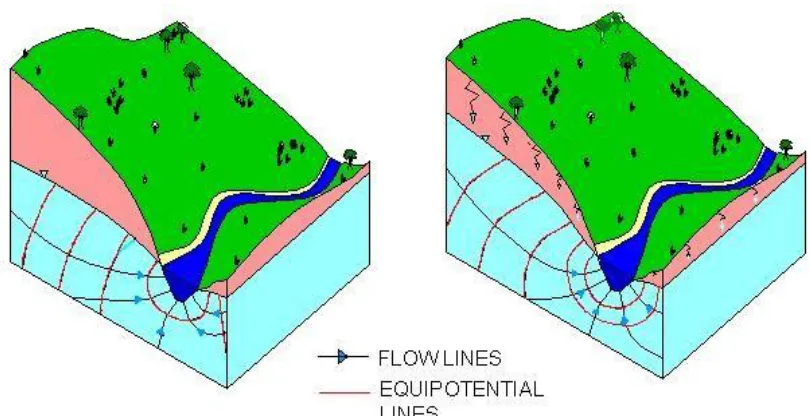
It may be observed from Figure 9 that both before any infiltration took place, there existed a gradient of the water table which showed a small gradient towards the river. However, the rise of the water table after the recharge due to infiltrating water is not uniform and thus the gradient of the water table after recharge is more than that before recharge. This has a direct bearing on the amount of ground water flow, which is proportional to the gradient. Based on actual observation or on mathematical analyses, we may draw lines of equal hydraulic head (the equipotentials) within the saturated zone, as shown in Figure 10. We may also draw the flow lines, which would be perpendicular to the equipotential lines. The flow lines, indicating the general direction of flow within the saturated soil zone is also drawn in the figure.
2.5.5 Examples of ground water flow
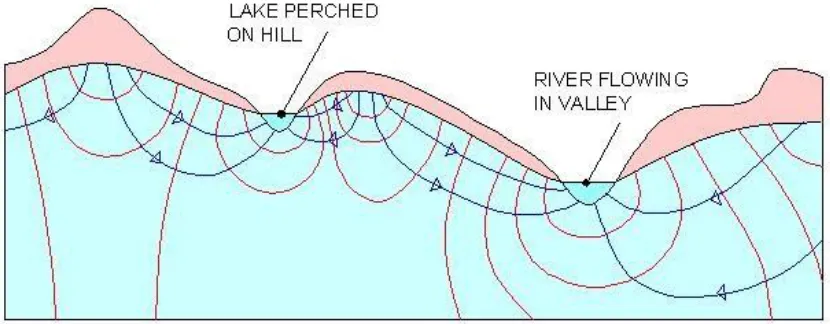
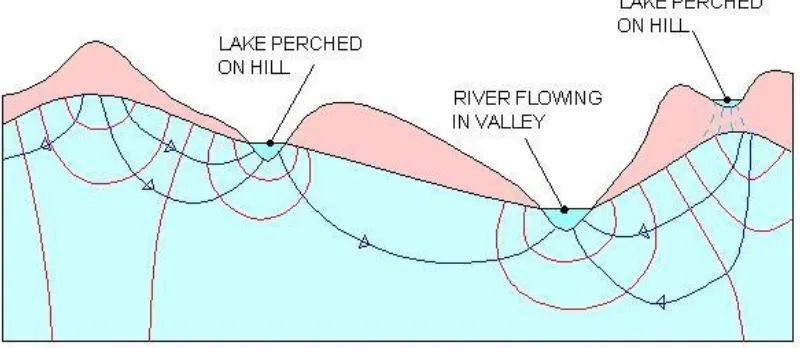
Although ground water flow is three – dimensional phenomenon, it is easier to analyse flows in two – dimension. Also, as far as interaction between surface water body and ground water is concerned, it is similar for lakes, river and any such body. Here we qualitatively discuss the flow of ground water through a few examples which show the relative interaction between the flow and the geological properties of the porous medium. Here, the two – dimensional plane is assumed to be vertical.
1. Example of a gaining lake and river.
2. Example of a partially losing lake, a disconnected losing lake, and a gaining river.
3. Example of flow through a heterogeneous media, case I.
4. Example of flow through a heterogeneous media, case II.
This case (Figure 14) is just opposite to that shown in example 3. Here, the flow is through a sub-soil material of high hydraulic conductivity sandwiched between materials of relatively low hydraulic conductivities.
2.5.6 Water table contours and regional flow
2.5.7 Aquifer properties and ground water flow
Porosity
Ground water is stored only within the pore spaces of soils or in the joints and fractures of rock which act as a aquifers. The porosity of an earth material is the percentage of the rock or soil that is void of material. It is defined mathematically by the equation
n = 100vv
v (2)
Where n is the porosity, expressed as percentage; vv is the volume of void space in a
unit volume of earth material; and v is the unit volume of earth material, including both voids and solid.
Specific Yield
tension so that, eventually, the stress of gravity will be exactly balanced by the surface tension (Hygroscopic water is the moisture clinging to the soil particles because of surface tension). Considering the above phenomena, the Specific Yield (Sy) is the ratio
of the volume of water that drains from a saturated soil or rock owing to the attraction of gravity to the total volume of the aquifer.
If two samples are equivalent with regard to porosity, but the average grain size of one is much smaller than the other, the surface area of the finer sample will be larger. As a result, more water can be held as hygroscopic moisture by the finer grains.
The volume of water retained by molecular and surface tension forces, against the force of gravity, expressed as a percentage of the volume of the saturated sample of the aquifer, is called Specific Retention Sr, and corresponds to what is called the Field Capacity.
Hence, the following relation holds good:
n = S y + S r (3)
Specific storage (ss)
Specific storage (ss), also sometimes called the Elastic Storage Coefficient, is the
amount of water per unit volume of a saturated formation that is stored or expelled from storage owing to compressibility of the mineral skeleton and the pore water per unit change in potentiometric head. Specific Storage is given by the expression
S s = γ (α + nβ ) (4)
where γ is the unit weight of water, α is the compressibility of the aquifer skeleton; n is the porosity; β is the compressibility of water.
Specific storage has the dimensions of length-1
The storativity (S) of a confined aquifer is the product of the specific storage (Ss) and
the aquifer thickness (b).
S = bS s (5)
All of the water released is accounted for by the compressibility of the mineral skeleton and pore water. The water comes from the entire thickness of the aquifer.
In an unconfined aquifer, the level of saturation rises or falls with changes in the amount of water in storage. As water level falls, water drains out from the pore spaces. This storage or release due to the specific yield (Sy) of the aquifer. For an unconfined
S = S y + hS s (6)
Where h is the thickness of the saturated zone.
Since the value of Sy is several orders of magnitude greater than hSs for an unconfined
aquifer, the storativity is usually taken to be equal to the specific yield.
2.5.8 Aquifers and confining layers
It is natural to find the natural geologic formation of a region with varying degrees of hydraulic conductivities. The permeable materials have resulted usually due to weathering, fracturing and solution effects from the parent bed rock. Hence, the physical size of the soil grains or the pre sizes of fractured rock affect the movement of ground water flow to a great degree. Based on these, certain terms that have been used frequently in studying hydrogeology, are discussed here.
• Aquifer: This is a geologic unit that can store and transmit water at rates fast
enough to supply reasonable amount to wells.
• Confining layers: This is a geologic unit having very little hydraulic conductivity.
Confining layers are further subdivided as follows:
o Aquifuge: an absolutely impermeable layer that will not transmit any water.
o Aquitard: A layer of low permeability that can store ground water and also transmit slowly from one aquifer to another. Also termed as “leaky aquifer’.
o Aquiclude: A unit of low permeability, but is located so that it forms an upper or lower boundary to a ground water flow system.