Probabilistical Robust Power Control for
Cognitive Radio Networks under
Interference Uncertainty Conditions
https://doi.org/10.3991/ijoe.v14i07.8967
Lingling Chen
Jilin University, Changchun, Jilin, China Jilin Institute of Chemical Technology, Jilin, Jilin, China
Zhiyi Fang, Xiaohui Zhao!!" Jilin University, Changchun, Jilin, China
Abstract—The focus of this paper is to find a robust power control strategy with uncertain noise plus interference (NI) in cognitive radio networks (CRNs)in an under orthogonal frequency-division multiplexing (OFDM) framework. The optimization problem is formulated to maximize the data rate of secondary users (SUs) under the constraints of transmission power of each SU, probabilistic the transmit rate of each SU at each subcarrier and robust in-terference constraint of primary user. In consideration of the feedback errors from the quantization due to uniform distribution, the probabilistic constraint is transformed into closed forms. By using Lagrange relaxation of the coupling constraints method and subgradient iterative algorithm in a distributed way, we solve this dual problem. Numerical simulation results show that our proposed algorithm is superior to the robust power control scheme based on interference gain worst case approach and non-robust algorithm without quantization error in perfect channels in the improvement of data rate of each SU, convergence speed and computational complexity.
Keywords—Cognitive radio networks, robust power control, probability con-straints, orthogonal frequency-division multiplexing (OFDM)
1
Introduction
[3-4]. That means the CR has to be the frequency-agile radio with flexible spectrum shaping abilities [5].
In CR system, the transmit power of each user is the main source of interference to other users. Therefore, the power control is necessary and naturally one of the key technologies of this system. A power allocation strategy is proposed to either maxim-ize the average data rate or minimmaxim-ize the outage probability of SU in cooperative and non-cooperative spectrum sensing in [6]. In [7], an optimal power control scheme is presented in cooperative dynamic spectrum access networks with diverse the quality of service (QoS) constraints. In downlink and uplink scenarios, two-phase mixed distributed/centralized control algorithm is proposed that requires minimal coopera-tion between secondary and primary devices in [8]. In order to maximize the output SNR and limit the interference to one PU in Rayleigh fading channel, an adaptive-power control scheme is given in [9]. In [10], with perfect interference adaptive-power infor-mation, a distributed power control algorithm is proposed for cognitive radio net-works (CRNs). In [11-12], transmit power and data rate allocation algorithms are presented based on the lower bound of the signal-to-interference-plus-noise ratio (SINR) of each SU. Unfortunately these algorithms do not consider the influence from the uncertainty of interference-plus-noise (NI) to the communication quality of SU. A robust power control scheme using the transition matrices to capture the chan-nel information is proposed by robust dynamic programming for the optimization of the worst-case performance in [13]. Since the statistical behavior of PU and the state transition probabilities of the channel are difficult to accurately described, the interval matrix uncertainty model and the likelihood uncertainty model are introduced to solve robust power control problems. However, the interference uncertainty in the channel is often not considered, which will increase the outage probability of users in CRNs. In underlay CRNs, a robust distributed uplink power allocation algorithm to maxim-ize the social utility of SUs is presented in [14], when the interference from PUs to the base station of SUs is uncertain.
After the analysis of the above literatures, we proposed a probabilistically robust power control (PRPC) algorithm for OFDM based cognitive radio networks under noise plus interference uncertainty. Specifically, our objective is to maximize the data rate of SU on all subcarriers to satisfy the probability constraint which the transmit rate of each SU less than the desired transmit rate at each subcarrier for the quantized NI error. We also give the comparison to show the performance of PRPC algo-rithm with the interference gain worst case approach given in [15] and the non-robust algorithm by computer simulation results.
2
System model
In this paper, we assume that there are
N
secondary users (SUs) andK
subcarri-ers in OFDM-based cognitive radio network. In order to ensure the reliable communi-cation of each SU, the transmit power should not be more than its maximum thresh-old, that is power budget. Thus we have.max 1
K i i
k
k
"
= p !P (1)Where i k
p represents the transmit power of the transmitter i of SU at the subcarri-erk . Pmaxi is the maximum transmitting power of the SU .
In order to satisfy the communication quality of PU at each subcarrier, the crucial constraint is that the interference from all SUs at each subcarrier should not exceed the acceptable threshold at that subcarrier [16-17] as follows
max
i i
k k k
p I+ !T (2)
Where max
k
T indicates the maximum allowable interference at the subcarrier k which the PUs can tolerant. i
k
I indicates the noise plus interference (NI) experienced by the SU i at the subcarrierk. It can be defined as
1,
N
i i ij j
k k k k
j i j
I p
= !
=" +
$
#(3)
Where i k ! and ij
k
! denote the normalized background noise power at the receiver input of the SU i on the kthsubcarrier and the normalized interference gain between the transmitter of the SUjand the receiver of the SU i over the subcarrierk respec-tively.
The optimization objective is to maximize the transmit data rate of each SU at all subcarriers through adjusting transmit power of SU at each subcarrier. And simulta-neously to satisfy constraints (1) and (2) respectively. To realize these goals, power allocation problem without imperfect system information can be expressed as
1
max
max 1
max log(1 )
s.t.
i K
k i
k k
i i
k k k
K
i i
k k
p I
p I T
p P
=
=
+
! + "
# $
" #%
&
&
However, due to random nature of wireless channels and channel estimation errors in practical communication environment, the associated channel information is diffi-cult to be obtained accurately.
Therefore, the robustness of power control problem should be considered.
3
Probabilistically robust power control problem formulations
Actually, due to imperfect channel estimation and quantization errors, the actual NI in (3) can not be reliable to obtain. In this case, parameter uncertainty is inevitable in real wireless communication systems. In order to alleviate the impact of such uncer-tainty impacts on the CR system, we guarantee the performance of SUs regarding i
k
d
as existing the random variable by power allocation to maximize their data rate for all subcarriers, i.e.
( )
(
log 1 ik)
i k p
i i
r k I k
p d ! + " #
(5)
Where
p
r{.}
represents probability operator. dki denotes an auxiliary variable thatserves as a lower bound on the achievable rate on the kth subcarrier with probability i
k
! , where i [0,1]
k
! " denotes the probability that the power allocation { }i k
p can
support the rates{ i k
d }.
Our objective is to maximize the transmit data rate of each SU at all subcarriers, simultaneously to satisfy constraints (1), (2) and (5). Then the robust power control problem under probability constraints can be formulated as
( )
(
)
1
max
max 1
max
s.t.
log 1
ik i k Ki k k
i i
k k k
K i i
k k
p
i i
r k I k
d
p I T
p P
p d
==
!
+
"
#
##
"
$
#
#
"
+
% &
#'
(
(
(6)
4
Robust power control algorithm
In this section, a robust power control algorithm is proposed to solve the transmit data rate problem of (6) for each SU on all subcarriers in CRNs.
After the simplification of (5), we can get
(2 i 1 i))
k k
i k p
d i
r I k
p ! " # $
By introducing a new variable i 2dik 1
k
! = " , problem (6) can be rewritten as
(
)
1
max
max 1
max log(1 )
s.t. i k i k K i k k i i
k k k
K i i
k k
p
i i
r k I k
p I T
p P p = = +! " + # $ $$ # % $
$ ! # & '
$(
)
)
(8) From (8), we can obtain
1
max
max 1
max log(1 )
s.t. 1 i i k k i k K i k k i i
k k k
K i i
k k
I
i i
r k p k
p I T
p P p ! = ! = " +" # $ + % $ $$ % & $ $ ' ( ) * + * , $ - .
$ / 0
1
2
2
(9)
Where i k
! describes the relative error in the NI on the kth subcarrier. It can be de-fined as follows
i i i k k k
i i
k k
I I I i
k I I
! " #
$ = =
(10)
Where i k
I! represents the estimate of the quantized NI of the i SU over the kth
subcarrier. i k
I
! denotes the corresponding quantization error.
In the OFDM-based CRNs, we mainly consider feedback errors coming from quantization. If the receivers need finite number of bits to feedback the quantized NI,
i k
! is assumed to follow uniform distribution on the interval[ i, ]i
k k
!" " .Since the
trans-mitters know the number of bits used for quantization of the NI, they can determine the maximum errors i
k
! . Thus the third constraint from (9) can be expressed as
1 1 2 2 1 1 1 i k
i i i i
k k k k
i i i i
k i i i k k k
k k k
I I
i i i i
r k p k k p k
I p
p d
! " !
# #
" "
# $
% & % &
' ( $ = " = +" $ ( )
* + * +
, -
.
, - (11)(1 2 ) i k i k p
i i i i
k k k k
I!
" # +$ % $ &
(12) that is, (10) can be rewritten as follows
1
max
max 1
max log(1 )
s.t.
(1 2 )
i k i k K i k k i i
k k k
K
i i
k k
p
i i i i
k k k k
I
p I T
p P ! = ! = +" # $ + % $ $ % & $
$" % +' ( ' ) $*
+
+
(13
Since the constraints on { i k
! } are decoupled across subcarriers, we can eliminate { i
k
! }.Thus the power optimization problem can be formulated as
1
max
max 1
max log 1
s.t. i k i k K p i k k I i i
k k k
K i i
k k
p I T
p P ! = ! = " # +$ % & ' ( ) + * + , + *
-.
.
(14)Where !ik = +1 " # " $ik 2 ik ki and ! >ik 0.5," <ik 1.
Obviously, the optimization problem (14) is a non-convex. According to convex optimization theory [18], the power control problem (14) can be converted into a convex one
1
max
max 1
min log 1
0 s.t. 0 i k i k K p i k k I i i
k k k
K i i
k k
p I T
p P ! = ! = " # $ & +% '
( ) * + $ + , -, $ + .
/
/
(15) The Lagrange function of problem (15) can be defined as(
)
maxmax
1 1 1
({ }, ,{ }) log 1 ik
i k
K p N K
i i i i i i i i i i i
k k k k I k k k k k k k
L p p P p I T!
= = =
" #
" #
$ µ = % + & + $ ' % (+ µ ' + % (
) * ) *
(
)
max max1 log 1 1
i k i k
K i p i i i i i i i K i
k I k k k k k k
k p p I P k T
!
= =
" $ %#
= )& +' +( + µ + + ,*& ( & µ
- .
/ 0
1
1
(16)
Where ! "i 0and i 0 k
µ ! represent Lagrange multipliers.
Therefore, according to the decomposition method of the Lagrange relaxation of coupling constraint proposed in [19], we provide a subgradient algorithm to solve the dual problem. Then the dual function of (15) is
(
)
maxmax
1 1
( ,{ })i i Nmin i { }, ,{ }i i i i i N i
k k k k k k
k= L p p k=
! " µ =
$
" µ # " # µ$
!(17) Where
(
{ }, ,{ })
log 1(
ik)
i kp
i i i i i i i i i i
k k k k I k k k k
L p $ µ =% +& +$ p + µ "'p I+ !#(
) * (18)
The dual problem (15) is given by
max
( ,{ })
s.t.
0,
0,
i i
k
i i
k
k
! " µ
" # µ # $
(19)According to KKT conditions, the optimal transmit power of each SU at the sub-scribe can be obtained by solving the following equation
({ }, ,{ })
0
i i i i
k k k
i k
L p
p
!
"
µ
=
!
(20)and the solution is
, 1 1
+ ln2
i opt i
k i i i k
k k
p = " I!
# µ $
! (21)
We can update the Lagrange multipliers by the subgradient iteration algorithm as follows
max 1
( 1) ( ) ( ) N
i i i i
k k
t t t p p
+
=
! # $"
% + =*% +& ( ' )+
,
-.
0
/ (22)max ( 1) ( ) ( )
i i i i
k t k t t p I Tk k k
+ !
" $ %# µ + = µ( + & * + ' +)
,
-. / (23)
Where [ ]y+=max{0, }y . t denotes the iteration time, and
( ), ( )
t
t
!
"
are thenonnegative step sizes.
The robust distributed power control algorithm is summarized as follows.
Step1.Initialized t=0 , 0
! (0) > i k
I ,0!pki(0)!pmaxi , pmaxi > 0, pkmax> 0, ! > 0i ,
0
i k
µ > ,! >ik 0,! "ik [0,1], ! >ijk 0,!i,!k.
Step2. Measured the interference gain between the transmitter of the SUjand the receiver of the SUiover the subcarrierk, and background noise power at the receiver input of the SUion the kthsubcarrier.
Step3. Updated the Lagrange multipliers according to (22) and (23). Increase the current iteration number by 1.
Step4. Calculated pk
i(t+1)= 1
!i(t+1)+µki(t+1)
"
# $%ln2 &1
'ik
(ki+ )kijpk j
j=1,i*j N
+
,
-. /
0
1"#1+2ik(t+1)$%.
Step5. Determined the transmit power vector satisfies
p t
ki( 1)
+
!
p t
ki( )
" #
, (where!
is an error tolerance factor), stop the iteration; otherwise, go to step 2.5
Simulation result and analysis
In this section, simulation results are presented to verify the effectiveness of our proposed probabilistically robust power control algorithm (PRPC) in the previous section. We also compare the performance in the proposed algorithm with the robust power control scheme (RPC) based on interference gain worst-case approach in [15] and the non-robust algorithm which ignores the quantized NI error under perfect channels.
Under our OFDM framework, we suppose that there are three active SUs and three subcarriers, i.e.N =3,K =3,. The maximum transmit power
p
maxi for each SU is 1 to guarantee the QoS of SUs. The background noise and the interference gain are ran-domly chosen from the intervals(
0,0.1/N
!
1
)
and(
0
1
/
N
!
1
)
respectively. For the proposed PRPC, the quantized NI relative error follows a uniform distribution for all SUs over[ i, ]ik k
!" " . For description convenience, let!ik =! "[0,1] for alli N k K! , ! .
The simulation results are given from Fig. 1 to Fig. 7.
First, we give the robustness of our algorithm on the transmit rate of each SU and the sum-rate of three SUs in the exited quantized NI relative errors in Fig.1 and Fig.2 to show the effects of the quantized NI uncertainty in the feedback channel, we as-sume that the probability i
k
(a) The transmit rate of SU1 in all subcarriers
(b) The transmit rate of SU2 in all subcarriers
0 5 10 15 20 25 30 0
5 10 15
Iteration
Tr
ans
m
it R
at
e (
bi
t/s
ym
bol
/H
z)
Proposed Algorithm(! =0.995," =0.2) Proposed Algorithm(! =0.995," =0.4) Proposed Algorithm(! =0.995," =0.6) Proposed Algorithm(! =0.995," =0.8) Worst-case Robust Approach in [15] Non-robust Algorithm
0 5 10 15 20 25 30 0
5 10 15
Iteration
Tr
ans
m
it R
at
e (
bi
t/s
ym
bol
/H
z)
(c) The transmit rate of SU3 in all subcarriers
Fig. 1. Transmit rate of each SU at all subcarriers by different algorithms
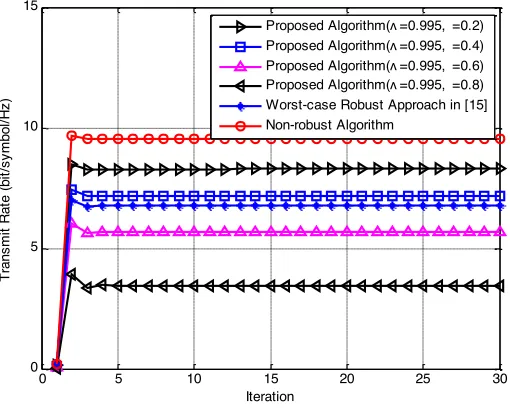
In Fig.1, we compare the transmit rate of each SU at each subcarrier under differ-ent given algorithms with the proposed algorithm. Since the estimated quantized NI error is ignored in the non-robust algorithm, the transmit rate of each SU in the pro-posed algorithm is less than that of the non-robust algorithm. Under our propro-posed algorithm, it is shown that the transmit rate monotonously decreases with the increas-ing quantized NI relative errors!. When ! is randomly selected from the interval
[
0,0.4]
, we can obtain that the transmit rate of each SU at all subcarriers of PRPC algorithm is more than that of the robust algorithm with consideration of the back-ground noise and interference gain uncertainties.When! is randomly chosen from the interval
[
0.6,1]
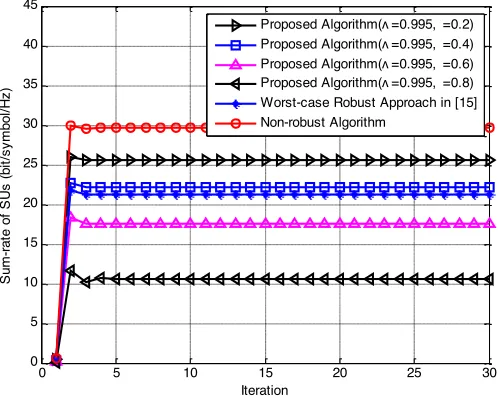
, the transmit rate of each SU at all subcarriers is less than that of RPC algorithm. Because the background noise and interference gain uncertainties in the proposed algorithm are greater than that of the RPC algorithm.In Fig.2, we can obviously observe that the sum-rate of three SUs demonstrates the same result as the transmit rate of individual SU with different!.
0 5 10 15 20 25 30 0
5 10 15
Iteration
Tr
ans
m
it R
at
e (
bi
t/s
ym
bol
/H
z)
Fig. 2. Sum-rate of three SUs by different algorithms
(a) The transmit rate of SU1 in all subcarriers
0 5 10 15 20 25 30
0 5 10 15 20 25 30 35 40 45
Iteration
Sum
-rat
e of
S
Us
(bi
t/s
ym
bol
/H
z)
Proposed Algorithm(! =0.995," =0.2) Proposed Algorithm(! =0.995," =0.4) Proposed Algorithm(! =0.995," =0.6) Proposed Algorithm(! =0.995," =0.8) Worst-case Robust Approach in [15] Non-robust Algorithm
0.5 0.55 0.6 0.65 0.7 0.75 0.8 0.85 0.9 0.95 1 2
3 4 5 6 7 8 9 10
!
Tr
ans
m
it R
at
e (
bit
/s
ym
bol
/H
z)
(b) The transmit rate of SU2 in all subcarriers
(c) The transmit rate of SU3 in all subcarriers
Fig. 3. Transmit rate of each SU at all subcarriers by different algorithms
0.5 0.55 0.6 0.65 0.7 0.75 0.8 0.85 0.9 0.95 1 4
5 6 7 8 9 10 11
!
Tr
ans
m
it R
at
e (
bi
t/s
ym
bol
/H
z)
Proposed algorithm," =0.2 Proposed algorithm," =0.4 Proposed algorithm," =0.6 Proposed algorithm," =0.8 Worst-case Robust Approach in [15] Non-robust Algorithm
0.5 0.55 0.6 0.65 0.7 0.75 0.8 0.85 0.9 0.95 1
3 4 5 6 7 8 9 10
!
Tr
ans
m
it R
at
e (
bi
t/s
ym
bol
/H
z)
In Fig.3, we present the impact of the probability !(! "[0.5,1]) on the transmit
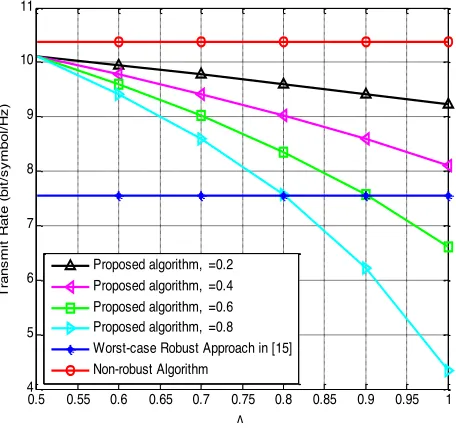
rate of each SU at each subcarrier under different algorithms. It is clear that the region of the quantized NI relative error extends with the increasing !. For a given !, if ! increases, the transmit rate of each SU over all subcarriers decreases. In addition, for a given !, if !increases, this transmit rate decreases. Therefore, !and ! are the two major factors that can affect the transmit rate of each SU at each subcarrier.
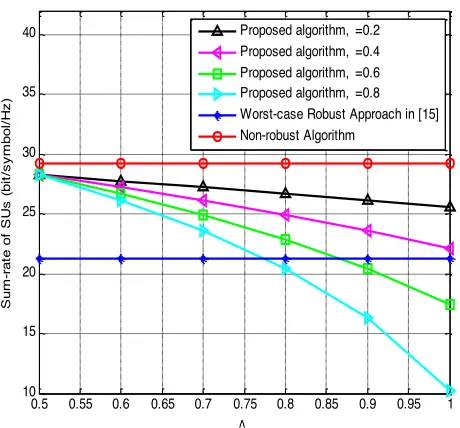
From Fig.4, when !is chosen in the interval [0.5,0.77] and !<0.6, we can see
that the sum-rate of three SUs at all subcarriers is more than that of RPC algorithm based on worst-case approach. Because the background noise and interference gain uncertainties in our proposed algorithm are less than that of the worst-case for RPC algorithm.
Fig. 4. Sum-rate of three SUs at all subcarriers by different algorithms
0.5 0.55 0.6 0.65 0.7 0.75 0.8 0.85 0.9 0.95 1 10
15 20 25 30 35 40
!
S
um
-r
at
e of
S
U
s (
bi
t/s
ym
bol
/H
z)
Fig. 5. Sum-rate of SUs vs. the quantized NI relative errors uncertainty!
From Fig.5, we know that the sum-rate of three SUs decreases with the increasing !. According to the inequality i i max
k k k
p +I! "T , for a fixed interference from all SUs at each subcarrier, if !increases, the interference constraint can satisfy at cost of reduc-tion of the transmission power of SUs. Thus, there is a trade off between robustness and the sum-rate of SUs. Moreover, the region of maximum transmit power of SUs will shrink with the increasing! . When the interference constraint satisfies
max
maxi /
k
T <<P K for all SUs, the constraint max
1
K i i
k k= p !P
"
is inactive. Therefore, theupper bound of the optimal power is determined by the interference threshold max
k
T .
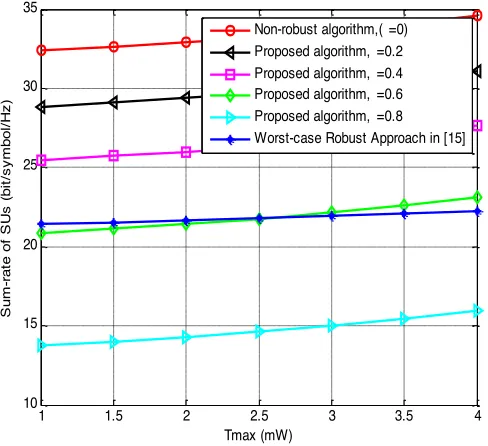
In other words, for the same uncertainty in NI, the higher max
k
T is, the more the sum-rate of all SUs is, Since big interference threshold!e.g. max 4
k
T = mW"may allow more transmit power for the improvement of the sum-rate of all SUs.
1 1.5 2 2.5 3 3.5 4
10 15 20 25 30 35
Tmax (mW)
S
um
-rat
e of
S
U
s (
bi
t/s
ym
bol
/H
z)
Fig. 6. Sum-rate of three SUs vs. maximum transmit power of each SU at all subcarriers
In order to describe the effects of max 1
K
i i
k
k= p P
!
"
vs. the sum-rate of SUs, we assume that the interference threshold is larger than the average maximum transmit power of each SU at each subcarrier, that is maxmaxi /
k
T >>P K, and i i max
k k k
p I+ !T is inactive. Hence according to max
1
K i i
k k
"
= p !P, for a given !, if the maximum transmit power Pmaxi
of the SUiincreases, the sum-rate of SUs increases too in Fig.6.
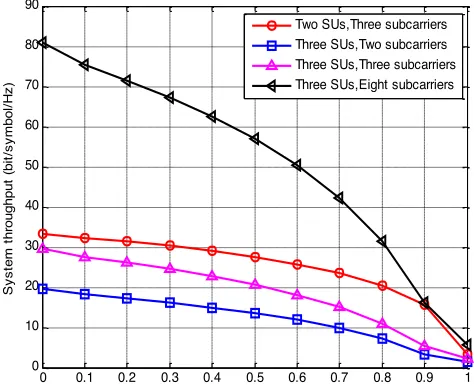
In Fig.7, we show the system performance under multiple SUs and multiple sub-carriers. As expected, the total throughput of all SUs increases with the decrease of ! in different combinations. Since the transmission power of each SU at all subcarriers should not be more than its maximum transmit power and the received SINR decreas-es with the increasing number of SUs and !, there are much more interference at the SU-Rx for a given number of subcarriers. With the increasing number of subcarriers or !, the system throughput gradually increases for a given number of SUs.
5 10 15 20 25 30 35 40
0 5 10 15 20 25 30 35 40 45 50 55
Pmax (mW)
S
um
-rat
e of
S
U
s (
bi
t/s
ym
bol
/H
z)
Fig. 7. System throughput vs. number of SUs, subcarriers and !
6
Conclusions
In this paper, we pay more attention to the robustness consideration that it is diffi-cult for secondary users (SUs) to obtain exact information of wireless channel in cog-nitive radio networks (CRNs), which may cause communication interruption for SUs, and becomes one of major concerns in multiuser OFDM-based CRNs. By taking the transmission rate of each SU over each subcarrier as a main performance metric, we transform this optimization problem into a tractable convex problem solved by dual decomposition method to obtain a new robust power control algorithm under the uncertainty of interference plus noise power, the introduced probability constraint, and the other two constraints. Simulation results prove that the proposed robust power control approach can improve the transmission rate of each SU, and satisfy the QoS constraints of both PUs and SUs. Additionally, the performance of the proposed algo-rithm is superior to that of RPC algoalgo-rithm based on interference gain worst-case ap-proach and non-robust algorithm (i.e., without considering quantization error on per-fect channel condition).
7
Acknowledgment
This work is supported in part by the National Natural Science Foundation of Chi-na under grant no. 61571209 and 61501059, scientific research fund of Jilin Provin-cial Education Department (Grant No. 2016134), outstanding youth fund of Jilin City
0 0.1 0.2 0.3 0.4 0.5 0.6 0.7 0.8 0.9 1 0
10 20 30 40 50 60 70 80 90
!
S
ys
tem
thr
oughput
(bi
t/s
ym
bol
/H
z)
Science and Technology Bureau (Grant No. 20166019), scientific research project of Jilin Institute of Chemical Technology(Grant No. 2015128(D)), and major scientific research project of Jilin Institute of Chemical Technology(Grant No. 2015010).
8
References
[1]XIN KANG, GARG, H.K. , YING-CHANG LiANG, RUI ZHANG Optimal power
alloca-tion for OFDM-based cognitive radio with new primary transmission protecalloca-tion criteria[J].
IEEE Transactions on Wireless Communications, 9(6)!2066-2075, (2010)
https://doi.org/10.1109/TWC.2010.06.090912
[2]YONGJUN XU, XIAOHUI ZHAO, YING-CHANG LiANG, Robust power control and
beamforming in cognitive radio networks: a survey[J]. IEEE Communications Surveys & Tutorials, , (2015) https://doi.org/10.1109/COMST.2015.2425040
[3]TIGANG JIANG, HONGGANG WANG, VASILAKOS, A. V., QoE-driven channel
allo-cation schemes for multimedia transmission of priority-based secondary users over cogni-tive radio networks[J]. IEEE Journal on Selected Areas in Communications, 30(7): 1215-1224, (2012). https://doi.org/10.1109/JSAC.2012.120807
[4]LINGLING CHEN, XIAOHUI ZHAO, An improved power control AFSA for minimum interference to primary users in cognitive radio networks[J]. Wireless Personal Communi-cations,87(1):293-311, (2016). https://doi.org/10.1007/s11277-015-3043-5
[5]SETOODEH, P., SIMON HAYKIN, Robust transmit power control for cognitive radio[J]. Proceedings of the IEEE, 97(5): 915-939, (2009). https://doi.org/10.1109/JPROC.2009. 2015718
[6]PEH, E.C.Y., YING-CHANG LiANG, YONGLIANG GUAN;YONGHONG ZENG,
Power control in cognitive radios under cooperative and non-cooperative spectrum sens-ing[J]. IEEE Transactions on Wireless Communications, 10(12): 4238-4248, (2011).
https://doi.org/10.1109/TWC.2011.101511.102234
[7]GATSIS, N., MARQUES, A. G., GIANNAKIS, G. B., Power control for cooperative dy-namic spectrum access networks with diverse QoS constraints[J]. IEEE Transactions on Communications, 58(3): 933-944, (2010). https://doi.org/10.1109/TCOMM.2010.0 3.080491
[8]ANHTUAN HOANG, YING-CHANG LiANG, ISLAM, M.H., Power control and channel
allocation in cognitive radio networks with primary users' cooperation[J]. IEEE Transac-tions on Mobile Computing, 9(3): 348-360, (2010). https://doi.org/10.1109/TMC.2009.136
[9]CHEN SUN, ALEMSEGED, Y.D., TRAN, H.N., HARADA, H., Transmit power control for cognitive radio over a Rayleigh fading channel[J]. IEEE Transactions on Vehicular Technology, 59(4): 1847-1857, (2010). https://doi.org/10.1109/TVT.2009.2037913
[10]KARACA, H. M., KURT, T., DICLE, S. Z., & ANARIM, E. (2013). Auction-based throughput maximization in cognitive radio networks under interference consrtaint[J]. Wireless Personal Communnications, 72(2): 1259-1275, (2013). https://doi.org/10.1007/ s11277-013-1076-1
[11]Y. XING, C.N. MATHUR, M.A. HALEEM, R. CHANDRAMOULI, AND K.P.
SUBBALAKSHMI, Dynamic spectrum access with QoS and interference temperature constraints[J], IEEE Trans. Mobile Computing, 6(4): 423-433, (2007).
https://doi.org/10.1109/TMC.2007.50
[12]L.B. LEAND E. HOSSAIN, Resource allocation for Spectrum Underlay in Cognitive Ra-dio Networks[J]. IEEE Trans. Wireless Comm., 7(12): 5306-5315, (2008).
[13]HUA XIAO, KAI YANG ; XIAODONG WANG, Robust power control under channel
[14]PARSAEEFARD, S., SHARAFAT, A.R., Robust distributed power control in cognitive radio networks[J]. IEEE Transactions on Mobile Computing, 12(4): 609-620, (2013)
https://doi.org/10.1109/TMC.2012.28
[15]MINGYUE ZHOU, XIAOHUI ZHAO, SHI PAN, etc., A robust power allocation algo-rithm in cognitive radio networks[J]. Journal of Information and Computational Science, 10(1): 69-77, (2013).
[16]S. HAYKIN, “Fundamental issues in cognitive radio” in cognitive wireless communica-tion networks[J]. E. Hossain and V. K. Bhargava, Eds. New York: Springer, (2007). [17]JALAEIAN, B., ZHU, R., SAMANI, H., MOTANI, M., An optimal cross-Layer
frame-work for cognitive radio netframe-work under interference temperature model[J]. IEEE Systems Journal,PP(99): 1-9, (2014).
[18]BERTSEKAS, D. P. Convex optimization theory[M]., Athena Scientific Belmont, MA, (2009).
[19]D. P. BERTSEKAS, Nonlinear programming[M]., 2nd ed. Athena Scientific, (1999).
9
Authors
Lingling Chen(1980-),received her Bachelor and PH.D degrees both in
Commu-nication Engineering from Jilin University, China, in 2004 and 2015 respectively. Currently, she is an associate professor of College of Information and Control Engi-neering, Jilin Institute of Chemical Technology, simultaneously she is a post-doctor in computer science and technology from Jilin University. Her research interests are in nonlinear optimization, mobile computing and cognitive radio networks.(e-mail: cll807900@ 163.com, affiliation: School of Computer Science, Jilin University, Changchun, Jilin, 130012, China and School of Information and Control Engineering, Jilin Institute of Chemical Technology, Jilin, Jilin, 130022, China).
Zhiyi Fang (1957-), received the PhD degree in computer science from Jilin
Uni-versity, Changchun, China, in 1998, where he is currently a professor of computer science. He was a senior visiting scholar of the University of Queensland, Australia, from1995 to 1996, and the University of California, Santa Barbara, from 2000 to 2001. He is a member of China Software Industry Association(CSIA) and a member of Open System Committee of China Computer Federation (CCF). His research inter-ests include distributed/parallel computing system, mobile communication, and wire-less networks.(e-mail: [email protected], affiliation: School of Computer Science, Jilin University, Changchun, Jilin, 130012, China).
Xiaohui Zhao(1957-), received his Bachelor and Master degrees both in Electrical Engineering from Jilin University of Technology, China, in 1982 and 1986 respec-tively, and his PH.D degree in control theory from University de Technology de Compiegne, in 1993, France. Currently, he is a Professor of College of Communica-tion Engineering, Jilin University. His research interests are signal processing, nonlin-ear optimization and wireless communication.(e-mail: [email protected], affiliation: Key Laboratory of Information Science, School of Communication Engineering, Jilin University, Changchun, Jilin, 130012, China).