University of Huddersfield Repository
Meng, Zhaozong and Lu, Joan
Implementing the Emerging Mobile Technologies in Facilitating Mobile Exam System
Original Citation
Meng, Zhaozong and Lu, Joan (2011) Implementing the Emerging Mobile Technologies in
Facilitating Mobile Exam System. In: 2nd International Conference on Networking and Information
Technology. IPCSIT 25th26th November 2011, 17 . IACSIT Press, Hong Kong, China, pp. 8088.
ISBN 9789810706807
This version is available at http://eprints.hud.ac.uk/id/eprint/17183/
The University Repository is a digital collection of the research output of the
University, available on Open Access. Copyright and Moral Rights for the items
on this site are retained by the individual author and/or other copyright owners.
Users may access full items free of charge; copies of full text items generally
can be reproduced, displayed or performed and given to third parties in any
format or medium for personal research or study, educational or notforprofit
purposes without prior permission or charge, provided:
•
The authors, title and full bibliographic details is credited in any copy;
•
A hyperlink and/or URL is included for the original metadata page; and
•
The content is not changed in any way.
For more information, including our policy and submission procedure, please
contact the Repository Team at: [email protected].
Implementing the Emerging Mobile Technologies in Facilitating Mobile Exam System
Zhaozong Meng, Joan Lu
School of Computing and EngineeringUniversity of Huddersfield
Huddersfield, West Yorkshire, HD1 3DH, UK {z.meng, j.lu}@hud.ac.uk
Abstract—Because of the wide possession of the handheld mobile devices, the application of the mobile technologies in enhancing learning activities attracts much research interest. This investigation aims at implementing students faced mobile technologies into test and exam to simplify the exam management and performance assessment. The research work focuses on the aspects of mobile device and platform oriented design, light-weight and efficient application, fast and convenient question navigation, and performance assessment, etc. In order to conduct an appropriate information service to the heterogeneous resource limited devices, the context-aware service notion is introduced to the system design. The user profile and device information are modeled and managed efficiently according to the data characteristics and their interrelationships for information adaptation. The assessment module can provide statistical results for learning performance analysis. A prototype system named Mobile Exam System (MES) is implemented on Apple iOS and Google Android OS in the current stage. Based on the work finished, some mobile oriented functions based on promising mobile technologies are suggested for next stages. The test and analysis demonstrate that the implementation of latest mobile technologies into exam is a successful attempt toward pervasive mobile learning and assessment.
Keywords-Mobile computing, E-exam, Context-awareness, Mobile native application, Mobile Exam System (MES)
I. INTRODUCTION
In the recent years, a lot of studies introduced the information and communication technologies (ICT) into the education area to enhance the teaching and learning activities [1, 2]. A typical example is the E-exam system that implements the technologies to simplify the examination process by computer aided control and automatic marking to reduce the complex paper work.
There are plenty of research publications on online E-exam systems. Yuan et al. presented a web-based examination system which carried out the examination and auto-grading for computer science education [3]. Huang et al. adopted S2SH and MVC web system development pattern to accomplish loose coupling to complete the essential function of online exam system, and the system increased the reusability of code and strengthened the flexibility and maintainability of the system [4]. Pang et al. proposed an online training and exam web service system architecture which characterized in high security, easy operation, powerful integration, easy maintenance and management [5].
Most computer based evaluation mechanisms are web based testing and they employ the client-server paradigm [6]. In some works, agent technology has been developed as a useful paradigm to break the limitations of the traditional distributed systems. Aye and Thwin presented an online exam system based on mobile agents to improve the performance of the system and its dependency on the underlying network [7]. Bhuvaneswari et al. proposed a centralized exam assessment system using mobile agents. This agent-based model considers the entire examination process and it significantly enhances the performance of the system [8]. Lu et al. proposed a database management architecture for mobile exam system [9]. A difficult challenge facing the E-exam system is the security problems such as authenticity, privacy, and cryptography, which are addressed in many literatures such as [10, 11, 12, 13].
The computer based E-exam systems are mature and strong in security and functionality. However, the stationary machines are too large in size for classroom learning. With the development of the mobile device capability and the wireless network infrastructure such as Wi-Fi and 3G, the mobile devices are widely used in different areas such as business, healthcare, and education [14]. On the other hand, the mobile devices ship many build-in modules, and become integrated personal information assistant. These mobile features make the mobile devices attractive and strong in many application scenarios. Thus, the application of mobile technologies in enhancing learning activities has attracted much research effort.
The rapid development of the mobile technology and its widespread application in diverse areas has motivated this research work to utilize the mobile technologies to facilitate the examination process. This investigation aims to verify the feasibility of applying the mobile technologies in facilitating the E-exam system. A case study of mobile exam system is designed and implemented as a validation study.
The remaining of this paper is structured as follows: section II presents the proposed MES system, and section III
describes the system design and implementation. Followed by the results, testing, and discussion of the system in section
IV, conclusions are drawn and future work is suggested in section V.
II. THE PROPOSED SCHEME
To solve the problems stated in the above section, a mobile based exam system MES is proposed in this work.
Although there are weaknesses for the mobile devices, such as limited screen size, bandwidth, and battery life, there are also strengths employing mobile devices in exam compared to stationary computers:
• Handheld and portable. The mobile devices are small in size, easy to manipulate, and appropriate for classroom learning.
• It is student’s personal belonging. Teachers do not need to prepare the devices, and students are familiar with their own devices.
• Improved computational power. The recent mobile phones and tablet PCs are stronger in hardware capability, operating systems, and applications.
• Plentiful build-in modules. Some build-in modules such as GPS and Bluetooth can be used to identify the students’ authentication and provide adapted information for users.
B. Mobile Device Oriented Application
There are different approaches for mobile application development, such as SMS/MMS, mobile widget, mobile web application, mobile native application. For the mobile exam case where information interaction happens frequently, the mobile web application and mobile native application are the promising solution compared with the other peer approaches.
1)Mobile Web Application
Web application is an important approach for mobile devices. Most mobile devices in nowadays ship with a web browser, thus the web based approach is a cross-platform method for the closed mobile operating systems. Many web technologies are introduced to enhance the user experience of mobile web, such as Ajax, jQuery mobile, jQTouch, etc. With these web technologies, the web application can also acquire some mobile native sense.
2)Mobile Native Application
The mobile native application is device and operating system specified application. Mobile application can only be developed with development tools supporting the operating system, and the functions fitting the device capability. This kind of applications can exploit the mobile device feature and generate good user experience with high efficiency. Table I gives the comparison of these two approaches [15].
TABLE I. MOBILE WEB AND MOBILE NATIVE APPLICATION
Approaches Compare Items
Mobile Web Application
Mobile Native Application Cross-platform Excellent Poor
User Experience Good Excellent
Data Management Limited Excellent
Development Complexity Medium Complex
Mobile Features Limited Excellent
Security Capability Medium Strong
Context awareness Medium Strong
C. Use the Mobile Devices’ Capability
The mobile device today is not just a telephony terminal, but an integrated mobile communication and computing assistant. Some build-in modules enables the system to
perform personalized information service, and these modules can be used in the system for information adaptation, user identification, etc.
D. The Proposed MES System
1) Application scenario: face to face supervised and
paper-based exam
The proposed system aimed application environment is face to face supervised and paper-based formal exam. This system can also be used for informal test as learning performance assessment during classroom learning. Test questions in the MES system are objective questions.
2) Equipment employed:Internet enabled mobile devices
This system aims to cover the dominant student faced internet enabled mobile devices. And in current stage, the task is to verify the mobile approach on dominant mobile operating systems: Apple iOS and Google Android OS.
3) Development tool: Rhomobile
As the mobile operating systems are proprietary and rather closed, and the devices are heterogeneous in device feature, it is not easy to create one application to cover all the devices. Some mobile development tools claims to be able to cover many mobile OSs, special consideration may be required to achieve the desired functions. In this system, the Rhomobile, which claims to cover iOS, Android, Blackberry, and Windows mobile, is selected as the development tool to implement the MES system.
III. SYSTEM DESIGN AND IMPLEMENTATION The mobile native application based MES system is different with the web based systems. This section presents the system architecture for efficient mobile exam system.
A. System Design
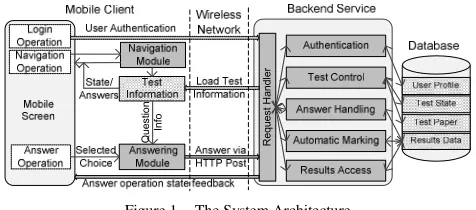
The system architecture and control logic of MES are given in Figure 1. The teacher uses PC to control the exam, and the students use mobile device to access and answer the questions. The server calculates the results and manages the results in backend database. The backend server is divided into six main functional modules, and the data is categorized into user profile, test state, test paper, and results data.
R
e
q
u
e
st
H
a
n
d
le
r
Q
u
e
st
io
n
In
[image:3.595.306.544.550.655.2]fo
Figure 1. The System Architecture
backend server. When the students answer a question, the server handles the requests and gives a feedback to notify the students the state of the answering operation.
B. System Implementation
The MES system is implemented with the above presented system architecture. The equipments, tools, communication medium, and technologies employed are:
Mobile Devices: Apple iOS and Google Android Wireless Infrastructure: Wi-Fi/3G
Test Setting and Management: Flex Builder Application on PCs and Mac Machines
Service Architecture: Apache/PHP/MySQL Mobile Development Tool: Rhomobile
Information Exchange Format: XML, JSON (JavaScript Objective Notation)
1) HCI Capability of the Mobile Devices
a) Mobile Native Application Interface
The design of the interface follows two principles: simple, and easy to use. In the first place, the information is simple and clearly presented. Then, the system is easy to learn and use so that the beginner can use it as the experienced. Compared with mobile web application, the mobile native application does not need the user to scroll up and down.
b) Two-Tier Navigation Model
To improve the efficiency of the navigation between questions, a two-tier navigation model is designed. The first tier of navigation buttons is on the top, and the second is on the bottom. For instance, button 1-5 in the first tier contains buttons 1 to 5 in the second tier which navigate to questions 1, 2, 3, 4, and 5. There is only one question displayed on the screen, so that the information can be clearly presented.
c) State Feedback of Answering Operation
When a student presses a button to answer a question, the state information will be returned to let the user know whether this operation is successful or not. Meanwhile, the pressed button is highlighted in a different colour. When the user navigates back to answered questions, the pressed button keeps the state as highlighted to notify which answer is selected in the previous operation.
2) Security
As the system is closed mobile application, it is strong in security compared with the web based applications. The main security concerns of the system are the authentication, privacy, and information encryption.
Authentication. Only registered teacher and student users can login and use the system. The user may register with E-mail and device ID for user identification.
Privacy. The information of each user is only available to the authorized users and managers. Information Encryption. Information exchange
between server and the mobile clients via HTTP should be encrypted to avoid unauthorized tapping.
3) Efficiency and Speed
For the resource constrained mobile devices, it is of great importance to effectively utilize the limited resource to enhance the efficiency. For MES, the following approaches
are employed to reduce the burden of both the server and mobile devices, and promote the speed and efficiency:
a) Reducing Data Interaction
As the communication load is heavy for the server when there are a large number of students in the exam, it is a challenge for mobile device to frequently communicate with the server. Thus, reducing data interaction during the exam is an effective solution. In this system, from the system design, to the communication technology, all steps of design keep in mind the principle of reducing the data interaction.
b) Light-weight Information Technologies
To save the limited bandwidth of the wireless network and reduce internet latency, the light-weight data exchange formats are applied, such as XML and JSON. An example snippet of JSON is given in List 1.
{“testpaper”:{ “test_info”:{
“testid”:“ABC”, “testtime”:“90”,“quantity”:“20”,…}, “que_type”:{
“q1”:“1”,“q2”:“3”,“q3”:“5”, ...}, “que_weight”:{
“w1”:“5”,“w2”:“5”,“w3”:“10”, …}, …}
}
List 1. Snippet of Test Information in JSON Format
IV. RESULTS AND TESTING
A. Results of the System
1) Functions Achieved
The MES system employs the mobile devices and wireless networks, and eventually achieves the following functions in the current stage:
• Test paper preparation
• Test management (start, pause, finish, timing) • Fast navigation, answering questions with mobile • Operation state feedback and test answer overview • Automatic marking with results and weights • Results distribution in pie, bar, and column charts • Results save to files (in .txt, .pdf, .xsl, .csv formats) • Performance monitoring
• E-mail feedback for test results notification
2) Some Interfaces of the MES System
[image:4.595.314.534.468.724.2]a) Test preparation
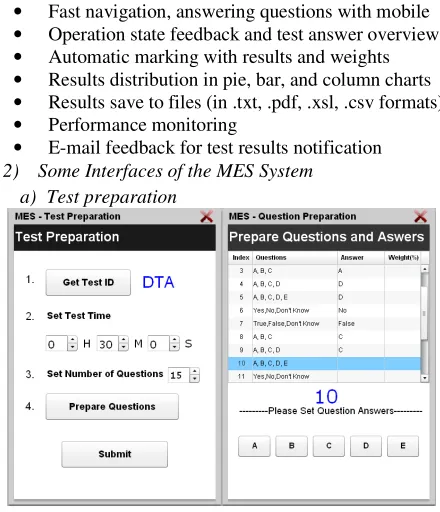
The test information includes the test ID, number of questions, test duration, questions, weights, and answers. The interface for test preparation is given in Figure 2.
b) Statistical Results for the test
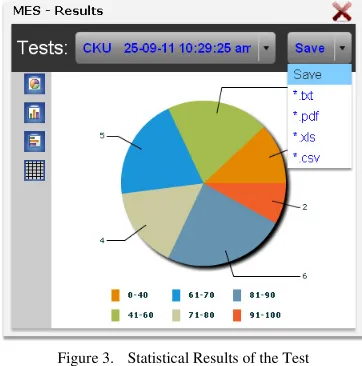
[image:5.595.79.260.201.384.2]The distribution of marks of the students is displayed in pie chart, bar chart, column chart, and table. And the data can be saved to .txt, .pdf, .xsl, .csv files, as what is shown in Figure 3.
Figure 3. Statistical Results of the Test
c) Student side mobile interface
For the student side, the interface to navigate and answer questions is given in Figure 4. The state of the answering question operation is returned and displayed on the bottom.
[image:5.595.72.289.446.640.2](1) (2)
Figure 4. MES Student Side Mobile Interface
B. Testing of the System
1) Testing Strategy
• Test equipments: Apple iPhone, iPod, iPad, and Android phone - HTC Desire
• Test Environment: Wi-Fi, and 3G network
• Test Items: interface, functionality, speed, correction
2) Testing Results
TABLE II. TESTING RESULTS
Mobile Platform Test Items
Apple iOS 4.3 (iPhone 4)
Android 2.3 (HTC Desire)
In
te
rf
a
ce Layout of Elements √ √
Information Display √ √
Fit screen size √ √
Page Navigation √ √
F
u
n
ct
io
n
a
li
ty
Authentication √ √
Preparing test √ √
Test state control √ √
Answering questions √ √
Answering state feedback √ √
Student change mind √ √
Automatic marking √ √
Results distribution √ √
Results save to file √ √
S
p
ee
d Login speed
√ √
Get question speed √ √
Answering speed √ √
Result calculation speed √ √
C
o
rr
ec
ti
o
n Navigation error N N
Answer error N N
State feedback error N N
Automatic marking error N N
Display/save errors N N
(Note: √ denotes correct or acceptable, and N for No error)
C. Use Cases of the System
1) Workflow of the MES
Figure 5. Workflow of the MES
The MES system simplifies the procedure of exam with the mobile technologies for classroom teaching and learning. It allows the teacher to initiate the sequences 1→2→3→4→5 in Figure 5 to evaluate the students learning performance. Compared with the traditional exam process, the application of the mobile system are more efficient in automatic control and calculation.
2) Performance Monitoring
Figure 6. Performance Monitoring of MES
D. Discussion
The employment of student faced mobile devices facilitates the operation for students and the management process for teachers. Also the simple interface and function are easy for the students to get used to the system. But it is difficult to guarantee that every student has a mobile device.
The mobile oriented application promotes the performance of the system. However, the heterogeneities in mobile devices and operating systems have increased the complexity of the application development process.
V. CONCLUSION AND FUTURE WORK
A. Conclusion
The verification and validation studies of MES can be said to be successful in the current stage. This investigation contributes to the following points:
(1) Conducted the fast, friendly, and simple application on current mobile devices successfully; (2) Achieved the function and interface of MES with
mobile application development principles; (3) Utilized the light-weight information interaction
technologies to degrade the computational and communication burden of the mobile devices; (4) Achieved fast and convenient navigation with
operation state feedback for exams with large number questions.
B. Future Work
The further studies will include issues listed as follows: (1) Extend the work to cover dominant mobile
operating systems, such as Windows mobile, and Blackberry for cross-platform application;
(2) Utilize of the mobile device feature and user preference to enhance the functionality of the system, e.g. identifying the students’ authentication with mobile device capability such as device ID and GPS, etc;
(3) Enhance the results information analysis mechanism for learning performance evaluation; (4) Extend current system to facilitate non-paper
exams, and design technical approaches to avoid plagiarism, such as multi-session test;
(5) Carry out a comprehensive evaluation of the system with classroom test and questionnaire investigations.
ACKNOWLEDGMENT
This work has been funded with support from the European Commission. The views expressed in this publication are those of the authors and do not necessarily represent the views of the Commission. The Commission cannot be held responsible for any use which may be made of the information contained therein.
REFERENCES
[1] M. Sharples, J. Roschelle, “Guest Editorial: Special section on Mobile Learning and Ubiquitous Technologies,” IEEE Transactions on Learning Technologies, Vol. 3(1), 2010, pp. 4-6
[2] G. Hwang, P. Wu, H. Ke, “An Interactive Concept Map Approach to Support Mobile Learning Activities for Natural Science Course,” Computers & Education, Vol. 57, 2011, pp. 2272-2280
[3] Z. Yuan, L. Zhang, G. Zhan, “A Novel Online Examination System for Computer Science Education,” 33rd ASEE/IEEE Frontiers in Education Conference, 5-8 Nov., 2003, Boulder, CO, pp. 7-10 [4] D. Huang, H. Huang, “Research and Realization of Online Exam
System Based on S2SH Framework,” 2010 Internationa Conference on Web Information System and Mining, 23-24 Oct., 2010, Sanya China, pp. 396-399
[5] H. Pang, S. Yang, L. Bian, “A Web Services Based Online Training and Exam System,” 4th International Conference on Wireless Communications, Networking and Mobile Computing (WiCOM '08), 12-14 Oct. 2008, Dalian China, pp. 1 - 4
[6] V. Jamwal, and S. Iyer, “Mobile Agent Based System for Distant Evaluation System,” In Proceedings of the IEEE International Symposium on Applications and Internet, Florida USA, Jan. 2003, pp. 362-369
[7] M. M. Aye, and M. M. Thet Thwin. “Mobile Agent Based Online Examination System,” 5th International Conference on Electrical Engineering/Electronics, Computer, Telecommunications and Information Technology. May 2008, Krabi, pp. 193-196
[8] N. Sudha Bhuvaneswari, S. Sujatha, C. Deepthi, “Proposal on Centralized Exam Assessment Apporation Using Mobile Agents,” In Proceedings of the International Conference on Communication and Computational Intelligence-2010, Erode India, 27-29 December, 2010, pp. 68-71
[9] J. Lu, A. Sundaram, Z. Meng, A. Vidyapriyadarshini, and G. Lu, “Mobile Exam System - MES: Architecture for Database Management,” In the International Conference on Education & Learning in Mobile Age - CELMA, 1-2 Jun., 2011, Lake District, UK [10] J. Castella-Roca, J. Herrera-Joancomarti, A. Dorca-Josa, “A Secure E-Exam Management System,” 1st International Conference on Availability, Reliability and Security (ARES'06), 20-22 April 2006, Vienna, Austria, pp. 864-871
[11] Andrea Huszti, Attila Petho, “A Secure Electronic Exam System,” Publi. Math Debrecen, 77/3-4 , 2010, pp. 299-312
[12] Im Y. Jung, and Heon Y. Yeom, “Enhancing Security for Online Exam Using Group Cryptology,” IEEE Transactions on Education, vol. 52, no. 3, August 2009, pp. 340-349
[13] T. S. M. Barhoom, and Shen-Sheng Zhang, “Trused Exam Marks System at IUG using XML-signature,” Procedding of the 4th International Conference on Computer and Information Technology (CIT’04), 2004, pp. 288-294
[14] M. Mahdavi, H. Khordadi, M. Khoobkar, “Web Transcoding for Mobile Devices Using a Tag-Based Technique,” World Applied Science Journal 10 (Special Issue of Computer & Engineering), 2010, pp. 49-58