Identity-based Authenticated and Efficient Traceable
Search System for Secure Cloud Storage
Miss. Shital Khandare Prof. H.A. Hingoliwala
PG student, Computer Department Associate Professor, Head of Computer Department
JSPM’s JSCOE, Handewadi, Pune JSPM’s JSCOE, Handewadi, Pune.
ABSTRACT: As Cloud Computing winds up overflowing, sensitive data are in effect dynamically incorporated into the cloud. For the insurance of information security, sensitive learning must be encoded before re-appropriating, that makes successful learning use a difficult undertaking. Instead of the fact that antiquated accessible coding plans empower clients to solidly seek over scrambled learning without capturing any relevancy of knowledge files. Secure inquiry over encoded remote information is important in distributed computing to confirm the knowledge protection and easy use. Thus, tracing and revoking the malicious user abuses secret key must be solved imminently. Here we propose associate written agreement free traceable attribute based mostly multiple keywords set search system with verifiable outsourced decipherment. The key written agreement free mechanism may effectively forestall the key generation centre (KGC) from unscrupulously looking and decrypting all encrypted files of users. Also, the decipherment method solely needs extreme is lightweight computation that may be a fascinating feature for energy-limited devices. Additionally, economical user revocation is enabled when the malicious user is found out. Moreover, the planned system is in a position to support versatile range of attributes instead of polynomial bounded. Versatile multiple keyword set search pattern is realized, and also the modification of the question keywords order doesn't have an effect on the search result.
KEYWORDS:–Authentication, Identity-based, Traceable Search System, Cloud Storage, key generation centre.
I.
INTRODUCTION
With the event of recent computing paradigm, cloud computing becomes the foremost notable one, which provides convenient, on-demand services from a shared pool of configurable computing resources. Therefore, an increasing variety of corporation’s associate degreed people like to source their information storage to cloud server. Despite the tremendous economic and technical benefits, unpredictable security and privacy issues become the most distinguished downside that hinders the widespread adoption of knowledge storage publically cloud infrastructure. Encryption could be a basic methodology to safeguard information privacy in remote storage. However, the way to effectively execute keyword hunt for plaintext becomes tough for encrypted data because of the unreadability of ciphertext. Outsourcing searchable encrypted knowledge to a 3rd party is of expanding enthusiasm in secure Cloud storage. In a typical application of this type, a sender encrypts documents to a receiver UN agency features a storage account in a very cloud server. The encrypted documents are uploaded to the storage server. The receiver will retrieve some encrypted documents containing a selected keyword by providing the server with a keyword search trapdoor such as that keyword. With this keyword seek trapdoor, the capacity server will realize the matching
Documents while not decryption. The crypto logical tool facilitating search on encrypted knowledge is spoken as searchable encoding. Searchable encoding has been realized in each isosceles and uneven (public-key) encoding settings. By getting into the time of massive information, web users sometimes choose to transfer their personal information to remote cloud servers such that they will cut back the value of native information management and maintenance.
correctness of outsourced cryptography publically key coding with PEKS i.e. keyword search system.
The authorized entities might illicitly leak their secret key to a third party for profits. Suppose that a patient someday suddenly finds out that a secret key corresponding his electronic medical data is sold-out on e-Bay. Such despicable behavior seriously threatens the patient’s data privacy. The intentional secret key discharge seriously undermines the muse of authorized access management and data privacy protection. Thus, it's terribly imperative to identify the malicious user or maybe prove it in associate passing court of justice. In attribute based totally access system, the key of user is said to line of various things rather than folks identity. As a result of the search and cryptography authority are typically shared by set of users who own the identical set of attributes, it's exhausting to trace the primary key owner. Providing traceability to a fine-grained search authorization system is crucial and not thought of in previous searchable writing systems.
II.
RELATED WORK
A Traceable CP-ABE system which achieved the identical degree of high quality (i.e., support ciphertext policies in any kind of monotone access structures), potency and security level together of the simplest existing (non-traceable) CP-ABE systems. Particularly, in proposed theme, given a decoding key, the tracing algorithmic program is able to search out the initial key owner, and so, can deter a malicious key owner to leak his decoding key for whatever motivation he has (e.g., for money gain) while not getting caught. This method is that the 1st traceable CP-ABE system that supports any monotone access structures and achieving adjective security within the commonplace model. The cost of achieving traceability in our system is additionally terribly low [1]. ABE with outsourced decryption: verifiability. They tend to change the first model of ABE with re-appropriated decipherment projected by in experience detail. to incorporate verifiability. Also tend to additionally project a concrete ABE theme with verifiable outsourced decipherment and evidenced that it's secure and verifiable. Theme doesn't depend on random oracles. To assess the utility of their theme, implemented it and conducted experiments in a much simulated outsourcing environment. Obviously, the theme well reduced the computation time needed for resource-limited devices to recover plaintexts [2].
Dual Server Public Key secret writing with Keyword Search (DSPEKS), that can forestall the within keyword guess attack which is AN inherent vulnerability of the standard PEKS framework. We tend to additionally introduce a brand new sleek Projective Hash perform
(SPHF) and used it to construct a generic DSPEKS scheme. AN economical representation of the new SPHF based on the Diffie-Hellman drawback is additionally conferred in the paper, which provides AN economical DS-PEKS theme while not pairings [3].
Simple and generic methodology to modify any ABE theme with non-verifiable outsourced decryption to Associate in Nursing ABE theme for checking outsourced decryption within the commonplace model. To concretely assess the performance of the new methodology, we tend to bestowed Associate in nursing representation of our generic methodology supported inexperienced et al.’s outsourced CPABE scheme while not verifiability. We tend to enforce our representation, Verifiable outsourced theme on laptop. Experiment results prove that our methodology is almost best within the sense that it introduces minimal overhead in exchange for verifiability [4].
Searchable trait based intermediary re encryption with keyword update, and projected a concrete construction satisfying the notion. We tend to additionally try the new scheme CCA secure within the computer memory. The theme is that the 1stof its kind to integrate searchable
attribute-based cryptography with trait based intermediary re encryption, that is applicable to many real-world applications. Although the new system enjoys its valuable benefits, it motivates some fascinating open issues, e.g., the way to scale back the size of search token, the way to enable a secret key holder to generate search token one by one, and the way to produce a lot of expressive keyword search [5].
Anew economical and privacy preserving redistributed count system with different keys. The framework is meant to permit completely different knowledge providers to firmly source their knowledge with their own public key, and for a cloud server to method the multi-key encryption knowledge on-the-fly. to confirm that the theme will be deployed in an exceedingly real-world application, we have a tendency to projected a brand new cryptographic primitive, Distributed two Trapdoors Public-Key Cryptosystem (DT-PKC), to downsize every key administration cost and individual key introduction probability. Their evaluations demonstrated that our framework (and the underlying building blocks) is sufficiently economical for a real-world readying [6].
Totally different from search scheme with predicate coding, our theme allows a flexible approved keyword search over arbitrarily-structured data. Additionally, by victimization proxy re-encryption and lazy re-encryption techniques, the planned theme is best suited to the cloud outsourcing model and enjoys economical user revocation. Moreover, the planned they semantically secure within the selective model [7].
An initial try, they tend to inspire and solve the problem of supporting economical hierarchal keyword search for achieving effective utilization of remotely hold on encrypted data in Cloud Computing. Also tend to initial provides a basic theme and show that by following the identical existing searchable coding framework, it's terribly inefficient to attain hierarchal search. Through thorough security analysis, we tend to show that our planned resolution is secure and privacy-preserving, whereas properly realizing the goal of hierarchal keyword search. In depth experimental results demonstrate the potency of our resolution [8].
Multi-keyword rank searchable coding (MRSE) may be a useful technique that permits information users to go looking over encrypted information within the cloud. Several MRSE systems are proposed within the literature and most of them are made based on the KNN-SE algorithms. Their new system doesn't need a predefined keyword set at the system setup part and support keyword search in discretional languages. The system permits versatile search authorization and time-controlled revocation. In addition, the connection scores computed by the cloud server are in ciphertext type and also the server isn't ready to tell that documents are the top-k results. They proved the safety of the system and conducted intensive computer simulations to demonstrate its potency [9].
They estimated the DPDCM model with different layers by comparison with the conventional DCM on the Animal-20dataset and the NUS-WIDE0-14 dataset. When there are three hidden layers, the DPDCM performs best and it outperforms the corresponding DCM by 3%−4% relative classification accuracy improvement on the two datasets. In addition, the DPDCM performs similarly to the conventional DCM in other cases. More importantly, PPDPDCM achieves a high training efficiency improvement of the learning algorithm without a low classification accuracy drop, proving the potential of the proposed schemes for feature learning on big data in internet of things [10].
III.
PROPOSED ALGORITHMA. Description of the Proposed Algorithm:-
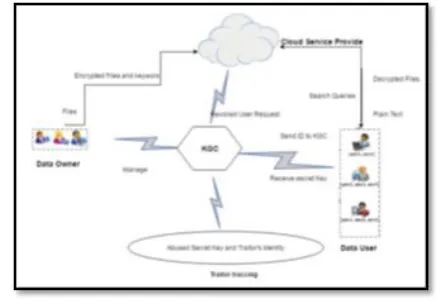
1) Data Owner
Data owner within the system registers 1st victimization authentication method. It selects the file to transfer and cipher. By victimization the public key it cypher the message into ciphertext. Once more information owner extracts multiple keywords from that message and send it to cloud controller.
2) Cloud Controller
Cloud Controller receives encrypted file and multiple keywords from data owner. It stores the data securely. Provides appropriate replies to data user queries related to message keywords. If user is malicious then user revocation is done by cloud controller.
3) Key Generation Centre (KGC)
Key generation centre (KGC) it manages the keys of data owner and data user. Provides public key to data owner to encrypt the file. It sends the identity based secret key to data user. Sends details about revoke user to cloud controller.
Fig. 1 Proposed System
4) Data User
Data user enters into system by using authentication process from KGC. It sends queries to cloud controller. Again, it sends his identity based key to KGC to get secret key and by using this secret key it decrypts the file.
5) Traitor Tracing
Traitor tracing keeps the track of users activities, if any user leak secret key knowingly or unknowingly. Traces that particular user. Sends details about that user to KGC for further user revocation process.
B.
Pseudo code
Identity-based Encryption
Decryption:-Input: Text file
Output: Encrypted file + Keywords
Step 2: Select the file F
Step 3: Take public key from key generation center to
encrypt file
Step 4: Cipher text + keywords
Step 5: Store to cloud controller
Step 6: User search file using query (keyword search)
Step 7: Send Identity key to KGC to generate Secret key
Step 8: Using secret key decrypt file to original
Step 9: End
Traitor Tracing
Input: Secret key (SK)
Output: User Revocation
Step 1: Initialization
Step 2: Provide secret key to user based on his identity
Step 3: Check if any malicious user at the time of
decryption having secret key
Step 4: Third party send request to users to leak secret key
Step 5: Those user accept the request, his all data send to
cloud
Step 5: Do User Revocation of that user by Cloud
IV.
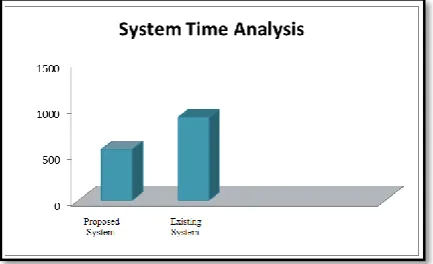
SIMULATIONRESULTSProposed system takes less time as compared to existing system. The typical time taken for secret writing and decipherment of knowledge is additional as compared to projected system in existing system whereas proposed system takes less time to encipher data. Fig 2 shows existing system time needed to write and transfer knowledge on cloud is additional whereas in projected system the time required to encrypt data and upload it to cloud is a smaller amount as compared to existing system. To transfer uploaded file from cloud is additionally quick with projected system. Fig. 3 shows total system performance of proposed system is better than existing system.
Fig 2. System Time Performance
Fig.3. Performance analysis
V.
CONCLUSIONThis project a completely unique technique Identity-based attested and economical Traceable Search System for Secure Cloud Storage. Identity-based attested information sharing (IBADS) protocol is meant supported linear pairing for cyber-physical cloud systems. At the moment incontestable the safety and correctness of the protocol, in addition as evaluating its performance. The social access of control and also the support of keyword search are vital problems in secure cloud storage system. During this work, we have a potential to outline a brand new paradigm of searchable secret writing system, and projected a concrete construction. It supports versatile multiple keywords set search, and solves the key written agreement drawback throughout the key generation procedure.
REFERENCES
[1] Z. Liu, Z. Cao, D.S. Wong, “White-box traceable ciphertext-policy attribute based encryption supporting any monotone access structures”, IEEE Transactions on Information Forensics and Security, 2013.
[2] J. Lai, R. H. Deng, C. Guan, and J. Weng, “Attribute-based encryption with verifiable outsourced decryption”, IEEE Transactions on Information Forensics and Security, 2013.
[3] R. Chen, Y. Mu, G. Yang, F. Guo and X. Wang, “Dual-Server Public-Key Encryption with Keyword Search for Secure Cloud Storage”, IEEE Transactions on Information Forensics and Security, 2016.
[4] B. Qin, R. H. Deng, S. Liu, and S. Ma, “Attribute-Based Encryption with Efficient Verifiable Outsourced Decryption”, IEEE Transactions on Information Forensics and Security, 2015
for Secure Cloud Storage”, IEEE Transactions on Information Forensics and Security, 2015
[6] X. Liu, R.H. Deng, K.K.R. Choo, J. Weng. “An efficient privacy preserving outsourced calculation toolkit with multiple keys.” IEEE
Transactions on Information Forensics and Security 11.11 (2016).
[7] W. Sun, S. Yu, W. Lou, Y. Hou and H. Li, “Protecting Your Right: Verifiable Attribute-based Keyword Search with Fine grained Owner-enforced Search Authorization in the Cloud”, IEEE Transactions on Parallel and Distributed Systems, 2016.
[8] C. Wang, N. Cao, J. Li, K. Ren, W. Lou. “Secure ranked keyword search over encrypted cloud data” IEEE 30th International Conference on Distributed Computing Systems (ICDCS).
[9] Y. Yang, X. Liu, R.H. Deng, “user Multi-Keyword Rank Search over Encrypted Data in Arbitrary Language”. IEEE Transactions on Dependable and Secure Computing, 2018 publish online.