Modification Application of Key Metrics 13x13 Cryptographic
Algorithm Playfair Cipher and Combination with Linear
Feedback Shift Register (LFSR) on Data Security
Based on Mobile Android
1
Denni Kurniawan,
2April Lia Hananto,
3Bayu Priyatna
1(Univesity Budi Luhur, Jakarta, Indonesia) 2,3(University Buana Perjuangan, Karawang, Indonesia)
---
************************
---Abstract:
Playfair cipher is a classic encryption method that is difficult to manually manipulate but apart from the advantages found in plyafair cipher there are also many shortcomings, can be solved by using the information frequency of occurrence bigram, can not enter lowercase letters, numbers and special characters when encrypting This research modifies the key matrix of playfair cryptography algorithms and combines with the Linear Feedback Shift Register (LFSR) algorithm, by changing the size of the 13x13 key matrix the playfair cipher is able to insert characters as many as 196 characters consisting of capital letters, lowercase letters. The result of calculation with avalanche effect method got average value 43,59% at playfair cipher done by modification of matrix key 13x13 and combined with LFSR generator, 2,15% at playfair cipher 10x10 matrix key without merged with LFSR and 34,41% at playfair classic 5x5. That the playfair cipher that has been modified and combined with the LFSR generator is stronger than the previous playfair cipher. The result of time complexity testing has fast encryption and decryption.
Keywords —Playfair, LFSR, cryptography, encryption, description.
---
************************
---I. INTRODUCTION
Data will be important if it produces useful information for a person or an institution or company, in general, important information will always generate high value validation in accordance with the principle of the information itself that is reliable and authenticity of the source. It does not rule out that very important and high value information can be targeted by criminals, who deliberately want to exploit the weaknesses of both conventional and modern systems such as theft and data destruction. The techniques that can be used to maintain the contents of a data is very diverse one of them is by using cryptography techniques (Chryphtography). Cryptography itself comes from the Greek word "cryptós" which means secret, while "gráphein" means writing, so if combined into "secret writing".
Currently cryptography is often used in many ways, especially to maintain information security such as confidentiality/privacy, data integrity, authentication and nonrepudiation used for authentication (Simbolon, 2016).
Examples of cryptographic techniques used both classical and modern, such as, Vigenere, Playfair, AES, RSA and many others. According to Bhat [1], the results of a comparison analysis between AES, RSA and Playfair Cipher cryptography, that Playfair Cipher excels in securing data efficiently and unambiguously. According to Mahyudin [2], Playfair Cipher should be used to disguise important messages needed quickly.
Then [3], Playfair Cipher is a classic encryption method that is difficult to manually analyze. An important component of the playfair algorithm is the
cipher table used for encrypting and decrypting the default table introduced by playfair is a table that has a matrix of size (5x5) containing the capital letters of AZ by omitting the letter J. Although the text security on the Playfair cipher algorithm this is very difficult to analyze, but it can still be solved by using the information frequency of occurrence bigram.
In addition to these problems [4], the classic Playfair cipher algorithm still has a number of weaknesses such as not being able to enter lowercase letters, numbers and special characters while encrypting. The resultant ciphertext of the playfair algorithm is easily solved when a cryptanalysis knows the ciphertext and its cipher table, although cryptanalis only knows its ciphertext without knowing that the cryptanalyst chiper table can guess the bigram by meaningful letters from a word [5]. Although by modifying the contents of the squares key by simply shifting according to the number of columns, then actually the key is repeated every 5 times. Thus this will result in a gap for conducting cryptanalysis [6].
Judging from these factors, the authors are interested in modifying the key matrix of the Playfair cryptography algorithm and combining it with other cryptographic algorithms, then implementing the modified Playfair cryptography algorithm into an application program and applied to secure data.
II. THEORETICALBASIS
A. Cryptography / Cryptography
Cryptography (cryptography) in Greek is divided into two terms namely "cryptós" which has a secret meaning, while "gráphein" means writing, from both terms combined to become "secret writing" [7]. The beginning of cryptography is the science and art to maintain the confidentiality of the message by encoding into a form that can not be understood anymore meaning. Then along with the development of cryptography is no longer limited to encrypt the message, but also provides aspects of security against attacks from cryptanalysis. Therefore, the notion of cryptografipun turned into science as well as art to maintain the security of messages [8].
B. Playfair Cipher Cryptography
Playfair Cipher is a symmetric symmetric substitution key substitution. Techniques used in conventional playfair ciphers split plaintext in sets of two characters each known as digraphs. Namely is composed of the alphabet as identification. The playfair password algorithm is formed using the 5 × 5 matrix of 25 letters created as shown in Figure II-1. The key matrix required for the encryption and description process is built by placing letters of the keyword without repetition from left to right and from top to bottom in the matrix, and then the remaining matrix completes with the remaining alphabets in alphabetical order. And change the letter "J" to "I" if it is on plaintext [9].
Figure II-1 Sample Key Matrix [9].
C. Playfair Cipher Encryption Algorithm
Before performing the encryption process, the plaintext to be encrypted is set first as follows : 1. All characters and spaces that do not belong to the
alphabet must be removed first from plaintext (if any).
2. If there is a letter J on the plaintext do the changes with the letter I.
3. Plaintext into the original message done arrangement according to the letter pair (bigram). 4. When there is a pair of the same letter then do change one letter of the letter pair with the letter Z or X insert it by using the letter X because the letter X is very minimal in the same bigram, unlike the letter Z, for example is the word FUZZY.
5. If the letters on the plaintext have an odd number then select an additional letter then add at the end of the plaintext. Additional letters can be selected for example the letter Z or X.
D. Algorithm Description Plafair Cipher
1. If there are two letters located on the same key row then each letter is changed using the letters on the left.
2. If there are two letters located on the same column then each letter is changed with the letter above it. 3. If two letters are not on the same row and column, change them to the letter in the first line intersection with the two letter columns. Then next the second letter is changed using letters at the fourth vertex of the rectangle formed from the letters used [3].
E. Linear Feedback Shift Register (LFSR)
LFSR is a register that shifts with a certain amount, output is selected and added modulo 2. Also fed back to the input register at each clock cycle. LFSR itself consists of N storage elements called stages. An N-stage LFSR is characterized by an N × N matrix, called TSR. The format and size of the TSR is based on the feedback stage dependence. Furthermore, the state is a linear function of the previous state [10].
III. SYSTEMDESIGN
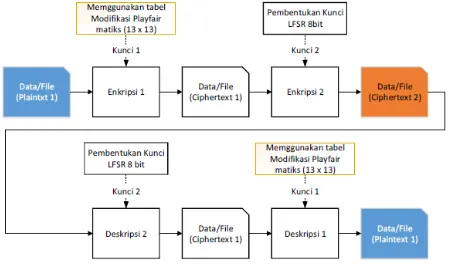
The research methodology used in this research is engineering, Theoretical Computer Science where the researcher uses a cryptographic technique with modification method of playfair algorithm table using 13x13 matrix and combining it with Linear Feedback Shift Register (LFSR) 8 bits. The process flow of systematic process from this research is poured in figure III-1 as follows:
Figure III-1 Flow of Data Security System
A. Playfair 13x13 Matic
The establishment of a 13 x 13 playfair matrix table of keys entered, in the formation of keys
consisting of letters, numbers and symbols Suppose the key example "IM @ Ululu5". The first step is a key consisting of numbers, letters or symbols should not have more than one appearance if there is such thing then remove the numbers, letters or symbols that have in common. So the key of "AkuM @ Ululu5" becomes "AkuM @ Ul5". In Table III-2 is a matrix formed from the key "AkuM @ U15":
Figure r III-2 Playfair 13x13 Matriks
B. Linear Feedback Shift Register (LFSR)
The step in the data encryption method using linear feedback Shift Register (LFSR) 8 bits, is the formation of the key matrix. Here is an illustration of the key formation process of LFSR key :
Figure III-3 Key Formation Process
Figure III-4 Establishment of LFSR Keys
In the above table enter initial input 10011001 then the resulting output is 10011001 then the next output is 00010001 and so on until (n). Then the resulting output compiles into a matrix of size (2 × n) where length (n) is based on the length of the row contained in ciphertexts which has been generated from the 1st encryption process, using playfair cipher.
IV. RESULTANDDISCUSSION
A. Construction User Interface
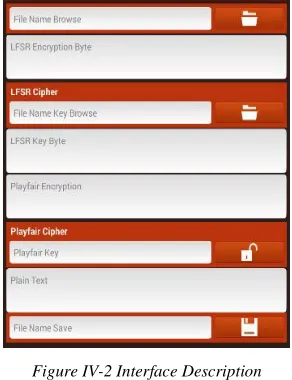
The built application user interface can be seen in Figure IV-1 and Figure IV-2 :
Figure IV-1 Main Interface Application and Encryption
Figure IV-2 Interface Description
B. The results of the 13x13 Playfair Cipher Matrix Cryptography Test and merged with LFSR
In the test of ciphertexst randomness is done as much as 30 experiments with different sample parameters that is based on the size of the file, the length of ciphertext characters and the same key. Results obtained from experiments using the application is calculated using the Avalanche Effect method with the formula :
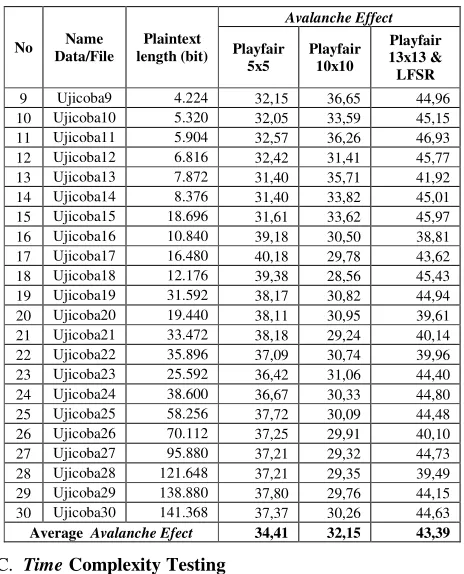
Where the number of bit changes obtained from the results of XOR calculation between plaintext with ciphertext first converted into binner number, then to prove that the modification of playfair algorithm with 13x13 key matrix and combined with LFSR have higher value of ciphertext randomness, then made comparison with previous method . Here is the result of the comparison of ciphertext randomness test can be seen in Table IV-1 :
Table IV-1 Comparison of Ciphertext Randomness Test Results
No Name
Data/File
Plaintext length (bit)
Avalanche Effect
Playfair 5x5
Playfair 10x10
Playfair 13x13 & LFSR
1 Ujicoba1 112 26,79 31,25 40,18
2 Ujicoba2 472 30,93 35,17 41,31
3 Ujicoba3 943 28,74 33,19 45,07
4 Ujicoba4 1247 29,35 34,64 41,06
5 Ujicoba5 1.961 29,73 35,90 46,51
6 Ujicoba6 2.232 32,21 32,39 39,87
7 Ujicoba7 3.480 31,75 33,33 45,34
No Name Data/File
Plaintext length (bit)
Avalanche Effect
Playfair 5x5
Playfair 10x10
Playfair 13x13 & LFSR
9 Ujicoba9 4.224 32,15 36,65 44,96
10 Ujicoba10 5.320 32,05 33,59 45,15
11 Ujicoba11 5.904 32,57 36,26 46,93
12 Ujicoba12 6.816 32,42 31,41 45,77
13 Ujicoba13 7.872 31,40 35,71 41,92
14 Ujicoba14 8.376 31,40 33,82 45,01
15 Ujicoba15 18.696 31,61 33,62 45,97 16 Ujicoba16 10.840 39,18 30,50 38,81 17 Ujicoba17 16.480 40,18 29,78 43,62 18 Ujicoba18 12.176 39,38 28,56 45,43 19 Ujicoba19 31.592 38,17 30,82 44,94 20 Ujicoba20 19.440 38,11 30,95 39,61 21 Ujicoba21 33.472 38,18 29,24 40,14 22 Ujicoba22 35.896 37,09 30,74 39,96 23 Ujicoba23 25.592 36,42 31,06 44,40 24 Ujicoba24 38.600 36,67 30,33 44,80 25 Ujicoba25 58.256 37,72 30,09 44,48 26 Ujicoba26 70.112 37,25 29,91 40,10 27 Ujicoba27 95.880 37,21 29,32 44,73 28 Ujicoba28 121.648 37,21 29,35 39,49 29 Ujicoba29 138.880 37,80 29,76 44,15 30 Ujicoba30 141.368 37,37 30,26 44,63
Average Avalanche Efect 34,41 32,15 43,39
C. Time Complexity Testing
In this time complexity testing done 30 times experiment with different sample parameters that is based on the size of the file and the length of the character ciphertext. This time complexity testing is obtained from the application during encryption process and description. After that done the average calculation time of encryption and description. Here is the result of time complexity test between Playfair 13x3 key matrix and merged with LFSR, Playfair classic martick lock 5x5 and Playfair 10x10 key matrix can be seen in Figure IV-3, Figure IV-4. Figure IV-5 and Figure IV-6 :
Figure IV-3 Complexity of Encryption Time
Figure IV-4 Average Encryption Time
Figure IV-5 Complexity Time Description
Figure IV-6 Average Time Description
V.CONCLUSIONS
characters as much as 196 characters consisting of capital letters, lowercase letters, numbers and some symbols. The result of avalanche effect calculation is got the mean value of playfair cipher algorithm done by modification of 13x13 matrix key and combined with LFSR generator 43.59%, playfair cipher algorithm performed 10x10 matrix modification without merged with LFSR of 32.15% and classical playfair algorithm 5x5 matrix without combined with LFSR of 34.41%.
This shows that the playfair cipher algorithm with 13x13 matrix and combined with the LFSR generator has a more random ciphertext than the previous playfair cipher and it can be concluded that the modified playfair cipher and combined with the LFSR generator is stronger than the previous playfair cipher, making it more difficult cryptanalysis in analyzing the bigram. Time stamp counter (TSC) time encryption test results obtained 22.57 seconds encryption time average on Playfair 13x13 method combined with LFSR, 1.44 sec on 10x10 Playfair method and 1.71 seconds on classical Playfair 5x5 method, while the average descriptions time of 1.25 seconds on the 13x13 Playfair method combined with LFSR, 1.13 seconds on the Playfair 10x10 and 1.14 sec methods on the classical 5x5 Playfair method. The value of the 13x13 Playfair method combined with LFSR is even greater than the Playfair 10x10 and Playfair 5x5 methods but the
three methods are classified as having fast encryption and decryption times.
REFERENCES
[1] K. Bhat, D. Mahto, and D. K. Yadav, “Vantages of Adaptive Multidimensional Playfair Cipher over AES-256 and RSA-2048,” vol. 8, no. 5, pp. 2015–2017, 2017. [2] K. Bhat, D. Mahto, and D. K. Yadav, “a Novel Approach
To Information Security Using Four Dimensional ( 4D ) Playfair Cipher Fused With Linear,” vol. 8, no. 1, pp. 15– 32, 2017.
[3] Nurkifli, E. H. (2014). Modifikasi Algoritma Playfair dengan matriks 12x12, (Sentika).
[4] H. Tunga and S. Mukherjee, “A New Modified Playfair Algorithm Based On Frequency Analysis,” vol. 2, no. 1, 2012.
[5] J. Choudhary, R. Kumar Gupta, and S. Singh, “a Generalized Version of Play Fair Cipher,” Compusoft, vol. 2, no. 6, pp. 176–179, 2013.
[6] E. Andriana and E. Andriana, “Algoritma Enkripsi Playfair Cipher Algoritma Enkripsi Playfair Cipher,” no. May, pp. 0–5, 2016.
[7] R. W. Simbolon, “Cipher Dan Steganografi Dengan Teknik Least Significant Bit ( Lsb ) Protecting The Student Academic Transcript Using Playfair Cipher Cryptography,” vol. 5, no. 1, pp. 59–70, 2016.
[8] G. H. Ekaputri, “Super-Playfair , Sebuah Algoritma Varian Playfair Cipher dan Super Enkripsi.”
[9] T. Nafis, M. Sadiq, and N. Siddiqui, “Addendum of Playfair Cipher in Hindi,” vol. 10, no. 5, pp. 977–983, 2017.
![Figure II-1 Sample Key Matrix [9].](https://thumb-us.123doks.com/thumbv2/123dok_us/8800638.1771672/2.612.372.488.239.351/figure-ii-sample-key-matrix.webp)