Copyright © 2014 CTTS.IN, All right reserved 301
Comparative Study of Traditional Material Management and
Material Management with ICT Application
Nawaj Kalim Hannure1, Sushma Shekhar Kulkarni2
1
P.G.Scholar, Department of Civil Engineering, Rajarambapu Institute of Technology, Islampur, Maharashtra, India 2
Director, Rajarambapu Institute of Technology, Islampur, Maharashtra, India [email protected]
Abstract – For management of a productive and cost efficient site, efficient material management is very essential. Research has shown that construction materials may constitute more than 50% of the total cost for a typical construction project. Therefore the proper management of this single largest component can improve the productivity and cost efficiency of a project and help to ensure its timely completion. One of the major problems in delaying construction projects is poor material management. The material management system attempts to insure that the right quality and quantity of materials are appropriately selected, purchased, delivered and handled on site in a timely manner and at a reasonable cost. This paper contains the different methods used by the construction companies and also describes the main results of survey carried out in Pune in different construction companies for their current material management process.
Keywords – Material management, Construction materials, ICT
1. I
NTRODUCTIONFor every construction industry material is required. In construction projects materials constitute major cost. Generally the cost of materials contains 50% to 60% of total cost of the project. In construction projects, material management is carried out to minimize wastage of material, shortage of material, damage of material, lack of storage space, and delay in supply.
1.1. Material management
Material management is a scientific technique, concerned with planning, organizing and control of flow of materials, from their initial purchase to destination. Material management contains mainly 4 processes i.e. planning, procurement, logistic and inventory.
1.2. Material management problem
The current manual material management process is unsatisfactory because they are labor intensive, inaccurate and error prone. In Pune, during survey following were the main manual material management problems found in construction companies.
1) Manual error 2) More paper work
3) Details cannot be found easily 4) Punctuality is less
5) Difficult to take on site decision 6) Easy updating is not possible
7) Exact location of material cannot be found 8) Lengthy procedure
9) Communication problem 10) Papers are missing
1.3. Objectives of material management Efficient material planning Buying or purchasing Procuring and receiving Storing and inventory control Supply and distribution of material Quality assurance
Good supplier and customer relationship Improved departmental efficiency
To fulfill all these objectives there should be good co-ordination between all the employs of material management department and also this department should have good co-ordination with other departments in the organization.
1.4. Functions of material management
To fulfill the above stated objectives the functions of the material management are also categorized.
(i) Primary Functions
Materials Requirements Planning (MRP) Purchasing
Inventory Planning and Control
Ascertaining and Maintaining the Flow and Supply of
Materials
Quality Control of Materials Departmental Efficiency (ii) Secondary Functions
Standardization and Simplification Make and Buy Decisions
Coding and Classification of Materials Forecasting and Planning
2. P
REVIOUSR
ESEARCHW
ORKCopyright © 2014 CTTS.IN, All right reserved working for more than 10 years in Sarwak. They found
that, at the planning and procurement stage more ICT tools are used than the logistic and inventory. They found that modern technology like RFID and bar code has not been utilized and considered as nonexistent in construction firms for material management because of its high cost.
Khyomesh V. Patel, Prof. Chetna M. Vyas (2011) had discussed about benchmarking process for waste control in building material. They have discussed the objectives and functions of material management. They discussed the process of material management i.e. planning, purchasing receiving, inspection, stacking and storage, issuing material. They have taken survey of material management in Ahmadabad of 3 known builders. They found that there should be centralized material management team co-ordination between the site and the organization. In construction industry there should be proper control, tracking and monitoring of the system is required and also awareness & accountability should be created within the organization.
N. B. Kasim, Peniel Ang Soon Ern (2010) had discussed process of material management. They have taken interview and questionnaire survey of A class contractors in Malaysia. The questionnaire survey was taken on implementation of ICT and interview was taken on acceptance of ICT for material management. They found that, main barrier of implementation of ICT is high cost and there was just average level of acceptance of ICT by the industries. In construction industries, for material management Microsoft office and handheld devices are widely adopted but bar code and RFID tools are not adopted.
Narimah Kasim (2011) worked in that area. He has discussed the process of material management. He found out the problems in material management such as lack of site storage spaces, small unloading area. ICT can reduce the level of confusion regarding the materials delivery from suppliers. He has taken a survey of „A‟ class contractor in Malaysia regarding implementation of ICT and discussed their results. The main reasons of resistance towards the increased level of implementing ICT in materials management are due to the high cost of investment.
Narimah Kasim, Rozlin Zainal, Alina Shamsuddin, Naadira Che Kamarudin (2012) The poor material management can affect the overall construction time, quality and budget. Generally the material management information is shared by papers which are error prone. They have discussed the materials management on
construction projects and potential to employ RFID in materials management practices. For large projects material management, complexity always increases. According to them the ICT can give good facility for these large projects.
2.1. Objectives of the study
To survey construction industries to study and analyze the present practices of material management.
To see how many construction industries use Information Communication Technique (ICT) tool for material management.
Apply and analyze the effect of Information Communication Technique (ICT) on material management.
To compute variance in traditional and Information Communication Technique (ICT) applied material management process.
2.2. Methodology
3. C
ASES
TUDYIn Pune, seven construction companies were surveyed regarding their current material management process. This survey was questionnaire based survey. The survey was taken regarding acceptance of ICT, its benefits and main barriers of implementation of ICT.
TABLE (1) ANALYSIS OF SURVEYD CONSTRUCTION COMPANIES FOR MATERIAL MANAGEMENT
Name of Company
Company 1 Company 2 Company 3 Company 4 Company 5 Company 6 Company 7
Type of project
Residential Residential, SEZ, School,
Malls
Residential, Commercial
Residential, Commercial
Residential, commercial, PMC project
Residential Residential, Commercial, Educational, Infrastructure Cost of project
( Cores)
112 5000 2.5 15 125 25 3000
Is MM carried out?
Copyright © 2014 CTTS.IN, All right reserved
Total cost of materials (%)
60 60 60 70 60 50 60
Method adopted for MM process
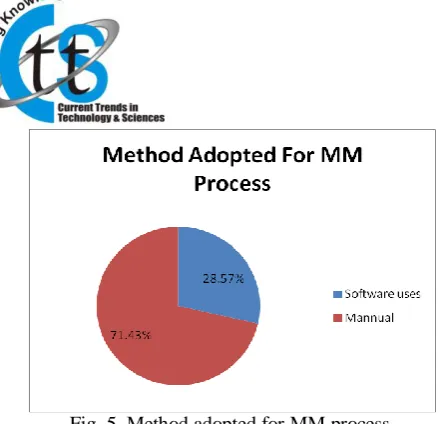
Manually Software Manually Manually Manually Manually Software
Type of software used
- ERP
(High-Rise)
- - - - SAP
Satisfaction of Current MM
process?
Yes Yes No No No Yes Yes
Benefit of current MM
Less cost, Easy to understand Get details easily, Updating easily possible, Gives correct stock Less cost, Less man power, Non technical person can handle Maintain stock, Less cost, Easy to understand
Less manpower, Cost is less
Less cost, Non technical Person can operate Reduce wastage, Easily contact with others Problem facing in current MM Manual error, More paper work, Easily details cannot find out, Easily cant update
No Manual
error, Exact location can‟t find
Manual error, More paper
work
No accurately operation
Manual error Skilled person requires but
satisfied
JIT concept used?
No Y (for some
material)
No No Y (for some
material)
No No
Bar code technique
used?
No No No No No No No
Benefit of ICT Accurate
work, Wastage of material reduces, Exact data of consumption and stocked material Good communication, Easily find location and consumption of martial, Reduces paper work Maintain stock well, Reduces manual error Time management, Reduces paper work, Easily communication Easily location, Get information of branded material is not,
Reduces manual error, Computerizing reduces work Automatic recoding, Maintained record very well Easily communication Barriers of implementing ICT High cost, Board of directors Not advisable to construction industry, High cost More man power, Technical person requires
High cost More
manpower
High cost Not possible in construction
industry
4. R
ESULTSAfter completion of questionnaire survey, following outcomes commemorated regarding material management system from the various construction companies.
4.1. Benefits of manual material management process For small site it is beneficial.
In Construction Company if only one project is going on then it is beneficial
Unskilled workers or non technical person can carry out
Less cost
It is easy to understand It requires less man power
4.2. Disadvantages of manual material management process are
Paper work increases Manually error occurs
Difficult to find details Not easy to find updates Missing of papers occurs
4.3. Benefits of ICT technique in construction
Can easily find out exact consumption of materials
Can easily get stock of materials and locations of materials
Accuracy increases
By only one click, one can easily get all details It can be useful in planning and procurement of materials
Wastage of materials get reduced Work becomes easy
Manual errors get reduced
Copyright © 2014 CTTS.IN, All right reserved It is easy to communicate or share the
information regarding materials
4.4. Barriers of implementing ICT technique in construction
High initial cost
It requires more man power to apply a tag Each material cannot be bar coded eg. coarse aggregate, fine aggregate, ready mix concrete etc by using bar code
Need to train workers
Open ended questions and detail discussion with the project managers were carried out and answers were received and it was concluded that maximum ICT tools were being used in planning and procurement stage while minimum ICT tools were being used in logistic and inventory stage.
4.5. Different ICT tools used in planning stage are showed in fig no. 1.
Fig. 1. ICT techniques used in planning stage
1. 100 % companies were using Microsoft excel, printer and PC type ICT tools in planning stage. 2. 14.29 % companies were using SAP, ERP
software and smart phone ICT tool in planning stage.
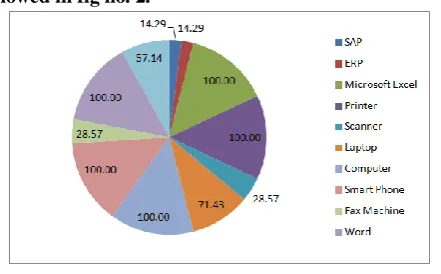
4.6. Different ICT tools used in procurement stage are showed in fig no. 2.
Fig. 2. ICT techniques used in procurement stage
1. 100 % companies were using Microsoft excel, printer, computer, smart phone and word type ICT tools in procurement stage.
2. 14.29 % companies SAP and ERP software were using in procurement stage.
4.7. Different ICT tools used in logistic stage are showed in fig no. 3.
Fig. 3. ICT techniques used in logistic stage
1. 100 % companies were using Microsoft excel, smart phone, word and PC type ICT tools in logistic stage.
2. 28.57 % companies were using scanner ICT tool in logistic stage.
4.8. Different ICT tools used in inventory stage are showed in graph no. 4.
Fig. 4. ICT techniques used in invrntory stage
1. 100 % companies were using computer ICT tool in inventory stage.
2. 14.29 % companies were using fax machine ICT tool in inventory stage.
5. D
ISCUSSIONCopyright © 2014 CTTS.IN, All right reserved Fig. 5. Method adopted for MM process
For their current material management process Company No. 1, Company No. 2, Company No. 6 and company No. 7 these construction companies were satisfied for their current material management process. The project managers of Company No. 3, Company No. 4 and Company No. 5 these construction companies were not satisfied for their current material management process. Figure 2 shows the satisfaction of current material management process. 57.14% companies are satisfied for their current material management process and 42.86% companies are not satisfied for their current material management process.
Fig. 6. Satisfaction of current MM process
According to project manager of Company No. 3, there should be advanced technique used rather than manual for material management. Not even a single construction company is using RFID or bar code technique for material management. Some companies are trying to use zero-inventory or just in time concept but for every material it‟s not possible because high risk of work stoppage is involved. The ICT technique is having lot of advantages but it is having barriers also. Its high initial cost is the main barrier. Generally construction companies contain more than one board of directors. So, if one agrees to implement other will not, that is also main barrier found out during survey.
6. I
MPLEMENTATION OFICT
T
ECHNIQUEA
CTUAL ONS
ITEThe ICT technique i.e. bar code was implemented on a site for 2 flats. During survey it was found that, for implementation of bar code technique in construction companies it will require more manpower but during
implementation of bar code technique actually on site it was found that no extra manpower was required. But if huge amount of material is there then there may be extra labor required. Table 2 shows that the average percentage cost of materials saved by ICT technique without considering implementation cost is 6.35%. Average percentage cost of materials saved by ICT technique with considering implementation cost but without extra labor cost is 4.47%. It also shows the net present value, profitability index and pay back period of bar code system (printer, scanner, bar codes) considering life of bar code system is 7 years and interest rate 11%
Table (2) Results
Average % cost of materials saved
NPV PI PBP
ICT without considering implementation cost
6.35% Rs.396500 19.02 3 months
ICT with implementation cost
but without considering extra
labor cost
4.47% Rs.270200 13.27 5 months
6.1. Problems faced during implementation of bar code
There should be clear line of sight between scanner and bar code.
Bar code scanner has short range.
Bar code scanner is hard to read in heavy sun light. The bar codes may be damaged by heavy dust. It should be made sure that the codes are properly stuck to the materials. There are chances of removing codes.
Each construction material can not be managed by bar code eg. steel, binding wire, coarse aggregate, fine aggregate
7. C
ONCLUSIONCopyright © 2014 CTTS.IN, All right reserved
A
PPENDIXTo carry a survey regarding material management in construction companies following questionnaire were prepared.
SR. No. Details
1 Name of organization 2 Name of owner
3 Address of organization 4 Address of site
5 Year of establishment of organization 6 Turnover of organization
7 Which types of projects are going on? 8 Cost of the project
9 Telephone No. 10 Email address
Sr. No. Questions Yes No
1 Do you carry out material management on your site?
2 Are you satisfied with current material management process? 3 Are there any benefits of current material management process? 4 Are there just in time concept is used?
5 Is there schedule of procurement of materials are prepared?
6 Are you using any ICT (Information Communication Technology) tool for material management?
7 Are you satisfied with ICT (Information communication Technology?) 8 Are material management details have been discussed within the
organization?
9 Is there any type of software is used for material management?
Sr. No.
Questions Comment
1 From when you are using material management process in your industry?
o None
o 6 Months
o 1 Year
o 1.5 Years
o 2 Years
o 2.5 Years
o 3 Years
o 5 years
o More than 5 years 2 In which activity material management process is carried
out?
o Planning
o Purchasing
o Receiving
o Inspection
o Inventory
o Logistic 3 Which method you have adopted for material
management process?
o Manually
o Bar Code
o RFID
o Handheld Devices
o Software
o Any other 4 Which type of software is used for material
management?
o ERP
o Primavera
o Microsoft project
o Any other
o None
5 What is the cost of the tool used for material management?
Copyright © 2014 CTTS.IN, All right reserved 7 Which are the costly materials used on site?
8 How many storage locations are used on site?
Category of material Type of materials Cost of material Quantity of material A
B C
1. Why you use material management in your construction industry?
2. What is the process of material management? 3. If not, why you don‟t carry out material
management in your construction industry? 4. What are the benefits of current material
management process?
5. What are the problems you are facing in current management process?
6. How order of the materials has been placed? 7. How you record and maintain the quantities of
materials which are consumed and stored? 8. Why you don‟t adopt “just in time” concept? 9. What is the time lag between procurement of
materials and using of materials?
10. For which purpose are you using ICT (Information Communication Technology) tool?
11. What are the benefits of ICT (Information Communication Technology) implementation? 12. What are the barriers towards ICT (Information
Communication Technology) implementation? 13. By using bar code which type of materials can be
manage?
A
CKNOWLEDGMENTAuthors are thankful to Mr. Dileep Thakurdesai for his encouragement and valuable guidance all the time and also to the project managers of surveyed companies.
R
EFERENCES[1] Narimah Kasim, “ICT Implementation for Materials Management in Construction Projects: Case Studies”, KICEM Journal of Construction Engineering and Project Management, pp.31-36, 2011.
[2] Khyomesh V. Patel, Prof. Chetna M. Vyas, “Construction materials Management on Project Sites”, National Conference on Recent Trends in Engineering & Technology, pp. 1-19, 13-14 May 2011.
[3] P. Gopalkrishnan, M. Sundaresan, “Materials Management an Integrated Approach”, Prentice Hall Of India Private Limited, pp. 5-7, 2005. [4] N. B. Kasim, Peniel Ang Soon Ern, “Awareness
of ICT Implementation for Materials Management in Construction Projects”, Int. J. of Computer and Communication Technology, Vol. 2, No. 1, pp. 1-10, 2010.
[5] Narimah Kasim, Rozlin Zainal, Alina Shamsuddin, Naadira Che Kamarudin, “Implementation on RFID Technology for
Real-Time Materials Tracking Process in Construction Projects”, IEEE Colloquium on Humanities, Science & Engineering Research (CHUSER 2012) Kota Kinabalu, Sabah, Malaysia, pp. 472-476, 3-4 December 2012. [6] Fara Diva Mustapa, Muzani Mustapa, Mohd
Saidin Misnan, Syamsul Hendra Mahmud, “ICT Adoption in Materials Management among Construction firms in Construction Industry”, IEEE Colloquium on Humanities, Science & Engineering Research, pp. 346-350, 2012. [7] Javad Majrouhi Sardroud, “Influence of RFID
technology on automated management of construction materials and components”, Scientia Iranica A, Vol. 19, No.3, pp. 381–392, 2012.
[8] Shivang Patel ”Import And Export Script” ETA-Melco Elevator Co. L.L.C., pp. 9-16, 2005. [9] Vanita Ahuja, Jay Yang, Ravi Shankar, “Study
of ICT adoption for building project management in the Indian construction
industry”, Automation in Construction, Vol. 18, pp. 415-423, 2009.
[10] Weisheng Lu, George Q. Huang, Heng Li, “Scenarios for applying RFID technology in construction project management”, Automation in Construction, Vol. 20, pp. 101-106, 2011. [11] A.K. Chitale and R.C. Gupta, “Materials
Management Text and Cases”, Prentice Hall Of India Private Limited, pp. 2-35, 2006.
[12] Dr. C.M. Sadiwala, Ritesh C. Sadiwala, “Materials and Financial Management”, New age international (p) limited, Chapter 1, pp. 1-10, 2007.
[13] www.scribd.com/doc/218971035/construction-material Apr 18, 2014 -
[14] www.theglobaljournals.com/ijar/file.php?val=A pril_2014...9479c...Apr 19, 2014
[15] www.coastalpacificpm.com/material-management.html Jul 7, 2012
[16] www.iiste.org/Journals/index.php/CER/article/v iewFile/5481/5581- - Related articles May 28, 2013