Research Journal
Volume 7, No. 20, Dec. 2013, pp. 47–54
DOI: 10.5604/20804075.1073057 Research Article
Received: 2013.09.19 Accepted: 2013.10.14 Published: 2013.12.06
INVESTIGATION AND ASSESSMENT OF OCCUPATIONAL RISK
ON THE METAL CUTTING MACHINE TOOL STAND
Jerzy Józwik1, Paweł Pietras2
1 Department of Production Engineering, Mechanical Engineering Faculty, Lublin University of Technology
36 Nadbystrzycka Str., 20-816 Lublin, Poland, e-mail: [email protected]
2 Graduate student of Mechanical Engineering Faculty, Lublin University of Technology, Poland
ABSTRACT
The paper analyzes occupational risk at selected metal cutting machine tool stands (turning, milling, drilling and grinding stands) and presents a set of recommendations formulated to minimize hazards at the above mentioned stands. The assessment is based on the analysis that allowed for selecting the best method of occupational risk assessment, measurements, observations, interviews and conclusions drawn from the obtained results. Occupational risk assessment forms were devised, what allowed for selecting appropriate action to increase the safety of selected machinery operators. The guidelines were assessed in terms of their practical implementation and expected utilitarian results.
Keywords: occupational risk, metal cutting machine tools, acoustic hazards, vibra-tions, occupational risk assessment forms.
INTRODUCTION
Metal machining is the most common manu-facturing method that the machine industry de-velopment is based on. The observed trends of increasing efficiency of metal machining entail increasing machinery operating speeds, which, in turn, increases the risk of accidents at such stands. The most common hazards include: all kinds of mechanical injuries, exposure to high levels of noise, body exposure to vibrations, risk of elec-tric shock, high temperature of chips, chemical substances present in cutting tool lubricants and their toxic fumes. These hazards pose a certain risk for operators of machine tool stands. In order to be reduced, occupational risk should first be as -sessed, as only then the sources of main hazards can be identified and eliminated. Under point 7 of §2 of the general health and safety regulations and the norm PN-N-18002:2000, occupational risk is defined as: „the probability of undesired events connected with the performed work caus-ing damage, particularly adverse health effects of
employees, due to occupational hazards resulting from work environment or manner of work” [13]. Occupational risk is comprised of many fac-tors; under §39 of the general health and safety regulations, they are divided into 8 categories: in-juries, diseases, occupational diseases, employee health, harmful and dangerous factors, employee qualifications, state of safety and health at work, and many others [1–4].
The concept of occupational risk pertains to all economic activities. Apart from casualties, it also involves material losses. Yet, given that un-der labor law the human being is consiun-dered the most important, it was therefore decided that oc-cupational risk should always concern human re-sources [5-24].
OBLIGATION OF OCCUPATIONAL RISK
ASSESSMENT
type and level of harmful, dangerous and noxious factors in workplace. This obligation pertains to all work positions and is regulated by relevant laws [19].
Under article 226 of the Labor Code, every employer is obliged to assess and record occupa-tional risk involved in work performed, to inform employees about occupational risk and safety measures protecting from hazards as well as to administer essential preventive measures reduc-ing the risk.
Under §39 of the general health and safety regulations issued by the Minister of Labor and Social Policy, the employer is obliged to conduct and record occupational risk assessment. The em-ployer is obliged to take records of the adminis-tered essential preventive measures [18].
The above requirements result from the Eu-ropean Union directives. Under article 6 of the framework directive 89/391/EWG, employers should prevent occupational risk by minimizing hazards to safety and health of their employees. The employer is required to follow the rules spec-ified in the above mentioned directive which in -clude: hazard prevention, assessing hazards that cannot be eliminated, eliminating sources of haz-ards, implementing new technological solutions, replacing dangerous operations with operations that pose less danger or no danger at all, proper training and instruction of the staff, proper pre-ventive policy and its coherent development, giving priority to collective preventive measures over individual preventive measures [18].
According to the latest amendments to the Labor Code, that is, the revised version of article 235, effective from July 3, 2009, the employer is obliged to determine causes of occupational dis-eases as well as the character and extent of haz-ards causing these diseases. The definition of oc -cupational disease was transferred to the Labor Code from the law on social security in respect of accidents at work and occupational diseases [6].
Under article 227 of the Labor Code, employ-ers are obliged to counteract occupational dis-eases. To this aim, they should administer mea-sures that prevent occupational diseases and other diseases involved in the performed work. These measures include: keeping in proper operational condition, both devices that limit or eliminate health-harmful factors in work environment and devices that are used to measure these factors, conducting at their own expense the examination and measurement of factors harmful to health, to
record and store the examination results, as well as to make them accessible to employees [19].
Even though legal regulations do not un-equivocally name the person responsible for con-ducting occupational risk assessment, it should be conducted by competent persons (a company employee, external consultant, etc.). The norm PN-N-18002:2000 recommends that the follow-ing data be used in assessfollow-ing occupational risk: information about stand localization and tasks performed there, information about employees operating the stand, particularly about those to whom special criteria are applied such as preg-nant women, young and inexperienced employ-ees or the disabled. Occupational risk assessment involves conducting relevant analyses (technical analysis of machinery and devices used, instruc-tions for stand operators, etc.), measurements of harmful or dangerous factors that occur at the stand (allowable concentration values and other values determined for a given stand according to the legal regulations and norms [13]), visual inspections and staff interviews (gathering in-formation about work measures used, preventive measures, materials and performed operations as well as the manner and time of performing these operations by the employees). The analysis of im-measurable values should be performed, most of all, by close observation of work environment, manner of performing work at a given stand and outside it, as well as by conducting invaluable staff interviews [13].
Those who conduct occupational risk assess-ment should possess appropriate knowledge and information about the following: identified haz -ards, risk types and how they are posed; materi -als, machines and technologies used at work; wok procedures and organization; staff exposure to materials used; type, probability, frequency and duration of hazard exposure; effects of exposure to certain harmful factors; norms and legal re -quirements concerning risk types at a given work-place. Such persons need to know and understand the rules and the idea of occupational risk assess-ment; additionally, it is recommended that they should be capable of inventing corrective or/and safety measures and of assessing their effective-ness [6].
earlier, effects, accidents, occupational diseases, failures that have taken place, etc. [13].
Risk level assessment connected with the work performed at a given stand should be con-duced whenever new stands are introcon-duced or the existing stands are to be changed. Occupational risk assessment is also necessary when techno-logical process or work organization is to be mod-ified. Also, such analysis should be conducted for preventive reasons in order to avoid hazards re-sulting form the worsening of machinery opera-tional condition, staff rotation or other factors that went undetected in previous inspections [13].
PURPOSES OF OCCUPATIONAL RISK
ASSESSMENT
The main purposes of conducting occupation-al risk assessment include:
• identifying hazards which occur on the tested stands,
• determining the probability of their occur-rence,
• determining the effect of the identified hazards on employees and work environment,
• selecting the optimal stand equipment, materi-als, safety measures and methods of work or-ganization, and, having identified the hazards, even selecting adequate employees to operate such stands, [16]
• establishing priorities concerning the reduc-tion or total eliminareduc-tion of hazards [16], • constant improvement of safety and health at
work [16],
• demonstrating to both employees and control bodies (e.g. National Labor Inspection agents) that the risk is known and appropriate mea-sures to eliminate it have been taken.
Occupational risk assessment begins with determining machine function, together with the
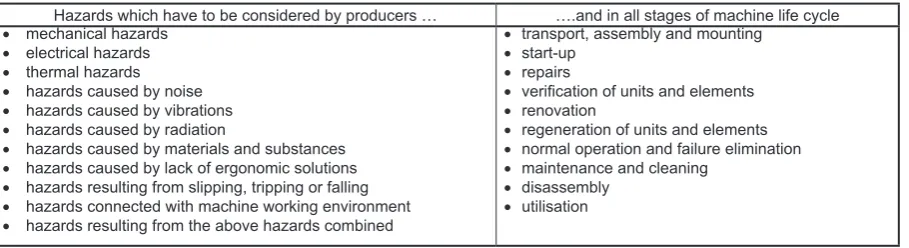
production profile of this machine, its efficiency, materials used, spatial limits and application type, planned cycle life, functions and modes of operation, predicted machine malfunctions and probable failures, employees responsible for op-erating the machine, and involuntary machine operation or its reasonably predictable misuse. Examples of involuntary machine operation or its reasonably predictable misuse include: ma-chine control loss, reflex action in the case of machine malfunction, failure or damage, im-proper behavior resulting from concentration loss or inattention, operating the machine in an irresponsible manner, haste, etc. When assessing occupational risk, hazards taken into consider-ation should include both the ones that may oc-cur at the stage of determining machine func-tions (design, production) and, most important-ly, those that may occur at all stages of machine life cycle (Table 1).
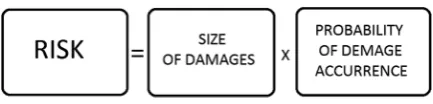
Having identified the hazards, risk assess -ment for every hazardous situation being consid-ered (for all hazards) should be conducted. The risk depends on such factors as the level of dam-age caused by a given hazard (L – low, M – me-dium, H – high) and the probability of damage occurrence (Figure 1), resulting from exposing an employee or employees to the hazard, a haz-ardous event and technical and human capabili-ties of preventing or limiting the damage.
Occupational risk assessment can be con-ducted using various tools, such as risk tables, risk charts, numerical methods, and the like. When assessing occupational risk based on risk calculation results, it needs to be established if safety measures are necessary to be taken and when the required risk reduction is to be obtained. Risk assessment results need to be recorded. The risk assessment records should include the procedure applied and results ob-tained, as well as such data as machine
tech-Hazards which have to be considered by producers … ….and in all stages of machine life cycle • mechanical hazards
• electrical hazards • thermal hazards • hazards caused by noise • hazards caused by vibrations • hazards caused by radiation
• hazards caused by materials and substances • hazards caused by lack of ergonomic solutions • hazards resulting from slipping, tripping or falling • hazards connected with machine working environment • hazards resulting from the above hazards combined
• transport, assembly and mounting • start-up
• repairs
• verification of units and elements • renovation
• regeneration of units and elements • normal operation and failure elimination • maintenance and cleaning
• disassembly • utilisation
nical details, assumptions made, all identified hazards and dangerous situations, events, data used and their sources, description of safety measures applied, description of risk-reduction aimed that are feasible using the safety mea-sures applied, residual risk connected with a given machine, documents prepared in the course of risk assessment.
METHODS OF OCCUPATIONAL RISK
ASSESSMENT
There are numerous methods of occupational risk assessment. Given the accuracy of risk as-sessment and type of data, the methods can be divided into two categories: qualitative and quan-tative [2, 16–22].
The qualitative methods are employed if there is no access to statistical databases provid-ing such information as number and type of ac-cidents, dangerous events, occupational diseas-es, time of exposure to harmful factors, and the like [2]. If there is no access to such information, one of the methods of event occurrence should be employed. The risk (R) can be expressed as a function (2).
R = f(P, S) (1)
where: S – the outcomes caused by the event, P – the probability of outcome occurrence, R – the assessed occupational risk.
This value can be determined in a descrip-tive manner (linguistically, qualitadescrip-tively) or by means of numbers (quantitatively). The outcome probability employed in the qualitative methods is not mathematically defined, but it is rather a measurement which states that outcomes of dif-ferent events are assessed at difdif-ferent levels. The risk is expressed as a combination of event fre-quency (probability) and consequences of their outcomes. The qualitative methods include: Pre-liminary Hazard Analysis (PHA), Risk Score, the method of five steps to risk assessment, risk graph and risk matrices according to the norm PN-N-18002 [2].
EXPERIMENTAL TESTS AND THEIR
RESULTS
Operating metal working machine stands al-ways poses numerous hazards, the applied safety measures notwithstanding. A vast number of such hazards occur over time and they are impos-sible to avoid. This results, among others, from changes in work environment, machinery wear, failures, and ignoring the industrial safety regula-tions on part of employees [2]. The Polish Norm PN-80/Z-08052 – Work protection. Dangerous and harmful factors in the work process describes hazards that should be taken into consideration when assessing occupational risk, yet not all of the hazards listed therein pertain to machining stands. Out of these hazards, 7 most important ones have been selected for the sake of the pres-ent paper. They include: exposure to high noise level, vibrations (measurable factors), risk of fall-ing down on the same level, injures caused by movable machine parts, the risk of being thumped or cut by protruding machine elements, the risk of burns and electric shock [8]. The fundamen-tal safety measures against the above hazards in-volve proper machinery arrangement and using shields protecting against injuries caused by chips and cooling agent splashing. Each stand should be equipped with a valid industrial safety manual. As for the measurable factors, periodic inspec-tions of their maximum allowable concentration (MAC) and maximum allowable intensity (MAI) should be conducted. The pathway distance be-tween the machines should be of at least 0.75 m, and there should be 2 m2 of free floor space per
employee. The room should be provided with proper lighting and ventilation [2].
The study was undertaken to assess occupa-tional risk involved in operating metal cutting machine tools such as: turning lathes – S-32, Cu-401 and C-11; milling machines – FWF-32, FYA -32 and FNB-26, drilling machines: WS-15 and WKA-25; as well as grinding machines: SPC-20 and SWA-10. The study involved measuring noise and vibrations generated by the metal cutting ma-chine tools as well as visual inspection necessary to assess immeasurable hazards. The noise mea-surement was done in the manner specified by the norm PN-N-01307:1994. Requirements for con-ducting measurements-namely, the microphone was at a height of 1.2 m over the floor and its dis -tance from the machine was the same as the dis-tance of the operator from the machine. The noise
measurements were done using a Sonopan P-01 meter. Another thing used was a correction filter type A, which is applied to measure maximum in-tensity level of sound A. Such filter best reflects the noise and frequencies the human ear is exposed to. The maximum allowable sound level is 85 dB, standardized by legal regulations and norms [11].
In order to measure vibration level, a vibra-tion meter, SEQUOIA Triaxal Acceleravibra-tion Com-puter, was used. It was connected to a signal con-verter and computer monitoring the vibrations. The sensor was mounted on the machine hous-ings so as to best examine the vibrations that an operator is exposed to. The vibration level was examined in the Y axis because vibrations in this direction were the highest and affected the ma-chine operators most. The obtained results were copied to a spreadsheet and – based on the data— relevant charts were made as well as the standard deviation σ and the maximum allowable value of vibration acceleration in the direction of the Y axis (1) were determined [16].
ahv,30min,dop= max{√ ay12, √ a
y22, √ ay32,…, √ ayn2} (1) It was assumed that vibrations affect the hu-man body via the upper limbs (local vibrations) and the time of their action is shorter than 30 min-utes. In accordance with such data, the acceptable value of short-term exposure to vibrations was taken as ahv,30min,dop= 11.2 m/s2.
COMPARISON OF THE TESTED MACHINE
GROUPS
Table 2 and Figure 2 offer a comparison of re-sults of measured noise level emitted on the tested metal cutting machine tool stands. Such com-parison allowed for distinguishing two groups of machines: one including machines which pose lowest hazard for their operators’ health and one which comprises machines posing the highest hazard for their operators’ health.
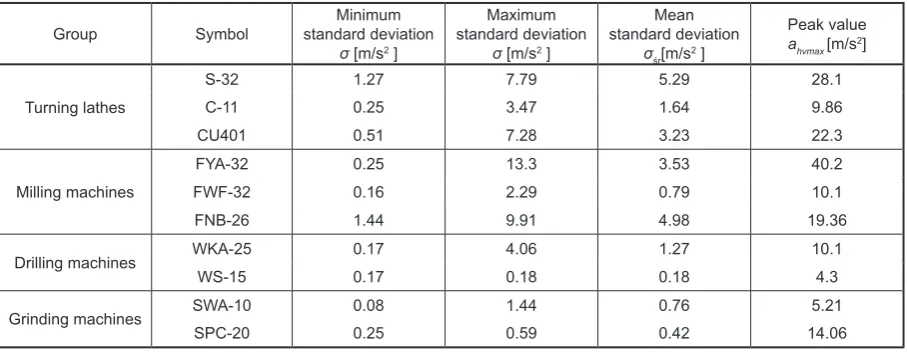
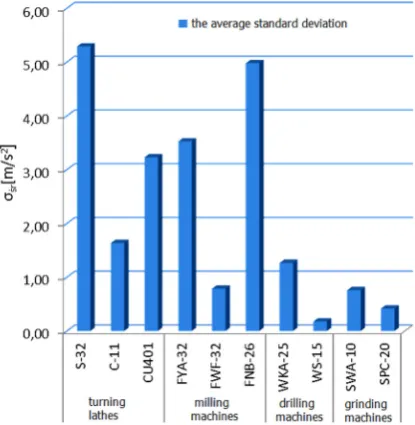
Table 3 and Figure 3 compare the obtained standard deviation σ and peak value ahvmaxfor vi-bration acceleration measurements in the direc-tion of the Y axis for the examined metal cutting machine tool stands. The acceptable acceleration value was taken as ahv,30min,dop= 11.2 m/s2.
In occupational risk assessment, the most significant parameter caused by local vibrations, that is, the ones affecting human body via the upper limbs, is the vibration acceleration peak value ahvmax; the acceptable value for this vibra -tion type is 12.8 m/s2. From Table 3 it can be
in-ferred that as many as five out of the examined machine tool stands do not satisfy the above men-tioned condition. Out of all the machines, it is the milling machine FYA-32 that poses a higher hazard in this respect, while the drilling machine WS-15 is the safest.
Table 2. Comparison of minimum, maximum and mean noise intensity levels on all the tested stands EA
Noise intensity level
[db]
Turning lathes Milling machines Grinding machines Drilling machines idle run operation test idle run operation test idle run operation test idle run operation test Mean 80.3 87.9 85.33 86.11 91.00 96.00 88.25 85.50
Min 68 82 82 83 90 96 87 82
Max 87 93 92 88 92 96 89 88
Group Symbol standard deviationMinimum
σ [m/s2 ]
Maximum standard deviation
σ [m/s2 ]
Mean standard deviation
σśr[m/s2 ]
Peak value
ahvmax[m/s2]
Turning lathes
S-32 1.27 7.79 5.29 28.1
C-11 0.25 3.47 1.64 9.86
CU401 0.51 7.28 3.23 22.3
Milling machines
FYA-32 0.25 13.3 3.53 40.2
FWF-32 0.16 2.29 0.79 10.1
FNB-26 1.44 9.91 4.98 19.36
Drilling machines WKA-25 0.17 4.06 1.27 10.1
WS-15 0.17 0.18 0.18 4.3
Grinding machines SWA-10 0.08 1.44 0.76 5.21
SPC-20 0.25 0.59 0.42 14.06
From a technological point of view, the stan-dard deviation σ is a more important parameter describing vibrations. The bar chart in Figure 3 illustrates a comparison of mean standard devia-tions, which allows for selecting each time the least technically efficient machines, that is, the machines which have the highest mean standard deviation σśr.
OCCUPATIONAL RISK ASSESSMENT
FORM FOR THE TESTED STANDS
In order to devise occupational risk assess-ment forms for the examined stands, it was first
necessary to measure noise level and vibration acceleration, conduct inspection and carry out in-terviews with employees.
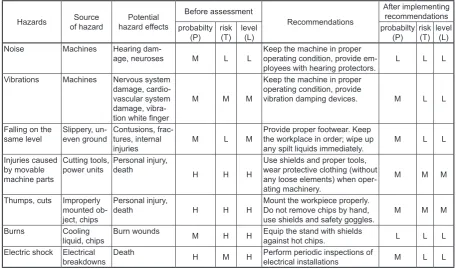
The method selected to conduct occupational risk assessment complied with the norm PN-N-18002/2000 due to its transparency and the pos-sibility of assessing both measurable and im-measurable values. This method is best known and most often described in the literature, and, as a result, most often employed by all kinds of companies, including those dealing with metal machining. The forms contain modifications and recommended preventive measures and means of reducing the risk involved in operating the exam-ined stands. In addition to that, occupational risk after the application of the suggested recommen-dations was also assessed. The devised occupa-tional risk forms are shown as tables. Table 4 is an example of the risk assessment form devised for a turning lathe S-32. Similar forms were made for other tested machines.
CONCLUSIONS
The analysis of the available works and the conducted research allowed for assessing occupa-tional risk on the selected metal cutting machine tool stands. Based on the conducted experimental tests, the following have been found:
• the fastest, most transparent and, at the same time, simplest method of occupational risk as-sessment is the method which complies with the norm PN-N-18002:2000.
• in the examined machine groups, the safest ma-chine tools include milling and drilling stands,
Fig. 2. Comparison of noise levels emitted by machines on tested metal cutting machine tool stands,
EAdop= 85dB – marked in the chart by a horizontal line
Fig. 3. Comparison of mean standard deviations of vibration acceleration in the direction of the Y axis of
• the operation of turning lathes and grinding machines involves a higher risk of accidents and failures; the safest stands are: the drilling machine WKA-25, the milling machines FNB-26 and FWF-32; while the highest hazard is posed by the turning lathe S-32 and grinding machine SPC-20,
• the most common problem identified in occu -pational risk assessment is lack of protection against chips and fast rotating elements break-ing off a machine or tool, which can cause grave injuries, cuts, or even death,
• emitted noise level should be taken into ac-count – it is recommended that personal pro-tectors be used as in the case of all the ma-chines, except for the turning lathe S-32, the noise emission level is very close to the threshold limit value of 85dB or even exceeds it, especially in the case of grinding stands SPC 20 and SWA 10, where – at operation – this value is exceeded by 11dB.
• the group of machines in the worst technical condition includes: turning lathes – S32, whose mean standard deviation σ = 5,29 m/s2, and
peak value ahvmax= 28,1 m/s2, CU401, whose
mean standard deviation σ = 3,23 m/s2, and
peak value ahvmax= 22,3 m/s2, and the milling
machines – FYA-32 (mean standard deviation
σ = 3,53 m/s2; a
hvmax= 40,2 m/s2) and FNB-26 (mean standard deviation σ = 4,98 m/s2; a
hvmax = 19,36 m/s2). In the case of these stands, the
rigidity of the machine tool-chuck-workpiece-tool system should be enhanced and vibration damping tools should be applied as well, • the group of machines in the best technical
condition includes: the turning lathe C11, the milling machine FWF-32, the drilling machines WKA-25 and WS-15, as well as the grinding machines SWA-10 and SPC-20, where the acceptable peak value ahvmax was not exceeded, and the values of standard deviation
σ are very low (< 1.5 m/s2),
• except for the drilling machines, all the other machines generate higher noise in operation tests than in idle running,
• there is no constant relationship between the rotational speed and emitted noise level EA be-cause for some machines, such as the turning lathe CU401 or the milling machine FYA-32, an increase in the speed n leads to increased noise emission, while for other machines, for example the turning lathe C-11, the drilling machines WKA-25 and WS-15, it resulted in decreased emitted noise levels.
• carrying out the necessary maintenance re-pairs to improve the technical condition of
Table 4. Occupational risk assessment form for a metal cutting machine tool stand (occupational risk assessment form devised for a turning lathe S-32, risk assessment levels: L – low, M – medium, H – high)
Hazards of hazardSource hazard effectsPotential Before assessment Recommendations
After implementing recommendations probabilty
(P) risk (T) level (L) probabilty(P) risk (T) level (L) Noise Machines Hearing
dam-age, neuroses M L L Keep the machine in proper operating condition, provide
em-ployees with hearing protectors. L L L Vibrations Machines Nervous system
damage, cardio-vascular system damage, vibra-tion white finger
M M M
Keep the machine in proper operating condition, provide
vibration damping devices. M L L
Falling on the
same level Slippery, un-even ground Contusions, frac-tures, internal
injuries M L M
Provide proper footwear. Keep the workplace in order; wipe up
any spilt liquids immediately. M L L Injuries caused
by movable machine parts
Cutting tools,
power units Personal injury, death H H H Use shields and proper tools, wear protective clothing (without any loose elements) when oper-ating machinery.
M M M
Thumps, cuts Improperly mounted ob-ject, chips
Personal injury,
death H H H Mount the workpiece properly. Do not remove chips by hand,
use shields and safety goggles. M M M Burns Cooling
liquid, chips Burn wounds M H H Equip the stand with shields against hot chips. L L L Electric shock Electrical
the examined machines will both ensure the safety to their operators and it will enhance the quality of machining conducted on these stands.
REFERENCES
1. Booth R.T. Risk Assessment Workbook. Aston University, Birmingham 1989.
2. Bryła R. Ocena ryzyka zawodowego na stanow
-isku obróbki skrawaniem metali. Stal - Metale i
Nowe Technologie, 5-6, 2007.
3. Karczewski J.T., Rączkowski B. Ocena ryzyka za
-wodowego na stanowisku – tokarz, frezer. ODDK, Gdańsk 2000.
4. Kinney G.F., Wiruth A.D. Practical Risk Analyses
for Safety Management. Naval Qweapons Centre, China Lake, 1976.
5. Lind N. Tolerable risk. International Conference on Safety, Risk and Reliability Trends in Engi-neering. IABSE, Malta 2001, Conference Report, ETH-Hönggerberg, Zürich 2001.
6. Norma EN 1050:1996. Safety of machinery – Prin-ciples for risk assessment.
7. Norma PN IEC 300-3-9:1999. Zarządzanie nieza
-wodnością. Przewodnik zastosowań. Analiza ryzy -ka w systemach technicznych.
8. Norma PN-80/Z-08052. Ochrona pracy.
Niebez-pieczne i szkodliwe czynniki występujące w pro
-cesie pracy. Klasyfikacja.
9. Norma PN-91/N-01353. Dopuszczalne wartości
przyspieszenia drgań oddziałujących na organizm człowieka przez kończyny górne i metody oceny narażenia.
10. Norma PN-EN ISO 14121-1:2008. Maszyny.
Bez-pieczeństwo. Zasady oceny ryzyka.
11. Norma PN-N-01307:1994. Hałas. Dopuszczalne wartości hałasu w środowisku pracy. Wymagania dotyczące wykonywania pomiarów.
12. Norma PN-N-18001:2004. System zarządzania
bezpieczeństwem i higiena pracy. Wymagania.
13. Norma PN-N-18002:2000. System zarządzania
bezpieczeństwem i higiena pracy. Ogólne wytycz -ne do oceny ryzyka zawodowego.
14. Norma PN-N-18002:2000. Systemy zarządzania bezpieczeństwem i higieną pracy. Ogólne wytycz -ne do oceny ryzyka zawodowego.
15. Projekt normy PN IEC 60300-3-9:2004. Zarządza
-nie -niezawodnością. Przewodnik zastosowań. Ana -liza ryzyka w systemach technicznych
16. Romanowska-Słomka I., Słomka A. Zarządzanie
Ryzykiem Zawodowym. Tarnobus Sp. z o.o. Tar-nobrzeg 2001.
17. Romanowska-Słomka I. Ryzyko zawodowe – pro
-cedury, metody, zagrożenia, Wrocław 2006.
18. Smoliński D. Ocena ryzyka zawodowego na stano
-wisku pracy – poradnik, Wrocław 2001.
19. Stec D. Zasady BHP w praktyce, Kraków 2009.
20. Szczelina K. Ogólne wytyczne do analizy ryzyka zawodowego, Kraków 2009.
21. Tokarz W. Zarządzanie bezpieczeństwem pracy. Ocena ryzyka zawodowego. Zał. 4F. Wyd. FO
-RUM, Poznań 2009.
22. Werner K. Ocena ryzyka zawodowego na stanowi-sku tokarza. Przyjaciel Przy Pracy, 6, 2009: 22-23. 23. www.gdansk.oip.pl/64.html (15.04.2013).