Int. J. Adv. Res. Sci. Technol. Volume 4, Issue 2, 2015, pp.308-312.
International Journal of Advanced Research in
Science and Technology
journal homepage: www.ijarst.com
ISSN 2319 – 1783 (Print)
ISSN 2320 – 1126 (Online)
Mathematical formulation of the writing pattern of different texts based on text
length and word length frequency in intra text perspective for stories of Hindi
language and comparison for two authors
Hemlata Pande* and H. S. Dhami
Department of Mathematics, Kumaun University, S. S. J. Campus Almora, Uttarakhand, India
*Corresponding Author’s Email:[email protected]; Address for correspondence: Govt. P. G. College, Bageshwar.
A R T I C L E I N F O A B S T R A C T
Article history: Received Accepted Available online
29 Jan. 2015 05Feb. 2015 16 Feb. 2015
Present paper is an innovative attempt in the direction to represent the relation among text length (determined in two different ways) and the total frequency of words of particular lengths in mathematical form. The texts written by two different authors have been compared on the basis of the determined formulation.
© 2015 International Journal of Advanced Research in Science and Technology (IJARST). All rights reserved. Keywords:
Text length, word length, model, authorship attribution
Introduction:
In Computational literary methods, linguistic variables are quantified, language is considered as the object for scientific study and extensive statistical and mathematical techniques are provided to examine literary data (Bagavandas and Manimannan, 2008). Dash (2008) has noted that application of the techniques, which “are the outcomes of an interface between computer and language corpora”, generates “new evidence to describe language and its properties from different perspectives.” Köhler and Altmann (2008) quoted that in Quantitative Linguistics discipline, quantitative interrelations are valuable in fundamental research and also have applications in different procedures, for example in natural language processing, in optimization of texts, language teaching and computational linguistics etc. Efforts have been made to represent different relations for linguistic elements in mathematical form by various researchers. In this regard following works can be cited to mention only a few: in the book by Popescu et al (2009, p.89) the proportion of auxiliaries within the given class (for example the class of words occurring once, twice..) have been formulated in terms of number of incidence of words; Pruscha (1998) has presented the relation between the text length and vocabulary of text, Zorbaz (2007) has examined the readability level of Turkish textbooks with the help of Ateşman‟s formula – depending on word and sentence length. Grzybek et al (2008) have tested the sentence length and word length relation with the help of Altmann-Menzerathian line. Buk and Rovenchak (2008) have examined the
syntactic structure in Ukrainian and have determined the dependence of clause length on the sentence length.
In the current work we have attempted to determine the interrelation between the text lengths (determined in two different ways) and the number of words of particular lengths. The study is based on the data determined for 37 stories written by the two authors namely „Rabindranath Tagore‟, and „Mohan Rakesh‟. The relation for the text length, measured in number of characters, has been expressed in terms of the total frequency of words of lengths two to four occurred in the text and the text length measured in terms of number of sentences.
Int. J. Adv. Res. Sci. Technol. Volume 4, Issue 2, 2015, pp.308-312. determination of the relation for text length, we have
compared the writings of the two authors on the basis of the identified relation.
Methodology:
Data:
The work has been initiated with the selection of 37 stories, written by two different authors: „Rabindranath Tagore‟, and „Mohan Rakesh‟, for data analysis from the website of „Hindi Samay‟. These stories have also been studied for the sentence length frequencies in our earlier work (Pande and Dhami, 2016). Data have been determined for the word length and text length as follows:
Sentence length frequency and corresponding text length: Similar to our earlier work (Pande and Dhami , 2016), the sentence length frequency data have been determined by the application of the „Sentence Analyzer‟ (source available at the website of Central Institute of Indian Languages) after a few modifications of stories and with the help of the sentence length
frequency data, the text length (
LT
2) in terms of the number of sentences in the text has been determined.Word length frequency: The data for the word length frequency distribution has been obtained with the help of MS Word tools by considering the length of a word as the total number of characters contained in the word. The number of words of particular length (2-4) occurred in the text has been calculated with the help of the determined data. Before the determination of the data for the word lengths, all the consonants of the Devanāgari alphabet which occurred in the modified form (mentioned in Pande and Dhami, 2015), with a dot below them, have been replaced by corresponding consonants.
Text Length in number of characters: The text length is measured in terms of total number of characters occurred in the text in forming the alphabetic words of the text. The space character, numerals and punctuation marks have not been considered in counting the text length. The length of text is determined with the help of word length frequency data
as 1
1
( )
p ll
TL
lf w
, wheref w
l( )
is the frequencyof words of length l occurred in the text and p is the highest length corresponding to which the frequency of occurrence of words in text is non zero.
Mathematical Formulation:
On the basis of the obtained data it has been noted that the total proportion of the words of lengths 2, 3, 4 in different texts is more than 65% (of total words) in all the considered texts and the average value of their total proportion for the considered texts is 76.67%. Thus the words of the mentioned lengths form a considerable part of stories of Hindi language. We have tried to relate their proportion in text with the text lengths. The aim of the present paper is to identify the pattern of variation of the text length (in characters) with the frequencies of the words above discussed lengths and number of sentences in text. It is not claimed that the text length (in number of characters) depends only in these variables but we want to demonstrate that if these variables are selected then what is the formulation and how it can be useful in determination of authorship?
We have attempted to formulate the relation of text
length
LT
1 in terms of text lengthLT
2 and the total frequency of the words (say,f
w ) having lengths two, three or four (f
w
f w
2( )
f w
3( )
f w
4( )
) in the intra text perspective. The data forLT
2,
f
wand
1
LT
have been determined for each of the considered texts with the help of sentence length and word length frequency tables. To obtain the required relation, we have first calculated the value of coefficient of determination (R²) for the linear relation betweenLT
1and
f
w as well as betweenLT
1and
LT
2 with the help of the obtained empirical values of the variables for all considered texts. The values of coefficient of determination in semi logarithmic and log-log scale have also been determined. Calculated values of R² have been listed in the Table: 1.Table: 1. Values of the R² for various linear relations
Relation Value of R² Relation Value of R²
1
4.242
w953.3
LT
f
0.9861
45.4
21474
LT
LT
0.9161
log(
LT
)
0.00013
f
w
3.689
0.865log(
LT
1)
0.001
LT
2
3.711
0.7781
28171log(
w) 82025
LT
f
0.883LT
1
29045log(
LT
2) 54699
0.8381
Int. J. Adv. Res. Sci. Technol. Volume 4, Issue 2, 2015, pp.308-312. Thus the Table (Table: 1) depicts that the values of
R², obtained corresponding to the double logarithmic scale, in the case of both word length and text length (in number of sentences), are nearly equal to the corresponding values obtained in simple scale (linear relation between variables). But as we want to determine a relation which will be applied to compare the stories of the two authors, therefore we have preferred the relation corresponding to the double logarithmic scale as it provides better estimation also in cases when the values of and are small; while the obtained linear relation provides the text length
even in the cases when
respectively. Thus we have taken up
the power law relation between and and between and
By combining the two power laws, we have assumed the relation for the above three variables in the form:
1 ( ) ( 2) (1)
b c
w
LT a f LT
where a, b and c are parameters. The model in the form of equation (1) has been fitted to the data of 37 stories for the two defined text lengths, frequencies of words having length two, three or four with the help of Datafit 9.1.32. Determined model is as under:
1.04767 0.11518
1
5.98636(
w)
(
2)
(2)
LT
f
LT
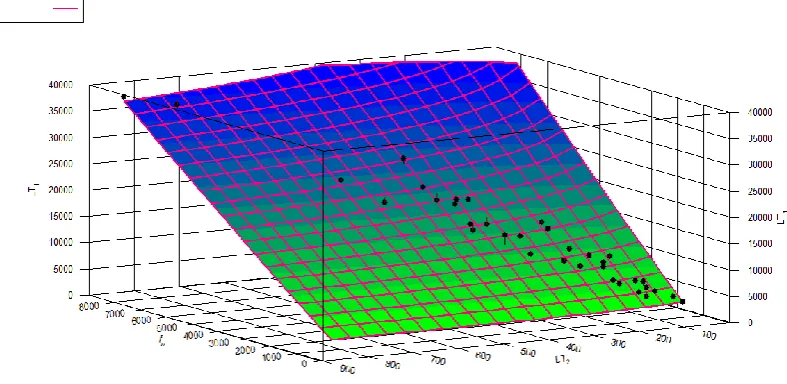
The observed values and the corresponding determined values by the equation (2) for the considered texts have been shown in the following figure (Figure: 1). The deviations from the actual values from the corresponding theoretical values have also been depicted in the figure.
Figure: 1. Observed and corresponding theoretical values of text length (in number of characters)
The values of the coefficient of multiple
determination (
R
2) and adjusted coefficient of multiple determination (R
a2)1 for the relation mentioned in equation (2) have been obtained as 0.988 and 0.987 respectively for the theoretical and observed text lengths for considered texts. As the values of the two coefficients of determination are contiguous to one, therefore the model mentioned in equation (1) can be
1 From DataFit:
2
2 2
1
( 1)
, number of parameters in 1
the model & number of data point
a
error sum of squares
R
total sum of squares
n R k
R k
n k
n s
assumed as the model that represents variation of text length (in number of characters) with respect to the number of words of particular lengths and the text length calculated in number of sentences.
Comparison of style of two authors
Int. J. Adv. Res. Sci. Technol. Volume 4, Issue 2, 2015, pp.308-312. Table: 2. Determined formulae of text length in case of two authors
Relation Author
0.88888 0.10026 1 5.95904( w) ( 2)
LT f LT I Mohan Rakesh
0.84879 0.12695 1 8.07174( w) ( 2)
LT f LT II Rabindranath Tagore
The equation (2) and the two relations in the Table:
2 demonstrate that the exponents of
f
w in the equations have values close to unity.Now for all the considered texts we have
determined the value of
LT
1 with the help of both of the equation I and II mentioned in the above table. Thedetermined and observed values of
LT
1 for different considered texts of two authors have been depicted with the help of following figure (Figure: 2) and the absolute values of the difference of the text lengths from the calculated values (when determined with the help of relation I and II) have been presented in the Table: 3.Figure: 2. Empirical vales of text lengths for the stories of two authors and corresponding evaluated values by using two relations I and II
Table: 3. Absolute values of the differences of determined text lengths from observed values of text lengths
Text
Absolute value of the difference of determined
text length from actual text length
Text
Absolute value of the difference of determined text
length from actual text length Text
Absolute value of the difference of determined text length from actual text
length
Relation I Relation II Relation I Relation II Relation I Relation II
RNT1 1210.328 297.9261 RNT14 3182.679 277.7905 MR6 231.2083 2415.207 RNT2 1828.899 7.452082 RNT15 1594.4 369.9764 MR7 294.5283 1073.063 RNT3 2214.594 310.2059 RNT16 1518.453 668.3816 MR8 474.6583 353.5586 RNT4 1555.08 861.0156 RNT17 459.4074 608.7714 MR9 294.1204 1075.477 RNT5 1425.228 65.49744 RNT18 200.1161 561.8747 MR10 62.17394 2654.189 RNT6 466.8762 535.3778 RNT19 2435.006 88.36928 MR11 37.63943 1552.593 RNT7 834.6271 35.0197 RNT20 720.171 129.6926 MR12 691.9236 1202.293 RNT8 467.9655 27.07751 RNT21 1917.534 760.5197 MR13 156.5403 1341.563 RNT9 835.207 703.7339 MR1 538.1967 1701.265 MR14 230.9654 4674.776 RNT10 3607.267 1239.298 MR2 755.6471 3607.218 MR15 115.596 1844.931 RNT11 1338.988 103.0728 MR3 765.3171 2994.244 MR16 28.91066 3214.123 RNT12 2070.824 325.4771 MR4 505.5281 4205.516
RNT13 1293.297 89.84739 MR5 529.9378 1322.781
In the Figure: 2 and Table: 3, RNT and MR abbreviations have been used for the stories of
Int. J. Adv. Res. Sci. Technol. Volume 4, Issue 2, 2015, pp.308-312. that the values of
LT
1are determined in better waywith the help of the relation II in the case of stories of author „Rabindranath Tagore‟ and similarly by relation I in case of 'Mohan Rakesh’. Thus these two equations can be assumed as supportive for the authorship determination for the stories of the two writers.
Conclusions:
On the bases of the study of data for 37 stories written by two authors we have concluded that the law of variation of text length of the Hindi stories can be formulated as:
Text length in number of characters =
a (total frequency of words of having length two to four)b (text length in number of sentences)c;
where a, b and c are parameters and the value of the exponent b is close to unity.
The fact propounded by Bagavandas and Manimannan in 2008 that the style is the relation between a writer and writer‟s work is also certified by us with the help of the determination of the laws of variation of text length in the form of two equations and presentation of their better pertinence in the case of data of texts of corresponding author. This new approach determined by us can be tested and applied in the case of the writings of different authors and different languages and hence has significance for the authorship attribution process.
Acknowledgement:
Authors are grateful to the University Grants Commission (UGC), New Delhi, INDIA for providing financial assistance in the form of Postdoctoral fellowship [F.4-2/2006(BSR)/13-770/2012(BSR)] to the first author. The research has been sponsored by the UGC under the „UGC Dr. D. S. Kothari Postdoctoral fellowship scheme‟.
References:
1. Antic G.; Stadlober E.; Grzybek P.; Kelih E. (2006). Word length and frequency distributions in different text genres. In M. Spiliopoulou et al. (Eds.): From Data and Information Analysis to Knowledge Engineering. Springer, Heidelberg. pp. 310-317.
2. Bagavandas, M. and Manimannan, G. (2008). Statistics and Literary Analysis. In P. Mohanty and R. Köhler(Eds.). Readings in quantitative linguistics. Indian Institute of Language Studies, Delhi. pp. 45-58.
3. Buk S. and Rovenchak, A. A. (2008). Menzerath-Altmann law for syntactic structures in Ukrainian. Glottotheory, vol. 1, No. 1, pp. 10-17.
4. Butler, C. (1985). Computers in Linguistics. Blackwell, Oxford.
5. Dash, N. S. (2008). The Techniques of Text Corpus Processing. In P. Mohanty and R. Köhler(Eds.). Readings in quantitative linguistics. Indian Institute of Language Studies, Delhi. pp. 81-112.
6. Fengxiang, F. (2007). A corpus based quantitative study on the change of TTR, word length and sentence length of the English language. In P. Grzybek and R. Köhler (Eds.) Exact Methods in the Study of Language and Text. Mouton de Gruyter Berlin – New York. pp. 123-130.
7. Grzybek, P. ,Kelih E. and Stadlober E. (2008). The relation between word length and sentence length: an intra - systemic perspective in the core data structure. Glottometrics, vol. 16, pp. 111-121.
8. Kelih, E., Antic, G., Grzybek, P. and Stadlober, E. (2005). Classification of Author and/or Genre? The Impact of Word Length. In: C. Weihs, and W. Gaul (Eds.), Classification – The Ubiquitous Challenge. Springer, Berlin, pp. 498–505.
9. Kelih, E., Grzybek, P., Antic, G. and Stadlober, E. (2006). Quantitative Text Typology: The Impact of Sentence Length. In: M. Spiliopoulou et al. (Eds.): From Data and Information Analysis to Knowledge Engineering.Springer, Berlin, pp. 382–389.
10.Köhler , R. and Altmann, G. (2008). Aims and Scope of Quantitative Linguistics. In P. Mohanty and R. Köhler(Eds.). Readings in quantitative linguistics. Indian Institute of Language Studies, Delhi. pp. 1-32.
11.Pande, H. and Dhami, H. S. (2013). Analysis for the significance of statistical word-length features in genre discrimination of Hindi texts. IOSR Journal of Mathematics 8(1). pp. 5-10.
12.Pande, H. and Dhami, H. S. (2015). Analysis and Mathematical Modelling of the Pattern of Occurrence of Various Devanāgari Letter Symbols according to the Phonological Inventory of Indic Script in Hindi Language. Journal of Quantitative Linguistics, 22:1, pp. 22-43.
13.Pande, H. and Dhami, H. S. (2016). Determination of distribution of sentence length frequencies for Hindi language texts and utilization of sentence length frequency profile for authorship attribution. Journal of Quantitative Linguistics 23(1). (to appear).
14.Popescu, I.-I., Altmann, G., Grzybek, P., Jayaram, B. D., Köhler, R., Krupa, V., Mačutek, J., Pustet, R., Uhlířová, L. and Vidya, M.N. (2009). Word Frequency Studies. Berlin, New York: de Gruyter.
15.Pruscha, H.(1998). Statistical models for vocabulary and text length with an application to the NT corpus. Literary and Linguistic Computing, vol. 13(4), pp. 195-198. 16.Zorbaz, K. Z. (2007). An evaluation on the