1. Introduction
asomotor tone is a partial contraction for vascular blood vessels under resting con-dition which allows the central nervous system to respond to several challenges such as hemorrhage, exercise and changes in position (Dampney, Horiuchi, & Tagawa, 2003). The autonomic nervous system, especially the sympathetic nervous system has critical effect on vasomotor tone and heart rate. Sympathetic system contains pre and post ganglionic neurons. Pre ganglionic neurons are located in intermediolateral cell column (IML) of the
V
* Corresponding Author:
Mohammad Naser Shafei, PhD.
Department of Physiology, School of Medicine, Mashhad University of Medical Sciences Tel: +98-511-8828565 - fax: +98-511-8828564
Introduction: Several supra spinal areas such as rostral ventrolateral medulla (RVLM) area are involved in basic cardiovascular regulation. The Kolliker— Fuse nucleus (KF) is located in pons and is heavily connected with RVLM. The cardiovascular effect of KF nucleus has been shown and it is suggested that KF is involved in sympathetic vasomotor tone and basic cardiovascular regulation. Therefore, in the present study, the effects of KF on basic cardiovascular values were evaluated.
Methods: After induction of anesthesia, a polyethylene catheter (PE-50) filled
with heparinized saline was inserted into the femoral artery of rats. Animals were then placed in a stereotaxic apparatus and KF nucleus was inactivated by microinjection of cobalt chloride (CoCl2). Blood pressure and heart rate (HR) were continuously recorded pre and post inactivation.
Results: Our result showed that inactivation of KF slightly changed mean arterial blood pressure (MAP) (92.3 ± 2.45 mmHg vs. 90.86 ± 1.7 mmHg) and HR (343.8 ± 4.6 beats/min vs. 350.7 ± 8.32 beats /min). However, these effects were not
significant in comparison to the control group.
Discussion: We concluded that synapses in the KF nucleus have no effect on regulation of basal blood pressure and heart rate, because CoCl2 is a synaptic blocker.
A B S T R A C T
Article info:Received: 2 August 2011 First Revision: 16 August 2011 Accepted: 5 September 2011
Key Words:
Kolliker-Fuse nucleus, CoCl2,
Blood Pressure, Heart Rate,
Reversible Inactivation.
spinal cord (Dampney, 1994; Dampney & Horiuchi, 2003; Dampney et al., 2003). Vasomotor activity and heart rate in resting conditions, heavily depend on in-puts originating from several supra spinal areas such as rostral ventrolateral medulla area (RVLM), caudal pres-sor area (CPA) and paraventricular nucleus of the hypo-thalamus (PVN) (Campos et al., 2008; Dampney et al., 2003; Guyenet, 2006).
Among these areas, RVLM is a well known pressor
region, playing a major role in the tonic and reflex con -trol of sympathetic vasomotor activity and cardiovas-cular regulation (Guyenet, 2006; Guyenet, Haselton, & Mohammad Naser Shafei 1,*, Hojatallah Alaei2, Esmaeil Farrokhi1
Autumn 2011, Volume 3, Number 1
Basic and Clinical
Sun, 1989).The RVLM receives several inhibitory and excitatory inputs from peripheral receptors and different nuclei in brain and also sends projections to many areas involved in cardiovascular regulation (Dampney, 1994; Dampneyet al., 2003; Guyenet, 2006). The parabrachial /Kolliker-Fuse (PB/KF) complex is an area that proj-ects to RVLM. This complex is subdivided into three
well-defined areas including: the medial parabrachial
nucleus, the lateral parabrachial nucleus, and Kolliker Fuse nucleus (KF) (Fulwiler & Saper, 1984). The KF nucleus is an important part of this complex that has numerous functions such as control of respiratory sys-tem, pain modulation and regulation of cardiovascular system (Dutschmann, Morschel, & Kron, 2004). Elec-trical stimulation of the KF causes a pressor effect with mild tachycardia (Korte, Jaarsma, & Luiten, 1992). In addition, stimulation of cardiac sympathetic afferents evokes large numbers of neurons in the KF nucleus (Dutschmann & Herbert, 1997; Lam, Gundlach, & Ver-berne, 1996). The KF nucleus is also involved in relay-ing of cardiovascular responses of cuneiform nucleus (CnF) (Korte et al., 1992; Shafei & Nasimi, 2011). The relationship of KF nucleus with brain areas involved in cardiovascular regulation such as RVLM, nucleus trac-tus solitarius (NTS), CnF, raphe nucleus, periaqueductal grey (PAG) and the intermediolateral (IML) column in spinal cord has been also shown by anatomical research (Dampney & Horiuchi, 2003; Korte et al., 1992; Shafei & Nasimi, 2011). Although these evidences indicate the involvement of KF nucleus in cardiovascular regulation, there has been no study till now evaluating the effect of the KF nucleus on basal vasomotor tone. Therefore, in this study the effect of KF nucleus on vasomotor tone was studied. The KF nucleus was reversibly inactivat-ed by cobalt chloride (CoCl2) (a nonselective synapse blocker) and its effects on basal mean arterial blood pressure (MAP) and heart rate (HR) was evaluated in anesthetized rats.
2. Methods
2.1. Animals and Surgery
Experiments in this study were carried out on 24 male Wistar rats (250–320 g). The rats were anesthetized intraperitoneally with urethane (1.4 g/kg), and supple-mentary doses (0.7 g/kg). The temperature was kept at 37.5C with a thermostatically controlled heating pad.
After induction of anesthesia, a polyethylene catheter
(PE-50) filled with heparinized saline was inserted in
the femoral artery for recording of blood pressure and
by both a Harvard polygraph and a computer program written by Dr Ali Nasimi in department of physiology, Isfahan University of Medical Sciences.
2. 2. Stereotaxic Surgery and Drug Microinjection
After cannulation of artery, the animals were placed in a stereotaxic apparatus (Stoelting, USA). The scalp was incised and skull was leveled between lambda and bregma and a small hole drilled in the skull. The stereo-taxic coordinates of KF were -8.4 to -8.8 mm caudal to bregma, -2.4 to -2.8 mm lateral to the midline suture and -7.3 to -7.8 mm ventral from the bergma according to the atlas of Paxinos and Watson (2005). Microinjection of the drug into the KF nucleus was done by a single barreled micropipette with internal diameter ranging
35–45 μm. The micropipette was connected through
PE-10 tube to an injection syringe and was carefully in-troduced into the CnF and injection was done (Shafei & Nasimi, 2011).
2.3. Experimental Groups
The following groups were used:
. The control group; Injection of 100 nl of saline into the KF nucleus
. The CoCl2 group; Injection of 100 nl of cobalt chlo-ride (CoCl2, 1mM, sigma) into the KF nucleus
2.4. Histological Procedure
At the end of each experiment, animals were trans-cardially perfused with 100 ml of 0.9% normal saline followed by 100 ml of 10% formalin. The brain was removed and stored in 10% formalin for at least 24h at
4oC. Frozen serial transverse sections (50μm) of brain
stem were cut using a cryostat at -20oC. Brain sections were stained with cresyl violet 1% and the injection
sites were verified according to the rat brain atlas of
Paxinos and Watson (2005) by light microscope (Hatam & Nasimi, 2007).
2.5. Data Analysis
The data obtained from the blood pressure and heart rate was expressed as mean ± SEM. The time course of changes in the heart rate and arterial pressure was plotted. The maximum change was compared with the pre-injection (paired t-test) and control (unpaired t-test)
values. The criterion for a statistical significance was
Rate in Anesthetized Rats
In this group, animals received saline (100 nl, n=8) into
the KF nucleus. Injection of the saline did not signifi -cantly alter the mean arterial blood pressure (MAP; be-fore: 90.3 ± 3.6 vs. after: 87.58 ± 2.76) and heart rate (HR; before: 332.28 ± 7. 84 vs. after: 345. 5 ± 6.72).
3.2. Effect of CoCl2 Microinjections into the KF on Basal Mean Arterial Blood Pressure and Heart Rate in Anesthetized Rats
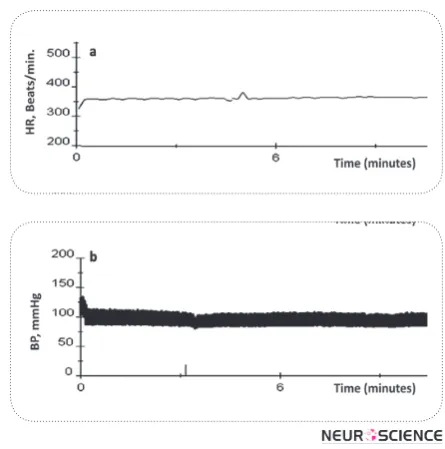
In order to investigate the effect of KF nucleus on va-somotor tone, we inactivated this nucleus by microin-jection of CoCl2 (1mM, 100 nl). A sample of the arte-rial pressure and heart rate tracings before and after the injection are shown in Fig. 1. Inactivation of KF nucleus slightly decreased mean arterial blood pressure (92.3 ± 2.45 mmHg vs. 90.86 ± 1.7 mmHg) and increased HR (343.8 ± 4.6 beats/min vs. 350.7 ± 8.32 beats /min).
However, this effects are not significant compare to the
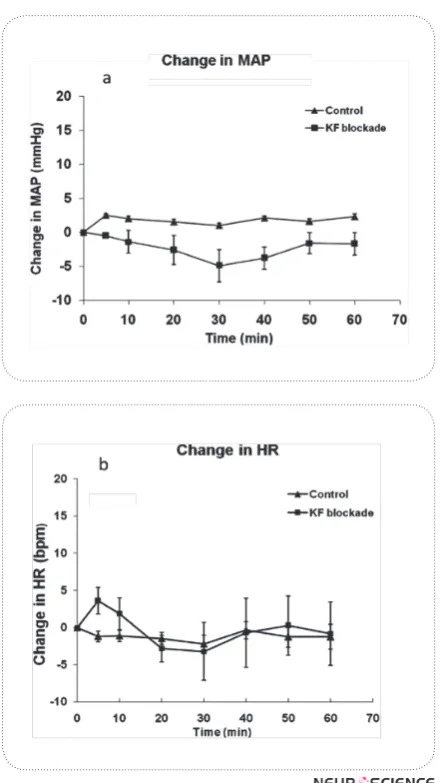
control group and pre injection values (t-test, P >0.05, n = 10, Fig. 2). Time course of the changes in MAP and HR is shown in Fig. 3.
Figure 1. A typical tracing, showing the effects of microinjec-tion of CoCl2 (1mM in100 nl) into the KF nucleus on (a) heart rate and (b) blood pressure. The vertical lines show the time of injection.
Figure 2. A typical tracing, showing the effects of microinjec-tion of CoCl2 (1mM in100 nl) into the KF nucleus on (a) heart rate and (b) blood pressure. The vertical lines show the time of injection.
4. Discussion
In the present study, we determined the role of KF nucleus on tonic control of cardiovascular system. Our results showed that inactivation of KF nucleus by
CoCl2 had no significant effect on basic mean arterial
blood pressure and HR. Microinjection of CoCl2 into the brain area is a well known method for evaluating
the role of specific areas in the brain in physiologi -cal functions. In this method, CoCl2, non-selectively
blocks pre-synaptic Ca2+ influx and inhibits the neu -rotransmitter release without affecting the passage of
fibers (Broadbent, Squire, & Clark, 2006; Kretz, 1984;
Lomber, 1999). Therefore, it is possible to identify the brain areas involved in information processing and
Autumn 2011, Volume 3, Number 1
Basic and Clinical
In our study, blockade of the KF by CoCl2 did not af-fect the basal MAP and HR. It is suggested that path-ways which synapse on the vasomotor neurons in KF nucleus are not involved in maintenance of vasomotor tone and maybe this nucleus has no role in regulation of vasomotor tone and cardiovascular values.
Although inactivation of this nucleus has no effect on baseline blood pressure and heart rate, we cannot rule out the effect of this area on cardiovascular system. The KF nucleus has widespread connections with areas in-volved in cardiovascular regulation including: RVLM, NTS, CnF, raphe nucleus, PAG and the IML column in spinal cord (Dampney & Horiuchi, 2003; Korte et al., Figure 3. Time courses of mean arterial pressure (MAP)(a) and heart rate (HR) (b) changes in response to the microin-jection of CoCl2 into the KF nucleus (n=10) in anesthetized
rats. Microinjection of CoCl2 produced no significant effect
on MAP and HR.
1992; Shafei & Nasimi, 2011). Involvement of KF nu-cleus in regulation of cardiovascular responses has been shown in several experiments. Electrical stimulation of the KF nucleus causes pressor and mild tachycardic effect (Korte et al., 1992). In addition, KF nucleus is
involved in chemoreceptor reflex (Dampney & Horiu -chi, 2003) and relaying of cardiovascular responses of CnF nucleus (Bohus, Koolhaas, & Korte 1996; Korte et al., 1992; Shafei & Nasimi, 2011). Stimulation of car-diac sympathetic afferents also evokes large numbers of KF neurons (Dutschmann & Herbert, 1997; Lam, Gundlach, & Verberne, 1996). Anatomical studies have shown that KF receives inputs from the NTS and has descending projections to the RVLM and the IML of spinal cord (Dampney & Horiuchi, 2003; Guo, Li, & Longhurst, 2002). This, suggests the involvement of KF
nucleus in baroreflex activity.
It is reported that several nuclei involved in cardio-vascular regulation are subject to the tonic inhibition of GABAergic neurons (Dampney et al., 2003; Mandel & Schreihofer, 2008). It is possible that, same as other nuclei, vasomotor neurons of KF are also strongly in-hibited by GABAergic neurons. Therefore, KF nucle-us neurons in resting condition have too little activity. However, a stressor factor such as hypoxia, decrease of the arterial pressure, hemorrhage or pain may reduce tonic inhibitory of GABA and activates them.
Kretz, R. (1984). Local cobalt injection: a method to discrimi-nate presynaptic axonal from postsynaptic neuronal activity. Journal of neuroscience Methods, 11(2), 129-135.
Lam, W., Gundlach, A. L., & Verberne, A. J. (1996). Increased nerve growth factor inducible-A gene and c-fos messenger RNA levels in the rat midbrain and hindbrain associated with the cardiovascular response to electrical stimulation of the mesencephalic cuneiform nucleus. Neuroscience, 71(1), 193-211.
Lomber, S. G. (1999). The advantages and limitations of perma-nent or reversible deactivation techniques in the assessment of neural function. Journal of neuroscience Methods, 86(2), 109-117.
Mandel, D. A., & Schreihofer, A. M. (2008). Glutamatergic in-puts to the CVLM independent of the NTS promote tonic inhibition of sympathetic vasomotor tone in rats. American Journal of Physiology-Heart and Circulatory Physiology, 295(4), H1772-H1779.
Paxinos, G., & Watson, C. The rat brain in stereotaxic coordi-nates. 2005: London, UK: Elsevier.
Shafei, M. N., & Nasimi, A. (2011). Effect of glutamate stimula-tion of the cuneiform nucleus on cardiovascular regulastimula-tion in anesthetized rats: role of the pontine Kolliker-Fuse nucleus. Brain Research, 1385, 135-143.
tion in the rat. Clinical and experimental pharmacology and physiology, 23(2), 177-182.
Broadbent, N. J., Squire, L. R., Clark, R. E. (2006). Reversible hippocampal lesions disrupt water maze performance dur-ing both recent and remote memory tests. Learndur-ing & Mem-ory, 13(2), 187-191.
Campos, R. R., Carillo, B. A., Oliveira-Sales, E. B., Silva, A. M., Silva, N. F., Futuro Neto, H. A., et al. (2008). Role of the cau-dal pressor area in the regulation of sympathetic vasomotor tone. Brazilian Journal of Medical and Biological Research, 41(7), 557-562.
Dampney, R. A. (1994). Functional organization of central path-ways regulating the cardiovascular system. Physiological Reviews, 74(2), 323-364.
Dampney, R. A., & Horiuchi, J. (2003). Functional organisation of central cardiovascular pathways: studies using c-fos gene expression. Progress in Neurobiology, 71(5), 359-384.
Dampney, R. A., Horiuchi, J., Tagawa, T., Fontes, M. A., Potts, P. D., & Polson, J. W. (2003). Medullary and supramedullary mechanisms regulating sympathetic vasomotor tone. Acta Physiologica Scandinavica, 177(3), 209-218.
Dutschmann, M., & Herbert, H. (1997). Fos expression in the rat parabrachial and Kolliker-Fuse nuclei after electrical stimula-tion of the trigeminal ethmoidal nerve and water stimulastimula-tion of the nasal mucosa. Experimental Brain Research, 117(1), 97-110.
Dutschmann, M., Morschel, M., Kron, M., & Herbert, H. (2004). Development of adaptive behaviour of the respiratory net-work: implications for the pontine Kölliker-Fuse nucleus. Respiratory physiology & neurobiology, 143(2-3), 155-165.
Fulwiler, C. E., & Saper, C. B. (1984). Subnuclear organization of the efferent connections of the parabrachial nucleus in the rat. Brain Research, 319(3), 229-259.
Guo, Z. L., Li, P., & Longhurst, J. (2002). Central pathways in the pons and midbrain involved in cardiac
sympathoexcita-tory reflexes in cats. Neuroscience, 113(2), 435-447.
Guyenet, P. G. (2006). The sympathetic control of blood pres-sure. Nature Reviews Neuroscience, 7(5), 335-346.
Guyenet, P. G., Haselton, J. R., & Sun, M. K. (1989). Sym-pathoexcitatory neurons of the rostroventrolateral medulla and the origin of the sympathetic vasomotor tone. Progress in brain research, 81, 105-116.