Analysis of Engine Performance by using
Acetylene in CI Engine Operated on
Dual Fuel Mode
Deepak Tanwar
1, Ruchika Tanwar
2,
Nakul Aggarwal
31,2,3
Mechanical Engineering Department, Institute of Technology and Science, Bhiwani-127021 India
ABSTRACT
A preliminary investigation on the utilization of used transformer oil (UTO) as an alternative fuel for a single cylinder, four stroke diesel engine with optimum injection timing of 20° bTDC (before top dead centre) and injection pressure of 200 bar showed that the engine fueled with UTO gave a lower thermal efficiency and higher smoke emission than the diesel operation at full load. This is because of higher viscosity and poor volatility of UTO compared to diesel. The present investigation is aimed to examine the combustion, performance and emissions of a single cylinder, four stroke, direct injection diesel engine developing 4.4 kW at a rated speed of 1500 rpm, at optimum injection timing and optimum injection pressure of 230 bar, with lower compression ratios of 17:1 and 16:1, fueled with UTO by varying the clearance volume. At lower compression ratio, the engine exhibits a lower thermal efficiency and more smoke level. The engine behavior was also tested at higher compression ratio of 18.5:1. The effect of compression ratio on emission parameters of the engine fueled with UTO in comparison with diesel fuel operation is obtained. The optimum compression ratio was found to be 18.5:1.
Keywords: Combustion, Compression Ratio, Diesel Engine, Emission, Performance, UTO.
1. Introduction
In the modern world, crude oils is used which serves in all the sectors that includes transportation, agricultural, commercial and domestic and power generation. In the year, the world consumption was an estimated 84 to 85 million barrels of oil in the year 2009. There is a growing demand and cost of liquid fuel in every country. In the last six decades, India’s energy consumption rate increases by 16 times because of fast rate of population growth [1]. At this rate, the fossil fuel will not be available for a long time as the gap between supply and demand increases large. With continuous use of petroleum products world is moving towards technological growth as well as environmental degradation.
To overcome this problem of energy in the future and growing concern with the pollution, the substitutes of petroleum fuels is necessary. A large amount of crude oil is imported from the foreign countries; it is also a reason for the development of alternative fuel. The use of alternative fuels is the only possible solution, which can be obtained either from the renewable sources or non-conventional sources. As we know that, compression ignition (CI) engine is widely used in several applications; the search for alternative fuels for CI engines is very important [2]. Some of the fuel falls under this category are alcohol, vegetable oil, bio mass, bio gas, used oil etc. Few alternative fuels can be directly used without any modification in the fuel or engine, but some of them need little modification to obtain relevant properties like conventional fuel. An important equipment used for transmission and distribution of electrical energy is power or electrical transformer at different power stations and distribution stations.
1.2 Importance of Alternative fuels 1.2.1 Limited source of crude oil
Transportation is the main reason that the any country currently depends heavily on crude oil. Most of this oil is imported from foreign countries and the major source of foreign crude oil is the Persian Gulf (this region provides one-fourth of the world’s current consumption of oil and nearly two thirds of the world’s oil reserves).
1.2.2 Environmental pollution
36 1.2.3 Global warming
Global warming, also known as the "Greenhouse Effect", is caused by an accumulation of carbon dioxide (CO2) emissions that do not leave the Earth’s lower atmosphere. We are already at risk because the level of greenhouse gas already high
1.2.7 Health problem
As known, fossil fuel provides a reliable energy for consumer there is a major risk associated with it. Carbon dioxide, produced from combustion of fossil fuels, is not a poisonous gas, but it is dangerous to the earth’s natural climate system. Particulate matter is comprised of tiny particles that remain in the emissions of fossil fuels. Carbon dioxide (CO2) and nitrogen oxide (NOx) are poisonous gases that are dangerous to humans when inhaled. These gases are produced mainly from mobile source emissions (i.e. vehicle exhaust emissions). Children and the old people are the most susceptible to developing asthma and other respiratory illnesses as a result of exposure to fossil fuel emissions. PM is of extreme concern to human health.
1.3 Various alternative fuels
Various alternate desirable in the form of solid, liquid and gas are discussed in the subsequent subsections.
Table 1.1 Different types of alternative fuels
Type of sources
Alternative fuels
Solid Liquid Gaseous
Wood Ethanol Hydrogen gas
Renewable Charcoal Methanol Biogas
Municipal Waste Biodiesel Producer gas
Natural gas
Non renewable CNG
LPG
1.3.1 Solid alternative fuels
Solid fuel refers to various types of solid material that are used as fuels to produce energy and provide heating, usually released through combustion. Solid fuels are not much suitable for the internal combustion engine but many experimental engines have been built till now.
LITERATURE SURVEY
Raheman H. et al. [1] investigated the performance of Ricardo E6 engine using biodiesel obtained from mahua oil (B100) and its blend with high speed diesel (HSD) at varying compression ratio (CR), injection timing (IT) and engine loading (L). The brake specific fuel consumption (BSFC) and exhaust gas temperature (EGT) increased, whereas brake thermal efficiency (BTE) decreased with increase in the proportion of biodiesel in the blends at all compression ratios (18:1–20:1) and in jection timings (35- 450 before TDC) tested.
Laguitton et al. [2] studied the effect of CR on the emissions of a diesel engine when CR is reduced from 18.4 to 16, in a single cylinder. This was achieved by modifying the piston bowl while maintaining the production engine squish clearance. Investigations on the effect of injection timing were performed at a number of the key operating points and the corresponding pressure-time curves analysed to help explain the measured results. It was reported that, although there was a small CO and HC penalty, lowering the compression ratio or retarding the injection timing results reduction in NOx and soot emissions.
Celik M.B. et al. [54] concluded that the methanol has a greater resistance to knock and it emits lower emissions than gasoline. As single cylinder small engines have low compression ratio (CR), and they run with marginally rich mixture, their power are low and emission values are high. The performance can be increased at high CR, if these engines are run with fuels which have high octane number.
Muralidharan, K. et al. [4] carriedout investigations to evaluate the performance, emission and combustion characteristics of a single cylinder, four stroke, variable compression ratio multi fuel engine when fueled with waste cooking oil methyl ester and its 20%, 40%, 60% and 80% blends with diesel (on a volume basis) were investigated and compared with standard diesel.
Kale, B. N. et al. [5] described the use of cotton seed vegetable oil (biodiesel) as a fuel for variable compression ratio CI engines. The study was based on the reports of about 40 scientists including (some manufacturers and agencies) between 1996 and 2010. The tests were conducted using different types of raw and refined vegetable oils. A majority of scientists mixed the transesterified vegetable oil or biodiesel oil with diesel with different proportions.
Murugan, S. et al. [6] also carried out an experimental investigation to utilize crude tire pyrolysis oil (TPO) as an alternative fuel in a diesel engine. TPO was desulphurised and then distilled through vacuum distillation. Also, two distilled tire pyrolysis oil (DTPO)-diesel fuel (DF) blends at lower (20%DTPO) and higher concentrations (90%DTPO) were used as fuels in a four stroke, single cylinder, air cooled, diesel engine without any engine modification. The results were compared with diesel fuel (DF) operation. Results indicated that the engine can run with 90% DTPO and 10% diesel fuel.
MATERIALS AND METHODS
3.1 Physical properties and chemical composition of UTO
A comparison of the chemical composition between of UTO and diesel is shown in Table 3.1. The chemical composition of the UTO indicates that the fuel has carbon close to that of diesel fuel. The hydrogen present in the UTO is 1.5 times lesser than that of diesel. It is evident from the table that the UTO has considerable oxygen present in it. Due to the oxidized nature, the fuel may be helpful in better combustion of the fuel air mixture
3.2 Inhibited oil
It is treated with hydro treated naphthenic base oil and an oxidation inhibitor to control sludge and deposit formation. It provides an long service life in comparison compared to non-inhibited is used transformer oils. It has an excellent low-temperature properties and is noncorrosive to copper and copper alloys. This oil does not contain any polychlorinated biphenyls. Mineral oil, synthetic esters and silicon oils are traditionally used as transformer oils. Mineral transformer oil is composed of hydrocarbons of paraffinic, aromatic or naphthenic structure that are obtained by fractional distillation of crude petroleum.
Chemical composition of UTO and diesel
Description Diesel UTO
C (%) 86.3 89.90
H (%) 12.1 9.11
N (%) 0.18 0.03
S (%) 0.3 0.32
O by difference (%) 0 0.40
C/H ratio 4.937 18.202
Carbon residue (%) 0.01 0.02
3.3 Method to change compression ratio
The compression ratio of the engine can be varied by five methods that are described below;
3.3.1 Cylinder swept volume
38
Increasing the cylinder volume without making any other changes will increase the compression ratio because it enlarges the cylinder volume without increasing the combustion chamber volume. In other words, the piston will have to suck more air into the same amount of space.
3.3.2 Clearance volume
Clearance volume is determined by the distance from the cylinder block deck to the top of the piston flat (not counting any dishes or domes) when the piston is at TDC. In engines, the pistons don't come all the way up to the height of the deck. They can be anywhere from 0.003 to 0.020 inch below it. This amount is known as the piston deck height, and it affects compression ratio because it affects the volume of air in the combustion area when the piston is at TDC. If the piston deck height is increased, then clearance volume is increased and the compression ratio is reduced. If the piston is closer to the deck, then the clearance volume is reduced and compression ratio is increased.
3.3.3 Piston dome or dish
It is associated with the piston geometry. Instead of a flat top surface it has a dome which looks like a dome stadium. Clearance volume does not take into account any pop-up domes or sunken-in dishes on the head of the piston
3.3.4 Combustion chamber
The volume of the combustion chambers is the final factor in determining the compression ratio. The larger the chamber, the more volume is added to the cylinder and the lower the compression ratio; smaller chambers reduce the volume and increase the compression ratio.
3.3 Engine specification
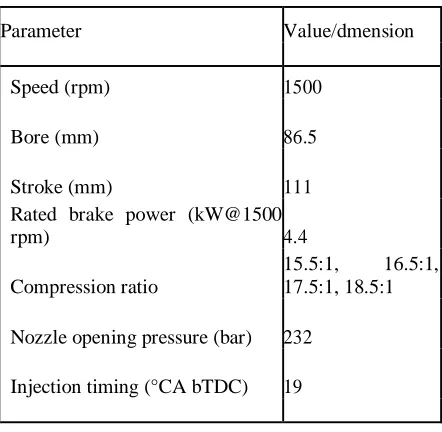
The test engine used in this investigation was a Eicher, single cylinder, four-stroke, air cooled, constant speed, direct injection diesel engine. The specifications of the engine are given in Table 3.3.
Table 3.3 Specifications of the test engine
Parameter Value/dmension
Speed (rpm) 1500
Bore (mm) 86.5
Stroke (mm) 111
Rated brake power (kW@1500
rpm) 4.4
Compression ratio
15.5:1, 16.5:1, 17.5:1, 18.5:1
Nozzle opening pressure (bar) 232
Injection timing (°CA bTDC) 19
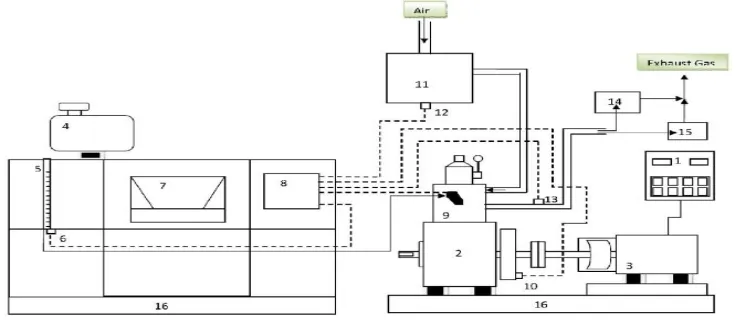
3.5 Description of the test engine
Schematic diagram of experimental setup
An uncertainty analysis was performed using the method described by Holman [68]. The details of instruments used in the study are given in Table 3.6.
The total percentage of the uncertainty of this experiment is calculated as given below.
(TFC)2 +(BP)2 +(BSFC)2 +(BTE)2 +(CO)2 +(CO2)2
+(UBHC)2 +(NO)2 +(O2)2 +(smoke number)2 +(EGT)2
+(uncertainty of pressure pick up)2 +(CA encoder)2]1/2
=[(1.5)2 + (0.2)2 + (1.5)2 + (1)2 (0.03)2 + (0.5)2 + (1)2 + (1) 2 + (1)2 + (1)2 + (0.15)2 + (1)2]1/2
=±3.28%
RESULTS AND DISCUSSIONS
Phase I: Preliminary investigation on combustion, performance and emission parameters forDI diesel engine only with optimum injection timing of 20° bTDC and standard nozzle opening pressure of 200 bar.
4.1 Combustion parameters 4.1.1 Pressure crank angle diagram
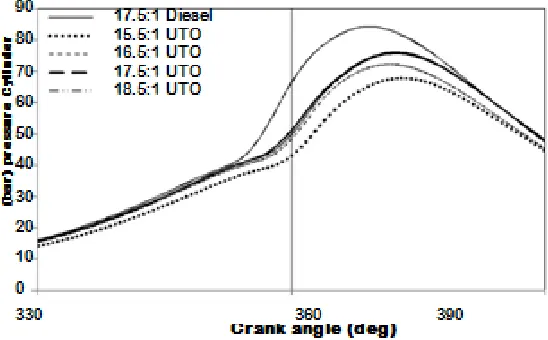
The variation of combustion pressure with respect to crank angle at full load is shown in Fig. 4.1. Peak pressure mainly depends upon the combustion rate at initial stages, which is influenced by the fuel intake component in the uncontrolled heat release phase. The fuel absorbs amount of heat from the cylinder immediately after injection and the amount of heat results in shorter or longer ignition delay.
40 4.1.2 Ignition delay
Ignition delay is the time difference measured in degree crank angle between start of injection and start of ignition of a fuel in diesel engine. The type of fuel is an important parameter affecting the ignition delay. The variation of the ignition delay for the UTO in different CR and diesel with respect to brake power is presented in Fig. 4.2. The ignition delay of the tested compression ratio in this study decreases as the brake power increases. As the load increases the heat prevailing inside the cylinder increases and helps the air fuel mixture to ignite sooner, hence this trend is genuine. It can also be observed from the figure that the ignition delay is found to decrease. Considering the diesel at standard compression ratio as a reference, it is clear that at full load CR 15.5:1 shows 2.68% longer ignition delay while CR`s 16.5:1, 17.5:1 and 18.5:1 results in shorter ignition delay of 3.39%, 9.82% and 10.7% with the UTO respectively.
Fig. 4.2 : Variation of the ignition delay with brake power
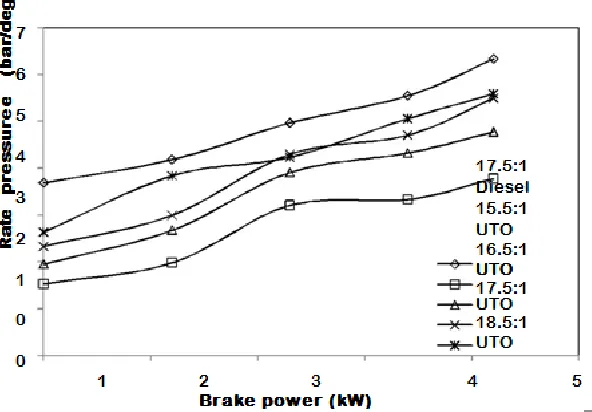
4.1.3 Rate of pressure rise
The rate of pressure rise defines the load that is imposed during the combustion process on the cylinder head and other components. The rate of pressure rise depends on the amount of heat released in the initial stage of combustion and the fuel quality. Higher the rate of pressure rise, higher the load on the piston and other components, which may cause severe damage of the parts. Fig. portrays the comparison of rate of pressure rise with respect to the brake power for the UTO and standard diesel.
4.2 Performance parameters 4.2.1 Brake thermal efficiency
Brake thermal efficiency give an idea of the output generated by the engine with respect to the heat supplied in the form of fuel. Generally, increasing the compression ratio improved the efficiency of the engine. This improvement in performance of the engine at higher CR is due to the reduced ignition delay. Fig. shows the variation of the BTE with brake power for the UTO and standard diesel.
Fig. 4.4: Variation in brake thermal efficiency with brake power
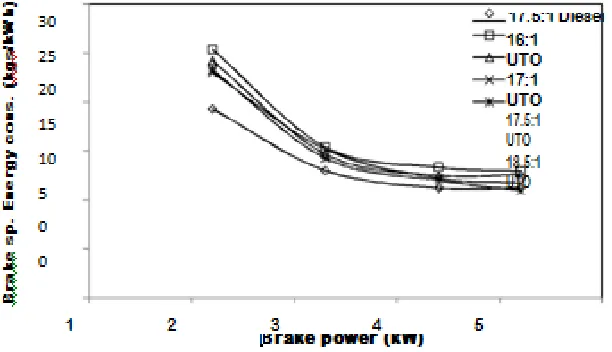
4.2.2 Brake specific energy consumption
An important parameter to measure the engine performance is the specific energy consumption. It is the product of brake specific fuel consumption and lower heating value.
Compare to diesel engine at standard situation, UTO shows 15.5%, 12.4% and 4.3% higher consumption at CR`s 15.5:1, 16.5:1 and 18.5:1 while CR of 18.5:1 consumes 2.1% lower than diesel. The increase in the fuel consumption is due to fuel density, viscosity and heating value, but with higher compression ratio lesser value of SEC is apparently desirable.
Fig. Variation in brake specific energy consumption with brake power
4.3 Emission parameters
4.3.1 Carbon monoxide (CO) emission
42
power for all compression ratios. Lower CRs of 15.5:1, 16.5:1 shows 20%, 18% higher CO than UTO operation at standard compression ratio, whereas 18.5:1 CRs shows20% less CO emission at maximum brake power. The decrease in the CO emission may be due to better combustion and oxygen enrichment of the fuel.
Fig. Variation in CO emission with brake power
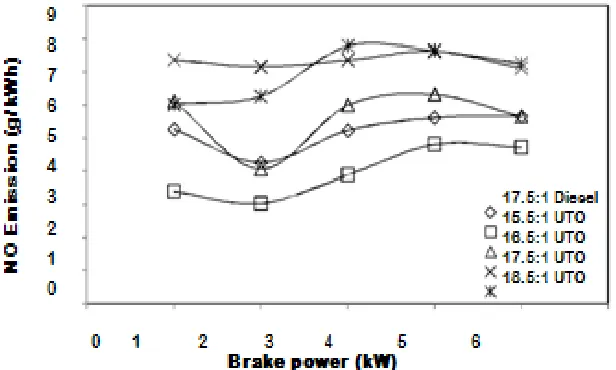
4.3.2 Nitrogen oxide (NO) emission
An engine can have up to 2000 ppm of oxides of nitrogen in the exhaust gas. With higher compression ratio, the cylinder pressure and high temperature contribute to dissociate diatomic N into monatomic N, thus resulting in more NO formation. The reduction in the NO emission is the prime objective of the engine researcher.
Fig. Variation in NO emission with brake power
4.4 Combustion parameters 4.4.1 Pressure crank angle diagram
Fig. Variation of combustion pressure with crank angle at full load
4.4.2 Heat release rate with crank angle
Heat Release Rate (HRR) is the measure of how fast chemical energy of fuel is converted into the thermal energy by combustion. The heat release rate is analyzed based on the changes in crank angle variation.
Fig. Variation of heat release rate with crank angle at full load
4.4.3 Maximum heat release rate
44 RESULT
The combustion, performance and emission characteristics of a single cylinder, four stroke, air cooled, diesel engine having a power output of 4.2 kW at at the of speed of 1500 rpm by utilizationof UTO, diesel blends and diesel have been analyzed and compared with those of diesel. The following are conclusions;
The UTO can be used as a fuel in the diesel engines as it possesses a heating value. Considering the specific energy consumption, UTO with CR18.4 can be the optimum CR tested.
The ignition delay for the UTO is shorter by about 1-3 °CA compared to that of diesel in the entire range of operation.
The HC and CO emissions for the all CR of UTO are marginally higher than those of diesel operation at full load.
The NO emission is higher at optimum CR 18.9 for UTO fuel than diesel at full load. Smoke is lower with the UTO than diesel at full load. The smoke value of UTO is lower at CR 18.5 than that of diesel at full load.
CONCLUSION
The combustion, performance and emission characteristics of a single cylinder, four stroke, air cooled, direct injection diesel engine having a power output of 4.4 kW at a constant speed of 1500 rpm, fueled with UTO, diesel blends and diesel have been analyzed and compared with those of diesel. The following are conclusions;
The ignition delay for the UTO is shorter by about 1-3 °CA compared to that of diesel in the entire range of operation.
The HC and CO emissions for the all CR of UTO are marginally higher than those of diesel operation at full load.
The NO emission is higher at optimum CR 18.5 for UTO fuel than diesel at full load. Smoke is lower with the UTO than diesel at full load.
Future Scopes
To fulfill the demand of energy, various alternative fuels have been developed to replace fossil fuel. These alternative fuels have to attain a suitable fuel property by proper treatment of fuel. As per the experiment, used transformer oil (UTO) has been proved as an alternate substitute for the diesel engine.
In the present investigation, higher engine efficiency was observed with the higher compression ratio. Along with higher efficiency, an increase in the NO emission was also observed which is very harmful and toxic exhaust emission, but other emissions of engine were found to be lower with higher compression ratio. Thus to use UTO as an alternative fuel, NO emission should be reduced as much as possible. This can be reduced by reducing the peak cylinder temperature.
REFERENCES
[1]. Gerg, p., “Energy scenario and vision 2020 in India”, Journal of Sustainable Energy & Environment, 3, pp.7-17, 2012
[2]. Heywood, J. B., “Internal combustion engine fundamentals” , McGraw- Hill Inc., New York, 1998.
[3]. Ganesan, V., “ Internal combustion engines” , Tata McGraw-Hill, New Delhi, 1998.
[4]. Tripathi, R. K. and Sahoo, P. K.,“Performance evaluation of a low speed IDI engine fueled with diesel and jatropha straight vegetable oil” , International Journal of Science Technology & Management, 2 (2), April 2011.
[5]. Behera, P. and Murugan, S., “Combustion, performance and emission parameters o f used transformer oil.and its diesel blends in a DI diesel engine” , Fuel, 104, pp.147-154, 2013.
[6]. Kinney, P. L., "Airborne concentrations of PM 2.5 and diesel exhaust particles on harlem sidewalks: A community based pilot study", School of Public Health at Columbia University, New York, 2000.
[7]. Swithenbank, J., Chen, Q., Zhang, X., Sharifi, V. and Pourkashanian, M., “ Review: Wood would burn”, biomass and bioenergy, 35, pp.999-1007, 2011.
engineering research and studies, ISSN 2249-8974.
[9]. Ames, G. C. W. and Baxter, H. O., “ Wood fuel: An alternative energy source for agribusiness and industry”, .
[10]. Cce.cornell.edu/environment/pages/heatingwithwood.aspx
[11]. Low-tech magazine: wood gas vehicle: firewood in the fuel tank.
[12]. Long, J. M. and Boyette, M. D., “ Development of a charcoal slurry for low-speed diesel engines: A preliminary study”, ISBN-13:9781618391568, pp.1355-60, 2011.
[13]. Valentin, S. V., Lewis, J., Yoshihara, Y. and Nishiwaki, K., “ Combustion characteristics of a charcoal slurry in a direct injection diesel engine and the impact on the injection system performance” Energy, 36, pp.4353-71, 2011.