P R O C E E D I N G S
Open Access
Protein sequence classification using feature
hashing
Cornelia Caragea
1*, Adrian Silvescu
2, Prasenjit Mitra
1,2From
IEEE International Conference on Bioinformatics and Biomedicine 2011
Atlanta, GA, USA. 12-15 November 2011
Abstract
Recent advances in next-generation sequencing technologies have resulted in an exponential increase in the rate at which protein sequence data are being acquired. Thek-gram feature representation, commonly used for protein sequence classification, usually results inprohibitivelyhigh dimensional input spaces, for large values ofk. Applying data mining algorithms to these input spaces may be intractable due to the large number of dimensions. Hence, using dimensionality reduction techniques can be crucial for the performance and the complexity of the learning algorithms. In this paper, we study the applicability of feature hashing to protein sequence classification, where the original high-dimensional space is“reduced”by hashing the features into a low-dimensional space, using a hash function, i.e., by mapping features into hash keys, where multiple features can be mapped (at random) to the same hash key, and“aggregating” their counts. We compare feature hashing with the“bag ofk-grams”approach. Our results show that feature hashing is an effective approach to reducing dimensionality on protein sequence classification tasks.
Introduction
Many problems in computational biology, e.g., protein function prediction, subcellular localization prediction, etc., can be formulated as sequence classification tasks [1], where the amino acid sequence of a protein is used to classify the protein in functional and localization classes.
Protein sequence data contain intrinsic dependencies between their constituent elements. Given a protein sequencex =x0, ..., xn-1over the amino acid alphabet,
the dependencies between neighboring elements can be modeled by generating all the contiguous (potentially overlapping) sub-sequences of a certain lengthk,xi-k, ...,
xi-1, i =k, ..., n, called k-grams, or sequence motifs.
Because the protein sequence motifs may have variable lengths, generating thek-grams can be done by sliding a
window of length k over the sequence x, for various
values of k. Exploiting dependencies in the data
increases the richness of the representation. However,
the fixed or variable length k-gram representations, used for protein sequence classification, usually result in pro-hibitivelyhigh-dimensional input spaces, for large values
of k. Applying data mining algorithms to these input
spaces may be intractable due to the large number of dimensions. Hence, using dimensionality reduction tech-niques can be crucial for the performance and the com-plexity of the learning algorithms.
Models such as Principal Component Analysis [2], Latent Dirichlet Allocation [3] and Probabilistic Latent Semantic Analysis [4] are widely used to perform dimensionality reduction. Unfortunately, for very high-dimensional data, with hundreds of thousands of dimen-sions (e.g., 160, 000 4-grams), processing data instances into feature vectors at runtime, using these models, is computationally expensive, e.g., due to inferenceat run-time in the case of LDA. A less expensive approach to dimensionality reduction is feature selection [5,6], which reduces the number of features by selecting a subset of the available features based on some chosen criteria. In particular, feature selection by average mutual informa-tion [7] selects the top features that have the highest average mutual information with the class. Recently, a
* Correspondence: [email protected]
1
Information Sciences and Technology, Pennsylvania State University, University Park, PA, USA
Full list of author information is available at the end of the article
new approach to dimensionality reduction, called feature hashing (or random clustering) has been introduced for text classification [8-11]. Feature hashing offers a very inexpensive, yet effective, approach to reducing the number of features provided as input to a learning algo-rithm, by allowing random collisions into the latent fac-tors. Specifically, the original high-dimensional space is
“reduced” by hashing the features into a
low-dimen-sional space, using a hash function, i.e., by mapping fea-tures to hash keys, where multiple feafea-tures can be
mapped (at random) to the same hash key, and“
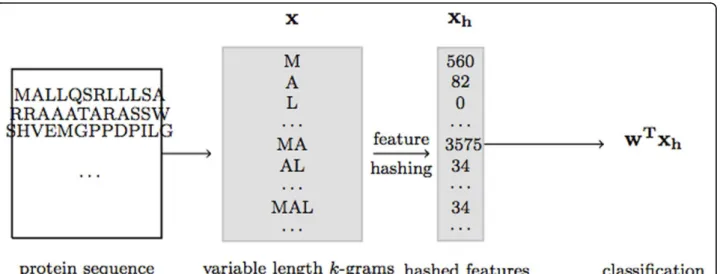
aggre-gating” their counts. Figure 1 shows the application of feature hashing on sparse high-dimensional feature spaces. Although very effective for reducing the number of features from very high dimensions (e.g., 222) to mid-size dimensions (e.g., 216), feature hashing can result in significant loss of information, especially when hash col-lisions occur between highly frequent features with sig-nificantly different class distributions.
In this paper, we study the applicability of feature hashing to protein sequence classification and address the following main questions: (i) How effective is feature hashing on prohibitively high dimensionalk-gram repre-sentations?; (ii) What is the influence of the hash size (i. e., the reduced dimension) on the performance of pro-tein sequence classifiers that use hash features, and what is the hash size at which the performance starts degrad-ing, due to hash collisions?; and (iii) How does the per-formance of feature hashing compare to that of the“bag
of k-grams” approach? The results of our experiments
on three protein subcellular localization data sets show that feature hashing is effective at reducing dimensional-ity on protein sequence classification tasks.
The paper is organized as follows. In Section 2, we discuss the related work. We provide background on feature hashing in Section 3. Section 4 presents experi-ments and results, and Section 5 concludes the paper.
Related work
Feature selection
Feature selection [5,7,12] is a dimensionality reduction technique, which attempts to remove redundant or irre-levant features in order to improve classification perfor-mance of learning algorithms. Feature selection methods have been widely used in Bioinformatics for tasks such as protein function prediction and gene prediction,
where the features could bek-grams; microarray
analy-sis; mass spectra analyanaly-sis; single nucleotide polymorph-isms (SNPs) analysis, among others (see [13] for a review).
Topic models
Topic models, such as Latent Dirichlet Allocation (LDA) [3], Probabilistic Latent Semantic Analysis (PLSA) [4], and Latent Semantic Indexing (LSI) [14] are dimension-ality reduction models, designed to uncover hidden
topics, i.e., clusters of semantically related words that co-occur in text documents. LSI uses singular value decomposition to identify topics, which are then used to represent documents in a low dimensional“topic”space. LDA models each document as a mixture of topics (drawn from a conjugate Dirichlet prior), and each topic as a distribution over the words in the vocabulary. LDA has recently emerged as an important tool for modeling protein data. For example, Airoldi et al. [15] proposed the mixed membership stochastic block models to learn
hidden protein interaction patterns. Pan et al. [16] used LDA to discover latent topic features, which correspond to hidden structures in the protein data, and input these features to random forest classifiers to predict protein interactions. However, topic models are computationally
expensive, for example, LDA requiresinference at
run-time to estimate the topic distribution.
Feature abstraction
Feature abstraction methods [17] are designed to reduce a model input size by grouping “similar” features into clusters of features. Specifically, feature abstraction learns an abstraction hierarchy over the set of features using hierarchical agglomerative clustering, based on the Jensen-Shannon divergence. Acutor level of abstraction through the resulting abstraction hierarchy specifies a compressed model, where the nodes (or abstractions) on the cut are used as “features” in a classification model. Silvescu et al. [17] used feature abstraction to simplify the data representation provided to a learner on biologi-cal sequence classification tasks.
Feature hashing
Shi et al. [8] and Weinberger et al. [9] presented hash kernels to map the high-dimensional input spaces into low-dimensional spaces for large scale classification and large scale multitask learning (i.e., personalized spam fil-tering for hundreds of thousands of users), respectively. Ganchev and Dredze [18] empirically showed that hash features can produce accurate results on various NLP applications. Forman and Kirshenbaum [10] proposed a fast feature extraction approach by combining parsing and hashing for text classification and indexing. Hashing techniques have been also used in Bioinformatics. For example, Wesselink et al. [19] applied hashing to find the shortest contiguous subsequence that uniquely iden-tifies a DNA sequence from a collection of DNA sequences. Buhler and Tompa [20] applied Locality-Sen-sitive Hashing (LSH) [21], a random hashing/projection technique, to discover transcriptional regulatory motifs in eukaryotes and ribosome binding sites in prokaryotes. Furthermore, Buhler [22] applied LSH to find short ungapped local alignments on a genome-wide scale. Shi et al. [8] used hashing to compare all subgraph pairs on biological graphs.
Markov models
In the context of protein sequence classification, it is worth mentioning the fixed and variable-order Markov models (MMs), which capture dependencies between neighboring sequence elements. MMs are among the most widely used generative models of sequence data
[23]. In a kth order MM, the sequence elements satisfy
the Markov property: each element is independent of
the rest given the kpreceding elements. One main
dis-advantage of MMs in practice is that the number of
parameters increases exponentially with the rangek of
direct dependencies, thereby increasing the risk of over-fitting. Begleiter et al. [24] (and papers cited therein) have examined methods for prediction using variable order MMs, including probabilistic suffix trees, which can be viewed as variants of abstraction wherein the abstractions are constrained to share suffixes.
In contrast to the approaches above, we used feature hashing, a very inexpensive approach, to reduce dimen-sionality on protein sequence classification tasks, and compared it with the“bag ofk-grams”approach.
Methods
The traditionalk-gram approaches construct a
vocabu-lary of size d, which contains allk-grams in a protein data set. A protein sequence is represented as a vectorx
with as many entries as the number of k-grams in the
vocabulary. For a protein sequence, an entryi inx can
record the frequency of k-gram i in the sequence,
denoted byxi. Because only a small number of k-grams (compared to the vocabulary size) occur in a particular
sequence, the representation of x is very sparse, i.e.,
only a small number of entries ofx are non-zero.
How-ever, storing the parameter vectors in the original input space requires O(d) numbers, which
Algorithm 1 Feature Hashing
Input: Protein sequence x; hash functions h and ξ,
h: S → {0,· · ·,b−1},ξ :S → {±1}. Output:Hashed feature vectorxh. xh: = [0, ..., 0];
for allk-gramÎx do
i=h(k-gram) % b; //Placesk-grams into hash bins, from 0 tob-1.
xhi =xhi +ξ(k−gram); //Updates theith hash feature value.
end for
return xh //Records values of hash features.
may become difficult given today’s very large collec-tions of protein and DNA sequence data. Feature hash-ing eliminates the need for such a requirement by implicitly encoding the mapping into a hash function. Next, we briefly overview feature hashing.
Feature hashing
Feature hashing [8-11] is a dimensionality reduction
technique, in which high-dimensional input vectorsx of
size dare hashedinto low-dimensional feature vectors
xh of size b. The procedure for hashing a protein
described next (see also Figure 1). Let S denote the set of all possible strings (ork-grams) andh andξ be two hash functions, such that h:S → {0,· · ·,b−1} and ξ :S → {±1}, respectively. For a protein sequence x,
each k-gram in x is directly mapped, using h, into a
hash key, which represents the index of the k-gram in
the feature vector xh, such that the hash key is a
num-ber between 0 and b - 1. Note thath can be any hash
function, e.g. hashCode()of the JavaString class,
ormurmurHashfunction available online at http://sites.
google.com/site/murmurhash/. Each index inxh stores
the value ("frequency counts”) of the corresponding
hash feature. The hash functionξ indicates whether to
increment or decrement the hash dimension of thek
-gram, which renders the hash feature vector xh to be
unbiased (see [9] for more details).
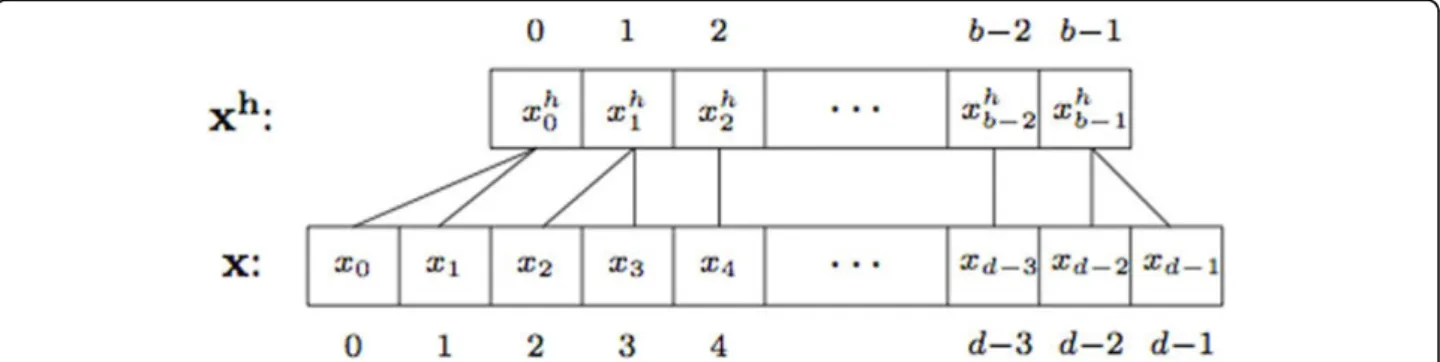
Thus, an entry iin xh records the“frequency counts” ofk-grams that are hashed together into the same hash keyi. That is,
xhi =
k:h(k)=i
ξ(k)xk, (1)
fork= 0, ...,d- 1 andi= 0, ...,b - 1. Note that in the trivial case ofξ≡ 1, xh
i represents the actual frequency
counts (see Figure 2).
As can be seen, multiple k-grams can be mapped,
throughh, into the same hash key. According to
Birth-day Paradox, if there are at least √b features, then
collisions are likely to happen [8], and hence, useful information for high accuracy classification could be
lost through feature hashing. The k-grams in a
collec-tion of protein sequences typically follow a Zipf
distri-bution, i.e., only very few k-grams occur with high
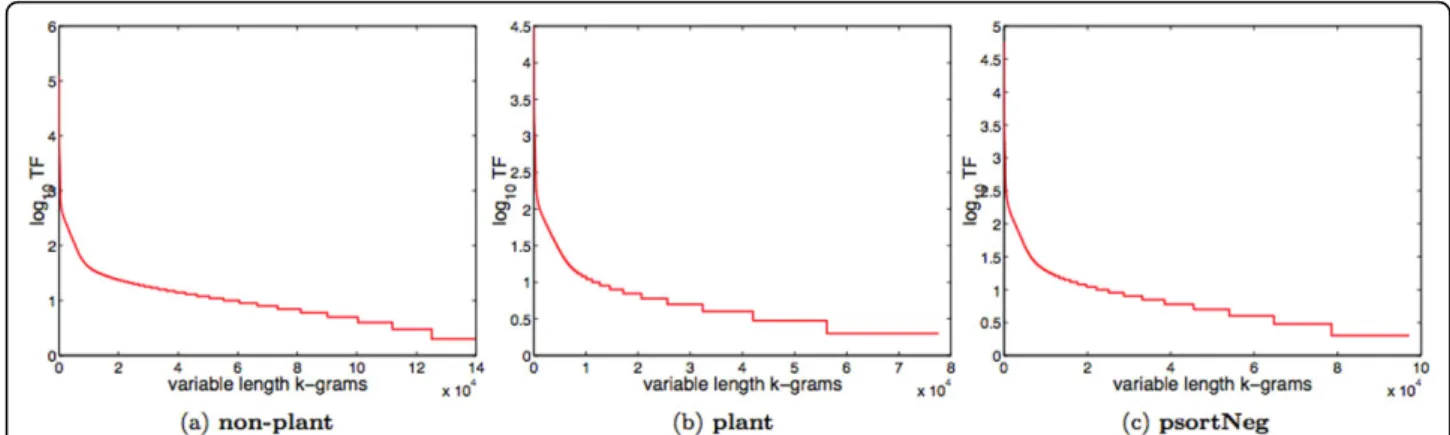
frequency, whereas the majority of them occur very rarely (see Figure 3). Because hash collisions are
inde-pendent of k-gram frequencies, most collisions are
likely to happen between infrequentk-grams.
Weinber-ger et al. [9] have proven that, for a feature vector x such that ||x||2 = 1, the length of x is preserved with
high probability, for sufficiently large dimension (or
hash size)b and sufficiently small magnitude ofx, i.e.,
||x||∞ (lower and upper bounds are theoretically
derived).
However, for many practical applications, the value of
b can be smaller than the theoretical lower bound. This
may be problematic as the smaller the size of the hash
vector xh becomes, the more collisions occur in the
data. Even a single collision of very high frequency words with different class distributions, can result in sig-nificant loss of information. Next, we empirically study the applicability of feature hashing on a protein subcel-lular localization prediction task.
Experiments and results
We used three protein subcellular localization data sets
in our study:psortNeg introduced in [25] and available
online at http://www.psort.org/dataset/datasetv2.html, andplant, and non-plantintroduced in [26] and avail-able online at http://www.cbs.dtu.dk/services/TargetP/
datasets/datasets.php. The psortNeg data set is
extracted from PSORTdb v.2.0 Gram-negative
sequences, which contains experimentally verified locali-zation sites. Our data set consists of all proteins that belong to exactly one of the following five classes: cyto-plasm (278), cytoplasmic membrane (309), periplasm
(276), outer membrane (391) and extracellular (190).
The total number of proteins in this data set is 1444. The plantdata set contains 940 proteins belonging to one of the following four classes:chloroplast(141), mito-chondrial(368), secretory pathway/signal peptide(269) and other (consisting of 54 proteins with label nuclear
and 108 examples with label cytosolic). Thenon-plant
data set contains 2738 proteins, each in one of the fol-lowing three classes:mitochondrial(361),secretory path-way/signal peptide (715) andother (consisting of 1224 proteins labeled nuclear and 438 proteins labeled cytosolic).
Experimental design
Our experiments are designed to explore the following questions: (i) How effective is feature hashing on
prohibitively high-dimensionalk-gram representations?; (ii) What is the influence of the hash size on the perfor-mance of biological sequence classifiers that use hash features, and what is the hash size at which the perfor-mance starts degrading, due to hash collisions?; and (iii) How does the performance of feature hashing compare to that of the“bag ofk-grams”approach?
To answer these questions, we proceeded with the fol-lowing steps. We first preprocessed the data by generat-ing all thek-grams from each collection of sequences, i. e., generating all the contiguous (potentially overlapping) sub-sequences of length k, for various values ofk. This
was done by sliding a window of length k over
sequences in each data set. Note that if a k-gram does
not appear in the data, it was not considered as a fea-ture. The number of uniquek-grams is exponential ink.
However, for large values of k, many of thek-grams
may not appear in the data (and, consequently, their fre-quency counts are zero).
Given a protein sequencex, we applied feature
hash-ing in two setthash-ings as follows: (i) We first generated all the k-grams of a fixed lengthk, wherek= 3. Each such
k-gram was then hashedinto a hash key. We refer to
this setting as the fixed-length k-grams; (ii) We then generated all thek-grams of various lengthsk, for values ofk= 1, 2, 3, and 4. Thus, this setting uses the union of
k-grams, for values ofkranging from 1 to 4. Each such
k-gram (i.e., unigram, 2-gram, 3-gram, or 4-gram) was
hashed into a hash key. We refer to this setting as the variable-length k-grams.
We trained Support Vector Machine (SVM) classifiers [27] on hash features, in both settings, fixed-length and variable-length k-grams, and investigated the influence of the hash size on the performance of the classifiers. Specifically, we trained SVM classifiers for values of the hash size (i.e., the reduced dimension) ranging from 210 to 222, in steps of 1 for the powers of 2, and compared their performance.
Furthermore, we applied feature hashing to sparse high-dimensional variable-lengthk-gram representations
to reduce the dimensionality to a mid-size b
-dimen-sional space, e.g.,b = 216 or b = 214, and compared the performance of SVM classifiers trained using hash fea-tures with that of SVM classifiers trained using“bag of
k-grams”.
Specifically, the feature representations used in each case are the following:
•a bag ofd variable-lengthk-grams (where all the variable-lengthk-grams are used as features). This experiment is denoted bybaseline.
•a bag of b hash features obtained using feature
hashing over alldvariable-length k-grams, i.e., for
eachk-gram, feature hashing produces an index i
such thati = h(k-gram) % b, where hrepresents a hash function. This experiment is denoted by FH.
In our experiments, we used the LibLinear implemen-tation of SVM, available at http://www.csie.ntu.edu.tw/ ~cjlin/liblinear/. As for the hash function, we
experi-mented with both the hashCodeof the Java String
class, and murmurHash. We found that the results
were not significantly different from one another in terms of the number of hash collisions and classification
accuracy. We also experimented with both
ξ :S → {±1} andξ≡ 1 - actual counts, and found that the results were not significantly different. The results
shown in the next subsection use the hashCode
func-tion andξ ≡ 1. On all three data sets, we reported the
average classification accuracy obtained in a 5-fold cross validation experiment. The results are statistically signif-icant (p< 0.05). The classification accuracy is shown as
a function of the number of features. Thex axis of all
figures in the next subsection shows the number of fea-tures on a log2 scale (i.e., number of bits in the
hash-table).
Results
Comparison of fixed length with variable lengthk-gram representations
Table 1 shows, on thenon-plantdata set, the
perfor-mance of SVMs trained using feature hashing on fixed length as well as variable lengthk-gram representations, where the hash size is set to 222. As seen in the table,
the performance of SVMs trained on fixed length k
-gram representations is worse than that of SVMs trained using variable lengthk-gram representations, withk ran-ging from 1 to 4 resulting in the highest performance (the representation is denoted by (1-4)-grams). The
per-formance of SVMs trained on fixed-length k-gram
representations is expected to be worse than that of
their counterparts trained on variable length k-gram
representations, as protein sequence motifs have usually variable length. The performance of SVMs trained using
variable length k-gram representations increases as we
add more dependencies in the data (i.e., larger values of
k), but starts decreasing as k becomes greater than 4,
which may be due to overfitting. Similar results are
obtained for theplantand psortNegdata sets (data not
shown).
The number of variable length k-grams, for kranging
from 1 to 4, is 155,017. Feature hashing eliminates the need for storing the vocabularies in memory by impli-citly encoding the mapping from strings to integers into a hash function. We conclude that feature hashing is very effective on prohibitively high-dimensional k-gram representations, which would otherwise be impractical to use. Because (1-4)-gram representation results in the highest performance, we used it for subsequent experiments.
The influence of hash sizes on classifiers’performance and the comparison of feature hashing with baseline (i.e., the“bag ofk-grams”approach)
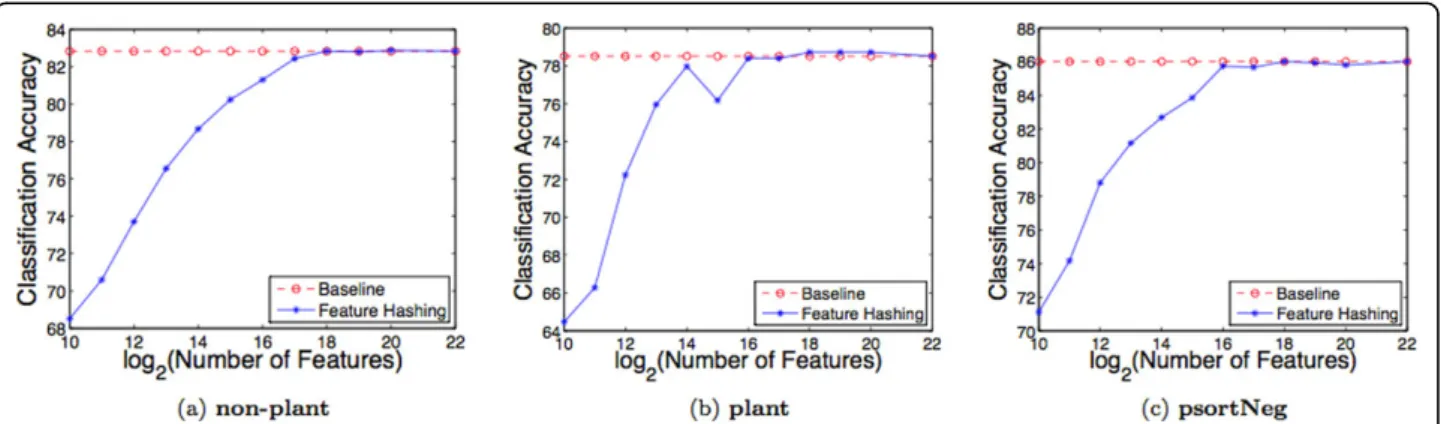
Figures 4a, b, and 4c show the influence of the hash size
b on the performance of the SVM classifiers, trained
using variable-lengthk-grams as feature representations, on the three protein data sets used in this study, non-plant,plant, and psortNeg, respectively. The values of
b range from 210 to 222. The figures also show the
results of the comparison of feature hashing (FH) with
baselineon the same data sets.
As can be seen in the figures, as the hash size b
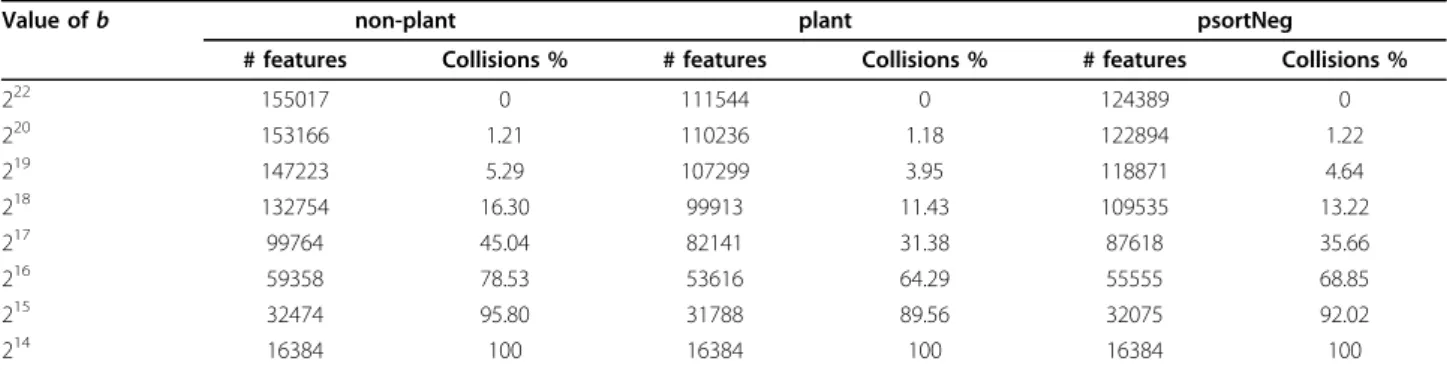
increases from 210 to 222, the performance of SVM clas-sifiers increases as well, due to a smaller rate of hash collisions for larger values of b. Table 2 shows, on all three data sets used, the number of unique features and the percentage of collisions for various hash sizes. The number of unique features is calculated as the number of non-empty entries in the hash vector, and the num-ber of collisions as the numnum-ber of entries with at least one collision. Note that the percentage of collisions below 214is 100%.
As the hash size increases beyond 216, the performance of SVM classifiers does not change substantially, and, eventually, converges. For example, on thenon-plantdata
Figure 4Feature hashing vs.“bag ofk-grams”. Comparison of feature hashing with the“bag of variable lengthk-grams”approach, referred as baseline on the protein data sets: (a)non-plant, (b)plant, and (c)psortNeg, respectively, using (1-4)-grams representations.
Table 1 Comparison of fixed-length with variable-length
k-gram representations.
Bag of fixed or variable lengthk-grams non-plant Accuracy % # features
1-grams 71.21 20
2-grams 70.85 400
3-grams 79.80 7999
4-grams 79.03 146598
(1-2)-grams 70.56 420
(1-3)-grams 79.69 8419
(1-4)-grams 82.83 155017
(1-5)-grams 80.09 950849
The performance of SVM classifiers trained using feature hashing on fixed length, 1-, 2-, 3-, 4-gram representations, as well as variable length, 2)-, (1-3)-, (1-4)-, (1-5)-grams representations, where the hash size is set to 222
set, with 216hash size, SVM achieves 81.3% accuracy, whereas with 222hash size, SVM achieves an accuracy of
82.83% (Figure 4a). On theplantdata set, SVMs achieve
78.4% and 78.51% accuracy, with 216and 222hash sizes, respectively (Figure 4b). Furthermore, as the hash size increases beyond 216, the percentage of hash collisions decreases until no collisions occur (Table 2). For all three data sets, with 222hash size, there are no hash collisions. The performance of SVMs trained on hash features in the 222dimensional space is matched by that of SVMs trained on hash features in the 218dimensional space, suggesting that the hash collisions beyond 218does not significantly distort the data.
Because 222(= 4,194,304) highly exceeds the number of unique features, and the rate of hash collisions becomes zero, this can be regarded as equivalent to the classifiers trained without hashing, which require storing the voca-bularies in memory, referred asbaseline(or the“bag of
k-grams”) (Figure 4). Moreover, we considered 216as the point where the performance starts degrading. Note that the vocabulary sizes, i.e., the number of unique variable lengthk-grams, fornon-plant,plant, andpsortNeg, are 155017, 111544, and 124389, respectively.
We conclude that, if feature hashing is used to reduce dimensionality from very large dimensions, e.g., 222to mid-size dimensions, e.g., 216, the hash collisions do not substantially hurt the classification accuracy, whereas if it is used to reduce dimensionality from mid-size dimen-sions to smaller dimendimen-sions, e.g., 210, the hash collision significantly distort the data, and the corresponding SVMs result in poor performance. Also, feature hashing makes it possible to train SVMs that use substantially smaller number of dimensions compared to the baseline, for a small or no drop in accuracy, for example, for a
hash size of 216= 65536 (compared to 155017
variable-lengthk-grams on thenon-plantdata set).
Conclusion
We presented an application of feature hashing to reduce dimensionality of very high-dimensional feature
vectors to mid-size feature vectors on protein sequence
data and compared it with the “bag of k-grams”
approach.
The results of our experiments on three protein sub-cellular localization data sets show that feature hashing is an effective approach to dealing with prohibitively high-dimensional variable lengthk-gram representations. Feature hashing makes it possible to train SVM classi-fiers that use substantially smaller number of features compared to the approach which requires storing the
vocabularies in memory, i.e., the “bag of k-grams”
approach, while resulting in a small or no decrease in classification performance.
Because recent advances in sequencing technologies have resulted in an exponential increase in the rate at which DNA and protein sequence data are being acquired [28], the application of feature hashing on bio-logical sequence data advances the current state of the art in terms of algorithms that can efficiently process high-dimensional data into low-dimensional feature vec-tors at runtime.
In the future, it would be interesting to investigate how the performance of hash kernels compares to that of histogram-based motif kernels for protein sequences, introduced by Ong and Zien [29], and the mismatch string kernels for SVM protein classification introduced by Lesli et al. [30]. Along the lines of dimensionality reduction, it would be interesting to compare the per-formance of feature hashing with that of feature abstrac-tion [17] on protein sequence classificaabstrac-tion tasks. Furthermore, another direction is to apply feature hash-ing to other types of biological sequence data, e.g., DNA data, and other tasks, e.g., protein function prediction.
Acknowledgements
This article has been published as part ofProteome ScienceVolume 10 Supplement 1, 2012: Selected articles from the IEEE International Conference on Bioinformatics and Biomedicine 2011: Proteome Science. The full contents of the supplement are available online at http://www.proteomesci. com/supplements/10/S1.
Table 2 The number of variable-lengthk-grams and the rate of hash collisions for various hash sizes.
Value ofb non-plant plant psortNeg
# features Collisions % # features Collisions % # features Collisions %
222 155017 0 111544 0 124389 0
220 153166 1.21 110236 1.18 122894 1.22
219 147223 5.29 107299 3.95 118871 4.64
218 132754 16.30 99913 11.43 109535 13.22
217 99764 45.04 82141 31.38 87618 35.66
216 59358 78.53 53616 64.29 55555 68.85
215 32474 95.80 31788 89.56 32075 92.02
214 16384 100 16384 100 16384 100
This research was funded in part by an NSF grant #0845487 to Prasenjit Mitra.
Author details 1
Information Sciences and Technology, Pennsylvania State University, University Park, PA, USA.2Naviance Inc., Oakland, CA, USA.
Authors’contributions
All authors have read and approved the final manuscript.
Competing interests
The authors declare that they have no competing interests.
Published: 21 June 2012
References
1. Baldi P, Brunak S:Bioinformatics: the Machine Learning ApproachMIT Press; 2001.
2. Jolliffe IT:Principal Component AnalysisSpringer-Verlag, New York; 1986. 3. Blei D, Ng A, Jordan M:Latent Dirichlet Allocation.Journal of Machine
Learning Research2003,3:993-1022.
4. Hofmann T:Probabilistic Latent Semantic Analysis.Proc of UAI’99, Stockholm1999.
5. Guyon I, Elisseeff A:An introduction to variable and feature selection.J Mach Learn Res2003,3:1157-1182.
6. Fleuret F:Fast Binary Feature Selection with Conditional Mutual Information.J Mach Learn Res2004,5:1531-1555.
7. Yang Y, Pederson JO:Feature selection in statistical learning of text categorization.In Proceedings of ICML1997, 412-420.
8. Shi Q, Petterson J, Dror G, Langford J, Smola A, Vishwanathan S:Hash Kernels for Structured Data.J Mach Learn Res2009,10:2615-2637. 9. Weinberger K, Dasgupta A, Attenberg J, Langford J, Smola A:Feature
Hashing for Large Scale Multitask Learning.Proc of ICML2009. 10. Forman G, Kirshenbaum E:Extremely fast text feature extraction for
classification and indexing.Proc of the 17th ACM CIKM, New York, NY, USA 2008, 1221-1230.
11. Langford J, Li L, Strehl A:Vowpal Wabbit online learning project.2007. 12. Kira K, Rendell LA:The feature selection problem: Traditional methods
and a new algorithm.Proc of AAAI, San Jose, CA1992, 122-134. 13. Saeys Y, Inza IN, Larrañaga P:A review of feature selection techniques in
bioinformatics.Bioinformatics2007,23:2507-2517.
14. Deerwester S, Dumais ST, Furnas GW, Landauer TK, Harshman R:Indexing by latent semantic analysis.Journal of the American Society for Information Science1990,41(6):391-407.
15. Airoldi E, Blei D, Fienberg S, Xing E:Mixed membership stochastic block models for relational data with application to protein-protein
interactions.In Proc of the Intl Biometrics Society-ENAR Annual Meeting2006. 16. Pan XY, Zhang YN, Shen HB:Large-Scale Prediction of Human
Protein-Protein Interactions from Amino Acid Sequence Based on Latent Topic Features.Journal of Proteome Research2010,9(10):4992-5001.
17. Silvescu A, Caragea C, Honavar V:Combining Super-Structuring and Abstraction on Sequence Classification.ICDM2009, 986-991. 18. Ganchev K, Dredze M:Small Statistical Models by Random Feature
Mixing.Proceedings of the ACL-2008 Workshop on Mobile Language Processing, Association for Computational Linguistics2008.
19. Wesselink JJ, delaIglesia B, James SA, Dicks JL, Roberts IN, Rayward-Smith V:
Determining a unique defining DNA sequence for yeast species using hashing techniques.Bioinformatics2002,18(2):1004-10.
20. Buhler J, Tompa M:Finding motifs using random projections.Proceedings of the Fifth Annual International Conference on Computational Biology, RECOMB‘012001, 69-76.
21. Indyk P, Motwani R:Approximate nearest neighbors: towards removing the curse of dimensionality.Proceedings of the Thirtieth Annual ACM Symposium on Theory of Computing, STOC‘981998, 604-613.
22. Buhler J:Efficient Large-Scale Sequence Comparison by Locality-Sensitive Hashing.Bioinformatics2001,17(5):419-428.
23. Durbin R, Eddy SR, Krogh A, Mitchison G:Biological sequence analysis: Probabilistic Models of Proteins and Nucleic AcidsCambridge University Press; 2004.
24. Begleiter R, El-Yaniv R, Yona G:On Prediction Using Variable Order Markov Models.Journal of Artificial Intelligence Res2004,22:385-421.
25. Gardy JL, Spencer C, Wang K, Ester M, Tusnady GE, Simon I, Hua S, deFays K, Lambert C, Nakai K, Brinkman FS:PSORT-B: improving protein subcellular localization prediction for Gram-negative bacteria.Nucleic Acids Research2003,31(13):3613-17.
26. Emanuelsson O, Nielsen H, Brunak S, von Heijne G:Predicting subcellular localization of proteins based on their N-terminal amino acid sequence.
J Mol Biol2000,300:1005-1016.
27. Fan RE, Chang KW, Hsieh CJ, Wang XR, Lin CJ:LIBLINEAR: A library for large linear classification.J of Machine Learning Res2008,9:1871-1874. 28. Ansorge W:Next-generation DNA sequencing techniques.New
Biotechnology2009,25(4):195-203.
29. Ong CS, Zien A:An Automated Combination of Kernels for Predicting Protein Subcellular Localization.Proc of WABI2008, 186-179. 30. Leslie C, Eskin E, Weston J, Noble WS:Mismatch String Kernels for SVM
Protein Classification.Advances in Neural Information Processing Systems (NIPS 2002)2002.
doi:10.1186/1477-5956-10-S1-S14
Cite this article as:Carageaet al.:Protein sequence classification using feature hashing.Proteome Science201210(Suppl 1):S14.
Submit your next manuscript to BioMed Central and take full advantage of:
• Convenient online submission
• Thorough peer review
• No space constraints or color figure charges
• Immediate publication on acceptance
• Inclusion in PubMed, CAS, Scopus and Google Scholar
• Research which is freely available for redistribution