2018 Volume 7 Number 3, 87-108
Implementation of English flipped classrooms: Students’
perceptions and teacher’s reflection
Nguyen, Thuong
Thai Nguyen University of Technology, Vietnam ([email protected])
Received: 19 July 2017 Revised: 15 August 2017 Accepted: 11 September 2017
Available Online: 19 September 2017 DOI: 10.5861/ijrsll.2017.1876
ISSN: 2243-7754 Online ISSN: 2243-7762
OPEN ACCESS
Abstract
Since English language teaching and learning require many authentic drills and reflective
practices during the learning process, many researchers, educators and teachers have tried
multiple techniques to improve learners’ active engagement and self-regulated learning. Yet,
the major problem for most English teachers is how to get enough time for both delivering all
the contents and facilitating students’ activities in the classroom. In recent years, “flipped
classroom” has been a feasible solution that offers a new pedagogical tendency in the field of
ESL (English as a second language)/EFL (English as a foreign language) teaching. Regarding
this trend of pedagogy, the paper aims to investigate the effect of the flipped model on English
language learners’ skill development at a college level. In addition, there is a part of narrative
inquiry involving the author’s personal reflection as a teacher of two English classes. The
result showed a significant improvement of students’ language competence through an
open-ended survey and a semi-structured interview. The findings also make a path to
rejuvenate English teaching and learning at Thai Nguyen University of Technology, Vietnam
and advocate an innovation in curriculum.
Nguyen, T.
Implementation of English flipped classrooms: Students’ perceptions and teacher’s
reflection
1. Introduction
In recent years, English is a vital language subject in every school, college, university, training center, and educational institution in Vietnam, and even a certificate of the English language can be used as a criterion to assess any interviewee when applying for a job. Hence, teaching and learning English have been improved continuously to meet learners’ need. Since 2008, the Vietnamese Ministry of Education has launched a ten-year National Scheme for Teaching and Learning Foreign Languages in the National Formal Educational System in the period of 2008 –2020, also known as the National Foreign Language Project (NFLP), worth about US $450 million, in order to implement new teaching and learning approaches of foreign languages at all levels. The goal of this scheme is that by 2020 the majority of Vietnamese young people are capable of using language independently in communication, learning and working in an integrated, multi-lingual, multicultural environment (Government of Vietnam, 2008).
Vietnamese language teachers, therefore, have been seeking many feasible strategies to apply in their daily work, yet it seems hard to make students more interested in communicative learning approach. In our modernized world, technology can become a useful tool to solve this problem. During the past five years, “Flipped classroom” has been a popular term related to blended learning, CALL (Computer Assisted Language Learning), MALL (Mobile Assisted Language Learning). There is a plethora of research on flipped model in different fields of study (Zainuddin & Halili, 2016), which entices many educators into improving their pedagogical methods. Flipping technique helps teachers change their role from “sage of the stage” to “guide on the side” (King, 1993). It comes into effect with differentiated instructions (Siegel, 2014) and classroom interaction (Egbert, Herman & Lee (2015).
For English teaching and learning, “flipped classroom” truly makes a difference when students actively get to know language contents on pre-recorded videos before coming to the class, so class time is devoted to various types of skill practice. This helps student become more responsible for their learning as well as enjoy the excitement of discovery on their academic path (Berrett, 2012; Fulton, 2012; Torkelson, 2012; Bishop & Verlager, 2013; Hung, 2015; Abeysekera & Dawson, 2015).
In Vietnamese educational setting, flipped classroom has not been implemented on a large scale, especially in EFL training. The quantity of research papers on the application of flipped model in the field of language teaching and learning is also limited. Thus, this study aims to fill in the gap of the world-wide research library, particularly to introduce a new trend of EFL strategy to many university lecturers, school teachers and training officials in Vietnam.
1.1 Statement of the problem
In reality, there are some problems in the current situation of EFL teaching and learning in Vietnam. The first disheartening fact is students’ low level of communicative competence in English. Students have spent several years studying English at high school and at colleges or universities, but most of them cannot use English to communicate in real life situations. One of the unexpected consequences is that they will not be able to find a good job after they graduate from universities. This has affected negatively students’ attitudes toward EFL learning, and even discouraged them to master English.
Implementation of English flipped classrooms: Students’ perceptions and teacher’s reflection
of them cannot apply this teaching approach successfully. Some teachers find it easier to stick to content-based lessons and spend most of the time covering required parts in the curriculum. As a result, there is a lack of teacher-student and student-student interaction in the classroom. In some cases, due to a big size class, a teacher is not able to interact individually with students as much as possible, so he/she does not know much about their preferences or any struggling issues they have.
For English language learners (ELLs), it is necessary for them to practice their language skills with their peers and teachers. However, students cannot drill their communicative skills as they often have only a few minutes to work in pairs or groups after learning grammar structures or vocabulary. Therefore, the researcher, as a teacher of English, expects to find a better way for students to master this international language in an effective and enjoyable way. Flipping the classroom will be such a way to help both teachers and students to attain their teaching and learning achievement.
2. Literature Review
In order to constitute a fundamental premise for flipped classroom approach, a review of various studies was conducted and presented briefly in the following part. There is an overview of the origin of flipped model and an investigation of recent trends of application in the field of English language teaching and learning.
2.1 History of Flipped Classroom
The origin of flipped classroom can be traced back to a Physics course taught by Professor Erik Mazur at Harvard University in 1991. He let his students to choose the content and pace of their own learning, which then advocated an interactive learning classroom environment (Mazur, 1991). The term “flipped classroom” was renamed by Baker (2000) after the notion of “inverted classroom” stated by Lage, Platt, and Treglia (2000) as they contended that learning would be more interesting for students when it occurred not only inside but also outside the classroom building.
Salman Khan, an MIT graduate, initially made YouTube video himself to teach his cousin in 2004. He soon became popular with his non-profit organization, known publicly as Khan Academy, which supplies world-wide learners with free academic videos in almost all fields of school subjects, science, social issues and technology. What he has done was so impressive that Bill and Melinda Gates decided to donate a big amount of money for the expansion of Khan institution. Many schools also support Khan’s programs by applying flipping technique through Khan videos (Thompson, 2011; Martin, 2013).
In 2007, two science teachers from Colorado, Jonathan Bergmann and Aaron Sams, started helping their absent students with pre-recorded videos. After that, they recognized the students’ excitement and motivation in learning activities after watching and exploring lesson contents before attending the class. Together, they wrote a book, “Flip your classroom: Reach every student in every class everyday”, which instructs many other educators and teachers to flip their classrooms successfully (Bergmann & Sams, 2012).
In his dissertation, Strayer (2007) defines flipped classroom as an “innovative classroom structure that moves the lecture outside the classroom via technology and moves homework and practice with concepts inside the classroom via learning activities” (p. ii). Similarly, regarding cognitive development, See & Conry (2014) claim that flipping classroom helps to move the low levels of Bloom’s Taxanomy (understanding and remembering) (Krathwohl, 2002) outside the class and fill in-class time with higher thinking skills (creating, evaluating, analyzing, and applying). So far, there have been many researches on flipping approach applied in engineering programs (Toto & Nguyen, 2009), in economics classes (Calimeris & Sauer, 2015), in foreign language teaching (Basal, 2015), in a course of business communication (Knight, 2016), and in nursing education (Green & Schlairet, 2016).
Nguyen, T.
LMS (Learning Management System) like Engrade, Schoology, Edmodo, Moodle, Desire2Learn, Canvas, eCampus, WebCT, Blackboard; software to record videos (Jing, Camtasia, Screenflow, PowToon); free educational videos on Khan Academy, Udacity, Coursera and Engvid.com or other videos with Screen casting program, YouTube, Teachertube or Screenomatic, TEDed, and Vimeo.
Other Web 2.0 tools include Padlet, Voxopop, and Jogtheweb (Basal, 2015). Additionally, according to Hung (2015), teachers can give some tasks for students by using WebQuest or AML (Academic Wordlist). Moreover, JiTT (Just-in-Time Teaching), known as a typical pedagogical strategy that allows students’ web-based assignment at home, should be incorporated with flipping approach. In this case, a teacher would change his/her classroom into an interactive learning environment with group discussions and collaborative activities. Since created in 2014, Flipped Learning Network (FLN) has been an official platform for educators and teachers to share knowledge, master skills and get resources before flipping their own classes. The four pillars F-L-I-P (Flexible learning environment, Learning culture, Intentional content, Professional educators) are counted as four criteria for a successful implementation of flipped learning approach, which individualizes students’ capacities by delivering differentiated instructions and creative learning tasks (Flipped learning network, 2014).
2.2 Flipped Classroom in the Field of English Language Teaching and Learning
Research and studies on the application of flipped classroom approach in English language teaching and learning have blossomed in the past three years. During a theoretical discussion, Correa (2015) made a connection between flipped classroom and the transformation of pedagogy. These two pedagogical strategies share common factors of learning time, scaffolding, learner autonomy, accessibility and functioning knowledge (Correa, 2015, p.119-120). Albeit possible limitations, flipping approach goes beyond the confines of banking education as it helps students to move forward on their critical reflection of living and doing.
Basal (2015) collected qualitative data with four themes after investigating an implementation of flipped model. He confirmed that this model brings many benefits to ELT teachers, “including videos of real life situations where students can listen to native speakers and teachers can take advantage of ready-to-use rich content” (p. 35). Similarly, Sung (2015) did a case study on a flipped EFL class in Korea. Students were to preview weekly readings or video, submit questions an LMS platform and join online talks on another online system. Then, they came to the class and shared their Thought Papers (TPs) by discussing the results of what they had done online. After class work involved the review of all learning material such as PowerPoints, TPs plus learning log activities. As a consequence, although facing some challenges of a new learning approach, students kept their positive attitudes towards flipping. Moreover, they hoped that flipped teaching would leverage the development of current EFL teaching and learning.
Hung (2015) introduced to her students a WebQuest active learning strategy that enabled them to become real explorers of knowledge. Findings revealed that both structure and semi-structured flip lessons were more interesting, engaging to English learners than the non-flip one. Since students have chances to actively get the information to their own preferences, they will be more responsible for their own learning outcomes. This heuristic method motivates students to practice their language skills not only during the circle of class hours but also through their lifetime.
Implementation of English flipped classrooms: Students’ perceptions and teacher’s reflection
groups gained more significant, actual achievement, compared to the control groups.
Since the 1980s, CLT (Communicative Language Teaching) has been applied in foreign language classrooms so that students would use languages as communicative tools. So as to increase interactive time during class hours, many teachers of English actually let students do some readings or exercises before coming to the class; however, this cannot be considered to be “flipping”. When students just finish readings, teachers have no tools for checking students’ comprehension. Besides, language learners need synchronous practices of skills rather than a completion of monotonous tasks. Thus, flipping enables teachers to accelerate students’ language competence through flexible and creative assignments. From constructivism viewpoints, flipping offers ample opportunities for students to “actively construct new ideas or concepts based on prior knowledge and/or experience” (Eryaman & Genc, 2010, p. 534). In other words, flipped classroom has been a stage for teachers to act as a coach while students turn out to be potential communicators in real-life, intriguing learning contexts.
Soliman (2016) has recently examined the Flipped classroom (FC) pedagogy applied in English for Academic Purposes (EAP) teaching. The module comprises three phases of Pre-Class Tasks, In-Class Tasks and After-Class Tasks throughout a 13-week semester. The study emphasizes the efficiency of FC method in EAP class and calls for further research on this branch of linguistic field.
Several educators investigate the impacts of flipped classroom on students’ English language skills or grammatical comprehension; for example, writing skill (Engin, 2014; Yu & Wang, 2016), listening skill (Ahmad, 2016); grammar (Al-Harbi & Alshumaimeiri, 2016). Yet, there is a paucity of overview of four language skills under the influence of flipping technique. Particularly, there are few discussions on how or to what extent students’ speaking, listening, reading and writing develop when they join an EFL flipped classroom. This paper, hence, aims to address this issue for the sake of students’ language competence and teachers’ professional development when it comes to our new era of educational technology.
2.3 Benefits of Flipping classroom for Teachers and Learners
Several benefits of flipping technique, drawn from research papers, public articles or other media coverage, can be counted as a concrete proof of its massive effect on educational development.
First, teachers can have more opportunities to pursue better teaching strategies and have a healthy relationship with students’ families when they flip their classrooms. They can actively prepare for the lessons anytime by using technological tools. Besides, instead of spending fifty minutes or more than two hours explaining the subject concepts, teachers now have more time to pay attention to students’ progress and help them with any struggling issues. As Dewey (2013) stated, “The teacher is not in the school to impose certain ideas or to form certain habits in the child, but is there as a member of the community to select influences which shall affect the child and to assist him in properly responding to these influences” (p. 36). Without being under the pressure of content coverage, teachers have more time to prepare creative, intellectual and interesting activities for students’ growth.
Nguyen, T.
One of the news stories posted by Edward Graham and Tim Walker on the National Education Association website (http://neatoday.org) is about teachers’ ideas of flipped classrooms. Tyler Johnstone, a math teacher in Folsom, California, has succeeded in incorporating the flipped model in his teaching for many years. His videos on YouTube are also being watched many times. He ensures that his students finish their tasks regularly. Surprisingly, some parents even watch the lessons with their children, as they really want to know what their children are learning. Another teacher in Germany, Daniele Massey, finds it easier to differentiate his instructions to meet students’ needs and help them learn better (Graham & Walker, 2013). In other words, flipping classrooms makes teachers become more enthusiastic to try their best to teach and improve the relationship between schools and families.
Second, the flipped learning approach helps students to explore knowledge contents themselves by watching lecture videos at home and get a deeper understanding of the lessons during classroom activities. As the lectures are recorded in the forms of videos, almost online as well, students are able to access lessons easily. They can also rewind, pause, or re-watch the videos if they want. Although there may be not direct explanations from the teacher, students take notes for their questions and bring the issues to the class. This approach, therefore, boosts students’ engagement and performance (Millard, 2012; Stone, 2012; Walsh, 2013; Clark, 2015).
With the review of some data on flipped classrooms, Goodwin and Miller (2013) assert that flipped classrooms help to raise test scores, give “particular benefits for students in advance placement classes and students with special needs” (p. 78). Same ideas from other research (Morgan, 2014; Evseeva & Solozhenko, 2015; Yu &Wang, 2016) are pointed out that flipping helps to increase academic achievement. Particularly, students are highly motivated with videos, which are different from monotonous traditional lessons, and they can monitor their own learning speed. In her video, Gerstein (2012) gives interesting explanations of flipped classrooms. She insists that learning has become a dimensional technique with which learners are active explorers who can celebrate the joy of mastering knowledge. The key point of her demonstration is that in inverted classrooms students construct their own meanings from learning experiences. It is not what a person learns; it is how he or she can learn from that, how to use the knowledge, and how to apply what he or she knows into real-life circumstances. From this vantage point, flipped lessons can assist learners to reach these goals.
Furthermore, students have more chances to practice English skills simultaneously when they watch the videos, listen to English sounds, read sentences, and write vocabulary. They can get authentic knowledge that they discover themselves. As Ayer states, “learning is a process of active discovery and that learning depends on concrete experiences…” (p. 15). Suffice it to say, flipped classrooms, or inverted classrooms, really make changes to traditional teaching and learning which force students to absorb knowledge passively. Students become satisfied with new ways of learning that fulfill their needs (Nanclares & Rodríguez, 2016) and challenge them with higher-order thinking skills (Alsowat, 2016). Accordingly, Newman, Kim, Lee, Brown, and Huston (2016) came to a conclusion that flipped teaching affects students’ knowledge acquisition involving information communication, information accessibility, information stimulation, information interaction and information accumulation (p. 67).
Implementation of English flipped classrooms: Students’ perceptions and teacher’s reflection
students’ learning. The teacher collected data during all classes and reflected on what he was doing for the benefits of students. He soon recognized his students’ excitement when they watched videos and finished the assignments together in the classroom.
In an interview by the Colbert Report, Salman Khan stated that by shifting our traditional way of teaching and learning, we are able to improve and utilize classroom activities more effectively. As students already watch the content, teachers have more time to explain about struggling issues and apply differentiated instructions, there will be more classroom interactions. Consequently, both teachers and students can improve education (Colbert, 2011).
2.4 Context
At Thai Nguyen University of Technology (TNUT), Vietnam, students are required to study three-part curriculum of the English language before they take a TOEFL Institutional Test (TOEFL ITP) as a prerequisite for their graduation. This means that they need to finish three English courses from the level Elementary to Intermediate. The amount of all lessons during these courses take both teachers and students much time to prepare and and acquire. Hence, a preliminary survey of the study was conducted to examine the current efficiency of content-based English language teaching for first year students at TNUT. Participants are 28 first-year students in two classes of Elementary (Speaking) and Pre-intermediate (Writing) level, among of them are twenty-three male and five female students. They all signed in the consent forms before taking the survey. 42% of students have been learning English for quite long time, from 1-5 years, others have spent more than 5 years of English study, and only a few of them started learning English during their first semester at university. As a result, 64% of these students responded to the question involving lesson comprehension that they understand half of the lesson (i.e. 50% of English knowledge during class time). Some can get from 60% to 90% of the big picture of a lecture, but most of them find it hard to tackle the issues in English. Nearly half of them confirm that the amount of time for skill practice counts for 2 periods of one class (one class comprises 4 periods, each period lasts 50 minutes). 42% of them allege that ‘limited personal ability’ is one of the factors preventing them from improving English competence while 32 % of them consider ‘lack of time for skill practice’ to be the main cause of their low results.
Most of the students (64%) claim that the teacher sometimes interacts with them individually. Moreover, they think that the teacher should only spend one third of the class hours for explaining grammar, structure or other linguistic issues, and the remaining time should be devoted to doing exercises, reviewing grammar/vocabulary and/or practicing English skills. From that vantage point, the researcher has been trying to implement flipped classroom approach in these English two classes so as to make a difference in both teaching and learning approach. The expected outcomes would be concerned with students’ attitudes towards ‘flipped’ learning and teacher’s new pedagogical strategies.
3. Research Methods
3.1 Research Questions
The paper seeks to answer these following research questions:
To what extent does flipped classroom model affect students’ improvement of English language skills?
To what extent do students appreciate the “flipped” learning approach?
3.2 Participants
Nguyen, T.
3.3 Instruments
Technological tools applied in the study comprises all teaching facilities, students’ personal device such as computers, mobiles, and the most important one is the E-learning Management System, an educational system of TNUT for teaching and learning activities. This platform makes it easier for teachers to upload videos as well as any other materials for students to access quickly. Students can also submit their homework and exchange information with one another on the discussion forum before coming to the class for face-to-face interaction.
To investigate students’ self-evaluation of the new learning approach, the researcher uses a set of 10 Likert-scale questions with five degrees (Strongly agree, Agree, Neutral, Disagree, Strongly Disagree). The questions focus on assessing students’ comprehension of the lessons, students’ development of speaking, listening, reading and writing, usefulness of videos, teacher’s individual interaction, students’ personal attitudes towards course workload, and overall evaluation of flipped classroom model.
In addition, to get “the meaning of a phenomenon from the views of participants” (Creswell, 2013, p. 21), the researcher conducted a semi-structured interview after collecting the questions. This type of qualitative data was analyzed base on emerging themes from students’ responses. Nine students from Speaking class and seven students from Writing class volunteered to participate in the interview. The length of each interview is about five to ten minutes for each student. Students had more opportunities to express their thoughts and recommendations for English classes.
In brief, the research methodology involves both quantitative and qualitative approach, which contributes to a holistic and authentic interpretation of data.
3.4 Procedure
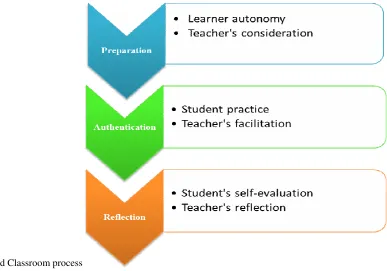
The research procedure lasts during the second semester of the 2016-2017 academic year within Speaking and Writing courses. Particularly, these first-year students were selected in Advanced Program, so they may already be better at basic knowledge of English and be more adaptive to changes. Students spend their whole ten-week semester to study different subjects of the English language. The flipped classroom pedagogy was implemented in three phases of learning process: Preparation, Authentication, Reflection.
Implementation of English flipped classrooms: Students’ perceptions and teacher’s reflection
Preparation - As the notion of flipped classroom is fairly new to students, the teacher-researcher, took one period (50 minutes) to explain about how the semester would go with dramatic changes of teaching and learning methods. A specific course syllabus delivered to the students included comprehensive information of the content, course objectives, learning materials, assignments and requirement, grading policy and teacher’s expectation. Students would get the picture of what and how they were going to do as joining English flipped classrooms. Students also needed to be taught some technological skills for their work on the E-learning system and utilization of other device for video watching. The teacher gave visual examples of how to deal with the videos (e.g, rewind, stop, pause, and/or link to other related videos). Expectation for students’ engagement in class activities such as discussion, pair work, group project was highlighted with the result of higher English proficiency level. In order to plan a flipped lesson, the teacher had to consider knowledge contents carefully to assign appropriate videos. The sources of educational videos are available on YouTube, Khan Academy, Engvid.com and TED-Ed (ed.ted.com). The teacher also prepares quizzes or different types of hands-on activities for students during class time. Meanwhile, students explore themselves some background information of the assigned topics related to the videos as well as the main contents of the lesson beforehand.
Authentication - This phase is divided into three parts: Before Class, During Class, After Class.
Before Class: Participants were required to watch the videos on E-learning prior to their coming lesson. They needed to study learning materials that helped them to understand the knowledge contents better. Particularly, students had to answer the questions elicited from the content and videos. They might reply to the content, or give comments on the videos by taking notes. They were sure to come to the class talking about what they have learned from the materials and videos so those notes were vital. E-learning assignments varied flexibly base on different lesson topics. For speaking class, students got weekly topics and prepared for their speech; while for writing class, students might finish an outline or search for resources that helped them with writing practice. Graded submissions met the requirements of full answers, quizzes and other tasks available.
During Class: This part involves students’ practice and teacher’s facilitation during classroom hours. To attain best results of high-order thinking skills, the teachers asked students to do peer-reviewed work on E-learning tasks upon class discussion. They would have more opportunities to share their struggling issues with their own partners, and then with the whole class. Teacher acted as a coach to listen, guide and assist students. After recalling the basic concepts of the lesson, students joined different hands-on activities such as situation reaction, role-play, team debate, creative ideas, etc. Sometimes, they did some mini-lecture on what they have learnt when finishing each chapter of the course book. Besides, they could play some educational games on vocabulary and common expressions that serves their skill practice. Presentation is an integral part of overall project throughout the semester so students spent several classes discussing their favorite topics, checking materials for references and consulting the teacher’s advice.
Contact: Students kept in touch regularly with one another and with the teacher through the Forum on E-learning system or through emails.
Resources: The teacher applied textbooks and many others resources online, which made students exhilarated with every activity they actively engaged in.
Nguyen, T.
Reflection - Students responded to a set of 10 Likert-scale questions and a semi-structured interview about the effects of flipped classroom. Representatives from each class talked about what they appreciated and how they developed their English skills with the flipped learning approach. Moreover, they could mention any drawbacks of this model and any recommendation for future classes not only in Speaking, Writing skill but also in other classes of the English language. The teacher took this chance to reflect on what she has done, what she could do to help students improve their language proficiency in a flipped classroom. The final part of this research includes the teacher’s personal reflection on the whole process of flipped strategy.
4. Results and Discussion
The quantitative analysis of results is divided into two parts corresponding with the two research questions. The first part involves students’ lesson comprehension and skill development; the second part is about their overall evaluation of flipped classroom. As Doyle (2008) stated, “The one who does the work does the learning” (p. 63), students were absolutely absorbed in studying English as well as eager to respond to the survey questionnaires. They not only gained more linguistic knowledge but also opened their mind towards different perspectives of teaching and learning methods. In other words, this study of flipped classroom enabled them to be active learners and decisive evaluators.
4.1 Students’ skill development
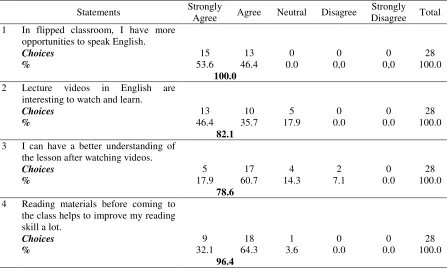
As shown in Table 1, all the students (100%) strongly approved that they had more opportunities to practice their speaking skill in English flipped classrooms. This could motivate both the teacher and students to enhance the efficacy of CLT (Communicative Language Teaching), which makes the target of language learning more attainable. Accordingly, flipped approach can be a useful tool to rejuvenate the current grammar-based or content-based EFL/ESL curricula.
Table 1
Statement 1, 2, 3, 4, 5, 6, 8 about students’ skill development and comprehension
Statements Strongly
Agree Agree Neutral Disagree
Strongly
Disagree Total 1
In flipped classroom, I have more opportunities to speak English.
Choices 15 13 0 0 0 28
% 53.6 46.4 0.0 0,0 0,0 100.0
100.0 2
Lecture videos in English are interesting to watch and learn.
Choices 13 10 5 0 0 28
% 46.4 35.7 17.9 0.0 0.0 100.0
82.1 3
I can have a better understanding of the lesson after watching videos.
Choices 5 17 4 2 0 28
% 17.9 60.7 14.3 7.1 0.0 100.0
78.6 4
Reading materials before coming to the class helps to improve my reading skill a lot.
Choices 9 18 1 0 0 28
% 32.1 64.3 3.6 0.0 0.0 100.0
Implementation of English flipped classrooms: Students’ perceptions and teacher’s reflection
Table 1 … continued
Statements Strongly
Agree Agree Neutral Disagree
Strongly
Disagree Total 5
I am confident to know the main ideas of the lesson in advance.
Choices 7 15 6 0 0 28
% 25.0 53.6 21.4 0.0 0.0 100.0
78.6 6
I also develop my listening through watching videos and classroom discussions.
Choices 10 13 5 0 0 28
% 35.7 46.4 17.9 0.0 0.0 100.0
82.1 8 Submitting assignments through
E-learning system really helps to improve my writing skill.
Choices 7 13 8 0 0 28
% 25.0 46.4 28.6 0.0 0.0 100.0
71.4
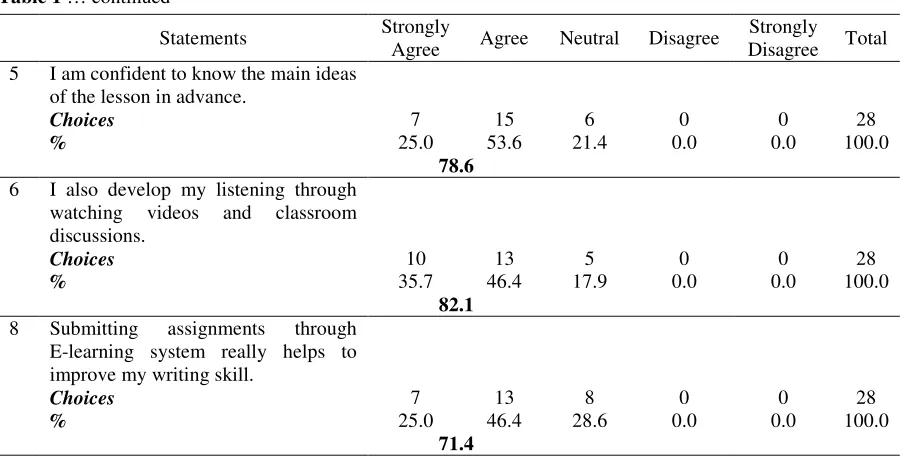
Next, 82.1% of the students showed their interests in video watching as they found it easier to learn basic concepts before coming to class; only five students (17.9%) presented a neutral position and no one disagreed. Regarding their lesson comprehension, most of the students (78.6%) strongly agreed or agreed they had a better understanding of the lesson after watching videos, while there were few neutral and disagreed ideas. This finding revealed that students actively fulfilled their class tasks on E-learning system after they got assigned videos. Furthermore, the teacher could realize some students might not get access to the internet or figure out the main ideas of the videos due to their language barrier.
Besides, the majority of participants (96.4%) responded positively to statement 4 “Reading materials before coming to the class helps to improve my reading skill a lot”. They actually increased their reading speech and drilled other skills such as skimming and scanning. In fact, weekly reading fostered their active learning and critical thinking inside and outside classroom environment. This is consistent with the studies done by Stone (2012), Hung (2015), and Basal (2015) and who got positive results of self-regulated learning. Furthermore, they enlarged their vocabulary and tackled some grammatical issues through reading different types of materials. The students appeared to be the master of their knowledge building. They became active in their own choices of learning styles and language acquisition. Hence, 78.6% of the students supported the statement that “I am confident to know the main ideas of the lesson in advance”. Joining classroom activities has now been their journey of intellectual growth when they have more time for critical thinking tasks because they had already known about basic concepts. The rest of the respondents (21.4%) kept their neutral ideas as they could not understand the videos thoroughly so they found it difficult to get the main ideas. In particular, some students said that they needed more teacher-led explanation after they watched videos or read materials.
Nguyen, T.
opportunities to develop their language skills. It has a synergistic effect on students’ learning approach and competence.
4.2 Students’ overall evaluation
Table 2
Statement 7, 9, 10 about students’ overall evaluation of flipped classroom
Statements Strongly
Agree Agree Neutral Disagree
Strongly
Disagree Total 7
In flipped model. the teacher has more time to interact with her students individually.
Choices 8 15 5 0 0 28
% 28.6 53.6 17.9 0.0 0.0 100.0
82.1 9
Although I have to prepare much work before class. I like this new way to study English.
Choices 6 9 8 5 0 28
% 21.4 32.1 28.6 17.9 0.0 100.0
53.6 10
The flipped classroom is more interesting than the traditional one.
Choices 17 6 5 0 0 28
% 60.7 21.4 17.9 0.0 0.0 100.0
82.1
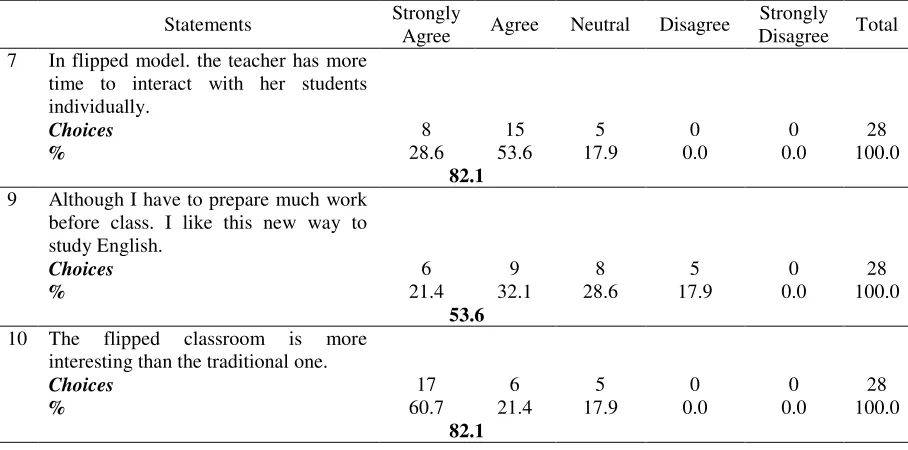
It is encouraging that 82.1% of the participants agreed and strongly agreed upon an increase of teacher-student interaction in flipped classroom. Without delivering the lesson contents through whole class presentation and explanation, the teacher had more time for differentiated instructions and individual interaction. She could go around the class to listen to group discussions or answer students’ questions. It was also better for the teacher to care about learners’ needs when she talked to them friendly in person. Accordingly, students were empowered to grow intellectually under the guidance of a considerate and loving teacher.
To measure students’ overall evaluation of flipped classroom, statement 9 asked about if students like this new way to study English despite much workload of class tasks. As a result, 53.6% of the students approved of the statement; eight students (28.6%) responded neutrally and five students (17.9%) disagreed on that. These findings show that some students had difficulties in accommodating with a new learning approach. Perhaps, some of them preferred “traditional classroom” where they did not have to complete E-learning assignments and get ready for high-order thinking activities. However, when responding to the last statement “The flipped classroom is more interesting than the traditional one”, 60.7% of the students strongly agreed, 21.4% agreed and 17.9% presented a neutral position. In general, although being perplexed by “flipped” pedagogy at the first time, students preferred such technologically applied method as they had better knowledge of the English language as well as developed four language skills simultaneously.
4.3 Semi-structured interview
With a view to getting specific perceptions of flipped classroom, the researcher conducted a semi-structured interview with nine students from Speaking class and seven students from Writing class. The interview consists of four questions:
What do you like when being a learner in a flipped classroom? What don’t you like when being a learner in a flipped classroom?
Implementation of English flipped classrooms: Students’ perceptions and teacher’s reflection
Most of the interviewees enjoyed telling about what they liked when being a learner in a flipped classroom. Their responses referred to specific aspects of flipped classroom model such as videos, interaction, performance, so they were coded into several issues of teacher student interaction, communication development, new method, personal traits, skill development, adoption, difficulties, and learner’s attitudes. These codes were then categorized into two following main themes: Advantages and disadvantages of the flipped classroom.
4.4 Advantages
The interviewees emphasized the benefits of a flipped classroom when they had opportunities to apply a new learning approach. One student alleged that “I like best in a flipped classroom is the method of studying. I know what I will learn, before class I can prepare for the answers. I can gain initiative in class about preparing for the lesson and getting high scores. I think a flipped classroom is good for me” or another student was interested in learning resources “I know a lot of interesting websites, videos; like team work; watch videos with native speakers.” Most of them implied that “I do like being a learner in a flipped classroom because in class I can spend more time to speak English and I also understand lessons better.”
Besides, the students confirmed the increase of teacher-learner interaction in the classroom like in the responses: “I think I understand the lesson more. The teacher has much time to discuss with each student” and “Students were allowed to discuss sincerely with the teacher and classmates, which made them more self-confident.”
Moreover, flipping approach, according to some students’ ideas, helped them develop good personal traits. They welcomed this new method on their ways to become better individuals, for example, “I become more self-aware and I think Vietnamese students should become more self-aware. Sometimes, I feel the usual method in teaching is very boring. We need some new methods like Flipping classroom. It will bring the passion to teacher and students.”
Hence, fourteen of the respondents confirmed that they were absolutely glad to learn in a EFL flipped classroom by giving answers such as “Nothing” or “There aren’t any problems in my class – flipped classroom.” in their replies to the second interview question.
All the participants agreed to adopt Flipped model in other classes of the English language since they advocated Flipped classroom for their achievement of higher proficiency levels. They all stated that
Yes, of course. Because I think it makes students to progress in study.
Yes, because this flipped model is very interesting. Students will like this flipped model and work harder.
Yes, I do. Because it helps students to understand lessons more and students can practice skills in class.
Yes, I do. Because this is a good solution. It has many benefits for students. For example, lecture videos in English are interesting to watch and learn, it helps students to reduce stress when studying. Besides, we also develop our listening skill through watching videos and classroom discussions.
In terms of skill development, the respondents focused on four English skill improvement through the answers such as “It (flipped classroom) affects all my skills. I must read materials; this improves my reading. In class, I have more time to practice, it makes me improve my speaking and pronunciation”, and “My writing skill is being developed, and my vocabulary is increasing, and my listening skill is improved, too” or “I think this method develops skills such as listening, reading and writing. Besides, when learning in class, students can develop speaking skills because students must discuss lecture with their teacher and partners.”
Nguyen, T.
lessons more if you learn in a flipped classroom. Although the flipped classroom is a new way to learn English, it is a very good way”.
4.5 Disadvantages
Only two ideas involve the obstacles that learners faced when they had to do a lot of assignments. Students could not play an active role during learning process if they could not finish all the assignment. “Sometimes, it’s hard for students because they also have to do lots of homework before class, then they don’t have time to prepare the lesson carefully.”
This could be an answer to the problem why some students found it hard to catch up with the pace of whole class learning process. They also identified that they should be more active and self-aware with the teacher’s guidance. In other words, self-awareness was emphasized as a remedy for this challenge through one student’s response: “I think that a flipped classroom needs to have self-aware students. If we don’t prepare for lessons at home, a flipped classroom means nothing. If we apply a flipped classroom, we should punish and reward students fairly.”
In summary, these findings from students’ overall evaluation support the implementation of flipped classroom in the field of EFL/ESL learning. Students’ positive and negative attitudes towards flipped pedagogy motivate the researcher, also as a teacher, to reflect on the study and all her endeavor to make changes to curriculum and teaching strategies.
5. Reflection on teaching in an EFL flipped classroom
“Teaching is a precious job” the saying has been etched in many Vietnamese teachers’ hearts since they started their career. I still remember the first day when I came to a class at Thai Nguyen University of Technology, Vietnam. At that time, I was absolutely a novice teacher who had just graduated from another university of education. I felt quite embarrassed in front of a large number of students who might not be interested in English but be really worried about different kinds of tests. I did not notice how to evoke their passion in English as in fact, I concerned myself more with how to teach effectively with a number of lessons and various pedagogical methods I had learnt. However, for language teaching and learning, a content-based class seems to be a counter-productive educational strategy. Gradually, I understood that it was not an interactive environment for language development when students sat still by tables and chairs, looking at anything appeared on the board, note taking and listening attentively to the lectures.
I was rather upset when my students had a little time for language skill practice. After they finished pair work, group work during a few minutes, they continued to go through other parts in the textbook. Therefore, I expected a change that would make my students speak up English naturally and fluently. Once, I tried to design some activities for an English club at the university. I was so surprised to see my students engaging enthusiastically in performances, songs, games, dances, etc. They talked to each other in English much more than they were in the classroom. How could I get a magical tool to turn my class into a learning club for them?
Implementation of English flipped classrooms: Students’ perceptions and teacher’s reflection
Last semester, the first time I watched Salman Khan’s videos, I felt extremely excited. I came back home, searching for his work on the internet, then I came up with the phrase, “flipped classroom”. It is not just about integrating technology into the curriculum. It is a shift from classroom lectures to home tasks and vice versa. I have never thought of this. Perhaps, a traditional way of teaching and learning has inculcated in my mind and kept me backward from innovations for a long time. Now, I am excited to know more about this new model.
While the “flipped classroom” or “flipped curriculum” has been quite popular in American education and other countries, it has not been mentioned in the national educational system of Vietnam. Thus, I am excited to introduce it as a new pedagogical strategy at my university. The purpose of my advocacy plan is to create positive changes and then apply the flipped curriculum for all ESL courses. Moreover, I expect an innovation in EFL/ESL teaching and learning with a flipped classroom model that inspires teachers’ professional development, benefits learners’ growth, and helps to build an interactive classroom environment.
Normally, most changes confront obstacles. I have committed myself to a traditional teaching and learning style for many years, so an innovated idea seems to exhilarate me much but also puzzle me a little about switching my curriculum. I have several concerns regarding the new teaching strategy. One of these is the direct effect on my students. How will they react to a new learning strategy? Will they be able to perform better or not? What skill needs to be prepared for them to learn in a flipped classroom? A lot of questions have emerged in my mind so far. This leads to reflection and its importance. According to Schön (1983), “We reflect on action, thinking back on what we have done in order to discover how our knowing-in-action may have contributed to an unexpected outcome” (p. 26). Hence, through the lens of reflection, the implementation of flipped approach into my English classes involves three major themes of pedagogy.
5.1 Theory Application
Most teachers might easily be amenable to the notion of “flipped classroom” at the first time, yet it requires more effort and determination to apply it in a real classroom setting. Initially, adequate knowledge of flipped classroom is vital for teachers to master. In recent years, several researchers (Zhang & Liu, 2014; Egbert & Lee, 2015; Angelini, 2016) have tried to implement flipped classroom technique during teacher education courses to equip pre-service teachers with basic tenets of flipped theory. I have myself taken into account numerous studies on flipping approach, learnt from other educators’ experience on flipped network, and watched sample videos, clips as well as reports online related to current applications of flipped strategy.
Recently, Schmidt and Ralph (2016) have conducted a case study on teachers’ uses of flipped classroom. The findings revealed that not many teachers know how to flip their classroom effectively. Thus, it is more important to incorporate a new method into daily teaching appropriately after considering students’ needs and other factors of facilities carefully. I thought of what technological tools are good for my lectures, what primary skills students should learn about E-learning, and I had prepared for a flipped curriculum in advance. I tried to help my students be ready to a new learning approach by explaining course requirements clearly and listening to their questions attentively. I was surprised to see that my students were excited about “Flipped classroom”. They expected to develop their English skills while engaging in enjoyable learning activities. They encouraged me to overcome administrative obstacles and move ahead with them on this educational journey.
5.2 Creative strategies
Nguyen, T.
presentation, etc. In writing class, after getting to know basic knowledge of writing skills, students also chose favorite topics, discussed with their partners about main issues of their topics, wrote drafts, played vocabulary games, and did peer-reviewed work and mini-projects.
Every day I noted in my teaching journal about how my students joined learning process, how they could get the answers to their own questions with my suggestions and consultancy, how they reacted to new approaches in their EFL flipped classroom. I was careful about evaluating students’ assignments and participation. Some students had difficulties in dealing with online sources; I divided them into mixed level groups so that strong students could help the weak ones. Group or team work made students adapt to different tasks better and even understand one another better. Besides, instead of jotting down ideas from the textbooks, I stimulated students’ exploration of major ideas in the lessons before they came to the class. I tried to scaffold the lessons in a variety forms of pictures, audio aids, visual aids, handcrafts…so that every learner reached his/her own potential. Giving comments on students’ work and listening to their feedback were also crucial to the whole process of flipped classroom.
5.3 Successive Reflection
One of the difficult things that my flipped pedagogy encountered was students’ lack of personal computers, so sometimes a few students came to the class without any notes or replies to the questions for the videos. They could use the university library for the internet access, but this might not be really convenient for all of them. Besides, some of them might be stressful with the weekly workload on the E-learning system. As a teacher, I tried to talk to these students more regularly to suggest them about solutions to their struggling issues. It was important to make every student’s voice heard regardless of his/her socio-economic background and English proficiency level. I was also ready to expect push-back as not every student liked the flipped class. After each lesson, I had to check my lesson plans and considered any modification if necessary. In short, reflection was concerned with the onus of teaching and training future generations. I expect to help my students to become good engineers with high English competence.
6. Prerequisites of “Flipped model” implementation
The media has perceived some cautions for teachers before they apply inverted classrooms in their cases. For example, in Wired magazine, Makice (2012) wrote an article titled “Flipping the classroom requires more than video” in which he gives a critical insight into the flipped learning approach. Starting with a discussion of Khan Academy, Makice confirms the widespread global knowledge that Khan and his colleagues have transmitted throughout the world; however, he denies Khan’s role as a savior of teachers and students, or the one who will be able to correct all of the educational dilemmas. Any teacher who applies flipped model without a careful consideration of students’ engagement and unforeseen circumstances will fail to reach the goal of effective teaching and learning.
Papastathis’s video on the flipped network website refers to a careful preparation for students prior to the application of flipping approach. He argues that students will support or adapt to new learning when they are ready for it. Giving students a detailed instruction for how to utilize technological tools and search useful information is one of primary important concerns. Students will then become more responsible for what they learn and how much time needed to understand online lectures (Papastathis, 2013). Similarly, on the Stanford news, Plotnikoff (2013) reports the study conducted at Standford Graduate School of Education. While most media coverage describes the first stage of flipping involves students’ learning themselves with online videos before going to class, the researchers of the study argue that teachers should provide hands-on exercises so that students have initial chances to discover what they are going to learn.
Implementation of English flipped classrooms: Students’ perceptions and teacher’s reflection
preparations in advance. First, teachers should get more training when they want to flip their classes; especially they should be fully aware of a student-centered approach in the classrooms. Second, technology is the major component of flipping, so students must have equal opportunities to access online sources. In addition, teachers have to be ready for any arising problem of technology such as impossible uploads or broken equipment.
Tucker (2012) tells typical stories of American teachers who have been working on recorded lectures for their content presentations. Andrea Smith, a 6th grade math teacher, in Washington D.C has struggled with video making, as in fact, creating effective online lessons is not an easy task. How to help students understand concepts and become interested? A long video that keeps students sit in at their computers for a long time is not viable. Thus, it is teachers’ endeavor to explain subject contents on videos clearly, attractively and logically. Lyddon (2015) discussed potential advantages and disadvantages to consider in the decision of whether to flip a foreign language classroom. He emphasizes the correlation between flipped learning and second language acquisition; therefore, language teachers should adopt flipped classroom with great care.
In the context of Thai Nguyen University of Technology, EFL teachers should also care about the students who do not have enough technological tools such as computers or smartphones, and who cannot have access to the Internet at home. These learners could not keep up with lessons if they did not study the materials or watch videos before going to class. However, some students might be lazy and they did not watch videos even when they had enough technological facilities. Consequently, they would be on the edge of class discussions and affect negatively their peers’ progress. In order to solve this problem, Brunsell and Horejsi (2013) suggest that teachers should add quizzes or short exercises on videos, and then ask students to reflect on what they have learnt from videos by asking questions or suggesting difficult items for class discussions.
In a nutshell, implementing a new type of curriculum requires both teachers’ careful preparation and students’ active participation. Especially, an innovation in the field of English teaching and learning needs the collaboration of other colleagues and the support from administrators, parents, and the community as well. Hence, EFL/ESL teachers should work together within interdisciplinary groups and initiate an innovation from the grassroots.
7. Conclusion
As Ayer (2010) states, “Teaching is at its heart an act of hope for a better future” (p. 37), this study sheds an important light on what EFL/ESL educators, teachers can do to lead their students on the way to success and better lives when they achieve a good command of the English language. This empirical research also offers an insight into the field of English teaching and learning at Thai Nguyen University of Technology, then recommends flipped classroom strategy for an innovation. The findings indicated that students developed all their four English skills and appreciated the adoption of flipped approach in every class. The researcher also took these valuable opportunities to reflect on her own teaching as well as authenticating a promising pedagogy. Furthermore, this technological applied method empowered language teachers to try their best to facilitate knowledge concepts and differentiated instructions. Particularly, English teachers, therefore, should consider how to reach their own professional potential before applying this new strategy. In addition, learning outcome will also be resulted from learners’ endeavor to control their own learning pace, content and efficacy. Hence, this study lays a foundation for more research on learner autonomy, technological tools, teachers’ training programs and assessment for flipped learning. Overall, despite some challenges, flipped classroom manifests radical issues of EFL/ESL curriculum while advocating flexible, effective teaching and heutagogical language learning.
8. References
Nguyen, T.
Ahmad, S. Z. (2016). The flipped classroom model to develop Egyptian students’ listening comprehension. English Language Teaching, 9(9), 166-178. https://doi.org/10.5539/elt.v9n9p166
Al-Harbi, S. S., & Alshumaimeiri, Y. A. (2016). The flipped classroom impact in grammar class on EFL Saudi secondary school students’ performance and attitudes. English Language Teaching, 9(10), 60-80. https://doi.org/10.5539/elt.v9n10p60
Alsowat, H. (2016). An EFL flipped classroom teaching mode: Effects on English language higher-order thinking skills, student engagement and satisfaction. Journal of Education and Practice, 7(9), 108-121. Angelini, M. L. (2016). Integration of the pedagogical models “Simulation” and “Flipped classroom” in teacher
instruction. SAGE open, 6(1). https://doi.org/10.1177/2158244016636430
Ayers, W. (2010). To teach: The journey of a teacher. (3rd ed.). New York, NY: Teachers College Press Baker, J. W. (2000). The ‘classroom flip’: Using web course management tools to become the guide by side.
Paper presented at the 11th International Conference on College Teaching and Learning, Jacksonville, FL.
Basal, A. (2015). The implementation of a flipped classroom in foreign language teaching. Turkish Online Journal of Distance Education, 16(4), 28-37. https://doi.org/10.17718/tojde.72185
Bergmann, J., & Sams, A. (2012). Flip your classroom: Reach every student in every class everyday. Washington, DC: International Society for Technology in Education.
Bergmann, J., & Sams, A. (2012, April 15). How the flipped classroom is radically transforming learning. The Daily Riff. Retrieved from http://www.thedailyriff.com
Berrett, D. (2012). How “flipping” the classroom can improve the traditional lecture. The Chronicle of Higher Education, 12, 1-14.
Bishop, J. & Verlager, M. A. (2013). The flipped class-room: a survey of the research. Paper presented at 120th ASEE Annual Conference & Exposition, Atlanta, USA. 23-26th June. Retrieved from
http://www.asee.org/public/conferences/20/papers/6219/view
Brunsell, E., & Horejsi, M. (2013). A flipped classroom in action. The Science Teacher, 80(2), 8.
Calimeris, L., & Sauer, K. M. (2015). Flipping out about the flip: All hype or is there a hope? International Review of Economics Education, 20, 13-28. https://doi.org/10.1016/j.iree.2015.08.001
Clark, K. (2015). The effects of the flipped model instruction on student engagement & performance in the secondary mathematics classroom. Journal of Educators Online, 12(1), 91-115.
https://doi.org/10.9743/JEO.2015.1.5
Correa, M. (2015). Flipping the foreign language classroom and critical pedagogies: a (new) old trend. Higher Education for the Future, 2(2), 114-125. https://doi.org/10.1177/2347631115584122
Creswell, J. W. (2013). Qualitative inquiry and research design: Choosing among five approaches (3rd ed.). Los Angeles: SAGE Publications.
Dewey, J. (2013). My pedagogical creed. In D. J. Flinders, & S. J. Thornton (Eds.), The curriculum studies readers (p. 36). New York, NY: Routledge.
Doyle, T. (2008). Helping students learn in a learner-centered environment: A guide to facilitate learning in higher education. Sterling, VA: Stylus.
Egbert, J., Herman, D., & Lee, H. (2015). Flipped instruction in English language teacher education: A
design-based study in a complex, open-ended learning environment. The Electronic Journal for English as a Second Language, 19(2), 1-23.
Engin, M. (2014). Extending the flipped classroom model: Developing second language writing skills through student-centered digital videos. Journal of the Scholarship of Teaching and Learning, 14(5), 12-26. https://doi.org/10.14434/josotlv14i5.12829
Eryaman, M. Y., & Genc, S. (2010). Learning theories. In C. Kridel (Ed.), The Sage encyclopedia of curriculum studies (pp. 534-537). Thousand Oaks, CA: Sage. https://doi.org/10.4135/9781412958806.n289 Evseeva, A., & Solozhenko, A. (2015). Use of flipped classroom technology in language learning. XV 44
International Conference “Linguistic and Cultural Studies: Tradition and Innovation”, LKTI, Russia. Procedia - Social and Behavorial Sciences, 206(2015).
Implementation of English flipped classrooms: Students’ perceptions and teacher’s reflection
http://fln.schoolwires.net//site/Default.aspx?PageID=92
Fulton, K. (2012). Upside down and inside out: flip your classroom to improve student learning. Learning & Leading with Technology, 39(8), 12-17.
Gerstein, J. (2012, July 18). An illustration of flipped classroom: The full picture [Video file]. Retrieved from http://www.youtube.com/watch?feature=player_embedded&v=cXcCBuU3ytU
Goodwin, B., & Miller, K. (2013). Research says / evidence on flipped classrooms is still coming in. Technology-Rich Learning, 70(6), 78-80.
Government of Vietnam. (2008). Prime Minister’s Decision No. 1400/Q Ttg, Approving “Teaching and Learning Foreign Languages in the National Formal Educational System in the Period of 2008 –2020". Ha Noi, Vietnam.
Graham, E., & Walker, T. (2013, March 29). What ‘Flipped’ classrooms can (and can’t) do for education. Neatoday. Retrieved from http://neatoday.org
Green, R. D., & Schlairet, M. C. (2016). Moving toward heutagogical learning: Illuminating undergraduate nursing students’ experiences in a flipped classroom. Nurse Education Today, 49, 122-128. https://doi.org/10.1016/j.nedt.2016.11.016
Hung, H. T. (2015). Flipping the classroom for English language learners to foster active learning. Computer Assisted Language Learning, 28(1), 81-96. https://doi.org/10.1080/09588221.2014.967701
King, A. (1993). From sage on the stage to guide on side. College Teaching, 41(1), 30-35. https://doi.org/10.1080/87567555.1993.9926781
Knight, M. (2016). Flipped classrooms and discovery learning in business and professional communication. Communication Quarterly, 79(1), 3-5. https://doi.org/10.1177/2329490616633828
Krathwohl, D. (2002). A revision of Bloom’s Taxonomy: An overview. Theory into Practice, 41(4), 212-218. https://doi.org/10.1207/s15430421tip4104_2
Lage, M. J., Platt, G. J., & Treglia, M. (2000). Inverting the classroom: A Gateway to creating an inclusive learning environment. The Journal of Economic Education, 31(1), 30-43.
https://doi.org/10.1080/00220480009596759
Lyddon, P. A. (2015). The flip side of flipped language teaching. In F. Helm, L. Bradley, M. Guarda, & S. Thouesny (Eds.), Critical CALL – Proceedings of the 2015 EUROCALL Conference (pp. 381-385). Padova, Italy, Dublin: Reseacrh-publishing.net. https://doi.org/10.14705/rpnet.2015.000362 Makice, K. (2012, April 13). Flipping the classroom requires more than video. Wired. Retrieved from:
http://www.wired.com
Martin, A. (2013). Khan academy's impact on motivation, confidence, and skill level in mathematics. ProQuest Dissertations and Theses, 87. Retrieved from
http://search.proquest.com/docview/1439933002?accountid=4117
Mazur, E. (1991). Can we teach computers to teach? Computers in Physics, 5(1), 31-38. https://doi.org/10.1063/1.4822968
Millard, E. (2012). Five reasons flipped classrooms work: Turning lectures into homework to boost student engagement & increase technology-fueled creativity. University Business, 15(11), 26-29.
Morgan, H. (2014). Focus on technology: Flip your classroom to increase academic achievement. Childhood Education, 90(3), 239-241. https://doi.org/10.1080/00094056.2014.912076
Moreschi, O. & Sherman, S. (Writer), Hoskinson, J. (Director). (2011, June 2). Salman Khan [Television series episode]. In S. Colbert (Producer), The Colbert Report. New York, NY: Comedy Central.
Nanclares, N. H., & Rodríguez, M. P. (2016). Students’ satisfaction with a blended instructional design: The potential of “Flipped Classroom” in Higher Education. Journal of Interactive Media in Education, 1(4), 1-12.
Newman, G., Kim, J., Lee, R. J., Brown, B. A., & Huston, S. (2016). The perceived effects of flipped teaching on knowledge acquisition. The Journal of Effective Teaching, 16(1), 52-71.
Obari, H., & Lambacher, S. (2015). Successful EFL teaching using mobile technology in a flipped classroom. In Proceedings of the 2015 EUROCALL Conference (pp. 433-438). Padova, Italy.