AUT J. Model. Simul., 49(1)(2017)57-74 DOI: 10.22060/miscj.2016.832
A multi-objective integrated production-allocation and distribution planning problem of
a multi-echelon supply chain network: two parameter-tuned meta-heuristic algorithms
A. Kazemi1*, K. Sarrafha2, M. Oroojeni Mohammad Javad31 Faculty of Industrial and Mechanical Engineering, Qazvin Branch, Islamic Azad University, Qazvin, Iran 2 Young Researchers and Elite Club, Qazvin Branch, Islamic Azad University, Qazvin, Iran
3 Department of Mechanical and Industrial Engineering, Northeastern University, Boston, USA
ABSTRACT: Supply chain management (SCM) is a subject that has found so much attention among different commercial and industrial organizations due to the competing environment of products. Therefore, integration of constituent element of this chain is a great deal. This paper proposes a multi objective production-allocation and distribution planning problem (PADPP) in a multi echelon supply chain network. We consider multi suppliers, manufacturers, distribution centers, customers, raw materials and products in the multi-time periods. Three objective functions are minimizing the total costs of supply chain between all echelons, the delivery time of products to customers with decrease flow time in the chain, and the lost sales of products in distribution centers. Since the under investigation model is proved as a strongly NP-hard problem, we solve it with two meta-heuristics algorithms, namely genetic algorithm (GA) and particle swarm optimization (PSO). Also, to justify the performance and efficiency of both algorithms, a variable neighborhood search (VNS) is addressed. The design of experiments and response surface methodologies (RSM) have been utilized to calibrate the parameters of both algorithms. Finally, computational results of the algorithms are assessed on some classified generated problems. Statistical tests indicate that proposed GA and PSO algorithms have a better performance in solving proposed model compared to VNS.
Review History: Received: 19 March 2016 Revised: 2 July 2016 Accepted: 4 July 2016 Available Online: 9 July 2016 Keywords:
supply chain management
multi objective production-distribution planning problem
genetic algorithm
particle swarm optimization response surface methodology
1- Introduction
Supply chain management (SCM) is an integrated structural, including material procurement, production, storage, distribution, and control of products. A supply chain is defined as a network of facilities that provides raw materials. These materials have become intermediate and final products, and ultimately, have been distributed among the customers [1]. Supply chain (SC) involves suppliers, manufacturing sites, distribution centers, retailers and customers, and consists of two processes that are highly integrated with each other, (i) production planning and inventory control process that deal with production, storage and relationship between them, and (ii) logistics and distribution process that how to transportation of products to customers and identifies how they are recycled [2]. Therefore, supply chain management (SCM) is a collection of ways to integrate suppliers, manufacturers, distribution centers and customer, until, the required of products with specified amount, at the appropriate time and in certain place be produced and supplied to customers, thus, the total costs of chain are minimized and needs of customers are meted with high service levels [3].
Most supply chain models presented in previous research can be grouped into integration of buyer- seller, integration of distribution planning, integration of production-inventory planning, and location-allocation models. Three stages current in the supply chain consist of material procurement, production, and distribution. Production and
distribution are the most important tasks and functions in supply chain. The core of supply chain management issues is related to production and distribution planning [4]. Production planning problem in SCM is the decisions to meet customers’ needs that manufacturer produces the products ordered, time, and amount of it [5-6]. Distribution planning problem in SCM is decisions on finding a channel to deliver products from a manufacturer to a customer [5]. These issues are mutually dependent on each other; therefore, they must be used simultaneously in an integrated way to minimize the costs resulting from chain [5,7,8].
Design and modeling of supply chain networks, such as production-distribution planning have been a vast area of research in many years. In the following paragraph, research work has been reviewed based on mathematical programming and solving methodologies.
capacity and inventory balance constraints. Lee and Kim [5] developed an analytic technique to solve the integrated production-distribution planning in SCM. They proposed a production-distribution system of the multi plant, multi-product and multi period by considering the constraints of resources. Yan et al. [13] designed a network of suppliers, manufacturers, distribution centers and customers with a mixed integer programming according to constraints of the materials requirements. Yilmaz [14] developed a strategic planning problem in three echelon supply chain network, including suppliers, manufacturers and distribution centers, in order to minimize production, distribution and transportation costs. You and Grossman [15] paid to optimize the design and supply chain planning by using valid and economic measures and uncertain demands. They used a stochastic model for the inventory, the expected date of delivery as quantity sizes to meet the supply chain proposed. Panagiotis and Lazaros [16] presented an optimal production allocation and distribution in supply chain network as a mixed integer programming (MILP) model. Their objective is determining the optimal configuration of a production-distribution network with operational and financial constraints. In this research, operational constraints are quality, production and supply restrictions and are related to allocation of the production and the work load-balance, and financial constraints are production costs, transportation costs and duties for the material following within the network subject to exchange rates.
There are many studies that fuzzy logic was used to assess supply chain problems, which can be pointed to [17-22]. In recent work research, Liang [22] proposed a fuzzy multi-objective production-distribution planning decisions with piecewise linear membership function in a supply chain with the multi product and multi time. The objective functions minimized total costs and total delivery time with considering inventory levels, labor levels at each source, available machine capacity, forecast demand and available warehouse space at each destination and total budget. Razmi et al. [23] proposed an integrated framework consisting of two stages of evaluating suppliers and allocation of orders. They provide a fuzzy TOPSIS model to evaluate suppliers, then considered an integer programming model with fuzzy goals and constraints for the optimal allocation of order quantities assigned to suppliers. Liang [24] examined the application of fuzzy sets to manufacturing/distribution planning decisions in supply chains. The objective function minimizes the total of production costs, including regular and overtime production costs, inventory carrying cost, subcontracting cost, and backordering cost. A fuzzy mathematical programming methodology for solving the MDPD integration problems in uncertain environments is considered. Liu and Papageorgiou [25] proposed production, distribution and capacity planning of global supply chain. They considered three objective costs, responsiveness and customer service level simultaneously. In this model, the ε-constraint method and lexicographic minimax method are used as solution approaches to tackle the multi-objective problem.
In the real word, due to the increased size of the problem and high time to solve this class of problems, meta-heuristic algorithms were used. In this regard the research done, Gen and Syarif [26] proposed a hybrid genetic algorithm (HGA) to design a supply chain network with multi-product in the multi time period. Their model determines the integration of production, distribution and inventory system so that products are produced and distributed in appropriate quantities by minimizing costs of the system while satisfying all demands
required. Byung et al. [4] developed a genetic algorithm for solving integration of production and distribution planning in a supply chain network. Their model is presented in three echelons of suppliers, manufacturers and distribution centers, and minimizes total costs, including the costs of ordering, procurement, inventory, production, and transportation. Kazemi et al. [27] presented two scenarios to solve in production-distribution planning problem (PDPP). In the first scenario, a centralized method is employed, and a genetic algorithm (GA) is presented for solving PDPP. Here, the crossover is a single point in plant-plant-plant. In the second scenario, an agent-based system is developed for solving PDPP. In this case, three GAs are assumed to be the agents of the model. Jolai et al. [28] proposed an integrated production-distribution planning which their supply chain network consists of a manufacturer with multiple plants, products, distribution centers, retailers and customers. In their model, decision maker’s imprecise aspiration levels of goals are incorporated into the model using a fuzzy goal programming approach. Due to the complexity of the considered problem, they proposed three meta-heuristics to tackle the problem. A simple genetic algorithm and a particle swarm optimization (PSO) algorithm with a new fitness function and an improved hybrid genetic algorithm are developed such that results show the improved hybrid genetic algorithm provide better solutions. Ashoka varthanan et al. [29] presented a multi-criteria integrated production-distribution planning by considering three major objectives, including total cost minimization, change in labor level reduction, and underutilization minimization for a renowned bearing manufacturing industry in India. The total cost minimization objective minimizes the regular, overtime, and outsourced production costs along with inventory holding, hiring/laying-off, backorder, and trip-wise distribution costs. This model is solved using a novel simulation-based analytic hierarchy process (AHP)-discrete particle swarm optimization (DPSO) algorithm. The solutions of the AHP-binary-coded genetic algorithm solutions. Vinay and Sridharan [30] presented a solution methodology using ant colony optimization (ACO) for a distribution-allocation problem. They used a two-stage supply chain considering a fixed cost for a transportation route. Sarrafha et al., [31] proposed an integrated production-distribution planning problem for a multi-echelon SCN by minimizing the total costs and transfer time. A multi-objective evolutionary approach with two Pareto-base meta-heuristic algorithms called multi-objective simulated annealing (MOSA) and NSGA-II is presented to solve the model. Sarrafha et al., [32] developed a multi-periodic structure for an SCND by considering a flow shop scheduling model at the factory level in order to obtain makespan. A bi-objective mixed-integer non-linear programming (MINLP) was suggested for minimizing the total SC and the average tardiness of products to DCs. A new Pareto-based algorithm called multi-objective biogeography based optimization (MOBBO) algorithm with tuned parameters was presented for solving the problem and the proposed algorithm was compared with MOSA and NSGA-II algorithms.
the chain’s costs and maximize responsiveness in the chain, the delivery time of products in the chain has been minimized. This optimization has been done with respect to the problem’s constraints and transferring products to the customers at the desired time. Also, in order to improve the customer service level, minimization of lost product sales in distribution centers has been considered as the third objective.
In this regard, we present an integrated production-allocation-distribution planning in a form of multi-objective decision making problem. We develop a objective for a multi-level supply chain, including multi supplier, manufacturer, distribution center, and customer for product in multi-time period using Lp metric method. As the model in large size problems strongly NP-hard, we solve the resulted model by using both algorithms, namely GA and PSO and the results are compared with the performance of basic variable neighborhood search (VNS) for some of the generated problems. Moreover, the response surface methodology (RSM) has been utilized to increase the accuracy of model solutions.
In this paper, a multi level multi product supply chain optimization model and solution method are proposed in order to minimize the total cost of the chain and also increase customer satisfaction and service level by minimizing the delivery time of products to customers with decrease flow time in chain, and the lost sales of products in distribution centers. PSO and GA algorithms have been suggested for solving the proposed model and results , has been statistically analyzed. The rest of the paper is organized as follows. In the next section, problem definition and mathematical formulation are presented. In section 3, the proposed multi-objective decision making technique will be described. Characteristics of the proposed Meta-heuristic algorithms are presented in section 4. Validation solutions for both algorithms are done in section 5. The details of tuning the parameters are described in section 6. Experimental and analysis of results demonstrated on different problems of various sizes are presented in section 7. Finally, conclusion and direction for future works appear in section 8.
2- Problem definition
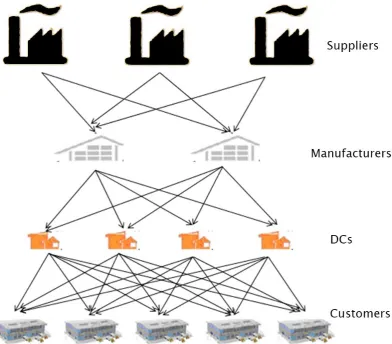
A supply chain with some suppliers, manufacturers, distribution centers (DCS) and customers is considered in this research. In SC of this study, various raw materials are supplied from multiple suppliers to multiple manufacturers, and various products produced by each manufacturer are carried to various distribution centers. Here, a distributor can be established as a logistics warehouse for delivering finished products from a manufacturer to a customer. Figure 1 illustrates the proposed supply chain network.
In the following subsections, assumptions are presented at first. Then, indices, parameters, decision variables, objective function and constraints are introduced.
2- 1- Assumptions
The assumptions to formulate the problem are as follows: • We have s suppliers, p manufacturers, d distribution centers and c customers.
• Each manufacturer can produce various products and can produce all the products ordered within each period. • Suppliers are assumed to be able to supply raw materials in each period.
• A transportation capacity constraint for all echelon is considered.
• A production capacity, raw materials and products warehouse capacity for manufacturers, and products warehouse capacity for DCs are considered.
• Location of suppliers, manufacturers and DCs are fixed. • The cost of invalidity considers when the shortage of products has been from DCs to customers.
• No discount has been considered in the proposed mod
2- 2- Indices
s: index of suppliers (s=1, 2, …, S)
p: index of manufacturers (p=1, 2, …, P)
d: index of distribution centers (d=1, 2, …, D)
c: index of customers (c=1, 2, …, C)
i: index of products (i=1, 2, …, I)
m: index of materials (m=1, 2, …, M)
t: index of periods (t=1, 2, …, T) 2- 3- Parameters
Cs: Fixed cost of establishing the supply center s.
Cp: Fixed cost of establishing the plant for manufacturer p.
Cd: Fixed cost of establishing the DC d.
DEcit: Demand of product i by customer c in period t.
CSMspmt: Supply cost per unit of raw material m from supplier s to manufacturer p in period t.
CTMspmt: Transportation cost per unit of raw material m from supplier s to manufacturer p in period t.
CPpit: Production cost per unit of product i at manufacturer p in period t.
CSEpit: Production preparation cost per unit of product i at manufacturer p in period t.
CHpmt: Inventory holding cost per unit of raw material m at manufacturer p in period t.
CHpit: Inventory holding cost per unit of product i at manufacturer p in period t.
CPpdit: Purchase cost per unit of product i at DC d from manufacturer p in period t.
CTpdit: Transportation cost per unit of product i from manufacturer p to DC d in period t.
CHdit: Inventory holding cost per unit of product i at DC d in period t.
CTdcit: Transportation cost per unit of product i from DC d to customer c in period t.
CPTspt: Transportation capacity of raw materials from supplier s to manufacturer p in period t.
CPTpdt: Transportation capacity of products from manufacturer p to DC d in period t.
CPTdct: Transportation capacity of products from DC d to customer c in period t.
CPPpit: Production capacity of product i at manufacturer p in period t.
CPDpmt: Inventory capacity of raw material m at manufacturer p in period t.
CPDdit: Inventory capacity product i at DC d in period t.
PScit: cost of lost sale of product i to customer c in period t.
TSMspmt: Transfer time per unit raw material m from supplier s to manufacturer p in period t.
TPpit: Production time per unit of product i at manufacturer p in period t.
TTpdit: Transfer time per unit of product i from manufacturer p to DC d in period t.
TTdcit: Transfer time per unit of product i from DC d to customer c in period t.
βmi: Quantity of raw material m consumed in product i.
2- 4- Decision Variables
QSMspmt: Quantity of raw material m supplied from supplier s to manufacturer p in period t.
QPpit: Production quantity per unit of product i at manufacturer p in period t.
QSpdit: Quantity of product i shipped from manufacturer p to DC d in period t.
QSdcit: Quantity of product i shipped from DC d to customer c in period t.
Ipmt: Inventory level of raw material m at manufacturer p in period t.
Ipit: Inventory level of product i at manufacturer p in period t.
Idit: Inventory level of product i at DC d in period t.
QLScit: Quantity last of sale of product i from customer c in
period t. 2- 5- Formulated problemThe first objective function of the proposed model given in Eq. 1 minimizes the total costs in supply chain, including fixed costs of establishing the suppliers, manufacturers and distribution centers, supply and transportation costs of raw materials, production preparation and production to manufacturers, inventory holding to manufacturer, purchase cost to DCs, transportation cost of products for DCs, inventory holding of products for DCs and transportation cost of products to customer. The second objective function given in Eq. 2 minimizes the delivery time of products for customers. The third objective function given in Eq. 3 minimizes the cost of last sales products for customers.
Fig. 1. Proposed supply chain network
1
:
0
pit if manufacturer p is procuded product i in period totherwise U
1 sup
:
0
spt
if
plier s is assigned to manufacturer p in period t
otherwise
X
1
:
0
pdt
if manufacturer p is assigned to DC d in period t
otherwise
X
1
:
0
dct
if DC d is assigned to customer c in period t otherwise
X
1 supplier :
0
s
if s is to be established
otherwise Y
1
:
0
p
if manufacturer p is to be established otherwise
Y
1
0 :
d
if DC d is to be established otherwise
S.t.
Constraint 4 indicates that a link between a supplier s and a manufacturer p in period t may exist only if supplier s is established. Constraint 5 shows that if the manufacturer p is established, it can be served by supplier s in period t. Eq. 6 indicates that a link between manufacturer p and a DC d in period t may exist only if manufacturer p is established. Eq. 7 indicates that if DC d is established, it can be served by manufacturer p in period t. Constraint 8 means that a link between a DC d and a customer c in period t may exist only if DC d is established. Eq. 9 means that each customer can be supplied by exactly one DC. Eqs. 10, 11 and 12 mean that the amount of raw material m and product i to be shipped among periods are limited by transportation capacities. Eq. 13 shows the production capacity per unit product i at manufacturer p if product i produced at manufacturer p in period t. Eq. 14 ensures that the inventory level of raw material m is limited by inventory capacity of raw materials at manufacturer p in period
t. Eqs. 15 and 16 state that inventory level of product i each period is limited by inventory capacity for manufacturers and DCs, respectively. Constraints 17, 18 are the balance equations of raw materials and products for manufacturers; for example Eq. 18 shows that inventory of product i in production center p
is equal to the inventory of that product in the previous period plus the production quantity of product i in production center
p in period t minus amount of product i transported from production center p to DCs in period t. Eq. 19 indicates the balance constraint of products for DCs. Eq. 20 indicates the quantity of lost sale of product i for DC d in period t that equal demand of product i minus the quantity of product i is shipped from DC d to customer c in period t. Finally, Eq. 21 and 22 (1) (2) (3) (4) (5) (6) (7) (8) (9) (10) (11) (12) (13) (14) (15) (16) (17) (18) 1
1 1 1 1 1 1 1 1 1 1 1
1 1 1 1 1 1 1 1 1
Z = = = = = = = = = = = = = = = = = = = = = + + + × + × + × + × + × + ×
∑
∑
∑
∑∑∑∑
∑∑∑∑
∑∑∑
∑∑∑
∑∑∑
S P D S P M T S P M T
s s p p d d spmt spmt spmt spmt
s p d s p m t s p m t
P I T P I T P M T
pit pit pit pit pmt pmt pit pit
p i t p i t p m t t
Min C Y C Y C Y CSM QSM CTM QSM
CSE U CP QP CH I CH I
1 1 1
1 1 1 1 1 1 1 1 1 1 1 1 1 1 1
= = =
= = = = = = = = = = = = = = =
+ × + × + × + ×
∑∑∑
∑∑∑∑
∑∑∑∑
∑∑∑
∑∑∑∑
P I T
p i
P D I T P D I T D I T D C I T
pdit pdit pdit pdit dit dit dcit dcit
p d i t p d i t d i t d c i t
CP QS CT QS CH I CT QS
2
1 1 1 1 1 1 1
1 1 1 1 1 1 1 1
Z = = = = = = = = = = = = = = = = × + × + × + ×
∑∑∑∑
∑∑∑
∑∑∑∑
∑∑∑∑
S P M T P I T
spmt spmt pit pit
s p m t p i t
P D I T D C I T
pdit pdit dcit dcit
p d i t d c i t
Min TSM QSM TP QP
TT QS TT QS
(
')
3
1 1 1
Z ( )
= = =
=
∑∑∑
C I T cit + Πcit × citc i t
Min PS QLS
, ,
≤
∀
spt s
X
Y
s p t
1
,
=
= ∀
∑
S spt ps
X Y p t
, ,
≤
∀
pdt p
X
Y
p d t
1
,
=
= ∀
∑
P pdt d pX Y d t
, ,
≤
∀
dct d
X
Y
d c t
1
1 , =
= ∀
∑
D dct dX c t
1
, ,
=
≤ × ∀
∑
M spmt spt spt mQSM CPT X s p t
1
, , =
≤ × ∀
∑
I pdit pdt pdti
QS CPT X p d t
1
, ,
=
≤ × ∀
∑
I dcit dct dcti
QS CPT X d c t
, ,
=
×
∀
pit pit pit
QP
CPP
U
p i t
, ,
≤
∀
pmt pmt
I
CPD
p m t
, ,
≤
∀
pit pit
I
CPD
p i t
, ,
≤
∀
dit dit
I
CPD
d i t
1
1 1
, , −
= =
= +
∑
S −∑
I × ∀pmt pmt spmt mi pit
s i
I I QSM b QP p m t
1
1
, , ,
−
=
= + −
∑
D ∀pit pit pit pdit d
I I QP QS p i t
1
1 1
, , ,
−
= =
= +
∑
P −∑
C ∀dit dit pdit dcit
p c
I I QS QS d i t
1
, , ,
=
= −
∑
D ∀cit cit dcit d
QLS DE QS c i t
, , , ,
, , , ≥0
spmt pit pmt pit
dit pdit dcit cit
QSM QP I I
I QS QS QLS
{ }
, , ,
,
,
,
∈
0,1
s p d spt pdt dct pit
Y Y Y X
X
X
U
0
,
0,
0=
0
pm pi di
I
I
I
(19)
(20)
(21)
(22)
ensures the non-negativity and binary of variables. The initial states of the inventories are presented in 23.
3- The proposed multi-objective decision making technique
Transforming a multi-objective problem into a single one for solving multi-objective optimization problems is one of the most used applications methods. To solve PADPP model, the compromise programming (CP) method is considered. Compromise programming is used to find a solution that comes as close as possible to the optimal (ideal) values of each objective function [33]. Here closeness is defined by the
Lp distance metric as follows:
In which z1,z2,...,zk are different and conflicting objective functions. zi*=min(zi), ignoring all other objectives is named the ideal value for the ith objective and δi is the weight of
objective function i determined by DM and k indicates the number of investigated objective functions. The x* is called
a compromise solution if minimizes Lp by considering, and . Different efficient solutions can be obtained by considering different values for parameters p
and δi. However, the most common values are p=1, 2, and ∞ that we used p=∞ and δ=[0.5 0.3 0.2] in this research. Since the model proposed is strongly NP-hard, two solving methodologies, including GA and PSO, are used to solve the model in the next section.
4- Solving methodology
Since a large number of constraints and decision variables and also binary variables cause the complexity of problem and due to be NP-hard problem that by [26-28] presented; and the high computational time to solve the exact problems (if not possible), we use two meta-heuristic algorithms, namely GA and PSO to solve the model in large sizes. In the proposed GA, a new chromosome representation is developed in which all members of population feasible chromosome are generated. Moreover,, another meta-heuristic algorithm, namely particle swarm optimization (PSO), is presented to validate the solution obtained by GA. To check the results obtained and to evaluate the performance and intelligence of both algorithms, a basic variable neighborhood search (VNS) algorithm is employed. Also, to obtain better solutions, the parameters of both algorithms are calibrated by using response surface methodology (RSM).
4- 1- A GA for PADPP
Genetic algorithm (GA) popularized by Holland [34]. This algorithm is particularly suitable for optimization of complex problems with unknown search space. GA begins by creating an initial population of chromosomes, then, the fitness of each chromosome is determined based on the objective function. Selection operator applies to the selection of parent chromosomes, then, crossover operator is used for offspring production, subsequently, the mutation operator is considered to improve the community. Then, new generations are produced and fitness function of each chromosome is determined. If stopping criteria is established, the best chromosome is considered as the best solution and the algorithm ends. 4- 1- 1- Chromosome representation
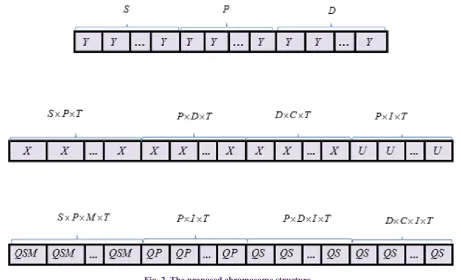
The structure of problem’s chromosomes includes binary
and integer variables which consist of three parts. The first part of chromosome indicates decisions on establishing potential suppliers, manufacturers, and distribution centers which consist of binary variables. The second part is a binary which includes assignment of the echelon of the chain in each period and decisions related to the production of products in each time period. The third part of a chromosome is an array with a dimension of suppliers, manufacturers, distributers, customers, raw materials, products, and time periods. The array indicates the amount of supply, production, and distribution of materials and products in each time period. An example of the mentioned structure is shown in Fig.2. In the first part, a binary array is established with dimensions of suppliers, manufacturers, and distribution centers. In the second part, a binary variable with the above-mentioned dimensions is considered. In this part, constraints 5, 7, and 9 are satisfied as follows:
The first link between suppliers and manufacturers in period t is established with respect to constraint 4. Then for constraint 5 satisfaction, each manufacturer must receive material from one supplier in each time period. If there is more than one available supplier, one random supplier is chosen in each period, and the variables related to the selection of the other suppliers would equal zero.
In the third part, the amount related to supply, production, and distribution of materials and products of chain’s echelon is determined in each period. For example, transferred products from the manufacturer to the distribution centers in each time period should not be more than distribution center capacity. Therefore, after assigning manufacturers to the distribution centers in the period t , products are sent to the distribution centers. Until the amount of transferred products exceeds the transferring capacity, the exceeded amount is calculated and the random product is selected. Then, the calculated amount is subtracted from the transferred amount that has been sent to the distributer. If the transferred amount of the selected product is more than the calculated exceeded the amount, we subtract the total exceeded amount of transferred product to the distributer. If the transferred amount of the selected product is less than exceeded amount, the value of the transferred product is considered to be zero to avoid an unfeasible solution. The remaining exceeded amount is calculated and the above-mentioned steps are repeated to calculate feasible solutions. In order to find feasible solutions and variables, the same procedure is implemented. In addition, a penalty policy is applied to the objective function, that none of the variables received the penalty function as below:
When a chromosome is feasible, the penalty value will be selected to zero, and if one of the constraints is not satisfactory, it will be considered as a non-zero value. According to the general form of constraints as the penalty value of a chromosome is obtained as follows: [35]:
Where, P(x), M, and g(x) indicate the penalty value of chromosome x, a large number, and constraint, respectively. When a chromosome is feasible, the penalty value will be zero and, otherwise, the penalty value will be multiplied by the cost function value. Also, it should be mentioned that, we consider normalization policy within penalty function framework in order to normalize all constraints. It should be noted that when the penalty is selected larger, that the coefficient is considered large; and so, for each type of constraint, the average of violation has been considered.
1 k * * i=1 ( ) ( )= −
∑
p p i i i iz z x
Min Z x
z δ
(24)
0, 1
>
∑
=i i i
δ δ
1
≤ ≤ ∞
p
( ) ( )= × −1 ,0
g x
P x M Max
4- 1- 2- Parent’s selection mechanism
In this paper, parents are selected based on roulette wheel method. The selection mechanism in roulette wheel is that for each chromosome in population,firstly, its fitness value is calculated, subject to the parents will more fitness value are more appropriate to be selected. Thus, the probability of selection for each chromosome based on descending order chromosomes is calculated in the following [36].
Where, fi and Pi denote its fitness value of chromosome i, and its probability of being selected, respectively. The cumulative probability of chromosomes i is calculated using the Eq. 18.
Then, for each chromosome in population, a random number r between zero and one is generated. If r<F1, the first chromosome is selected, otherwise i-th chromosome is selected such that .
4- 1- 3- Crossover operation
Crossover operator is considered to produce new offspring by using composition profile of the two chromosomes in the mating pool from the parents who have been selected in the selection operator. In this paper, we used a uniform crossover to incorporate the elements from parents strings into offspring strings [37]. The following steps show the crossover operator of this research:
• After parents’ selection, several pairs of chromosomes are selected randomly from the mating pool by predetermined crossover rate (Pc) and are mixed to produce offspring.
• Generate a random vector (matrix) that each member of this vector (matrix) is a number with one and two (the numbers of parents).
• If the genes vector (matrix) contains the number one, related genes for the first offspring are selected from the first parent, and for the second offspring are selected from the second parent. Otherwise, the opposite will be applied. The structure performance proposed crossover are shown in Fig. 3.
4- 1- 4- Mutation operation
The mutation operator when the movement from present population to new population causes to increase the level of variation in the population, and this diversity, is based on the evaluation and progress in reaching the final solution. Thus, to prevent falling off all solution in population into a local optimum, mutation performs after a crossover is applied. In order to obtain a new offspring by using mutation in this paper at least one of the parts of a chromosome is considered. Then, regarding the rate of mutation (Pm), the number chromosomes to generate offspring are randomly selected. More, two genes from one chromosome are selected and their positions swap together [38]. Figure 4 illustrates this operation.
4- 1- 5- Stopping criteria
If the best answer (best chromosome) over several generations, no observed significant difference, could the GA to achieve a good response. This criterion is the most application used convergence criteria.
In the next subsection, another meta-heuristic algorithm, particle swarm optimization (PSO), is developed to verify of solutions.
Fig. 2. The proposed chromosome structure
1,2,...,
= =
∑
ii
i i
f
P i popsize
f (26)
(27) 1
, 2
=
=
∑
i≤ ≤
i i
j
F
P
i popsize
1
− ≤ ≤
i i
4- 2- A PSO for PADPP
Particle swarm optimization (PSO) was first introduced by Kennedy and Eberhart [39] as an optimization method, and it is a significant member of swarm intelligence techniques. PSO is a population based search algorithm founded on the simulation of the social behavior of birds, bees or a school of fishes. The PSO can be easily implemented and it is computationally efficient when compared with a mathematical algorithm and other heuristic optimization techniques. The steps involved in the developed PSO of this research are explained in the following subsections.
4- 2- 1- Initialization
In this step, the input parameters of PSO are initialized. The parameters are (1) the population size (nPop) that is the number of particle at each generation, (2) cognitive coefficient (C1) that is the weight of each particle in terms of decision making, (3) social coefficient (C2) that is the weight of particle in terms of learning, (4) randomly selected value (r1, r2) with uniform distribution between zero and one, (5)
inertia (w) that controls the momentum of the particle, and (6) the number of iteration in each swarm (nIt).
In the proposed model of this paper, a new type of coding process schemes is considered that for PSO are similar to the ones described for GA.
4- 2- 2- Main loop of the PSO
In this algorithm, each row of the matrix (equivalent to a chromosome in the genetic algorithm) is called a particle. These particles are containing variable values. Each particle spins with a certain speed on the cost of procedures. Particles update its velocity and position based on personal (local) and global best value as the relationships 28 and 29:
Indexes i and d show the particle number and index of number axis the particle, respectively. Here, indicates current position i in repeat d and axis. Thus, is the velocity of particle i in repeat k. After the algorithm updates the velocity vector of each particle, the calculated velocity adds the position or a number of particles. Update the particle velocity based on best of the personal value (solution with the lowest cost that has been found by a particle) that is named (P-best), and best of the global value (solution with the lowest cost in the current population) as (g-best) performed. If the cost in the best personal solution is less than the cost of the global solution, the best personal solution is replaced by the best global solution. Figure 5 shows the contents.
Fig. 3. An example of the uniform crossover
Fig. 4. An example of the mutation operator
1
( 1)
( )
1( 1)
+ +
−
+ =
−+
−+
k k k
i d i d i d
x
t
x
t v
t
(28)(
)
(
)
1
1 1
2 2
( 1)
( )
( )
( )
( )
( )
( )
+
− −
− −
−
+ =
×
+
−
+
−
k k k
i d i d
k k
i d i d
k k
d i d
v
t
t v
t
c r Pbest
t
x
t
c r gbest t
x
t
w
(29)
−
k i d x
−
k i d v
4- 2- 3- Stopping criteria
This algorithm is also stopped when there is no observed significant difference for several iterations in the current best solution. The soloution obtained by GA and PSO are verified by a variable neighborhood serach in next section.
5- Solution validation
In order to validate the solution, we use a variable neighborhood search (VNS) algorithm to solve the model until an upper bound on the solution is obtained and analyzed the quality of the solutions obtained by GA and PSO. This algorithm is based on a systematic variation in the nieghborhood structure (NS). The pseudo-code of the nieghborhood search algorithm is shown in Fig. 6 [41].
Choosing the appropriate parameters for meta-heuristics algorithms are effective in the quality of solutions. In next section, the design of experiments (DOE) approach is taken to tune the parameters of GA and PSO.
6- Tuning the parameters
In this section, in order to calibrate the algorithm parameters, the design of experiment (DOE) approach is used. Therefore, the response surface methodology (RSM) is used to estimate the response function. Response surface methodology is a mathematical method for modeling and analyzing of problems in which several independent variables affect a dependent variable or response and aims to optimize the response. The first step in RSM is to determine a suitable approximation for the true functional relationship or response as follows [42-43]:
Function f is named surface response or function response between the response y and x1,x2,...,xk of k quantitative factors.
The additional er measures the experimental errors. Moreover, determine the indicators and factors are evaluated. Then, the high and low surface of factors are specified, this means that in an initial interval of a factor with keeping fixed other factors in several times, the sensitive range of other factors are obtained by try and error. Then, we run the test by considering the number of replications as 2k + 2k + number of intermediate tests (factor
points + axial points + central points) [44-45] where there are
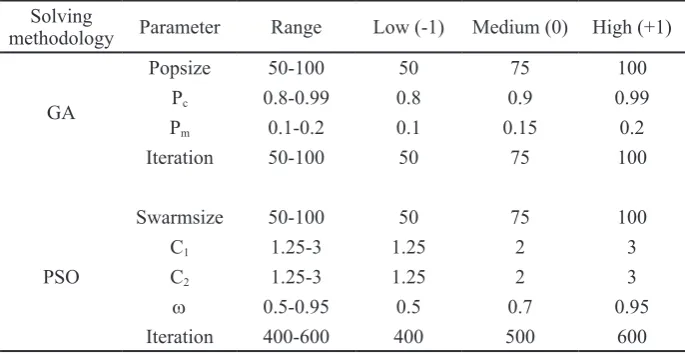
k=4 factors for GA and k=5 factors for PSO which each factor has three levels of low, medium, and high coded by (-1), (0), and (+1), respectively. The levels of parameters and the search ranges are shown in Table 1.
The developed algorithms are coded in MATLAB 10.0 (R2010a)
software environment on a laptop with Intel® Core ™ i5 CPU and 4 GB RAM, to estimate the response functions. The PDPP with five suppliers, six manufacturers, six DCs, five customers, three raw materials, three products, and in the three periods is considered for the experiments of RSM.
Moreover, the type of experimental design is cubic and we use central composite designs for the experiments. Therefore, the distance α of the axial points from the design center to generate a face-centered design is utilized in which a=1. Therefore, we choose cube point, since the factor setting represents the cube points in the design.
The design points by the value of all three objectives together with the fitness values that are obtained by combined objective function are show in Tables 2 and 3 for GA and PSO, respectively.
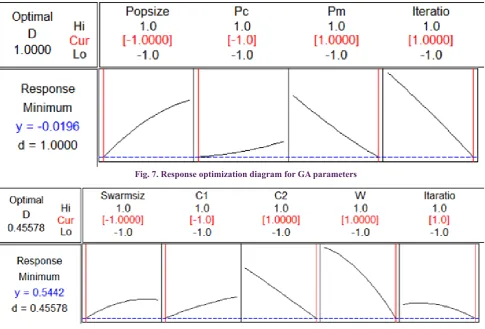
Moreover, the analyses of variance results are given in Tables 4 and 5 that show the suitability of any two regression functions and can be used for GA and PSO in RSM. Moreover, Eqs. 31 and 32 obtained, and the optimum combinations of the parameters having the red values are shown in Figs. 7 and 8, and also are reported in Table 6 for each algorithm.
In the next section, performances of both algorithms on various problems with the tuned parameters are analyzed.
7- Computational results
In this section, the combined objective function value to evaluate and analyze the performances of the solution methods for problems with different sizes is considered. Test problems have been implemented by the proposed two GA and PSO algorithms and basic VNS algorithm in 20 different sizes. Also, to decrease uncertainties of the solutions, average three times running each problem are considered as the final response. The data of parameters are generated from distributions given in Table 7.
Fig. 6. A variable neighborhood search procedure [41]
(
1,
2,...,
)
=
k+
ry
f x x
x
e
(30)0.820035 0.191900 0.087067
2 0.204156 0.046678 0.083558
2 2 2
0.024942 0.030942 0.026558 0.008612
0.086388
0.198613 0.04013
= + +
− + −
+ + − ×
− ×
+ × −
RGA popsize Pc
Pm Iteration popsize
Pc Pm Iteration popsize Pc
popsize Pm
poopsize Iteration 8P Pc m×
(31)
(32) 0.851359 0.006628 0.004611 1
0.037739 2 0.066278 0.002372
2 2 2
0.023139 0.006389 1 0.001239 2
2 2
0.040289 0.021039 0.001925 1 0.000325 2 0.0
= + +
− − −
− − −
− − − ×
+ × +
RPSO swarmsize C
C Iteration
swarmsize C C
Iteration swarmsize C
swarmsize C
w
w
15388
0.008375 0.018113 1 2 0.008850 1 0.004888 1 0.029675 2 0.003613 2 0.0057
×
+ × + ×
+ × + × − ×
− × − ×
swarmsize
swarmsize Iteration C C
C C Iteration C
C Iteration Iteration
w
w w
Solving
methodology Parameter Range Low (-1) Medium (0) High (+1)
GA
Popsize 50-100 50 75 100
Pc 0.8-0.99 0.8 0.9 0.99
Pm 0.1-0.2 0.1 0.15 0.2
Iteration 50-100 50 75 100
PSO
Swarmsize 50-100 50 75 100
C1 1.25-3 1.25 2 3
C2 1.25-3 1.25 2 3
w 0.5-0.95 0.5 0.7 0.95
Iteration 400-600 400 500 600
Table 1. Levels of the factors for tuning the parameters of both algorithms
Run
number Popsize GA ParameterPc Pm Iteration Lp-metric with P=∞GA Implementing
1 -1 -1 -1 +1 0.797
2 +1 -1 -1 -1 0.325
3 -1 +1 -1 -1 0.882
4 +1 +1 -1 -1 0.699
5 -1 -1 +1 -1 0.478
6 -1 +1 +1 -1 0.664
7 +1 +1 +1 -1 0.819
8 -1 -1 -1 +1 0.383
9 -1 -1 +1 +1 0.267
10 +1 -1 +1 +1 0.256
11 -1 +1 +1 +1 0.371
12 +1 +1 +1 +1 0.613
13 -1 0 0 0 0.588
14 +1 0 0 0 0.901
15 0 -1 0 0 0.872
16 0 +1 0 0 0.835
17 0 0 -1 0 0.744
18 0 0 +1 0 0.977
19 0 0 0 +1 0.705
20 0 0 0 0 0.829
Run number
PSO Parameter PSO Implementing
Swarm
size C1 C2 w Iteration Lp-metric with P=∞
1 -1 -1 -1 -1 +1 0.8613
2 -1 +1 +1 +1 -1 0.6430
3 -1 0 0 0 0 0.8392
4 +1 -1 -1 +1 +1 0.7886
5 0 0 0 -1 0 0.8358
6 -1 -1 +1 -1 -1 0.8186
7 0 -1 0 0 0 0.8570
8 +1 +1 +1 +1 +1 0.6748
9 0 0 0 0 0 0.8758
10 0 0 0 0 +1 0.8273
11 -1 +1 -1 +1 +1 0.7287
12 0 0 +1 0 0 0.8501
13 -1 -1 +1 +1 +1 0.5295
14 0 +1 0 0 0 0.8234
15 +1 -1 +1 -1 +1 0.7998
16 0 0 -1 0 0 0.8407
17 +1 -1 -1 -1 -1 0.8495
18 -1 -1 -1 +1 -1 0.7555
19 +1 +1 -1 +1 -1 0.7740
20 0 0 0 0 -1 0.8077
Table 3. The results obtained by PSO implementation
Source DF Seq SS Adj SS Adj MS F P-value
Regression 14 3.37183 3.37183 0.240845 2.66 0.043
Linear 4 1.58876 1.58876 0.397190 4.39 0.018
Square 4 0.03487 0.03487 0.008716 0.10 0.982
Interaction
Residual 6 1.74820 1.74820 0.291367 3.22 0.036
error 13 1.17549 1.17549 0.090422
Lack-of-fit 10 1.17549 1.17549 0.117549 430.99 0.0001
Pure error 3 0 0 0
Total 27 4.54731
Source DF Seq SS Adj SS Adj MS F P-value
Regression 20 0.188858 0.188858 0.009443 7.35 0.002
Linear 5 0.105980 0.105980 0.021196 16.50 0.0001
Square 5 0.056204 0.056204 0.011241 8.75 0.003
Interaction
Residual 10 0.026674 0.026674 0.002667 2.08 0.143
error 9 0.011559 0.011559 0.001284
Lack-of-fit 6 0.011559 0.011559 0.001926 4.51 0.122
Pure error 3 0 0 0
Total 29 0.200417
Table 4. Analysis of variance for the response of GA
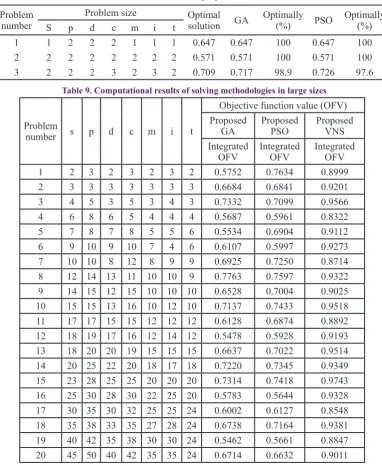
There, two classes of problems are considered as small size and large size. In the small size, to ensure the integrity and accuracy of the model, their optimal solutions are obtained by using developed mathematical programming in Lingo 11 software. Table 8 demonstrates an objective function value for each problem with various indicators and parameters in small size. In the large size, 20 test problems are examined that show the results of both GA and PSO algorithms in comparison with basic VNS to solve the proposed PDPP model. These comparisons are shown in Fig. 9, and Tables 9 shows computational results which involve combined objective function value for the large size. Moreover, to show the convergence of both GA and PSO algorithms, the
diagram of the combined objective function value in certain iterations for problem number 7 are shown in Figs. 10 and 11, respectively.
Tables 10, 11, and 12 display the amount of transferred material from suppliers to the manufacturers, the number of transferred products from manufacturers to the distributers, and amount of sent products from distributors to the retailers for the problem 7.
Fig. 7. Response optimization diagram for GA parameters
Fig. 8. Response optimization diagram for PSO parameters
Methodology Parameter Optimum value
GA
Pop size 50
Pc 0.8
Pm 0.2
Iteration 100
PSO
Swarm size 50
C1 1.253
C2 3
w 0.95
Iteration 600
Table 6. Optimum parameter levels Table 7. The amounts of parameters for test problems
Parameter Distribution Parameter Distribution
DEcit Norm(400,20) CTdcit Uniform(160,170)
CPpit Uniform(35,45) CTMspmt Uniform(8,12)
CSEpit Uniform(10,20) CPDpit Uniform(30,40)
TSMspmt Uniform(24,48) hour TPpit Uniform(12,48) hour CPpdit Uniform(125,130) CPTspt Uniform(3500,5500) CHpit Uniform(10,15) CPTpdt Uniform(3000,6000) CTpdit Uniform(8,13) CPTdct Uniform(3000,6000) CHdit Uniform(10,15) TTpdit Uniform(48,96) hour
CSMspmt Uniform(10,20) CPPpit Uniform(45,50)
CPDdit Uniform(40,45) TTdcit Uniform(24,48) hour
CHpmt Uniform(5,10) CPDpmt Uniform(15,25)
PScit Uniform(30,40) bmi Uniform(0.2,0.5)
p`
cit Uniform(10,15) Cs Uniform(350,700)
The analysis of variance test (ANOVA) is a parametric test that examines the variance of the two communities. Since we are dealing with multi-mode, ANOVA was used to test different hypotheses [46]. In this research, the one-way analysis of variance has been utilized to compare the efficiency of proposed GA and PSO to the basic VNS, which was employed in Minitab 14 software environment. The significant difference between the proposed GA, PSO, and basic VNS, are indicated in Table 13 and Figs. 12 and 13. Moreover, t-test efficiency of GA and PSO for solving the proposed PDPP model is performed which outputs the results presented in Table 14, and Figs. 14 and 15.
8- Conclusion and future work
In this research, a multi-objective linear programming model was proposed for production-allocation and distribution planning problem in supply chain network. Three objective functions including (1) minimizing total costs of chain from suppliers to customers, (2) increasing responsiveness to the customer with minimizing the delivery time of products, and
(3) minimizing the cost of last sales products for customers to increase the service level. Since the problem was an NP-hard, two meta-heuristic algorithms, namely GA and PSO to solve the model were developed, where the parameters were tuned using the RSM method. A VNS algorithm was used to verify the performance and intelligence of the both algorithms. Finally, with implementation problems in different sizes, the performance of both algorithms is specified and the results have been reported. Moreover, statistical tests called ANOVA and t for comparison were used. The following can be considered in future research:
• Both backorders, as well as lost sales, are considered, in case of not being able to fulfill customers’ demands. • Different multi-objective solution methodologies and also the uncertainty of parameters such as costs, demands, transportation capacity, inventory capacity and production capacity in this problem can be presented as a fuzzy model.
• To enhance the sensitivity analysis and result discussion of decision variables regarding the multiple objectives is Problem
number S p Problem sized c m i t Optimal solution GA Optimally (%) PSO Optimally (%)
1 1 2 2 2 1 1 1 0.647 0.647 100 0.647 100
2 2 2 2 2 2 2 2 0.571 0.571 100 0.571 100
3 2 2 2 3 2 3 2 0.709 0.717 98.9 0.726 97.6
Table 8. The results evaluation of proposed model in small sizes
Table 9. Computational results of solving methodologies in large sizes
Problem
number s p d c m i t
Objective function value (OFV) Proposed
GA Proposed PSO Proposed VNS Integrated
OFV Integrated OFV Integrated OFV
1 2 3 2 3 2 3 2 0.5752 0.7634 0.8999
2 3 3 3 3 3 3 3 0.6684 0.6841 0.9201
3 4 5 3 5 3 4 3 0.7332 0.7099 0.9566
4 6 8 6 5 4 4 4 0.5687 0.5961 0.8322
5 7 8 7 8 5 5 6 0.5534 0.6904 0.9112
6 9 10 9 10 7 4 6 0.6107 0.5997 0.9273
7 10 10 8 12 8 9 9 0.6925 0.7250 0.8714
8 12 14 13 11 10 10 9 0.7763 0.7597 0.9322
9 14 15 12 15 10 10 10 0.6528 0.7004 0.9025
10 15 15 13 16 10 12 10 0.7137 0.7433 0.9518
11 17 17 15 15 12 12 12 0.6128 0.6874 0.8892
12 18 19 17 16 12 14 12 0.5478 0.5928 0.9193
13 18 20 20 19 15 15 15 0.6637 0.7022 0.9514
14 20 25 22 20 18 17 18 0.7220 0.7345 0.9349
15 23 28 25 25 20 20 20 0.7314 0.7418 0.9743
16 25 30 28 30 22 25 20 0.5783 0.5644 0.9328
17 30 35 30 32 25 25 24 0.6002 0.6127 0.8548
18 35 38 33 35 27 28 24 0.6738 0.7164 0.9381
19 40 42 35 38 30 30 24 0.5462 0.5661 0.8847
QSM (s, p, m, t)
QSM(1 .1.1.1)=112 QSM(3.2.2.1)= 982 QSM (1.1.1.4)=668 QSM(3.2.2.2)= 621 QSM (1.1.2.1)=720 QSM(3.2.3.2)= 741 QSM (1.1.2.2)=202 QSM(3.2.3.3)= 480 QSM(1.1.2.3)=617 QSM(3.2.4.1)=120 QSM(1.1.3.1)=1072 QSM(3.2.4.4)= 565 QSM(1.1.3.2)=1175 QSM(5.4.1.1)= 4331
QSM(1.1.3.3)=512 QSM(5.4.1.3)= 579 QSM(1.1.4.1)=467 QSM(5.4.1.4)= 316 QSM(1.1.4.4)=646 QSM(5.4.2.4)= 517 QSM(2.3.1.1)= 1192 QSM(5.4.3.2)= 678 QSM(2.3.2.2)= 45 QSM(5.4.3.3)= 177 QSM(2.3.3.2)= 1431 QSM(5.4.4.2)= 801 QSM(2.3.3.4)=1372 QSM(5.4.4.3)= 548 QSM(2.3.4.2)= 1529 QSM(5.4.4.4)= 644 QSM(2.3.4.3)= 609 QSM(6.7.1.2)= 536 QSM(2.3.4.4)= 108 QSM(6.7.3.1)= 662 QSM(6.7.2.2)= 563 QSM(6.7.1.4)= 1258 QSM(6.7.3.4)= 624 QSM(6.7.1.2)= 91
QS (d, c, i, t)
QS(1.4.6.4)=253 QS(2.2.1.1)= 591 QS(1.4.2.3)=509 QS(2.2.2.2)= 1168 QS(1.4.1.3)=575 QS(2.2.2.3)= 418 QS(1.4.5.3)=1163 QS(2.2.2.4)= 1117 QS(1.4.6.1)=1179 QS(2.2.3.1)= 1006 QS(1.4.6.2)=695 QS(2.2.3.3)= 888 QS(1.4.5.1)=1080 QS(2.2.4.1)= 330 QS(1.6.4.2)=1381 QS(2.2.4.3)= 170 QS(3.5.1.1)= 527 QS(4.1.1.1)= 875 QS(3.5.1.2)= 557 QS(4.1.1.2)= 1604 QS(3.5.1.4)= 307 QS(4.1.1.4)= 483
QS(3.5.2.2)= 72 QS(4.1.2.2)= 1904 QS(3.5.2.3)= 520 QS(4.1.3.2)= 524
QS(3.5.2.4)= 186 QS(4.1.3.3)= 908 QS(3.5.4.1)= 728 QS(4.1.4.1)= 280 QS(3.5.4.2)= 542 QS(4.1.4.2)= 542 QS(5.6.1.1)= 4331 QS(6.3.2.1)= 1320
QS(5.6.1.3)= 579 QS(6.3.2.2)= 1077 QS(5.6.1.4)= 316 QS(6.3.2.3)= 1234 QS(5.6.2.4)= 517 QS(6.3.2.4)= 1196 QS(5.6.3.2)= 678 QS(6.3.3.1)= 801 QS(5.6.3.3)= 177 QS(6.3.3.2)= 548 QS(5.6.3.4)= 1397 QS(6.3.3.3)= 1417
QS(5.6.4.3)= 100 QS(6.3.3.4)= 543 QS (p, d, i, t)
QS(1.3.1.1)=1464 QS(1.3.2.2)=198 QS(1.3.1.3)=575 QS(1.3.2.4)=419 QS(2.1.1.2)=848 QS(3.3.1.1)= 7176 QS(2.1.1.3)=810 QS(3.3.1.3)= 511 QS(2.1.2.4)= 475 QS(3.3.2.4)= 429 QS(2.1.6.1)= 2447 QS(3.3.3.1)= 1131
QS(2.1.4.2)= 180 QS(3.3.3.3)= 69 QS(3.3.3.4)= 695 QS(4.2.1.3)= 667
QS(3.3.4.2)= 993 QS(4.2.1.4)= 351 QS(3.3.5.3)= 489 QS(4.2.2.4)= 46 QS(4.2.3.1)= 1371 QS(4.2.4.2)= 1415 QS(4.2.3.4)= 1804 QS(4.2.4.3)= 371 QS(5.4.4.2)= 801 QS(5.4.2.2)= 563 QS(5.4.4.3)= 548 QS(5.4.1.2)= 333 QS(5.4.4.4)= 644 QS(5.4.4.1)= 26 QS(5.4.3.3)= 480 QS(5.4.6.1)= 997
Table 10. Amount of transferred material from suppliers to the
manufacturers for the problem 7 Table 12. Amount of sent products from distributors to the retailers for the problem 7
Table 11. Amount of transferred products from manufacturers to the distributers for the problem 7
proposed.
Fig. 10. Convergence diagram of GA in number problem 7
Table 13. Analysis of variance for performance comparisons
Fig. 12. The significant difference of the basic VNS Fig. 11. Convergence diagram of PSO in number problem 7
Source df SS MS F-test P-value
Response 2 0.86532 0.43266 122.93 0.000 Error 57 0.20061 0.00352
Total 59 1.06593
Algorithm N Mean StDev SE Mean P-value
GA 20 0.6446 0.0706 0.016
0.134
PSO 20 0.6777 0.0655 0.015
Table 13. Analysis of variance for performance comparisons
Fig. 13. Boxplot of the significant different of response
References
[1] Simchi-Levi, D.; Kaminsky, P. and Simchi-Levi, E.; “Designing and managing the supply chain: consepts, strategies, and case studies,” Irwin McGraw-Hill, New York, 2000.
[2] Boudia, M.; “Coordination of production planning and distribution,” 4OR. Vol. 6, No. 1, pp. 93-96, 2008. [3] Altiparmak, F.; Gen, M.; Lin, L. and Paksoy, T.;
“A genetic algorithm approach for multi-objective optimization of supply chain networks,” Computers & Industrial Engineering, Vol. 5, No. 1, pp. 196-215, 2006. [4] Park, B.; Choi, H. and Kang, M.; “Integration of production and distribution planning using a genetic algorithm in supply chain management. In: Melin P, Castillo O, Ramirez EG, Kacprzyk J, Pedrycz W, editors. Analysis and design of intelligent system using soft computing techniques,” Springer, Berlin, pp. 416-426, 2007.
[5] Lee, Y.H. and Kim, S.H.; “Production-Distribution planning in supply chain considering capacity constraints,” Computers & industrial engineering, Vol. 43, No. 1, pp. 169-190, 2002.
[6] Pirkul, H. and Jayaraman, V.; “A multi-commodity, multi- plant, capacitated facility location problem: formulation and efficient heuristic solution,” Computers & Operations Research, Vol. 25, No. 10, pp. 869-878, 1998.
[7] Rizk, N.; Martel, A. and D’Amours, S.; “Multi-item dynamic production-distribution planning in process industries with divergent finishing stage,” Computers & Operations Research, Vol. 33, No. 12, pp. 3600-3623, 2006.
[8] Selim, H.; Araz, C. and Ozkarahan, I.; “Collaborative production-distribution planning in a supply chain: a fuzzy goal programming approach,” Transportation Research Part E: Logistics and Transportation Review, Vol. 44, No. 3, pp. 396-419, 2008.
[9] Fahimnia, B.; Zanjirani Frahani, R.; Marian, R. and Luong, L.; “A review and critique on integrated production– distribution planning models and techniques,” Journal of Manufacturing Systems, Vol. 32, No. 1, pp. 1-19, 2013.
[10] Williams, J.F.; “Heuristic techniques for simultaneous scheduling of production and distribution in multi-echelon structures: theory and empirical comparisons,” Management Science, Vol. 27, No. 3, pp. 336-352, 1981. [11] Cohen, M.A. and Lee, H.L.; “Recourse deployment
analysis of global manufacturing and distribution networks,” Journal of Manufacturing and Operations Management, Vol. 2, No. 1, pp. 81-104, 1989.
[12] Ӧzdamar, L. and Yazgac, T.; “Capacity driven due date settings in make-to-order production systems,” International Journal of Production Economics, Vol. 49, No. 1, pp. 29-44, 1997.
[13] Yan, H.; Yu, Z. and Cheng, T.C.E.; “A strategic model for supply chain design with logical constraints: formulation and solution,” Computers & Operations Research, Vol. 30, No. 14, pp. 2135-2155, 2003.
[14] Yilmaz, P. and Catay, B.; “Strategic level three-stage production-distribution planning with capacity expansion,” Computers & Industrial Engineering, Vol. 51, No. 4, pp. 609-620, 2006.
[15] You, F. and Grossman, I.E.; “Design of responsive supply chain under demand uncertainty,” Computers & Chemical Engineering, Vol. 32, No. 12, pp. 3090-3111, 2008. [16] Tsiakis, P. and Papageorgiou, L.G.; “Optimal production
allocation and distribution supply chain networks,” International Journal of Production Economics, Vol. 111, No. 2, pp. 468-483, 2008.
[17] Petrovic, D.; Roy, R. and Petrovic, R.; “Supply chain modelling using fuzzy sets,” International Journal of Production Economics, Vol. 59, No. 1, pp. 443-453, 1999. [18] Chen, Y.W. and Tzeng, G.H.; “Fuzzy multi-objective
approach to the supply chain model. In: Tzaskalik T, Michnik J (eds) Multiple objective and goal programming advances in soft computing,” Physica Verlang, Heidelberg, pp. 221-234, 2002.
[19] Lin, C.W.R. and Chen, H.Y.S.; “A fuzzy strategic alliance selection framework for supply chain partnering under limited evaluation resources,” Computers in Industry, Vol. 55, No. 2, pp. 159-179, 2004.
[20] Aliev, R.A.; Fazlollahi, B.; Guirimov, B.G. and Aliev, R.R.; “Fuzzy-genetic approach to aggregate production-distribution planning in supply chain management,” Information Sciences, Vol. 177, No. 20, pp. 4241-4255, 2007.
[21] Bilgen, B.; “Application of fuzzy mathematical programming approach to the production allocation and distribution supply chain network problem,” Expert Systems with Applications, Vol. 37, No. 6, pp. 4488-4495. 2010. [22] Liang, T.F.; “Fuzzy multi-objective production/distribution
planning decisions with multi-product and multi-time period in a supply chain,” Computers & Industrial Engineering, Vol. 55, No. 3, pp. 576-694, 2008.
[23] Razmi, J.; Jafari Songhori, M. and Khakbaz, M.H.; “An integrated fuzzy group decision making/fuzzy linear programming (FGDMLP) framework for supplier evaluation and order allocation,” The International Journal of Advanced Manufacturing Technology, Vol. 43, No. 5, pp. 590-607, 2009.
[24] Liang, T.F.; “Integrated manufacturing/distribution planning problem decisions with multiple imprecise goals in an uncertain environment,” Quality & Quantity, Vol. 46, No. 1, pp. 137-153, 2012.
[25] Liu, S. and Papageorgiou, L.G.; “Multiobjective optimization of production, distribution and capacity planning of supply chains in the process industry,” Omega, Vol. 41, No. 2, pp. 369-382, 2013.
[26] Gen, M. and Syarif, A.; “Hybrid genetic algorithm for multi-time period production/distribution planning,” Computers & Industrial Engineering, Vol. 48, No. 4, pp. 799-809, 2005. [27] Kazemi, A.; Fazel Zarandi, M.H. and Moattar Husseini,
S.M.; “A multi-agent system to solve the production-distribution planning problem for a supply chain: a genetic algorithm approach,” The International Journal of Advanced Manufacturing Technology, Vol. 44, No. 1, pp. 180-193, 2009. [28] Jolai, F.; Razmi, J. and Rostami, N.K.M.; “A fuzzy goal
programming and meta heuristic algorithms for solving integrated production: distribution planning problem,” Central European Journal of Operations Research, Vol. 19, No. 4, pp. 547-569, 2011.
[29] Ashoka Varthanan, P.; Murugan, N.; Mohan Kumar, G. and Parameswaran, S.; “Development of simulation-based AHP-DPSO algorithm for generating multi-criteria production-distribution plan,” The International Journal of Advanced Manufacturing Technology, Vol. 60, No. 1, pp. 373-396, 2012.
[30] Vinay, V.P. and Sridharan, R,; “Taguchi method for parameter design in ACO algorithm for distribution– allocation in a two-stage supply chain,” International Journal Advanced Manufacturing Technology, Vol. 64, No. 1, pp. 1333-1343, 2013.
[31] Sarrafha, K.; Kazemi, A. and Alinezhad, A.; “A multi-objective evolutionary approach for integrated production-distribution planning problem in a supply chain network,” Journal of Optimization in Industrial Engineering, Vol. 14, No. 7, pp. 89-102, 2014.
[32] Sarrafha, K.; Rahmati, S.H.A.; Akhavan Niaki, S.T. and Zaretalab, A.; “A bi-objective integrated procurement, production, and distribution problem of a multi-echelon supply chain network design: A new tuned MOEA,” Computers & Operations Research, Vol. 54, No. 1, pp. 35-51, 2015.
[33] Zeleny, M.; “Multiple Criteria Decision Making,” Irwin McGraw-Hill, New York, 1982.
[34] Holland, J.H.; “Adaptation in natural and artificial systems: An introductory analysis with applications to biology,” control and artificial intelligence, Michigan: University of Michigan Press, 1975.
[35] Yeniay, O. and Ankare, B.; “Penalty function methods for constrained optimization with genetic algorithms,” Mathematical and Computational application, Vol. 10, No. 1, pp. 45-56, 2005.
[36] Deb, K.; “An Introduction to genetic algorithms,” Sadhana, Vol. 24, No. 4, pp. 293-315, 1999.
[37] Bate, S.T. and Jones, B.; “A review of uniform crossover designs,” Journal of Statistical Planning and Inference, Vol. 138, No. 2, pp. 336-351, 2007.
[38] Gross, D. and Harris, C.M.; “Fundamental of queuing theory (3rd ed),” Wiley Interscience, New York, NY, 1998. [39] Kennedy, J. and Eberhart, R.; “Particle swarm optimization,” In: Proceedings of IEEE international conference on neural network, IV, Vol. 4, No. 1, pp. 1942-1948, 1995.
[40] Liu, T.C. and Wang, J.C.; “A discrete particle swarm optimizer for graphic presentation of GMDH network, in proc,” Conferences - IEEE Systems, Man, and Cybernetics, Vol. 3, No. 1, pp. 2329-2333, 2005.
[41] Mladenovic, N. and Hansen, P.; “Variable neighborhood search,” Computers & Operation research, Vol. 24, No. 11, pp. 1097-1100, 1997.
[42] Montgomery, D.C.; “Response surface methodology,” Wiley, New York, 2004.
[43] Khan, M.M.A.; Romoli, L.; Fiaschi, M.; Dini, G. and Sarri, F.; “Multi response optimization of stainless steels in a constrained fillet joint configuration using RSM,” The International Journal of Advanced Manufacturing Technology, Vol. 62, No. 5, pp. 587-603, 2012.
[44] Pasandideh, S.H.R.; Akhavan Niaki, S.T. and Hajipour, V.; “A multi-objective facility location model with batch arrivals: two parameter-tuned meta-heuristic algorithms,” Journal of Intelligent Manufacturing, Vol. 24, No. 2, pp. 331-348, 2013. [45] Jamili, A.; Shafia, M.A. and Tavakkoli-Moghaddam, R.;
“A hybrid algorithm based on particle swarm optimization and simulated annealing for a periodic job shop scheduling problem” The International Journal of Advanced Manufacturing Technology, Vol. 54, No. 1, pp. 309-322, 2011.
[46] Montgomery, D.C.; “Design and analysis of experiments (6th ed),” Wiley, New York, USA, 2005.
Please cite this article using:
A. Kazemi, K. Sarrafha, M. Oroojeni Mohammad Javad,”A multi-objective integrated production-allocation and distribution planning problem of a multi-echelon supply chain network: two parameter-tuned meta-heuristic algorithms”, AUT J. Model. Simul., 49(1)(2017)57-74.
![Fig. 5. Variation and how to determine the next location a particle [40]](https://thumb-us.123doks.com/thumbv2/123dok_us/8944391.1853759/8.595.334.536.617.731/fig-variation-determine-location-particle.webp)
![Fig. 6. A variable neighborhood search procedure [41]](https://thumb-us.123doks.com/thumbv2/123dok_us/8944391.1853759/9.595.41.282.226.396/fig-a-variable-neighborhood-search-procedure.webp)