Confirmatory Factor Analysis of the Experiential Avoidance
Questionnaire in High School Students
Atefeh Jonbeshi
1, Khadijeh Abolmaali
21Department of Psychology and Social Science, Roudehen Branch, Islamic Azad University,
Roudehen, Iran.
2Associate Professor, Group of Psychology, Department of Psychology and social science,
Roudehen Branch, Islamic Azad University, Roudehen, Iran.
Submitted: 21 June 2017
Accepted: 26 September 2017
Int J Behav Sci. 2017; 11(1): 1-7
Corresponding Author: Khadijeh Abolmaali, Associate Professor, Group of Psychology,
Department of Psychology and social science,
Roudehen Branch, Islamic Azad University, Roudehen,
Iran.
E-mail: [email protected]
Abstract
Introduction: Experiential avoidance is a phenomenon that refers to a verbal regulation based on deliberate attempt to avoid or escape from personal experience, such as bodily sensations, emotions, thoughts, memories, behavioral predispositions that disturb perception. The aim of the present study was to consider the confirmatory factor analysis of experiential avoidance questionnaire in high school students in Iran.
Methods: The study method was a descriptive and the statistical population included all second-high
school students in Damavand city in Iran in 2016. Four hundred and thirty-fourparticipants were
randomly selected via multi-stage sampling method and completed 3 questionnaires: experiential avoidance, test anxiety, positive and negative perfectionism.
Results: Results of confirmatory factor analysis showed that fit indicators such as normed Chi-square
(X2/df = 2.542), root mean square error of approximation (RMSEA = 0.060), comparative fit index (CFI
= 0.923), goodness of fit index (GFI = 0.929) and adjusted fit index (AGFI = 0.897) support the six-factor structure of the experiential avoidance questionnaire. The six factors are behavioral avoidance; incompatibility distress; procrastination; distraction / suppression; denial / repression; and distress tolerance. The Cronbach's alpha coefficients for these factors were obtained 0.75, 0.75, 0.54, 0.88, 0.66 and 0.77, respectively. The relationship between test anxiety and negative perfectionism was positive and significant, which is indicative of convergent validity; and the relationship between positive perfectionism with some of components of experiential avoidance were negative and significant, which is indicative of divergent validity.
Conclusion: The results showed that this questionnaire have reliability and validity in Iranian students. Thus, psychologists and researchers have been recommended to use this questionnaire for diagnostic assessments, intervening programs, and identification of experiential avoidance dimensions.
Keywords: Experiential Avoidance, Confirmatory Factor Analysis, Test Anxiety, Perfectionism
Introduction
indicates that negative thoughts, emotions and feelings are not problematic, but the way a person responds to it can lead to problems. In particular, it is assumed that a constant and continuous desire to avoiding of experience uncomfortable thoughts and feelings (and avoidance and prevention of these related experience) refers to a wide range of problems [5].
The dimensions of experiential avoidance include behavioral avoidance (situational and obvious avoidance of physical discomforts and distresses), distress aversion (negative assessment and attitudes towards depression, unacceptable distress), procrastination (postponing the predicted distress), distraction / suppression (trying to ignore or suppress the distress), repression / denial (distancing from the distress, lack of awareness of the distress) and distress tolerance (tend to behave effectively against distress) [6]. It encompasses attempts to cognitively manipulate the effects of unpleasant events (e.g., distracting oneself from anxious feelings), and to avoid such experiences through behavioral change e.g., taking sick days to avoid work stressors). As a response to external, stressful stimuli, EA may lead to the reduction of reactions towards social, psychological, physical, educational and academic complaints, productivity, and will decrease the level of judgment, while increasing errors, and slowing down reaction time [7]. EA plays an important role in the etiology, continuation and intensification of various forms of psychopathology, such as anxiety and depression [3]. EA when used rigidly and difficultly, turns to a disrupting process that spends a lot of time and energy in attempt to manage, control, or fight with unwanted personal events. Moving in the path toward valuable targets, experiential avoidance reduces the contact with the present time experiences, and thus leads to malfunctions. Studies show that experiential avoidance leads to strengthening of anxiety symptoms in people with no history of related anxiety disorders. In the past two decades experimental avoidence is known as a predictor of school performance [8]. Therefore, EA is not a purely co-morbid process or the result of disorders associated with anxiety, but is also a psychological vulnerability to anxiety disorders [9].
EA is associated with thought suppression [10], emotional suppression [11], avoidant types of coping [12], and plays an important role in shaping psychological disorder. It is believed that EA has a role in a wide variety of different psychological disorders and practical contexts [13]. It is known as a factor in the etiology of maladaptive behavior and also for its relationship to specific diagnostic categories [14].
EA has been associated with depression, rumination, worry and neuroticism [15]. Researchers showed that ruminative thoughts and depression are significantly correlated with cognitive and behavioral EA [16]. Also it has been showed that EA had a greater influence on mood problems [17] and can predict changes in distress (major depressive disorder, dysthymia, generalized anxiety disorder) and fear disorders (social anxiety disorder, panic disorder with or without agoraphobia, agoraphobia without panic) [3]. "EA amplifies anxiety symptomatology
in individuals with no history of anxiety-related disorders. Furthermore, EA has a relationship to the development of emotional disturbances [11]. Thus, there is evidence that EA is not merely a concomitant or consequence of anxiety-related pathology, it is rather a psychological vulnerability for anxiety pathology [9]. Garcia-Oliva and Piqueras [18] found that EA can largely explain the addictive use of the Internet, mobile phones, and video games. Santanello and Gardner [19] believe that there is a relationship between EA, maladaptation and negative perfectionism.
Negative perfectionism is associated with unrealistic expectations of his performance and avoids the negative consequences. Anxiety sensitivity and EA were significantly associated with each other and with anxiety-related symptoms. There is a negative relationship between EA , mindfulness [20], flexibility [21] and interpersonal interaction [22], resulting in anxiety sensitivity, mental health problems [23] and psychological distress [24].
With an overview of what was being said, and bearing in mind the importance of structure such as EA in psychopathology, it seems to be necessary to develop appropriate tools to measure these structures in Iranian students. Therefore, this study aimed to do standardization of experiential avoidance questionnaire among the Iranian students. Thus, the aim of this research was to identify factor structure, concurrent validity and reliability of experiential avoidance in high school Iranian students.
Method
The research method used in this study was a descriptive. The study population included all boys and girls secondary schools students in the city of Damavand in 2016. A multi-stage sampling method was used for sample selection. Four hundred and thirty four students completed 3questionnaires: 1) Anxiety questionnaire, 2) Positive and Negative Perfectionism Questionnaire, 3) and Experiential Avoidance Questionnaire.
1. Anxiety test Questionnaire (25): This questionnaire consisted of 25 items, and was scored in a Likert scale [never = 0, rarely = 1, sometimes = 2, often = 3]. The relationship between the test anxiety and EA questionnaire was positive and significant, and the relationship EA questionnaire with the score of self-esteem was negative and significant. The internal consistency via Cronbach's alpha coefficient was obtained 0.94 [25]. In this study, the Cronbach's alpha coefficient for this questionnaire was equal to 0.92
subscales of perfectionism with self-esteem were obtained as 0.44 and -0.52, respectively. In this study, the Cronbach's alpha coefficients for positive and negative perfectionism were as 0.73 and 0.85, respectively.
3. Experiential Avoidance Questionnaire (6): This questionnaire consists of 62 items that evaluates the six subscales in a 6-point Likert scale from strongly agree = 5 to strongly disagree = 0). Behavioral avoidance is measured by items 1, 8, 14, 20, 26, 32, 39, 45, 51, 55, 59. 2) Incompatible distress by items 2, 7, 13, 19, 25, 31, 34, 38, 44, 50, 54, 48, 61. 3) Procrastination is measured by items 5, 11, 17, 36, 42, 47. 4) Distraction / suppression by items 3, 9, 15, 22, 27, 33, 40. 5) Denial / repression is measured by items 4, 10, 16, 21, 23, 28, 35, 41, 46, 49, 52, 56, 60. 6). Distress tolerance by items 6, 12, 18, 24, 29, 37, 43, 48, 53, 57, 62, respectively. Items 23 and 30 are scored in reverse. Gamez et al. (2011) reported
Cronbach's alpha coefficients in different samples from 0.91 to 0.95.
Results
In this study 122 participants (28.1%) were male and 308 subjects (71%) were female. It should be noted that four participants in the study did not answer the question related to their gender. The participants' age range was as follows: 108 (24.9%): 15 years old; 144 (33.2%): 16 years old; 117 (22%) 17 years old and 56 (12.8%) 18 years old. It should be noted that the average age of participants in this study was 16.31 years with a SD of 0.68. The participants' field of study was as follows: 100 (24%): Humanities; 94 (21.7%): Science; 52 (12%): Mathematics; 42 (7.9%): Design; 39 (9%): Management; 44 (10.1%):
Architecture and 56 (12.9%): Computer Science. It is noteworthy that three of the participants did not specify their fields of study.
The mean, standard deviation and Cronbach's alpha coefficient of experiential avoidance dimensions
(behavioral avoidance, incompatibility distress,
procrastination, distraction / suppression, denial / repression, distress tolerance) are presented in Table 1.
With the exception of the experiential avoidance procrastination dimension, the Cronbach's alpha coefficients obtained for dimensions of this study variables are satisfactory. This shows that with the exception of experiential avoidance procrastination dimension, the tool statements employed to measure the study variables have an acceptable internal consistency.
Table 1. The mean, standard deviation and Cronbach's alpha coefficient of experiential avoidance dimensions
Variable Mean DeviationStandard Cronbach's alpha
Behavioral
avoidance 48.32 7.72 0.725
Incompatibility
distress 58.19 8.73 0.757
Procrastination 20.59 4.33 0.1544
Distraction /
Suppression 31.62 5.79 0.880
Denial /
Repression 45.75 8.91 0.667
Distress
tolerance 49.89 8.37 0.775
Total score 254.263 30.65 0.894
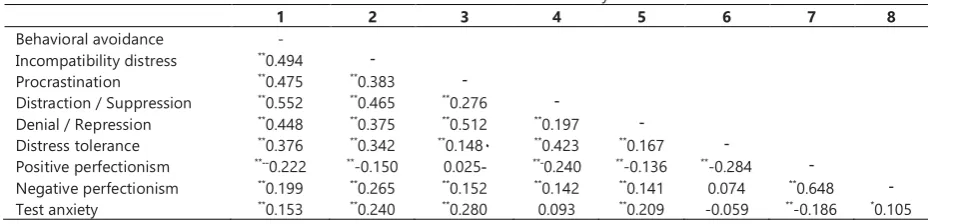
Table 2. The correlation matrix between the study variables
Table (2) shows the correlation coefficients between the dimensions of the research variables. As expected, all factors of experiential avoidance (excluding the distress tolerance dimension) had a positive correlation with test anxiety at a significant level of 0.01. The positive perfectionism dimension was negatively correlated with test anxiety at significance level of 0.01, while the negative perfectionism dimension was positively correlated with test anxiety at significance level of 0.05. All aspects of experiential avoidance, excluding distress tolerance, were positively correlated with negative perfectionism at a significant level of 0.01. Also, the dimensions of behavioral
avoidance, incompatibility distress, and
distraction/suppression and distress tolerance were positively correlated with positive perfectionism at a significant level of 0.01. This is while the aspect of denial/suppression was negatively correlated with positive perfectionism at significance level of 0.01.
Confirmatory Factor Analysis (CFA) was used to prove whether the six-factor model of EA questionnaire is consistent with the data collected from the sample group or not. Thus, the six-factor structure of the 62- item experiential avoidance questionnaire were tested. Confirmatory factor analysis was carried out using AMOS 7.0 software and a maximum likelihood estimation (mle) was applied. Chi-Square test was used which showed that the model does not fit the data: p < 0.05, X2 (N = 434, df = 1814) = 5316.308.
As the Chi-Square is strongly influenced by the sample size, other fitness indices were studied (X2/df = 2.931, CFI = 0.534, GFI = 0.690, AGFI = 0.666 and RMSEA = 0.067). The observations showed that only two Chi-Square indicators are normalized and the Root Mean Square Error of Approximation (RMSEA) supports that the model fits the data.
Considering the unfitting of the 62-item questionnaire,
1 2 3 4 5 6 7 8
Behavioral avoidance -
Incompatibility distress **0.494
-Procrastination **0.475 **0.383
-Distraction / Suppression **0.552 **0.465 **0.276
-Denial / Repression **0.448 **0.375 **0.512 **0.197
-Distress tolerance **0.376 **0.342 **0.1480 **0.423 **0.167
-Positive perfectionism **--0.222 **-0.150 0.025- **-0.240 **-0.136 **-0.284
-Negative perfectionism **0.199 **0.265 **0.152 **0.142 **0.141 0.074 **0.648 -
there was a question raised as to: why the fit indices resulting from confirmatory factor analysis did not support the six-factor structure of the experiential avoidance questionnaire? In response to this question, Kline [28] mentions that one of the reasons for the weakness of fit indices in confirmatory factor analysis results, is the high number of items, in other words, the number of observed variables.
Item parceling is one of the several procedures for combining individual items and using these combined items as the observed variables, typically being observed as variables in Confirmatory Factor Analysis (CFA) or Structural Equation Modelling (SEM) [29]. Kishton and Widaman [30] consider a "parcel" unit which is a simple integration of several items that assesses a single structure. The use of item parceling technique increases the credibility of markers combining level. On the other hand, based on the results by Monte Carlo, when the number of markers increases for each factor, the value of
fitness indices will decrease. The use of item parceling technique can increase the value of fitness indices. Most researchers consider the factor analysis method as the best approach for items parceling. Due to the fact that the ratio of number of indicators to the factors in the experiential avoidance questionnaire was high, principal component analysis method was used to carry out item parceling on the experiential avoidance questionnaire statements with the help of exploratory factor analysis results. Thus, by fixing 1 as the number for each component, the statements related to each component was analyzed separately. After on, every statement with stronger factor loadings was parceled with the items with low and medium load factor.
This enabled the parceled units to have the same weight as well as having the same factor loads in the measurement model. In general, the statements for each component of the experiential avoidance questionnaire were parceled as follows.
A) Behavioral avoidance 45+39 + 1 + 59 = )Parcel_1) 55 + 8 + 14+32 =)Parcel_2)
20+51+26 =)Parcel_3
B) Incompatibility distress 50 + 13 +25 =)Parcel_1)
34 + 2+44 =)Parcel_2) 54+19+58 =)Parcel_3) 7+31+61+38 =)Parcel_4)
C) Procrastination 42 + 36 +17 =)Parcel_1) 47+30+11+5 =)Parcel_2)
D) Distraction / Suppression 27+3 + 22 = )Parcel_1) 40+15+9+34 =)Parcel_2)
E) Denial / Repression 56 + 16 +28 =)Parcel_1)
35 + 52+60 =)Parcel_2) 21+46+49 =)Parcel_3)
4+10+41 =)Parcel_4)
F) Distress tolerance 37 + 24 +43 =)Parcel_1) 29+57+18+48 =)Parcel_2)
12+6+62+53 =)Parcel_2)
After the item parceling was done, the factor structure of experiential avoidance questionnaire was evaluated, using AMOS 7.0 software, once again, estimating the maximum likelihood (ML). As expected, the Chi-square index indicated poor model fit with the data gathered (X2 (N = 434, df = 120) = 305.085. However, the evaluation of other fit indices showed that all fit indexes such as normed
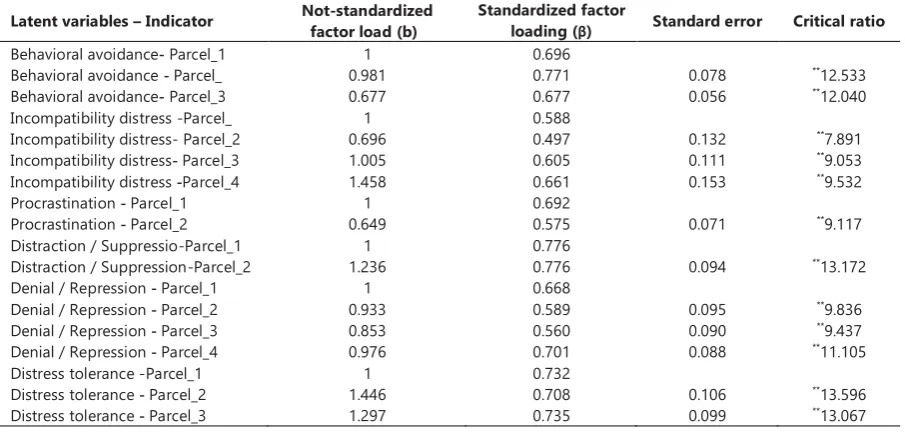
Chi-square (X2/df = 2.542), root mean square error of approximation (RMSEA = 0.060), comparative fit index (CFI = 0.923), goodness of fit index (GFI = 0.929) and adjusted fit index (AGFI = 0.897) support the six-component structure of the experiential avoidance questionnaire. Table (3) shows the estimation of standardized factor loadings for each of the parceled items in the questionnaire.
Table 3. Parameters of the measurement model of the behavioral avoidance questionnaire in the confirmatory factor analysis after items parceling
Latent variables – Indicator Not-standardized factor load(b)
Standardized factor loading(
β) Standard error Critical ratio
Behavioral avoidance-Parcel_1 1 0.696
Behavioral avoidance-Parcel_ 0.981 0.771 0.078 **12.533
Behavioral avoidance-Parcel_3 0.677 0.677 0.056 **12.040
Incompatibility distress-Parcel_ 1 0.588
Incompatibility distress- Parcel_2 0.696 0.497 0.132 **7.891
Incompatibility distress-Parcel_3 1.005 0.605 0.111 **9.053
Incompatibility distress-Parcel_4 1.458 0.661 0.153 **9.532
Procrastination-Parcel_1 1 0.692
Procrastination-Parcel_2 0.649 0.575 0.071 **9.117
Distraction / Suppressio-Parcel_1 1 0.776
Distraction / Suppression-Parcel_2 1.236 0.776 0.094 **13.172
Denial / Repression-Parcel_1 1 0.668
Denial / Repression-Parcel_2 0.933 0.589 0.095 **9.836
Denial / Repression-Parcel_3 0.853 0.560 0.090 **9.437
Denial / Repression-Parcel_4 0.976 0.701 0.088 **11.105
Distress tolerance -Parcel_1 1 0.732
Distress tolerance-Parcel_2 1.446 0.708 0.106 **13.596
Note: The non-standardized factor loading of Parcel_1 indicators is established in all components using 1. Therefore, the standard error and critical ratio of those indicators have not been calculated.
Based on the results presented in Table 3, the standardized factor loadings of all the indicators are higher than 0.32. The highest factor loading belongs to the second item of the distress tolerance (Parcel_2) (0.807), and the lowest factor loading belongs to the second item (parcel_2) of the incompatibility distress
(0.497). Therefore, it can be mentioned that all of the indicators have the necessary functionality to measure six latent variables, comprising, behavioral avoidance,
incompatibility distress, procrastination,
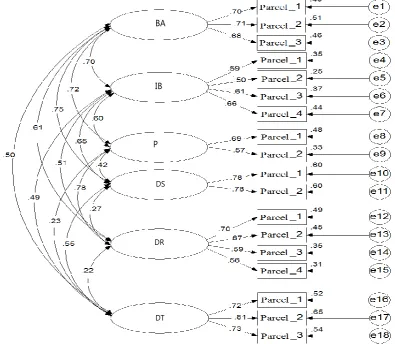
distraction/suppression, denial/repression and distress tolerance. Figure 3 shows the six-component measurement model of experiential avoidance questionnaire and its factor loadings using standard data after item parceling.
Figure 3. The six-component measurement model of experiential avoidance questionnaire and its factor loadings by using standard data after items parceling.
In above figure: BA: Behavioral Avoidance; ID: Incompatibility Distress; P: Procrastination; D/S: Distraction/Suppression; D/R: Denial/Repression; and DT: Distress Tolerance
Discussion
The purpose of this research was to evaluate the psychometric properties of the experiential avoidance questionnaire. The results supported the validity and reliability of the questionnaire and indicated that the experiential avoidance questionnaire has a good internal consistency. Evaluating the internal consistency of the experiential avoidance questionnaire items showed that Cronbach's alpha coefficients range from 0.54 to 0.89. The principal component analysis confirmed six factors of
behavioral avoidance, incompatibility distress,
procrastination, distraction/suppression,
denial/repression and distress tolerance. Also, CFA supported the factor structures of experiential avoidance questionnaire.
Correlation coefficients between the factors of test anxiety and positive and negative perfectionism questionnaires suggest the convergent validity of these questionnaires. To explain these findings, one can say experiential avoidance are not pathogenic, always. In the short term, EA can be considered as an adaptive process and can be a form of adaptive emotion regulation. EA becomes problematic when a person strongly and almost solely and without attention to the situational proportionality relies on it [31] In some situations, subtle avoidance or behavior suppression can be considered as a protective strategy to prevent apparent dangerous BA
IB
P
DS
DR
consequences [9]. Therefore, EA is not merely a co-morbid process or the result of disorders associated with anxiety but it can be a psychological vulnerability to anxiety [9]. Negative perfectionism is an "avoidance" construct [32]. This construct is built on negativity, anxiety, and concern about the failures and frustrations and leads the individual to make efforts to escape from and to avoid negative consequences. Based on this mechanism of influencing, the negative perfectionism imposes anxiety and worry to the individual in case of non-fulfillment of the objectives and ideal criteria and increases the negativity. In this process, the possibility of using ineffective coping strategies, anxiety, and worry would increase [33]. Anxiety and worry activate the sympathetic system that affects the physiological responses. [34].
Conclusion
The findings of the current study can complement prior research about psychometric properties of the experiential avoidance questionnaire (AAQ), such as studies by Games et al. (6) and Vaughan-Johnston et al. (7). The findings indicate that the questionnaire has internal consistency. Moreover, AAQ exhibited a strong convergence validity with respect to the positive and negative perfectionism questionnaire and anxiety test. Confirmatory factor analysis also supported the factor structure of the questionnaire that was reported by Gamez et al. (6). As a result of this study the questionnaire is recommended to be used by psychologists for diagnosis assessment, intervening programs and identification of dimensions of experiential avoidance. In addition, considering the desirable psychometric properties, this questionnaire, can be suggested for ongoing research activities.
References
1. López JC RF, Feder J, Rubio A, Suárez Aguirre JJ, Rodríguez JA, Luciano C. The role of experiential avoidance in the performance on a high cognitive demand task. International Journal of Psychology & Psychological Therapy. 2010;10(2):475-88.
2. Hayes SC, Wilson KG, Gifford EV, Follette VM, Strosahl K. Experimental avoidance and behavioral disorders: a functional dimensional approach to diagnosis and treatment. Journal of consulting and clinical psychology. 1996 Dec;64(6):1152-68. PubMed PMID: 8991302. Epub 1996/12/01. eng.
3. Spinhoven P, Drost J, de Rooij M, van Hemert AM, Penninx BW. A Longitudinal Study of Experiential Avoidance in Emotional Disorders. Behavior Therapy. 2014 2014/11/01/;45(6):840-50. 4. Olanrewaju AK RA, Kehinde OO The Moderating Role of
Experiential Avoidance on the Relationship of Determinants of Risky Sexual Behaviour and Attitude Among Nigerian Adolescents. Public Health and Preventive Medicine. 2015;1(2):33-41. 5. Berman NC, Wheaton MG, McGrath P, Abramowitz JS. Predicting
anxiety: the role of experiential avoidance and anxiety sensitivity. Journal of anxiety disorders. 2010 Jan;24(1):109-13. PubMed PMID: 19819106. Epub 2009/10/13. eng.
6. Gamez W, Chmielewski M, Kotov R, Ruggero C, Watson D. Development of a measure of experiential avoidance: the Multidimensional Experiential Avoidance Questionnaire. Psychological assessment. 2011 Sep;23(3):692-713. PubMed PMID: 21534697. Epub 2011/05/04. eng.
7. Vaughan-Johnston TI, Quickert RE, MacDonald TK. Psychological flexibility under fire: Testing the incremental validity of experiential avoidance. Personality and Individual Differences. 2017 2017/01/15/;105:335-49.
8. Pickett SM LC, Parkhill MR, Orcutt HK. Personality and
experiential avoidance: a model of anxiety sensitivity. Pers Individ Dif. 2012;53:246–50.
9. Kashdan TB, Barrios V, Forsyth JP, Steger MF. Experiential avoidance as a generalized psychological vulnerability: comparisons with coping and emotion regulation strategies. Behaviour research and therapy. 2006 Sep;44(9):1301-20. PubMed PMID: 16321362. Epub 2005/12/03. eng.
10. Wenzlaff RM WD. Thought suppression. Annual review of psychology. 2000;51:59-91.
11. Kashdan TB, Breen WE, Afram A, Terhar D. Experiential avoidance in idiographic, autobiographical memories: construct validity and links to social anxiety, depressive, and anger symptoms. Journal of anxiety disorders. 2010 Jun;24(5):528-34. PubMed PMID: 20399602. Pubmed Central PMCID: PMC2869082. Epub 2010/04/20. eng.
12. Karekla M, Panayiotou G. Coping and experiential avoidance: unique or overlapping constructs? Journal of behavior therapy and experimental psychiatry. 2011 Jun;42(2):163-70. PubMed PMID: 21315877. Epub 2011/02/15. eng.
13. Monestès J ea. Experiential Avoidance as a Common Psychological Process in European Cultures. Journal of Psychological Assessment. 2016:1-11.
14. Chawla N, Ostafin B. Experiential avoidance as a functional dimensional approach to psychopathology: an empirical review. Journal of clinical psychology. 2007 Sep;63(9):871-90. PubMed PMID: 17674402. Epub 2007/08/04. eng.
15. Spinhoven P DJ, de Rooij M, van Hemert AM, Penninx BWJH. Is Experiential Avoidance a Mediating, Moderating, Independent, Overlapping, or Proxy Risk Factor in the Onset, Relapse and Maintenance of Depressive Disorders? Cognitive Therapy and Research. 2016;40:150-63.
16. Cribb G M, ML, Carter S. Rumination and Experiential Avoidance in Depression. Behaviour Change. 2006;23(3):165–76.
17. Mehta S ea. The Long Term Role of Anxiety Sensitivity and Experiential Avoidance on Pain Intensity, Mood, and Disability among Individuals in a Specialist Pain Clinic. Pain research & management. 2016;2016:6954896.
18. Garcia-Oliva C, Piqueras JA. Experiential Avoidance and Technological Addictions in Adolescents. Journal of behavioral addictions. 2016 Jun;5(2):293-303. PubMed PMID: 27363463. Pubmed Central PMCID: PMC5387780. Epub 2016/07/02. eng. 19. Santanello AW, Gardner FL. The Role of Experiential Avoidance in
the Relationship Between Maladaptive Perfectionism and Worry. Cognitive Therapy and Research. 2007 June 01;31(3):319-32. 20. Mahoney CT, Segal DL, Coolidge FL. Anxiety Sensitivity,
Experiential Avoidance, and Mindfulness Among Younger and Older Adults: Age Differences in Risk Factors for Anxiety Symptoms. International journal of aging & human development. 2015 Oct;81(4):217-40. PubMed PMID: 26676836. Epub 2015/12/18. eng.
21. TB K. Psychological Flexibility as a Fundamental Aspect of Health. Clinical psychology review. 2010;30(7):865–78.
22. Gerhart JI, Baker CN, Hoerger M, Ronan GF. Experiential avoidance and interpersonal problems: A moderated mediation model. Journal of Contextual Behavioral Science. 2014 2014/10/01/;3(4):291-8.
23. Karimi J, Izadi R. The role of experiential avoidance and anxiety sensitivity in the prediction of mental and general health in Nursing Students. Iranian Journal of Nursing Research. 2016;10(4):32-42. eng %@ 1735-7012 %[ 2016.
24. Macedo A MMPA. Perfectionism and psychological distress: a review of the cognitive factors. IJCNMH. 2014;1(6):1-10. 25. Abolqasemi A AMA, Najarian B, Shokrkon H. Construction and
Validation of a Scale to measure anxiety. Journal of Education and Psychology, University of martyr Chamran. 1996;3:61-74. 26. Terry-Short LA, Owens RG, Slade PD, Dewey ME. Positive and
negative perfectionism. Personality and Individual Differences. 1995 1995/05/01/;18(5):663-8.
27. MA B. Reliability (reliability) credit positive and negative perfectionism scale. Journal of Psychological Science. 2003;2(8):38-56.
28. RB K. Principles and practice of structural equation modeling. Fourth edition ed. New York: The Guilford Press; 2006.
29. Meade C, Jeanloz R. Deep-Focus Earthquakes and Recycling of Water into the Earth's Mantle. Science (New York, NY). 1991 Apr 05;252(5002):68-72. PubMed PMID: 17739075. Epub 1991/04/05. eng.
Example. Educational and Psychological Measurement. 1994 1994/09/01;54(3):757-65.
31. Schmalz JE MA. Measuring experiential avoidance in adults: The Avoidance and Fusion Questionnaire. International Journal of Behavioral Consultation and Therapy. 2010;6:198-213.
32. JE N. Dysfunctional Cognitions: Associations with Perfectionistic Thinking Utilizing the Positive and Negative Perfectionism Construct. McNair Scholars Journal. 2004;8(1).
33. MA B. Perfectionism and coping styles. Iranian Psychology. 2008;17:7-17.