DEMOGRAPHIC RESEARCH
VOLUME 32, ARTICLE 48, PAGES 1329
−
1360
PUBLISHED 3 JUNE 2015
http://www.demographic-research.org/Volumes/Vol32/48/ DOI: 10.4054/DemRes.2015.32.48
Research Article
What does living alone really mean for older
persons? A comparative study of Myanmar,
Vietnam, and Thailand
Bussarawan Teerawichitchainan
John Knodel
Wiraporn Pothisiri
This publication is part of the Special Collection on “Living alone: One-person households in Asia,” organized by Guest Editors Wei-Jun Jean Yeung and Adam Ka-Lok Cheung.
©2015 Teerawichitchainan, Knodel & Pothisiri.
This open-access work is published under the terms of the Creative Commons Attribution NonCommercial License 2.0 Germany, which permits use, reproduction & distribution in any medium for non-commercial purposes, provided the original author(s) and source are given credit.
1 Introduction 1330
2 Background 1330
2.1 Theoretical perspectives on elderly solo dwelling 1330
2.2 Country settings 1333
3 Data and methods 1335
3.1 Data 1335
3.2 Variables 1336
3.2.1 Living arrangements 1337
3.2.2 Indicators of elderly wellbeing 1337
3.2.3 Sociodemographic characteristics 1340
4 Results 1340
4.1 Sample description 1340
4.2 Prevalence of solo living among older persons 1343
4.3 Correlates of living alone 1345
4.4 Living alone and old-age wellbeing 1347
4.4.1 Economic wellbeing 1347
4.4.2 Social participation 1348
4.4.3 Psychological distress 1350
4.4.4 Met need for care 1351
4.4.5 Gender differentials in wellbeing indicators 1352
5 Discussion and conclusions 1354
6 Acknowledgements 1356
What does living alone really mean for older persons?
A comparative study of Myanmar, Vietnam, and Thailand
Bussarawan Teerawichitchainan0F
1
John Knodel1F
2
Wiraporn Pothisiri2F
3
Abstract
BACKGROUND
Rapid development and social change in Asia have led many to assume that the proportion of elderly people living alone is rising and that they tend to live in destitute situations. These assumptions often lack empirical validation.
OBJECTIVE
We address the trends and correlates of solitary living among older persons in Myanmar, Vietnam, and Thailand. We examine the extent to which this form of living arrangement equates with their financial stress, physical and social isolation, psychological distress, and met need for personal care.
METHODS
We analyze 2011–12 national surveys of older persons from the three countries. We employ descriptive and multivariate analyses using either binary logistic regression or multiple classification analysis.
RESULTS
There has been a modest upward trend in solo living among the elderly in the three countries over the last few decades. The prevalence of solo living remains low, accounting for less than one-tenth of all elders in each setting. A substantial proportion of solo-dwelling elders live in quasi-coresidence. Solo living is not always associated with financial stress. Although solitary dwellers report more psychological distress than others, our evidence does not support the claim that they are socially alienated. Note, however, that solo-living elders who are childless are the most vulnerable group and
1 School of Social Sciences, Singapore Management University, 90 Stamford Road, Singapore 178903.
Tel: 65-6828-0664, Fax: 65-6828-0423. E-Mail: [email protected].
2 Population Studies Center, University of Michigan, U.S.A. E-Mail: [email protected]. 3
will need attention from policymakers and social workers. While solitary living tends to be correlated with adverse wellbeing outcomes in Myanmar and Vietnam, this is less the case in Thailand.
CONCLUSIONS
Our evidence provides a varied and nuanced view regarding the trends and situations of solitary-living elders in developing Southeast Asia.
1. Introduction
Sweeping demographic, socioeconomic, and cultural transformations in Asia have led many to assume that the proportion of older persons living alone is rising. Moreover, as Croll (2006) and Jamieson and Simpson (2013) have pointed out, it is sometimes assumed that solo-dwelling elders or elderly couples that live alone are in adverse and sometimes destitute situations, including being deserted by their children. This is particularly true in media accounts (e.g., Arora 2013; Bangkok Post 2010; Charasdamrong 1992; Charoenpo 2007; French 2006). However, these assumptions often lack empirical validation and ignore nuances in solitary living among the elderly (Knodel 2014; Palloni 2002; Wong and Verbrugge 2009). Based on recent national aging surveys, this study examines the situation and correlates of older persons in Myanmar, Vietnam, and Thailand who live in one-person households. The mixture of commonalities and differences in political systems, cultural underpinnings, family systems, levels of development, and degree of population aging that characterize these countries render them particularly suitable for comparative analysis. More specifically, we address the question of who among older persons aged 60 and over lives alone, and the extent to which this form of living arrangement is associated with financial stress, physical and social isolation, psychological distress, and personal assistance, if needed.
2. Background
2.1 Theoretical perspectives on elderly solo dwelling
prescriptions, as individuals may have become more invested in fulfilling their own needs rather than collective familial interests and filial obligations (Croll 2006). Attitudinal change combined with declining family size and increased migration of adult children has led to speculation that not only will the proportion of older persons living alone increase in Asia, but their wellbeing will also likely be adversely impacted (e.g., Cheung and Kwan 2009; Hendricks and Yoon 2006; Tout 1989; Vos, Ocampo, and Cortez 2009). This section reviews theoretical perspectives related to the prevalence and consequences of solo dwelling among older persons.
Rising trends in one-person households among the elderly have been explained by a combination of demographic, economic, and cultural factors. Demographic transitions, particularly fertility decline and increased migration of children from rural to urban areas, lower the number of children available for older parents to coreside with. At the same time, increasing life expectancy at older ages may increase the duration of old-age dependency. Fertility decline is also associated with urbanization and rising levels of education and income, which can induce value changes, including living arrangement preferences. An economic explanation for solo dwelling posits that higher levels of income enable the elderly to afford more privacy in the form of living alone. This argument ties in closely with the cultural explanation, which associates the increase in solitary living with the rise in individualism and the decline in family-centered values, which can influence residential preference among older parents and children. Evidence from western settings indicates that the increase in solitary living among the elderly is embedded in broad social transformations and may vary across race and ethnicity (Kramarow 1995).
net schemes are unavailable for the elderly who lack family care (Wong and Verbrugge 2009).
Empirical support for the predominance of adverse consequences, however, has been mixed. Previous research indicates that the associations between solitary living and wellbeing outcomes among older persons are often moderated by factors such as gender, ethnicity, and social networks. For example, solo dwelling is more detrimental to the psychological health of men than of women (Dean et al. 1992; Jeon et al. 2007). Evidence suggests that women living alone are not necessarily socially alienated. They are more likely than men to maintain active social ties with relatives and friends and to report higher levels of social support regardless of marital status (Michael et al. 2001). Moreover, US-based research shows that Hispanic elderly who live alone report more depressive symptoms compared to other ethnic groups in similar living arrangements because of their cultural preferences for close family ties, multi-generational living arrangements, and frequent interactions among extended family members (Waite and Hughes 1999). Furthermore, the social support networks of solo-living elders are more likely to contain friends and remote family members than the networks of those living with their spouse (Barrett 1999). The differentials in social network composition may translate into different degrees of protective benefit against daily and chronic stressors (Russell and Taylor 2009).
The extent to which living alone influences the wellbeing of the elderly, net of other social characteristics, also remains unclear. Several common characteristics of solo dwellers tend to be associated with old-age distress and vulnerability. For instance, elders who live alone are typically female and widowed, attributes that are considered risk factors for psychological distress. Additionally, they tend to be susceptible to various stressors including undesirable health and life events, disability, and financial strain. In some contexts solo-dwelling elders tend to live in poor, crime-ridden neighborhoods, which can lead to more self-imposed isolation. Evidence thus points to the importance of considering marital history, socioeconomic resources, and various stressors when examining how solo living is linked to elderly wellbeing (Russell and Taylor 2009).
anecdotal evidence rather than solid facts (Knodel, Amornsirisomboon, and Khiewyoo 1997).
Although it is feared that development has led to a deterioration in filial transfers and intergenerational coresidence, evidence suggests that filial piety is far from eroding in Asia, but rather that the intergenerational contract may have been renegotiated and reinterpreted by both parent and child generations in a robust and reciprocated cycle of care (Croll 2006: 473). Rising income levels have enabled Asian parents to invest in their children to an unprecedented level. Given the greater mobility of children, their declining fertility, and new social trends, parents face considerable uncertainty that these investments will be honored. One way to increase the odds of filial return is for parents to continue investing into their children‟s adulthood and to partake in grandchild care (Croll 2006: 479–480). Other new strategies include an emphasis on mutual care, reciprocal exchanges, and interdependence in a less hierarchical manner. Changes in intergenerational contracts can therefore lead to a value change vis-a-vis older persons‟ living arrangement preferences. While some elders live alone due to involuntary circumstances, others do it by choice because they prefer privacy, or not to burden younger generations and to avoid undue conflicts arising from living in multi-generational households (Bennett and Dixon 2006).
2.2 Country settings
Myanmar, Vietnam, and Thailand are characterized by a combination of similarities and differences that make them suitable for a comparative analysis of their older populations. While they share common cultural underpinnings of old-age support and are similar in several key demographic aspects, they differ substantially in level of economic development and political system. Throughout the region filial responsibility for aged parents is viewed as repayment for parental sacrifices in the course of childrearing and parental care during childhood (Croll 2006). Following this cultural imperative, in all three countries the family, and particularly the adult children, has traditionally played a predominant role in providing support for older members, with intergenerational coresidence serving as an important linchpin for this system. Moreover, the family support system is reciprocal, with older persons making significant contributions to their adult children, including providing important services such as doing household chores if coresident and grandchild care, including custodial care of grandchildren whose parents have migrated to find work (Knodel and Nguyen 2014; Prachuabmoh, Knodel, and Teerawichitchainan 2014).
shown in Table 1, are at or below-replacement levels.3F
4 At the same time, declining
mortality has extended the life expectancy of older persons. Together, these demographic trends pose challenges for the continuation of family support in its past and present form, as adult children with fewer siblings face longer periods of responsibility for their elderly parents. In addition, substantial population aging is expected to take place in the coming decades. The Thai population aged 60 and above is projected to increase most dramatically, approaching two-fifths by mid-century. However, even in Myanmar, where population aging will be the slowest among the three countries, the population aged 60 and above is projected to almost triple from 8% in 2010 to 22% by 2050.
Table 1: Socioeconomic and demographic indicators, Myanmar, Vietnam, and Thailand
Myanmar Vietnam Thailand
Total population, 2010 (in thousands)e 51,913 89,047 66,402 Total fertility rate, 2005–2010e
2.1 1.9 1.5 Life expectancy, 2005–2010e
64.2 75.1 73.3 % aged 60+, 2010e
7.7 8.9 12.9 % aged 60+, 2050 (medium projection)e
22.3 30.6 37.5 % in urban areas, 2010f
31.4 30.4 44.1 % Adult literacy rateb
92.3 (2010) 93.2 (2010) 93.5 (2005) Gross domestic product per capita (PPP), 2010a
1255 (est.) 3143 9215 % Economically active population in agriculture, 2012c 66.4 62.3 47.0 % Population with access to electricityd 49 (2010) 98 (2010) 99 (2009) % of main roads pavedb
11.9 (2005) 47.6 (2007) 98.5 (2000) Human development index rank (out of 186 countries), 2012b
149 127 103
Sources: a
International Monetary Fund, World Economic Outlook Database, April 2013; b
United Nations Development Program (UNDP), 2013 Human Development Report. New York: United Nations; c
Food and Agriculture Organization of the United Nations (FAO) Statistics Division (accessed August 25, 2013); d
World Bank. World Development Indicators Data Bank (accessed August 8, 2013); e
United Nations, 2013. World Population Prospects: The 2012 Revision, New York: United Nations;
f
United Nations, 2014. World Urbanization Prospects: The 2014 Revision. New York: United Nations.
The majority of the population in all three countries still lives in rural areas, although by 2010 the percentage living in officially classified urban areas is distinctly highest in Thailand at 44%, compared to less than a third in Myanmar and Vietnam. Likewise, over 90% of adults in all three countries are literate. Other socioeconomic indicators show dramatic differences among the three countries, clearly indicating that Myanmar is by far the least developed and Thailand the most developed, with Vietnam falling in-between. This is apparent in comparisons of per-capita GDP, which in
4 Until the recent structural reforms initiated since 2010, Myanmar was one of the world‟s most secluded
Myanmar is barely 40% of that in Vietnam and only 14% of that in Thailand. Myanmar ranks as the poorest country in Southeast Asia (Index Mundi 2013).
Other socioeconomic indicators also confirm the sharp differences in the ranking of the three countries regarding development. The percentage of the economically active population engaged in agriculture is highest in Myanmar and lowest in Thailand. Although access to electricity is virtually universal in Vietnam and Thailand, this is true for less than half of households in Myanmar. Almost all major roads in Thailand are paved compared to about half of those in Vietnam and only 12% in Myanmar. Perhaps the UNDP human development index best sums up the cross-national differences in socioeconomic development, revealing that Myanmar is considerably further down the list than Vietnam, which in turn has a lower ranking than Thailand (see Table 1).
Furthermore, the political systems in the three countries are vastly different. The politics of Thailand are conducted within the framework of a constitutional monarchy, although in 2014 a military coup overthrew the elected government and the future political situation remains uncertain. Vietnam is governed by a one-party system led by the Communist Party of Vietnam. After decades governed by a military junta, Myanmar initiated major reforms in 2010 and held a general election, which was won by a military-backed political party. These different and evolving political systems may affect social protection measures that have implications for state assistance of older persons living alone.
In sum, Myanmar, Vietnam, and Thailand share certain cultural features common to the region but contrast sharply in their levels of economic development and differ in their recent demographic histories. They thus provide a particularly appropriate combination of settings to explore the roles of development and demography on trends and correlates of solitary living. Emphasis in the interpretation of results is on the critical role that differences in economic development and demographic trends play, in interaction with each other, in accounting for observed differences. It thus fills what has largely been a gap in previous comparative research and serves to make a case that these aspects of societal context deserve a prominent place within conceptual frameworks that guide comparative studies of one-person households.
3. Data and methods
3.1 Data
VNAS are the first national level surveys of older persons in those countries. The MAS was conducted under the sponsorship of HelpAge International. The sample consisted of 4,080 persons aged 60 and older throughout Myanmar except Kachin state, which was omitted because of security reasons. The sampling was multistage and involved first selecting 60 townships and then 150 rural villages and 90 urban wards within the townships. The VNAS was carried out under the sponsorship of the Vietnam Women‟s Union. The sample consisted of persons aged 50 and over, including 2,789 aged 60 and above living in 200 communes in 12 provinces representative of Vietnam‟s six ecological regions. The SOPT was conducted by the National Statistical Office (NSO) and was the fourth in a series of Thai government surveys of older persons. The sample consisted of persons aged 50 and over, among whom 34,173 were aged 60 and older. For Thailand, in addition to the four NSO surveys, two other national aging surveys were conducted in 1986 and 1995 under the auspices of Chulalongkorn University.
The following analyses employ both descriptive and multivariate analyses using either binary logistic regression or multiple classification analysis (MCA). The former is utilized when the dependent variable is binary; for example, living alone versus living with others. MCA is a technique for examining, within the context of an additive model, the interrelationship between a continuous dependent variable and predictor variables measured at any level, including at the nominal level such as different categories of living arrangement. Analysis of variance is used to determine the level of statistical significance of the extent to which all predictors together explain the dependent variable as well as the significance level at which each particular predictor by itself, for example, living arrangements, accounts for a significant portion of the
variance.4F
5
The designs of all three surveys require that results be weighted to be nationally representative. Results are thus based on weighted data. In interpreting the results of the Thai survey, however, it is important to recognize that the large sample size ensures that even relatively slight differences in multivariate results will be statistically significant, even if substantively they are insubstantial.
3.2 Variables
Comparative research poses numerous challenges when trying to harmonize variables. These include the complexity and subjectivity of language, and the difficulty in achieving complete equivalence of concepts that come from different linguistic and cultural contexts (Angel 2013). Such challenges are particularly acute in comparative aging research because current generations of older persons tend to speak only their
5
native language and have much less exposure to multiculturalism than younger generations. This section describes how we construct and harmonize key variables and address some of these challenges.
3.2.1 Living arrangements
Living alone is measured as a dichotomous variable indicating whether the respondent lives alone or lives with others at the time of survey. Additionally, we incorporate a mutually exclusive categorical variable indicating detailed living arrangements, including whether the respondent a) lives alone and is childless; b) lives alone with no child nearby; c) lives alone but adjacent to at least one child; d) lives with spouse only, regardless of whether children live nearby; e) coresides with at least one child regardless of whether others are present or if any child lives nearby; f) lives in other types of living arrangement. The residual “other” category in terms of living arrangements (the last category) is a mixture of quite different situations, such as living with a spouse and others (e.g., a grandchild or a relative) but not with a child or living only with a grandchild or only with siblings. The considerable diversity of the situations within this category renders interpreting the results for this category difficult and thus will be disregarded in the comments presented in the results section. The “other” category accounts for 10.4% of the Myanmar sample and 11.7% and 17.8% of the Vietnam and Thai samples respectively.
3.2.2 Indicators of elderly wellbeing
The present study incorporates multi-dimensional aspects of older persons‟ wellbeing indicators, including household wealth, self-assessed economic wellbeing, social participation, psychological distress, and met need for personal care. For the first four indicators we construct indices specific to the type of information available in a particular survey. The indices are not necessarily constructed from identical information, given the differences in the question and response categories found in each survey. In order to provide a metric common to all three and thus improve comparability, we convert these indices into percentiles relative to the total sample of persons 60 and older in each respective survey.
derived from the first principal component. Since the range and mean of the scores are specific to the particular survey they are ranked in terms of percentiles, and thus for each survey they range between 0 and 100 with a mean of 50. The subjective measure is an index consisting of additive scores derived from the answers to two questions. One question was in all three surveys and asked respondents how adequate their income was for meeting their needs, with answers recorded in four categories corresponding to successive levels of adequacy and thus scored from 1 (rarely or never adequate) to 4 (more than adequate). For Myanmar and Vietnam a second question asked how their overall economic situation was relative to their peers‟, with answers recorded in five successive categories ranging from “much worse” to “much better” and scored from 1 to 5. In Thailand a second question asked how satisfied respondents were with their financial situation, with answers recorded in three successive categories ranging from “unsatisfied” to “very satisfied” and scored from 1 to 3. The scores of the two questions in each survey were then summed and converted into percentiles. Thus for each survey the value of the index ranges between 0 and 100, with a mean of 50.
When interpreting the results, the following caveats must be considered. Measures based on household possessions are very sensitive to the number of persons in the household, given that more people will have bought things that are counted as household possessions and larger households have greater need for various appliances. Unfortunately it is not possible to control for the number of household members in the analysis, since persons who live alone are synonymous with one-person households. Self-assessment of economic situation avoids this problem and allows the respondent to assess whether what they have is sufficient for their needs and takes into account whether or not they feel that they lack possessions that would help meet their daily needs. While self-assessed measurement avoids the problem of the strong association between number of household members and number of household possessions, subjective measures have their own limitations, given that they are relative to the person‟s own social milieu. Persons living in poor and better-off communities with the same score may in fact differ considerably in terms of their objective economic situation.
cooperative/savings groups, and how frequently in the last year they had attended temple/church/mosque. Vietnamese elders were probed as to how often during the last 12 months they had participated in social activities in their community, including the Elderly Association, Farmers Union, Veterans Association, and Women‟s Union. For each country we aggregate the answers to questions pertaining to elders‟ participation in community-based activities and convert the scores into percentiles relative to the total sample of persons 60 and older in each respective survey. Higher values of the index indicate greater variety and magnitude of older persons‟ social participation, with a range between 0 and 100 and a mean of 50.
To construct a psychological distress index, we aggregate the answers to questions related to the mental wellbeing of older adults during the one week (Vietnam) and one month (Myanmar and Thailand) prior to the survey. The questionnaire items in each survey related to psychological health were adapted from the SF-36 health assessment instrument, which has been validated and utilized in several settings including Asian contexts (VanLandingham 2009; Ware and Sherbourne 1992). There are items common to all three surveys as well as those that are common to some but not to others. For instance, respondents in all three surveys were asked whether they felt sad, unhappy, depressed, lonely, or experienced loss of appetite. In the Myanmar and Thai surveys, older persons indicated whether they felt moody/upset. Additionally, Thai respondents were asked whether they worried a lot, felt hopeless, or that life was not worthwhile. Sleeping difficulties and positive emotions such as „happy‟ and „peaceful‟ were probed in the Vietnam and Myanmar surveys. Based on Cronbach‟s alpha, the reliability coefficients for the questionnaire items included in the psychological distress index are 0.75 for Myanmar, 0.70 for Vietnam, and 0.86 for Thailand, thus indicating good internal consistency. For all three surveys, possible answers range from 1 (not at all), to 2 (some of the time), and 3 (often/always). We do reverse coding for the positive feelings. Higher index scores suggest greater psychological distress. We convert the index scores into percentiles relative to the sample of all adults aged 60 and older in each survey to provide a metric common across countries. For each survey the value for the index ranges from 0 to 100, with a mean of 50. Higher percentiles suggest greater psychological distress.
cross-country comparisons of level of met need for care based on this measure are inappropriate. Nevertheless, the measure is still useful for comparing met need for care across different types of living arrangements within each country.
3.2.3 Sociodemographic characteristics
Background characteristics incorporated into the analyses include gender, age,
ever-married status, number of children, location of residence, educational attainment, pension, last year‟s work status, and functional limitation indices. These characteristics are treated as independent variables in the analysis of correlates of solo living, whereas they are considered control variables in the analyses of old-age wellbeing, since in previous studies they often correlate with wellbeing.
Age is incorporated as a categorical variable divided into 5-year age groups up to 80 and over. Marital status is measured as a dichotomous variable signifying whether the respondent had ever been married. Educational attainment is incorporated as a categorical variable indicating whether the respondent has no education, some primary, completed primary, or beyond primary education. A sizeable proportion of older persons in Myanmar who received monastic education are considered as having some primary education. Functional limitation index for each country is constructed by aggregating respondents‟ replies to questions related to their functional ability, including walking 200–300 meters, lifting things that weigh 5 kilograms, squatting, walking up and down stairs, and using fingers to grasp things. Response categories vary across countries, ranging from “no difficulty” to “inability to perform without assistance”. Like other wellbeing indices, this measure is converted into percentiles with a range from 0 to 100 and a mean of 50. Higher percentiles indicate greater extent of functional limitation relative to the sample of persons 60 and older in each respective country.
4. Results
4.1 Sample description
Table 2: Demographic and socioeconomic characteristics of survey samples of older persons aged 60 and over in Myanmar, Vietnam, and Thailand
Sociodemographic characteristics
Myanmar Vietnam Thailand
Total (unweighted N=4080) Living alone (unweighted N=276) Total (unweighted N=2789) Living alone (unweighted N=261) Total (unweighted N=34173) Living alone (unweighted N=3267) Gender (%)
Men 46.0 23.8 43.0 13.4 44.1 32.3 Women 54.0 76.2 57.0 86.6 55.9 67.7 Age (%)
60–64 28.2 22.8 30.2 18.9 33.1 26.8 65–69 23.6 19.3 15.3 10.1 24.8 24.1 70–74 19.1 18.7 22.7 23.4 19.1 24.1 75–79 14.8 16.3 8.6 14.1 12.9 14.6 80+ 14.3 22.9 23.1 33.5 10.2 10.4 Mean age 70.46 72.58 70.71 73.58 69.24 69.99
Marital status (%)
Never married 4.5 12.25 4.0 10.7 3.9 10.7 Married, spouse present 53.4 -- 67.5 -- 60.0 1.2a
Separated/divorcedb
2.6 7.8 1.9 7.9 7.3 19.5 Widowed 39.4 79.7 26.6 81.4 28.8 68.6
Number of children (%)
None 6.8 21.4 4.7 15.1 6.4 16.2 One 7.0 11.0 3.5 7.6 8.8 9.7 Two 11.2 12.5 10.2 8.4 19.0 17.9 Three 13.9 12.2 13.7 11.6 21.2 18.8 Four and more 61.1 42.9 67.8 57.3 44.5 37.3 Mean number of children 4.27 3.20 4.69 4.09 3.51 3.02
Location of residence (%)
Rural 68.6 77.5 67.1 81.2 66.5 66.7 Urban 31.4 22.5 32.9 18.8 33.5 33.3
Education (%)
No Education 22.1 39.0 18.5 30.4 11.8 13.5 Some primary 44.9 37.5 31.5 43.3 4.7 6.3 Primary completion 14.9 12.1 17.8 11.8 72.7 71.1 Beyond primary 18.1 11.4 32.3 14.4 10.8 9.1
Pension (%)
Have pension 8.3 3.7 18.4 8.4 7.5 7.7 No pension 91.7 96.3 81.6 91.6 92.5 92.3 Worked last year (%)
Worked 29.9 37.0 38.8 38.6 42.7 35.4 Did not work 70.1 63.0 61.2 61.4 57.3 64.6
Mean functional limitation index 50.01 53.53 50.02 55.09 50.00 49.90
Sources: The 2012 Myanmar Aging Survey, 2011; 2011 Vietnam Aging Survey; 2011 Survey of Old Persons in Thailand.
Notes:a This is likely due to an error in the Thai data; b Includes currently married but live separately
Vietnamese and Thais are married at the time of survey compared to just above half of the Myanmar sample, likely reflecting the considerably higher mortality in Myanmar. Correspondingly, there are substantially greater percentages of widowed persons in Myanmar than in Thailand and Vietnam. Vietnamese elders have the highest mean number of children and Thais the lowest. Although not shown in the table, the family size among younger elderly is lower than among the older elderly in all three countries, reflecting trends from high to lower fertility.
The various socioeconomic characteristics of our samples concur with some development indicators (Table 1). Although the majority of older persons in all three countries live in rural areas, corresponding to Thailand‟s higher levels of urbanization, slightly greater proportions of older persons in Thailand live in urban areas than in Vietnam and Myanmar. Fewer older persons in Thailand have no education compared to Vietnam and Myanmar, which differ from each other only modestly. Note, however, that while 11% of Thai elders have more than primary schooling, the proportion of Vietnamese older persons with similar educational attainment is three times larger (33%). Only 8% of elders have pensions in Thailand and Myanmar compared to 18% in Vietnam, probably reflective of the country‟s socialist legacies. In all three countries, less than half of older persons worked during the year prior to the survey, but the proportions still are highest in Thailand and lowest in Myanmar.
4.2 Prevalence of solo living among older persons
Figure 1 shows temporal trends in one-person households among older adults in the three countries based on available data, and covers most of the last two decades for Vietnam and Thailand but only the last decade for Myanmar. For all countries, approximately 4% of older persons lived alone at the earliest date shown. However, a modest upward trend in elderly solo living is evident in all three countries during the limited time span covered, with the increase most striking in Thailand. The prevalence of one-person households among elder Thais doubled during the given period. The most recent data indicate that solo dwelling among older persons is highest in Thailand, reaching almost 9% by 2011, and lowest in Myanmar, where only 5% lived alone in 2012. Meanwhile, according to data from the Vietnam (Household) Living Standards Surveys, the percentages of older Vietnamese living alone almost doubled from 3.5% two decades ago to 6.4% by 2010. Note that the VNAS results show a somewhat lower proportion living alone for 2011 (5.3%) than the 2010 Vietnam Household Living Standards Survey.
Figure 1: Percent living alone among older persons aged 60 and over in Myanmar, Vietnam, and Thailand
In interpreting the results in Figure 1, it is essential to recognize that living alone is defined in terms of the number of persons within the same household (i.e., typically the same dwelling unit) and does not imply that the older persons‟ children or relatives do not live close by. In fact, as Figure 2 indicates, in all three countries substantial proportions of older persons in solo dwelling actually live in relatively close proximity to at least one of their children. For example, the share that has a child living next door or very near ranges from almost a third in Thailand to almost half in Vietnam. Indeed, these cases can be considered as quasi-coresidence. Moreover, in both Myanmar and Vietnam over 60% of older persons who live in a solitary household have a child living at least within the same locality (i.e., the same village or urban ward), while in Thailand almost half do.
Figure 2: Location of the nearest child among older persons aged 60 and over living alone in Myanmar, Vietnam, and Thailand
Sources: The 2012 Myanmar Aging Survey, 2011 Vietnam Aging Survey, and 2011 Survey of Older Persons in Thailand.
4.3 Correlates of living alone
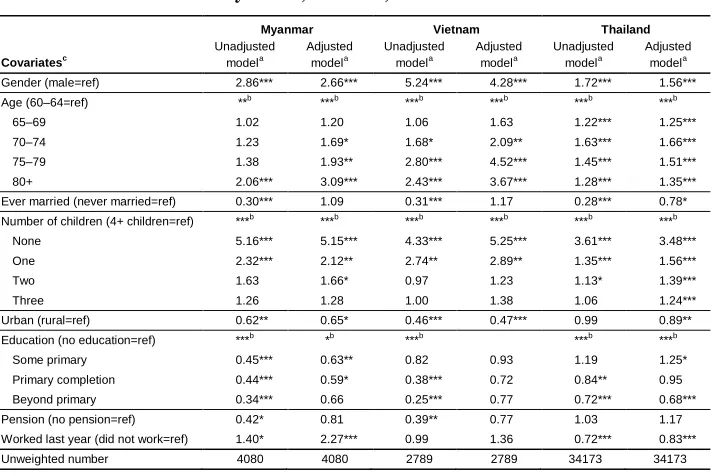
In the analysis presented in Table 3 we use binary logistic regressions to examine the correlates of living alone. For each country we incorporate two models: an unadjusted model treating each variable as a sole correlate of living alone (i.e., zero-order effect) and an adjusted model considering all covariates simultaneously. Coefficients are expressed as the ratio of the odds of living alone versus living with others for each category relative to the comparable odds of the reference category for each variable. Statistically significant odds ratios above 1 indicate that the particular category is associated with higher chances of living alone than the reference category, whereas values below 1 indicate the opposite. Additionally, we indicate the statistical significance of the differences in the overall set of variable categories between those living alone and those living with others.
Table 3: Exponentiated coefficients (odds ratios) from binary logistic
regression models predicting solo living among older persons aged 60 and over in Myanmar, Vietnam, and Thailand
Covariatesc
Myanmar Vietnam Thailand
Unadjusted modela Adjusted modela Unadjusted modela Adjusted modela Unadjusted modela Adjusted modela
Gender (male=ref) 2.86*** 2.66*** 5.24*** 4.28*** 1.72*** 1.56*** Age (60–64=ref) **b
***b
***b
***b
***b
***b
65–69 1.02 1.20 1.06 1.63 1.22*** 1.25*** 70–74 1.23 1.69* 1.68* 2.09** 1.63*** 1.66*** 75–79 1.38 1.93** 2.80*** 4.52*** 1.45*** 1.51*** 80+ 2.06*** 3.09*** 2.43*** 3.67*** 1.28*** 1.35*** Ever married (never married=ref) 0.30*** 1.09 0.31*** 1.17 0.28*** 0.78* Number of children (4+ children=ref) ***b
***b
***b
***b
***b
***b
None 5.16*** 5.15*** 4.33*** 5.25*** 3.61*** 3.48*** One 2.32*** 2.12** 2.74** 2.89** 1.35*** 1.56*** Two 1.63 1.66* 0.97 1.23 1.13* 1.39*** Three 1.26 1.28 1.00 1.38 1.06 1.24*** Urban (rural=ref) 0.62** 0.65* 0.46*** 0.47*** 0.99 0.89** Education (no education=ref) ***b
*b
***b
***b
***b
Some primary 0.45*** 0.63** 0.82 0.93 1.19 1.25* Primary completion 0.44*** 0.59* 0.38*** 0.72 0.84** 0.95 Beyond primary 0.34*** 0.66 0.25*** 0.77 0.72*** 0.68*** Pension (no pension=ref) 0.42* 0.81 0.39** 0.77 1.03 1.17 Worked last year (did not work=ref) 1.40* 2.27*** 0.99 1.36 0.72*** 0.83*** Unweighted number 4080 4080 2789 2789 34173 34173 *p≤0.05; **p≤0.01; ***p≤0.001
Sources: The 2012 Myanmar Aging Survey, 2011 Vietnam Aging Survey; 2011 Survey of Older persons in Thailand.
Notes: Unadjusted models include one covariate (i.e., zero-order effect). Adjusted models incorporate all covariates; b
Refers to differences in the overall set of variable categories between those living alone and those living with others based on Wald tests;
c
This analysis includes a continuous variable indicating functional limitation index. But its coefficients are not reported.
economic activity is significantly associated with a higher likelihood of living alone among older persons in Myanmar but a lower likelihood among elderly Thais.
4.4 Living alone and old-age wellbeing
4.4.1 Economic wellbeing
Table 4 presents the mean percentiles of objective and subjective measures of economic wellbeing indices according to living arrangement categories. Results are provided both unadjusted and statistically adjusted by multiple classification analysis (MCA) for covariates that are listed in the footnote.
For the household wealth index, the overall pattern of the results in relation to the various living arrangement situations is only modestly affected after adjusting for other covariates. In all countries, persons in all three categories of living alone score distinctively lower than those who live independently with spouse, who in turn score distinctively lower than those who live with children. Only in Vietnam does controlling for other covariates moderate the disadvantage of living alone to a noticeable, although not particularly large, extent. As noted, however, these relationships with household wealth based on possessions and household quality are very sensitive to household size, and thus may obscure the extent to which respondents are seriously worse off economically.
Table 4: Unadjusted and adjusted mean percentiles of subjective and
objective measures of economic wellbeing indices, older persons aged 60 and over in Myanmar, Vietnam, and Thailand
Alone, childless Alone, no child nearby Alone, child nearby With spouse only With
children Other Household wealth indexa,b
Myanmar
Unadjusted 28.3 29.5 25.0 39.3 52.7 48.4 Adjusted 29.0 32.2 28.9 40.5 52.7 46.7
Vietnam
Unadjusted 6.5 19.7 20.4 43.2 57.7 45.5 Adjusted 11.2 29.2 32.1 44.4 56.6 46.1
Thailand
Unadjusted 25.7 32.1 23.8 41.7 58.3 48.2 Adjusted 19.3 32.3 28.1 41.9 58.4 47.8
Index of subjective economic wellbeinga,b
Myanmar
Unadjusted 38.1 39.0 38.2 44.4 51.9 45.9 Adjusted 34.4 39.3 39.1 44.7 52.1 44.1
Vietnam
Unadjusted 37.4 33.9 32.8 47.8 52.7 49.7 Adjusted 34.5 38.6 36.7 46.7 53.1 48.7
Thailand
Unadjusted 47.1 52.3 51.6 52.2 50.0 46.1 Adjusted 43.1 52.5 53.5 52.0 50.3 45.5
Number (unweighted) Myanmar 58 95 123 239 3167 398 Vietnam 35 106 120 505 1759 264 Thailand 598 1708 957 6190 18861 5859
Sources: The 2012 Myanmar Aging Survey, 2011 Vietnam Aging Survey, and 2011 Survey of Older Persons in Thailand.
Notes: a
Adjusted mean percentiles are based on MCA and control for gender, age, ever married status, area, education, pension, work status last year, and functional limitation index; b
All unadjusted and adjusted differences across types of living arrangement are statistically significant at the .001 level or beyond.
In brief, solitary-living elders in all three countries tend to live in significantly less wealthy households, judged in terms of household possessions and housing quality. Older persons who live alone in Myanmar and Vietnam are clearly disadvantaged economically in terms of self-assessed economic wellbeing. However, this is not true for Thailand, except for a small minority of childless solo dwellers. Moreover, the small subgroup of childless persons that live alone in Myanmar and Vietnam are also particularly disadvantaged.
4.4.2 Social participation
common assumptions regarding how solo living is related to levels of social connectedness. On one hand, it is assumed that older persons living alone are not only physically isolated but also socially alienated. On the other hand, solo-dwelling elders, particularly those that are childless or do not live adjacent to a child, tend to have fewer family obligations and can thus afford to participate in social activities more frequently.
Table 5: Unadjusted and adjusted mean percentiles of social participation indices, older persons aged 60 and over in Myanmar, Vietnam, and Thailand
Alone, childless
Alone, no child nearby
Alone, child
nearby With spouse only With children Other
Myanmara,b
Unadjusted 47.8 40.0 43.5 53.2 50.3 48.7 Adjusted 48.6 45.1 50.9 50.6 50.3 48.5 Vietnama,b
Unadjusted 32.2 49.9 39.4 58.6 49.1 46.2 Adjusted 50.7 56.0 46.4 55.8 48.1 50.5 Thailanda,b
Unadjusted 48.2 52.7 51.2 53.9 48.5 50.3 Adjusted 54.4 52.3 52.2 52.4 48.9 50.1 Number (unweighted)
Myanmar 58 95 123 239 3167 398 Vietnam 35 106 120 505 1759 264 Thailand 598 1708 957 6190 18861 5859
Sources: The 2012 Myanmar Aging Survey, 2011 Vietnam Aging Survey, and 2011 Survey of Older Persons in Thailand.
Notes: a
Adjusted means are based on MCA and control for gender, age, ever married status, area, education, work status last year, functional limitation index, and household wealth index; b
Unadjusted and adjusted differences across types of living arrangement are statistically significant at the .01 level or beyond. The only exception is the difference in adjusted mean percentiles of social participation index for Myanmar, which is significant at the .10 level.
participation than their counterparts in other family arrangements. This is also the case for Thai elders who live with children. Childless solo-dwellers in Thailand actually score highest compared to other Thai elders in terms of mean percentiles of social participation.
In brief, evidence from Myanmar suggests slightly lower levels of social participation among solo dwellers that are childless and that do not have children nearby. Evidence from Vietnam and Thailand partially supports the second hypothesis, which argues that coresidence or quasi-coresidence can increase older persons‟ family obligations, thus reducing their participation in community-based activities.
4.4.3 Psychological distress
Table 6 displays the mean percentiles of psychological distress indices. Unadjusted results in all three countries show higher stress among all three categories of living alone compared to those who live with others. However, adjusting for covariates considerably reduces most differences across types of living arrangement in all three countries, with the exception of childless solo-living elders in Myanmar and Thailand. Despite the contraction, the adjusted differences remain statistically significant across all three countries.
Table 6: Unadjusted and adjusted mean percentiles of psychological distress indices, older persons aged 60 and over in Myanmar, Vietnam, and Thailand
Alone, childless
Alone, no child nearby
Alone, child nearby
With spouse
only With children Other
Myanmara,b
Unadjusted 53.0 57.2 64.4 51.5 48.8 53.1 Adjusted 51.9 49.2 55.5 50.5 49.2 54.7
Vietnama,b
Unadjusted 72.9 78.9 73.0 47.7 48.2 51.7 Adjusted 64.8 65.4 60.6 47.3 49.5 51.3 Thailanda,b
Unadjusted 57.9 56.1 55.6 48.0 49.2 50.3 Adjusted 56.2 52.6 48.9 47.8 50.0 50.9 Number (unweighted)
Myanmar 58 95 123 239 3167 398 Vietnam 35 106 120 505 1759 264 Thailand 598 1708 957 6190 18861 5859
Sources: The 2012 Myanmar Aging Survey, 2011 Vietnam Aging Survey, and 2011 Survey of Older Persons in Thailand.
Notes: a
Adjusted means are based on MCA and control for gender, age, ever married status, area, education, work status last year, functional limitation index, and household wealth index; b
All unadjusted and adjusted differences across types of living arrangement are statistically significant at the .001 level or beyond.
4.4.4 Met need for care
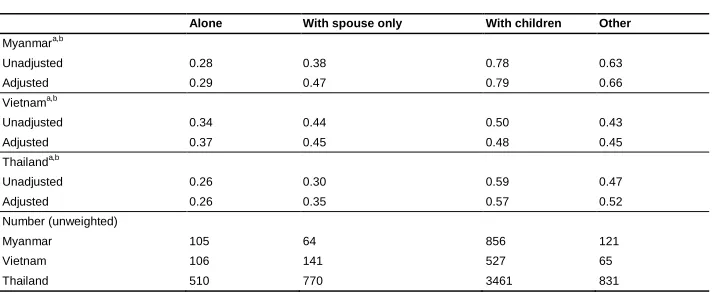
Table 7 shows unadjusted and adjusted proportions of older persons who need care (i.e., have ADL difficulties) and who reported having received care. In this analysis we combine different sub-categories of older persons living alone, due to the small number of observations of childless solo dwellers with ADL difficulty in Myanmar and Vietnam.
persist. Only in Vietnam are the adjusted differences in met need for care not statistically significant.
Table 7: Unadjusted and adjusted proportions of met needs for care, older persons aged 60 and over with ADL difficulty in Myanmar, Vietnam, and Thailand
Alone With spouse only With children Other
Myanmara,b
Unadjusted 0.28 0.38 0.78 0.63 Adjusted 0.29 0.47 0.79 0.66 Vietnama,b
Unadjusted 0.34 0.44 0.50 0.43 Adjusted 0.37 0.45 0.48 0.45 Thailanda,b
Unadjusted 0.26 0.30 0.59 0.47 Adjusted 0.26 0.35 0.57 0.52 Number (unweighted)
Myanmar 105 64 856 121
Vietnam 106 141 527 65
Thailand 510 770 3461 831
Sources: The 2012 Myanmar Aging Survey, 2011 Vietnam Aging Survey, and 2011 Survey of Older Persons in Thailand.
Notes: a
Adjusted proportions refer to predicted probabilities of having met need for care, which are derived from binary logistic regression analysis that controls for gender, age, area, education, and household wealth index; bUnadjusted and adjusted differences across types of living arrangement are statistically significant at the .001 level or beyond. The exception is Vietnam, whereby neither difference in unadjusted nor adjusted proportions of met needs is statistically significant.
4.4.5 Gender differentials in wellbeing indicators
Table 8: Mean percentiles of economic wellbeing, social participation, psychological distress indices and percentages of met need for care among older persons aged 60 and over in Myanmar, Vietnam, and Thailand
Wellbeing indicators
Myanmara
Vietnama
Thailanda
Men Women Men Women Men Women Unweighted
N=1742
Unweighted N=2338
Unweighted N=1106
Unweighted N=1683
Unweighted N=14541
Unweighted N=19632
Household wealth index
Alone 30.5 26.1 18.6 17.2 28.2 24.7
With others 51.2 51.2 52.9 51.0 52.5 52.1 Subjective economic wellbeing index
Alone 45.6 36.0 41.1 36.4 52.1 50.6 With others 50.3 50.9 50.7 50.8 50.5 49.4 Social participation index
Alone 41.6 43.7 48.8 41.1 47.9 53.2
With others 54.8 46.4 55.9 46.1 49.9 49.8 Psychological distress index
Alone 50.9 62.0 62.9 73.0 54.8 57.0 With others 45.2 53.4 43.9 52.8 46.2 51.4
% Met need for care
Alone 41.7 24.4 24.9 35.0 16.8 30.6
With others 70.4 73.6 49.0 47.6 47.7 56.1
Sources: The 2012 Myanmar Aging Survey; 2011 Vietnam Aging Survey; and 2011 Survey of Older Persons in Thailand.
Note: a
Male-female differences significant at the .05 level or beyond are shown in bold face.
5. Discussion and conclusions
Based on recent nationally representative surveys of older persons in Myanmar, Vietnam, and Thailand, this study is among the first to compare trends and situations of older persons living alone in developing Southeast Asia. The study has several important limitations. Given the cross-sectional nature of the surveys, only associations rather than causal relationships between solo living and old-age wellbeing can be determined. For instance, we cannot infer whether solitary living leads to financial stress or whether financial stress causes one to live alone. This shortcoming speaks to the need for comparative longitudinal data to address the mechanisms through which solitary living and old-age wellbeing are linked. In addition, typical in comparative research, harmonizing key variables to maximize comparability across the surveys poses a serious challenge. While numerous efforts have been made in this study to address the issues of comparability, we recognize that they cannot entirely be discounted.
Comparisons with previous studies reveal a modest upward trend in one-person households among older populations over the last two decades in Vietnam and Thailand and during the last 10 years in Myanmar. However, evidence does not suggest that there has been a major transformation, at least for the time being, in family structure and intergenerational transfers involving older persons. Compared with western contexts the prevalence of solo living remains low, accounting for less than one-tenth of all older persons in the three countries. Moreover, the surveys reveal that a very substantial proportion of the elderly in one-person households live in quasi-coresidence, with a child living next door or very nearby, and over three-fifths in Myanmar and Vietnam and nearly half in Thailand have at least one child residing in the same locality. Recognizing this underscores the limitation of defining living alone among older persons narrowly in terms of an individual household (Knodel and Saengtienchai 1999). While the proportion of older persons living alone is almost certain to continue rising, it is important to recognize that patterns and forms of solitary living observed in this region may differ from those in the west (see Ofstedal, Knodel, and Chayovan 1997). In particular, quasi-coresidence emerges as an important aspect of solo dwelling in all three countries. Perhaps this illustrates a critical aspect of how intergenerational support and transfers are being renegotiated and reinterpreted, as mentioned in Croll (2006).
solo-dwellers as disadvantaged, lonely, depressed, and financially stressed, our population-based evidence provides a nuanced and mixed view regarding their situations. First, solo living is associated with financial stress to a certain extent and depends in part on how the economic situation is measured. For example, when self-assessed economic wellbeing is considered, our results show that solo-living elders, particularly those who are childless, are distinctively worse off than those in other living arrangements and that financial stress among older persons living alone seems more evident in Vietnam and Myanmar than in Thailand. Furthermore, in terms of social participation, we do not find any evidence to support the notion that solo dwellers are socially alienated or disconnected. Rather, they tend to be as socially participatory as, if not slightly more active than, those living with others. This is particularly the case for Vietnamese and Thai solo dwellers who are childless and those who do not have children living nearby. Fewer family obligations (e.g., grandchild care) may allow these elders to participate more frequently in community-based activities.
In all three countries, solo dwellers generally report more psychological distress than those living with others. In both Vietnam and Thailand, older persons who live alone and are childless express the most severe psychological distress compared to their counterparts in other forms of living arrangement. Note that having children, regardless of whether or not they live nearby, seems to offer solo-dwelling elders some protection from psychological woes. In addition to its adverse influence on elderly psychological wellbeing, solitary living appears to restrict the chances of older adults receiving personal assistance when need arises. In developing (rural) contexts where outsourcing of elderly care is still uncommon, remittances from children living outside the parental locality to pay for care assistance are unlikely to substitute for a child‟s physical presence. Moreover, since personal care for aged parents is typically considered a filial obligation in Southeast Asian culture, even if a paid caregiver is available, parents may find this an unacceptable alternative (Knodel et al. 2013).
experience social stigma and feel alienated. In addition, multiple disadvantages may result from selection, as childlessness is an unconventional experience for older persons in the study samples. Thus, they may have characteristics that are prone to economic, social, and psychological vulnerabilities. Regardless of reasons making childless solo dwellers particularly disadvantaged, this minority of solo dwellers (ranging between 15% and 21% in the three countries under study) will need attention from policymakers and social workers.
Consistent with the view that modernization promotes solo living among older persons, the upward trend in one-person households is most striking in Thailand where the economy is most developed. While solo dwelling is correlated strongly with adverse outcomes in old-age wellbeing in Myanmar and Vietnam, this is much less the case in Thailand, where strong negative effects are clear only for met need for personal assistance and the wealth measure based on household possessions and housing quality. Only a small minority of childless solo-dwelling Thai elders experience noticeably greater subjective financial stress and psychological distress than those that live with others. Why are the results for Thailand different from those for Myanmar and Vietnam? Possible explanations include ideational change associated with modernization and adaptive processes including provision of considerable remittances by children who migrate (Knodel et al. 2010). Yet results from earlier surveys conducted in 1994 and 2002 when the development level was less advanced also show that self-assessed economic situations differed little for older persons that lived alone and those that lived with others (unpublished tabulations by authors). Differences in the manner in which the surveys were conducted or linguistic differences between the countries may also be at play (Angel 2013). In brief, while we are able to clearly demonstrate that the implications for an elderly person of living in a one-person household are different in Thailand than in Myanmar or Vietnam, the reason for the cross-national differences remains an open question.
6. Acknowledgements
References
Angel, R.J. (2013). After Babel: Language and the fundamental challenges of
comparative aging research. Journal of Cross Cultural Gerontology 28(3): 223–
238. doi:10.1007/s10823-013-9197-2.
Arora, K. (2013). India urgently needs to review its policy on the elderly. Times of
India August 6, 2013.
Bangkok Post (2010). Tackling plight of the elderly. Editorial. Bangkok Post May 8,
2010.
Barrett, A.E. (1999). Social support and life satisfaction among the never married.
Research on Aging 21(1): 46–72. doi:10.1177/0164027599211003.
Bennett, J. and Dixon, M. (2006). Single person households and social policy: Looking
forwards. York: Joseph Rowntree Foundation.
Charasdamrong, P. (1992). The Misery of Those Left Behind. Bangkok Post, May 10,
1992
Charoenpo, A. (2007). Govt. to care for abandoned elderly. Bangkok Post, April 12,
2007
Cheung, C.-K., and Kwan, A.Y.-H. (2009). The erosion of filial piety by modernization
in Chinese cities. Aging & Society 29:179–198. doi:10.1017/S0144686X080078
36.
Croll, E.J. (2006). The intergenerational contract in the changing Asian family. Oxford
Development Studies 34(4): 473–491. doi:10.1080/13600810601045833.
Dean, A., Kolody, B., Wood, P., and Matt, G.E. (1992). The influence of living alone
on depression in elderly persons. Journal of Aging and Health 4(1): 3–18.
doi:10.1177/089826439200400101.
Filmer, D. and Pritchett, L.H. (2001). Estimating wealth effects without expenditure data – or tears: An application to educational enrollments in states of India.
Demography 38(1): 115–132. doi:10.1353/dem.2001.0003.
French, H. (2006). Rush for wealth in China‟s cities shatters the ancient assurance of
care in old age. New York Times, November 3, 2006.
Hendricks, J. and Yoon, H. (2006). The sweep of age and aging: changing mores,
changing policies. In: Hendricks, J. and Yoon, H. (eds.). Handbook of Asian
Index Mundi (2013) [electronic resource]. Burma Economy Profile 2013. United States:
Central Intelligence Agency. [http://www.indexmundi.com/burma/economy_pro
file.html]
Jamieson, L. and Simpson, R. (2013). Living Alone: Globalization, Identity and
Belonging. Palgrave Macmillan. doi:10.1057/9781137318527.
Jeon, G.S., Jang, S.N., Rhee, S.J., Kawachi, I., and Cho, S.I. (2007). Gender differences
in correlates of mental health among elderly Koreans. Journals of Gerontology:
Social Sciences 62B: S323–S329.
Knodel, J. (2014). Is intergenerational solidarity really on the decline?: Cautionary
evidence from Thailand. Asian Population Studies 10(2): 176–194. doi:10.1080/
17441730.2014.902160.
Knodel, J., Amornsirisomboon, P., and Khiewyoo, J. (1997). Living arrangements, family support, and the welfare of the elderly: Findings and implications of the 1994 Survey of Elderly in Thailand. Ann Arbor, MI: Population Studies Center, University of Michigan (Elderly in Asia Report No. 97-43).
Knodel, J., Kespichayawattana, J., Saengtienchai, C., and Wiwatwanich, S. (2010). How left behind are rural parents of migrant children: Evidence from Thailand.
Ageing and Society 30(5): 811–841. doi:10.1017/S0144686X09990699.
Knodel, J., Kespichayawattana, J., Wiwatwanich, S., and Saengtienchai, C. (2013). The
future of family support for Thai elderly: Views of the populace. Journal of
Population and Social Studies 21(2): 110–132.
Knodel, J. and Nguyen, M.D. (2014). Grandparents and grandchildren: care and support
in Myanmar, Thailand and Vietnam. Ageing & Society (FirstView): 1–29.
doi:10.1017/S0144686X14000786.
Knodel, J. and Saengtienchai, C. (1999). Studying living arrangements of the elderly:
Lessons from a quasi qualitative case study approach in Thailand. Journal of
Cross-Cultural Gerontology 14(3): 197–220. doi:10.1023/A:1006620314634.
Kramarow, E.A. (1995). The elderly who live alone in the United States: Historical
perspectives on household change. Demography 32(3): 335–352. doi:10.2307/20
61684.
Michael, Y.L., Berkman, L.F., Colditz, G.A., and Kawachi, I. (2001). Living arrangements, social integration, and change in functional health status.
Ng, K.-M., Lee, T., and Chi, I. (2004). Relationship between living arrangements and
psychological wellbeing of older people in Hong Kong. American Journal on
Ageing 23(4): 167–171. doi:10.1111/j.1741-6612.2004.00044.x.
Ofstedal, M.B., Knodel, J., and Chayovan, N. (1997). Intergenerational support and
gender: A comparison of four Asian countries. Journal of Southeast Asian
Studies 27(2): 21–41. doi:10.1163/030382499X00039.
Palloni, A. (2002). Living arrangements of older persons. Population Bulletin of the
United Nations Special Issue 42/43: 54–110.
Prachuabmoh, V., Knodel, J., and Teerawichitchainan, B. (2014). Contributions of
Older Persons to the Families: Examples from Myanmar, Vietnam, and Thailand. Paper presented at the Asia/Pacific Regional Conference 2014, Chiang
Mai, Thailand, September 1–4 2014. [available at https://umich.box.com/s/5naxe
46mwiwcz0g461di]
Ramos, M. and Wilmoth, J. (2003). Social relationships and depressive symptoms
among older adults in Southern Brazil. Journals of Gerontology: Social Sciences
58(4): S253–S261.
Russell, D. and Taylor, J. (2009). Living alone and depressive symptoms: The influence of gender, physical disability and social support among Hispanic and
non-Hispanic older adults. Journals of Gerontology: Social Sciences 64(1): 95–104.
Spoorenberg, T. (2013). Demographic changes in Myanmar since 1983: An
examination of official data. Population Development Review 39(2): 309–324.
doi:10.1111/j.1728-4457.2013.00593.x.
Tout, K. (1989). Ageing in Developing Countries. Oxford: Oxford University Press.
VanLandingham, M. (2009). The impacts of rural-to-urban migration on the health of working-age adult migrants in Ho Chi Minh City. In: Luong, H.V. (ed.).
Urbanization, migration, and poverty in a Vietnamese metropolis. Singapore: National University of Singapore Press: 134–154.
Vos, R., Ocampo, J., and Cortez, A.L. (2009). Aging and development. London: Zed
books.
Waite, L.J. and Hughes, M.E. (1999). At risk at the cusp of old age: Living arrangements and functional status among black, white, and Hispanic adults.
Ware, J.E. and Sherbourne, C.D. (1992). The MOS 36-item short-form health survey
(SF-36). Medical Care 30(6): 473–483.
doi:10.1097/00005650-199206000-00002.
Wong, Y.S. and Verbrugge, L.M. (2009). Living alone: Elderly Chinese Singaporeans.
Journal of Cross-Cultural Gerontology 24(3): 209–224. doi:10.1007/s10823-008-9081-7.
World Bank (2012). Reducing Elderly Poverty in Thailand: The Role of Thailand‟s
Pension and Social Assistance Programs. Bangkok: The World Bank. [http://doc
uments.worldbank.org/curated/en/home]
Yeh, S.-C.J. and Lo, S.K. (2004). Living alone, social support, and feeling lonely
among the elderly. Social Behavior and Personality 32(2): 129–138. doi:10.222