O R I G I N A L R E S E A R C H
Effects of PEGylation on capture of
dextran-coated magnetic nanoparticles in
microcirculation
This article was published in the following Dove Press journal: International Journal of Nanomedicine
Chien-Yu Chiu1,2 Tze-Wen Chung3,4 Si-Yi Chen2
Yunn-Hwa Ma2,5
1Graduate Institute of Biomedical
Sciences, College of Medicine, Chang Gung University, Guishan, Taoyuan City
33302, Taiwan, ROC;2Department of
Physiology and Pharmacology, College of Medicine, Chang Gung University, Guishan, Taoyuan City 33302, Taiwan,
ROC;3Department of Biomedical
Engineering, National Yang-Ming University, Beitou, Taipei City 11221,
Taiwan, ROC;4Center for Advanced
Pharmaceutical Research and Drug Delivery, National Yang-Ming University, Beitou, Taipei City 11221, Taiwan, ROC;
5Department of Neurology, Chang Gung
Memorial Hospital, Guishan, Taoyuan City 33305, Taiwan, ROC
Background:Magnetic nanoparticles (MNPs) can be localized against hemodynamic forces
in blood vessels with the application of an external magneticfield. In addition, PEGylation of
nanoparticles may increase the half-life of nanocomposites in circulation. In this work, we examined the effect of PEGylation on the magnetic capture of MNPs in vivo.
Methods: Laser speckle contrast imaging and capillaroscopy were used to assess the
magnetic capture of dextran-coated MNPs and red blood cell (RBC) flow in cremaster
microvessels of anesthetized rats. Magnetic capture of MNPs in serumflow was visualized
with an in vitro circulating system. The effect of PEGylation on MNP-endothelial cell interaction was studied in cultured cells using an iron assay.
Results:In microcirculation through cremaster muscle, magnet-induced retention of 250 nm
MNPs was associated with a variable reduction in RBCflow, suggesting a dynamic coupling
of hemodynamic and magnetic forces. After magnet removal, faster restoration offlow was
observed in PEG(+) than PEG(–) group, which may be attributed to a reduced interaction
with vascular endothelium. However, PEGylation appears to be required for magnetic capture of 50 nm MNPs in microvessels, which was associated with increased hydrodynamic
diameter to 130±6 nm in serum, but independent of theς-potential.
Conclusion: These results suggest that PEGylation may enhance magnetic capture of smaller MNPs and dispersion of larger MNPs after magnet removal, which may potentially
affect the targeting, pharmacokinetics and therapeutic efficacy.
Keywords: polyethylene glycol, magnetic nanoparticles, hemodynamics, microcirculation, magnetic targeting
Background
Magnetic localization of nanoparticles with an iron oxide core is a promising approach
for target drug delivery.1–5With the superparamagnetic characteristics of the
nano-sized iron oxide core, magnetic nanoparticles (MNPs) can be manipulated with an external magneticfield and thereby serve as carriers for delivery of drugs.1–4,6,7To
achieve local accumulation of MNPs, various magneticfield designs have been tested
ex vivo8 and in vivo,9–23including alternating current-induced magnetic field9 and
NdFeB magnet applied in a stationary8,10–16,20–23 or mobile17-19 manner. Magnetic
force-induced local retention of MNPs with particle sizes in the range of 130–366 nm
has been demonstrated with good reproducibility in vivo,11,12,14,16,20–23including in vessels of different sizes11,12and tumor tissues.14,16,20–23Magnetic targeting with these
MNPs may serve as a feasible strategy for delivery of thrombolytic17,19,24,25 and
Correspondence: Yunn-Hwa Ma Department of Physiology and
Pharmacology, Chang Gung University, 259 Wen-Hwa 1st Road, Guishan District, Taoyuan City 33302, Taiwan, ROC Tel/Fax +886 3 211 8800 ext 5152 or 5266 Email [email protected]
International Journal of Nanomedicine
Dove
press
open access to scientific and medical research
Open Access Full Text Article
International Journal of Nanomedicine downloaded from https://www.dovepress.com/ by 118.70.13.36 on 22-Aug-2020
chemotherapeutic13,14,16,22,23drugs. The therapeutic efficacy will be determined by strategic coupling of targeting, which
depends on the properties of the particles and appliedfield,
and drug release at the site of action. In target thrombolysis,
interaction of the magnetic nanocomposites with thefibrin
clot in the rat embolic model requires application of a mobile
rather than a stationary magnet.17In addition, magnetic force
may be applied to control release of encapsulated drugs to
ensure thrombolytic efficiency in vivo.25
Following in vivo administration, MNPs are taken up
by the reticuloendothelial system (RES) within minutes.3,6
The fate of MNPs subjected to phagocytosis by RES
depends on the size, surface modification, chemical
com-position, surface charge and hydrophobicity of
MNPs.2,3,7,26–28Specifically, surface modification or poly-mer coating was shown to improve stability, dispersity and
biocompatibility of MNPs.2,3,7,26–28 The polymer,
poly-ethylene glycol (PEG), is a stable, biocompatible, hydro-philic polymer, which has been extensively studied for
applications to drug or gene delivery.29–31 Immobilized
PEG on the nanoparticle alters the surface characteristics of the particle, which is dependent on the molecular
weight and polymer conformation. PEG modification can
also hinder interaction with plasma proteins and reduce
plasma protein adsorption on the surface of the
nanoparticles.29,30,32Moreover, PEG reduces the response
of the immune system to nanoparticles.3,29–31,33 This in
turn reduces clearance of the nanoparticles from the circu-lation, and thereby allows a longer circulation time and
more nanoparticle accumulation at the target site.33–35
Nevertheless, PEGylation may also reduce internalization
of MNPs by tumor cells30,36–38 as well as endothelial
cells38,39in culture, and thus potentially reduce intracellu-lar delivery of drugs.
After intravascular administration, nanoparticles will initially contact the endothelium of the blood vessel, which is composed of a thin continuous layer of cell lining. The interaction of multifunctional nanoparticles
with the endothelium is important,38–42 as it is the main
target in the treatment of disease, including inflammatory,
cardiovascular and oncological diseases.43,44 PEG coating
reduces adhesion of polystyrene spheres to endothelial
monolayer under physiological shear in vitro.39 In
addi-tion, PEG modulates the intracellular behavior of
nanopar-ticles, probably due to protein adsorption.45 We recently
demonstrated that PEGylation of dextran-coated MNPs
may alter particle properties in circulation.46 Although
PEGylated nanocomposites with iron oxide core can be
magnetically captured in vivo,16,47 the effect of
PEGylation on the behavior of MNPs subjected to mag-netic capture in circulation has not been investigated.
In the current study, the effect of PEG modification on
the behavior of dextran-coated MNP in response to mag-netic and hemodynamic forces was assessed by
visualiza-tion of red blood cell flow in microvessels in vivo, using
a cremaster microcirculatory preparation of rats.11 The
results suggest that PEGylation may induce a shielding effect, facilitate capture and escape of MNPs in a
size-dependent manner, and modulate blood flow in the
pre-sence of a magneticfield.
Methods
Materials
Dextran-coated magnetic nanoparticles (MNPs; 50 and
250 nm) with (nanomag®-D PEG-COOH) or without
(nanomag®-D COOH) polyethylene glycol (PEG; 600
dal-tons) were purchased from Micromod Partikeltechnologie GmbH (Rostock, Germany). Neodymium (NdFeB) magnets were purchased from New Favor Industry Co., Ltd (Taiwan).
Hydroxyethyl starch solution (6%, Voluven®) was purchased
from Fresenius Kabi (Germany). Heparin (50,000 units),
Inactin® (sodium salt of
ethyl-[1-methyl-propyl]-malonyl-thio-urea), fetal bovine serum (FBS), ammonium persulfate and potassium thiocyanate (KSCN) were purchased from Sigma (St Louis, MO, USA). M199 medium and trypsin-ethylenediaminetetra acetic acid were purchased from Gibco BRL (Grand Island, NY, USA). Horse serum was purchased
from Hyclone® (Logan, UT, USA). Penicillin/streptomycin/
amphotericin and endothelial cell growth supplement (ECGS) were purchased from Upstate Biotechnology (Lake Placid, NY, USA).
Size and
ζ
-potential measurement of
nanoparticles
The hydrodynamic size distribution and the ζ-potential of
MNPs were determined by dynamic light scattering and
electrophoretic light scattering, respectively, using
a particle analyzer (NanoPlus, Micromeritics; GA, USA). MNPs were suspended at a concentration of 0.05 mg/mL in deionized water (DIW), phosphate buffered saline
(PBS; NaCl 137 mM, KCl 2.7 mM, Na2HPO4 10 mM,
KH2PO4 2 mM; pH 7.4) or particle-free horse serum,
which was subjected to a series of centrifugation to ensure
removal of suspended particles. Briefly, the horse serum
was centrifuged at 300×g for 15 mins (Sorvall RT6000B;
International Journal of Nanomedicine downloaded from https://www.dovepress.com/ by 118.70.13.36 on 22-Aug-2020
MA, USA); the supernatant was then centrifuged at
3,800×g for 10 mins (Beckman coulter AV anti
J-E centrifuge; CA, USA), followed by 100,000×g for 1 hr (Beckman coulter optima L-100 K; CA, USA) to remove any particular matter. After centrifugation and removal of the upper lipid layer, particle-free serum was obtained and used to mimick serum components in circu-lation. MNPs were suspended by a 10-mins sonication prior to the measurement at 25°C. PBS and serum samples were analyzed with identical parameter setting.
Cremaster muscle preparation
The cremaster muscle was prepared based on a previous
study with minor modification,11 and the experimental
protocol was approved by the Institutional Animal Care and Use Committee at Chang Gung University, which is
certified by the American Association for Accreditation of
Laboratory Animal Care. Briefly, Sprague Dawley rats
(330±7 g, n=23) were anesthetized using Inactin® (100 mg/kg; i.p.). After hair removal from the lower abdo-men and the scrotum, a rectal probe was inserted to ensure the core body temperature at 37±1°C, followed by urinary bladder cannulation. The left cremaster muscle was dis-sected, and the testis was removed. From the left femoral artery, the iliac artery was cannulated in a retrograde
man-ner with a PE50 tubing without interrupting the bloodflow
to the pudic epigastric artery, a branch of the iliac artery that supplies blood to the cremaster bed. Two small branches of the left iliac artery and pudic epigastric artery were ligated, allowing most of injected particles to reach the cremaster vasculature. With the cremaster vasculature
remaining part of the rat circulation (Figure S1), the
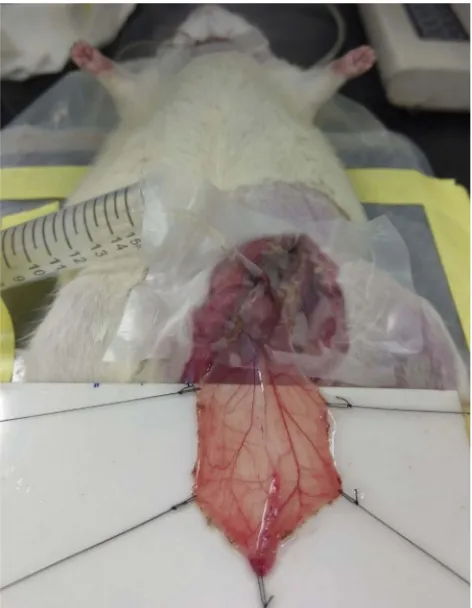
mus-cle was then placed in situ on a cylindrical NdFeB magnet (1.9 cm in diameter; 0.8 cm in thickness), and tension was applied. Saline-hydroxyethyl starch (1:2) mixture was
con-tinuously infused at a rate of 30 μL/min for injection of
MNPs via an injection port on the intra-arterial catheter tubing. At completion of the study (see below), the rats were euthanized by cervical dislocation under anesthesia.
Laser speckle imaging
The laser speckle contrast imaging (MoorFLPI-2™; Moor
Instruments, England) was used to monitor tissue blood
flow changes in real time. A random speckled pattern is
generated as blood cells move in the tissue, which is illuminated by a focused diode laser at 650 nm. The region
of interest (ROIs) in thefield of monitoring was analyzed
with time. Blood flow is presented as 2-D images or
tracings that were updated every 10 sec. The simultaneous
recordings offlux and photo images reveal patterns offlow
and MNP retention in a single microvessel. There are two major branches of microvessels in the cremaster muscles. For data analysis, six to eight ROIs in each branch were averaged to obtain perfusion values of each branch. The
lowest blood flow occurred 4–13 mins after intra-arterial
injection of MNPs (+MNP), and the flow 5 and 15
mins after removal of the magnet (-Mag) was calculated as percent basal level.
Capillaroscopy
Visualization and characterization of MNP capture in
cre-master microcirculation were performed using the
CapiScope Handheld Video Capillaroscope System (KK Technology, Honiton, England), which generated oblique
profiled epi-illumination imaging by light-emitting diodes
at a wavelength of 525~535 nm. In the image, RBCs were
viewed asflowing subjects over a gray background, which
delineates vessel wall as a faint contour, whereas MNP pellet captured by the magnet was observed as a dark subject. A color mode was used to increase the contrast
for observation of the vessel wall. RBCflow and diameter
of a single vessel was determined from the images.
In vitro circulation system
To observe magnetic capture of MNPs in a circulatory sys-tem, magnet-induced MNP retention in a silicon tubing (i.d. 2 mm; o.d. 4 mm) was recorded using a CCD camera (MD130, Sage Vision, Taiwan) controlled by Future WinJoe software (Future Optics, Hangzhou, China) mounted on a dissecting microscope (SL-620, Sage Vision, Taiwan). A permanent magnet (2×1×0.5 cm; 1.55 kG) was placed by the silicon tube at a 45° angle, 5 cm downstream from the injection site as illustrated inFigure 4A. The peristaltic pump
(Masterflex®7553–80, Vernon Hills, Il, USA) with silicone
tubing (Peroxide; L/STM13 #96400-13 with i.d. 0.8 mm)
induced a flow of 2 mL/min through the total length of
150 cm tubingfilled with horse serum or hydroxyethyl starch
solution. The horse serum was centrifuged at 100,000 g for 1 hr to remove particular matter prior to use. The shear stress of
the system with serum was calculated to be 0.7 dyn/cm2,
using a viscosity of 1.66 mPa s.48In experiments with serum,
particles (0.1 mg) were injected into the silicon tube in approximately 10 s, followed by a 10 mins observation per-iod. In experiments with hydroxyethyl starch solution,
parti-cles (0.1 mg) and citrated whole blood (20μL) were injected
simultaneously, followed by a 1 min observation period. The
International Journal of Nanomedicine downloaded from https://www.dovepress.com/ by 118.70.13.36 on 22-Aug-2020
2-dimentional area of the particle retention in the silicon tube was analyzed by image-J software.
Endothelial cell culture
Human umbilical vein endothelial cells (HUVECs) were obtained with a protocol approved by the institutional review board of Chang Gung Memorial Hospital to study
MNP-HUVEC interaction, as described previously.38,40 HUVEC
were cultured in M199 medium with FBS (10%), heparin
(100 μg/mL), endothelial cell growth supplement (ECGS)
(30μg/mL) and penicillin/streptomycin/amphotericin (1%)
at pH 7.4. The cells were maintained at 37°C in an incubator
supplied with 5% CO2and used between passages 3–9.
Cellular uptake of MNPs
HUVECs were cultured in a 24-well culture plate with
M199 medium to 90% confluence prior exposure to
MNPs (100 μg/mL) with or without placement of the
NdFeB magnet underneath the well for 0.5–6 hrs. All
groups were subjected to the NdFeB magnet for 5 mins immediately after addition of MNPs to ensure sedi-mentation of the particles. After trypsinization, hydrochlo-ric acid (10% v/v) was added to the cell pellet and incubated at 55°C for 4 hrs, followed by treatment with ammonium persulfate (1 mg/mL) and KSCN (1 M). The amount of cell-associated iron was determined by
mea-surement of OD490 with a VICTOR3 Multilabel Plate
Reader (PerkinElmer, Shelton, CT, USA). A standard curve with a known concentration of MNPs was prepared under identical conditions for the calibration.
Statistical analysis
Data are presented as mean ± SEM. All results were
analyzed using a student’s t-test, pairedt-test or one-way
analysis (ANOVA) with repeated time measurement
fol-lowed by Duncan’s post hoc test. Statistical significance
was determined atP<0.05.
Results
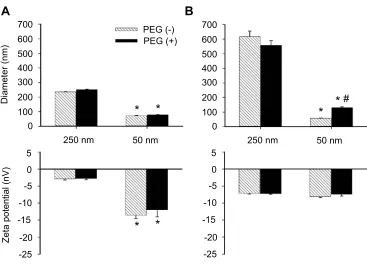
Figure 1 illustrates hydrodynamic diameters and the ζ
-potential of PEG(–)vsPEG(+) MNPs in PBS or serum.
In PBS (Figure 1A), PEGylation induced no effect on
ζ-potential or hydrodynamic size in either size of
MNPs studied. In serum (Figure 1B), the
hydrody-namic diameter of both the PEG(–) and PEG(+)
MNPs of 250 nm increased to about 600 nm. However, only the hydrodynamic diameter of PEG(+) 50 nm MNPs increased in size with the corresponding
PEG(–) MNPs remaining largely unchanged. Despite
the very different sizes, the ζ-potentials of all MNPs
in serum were similar and averaged from −7.2 to −8.2
mV, probably due to formation of protein corona.
Figure 2illustrates images of MNP accumulation with
time in a representative microvessel preparation of cre-master skeletal muscle with an underlying magnet. The
upper panel shows the initial rapidflow through the vessel,
and as early as 1 min after MNP (5 mg/kg) administration,
theflow is reduced in a localized region. The
correspond-ing lower panel provides photographs and the growcorrespond-ing
dark, localized region, reflecting the accumulation of
MNPs. Such retention of MNPs interfered the speckle
signals and left gray images at 2–10 mins after MNP
administration. Gradual reduction of the RBC flow to
84% of basal level was measured upstream of the retention site 4 mins after administration of MNPs. Removal of the magnet 15 mins after administration resulted in the rapid
removal of the MNPs and restoration of theflow. In
con-trast, the flow of the parallel vessel remained relatively
stable at 93±2% (n=5) of the basal value at these time points studied.
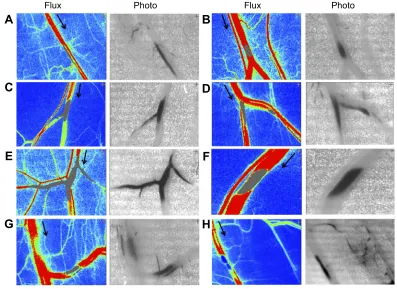
Supplemental data (Figure S2) provide an expanded
view of the accumulation site, where magnetic capture of MNPs occurred in the cremaster microvessels (photo
views) and the flow was affected not only in the parent
vessel but also in downstream branches as evident by the
gray area in theflux view. However, no significant
differ-ence was observed comparing RBC flow up- vs
down-stream of the retention sites without any branch in between (A, B, F, G, H; n=5).
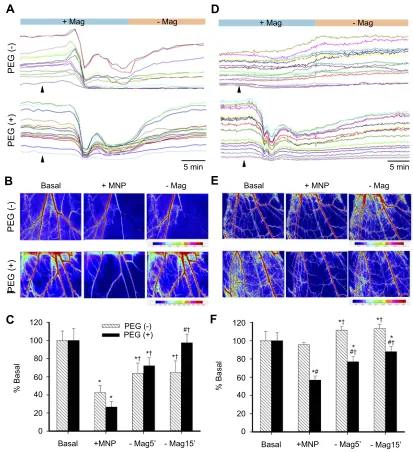
Figure 3shows the results from injection of PEGylated
MNPs subjected to magnetic capture on RBC flow in
cre-master microvessels in vivo. After intra-arterial
administra-tion of 250 nm particles under magnetic capture
(Figure 3A–C), RBC flow was reduced in most of the
ROIs studied; however, in some vessels, the RBC flow
fluctuated even with the magnet underneath the muscle
piece. After magnet removal (-Mag), theflow was
immedi-ately restored in PEG(+) rat, whereas the flow in most
vessels of the PEG(–) rat was at best only partially restored
after magnet removal (Figure 3A). Most tracings, which
represent the relative changes of RBC flow with time, of
vessels in the PEG(+) rat recovered to near basal levels of
individual vessel after magnet removal (Figure 3A). This
was also observed in the representative flux images from
the same rat inFigure 3B. MNPs of 250 nm with vs without
PEG significantly reduced basal bloodflow by 73% (n=11
International Journal of Nanomedicine downloaded from https://www.dovepress.com/ by 118.70.13.36 on 22-Aug-2020
branches from 5 rats) vs 58% (n=9 branches from 5 rats),
respectively (Figure 3C); however, no significant effect was
observed between the PEG(+) and PEG(–) groups. Five
minutes after magnet removal (-Mag), significant
restora-tion of the flow was observed in both PEG(+) vs PEG(–)
groups. Fifteen minutes after magnet removal, the flow of
the PEG(+) group returned to near the basal level, which is significantly higher than that in the PEG(–) group (P<0.05).
In another group of rats receiving 50 nm MNPs, distinct tissue perfusion patterns were observed. Magnetic
capture-induced flow reduction occurred only in the rat receiving
PEG(+), but not PEG(–) MNPs (Figure 3DandE). The
mag-netic capture of PEGylated MNPs reducedflow in almost all
vessels studied in this representative rat, demonstrating a dynamic retention pattern with the magnet in place; whereas
magnet removal partially restored theflow (Figure 3DandE).
-25
*
*
*
*
*
#
*
-20 -15 -10 -5 0 5
-25 -20 -15
-10 -5 0 5 0
Diameter (nm)
Zeta potential (nV)
250 nm 50 nm
PEG (-) PEG (+)
250 nm 50 nm
100 200 300 400 500 600 700
A
B
0 100 200 300 400 500 600 700
Figure 1Diameter andς-potential of MNPs with or without PEG. Particle size andζ-potential of MNPs were measured in phosphate-buffered saline (PBS,A) or serum (B). The values shown are mean ± SE (n=3–4). *,#
p<0.05 compared with the corresponding 250 nm particles and PEG(–) groups, respectively.
Basal
Flux
Photo
1’ 2’ 3’ 4’ 10’ - Mag
Figure 2Magnetic capture of MNP and subsequentflow changes in microvessels. MNPs (5 mg/kg, 250 nm) were administered intra-arterially to the left cremaster muscle with an NdFeB magnet placed underneath. MNP accumulation 1 to 14 mins after administration is illustrated asflux and photo images. The arrow in theflux images indicates theflow direction of the adjacent vessel. Representative capture of MNP in a microvessel with time were observed, followed by removal of the magnet (-Mag) 14 mins after MNP administration. Scale bar indicates 0.3μm.
International Journal of Nanomedicine downloaded from https://www.dovepress.com/ by 118.70.13.36 on 22-Aug-2020
In contrast, intra-arterial administration of MNPs without PEG caused a gradual increase in theflow of primarily larger vessels
under influence of the magnet, with stabilized RBCflow after
magnet removal (Figure 3D).Figure 3Fillustrates that 4–13
mins after administration of 50 nm MNPs without PEG in
magneticfield, the microvascularflow was not altered (n=17
branches from 10 rats), suggesting minimal magnetic capture;
whereas PEGylated MNPs of 50 nm significantly reduced
basal blood flow by 46% (n=23 branches from 13 rats;
P<0.05). Fifteen minutes after magnet removal (-Mag), the
flow was restored to 87% of basal level in the PEG(+) group.
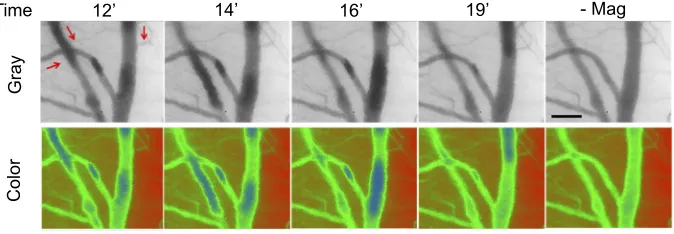
Figure 4illustrates representative dynamic retention of
PEG(+) MNPs in response to magnetic capture using capillaroscopy. Both gray and color modes of capillaro-scopy images display the change in location of MNP
agglomerate 12–19 mins after MNP (250 nm)
administra-tion with the magnet underneath the cremaster preparaadministra-tion. Even with the magnet in place, the agglomerate of PEG(+)
A
D
B
C
F
E
120
100
PEG (-)
Basal + MNP - Mag
5 min
0 50 100 150 200 250 300
0100 200300 400500600700 800900 1.000
50 100 150 200 250 300
50 100150200 250300350400
5 min - Mag
+ Mag + Mag - Mag
Basal + MNP - Mag
PEG (+)
80
60
40
% Basal
PEG (+)
PEG (+)
PEG (-)
PEG (-)
% Basal
20
0
Basal +MNP - Mag5’ - Mag15’ Basal +MNP
*#
- Mag5’ - Mag15’
120
100
80
60
40
20
0
* *†
*† *† *†
*†
*
*
#† *
#† #†
Figure 3Two-dimensional hemodynamic effects of magnetic capture of PEGylated MNPs in microvessels. RBCflow in cremaster microvessels of individual rats with administration of MNPs of 250- (A–C) or 50- (D–F) nm with (+) or without (−) PEG, as indicated, was monitored in a real-time manner. The arrowheads indicate administration of the particles. Speckle images offlow (Flux) with sites offlow acquisition are shown after administration of the particles (BandE; 5 mg/kg; +MNP) and subsequent magnet removal (-Mag). Effects of PEGylation on magnetic capture of MNPs are summarized (CandF; n=9–23). *,#,†P<0.05 compared with the corresponding
basal, PEG(−) and +MNP groups, respectively.
International Journal of Nanomedicine downloaded from https://www.dovepress.com/ by 118.70.13.36 on 22-Aug-2020
MNPs moved along the vessels. After removal of the magnet (-Mag), no retention was observed in any
micro-vessel in thisfield. In contrast, no such agglomerates were
observed after injection of PEG(+) MNPs in the absence
of the magnet (Figure S3).
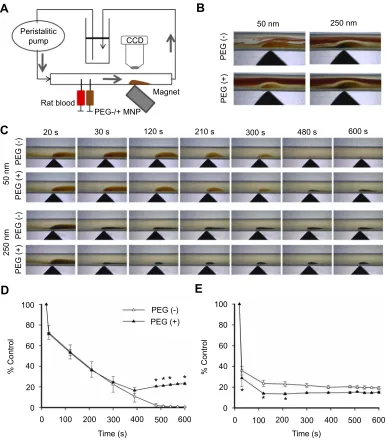
To determine whether PEGylation may exert an effect on magnetic capture of MNPs, MNPs with or without PEG were injected in a silicon tube with serum or hydroxyethyl starch
flow at 2 mL/min in circulation, as illustrated inFigure 5A.
Magnetic capture of 50 and 250 nm MNPs in hydroxyethyl
starchflow was observed 14 sec after co-administration with
rat blood in an upstream syringe (Figure 5B). With or without
PEGylation, pellet formation occurred in response to the
pre-sence of both the magnet and RBCflow; a clear boundary was
observed between the pellet and the RBCflow. In experiments
without administration of whole blood, MNPs were injected
into the flowing serum at 2 mL/min to observe magnetic
capture of MNPs without RBC interruption. Pellet formation was observed in the silicon tube by the magnet within 20 sec, followed by gradual reduction of the pellet size in the presence
of the magnet and serumflow (Figure 5C). In the 50 nm group,
the pellet size of PEG(−) particle was gradually reduced with
time and became almost invisible after 480 sec; whereas the pellet size of PEG(+) particles gradually decreased with time,
and then increased after 390 sec (Figure 5C). The size of the
pellets of 250 nm particles decreased quickly and reached equilibrium between 120 and 600 sec.
The retention areas of 50 and 250 nm particles inFigure 5C
are summarized inFigure 5DandE, respectively. At 30 sec, the
retention areas of 50 nm particles of PEG(−) and PEG(+)
remained at about 72% (Figure 5D), whereas that of 250 nm
particles dropped to 36% and 29% (Figure 5E), respectively.
However, an increase in the 2-D area of PEG(+) particles was observed after 400 sec, resulting in significantly more particle retention in the group of PEG(+) at the end of observation
(Figure 5D; P<0.05). In contrast, no significant difference
between PEG(−) and PEG(+) groups was observed after 300
sec (Figure 5E).
To determine whether PEGylation may reduce MNP–
endothelium interaction and facilitate post-magnet dispersion, 250 nm MNPs with or without PEG were incubated with
cultured HUVECs under magneticfield, followed by analysis
of cell-associated MNP (MNPcell;Figure 6). Here, the magnet
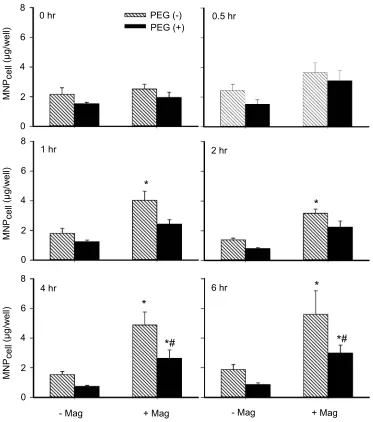
significantly increased MNPcell with and without PEG by
1.3~3.5 and 1.2~3.2 fold, respectively, at 1–6 hrs after
admin-istration of MNPs (P<0.05). Overall ANOVA indicates
a significant difference between the PEG(−) vs (+) groups
(P<0.05). In the presence of the magnet, PEGylation signifi
-cantly reduced MNPcellby 46% and 47% at 4 and 6 hrs after
administration of MNPs, respectively (n=7,P<0.05).
Discussion
Using RBC flow as an indicator, PEGylation has been
demonstrated to be able possibly to alter the pattern of dextran-coated MNP retention in response to magnetic
capture. To our knowledge, this is thefirst in vivo
demon-stration that PEGylated MNPs may be more sensitive to magnetic capture against hemodynamic forces. This was especially prominent for smaller particles, which are
asso-ciated with an increased hydrodynamic diameter.
PEGylation enhanced dispersion of larger magnetite parti-cles after magnet removal, which likely contributed to
reduced MNP–MNP and MNP–endothelium interaction.
Our previous studies demonstrated that magnetic
cap-ture of PEG(–) MNPs led to visible particle retention in
the cremaster vasculature along the magnet margin in the photo view, which was associated with a reduction of
tissue perfusion.11In this investigation, laser speckle
tech-nology with a higher spatial resolution is used, enabling subtle hemodynamic changes that arise from MNP
Time 12’ 14’ 16’ 19’ - Mag
Gray
Color
Figure 4Dynamic retention of MNP with PEG in the representative vessels in magneticfield. Magnetic capture of PEG(+) MNPs (250 nm; 5 mg/kg) in cremaster microcirculation was observed by capillaroscopy under gray and color mode 12–19 mins after administration of the MNPs and 1 min after removal of the magnet (-Mag). The red arrows indicate theflow direction of the adjacent vessel. The results are representative of 6 experiments. Scale bar indicates 50μm.
International Journal of Nanomedicine downloaded from https://www.dovepress.com/ by 118.70.13.36 on 22-Aug-2020
retention in a single vessel to be recorded. Although
sig-nificant MNP retention may be observed in a single vessel,
blood flow in the microvessel up- and down-stream may
still be maintained at a similar level, suggesting that MNP retention does not completely occlude the vessel. Although
the structure of PEG may attenuate MNP–endothelium
interaction, PEGylation significantly increased the
hydro-dynamic diameter of especially smaller particles in the serum, which may lead to enhanced magnetic capture.
For the 250 nm nanoparticles, PEGylation facilitates
the restoration of tissue flow after magnet removal,
which would lessen the potential of any adverse effect
on hemodynamics with PEG(+) MNPs in magnetic tar-geting. PEGylation of MNPs may reduce the packing density of magnetically accumulated MNPs, since the hydrophilic PEG chains would assume an extended con-formation in the aqueous phase. This in turn would account for the better dispersibility in circulation,3,29,49 resulting in dynamic pellet accumulation in magnetic
field and fast blood flow restore after magnet removal.
Although no significant changes in averaged RBCflow
were observed with 50 nm PEG(–) MNPs in the presence
of the magnet, RBC flow in larger vessels gradually
increased with time (Figure 3D). It is plausible that the
A
20 s Rat blood
PEG-/+ MNP
Magnet CCD
Peristalitic pump
100
PEG (-)
PEG (-)
PEG (+)
PEG (-)
PEG (+)
PEG (-)
PEG (+)
50 nm
250 nm
PEG (+)
* *
* *
*
* *
80
60
40
20
0
0 100
% Control % Control
200 300
Time (s) Time (s)
400 500 600
100
80
60
40
20
0
0 100 200 300 400 500 600
30 s 120 s 210 s 300 s
50 nm 250 nm
480 s 600 s
B
C
D
E
Figure 5Effects of size and PEGylation on retention of particles subjected to serum/RBCflow and magneticfield. In vitro circulation system (A) was established to observe particle retention in hydroxyethyl starch/RBC solution (B) or serum (C, D,E) at 2 mL/min and magneticfield. Summarized 2-D retention of particles of 50 vs 250 nm are presented in (D) and (E), respectively (n=3). Values are mean ± SEM. *p<0.05 compared with the corresponding PEG(−) groups, respectively.
International Journal of Nanomedicine downloaded from https://www.dovepress.com/ by 118.70.13.36 on 22-Aug-2020
magnetic force acting on the captured PEG(–) MNPs may induce mechanical stimulation upon the endothelium, which is known to release nitric oxide and cause
vasodilation.50In contrast, PEG may promote
agglomera-tion of smaller MNPs in magnetic field, which reduces
RBC flow in microcirculation and facilitates magnetic
capture.
In response to magnetic capture in vitro, similar initial particle retention was observed irrespective of particle size
and PEGylation in the serum flow (Figure 5C), which
allows observation of particle retention with protein cor-ona development. Although the size of the 2-D pellet of the particles may not represent the amount of the particles
captured, such a system may provide information concern-ing particle capture within a short period. Notably, the retention of PEG(+) MNPs of 50 nm gradually declined
to only 20%, and thereafter significantly increased,
sug-gesting that the magnet might capture PEG(+) MNPs recirculating to the site of the magnet. In a magnetic
field, the capture–escape–recapture cycle probably also
occurred in vivo.
Endothelial cells interact with MNPs much less than do
tumor cells in culture,38 possibly favoring the use of
MNPs for delivering drugs to treat solid tumors. Although the method employed herein cannot differentiate adsorbed from internalized MNPs, less adhesion is
0 2 4 6 8
MNP
cell
(µg/well)
MNP
cell
(µg/well)
MNP
cell
(µg/well)
0 2 4 6 8
0
- Mag + Mag - Mag + Mag
2 4 6 8
0 hr
1 hr
*
*
*
*
*
#*
#2 hr 0.5 hr PEG (-)
PEG (+)
4 hr 6 hr
Figure 6PEGylation attenuated MNP interaction with cultured endothelial cells. Human umbilical vein endothelial cell (HUVEC)-associated MNP was determined after incubation of 250 nm MNP (100μg/mL; 19.7μg/cm2
) in the absence (-Mag) and presence (+Mag) of the magnet for up to 6 hrs after application of the magnet for 5 mins to facilitate sedimentation. Values are presented as mean ± SE (n=7). *,#
P<0.05 compared with the corresponding control (0 hrs) and PEG(−) groups, respectively.
International Journal of Nanomedicine downloaded from https://www.dovepress.com/ by 118.70.13.36 on 22-Aug-2020
generally associated with a concomitant less particle
internalization.51 Our results are consistent with previous
findings that PEGylated particles exhibit reduced
interna-lization by endothelial cells38,52as well as other cells.37,53 PEGylation may reduce the interaction between the parti-cles and the endothelial cells, which may mediate, at least partially, the altered behavior of PEG(+) MNPs in circula-tion. The PEGylation-associated dynamic retention of 250 nm particles in response to magnetic force may increase the passage of nanocomposites through the leaky vascula-ture into the tumor tissue and thereby increase local con-centration of the delivered drug.13,53
Previous studies have demonstrated a significant
differ-ence between theζ-potential of PEG(−) and PEG(+) MNPs
in aqueous solution,38distinct behaviors in circulation are not
attributed to the ζ-potential of MNPs, probably owing to
nearly immediate corona formation after nanoparticles in
contact with plasma proteins.32,54,55 The enhanced capture
of smaller PEG(+) MNPs may be attributed to the PEG–
plasma protein interaction and then agglomerate formation, resulting in an increased hydrodynamic diameter of MNPs. It has been recently demonstrated that plasma protein adsorp-tion of PEG(+) MNPs, but not bare MNPs, triggers
comple-ment activation,56 which may consequently alter protein
corona composition, physical characteristics and particle behaviors in circulation. For larger MNPs, PEGylation may
reduce particle–particle interaction induced by magnetic
moment generation in magnetic field, and thus enhance
MNP escape, allowing dynamic retention of MNPs in vivo. The results herein suggest that PEG(+) MNPs circulation can be magnetically captured. Moreover, the weakening vascular
wall–nanoparticle interaction by PEGylation may facilitate
blood residence,27,32favoring the therapeutic outcome with
the target in the circulating blood. Nevertheless, the charac-teristics of PEGylated nanoparticles may also depend on the
composition of the PEG moiety.45The molecular weight,57,58
density59and conformation39,60,61of PEG may affect
nano-particle–cell interaction,32,39 the biocompatibility of the
nanoparticles,32,59 and thus their behaviors in circulation.
Further studies of the composition of the PEG(+) MNPs coating materials should be undertaken.
Conclusion
This study demonstrates that PEGylation alters the behavior of dextran-coated MNPs in response to magnetic and hemo-dynamic interaction. In magnetic targeting, the PEG moiety may enhance magnetic capture of PEGylated MNPs and reduce the risk of vessel occlusion by aggregated particles,
presumably by attenuating MNP–MNP and MNP–
endothe-lium interaction. Thus, with PEGylated MNPs as drug carriers, therapeutic goals may be potentially achieved in
stationary magnetic field. Nevertheless, PEG molecules
with different length may form distinct 3-D structure.32
Whether MNPs with different PEG in length may exert different behavior remains to be determined.
Abbreviation list
APS, ammonium persulfate; DIW, deionized water; ECGS, endothelial cell growth supplement; FBS, fetal bovine serum; HUVEC, human umbilical vein endothelial cells; KSCN, potassium thiocyanate; Mag, magnet; MNPs,
magnetic nanoparticles; MNPcell, cell-associated MNP;
PBS, phosphate buffered saline; PEG, polyethylene glycol; RBCs, red blood cells; RES, reticuloendothelial system; ROIs, regions of interest.
Acknowledgments
The work was supported by Ministry of Science and Technology (MOST 107-2311-B-182-002-), Chang Gung Memorial Hospital (CMRPD1E0013; BMRP432). Thanks
also goes to Timothy Wiedmann, Department of
Pharmaceutics, University of Minnesota for editing this manuscript.
Disclosure
The authors report no conflicts of interest in this work.
References
1. Wahajuddin AS. Superparamagnetic iron oxide nanoparticles: mag-netic nanoplatforms as drug carriers. Int J Nanomed.
2012;7:3445–3471. doi:10.2147/IJN.S30320
2. Reddy LH, Arias JL, Nicolas J, Couvreur P. Magnetic nanoparticles: design and characterization, toxicity and biocompatibility, pharmaceu-tical and biomedical applications. Chem Rev. 2012;112 (11):5818–5878. doi:10.1021/cr300068p
3. Singh D, McMillan JM, Liu XM, et al. Formulation design facilitates magnetic nanoparticle delivery to diseased cells and tissues.
Nanomedicine.2014;9(3):469–485. doi:10.2217/nnm.14.4
4. Shen L, Li B, Qiao Y. Fe3O4 nanoparticles in targeted drug/gene delivery systems.Materials.2018;11(2):324. doi:10.3390/ma11081451 5. Ulbrich K, Holá K, Šubr V, Bakandritsos A, Tuček J, Zbořil R.
Targeted drug delivery with polymers and magnetic nanoparticles: covalent and noncovalent approaches, release control, and clinical studies. Chem Rev. 2016;116(9):5338–5431. doi:10.1021/acs. chemrev.5b00589
6. Mody VV, Cox A, Shah S, Singh A, Bevins W, Parihar H. Magnetic nanoparticle drug delivery systems for targeting tumor.Appl Nanosci.
2013;4(4):385–392. doi:10.1007/s13204-013-0216-y
7. Amstad E, Textor M, Reimhult E. Stabilization and functionalization of iron oxide nanoparticles for biomedical applications.Nanoscale.
2011;3(7):2819–2843. doi:10.1039/c1nr10173k
International Journal of Nanomedicine downloaded from https://www.dovepress.com/ by 118.70.13.36 on 22-Aug-2020
8. Janikowska A, Matuszak J, Lyer S, et al. A novel human artery model to assess the magnetic accumulation of SPIONs under flow conditions.Sci Rep.2017;7:42314. doi:10.1038/srep42314 9. Zhao Q, Wang L, Cheng R, et al. Magnetic nanoparticle-based
hyperthermia for head & neck cancer in mouse models.
Theranostics.2012;2(1):113–121. doi:10.7150/thno.3854
10. Liu HL, Hua MY, Yang HW, et al. Magnetic resonance monitoring of focused ultrasound/magnetic nanoparticle targeting delivery of ther-apeutic agents to the brain.Proc Natl Acad Sci U S A.2010;107 (34):15205–15210. doi:10.1073/pnas.1003388107
11. Ma YH, Chen SY, Tu SJ, Yang HW, Liu HL. Manipulation of magnetic nanoparticle retention and hemodynamic consequences in microcirculation: assessment by laser speckle imaging.
Int J Nanomed.2012;7:2817–2827. doi:10.2147/IJN.S31730 12. Tu SJ, Wu SY, Wang FS, Ma YH. Retention assessment of magnetic
nanoparticles in rat arteries with micro-computed tomography.Phys Med Biol.2014;59(5):1271–1281. doi:10.1088/0031-9155/59/5/1271 13. Yang HW, Hua MY, Hwang TL, et al. Non-invasive synergistic treatment of brain tumors by targeted chemotherapeutic delivery and amplified focused ultrasound-hyperthermia using magnetic nanographene oxide.
Adv Mater.2013;25(26):3605–3611. doi:10.1002/adma.201301046 14. Shen JM, Guan XM, Liu XY, Lan JF, Cheng T, Zhang HX.
Luminescent/magnetic hybrid nanoparticles with folate-conjugated peptide composites for tumor-targeted drug delivery.Bioconj Chem.
2012;23(5):1010–1021. doi:10.1021/bc300008k
15. Ma YH, Hsu YW, Chang YJ, Hua MY, Chen JP, Wu T. Intra-arterial application of magnetic nanoparticles for targeted thrombolytic ther-apy: a rat embolic model. J Magn Magn Mater. 2007;311 (1):342–346. doi:10.1016/j.jmmm.2006.10.1204
16. Schleich N, Po C, Jacobs D, et al. Comparison of active, passive and magnetic targeting to tumors of multifunctional paclitaxel/SPIO-loaded nanoparticles for tumor imaging and therapy. J Control Release.
2014;194:82–91. doi:10.1016/j.jconrel.2014.07.059
17. Ma YH, Wu SY, Wu T, Chang YJ, Hua MY, Chen JP. Magnetically targeted thrombolysis with recombinant tissue plasminogen activator bound to polyacrylic acid-coated nanoparticles. Biomaterials.
2009;30(19):3343–3351. doi:10.1016/j.biomaterials.2009.02.034 18. Yang HW, Hua MY, Lin KJ, et al. Bioconjugation of recombinant
tissue plasminogen activator to magnetic nanocarriers for targeted thrombolysis.Int J Nanomed.2012;7:5159–5173.
19. Tadayon A, Jamshidi R, Esmaeili A. Targeted thrombolysis of tissue plasminogen activator and streptokinase with extracellular biosynthesis nanoparticles using optimized Streptococcus equi supernatant.
Int J Pharm.2016;501(1–2):300–310. doi:10.1016/j.ijpharm.2016.02.011 20. Che E, Gao Y, Wan L, et al. Paclitaxel/gelatin coated magnetic mesoporous silica nanoparticles: preparation and antitumor efficacy in vivo. Microporous Mesoporous Mat. 2015;204:226–234. doi:10.1016/j.micromeso.2014.11.013
21. Bai J, Wang JTW, Rubio N, et al. Triple-modal imaging of magnetically-targeted nanocapsules in solid tumours in vivo.
Theranostics.2016;6(3):342–356. doi:10.7150/thno.11918
22. Cui Y, Zhang M, Zeng F, Jin H, Xu Q, Huang Y. Dual-targeting magnetic PLGA nanoparticles for codelivery of paclitaxel and curcu-min for brain tumor therapy. ACS Appl Mater Interfaces. 2016;8 (47):32159–32169. doi:10.1021/acsami.6b10175
23. Liao J, Wei X, Ran B, Peng J, Qu Y, Qian Z. Polymer hybrid magnetic nanocapsules encapsulating IR820 and PTX for external magnetic
field-guided tumor targeting and multifunctional theranostics.
Nanoscale.2017;9(7):2479–2491. doi:10.1039/c7nr00033b
24. Varna M, Juenet M, Bayles R, Mazighi M, Chauvierre C, Letourneur D. Nanomedicine as a strategy to fight thrombotic diseases.Future Sci OA.2015;1(4). doi:10.4155/fso.15.46
25. Chen JP, Liu CH, Hsu HL, Wu T, Lu YJ, Ma YH. Magnetically controlled release of recombinant tissue plasminogen activator from chitosan nanocomposites for targeted thrombolysis.J Mater Chem B.
2016;4(15):2578–2590. doi:10.1039/C5TB02579F
26. Petros RA, DeSimone JM. Strategies in the design of nanoparticles for therapeutic applications. Nat Rev Drug Discov. 2010;9 (8):615–627. doi:10.1038/nrd2591
27. Elsabahy M, Wooley KL. Design of polymeric nanoparticles for biomedical delivery applications. Chem Soc Rev. 2012;41 (7):2545–2561. doi:10.1039/c2cs15327k
28. Abboud M, Youssef S, Podlecki J, Habchi R, Germanos G, Foucaran A. Superparamagnetic Fe3O4 nanoparticles, synthesis and surface modification.Mater Sci Semicond Process.2015;39:641–648. doi:10.1016/j.mssp.2015.05.035
29. Kolate A, Baradia D, Patil S, Vhora I, Kore G, Misra A. PEG – a versatile conjugating ligand for drugs and drug delivery systems.
J Control Release.2014;192:67–81. doi:10.1016/j.jconrel.2014.06.046 30. Rabanel JM, Hildgen P, Banquy X. Assessment of PEG on polymeric particles surface, a key step in drug carrier translation. J Control Release.2014;185:71–87. doi:10.1016/j.jconrel.2014.04.017 31. Gref R, Domb A, Quellec P, et al. The controlled intravenous delivery of
drugs using PEG-coated sterically stabilized nanospheres.Adv Drug Del Rev.2012;64(Supplement):316–326. doi:10.1016/j.addr.2012.09.008 32. Pelaz B, Del Pino P, Maffre P, et al. Surface functionalization of
nanoparticles with polyethylene glycol: effects on protein adsorption and cellular uptake.ACS Nano.2015;9(7):6996–7008. doi:10.1021/ acsnano.5b01326
33. Oberoi HS, Nukolova NV, Kabanov AV, Bronich TK. Nanocarriers for delivery of platinum anticancer drugs.Adv Drug Del Rev.2013;65 (13–14):1667–1685. doi:10.1016/j.addr.2013.09.014
34. Fang RH, Hu CM, Zhang L. Nanoparticles disguised as red blood cells to evade the immune system.Expert Opin Biol Ther.2012;12 (4):385–389. doi:10.1517/14712598.2012.661710
35. Lim EK, Jang E, Lee K, Haam S, Huh YM. Delivery of cancer therapeutics using nanotechnology. Pharmaceutics. 2013;5(2):294. doi:10.3390/pharmaceutics5020294
36. Hu FQ, Zhang YY, You J, Yuan H, Du YZ. pH triggered doxorubicin delivery of PEGylated glycolipid conjugate micelles for tumor target-ing therapy. Mol Pharm. 2012;9(9):2469–2478. doi:10.1021/ mp300002v
37. Qu JB, Shao HH, Jing GL, Huang F. PEG-chitosan-coated iron oxide nanoparticles with high saturated magnetization as carriers of 10-hydroxycamptothecin: preparation, characterization and cytotoxi-city studies. Colloid Surf B-Biointerfaces. 2013;102:37–44. doi:10.1016/j.colsurfb.2012.08.004
38. Lu YC, Luo PC, Huang CW, et al. Augmented cellular uptake of nanoparticles using tea catechins: effect of surface modification on nanoparticle-cell interaction. Nanoscale. 2014;6(17):10297–10306. doi:10.1039/c4nr00617h
39. Onyskiw PJ, Eniola-Adefeso O. Effect of PEGylation on ligand-based targeting of drug carriers to the vascular wall in blood
flow.Langmuir.2013;29(35):11127–11134. doi:10.1021/la402182j 40. Siow WX, Chang YT, Babic M, Lu YC, Horak D, Ma YH.
Interaction of poly-l-lysine coating and heparan sulfate proteoglycan on magnetic nanoparticle uptake by tumor cells. Int J Nanomed.
2018;13:1693–1706. doi:10.2147/IJN.S156029
41. Matuszak J, Zaloga J, Friedrich RP, et al. Endothelial biocompatibil-ity and accumulation of SPION underflow conditions.J Magn Magn Mater.2015;380:20–26. doi:10.1016/j.jmmm.2014.09.005
42. Friedrich RP, Janko C, Poettler M, et al. Flow cytometry for intracellular SPION quantification: specificity and sensitivity in comparison with spectroscopic methods. Int J Nanomed. 2015;10:4185–4201. doi:10.2147/IJN.S82714
43. Lu Q, Ye F, Yang X, et al. Accelerated recovery of endothelium function after stent implantation with the use of a novel systemic nanoparticle curcumin. Biomed Res Int. 2015;2015(2015):291871. doi:10.1155/2015/291871
44. Zapotoczny S, Szczubialka K, Nowakowska M. Nanoparticles in endothelial theranostics. Pharmacol Rep. 2015;67(4):751–755. doi:10.1016/j.pharep.2015.05.018
International Journal of Nanomedicine downloaded from https://www.dovepress.com/ by 118.70.13.36 on 22-Aug-2020
45. Silvestri A, Di Silvio D, Llarena I, et al. Influence of surface coating on the intracellular behaviour of gold nanoparticles: afluorescence correlation spectroscopy study.Nanoscale.2017;9(38):14730–14739. doi:10.1039/c7nr04640e
46. Lin YL, Lin YC, Wang LJ, Ngo ST, Ma YH. Renal perfusion assessment using magnetic nanoparticles with 7T dynamic suscept-ibility contrast MRI in rats.J Magn Magn Mater.2019;475:76–82. doi:10.1016/j.jmmm.2018.11.041
47. Gultepe E, Reynoso FJ, Jhaveri A, et al. Monitoring of magnetic targeting to tumor vasculature through MRI and biodistribution.
Nanomedicine (Lond).2010;5(8):1173–1182. doi:10.2217/nnm.10.84 48. Windberger U, Bartholovitsch A, Plasenzotti R, Korak KJ, Heinze G. Whole blood viscosity, plasma viscosity and erythrocyte aggregation in nine mammalian species: reference values and comparison of data.
Exp Physiol.2003;88(3):431–440.
49. Bunker A. Poly(ethylene glycol) in drug delivery, why does it work, and can we do better? All atom molecular dynamics simulation provides some answers. Phys Procedia. 2012;34:24–33. doi:10.1016/j.phpro.2012.05.004
50. Erkens R, Suvorava T, Kramer CM, Diederich LD, Kelm M, Cortese-Krott MM. Modulation of local and systemic heterocellular communica-tion by mechanical forces: a role of endothelial nitric oxide synthase.
Antioxid Redox Signal.2017;26(16):917–935. doi:10.1089/ars.2016.6904 51. Lesniak A, Salvati A, Santos-Martinez MJ, Radomski MW, Dawson KA, Aberg C. Nanoparticle adhesion to the cell membrane and its effect on nanoparticle uptake efficiency.J Am Chem Soc.
2013;135(4):1438–1444. doi:10.1021/ja309812z
52. Yu M, Huang S, Yu KJ, Clyne AM. Dextran and polymer polyethy-lene glycol (PEG) coating reduce both 5 and 30 nm iron oxide nanoparticle cytotoxicity in 2D and 3D cell culture.Int J Mol Sci.
2012;13(5):5554. doi:10.3390/ijms13055554
53. Yang HW, Hua MY, Liu HL, et al. Self-protecting core-shell mag-netic nanoparticles for targeted, traceable, long half-life delivery of BCNU to gliomas. Biomaterials. 2011;32(27):6523–6532. doi:10.1016/j.biomaterials.2011.05.047
54. Fleischer CC, Payne CK. Nanoparticle-cell interactions: molecular structure of the protein corona and cellular outcomes.Accounts Chem Res.2014;47(8):2651–2659. doi:10.1021/ar500190q
55. Sakulkhu U, Mahmoudi M, Maurizi L, Salaklang J, Hofmann H. Protein corona composition of superparamagnetic iron oxide nano-particles with various physico-chemical properties and coatings.Sci Rep.2014;4:5020. doi:10.1038/srep05020
56. Escamilla-Rivera V, Solorio-Rodríguez A, Uribe-Ramírez M, et al. Plasma protein adsorption on Fe(3)O(4)-PEG nanoparticles activates the complement system and induces an inflammatory response. Int J Nanomed. 2019;14:2055–2067. doi:10.2147/IJN. S192214
57. Rahme K, Chen L, Hobbs RG, Morris MA, O’Driscoll C, Holmes JD. PEGylated gold nanoparticles: polymer quantification as a function of PEG lengths and nanoparticle dimensions. RSC Adv.2013;3(17):6085–6094.
58. Riedinger A, Guardia P, Curcio A, et al. Subnanometer local tem-perature probing and remotely controlled drug release based on azo-functionalized iron oxide nanoparticles. Nano Lett. 2013;13 (6):2399–2406. doi:10.1021/nl400188q
59. Xu Q, Ensign LM, Boylan NJ, et al. Impact of surface polyethylene glycol (PEG) density on biodegradable nanoparticle transport in mucus ex vivo and distribution in vivo. ACS Nano. 2015;9 (9):9217–9227. doi:10.1021/acsnano.5b03876
60. Li J, Sharkey CC, Huang D, King MR. Nanobiotechnology for the therapeutic targeting of cancer cells in blood. Cell Mol Bioeng.
2015;8(1):137–150. doi:10.1007/s12195-015-0381-z
61. Decuzzi P, Godin B, Tanaka T, et al. Size and shape effects in the biodistribution of intravascularly injected particles.J Control Release.2010;141(3):320–327. doi:10.1016/j.jconrel.2009.10.014
International Journal of Nanomedicine downloaded from https://www.dovepress.com/ by 118.70.13.36 on 22-Aug-2020
Supplementary material
Figure S1Cremaster muscle preparation of an anesthetized rat. Left cremaster muscle was spread with tension created by suture on a home-made platform. The muscle preparation was then subjected to laser speckle contrast imaging or cappillaroscipy from above.
International Journal of Nanomedicine downloaded from https://www.dovepress.com/ by 118.70.13.36 on 22-Aug-2020
International Journal of Nanomedicine
Dove
press
Publish your work in this journal
The International Journal of Nanomedicine is an international, peer-reviewed journal focusing on the application of nanotechnology in diagnostics, therapeutics, and drug delivery systems throughout the biomedical field. This journal is indexed on PubMed Central, MedLine, CAS, SciSearch®, Current Contents®/Clinical Medicine,
Journal Citation Reports/Science Edition, EMBase, Scopus and the Elsevier Bibliographic databases. The manuscript management system is completely online and includes a very quick and fair peer-review system, which is all easy to use. Visit http://www.dovepress.com/ testimonials.php to read real quotes from published authors.
Submit your manuscript here:https://www.dovepress.com/international-journal-of-nanomedicine-journal
A
Flux Photo Flux Photo
C
E
G
H
F
D
B
Figure S2Magnetic capture of MNP and subsequentflow changes in microvessels. MNPs (5 mg/kg) were administered intra-arterially to the left cremaster muscle with a NdFeB magnet placed underneath. MNP accumulation 1 to 14 mins after administration is illustrated asflux and photo images. The arrow in theflux images indicates the flow direction of the adjacent vessel. Patterns of magnetic capture of MNPs in microvessels (A–H) were observed.
Time
Gray
Color
Basal + MNP 10’ 12’ 14’
Figure S3Dynamic retention of MNP with PEG in the representative vessels without magneticfield. Without magnetic capture of PEGylated MNPs (250 nm; 5 mg/kg) in cremaster microcirculation was observed by capillaroscopy under gray and color mode 12–19 mins after administration of the MNPs. The red arrows indicate theflow direction of the adjacent vessel. The results are representative of 6 experiments. Scale bar indicates 50μm.
International Journal of Nanomedicine downloaded from https://www.dovepress.com/ by 118.70.13.36 on 22-Aug-2020