Patron: Her Majesty The Queen Rothamsted Research Harpenden, Herts, AL5 2JQ
Telephone: +44 (0)1582 763133 Web: http://www.rothamsted.ac.uk/
Rothamsted Research is a Company Limited by Guarantee Registered Office: as above. Registered in England No. 2393175. Registered Charity No. 802038. VAT No. 197 4201 51. Founded in 1843 by John Bennet Lawes.
Rothamsted Repository Download
A - Papers appearing in refereed journals
Talibudeen, O. and Goulding, K. W. T. 1983. Charge heterogeneity in
smectites. Clays and Clay Minerals. 31 (1), pp. 37-42.
The publisher's version can be accessed at:
•
https://dx.doi.org/10.1346/ccmn.1983.0310106
•
http://www.clays.org/journal/archive/volume%2031/31-1-37.pdf
The output can be accessed at:
https://repository.rothamsted.ac.uk/item/8v777
.
© 1 January 1982, Clay Minerals Society.
CHARGE H E T E R O G E N E I T Y IN SMECTITES
OSCAR TALIBUDEEN AND KEITH W. T. GOULDING Rothamsted Experimental Station, Harpenden
Hertfordshire AL5 2JQ, United Kingdom
Abstract The heterogeneity of sites for Ca---~K exchange was examined by microcalorimetry in the <0.2- /zm fractions of some selected smectites. Six groups of sites, ranging in exothermic exchange enthalpy (-d(AHx)/dx) from 5.7 to 10.9 kJ/eq were identified. In Wyoming bentonites, only three groups with en- thalpies of 5.7 to 7.5 kJ/eq were distinguished, although in the 0.2-1.0-p~m fraction, a 10.7-kJ/eq group was also observed. Redhill and Camp Berteau smectites contained, in addition, groups with enthalpies of 8.7-10.9 kJ/eq, but a New Mexico sample only had groups with the higher values. Thus, the exchange enthalpies of four main groups of sites (reclassified from those observed) appear to be inversely related to the extents of interlayer expansion in the samples by the adsorption of polar molecules. Consequently, a 'true mont- morillonite,' such as a <0.2-/~m Wyoming bentonite, contains only fully expanding layers with -d(AHx)/ dx values between 5.7 and 7.5 kJ/eq. As such, it is less heterogeneous and should have a much greater swelling capability than Camp Berteau montmorillonite which has, in addition, groups with exchange en- thalpies of 8.7 and 10.3 kJ/eq.
Key Words---Cation exchange, Enthalpy, Smectite, Surface charge, Swelling.
I N T R O D U C T I O N
Goulding and Talibudeen (1980) reported recently that six groups of homoenergetic sites can be distinguished in aluminosilicates and soils when changes in the dif- ferential enthalpy of exchange, - d ( A H x ) / d x , are mea- sured calorimetrically. The analysis of the changes in -d(A~Hx)/dx with increasing K saturation, x, suggested a stepwise Ca---~K exchange in which groups with the more negative enthalpies were saturated with K at the lower K concentration. Where expanding layer min- erals w e r e e n c o u n t e r e d , the differential e n t r o p y , - d ( A S ) / d x : x , relationship predicted that in each group of sites, Ca---~K exchange increased the structural order in that group to a maximum until the group was fully saturated with K. The - d ( A S ) / d x value then immedi- ately changed to a minimum corresponding with max- imum structural disorder in the next group. This pro- cess repeated itself until all groups of sites were saturated with K.
Lee et al. (1975) examined two kaolinites by high res- olution electron microscopy and d e m o n s t r a t e d the presence of occluded islands o f micaceous layers in- terleaved with kaolinite layers, such islands accounting for the K content of the samples. This observation sug- gests that impurities that bind K strongly in a more inert layer-silicate matrix occur in discontinuous random in- terstratification with the parent body. Such impurities have therefore been difficult to separate and identify. F o r the montmorillonites, no such visual evidence is available at present, but differences in size distribution, morphology and orientation of particles, charge density of the layers, interparticle swelling in water, intrapar- ticle expansion on adsorbing polar molecules, organic cations, and water, and the distribution of Na, Mg, and
Ca in fine and coarse clay fractions have all been used to characterize smectites from various sources (e.g., Byrne, 1954; Roberson et al., 1968; Lagaly and Weiss, 1976).
Using the microcalorimetric method described pre- viously (Talibudeen et al., 1977), the present study characterizes the surface charge distribution of six ' s t a n d a r d ' montmorillonites with greater precision than has been achieved hitherto by other techniques, and thus defines experimentally a fundamental property of a 'true' montmorillonite. The initial comparison is between dif- ferent samples of Wyoming bentonite and then between single samples of montmorillonites from different lo- cations. Finally, the results are related to those ob- tained by other workers using different techniques.
M A T E R I A L S A N D M E T H O D S
The six smectites examined are three samples of Wy- oming bentonite A, B, and C, from two consignments obtained from F. W. Berk & Co. over a gap of ca. 25 years (presumably from different pits), samples from Redhill, Surrey, England, and Camp Berteau, Moroc- co, obtained from A. H. Weir (Weir, 1965), and 'Mont- morillonite No. 11' from Santa Rita, N e w Mexico, sup- plied b y W a r d ' s Natural Science Establishment. F o r all samples except the New Mexico smectite, chemical analyses and layer charge distribution were given by Weir (1965). Properties of all samples relevant to this study are given in Table 1.
Preparation o f clay fractions. The <0.2-t~m fractions of all samples and the 0.2-1.0-/~m fraction of the Wy- oming bentonites were separated as follows: the crushed clay was saturated with N a by washing with 1 M NaC1. The >0.2-/zm fraction was sedimented from a 1% salt-
38 Talibudeen and Goulding Clays and Clay Minerals
free suspension by centrifuging. The <0.2-txm fraction was flocculated from the supernatant suspension by making it one molar in NaC1. The flocculate was Washed with water and absolute alcohol until free of chloride, then with petroleum ether, and air dried. The amounts of the <0.2-tzm fraction in the untreated samples were: Wyoming bentonite (mean o f A, B, and C) 49%, Redhill 65%, Camp Berteau 24%, and New Mexico 19%. The 0.2-1.0-#m fraction of the Wyoming bentonites was similarly washed and dried.
Ca-saturation. The Na-clay was saturated with Ca by washing with 0.5 M CaC1._, until free of N a and pro- cessed as described above to an air-dry powder.
Surface area. Surface areas of the Ca-saturated clays were determined by the vapor phase adsorption of eth- ylene glycol.
Thermodynamic parameters. F o r Ca--~K exchange, differential and integral enthalpies, -d(AH• and AHx, respectively, were determined at 30~ using a modified L K B microcalorimeter (Talibudeen et al.,
1977; Goulding and Talibudeen, 1980). Standard free energies, AG,,, were determined by the 'Gaines and Thomas' analysis of the exchange isotherms (Goulding and Talibudeen, 1980). These values were determined from measurements with Ca-saturated smectites which were pre-equilibrated with water in a paste to ensure that their negatively charged sites were accessible to K ions for the exchange reaction.
R E S U L T S AND D I S C U S S I O N
Gross properties
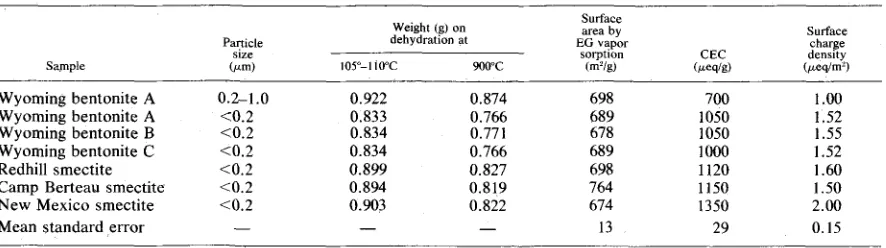
Large differences in the gross properties of the Ca- saturated smectites can be seen from the data listed in Table 1. Similar differences were observed in the amounts of <0.2-/xm clay in the untreated samples, ex- cept for the unusually small quantity in the Wyoming b e n t o n i t e s , i . e . , R e d h i l l > W y o m i n g b e n t o n - ite > Camp Berteau > New Mexico. The dehydration weights, cation-exchange capacities (CEC), and sur-
face areas of the <0.2-p~m fraction of the three Wyo- ming bentonites were similar. The coarse fraction had a larger dehydration weight and a similar surface area, but a much smaller CEC, resulting in its much smaller surface charge density (SCD).
The dehydration weights of the <0.2-/zm fractions of the Redhilt, Camp Berteau, and New Mexico smectites were greater than those of the Wyoming bentonites. The CEC of the seven materials were in the order New Mex- ico > C a m p B e r t e a u = R e d h i l l > ' f i n e ' W y o m i n g bentonites >> ' c o a r s e ' Wyoming bentonite. The surface area of the Camp Berteau smectite (764 m2/g) was larger than those of the other materials (674-698 me/g). Thus, the trend of the derived SCD is New Mexico > Camp Berteau = Redhill = 'fine' W y o m i n g b e n t o n i t e s >> ' c o a r s e ' Wyoming bentonite.
The standard thermodynamic functions (Table 2) for the four Wyoming bentonite samples were generally similar except that the AH~, and AS(, values for the coarse Wyoming bentonite A were more positive than those for the fine fractions of bentonites A, B, and C. This is in keeping with the smaller SCD of the coarse fraction and suggests that Ca---~K exchange had less effect on the re-ordering of the silicate layers of the coarser ma- terial than of the finer material.
The AG~, values for the Redhill, Camp Berteau, and New Mexico materials were more negative than those for the Wyoming bentonite, the order of K preference being N e w Mexico > Camp Berteau > Redhill. How- ever, the AH,, values for the Redhill and Camp Berteau samples were similar to those for the three 'fine' Wy- oming bentonites so that their calculated AS0 values were more positive (mean -14.37 and - 1 7 . 8 4 J/K/eq, re- spectively). This difference in entropy change ind!cates that with K-saturation, the rearrangement of silicate sheets, adsorbed cations, and interlayer water was less regular in the Redhill and Camp Berteau samples than in the 'fine' Wyoming bentonites. The 2xS. value for ' c o a r s e ' Wyoming bentonite was essentially the same as those for the Redhill and Camp Berteau materials, suggesting that the forces binding adjacent silicate sheets
Table 1. Description of Ca-saturated montmorillonites.'
Sample
Surface Weight (g) on area by Particle dehydration at EG vapor
size sorptlon
(btm) 105~- 1 [0~ 900~ (m2/g) (,~eq/g) CEC
Surface charge density (p.eq/m'-')
Wyoming bentonite A 0.2-1.0 0.922 0.874 698 700 1.00 Wyoming bentonite A <0.2 0.833 0.766 689 1050 1.52 Wyoming bentonite B <0.2 0.834 0.771 678 1050 1.55 Wyoming bentonite C <0.2 0.834 0.766 689 1000 1.52 Redhill smectite <0.2 0.899 0.827 698 1120 1.60 Camp Berteau smectite <0.2 0.894 0.819 764 1150 1.50 New Mexico smectite <0.2 0.903 0.822 674 1350 2.00
Mean standard error - - - - - - 13 29 0.15
Table 2. Standard thermodynamic parameters for Ca----~K exchange.
-AGo -AHo -ASo Clay (kJ/eq) (kJ/eq) (J/K/eq)
Wyoming bentonite A
(0.2-1.0/xm) 1.32 6.07 15.66
Wyoming bentonite A 1.71 6.59 16.10
Wyoming bentonite B 1.46 6.95 18.11
Wyoming bentonite C 1.14 6.99 19.30
Mean 1.41 6.65 17.29
Redhill smectite 1.88 6.41 14.94
Camp Berteau smec-
tite 2.71 6.89 13.79
New Mexico smectite 3.88 9.28 17.81
Mean standard error _+0.29 _+0.22 _+ 1.62
The standard enthalpy -AH0 is taken to be equal to AHx=I, measured by microcalorimetry.
t o g e t h e r (and also their a s s o c i a t e d cations and w a t e r m o l e c u l e s ) in t h e clay crystallites w e r e similar. B y con- trast, the AGo and AH0 values f o r t h e N e w M e x i c o sam- ple w e r e m u c h m o r e n e g a t i v e t h a n for t h e 'fine' W y o - ming b e n t o n i t e s so that their c a l c u l a t e d AS0 v a l u e s w e r e similar. T h u s , the enthalpic f a c t o r was t h e driving f o r c e for Ca--+K e x c h a n g e in the N e w M e x i c o sample, pos- sibly b e c a u s e of its higher S C D .
Diffuse d o u b l e l a y e r t h e o r y , w h i c h c o n s i d e r s o n l y c o u l o m b i c nonspecific interactions b e t w e e n cations and the charged surface, predicts that K selectivity in Ca---~K e x c h a n g e should d e c r e a s e with increasing S C D . This
t y p e o f K selectivity has b e e n o b s e r v e d e x p e r i m e n t a l l y in w o r k with soil series selected f o r contrasting t e x t u r e and m i n e r a l o g i c a l c o m p o s i t i o n of their clay fractions. H o w e v e r , W e i r (1965) found that t h e K retained by six m o n t m o r i l l o n i t e s , against e x c h a n g e by 1 M a m m o n i u m a c e t a t e , i n c r e a s e d with the c h a r g e on their silicate sheets. S u c h r e t e n t i o n of K m a y be related to K selec- tivity so that W e i r ' s e v i d e n c e p r o b a b l y highlights t h e i m p o r t a n c e of specific interactions b e t w e e n cations and the surface, w h i c h is supported in the p r e s e n t w o r k b y the c o m p a r a t i v e series for
- A G o : N e w M e x i c o > C a m p B e r t e a u > R e d - hill = W y o m i n g b e n t o n i t e s ;
- A H 0 : N e w M e x i c o >> C a m p B e r t e a u = R e d - hill = W y o m i n g b e n t o n i t e s ;
S C D : N e w M e x i c o > C a m p B e r t e a u = R e d - hill = 'fine' W y o m i n g b e n t o n i t e s > ' c o a r s e ' W y - o m i n g b e n t o n i t e A.
H o w e v e r , as stated a b o v e , the structural o r d e r o f t h e layers (which affects e n t r o p i e s o f e x c h a n g e ) is equally i m p o r t a n t , cf. the ' c o a r s e ' W y o m i n g b e n t o n i t e and C a m p B e r t e a u materials. T h u s , a c o m p l e x relationship b e t w e e n c o u l o m b i c , specific, and e n t r o p i c f o r c e s de- t e r m i n e s overall K selectivity, r a t h e r than any single factor.
Differential heats of Ca--~K exchange
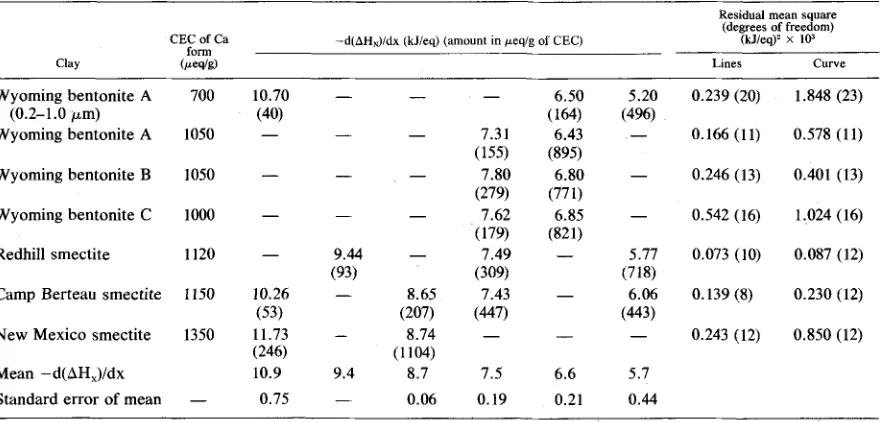
A n analysis o f the - d ( A H x ) / d x : x relationship by an iterative m e t h o d (Goulding and T a l i b u d e e n , 1980) iden- tified regions o f c o n s t a n t - d ( A H x ) / d x . (Statistical re- sidual-mean squares for 'straight lines' and 'single c u r v e '
Table 3. Groups of sites with constant differential enthalpies of Ca--~K exchange and the amount of cation-exchange capacity apportioned to each group.
Residual mean square (degrees of freedom) CEC of Ca -d(AHN)/dx (kJ/eq) (amount in p~eq/g of CEC) (kJ/eq) e • 103
form
Clay (/zeq/g) Lines Curve
Wyoming bentonite A 700 10.70 - - - - - - 6.50 5.20 0.239 (20) 1.848 (23)
(0.2-1.0/zm) (40) (164) (496)
Wyoming bentonite A 1050 - - - - - - 7.31 6.43 - - 0.166 ( 1 1 ) 0.578 (11)
(155) (895)
Wyoming bentonite B 1050 - - - - - - 7.80 6.80 - - 0.246 (13) 0.401 (13)
(279) (771)
Wyoming bentonite C 1000 - - - - - - 7.62 6.85 - - 0.542 (16) 1.024 (16)
(179) (821)
Redhill smectite 1120 - - 9.44 - - 7.49 - - 5.77 0.073 (10) 0.087 (12)
(93) (309) (718)
Camp Berteau smectite 1150 10.26 - - 8.65 7.43 - - 6.06 0.139 (8) 0.230 (12)
(53) (207) (447) (443)
New Mexico smectite 1350 11.73 -- 8.74 - - - - - - 0.243 ( 1 2 ) 0.850 (12)
(246) (1104)
Mean -d(AHx)/dx 10.9 9.4 8.7 7.5 6.6 5.7
Standard error of mean - - 0.75 - - 0.06 0.19 0.21 0.44
40 Talibudeen and Goulding Clays and Clay Minerals
Table 4. Percentage of layer charge for various extents of interlayer expansion by water or ethylene glycol predicted by enthalpy measurements.
Predicted expansion (by molecular adsorption)
Full (bimolecular)
High Medium Low Quarter Half
Clay None ( s e m i m o l e c u l a r ) (unimolecular) K-selectivity
Wyoming bentonite A 5.7 - - - - - - 23.4 70.9
0.2-1.0/zm (1.59)
Wyoming bentonite A - - - - - - 14.8 85.2 - -
Wyoming bentonite B - - - - - - 26.6 73.4 - -
Wyoming bentonite C - - - - - - 17.9 82.1 - -
Redhill smectite - - 8.3 - - 27.6 - - 64.1
(3.70)
Camp Berteau smectite 4.6 - - 18.0 38.9 - - 38.6
(2.11) (8.24)
New Mexico smectite 18.2 - - 81.8 - - - - - -
(9.79) (44.0)
The percentages (w/w) of true and hydrous mica layers are based on the theoretical K content of 'true mica' layers of 2511/zeq/g. Unless otherwise specified, all samples are <0.2/xm particle size.
fits are given in Table 3.) Such a separation is a much more precise guide to the similarities and differences between these so-called 'standard' montmoriUonites than their gross physicochemical properties. Six such groups were identified with significantly different mean -d(AHx)/dx values of 10.9, 9.4, 8.7, 7.5, 6.6, and 5.7 kJ/eq. The 10.9-kJ/eq group is tentatively assigned to nonexpanding 'true mica' layers, the 9.4-kJ/eq and 8.7- kJ/eq groups to partially expanding 'hydrous mica' lay- ers, and the 7.5-kJ/eq, 6.6-kJ/eq, and 5.7-kJ/eq groups to fully expanding 'true montmorillonite' layers (Table
4).
Odom and Low (1978) used a similar classification when relating the b dimensions of the <0.2-tzm frac- tions of six Na-saturated montmorillonites to their spe- cific surface areas and to the mass ratio (water adsorbed at 42.6 cm water tension)/(montmorillonite). They con- cluded that for these materials with a CEC range of 660-1150 tzeq/g, the fraction of unexpanded layers at a water tension of 42.6 cm was constant at a value of 0.18, and the fraction of partially expanded layers was not significantly different from 0. Although these results cannot be compared precisely with the present results, they provide some support for the mechanisms de- scribed in our hypothesis, which was evolved to relate the present results to the differences in the expandibil- ity of various montmorillonites on adsorption of water and ethylene glycol. Odom and Low (1978) found that the distribution of unexpanded, partially and fully ex- panded layers in the Otay and Cameron montmorillon- ites (SCD > 2.0 tzeq/m 2) was similar to that for Belle Fourche and Upton montmorillonites (SCD - 1.0/zeq/ m2). A similar comparison by our differential enthalpy measurements between, for example, the New Mexico
smectite (SCD = 2.0 tLeq/m 2) and the Upton mont- morillonite (SCD = 1.50/zeq]m2), suggests that Odom and Low' s conclusion is most unlikely.
Tables 3 and 4 show that the 'fine' fraction of the Wy- oming bentonites are similar in that they contain similar amounts of fully expanding layers having high and me- dium K-binding strength, a conclusion based on the groups with constant - d ( A H 0 / d x identified in them. We propose that smectites composed only of such a distri- bution of K-adsorbing groups should be classified as 'true' montmorillonites, and suggest that this is the most precise definition of a 'true montmorillonite.' The 'coarse' Wyoming bentonite A is clearly differentiated from the fine materials in having 1.59% (w/w) of true mica layers (=5.7% of its CEC) and a different distri- bution o f ' t r u e ' montmorillonite layers. The mica layers increase progressively from 3.7% in the Redhill, 10.4% in the Camp Berteau, to 53.8% in the New Mexico sam- pies when comparing the fine fractions. Thus, the <0.2- ~ m fraction of Wyoming bentonite may be regarded as a 'true' montmorillonite and taken as a reference stan- dard. We suggest that the group with the smallest K-binding strength, i.e., a -d(AHx)/dx value of 5.20 kJ/ eq found in the 'coarse' Wyoming bentonite, occurs on very thin sheets of the 'true' montmoriUonite that are so firmly wrapped round the large particles that they cannot be separated into the <0.2-/~m fraction by our fractionation procedure. The gradation of binding strength into these three cateogries of fully expanding layers is likely to be the result of 'edge' and 'planar' effects of three degrees of specificity for K, incorpo- rating, amongst other properties, different extents of layer curvature.
in CEC, SCD (Table 1), AGo and AH0 values (Table 2), in the absolute and relative distributions of -d(AHx)/ dx values (Table 3), and hence in the distribution of ex- pandible and nonexpandible layers (Table 4). In partic- ular, the -d(AHx)/dx value of 11.73 kJ/eq for true mica layers is about 11% more than we have found for such layers in this work and previously (Goulding and Tali- budeen, 1980, Table 3). This difference may be caused by a micaceous component with an abnormal SCD (cf. Table 1). If so, Tables 3 and 4 suggest that all of the CEC, but only 54% of the weight, is accounted for by nonexpanding and partially expanding charged layers and that 46% of the silicate sheets are uncharged.
Classification o f the heterogeneity o f charge
Irregular periodicity along the c axis in piperidine and dodecylamine complexes of montmorillonite suggest that montmorillonites are made up of different mixed- layer sequences of sheets of various chemical compo- sitions, or, that they incorporate minor structural ir- regularities (Byrne, 1954). Using alkyl ammonium ions of increasing chain length, Lagaly and Weiss (1976) characterized about 200 montmorillonites into six groups based on layer charge distribution. Using a similar tech- nique, Stul and Mortier (1974) found that Wyoming bentonite had 9 and Camp Berteau montmorillonite 6 interlayer-cation density classes, the former being the most heterogeneous of the six montmorillonites ex- amined. They found that no layer-charge density class dominated the physicochemical properties of these ma- terials and that ionic substitution was discontinuous, its contribution to the gross SCD being different for each sample.
~i~el and Machajdik (1981) examined 12 montmoril- lonites by X-ray powder diffraction (XRD) after NH4- and K-saturation and subsequent adsorption of water and ethylene glycol (EG). Three types of "montmoril- lonite layers" were observed: nonexpanding, expand- ing to one layer, and expanding to two layers of ad- sorbed molecules (cf. Table 4). We suggest that the groups of constant -d(AHx)/dx evaluated in the present study are related to the zonal expansion of interlayer space and that only fully expanding layers, relating to the three smallest values of -d(AHx)/dx in Table 3, can be attributed to 'true' montmorillonite layers. Ci~el and Machajdik (1981) also observed a 'one EG-layer' com- plex in all of their samples, similar to our observations with montmorillonites, other than Wyoming bentonite, where the -d(AHx)/dx predicted substantial propor- tions of partially expanding layers. These authors also demonstrated this heterogeneity of charge by the ex- pansion of some unexpanded 10-A layers by EG but not by water. Their XRD results led them to conclude that "there appears to be a prevailing random distribution of layers in the structure" and that "it is sometimes difficult to decide whether a sample formed by (the) three
kinds of layers represents a zonal or (an) ordered mixed layering."
Thus, although the surface charge of smectites can be split into about 10 different classes by other tech- niques, none of which axe said to dominate their phys- icochemical properties, our work demonstrates that three major groups of homoenergetic sites exist which affect these properties, especially Ca--*K exchange be- havior and inter- and intraparticle swelling.
Tributh (1975) suggested, from XRD work, that the charge heterogeneity in montmorillonites from benton- ite deposits does not change appreciably with particle size. Our results (Table 4) contradict this for Wyoming bentonite demonstrating yet again that current XRD techniques are not sensitive enough to pick up such dif- ferences (see also Goulding and Talibudeen, 1980). However, Tributh also asserted that in soil clays, charge heterogeneity does change considerably with particle size, as we found previously (Goulding and Talibudeen, 1979). We are investigating this further with several contrasting soils by microcalorimetry.
A C K N O W L E D G M E N T S
N. Ramanjooloo separated the <0.2-~m fractions from the crude samples. V. Cosimini and G. J. Smith assisted with the chemical and radiochemical analyses, respectively, and M. Howe with the Ca-saturation of the clays.
R E F E R E N C E S
Byrne, P. J.S. (1954) Some observations on montmorillon- ite-organic complexes: in Clays and Clay Minerals, Proc. 2nd Natl. Conf., Columbia, Missouri, 1953, A. Swineford and N. Plummer, eds., Natl. Acad. Sci.-Nat. Res. Counc. Publ. 327, Washington, D.C., 241-253.
~i~el, B. and Machajdik, D. (1981) Potassium- and ammo- nium-treated montmorillonites. I. Interstratified structures with ethylene glycol and water: Clays & Clay Minerals 29, 40-46.
Goulding, K. W. T. and Talibudeen, O. (1980) Heteroge- neity of cation-exchange sites for K-Ca exchange in alu- minosilicates: J. Coll. lnterf. Sci. 78, 15-24.
Lagaly, G. and Weiss, A. (1976) The layer charge of smec- titic layer silicates: in Proc. Int. Clay Conf., Mexico City, 1975, S. W. Bailey, ed., Applied Publishing Ltd., Wilmette, Illinois, 157-172.
Lee, S. Y., Jackson, M. L., and Brown, J. L. (1975) Mica- ceous occlusions in kaolinite observed by ultramicrotomy and high resolution electron microscopy: Clays & Clay Min- erals 23, 125-129.
Odom, J. W. and Low, P.F. (1978) Relation between swell- ing, surface area and b dimension of Na-montmorillonites:
Clays & Clay Minerals 26, 345-351.
Roberson, H. E., Weir, A. H., and Woods, R. D. (1968) Morphology of particles in size-fractionated Na-montmo- rillonites: Clays & Clay Minerals 16, 239-247.
42 Talibudeen and Goutding Clays and Clay Minerals
Talibudeen, O., Goulding, K. W. T., Edwards, B. S., and Min- ter, B . A . (1977) An automatic micro-injection system and its use in the microcalorimetry of cation exchange sorption:
Lab. Practice 26, 952-955.
Tributh, H. (1975) The transformation of mica-like layer sil-
icates to expansible three-layer clay minerals: Z. fiir Pflan- zenernahr. Bodenkd. 139, 7-25.
Weir, A . H . (1965) Potassium retention in montmorillonites: Clay Miner. 6, 17-22.
(Received 16 July 1981; accepted 31 Janauary 1982)
Pe31oMe---HccJ1e~oBa.~acb reTeporeuaocTb MeCT o6Mena Ca---~ K nyTeM MnKpoKa.nopriMeTpnrl BO qbpaKtlnJax pa3MepOM <0,2 /ZM lteKOTOpblx OTO6panttblX CMeKTHTOB. Onpe~eJ1eno mecTb rpynn MeCT B ~nana3oHe aK3ovepranqecrofi o6Mermo~i ~rrr~ibitnn (-d(AHx)/dx) ov 5,7 ~Io 10,9 r~Im/~K~. B 6euTormwax n3 JlaeMnnra na6am~a~nc~, TOJIbKO TpI, I rpynm,I c 0HTaYlbnH,qMU OT 5,7 ~O 7,5 K~)K/3KB, XOV~I BO qbpaKqnn paaMepOM 0,2--1,0 t~M 6bI~a nafiaena TaK)Ke rpynna c anTa~nnefi 10,7 K~K/aKB. CMeKTHTbI Pe;arn~ n KaMn BepTo ~ono~nnTe~no co~ep~Ka.qn rpynm,i c onTa~nnnMn OT 8,7 40 10,9 K~Z~/aKB, no o6pa3ea n3 HoBoro Mer- cnKa co~ep~Kaa TOJIbKO rpynribi c BbICmHMH 3naqenH~iMn. I7[OOTOMy, Ka~KeTC~t, qTO O6MeHnble 9HTa.IIbIntH qeTblpex rJIaBnblX rpynn MeCT (nepeKJIaCCl, lqbnllnpoBaI-II-IblX i/i3 Ita6Jnoj~aeMblX) ~IBJIfftOTC~ o6paTHOCB~t- 3anUbIM~I CO cTeneHb~O Me:~KCJIO~HO~ 3KCnaIJe~IH, BOaHHKa~OIIlefl ~3 a~cop6I~n nO3I,qp~Ib~X MO2IeKy~I. C3Ie- ~OBaTeJlbnO, "HaCTO~III~!4~ MOnTMop~3IJIOm4T," TaKO~ KaK < 2/XM 6eI-ITOWdT 143 JIaeMnura c o R e p ~ T TOdn, KO uonnocTu~O ua6yxaeM~e c:xon co 3 n a q e ~ -d(AHx)/dx ~e~r,41y 5,7 a 7,5 ~z</~r,s. Ka~ raKo~o~ 3TOT 6ettTOHI4T ~lBJ-ffleTC,q MeHee reTeporeHnblM n ~O.rl:~KeH rlMeTb HaMHOFO 60.rlblllylO na6yxa~o~y~o CnOCO6- IiOCTb, qeM MOHTMopeJIJIOI-IHT I, I3 KaMn BepTo, KOTOpb~l KpOMe TOrO ltMeeT rpynnb~ c O6Mennb~Mn 3HTa.llb- nnnMn ow 8,7 ~to 10,3 i~]~m/3i~. [E.C.]