Multi-Objective Optimization of Rotorcraft Compact Spinning
Core-Spun Yarn Properties
Parvaneh Kheirkhah Barzoki, Morteza Vadood
*, and Majid Safar Johari
Abstract- One way to improve the properties of staple yarns is to employ core–compact yarn spinning system. This type of yarn is used in a wide range of applications and up to now many researchers have studied its production process and properties. However, there is a lack of researches regarding the optimization of the properties of rotorcraft compact spinning (RoCos) core-spun yarns based on the spinning parameters. Therefore, in this paper, the influence of some spinning parameters including the pre-tension of filament, yarn count and type of sheath fiber on the properties of RoCos core-spun yarns was investigated. To achieve the goals of this research, the physical and mechanical properties of RoCos core-spun yarns including the tenacity, hairiness and abrasion resistance were measured, and then modeled by artificial neural network (ANN). Finally, to optimize all measured properties at the same time the ANN models and non-dominated sorting genetic algorithm (NSGAII) method were applied as a hybrid model. The results showed that the presented method could be successfully used to determine the spinning parameters to produce RoCos yarns with desired properties. The optimized values of hairiness, tenacity and abrasion resistance for an ideal yarn were observed at yarn count of 41.5 tex, filament pre-tension of 125 g and for sheath fiber of viscous/polyester.
Keywords: rocos, core-spun yarn, artificial neural network, non-dominated sorting genetic algorithm, multi-objective optimization
I. INTRODUCTION
C
ore spinning system has two distinct categories: core and sheath. The core is usually made of filament yarns and the sheath part is made of staple fibers. The main aimP. Kheirkhah Barzoki and M. Safar Johari
Department of Textile Engineering, Amirkabir University of Technology, Tehran, Iran.
M. Vadood
Department of Textile Engineering, Yazd University, Yazd, Iran. Correspondence should be addressed to M. Vadood
e-mail: [email protected]
of using the core-spun yarns is to mix the advantage of different properties of both components. Core yarns are used in different fields and up to now some studies have been accomplished about core yarns production system [1-5]. Bhatnagar [6] studied the effects of twist, pre-tension, and feed positions of the core filament on properties of core-spun yarns. Yuan et al. [7] studied the effects of changing compound spinning conditions such as the tension ratio between filaments and staple fibers, and position where the filaments were fed into the staple fibers. These kinds of yarns have various properties which can be predicted with different models. In recent decades, ANN models have been employed in many published works to predict the properties of various yarns and many other characteristics of textile materials precisely [8-11].
On the other hand, in many engineering problems, objectives under consideration conflict with each other, so the optimization of a particular solution with respect to a single specified objective may cause to obtain unacceptable results regarding the other objectives. A reasonable solution to a multi-objective problem is to investigate a set of solutions, each of which satisfies the objectives at an acceptable level without being dominated by any other solution [12]. Multi-objective formulations are realistic models for many complex engineering optimization problems. Customized genetic algorithms have been demonstrated to be particularly effective to determine excellent solutions to these problems [13-18].
optimization to design blended fabric. In this research, he illustrated that multiple objective optimization is feasible for designing textile proucts. Recently Majumdar et al. [22] derived a simultaneous optimal solution of two objectives, namely air permeability and thermal conductivity for both single jersey and 1×1 rib knitted fabrics with desired ultraviolet (UV) protection. In this work, Pareto-optimal solutions were derived by an elitist multi-objective evolutionary algorithm based on non-dominated sorting genetic algorithm (NSGAII), and the effective knitting and yarn parameters for engineer knitted fabrics with optimal comfort and desired level of UV protection were obtained.
Due to the lack of information on prediction and multi optimization about the RoCos (Rotorcraft Compact Spinning) core-spun yarns, in present study the relation between the controllable factors and physical and mechanical properties of RoCos yarns was modeled, and then the best controllable factors for an ideal yarn were determined using multi optimization method. To this aim, using ANN the tenacity, abrasion resistance and hairiness of yarn were modeled, and NSGAII technique of multi-objective optimization has been implemented with the aim to maximize the tenacity and abrasion resistance and to minimize the hairiness, simultaneously.
II. ANN
ANN models are very useful in modeling nonlinear and complex systems. ANN includes three layers namely: input, hidden and output layers. Neurons in each layer are connected by associated weights to other neurons in the next layer. The input data is received in input layer and the output is obtained in the output layer by mathematical operations through hidden layers. The number of hidden layers and neurons in each hidden layer are the most important parameters in ANN model [23].
III. NSGAII
Generally, in the method of multi-objective optimization, there are some optimal solutions known as Pareto-optimal or non-dominated solutions, so that each solution can be considered as a response. The Pareto-optimal solutions plotted regarding the related objectives are called Pareto-optimal fronts. NSGAII is one of the most used methods for
multi optimization and its purpose is to find a set of solutions as much as close to Pareto-optimal front simultaneously with maximum variety. All operations in NSGAII are the same as those in genetic algorithm (GA) including crossover and mutation, except for the fitness assignment method which is modified by fast non-domination sorting and crowding distance sorting [17, 24, 25].
A. Fast Non-Domination Sorting
The population generated by GA is sorted into a hierarchy of subpopulations based on non-domination method. In this method each objective for a solution is compared with the corresponding objectives in other solutions as follows (for example a solution with two objectives):
(1)
Where, S is the solution, O is the objective, and indices i and j are the ith and jth solutions, respectively. Based on the upper constraint jth solution is dominated by ith one, otherwise it is non-dominated. Therefore, the whole population is divided into different ranks such as solutions in Rank 1 which are better than ones in Rank 2 and solutions in Rank 2 which are better than ones in Rank 3 and so on.
B. Crowding Distance
After sorting the population, the crowding distance is assigned to each individual for each rank. To this aim, regarding each objective, the fitness values of objective functions for solutions are sorted in descending order. The crowding distance operator helps in distributing the solutions uniformly to the ranks rather than bunching up at several good points. The individuals of the next generation are selected using tournament selection function based on the rank and crowding distance. In tournament function two individuals are compared and that with better rank is selected, and if two individuals have the same rank one with higher crowding distance is selected.
IV. MATERIAL AND METHOD
In this study, 56 different types of yarn samples were produced on a compact-core spinning system. A blended
Elongation (%) Tenacity (cN/tex) Percentage of fiber blending (%) Denier Length (mm) Type of sheath fiber
20 18.63 45 1.5 38 Viscose
45 40.21 55 1.4 34 Polyester
6 27.46 100 1.24 27 Cotton
TABLE I
PROPERTIES OF SHEATH FIBERS
1 1 1 1
i j i j
2 2 2 2
O O O O
S S or S S
O O O O
> ≥
≥ >
viscose/polyester and cotton fibers were used as the sheath fiber with properties presented in Table I. Multifilament nylon (30 monofilaments: elongation-at-break and tenacity of monofilament were 26% and 4600 cN/Tex, respectively) with count of 100 denier was used as the core filament.
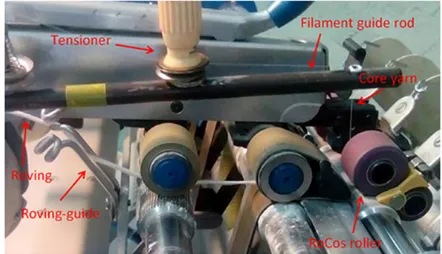
The cotton and viscose/polyester roving count were 0.72 and 1.09 Ne, respectively. To produce the samples, RoCos system was installed on SKF lab spinner instead of delivery top roller (Fig. 1).
In order to produce different types of compact-core yarns, core filament should be pre-drawn before entering the front rollers (RoCos roller). Filament also should be fed to compactor groove of RoCos roller and to this aim, a guide rod and a pre-tensioner were used. Fig. 2 illustrates the process of core-compact yarn production and Table II exhibits the machine parameters for producing RoCos yarns.
In this study, the tenacity, hairiness and abrasion resistance were considered as the physical and mechanical properties of compact-core yarns, and to determine the effect of controllable factors on these properties, 7 levels of filament pre-tension (25, 50, 75, 100, 125, 160 and 180 g), 4 levels of yarn count (41.5, 43.5, 48 and 59 tex) and two kinds of sheath fibers (cotton and polyester/viscose) were chosen. The list of yarn samples and considered controllable factors are presented in Table III.
The Instron testing machine (Model: M10-8201-1) was
used to measure the tenacity of yarns with a gauge length of 25 cm according to ASTM D2256, and the speed of testing was selected according to the breaking time of 20 s. For measuring hairiness (number of hairs longer than or equal to 3 mm), a Shirley hairiness tester (Model SDL096/8) was used based on ASTM D5647. The measurement was carried out on 20 m of each yarn sample at the speed of 60 m/min. Abrasion resistance was determined by a Shirley abrasion tester (Model: Y027) according to ASTM D6611. In order to determine the tenacity, each test was repeated 10 times, and for abrasion resistance and hairiness it was 5 times. All experiments were conducted at the condition of 30 ºC and 60 RH%.
V. RESULT AND DISCUSSION
A. ANN Model
To find the best set of ANN parameters to predict each property, the trial and error method was applied. Regarding the literature review, the number of hidden layers and neurons in each hidden layer were considered between 1 to 3 and 1 to 10, respectively. The activation functions for all hidden and output layers were considered tangent hyperbolic and linear functions, respectively. Obviously, the input parameters to ANN models are the pre-tension of filament, yarn count and the kind of sheath fibers. The ANNs were trained with the error back propagation algorithm using Trainlm function. 20% of data for test, 20% for validation and the rest were selected for training set, randomly. As the initial weights in ANN were selected randomly, each ANN topology was created five times and the best obtained result was considered for that topology. To evaluate the accuracy of the created ANNs, besides the correlation coefficient (R-value) two more indexes namely MSE (mean square error) and MAPE (mean absolute percentage error) were calculated between ANN outputs and corresponding actual values for testing set (Eqs. (2) and (3)).
(2)
(3)
Setting parameters Value
Twist per meter 900
Spindel speed (rpm) 22000
Ring diameter (mm) 36
Traveler* ISO No. 50
Fig. 1. Rotorcraft compact spinning roller (RoCoS).
Fig. 2. Production of core-compact yarns.
TABLE II MACHINE PARAMETERS
* Traveler type: J
n
i i
i 1 i
y x
1
MAPE 100
n = x
−
= × ×
∑
n
2
i i
i 1 1
MSE (y x )
n =
Where, y and x are the ANN output and corresponding actual values, respectively. The obtained results revealed that the use of MAPE index leads to higher accuracy in prediction. Table IV. shows the best topology of ANNs for each measured properties and Fig. 3 depicts the ANN outputs based on the MAPE index along with corresponding actual values in testing group for different properties.
B. NSGAII algorithm
After determining the best topology of ANN for each property, the value of tenacity and abrasion resistance and hairiness can be predicted accurately by inserting the
pre-tension of filament, yarn count and the kind of sheath fiber to the ANN models. Therefore, at this step, the optimization of all properties at the same time is possible. Clearly, for an ideal yarn the tenacity and abrasion resistance should be maximum and hairiness should be minimum. Considering that GA minimizes the fitness function, in this step three objectives are defined as follows (Eq. (4)) and each solution contains all objectives.
(4)
No. Filament pre-tension (g)
Yarn count
(tex) Type of sheath fiber No.
Filament pre-tension (g)
Yarn count
(tex) Type of sheath fiber
1 25 41.5 Viscose/polyester 29 25 48 Viscose/polyester
2 50 41.5 Viscose/polyester 30 50 48 Viscose/polyester
3 75 41.5 Viscose/polyester 31 75 48 Viscose/polyester
4 100 41.5 Viscose/polyester 32 100 48 Viscose/polyester
5 125 41.5 Viscose/polyester 33 125 48 Viscose/polyester
6 160 41.5 Viscose/polyester 34 160 48 Viscose/polyester
7 180 41.5 Viscose/polyester 35 180 48 Viscose/polyester
8 25 41.5 Cotton 36 25 48 Cotton
9 50 41.5 Cotton 37 50 48 Cotton
10 75 41.5 Cotton 38 75 48 Cotton
11 100 41.5 Cotton 39 100 48 Cotton
12 125 41.5 Cotton 40 125 48 Cotton
13 160 41.5 Cotton 41 160 48 Cotton
14 180 41.5 Cotton 42 180 48 Cotton
15 25 43.5 Viscose/polyester 43 25 59 Viscose/polyester
16 50 43.5 Viscose/polyester 44 50 59 Viscose/polyester
17 75 43.5 Viscose/polyester 45 75 59 Viscose/polyester
18 100 43.5 Viscose/polyester 46 100 59 Viscose/polyester
19 125 43.5 Viscose/polyester 47 125 59 Viscose/polyester
20 160 43.5 Viscose/polyester 48 160 59 Viscose/polyester
21 180 43.5 Viscose/polyester 49 180 59 Viscose/polyester
22 25 43.5 Cotton 50 25 59 Cotton
23 50 43.5 Cotton 51 50 59 Cotton
24 75 43.5 Cotton 52 75 59 Cotton
25 100 43.5 Cotton 53 100 59 Cotton
26 125 43.5 Cotton 54 125 59 Cotton
27 160 43.5 Cotton 55 160 59 Cotton
28 180 43.5 Cotton 56 180 59 Cotton
TABLE III
LIST OF YARN SAMPLES AND CONTROLLABLE FACTORS
Measured properties (best topology ofHidden layer ANN)
Accuracy index between ANN output with best topology and corresponding actual values for testing group
MAPE MSE R-value
Tenacity [8 3]* 0.0626 0.8500 0.9929
Hairiness [6 6] 0.0997 0.3283 0.8374
Abrasion resistance [2 4 4] 0.1744 1.8600 0.7587
TABLE IV
THE BEST TOPOLOGY OF ANN FOR EACH INVESTIGATED PROPERTIES BASED ON MAPE
1 value
2 value
3
Objective =Tenasity
Objective =abrasion resistance 1
bjective =
value O
NSGAII starts with randomly generated 100 initial populations and it ranks the individuals based on the dominance. The fast non-dominated sorting procedure finds out the non-domination ranks where individuals of a particular rank are non-dominated by any solution. In the next step, the crowding distance is calculated for each individual. NSGAII steps are repeated and the Pareto-optimal front is obtained at the end of 100 generations leading to the final set while the crossover and mutation rate are 0.8 and 0.2, respectively. Fig. 4 shows the 3D scattered Pareto-optimal front for tenacity, hairiness and abrasion resistance. The coordinates of some points on the axes are displayed for better comprehension of point’s position. As can be seen in Fig. 4, while the tenacity and abrasion
resistance increase, the hairiness decreases. In this study, the Pareto-optimal front contains 56 solutions for RoCos core-compact yarn. It must be noted that the corresponding values of the filament pretension, yarn count and kind of sheath fibers for each point in Fig. 4 are presented by NSGAII.
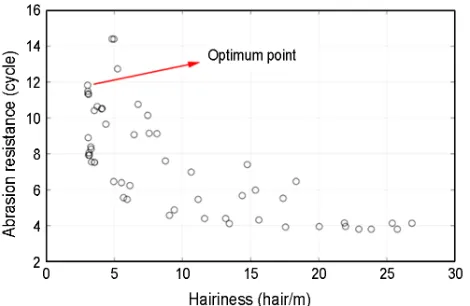
As all the solutions in the Pareto front are better than all those in the others, at least in terms of one objective, any one of them is an acceptable solution. The choice of one solution over other depends completely on the end user requirements. For better understanding the relation between three optimized mentioned properties, the Pareto-optima fronts are illustrated in 2D-dimensional figures (Figs. 5 to 7).
In Figs. 5 and 6, the trends between the parameters are very clear; one is decreasing while the other is increasing. However, a specified trend is not observed in Fig. 7, because
Fig. 3. ANN outputs based on the MAPE index along with corresponding actual values for different properties (testing group).
Property Measured value Observed values for “Optimum point”
Tenacity (cN/tex) 21.77 21.46
Abrasion resistance (cycle) 12.1 11.82
Hairiness (hair/m) 4.8 3.03
TABLE V
CHARACTERISTICS OF OPTIMUM YARN
Fig. 4. Result of implementation NSGAII (the optimal Pareto front for measured properties).
the tenacity and abrasion resistance should be maximized simultaneously. By obtaining the Pareto-optima solutions, the relation between yarns characteristics becomes clear and a yarn with desired values of hairiness, tenacity and abrasion resistance can be produced with a suitable combination of filament pre-tension, type of sheath fibers and yarn count. For example, a point has been indicated in Fig. 4 as “Optimum point”. This point has been highlighted in Figs. 5 to 7, too. As can be seen, this point enjoys from higher values of tenacity and abrasion resistance, while it has low value of hairiness. According to the results obtained from Table III, there is a yarn with characteristics very close to the optimum point characteristics (Table V). The spinning parameters for this yarn were count of 41.5 tex, filament pre tension of 125 g and sheath fiber of polyester/ viscous. So, for an ideal yarn in RoCos spinning system, these parameters can be considered for spinning.
The method applied using NSGAII is effective, less subjective, more practical and computationally efficient. The result of this method is a set of trade off solutions, and engineers can select their own desired solution
easily without need to use time-consuming and costly experiments.
VI. CONCLUSION
In this paper, a database was created by considering the influence of spining parameters such as filament pre-tension, yarn count and type of sheath fiber on the tenacity, hairiness and abrasion resistance of compact-core spun yarns.Then, the relation between the spining parameters and measured properties was modeled using ANN, accurately. In the next step, to optimize measured properties simultaneously, NSGAII was applied by the help of ANN models obtained. The results illustrated the relations between the measured properties, therefore, the spining parameters for a core yarn with desired properties could be determined easily. This method is effective, less subjective, more practical and not time-consuming, and can be used to predict the input parametrs for a product with desired properties instead of difficult and expensive experimental testing.
REFERENCES
[1] Z. Xia, X. Wang, W. Ye, H.A. Eltahir, and W. Xu, “Fiber trapping comparison of embeddable and locatable spinning with sirofil and siro core-spinning with flute pipe air suction”, Text. Res. J., vol. 82, no. 12, pp. 1255-1262, 2012.
[2] J. Chen, Q. Xu, Z. Xia, and W. Xu, “An experimental study of influence of filament and roving location on yarn properties during embeddable and locatable spinning”, Fiber. Polym., vol. 13, no. 9, pp. 1196– 1200, 2012.
[3] A. Pourahmad and M.S. Johari, “Comparison of the properties of ring, solo, and siro core-spun yarns”, J. Text. Inst., vol. 102, no.6, pp. 540-547, 2011.
[4] A. Sawhney, K. Robert, G. Ruppenicker, and L. Kimmel, “Improved method of producing a cotton covered/polyester staple-core yarn on a ring spinning frame”, Text. Res. J., vol. 62, no. 1, pp. 21-25, 1992. [5] A. Sawhney, G. Ruppenicker, L. Kimmel, and K.
Robert, “Comparison of filament-core spun yarns produced by new and conventional methods”, Text. Res. J., vol. 62, no. 2, pp. 67-73,1992.
[6] N. Balasubramanian and V. Bhatnagar, “The effect of spinning conditions on the tensile properties of core-spun yarns”, J. Text. Inst., vol. 61, no. 11, pp. 534-554, 1970.
[7] X. Yuan, S. Mingbao, and S. Shiyuan, Text. Inst. 83rd
World Conference, Shanghai, China, 2004.
[8] H. Hasani and M. Shanbeh, “Application of multiple linear regression and artificial neural network
Fig. 6. Optimal Pareto front for hairiness and abrasion resistance for RoCos core-compact yarn.
algorithms to predict the total hand value of summer knitted T-shirtsˮ, Ind. J. Fibre. Text. Res., vol. 35, no. 3, pp. 222-227, 2010.
[9] E. Naghashzargar, D. Semnani, S. Karbasi, and H. Nekoee, “Application of intelligent neural network method for prediction of mechanical behavior of wire-rope scaffold in tissue engineering”, J. Text. Inst., vol. 105, pp. 264-274, 2014.
[10] M. Vadood, D. Semnani, and M. Morshed, “Optimization of acrylic dry spinning production line by using artificial neural network and genetic algorithm”, J. Appl. Polym. Sci., vol. 120, no.2, pp. 735-744, 2011.
[11] V. Ghorbani, M. Vadood, and M.S. Johari, “Prediction of polyester/cotton blended rotor-spun yarns hairiness based on the machine parameters”, Ind. J. Fibre. Text. Res., vol. 41, no.1, pp. 19-25, 2016.
[12] X.-S. Yang, “Artificial intelligence, evolutionary computing and meta-heuristics: in the footsteps of Alan Turing”, Springer, 2012.
[13] K. Deb, “Multi-objective optimization using evolutionary algorithms”, John Wiley & Sons, 2001. [14] K. Deb, Search methodologies, Springer, ?????, 2014. [15] R.T. Marler and J.S. Arora, “Survey of multi-objective
optimization methods for engineering. structural and multidisciplinary optimization”, Struct. Multidiscip. Opt., vol. 26, no. 6, pp. 369-395, 2004.
[16] A. Konak, D.W. Coit, and A.E. Smith, “Multi-objective optimization using genetic algorithms: A tutorial”, Reliab. Eng. Syst. Safe., vol. 91, no. 9, pp. 992-1007, 2006.
[17] K. Deb, A. Pratap, S. Agarwal, and T. Meyarivan, “A fast and elitist multiobjective genetic algorithm:
NSGA-II”, IEEE T. Evolut. Comput., vol. 6, no. 2, pp. 182-197, 2002.
[18] B. Najlawi, M. Nejlaoui, Z. Affi, and L. Romdhane, “Multi-objective design optimization of the NBTTL mechanism”, in Advances in Acoustics and Vibration, vol. 5, Switzerland, Springer, 2017, pp. 175-184. [19] J. Chen, Y. Ding, Y. Jin, and K. Hao, “A synergetic
immune clonal selection algorithm based multi-objective optimization method for carbon fiber drawing process”, Fiber. Polym., vol. 14, no.10, pp. 1722-1730, 2013.
[20] W. Han and X. Wang, “Multi-objective optimization of the coat-hanger die for melt-blowing process”,
Fiber. Polym., vol. 13, no. 5, pp. 626-631, 2012. [21] L.H.G.J.H. Gu, Cotton Text. Tech., vol. 6, pp. 010,
2009.
[22] A. Majumdar, P. Mal, A. Ghosh, and D. Banerjee, “Multi-objective optimization of air permeability and thermal conductivity of knitted fabrics with desired ultraviolet protection”, J. Text. Inst., vol. 108, no.1, pp. 110-116, 2017.
[23] D. Semnani and M. Vadood, “Improvement of intelligent methods for evaluating the apparent quality of knitted fabrics”, Eng. Appl. Artif. Intell., vol. 23, no. 2, pp. 217-221, 2010.
[24] D.E. Golberg, “Genetic algorithms in search, optimization and machine learning”, Addion wesley, 1989.
[25] S. Sette and L. Langenhove, “Optimising the fibre-to-yarn production process: finding a blend of fibre qualities to create an optimal price/quality yarn”,