Differential expression of tissue-specific
adhesion molecules on human circulating
antibody-forming cells after systemic, enteric,
and nasal immunizations. A molecular basis for
the compartmentalization of effector B cell
responses.
M Quiding-Järbrink, … , J Holmgren, C Czerkinsky
J Clin Invest.
1997;
99(6)
:1281-1286.
https://doi.org/10.1172/JCI119286
.
Expression of the adhesion molecules CD44, L-selectin (CD62L), and integrin alpha 4 beta
7 by antibody-secreting cells (ASC) was examined in human volunteers after oral, rectal,
intranasal, or systemic immunization with cholera toxin B subunit. Almost all blood ASC,
irrespective of immunization route, isotype (IgG and IgA), and immunogen, expressed
CD44. On the other hand, marked differences were observed between systemically and
intestinally induced ASC with respect to expression of integrin alpha 4 beta 7 and
L-selectin, adhesion molecules conferring tissue specificity for mucosal tissues and peripheral
lymph nodes, respectively. Thus, most ASC induced at systemic sites expressed L-selectin,
whereas only a smaller proportion of ASC expressed alpha 4 beta 7. In contrast, virtually all
IgA- and even IgG-ASC detected after peroral and rectal immunizations expressed alpha 4
beta 7, with only a minor fraction of these cells expressing L-selectin. Circulating ASC
induced by intranasal immunization displayed a more promiscuous pattern of adhesion
molecules, with a large majority of ASC coexpressing L-selectin and alpha 4 beta 7. These
results demonstrate that circulating ASC induced by mucosal and systemic immunization
express different sets of adhesion molecules. Furthermore, these findings provide for the
first time evidence for differential expression of adhesion molecules on circulating ASC
originating from different mucosal sites. Collectively, these results may explain the
anatomical division of mucosal and systemic […]
Research Article
Find the latest version:
J. Clin. Invest.
© The American Society for Clinical Investigation, Inc. 0021-9738/97/03/1281/06 $2.00
Volume 99, Number 6, March 1997, 1281–1286
Differential Expression of Tissue-specific Adhesion Molecules on Human
Circulating Antibody-forming Cells After Systemic, Enteric, and
Nasal Immunizations
A Molecular Basis for the Compartmentalization of Effector B Cell Responses
Marianne Quiding-Järbrink,* Inger Nordström,* Gösta Granström,‡ Anders Kilander,§ Marianne Jertborn,* Eugene C. Butcher,iAndrew I. Lazarovits,¶ Jan Holmgren,* and Cecil Czerkinsky***
*Department of Medical Microbiology and Immunology, University of Göteborg, S-413 46 Göteborg, Sweden; ‡Department of
Otorhinolaryngology and §Department of Internal Medicine, Sahlgrenska University Hospital, S-413 46 Göteborg, Sweden; iDigestive
Disease Center and Department of Pathology, Stanford University, Stanford, California 94305; ¶Robarts Research Institute, University
Hospital and University of Western Ontario, London, Ontario, Canada; and **Institut National de la Santé et de la Recherche Médicale, Unit 80, Herriot Hospital, 69437 Lyon, France
Abstract
Expression of the adhesion molecules CD44, L-selectin
(CD62L), and integrin a4b7 by antibody-secreting cells
(ASC) was examined in human volunteers after oral, rectal, intranasal, or systemic immunization with cholera toxin B subunit. Almost all blood ASC, irrespective of immuniza-tion route, isotype (IgG and IgA), and immunogen, ex-pressed CD44. On the other hand, marked differences were observed between systemically and intestinally induced ASC
with respect to expression of integrin a4b7 and L-selectin,
adhesion molecules conferring tissue specificity for mucosal tissues and peripheral lymph nodes, respectively. Thus, most ASC induced at systemic sites expressed L-selectin,
whereas only a smaller proportion of ASC expressed a4b7.
In contrast, virtually all IgA- and even IgG-ASC detected
after peroral and rectal immunizations expressed a4b7,
with only a minor fraction of these cells expressing L-selec-tin. Circulating ASC induced by intranasal immunization displayed a more promiscuous pattern of adhesion mole-cules, with a large majority of ASC coexpressing L-selectin
and a4b7. These results demonstrate that circulating ASC
induced by mucosal and systemic immunization express different sets of adhesion molecules. Furthermore, these findings provide for the first time evidence for differential expression of adhesion molecules on circulating ASC origi-nating from different mucosal sites. Collectively, these re-sults may explain the anatomical division of mucosal and systemic immune responses in humans as well as the com-partmentalization of mucosal immune responses initiated in
the upper vs. the lower aerodigestive tract. (J. Clin. Invest.
1997. 99:1281–1286.)Key words: cell trafficking•
antibody-forming cells • adhesion molecule • human • mucosa
Introduction
Lymphocyte recirculation through lymphoid and nonlymphoid tissues is critical to ensure contact of the immune system with newly encountered antigens and to direct memory and effector cells to sites of immune reactions during tissue injury or infec-tion. The migration of effector and memory lymphocytes is, in contrast with that of naive cells, preferentially directed to pe-ripheral tissues and to a much lesser degree to secondary lym-phoid organs (1–3). In addition, these cells preferentially “home” back to the tissue where they were first activated (4–6). Thus, immunoblasts from the peripheral lymph nodes (PLN)1
tend to home to PLN or to extramucosal sites of inflammation, whereas blast cells originating from mucosal inductive sites, such as Peyer’s patches (PP), localize preferentially in the gut wall and in mucosa-associated exocrine glands. However, a certain degree of compartmentalization exists also within mu-cosa-associated lymphoid tissues (7).
The process of selective lymphocyte homing is dependent on binding of organ-specific adhesion molecules, so-called homing receptors, expressed on lymphocytes, to their ligands, addressins, on postcapillary high endothelial venules (HEV) in the target organ. It is generally believed that transient and re-versible interactions between selectins and their carbohydrate ligands mediate primary binding of leukocytes and their rolling onto HEV (8, 9). These signals, in concert with binding of en-dothelial surface molecules and/or surface bound chemokines, induce rapid activation of integrins. Integrin binding to endo-thelial counter receptors results in strengthened adhesion and triggers extravasation. However, it is now apparent that the different adhesion molecules involved in lymphocyte homing have overlapping functions, as illustrated by the finding that
b1 and b7 integrins mediate initial lymphocyte binding and rolling under shear flow (10).
In humans, the best characterized leukocyte adhesion mol-ecules conferring tissue specificity are L-selectin (CD62L) and
Portions of this work were presented at the 7th International Con-gress of Mucosal Immunology, San Diego, CA on 16–20 July 1995.
Address correspondence to Cecil Czerkinsky, Department of Medical Microbiology and Immunology, University of Göteborg, Guldhedsgatan 10A, S-413 46 Göteborg, Sweden. Phone: 46-31-82 51 36; FAX: 46-31-60 47 61; E-mail: [email protected]
Received for publication 22 July 1996 and accepted in revised form 27 December 1996.
integrin a4b7. On lymphocytes, the a4 integrin chain can asso-ciate with two different b chains, b1 and b7. a4b7 is a receptor for the mucosal addressin cell adhesion molecule (MAdCAM-1) (11), and is thereby involved in selective lymphocyte traffick-ing to mucosal lymphoid tissues (12). a4b1 binds to endothe-lial cells via the vascular cell adhesion molecule, VCAM-1, and is mainly mediating lymphocyte migration into sites of inflam-mation (13) but not to PLN (14). L-Selectin has been identi-fied as a lymphocyte homing receptor mediating binding to and entry into PLN (15). Its ligand, the PLN addressin, is a tis-sue-specific endothelial cell carbohydrate antigen found on HEV of PLN in adults and at sites of chronic inflammation (16). In addition, it has been shown that the hyaluronate-bind-ing molecule CD44 may be involved in lymphocyte bindhyaluronate-bind-ing to mucosal HEV in vitro (17, 18).
In this study, we have examined whether the known differ-ences in migratory behavior of circulating B cell blasts origi-nating from systemic vs. mucosal sites could be explained by the use of distinct organ-specific adhesion molecules. We now report that human circulating antibody-forming cells induced by intestinal, systemic, and intranasal immunization express distinct combinations of integrin a4b7 and L-selectin.
Methods
Volunteers and immunizations. The study was performed with due approval from the Human Research Ethical Committee of the Medi-cal Faculty at the University of Göteborg, and comprised 44 healthy volunteers, aged 18–51, who gave informed consent to participate.
Peroral (p.o.) immunizations: 14 volunteers received two doses of an oral cholera vaccine (19), given 2–3 wk apart, each dose consisting of 1011 killed Vibrio cholerae organisms and 1 mg of purified
recombi-nant cholera toxin B subunit (CTB) (SBL Vaccine, Stockholm, Swe-den) given in 150 ml of a bicarbonate buffer.
Rectal immunizations: seven volunteers were immunized twice, 2 wk apart, with the above CTB-containing cholera vaccine, given by means of a syringe in 3 ml of physiological saline. After administra-tion of the immunogen, the volunteers stayed in horizontal posiadministra-tion for 30 min with one rotation after 15 min.
Intranasal (i.n.) immunizations: six volunteers were immunized twice with 0.5 mg of purified CTB (Institut Merieux, Lyon, France) 2 wk apart. After a nasal wash with physiological saline, 250 mg of CTB was introduced into each nostril in aliquots of 25 ml. Four additional volunteers received 100 mg of recombinant CTB (SBL vaccine), in the form of an aerosol sprayed onto the nasal mucosa. The vaccine was administered in saline without bicarbonate to minimize the risk of any CTB reaching the intestine in an active (acid-labile penta-meric) form. These doses were selected from preliminary clinical studies and found to give consistent blood antibody-secreting cell (ASC) responses without inducing untoward reactions, whereas higher doses (1 mg) gave rise to transient local nasal hypersecretion and repeated sneezings.
Systemic immunizations: four volunteers received a total of 50 mg rCTB, administered by intracutaneous injections at two sites in the arm, each injection consisting of z 25 mg rCTB in 50 ml physiological
saline. These immunizations caused a local erythematous reaction, which appeared 7–10 d after injection and disappeared within 3–4 wk. Seven additional volunteers received an s.c. injection of a tetanus tox-oid (TT)/diphtheria toxtox-oid vaccine (SBL) containing two Floculation Unit of TT.
In all groups, only the volunteers responding to the immuniza-tions with sufficient numbers of ASC were included in further analy-ses of adhesion molecule expression (see Results).
Isolation of mononuclear cells. Heparinized venous blood was col-lected 1 wk after the last immunization, and mononuclear cells (MNC) were isolated by gradient centrifugation on Ficoll-HypaqueTM
(Pharmacia Diagnostics AB, Uppsala, Sweden). Interface MNC were collected, washed three times with cold PBS, and then resuspended in cold PBS supplemented with 1% (vol/vol) fetal calf serum or in Is-cove’s medium with 5% of fetal calf serum and 100 mg/ml of gentami-cin (Gibco Europe, Edinburgh, UK) (complete medium). Cell sus-pensions were kept on ice before being further fractionated and/or assayed for ASC numbers.
Fractionation of MNC. Cell surface expression of CD44, integrin
a4b7, and L-selectin by isolated ASC was determined using a combi-nation of immunomagnetic cell sorting and ELISPOT techniques (20). Briefly, paramagnetic microspheres (Dynabeads; Dynal, Oslo, Norway) coated with sheep antibodies to mouse immunoglobulins were incubated overnight at 48C with mouse monoclonal antibodies Hermes-3, ACT-1, or Dreg-56, specifying CD44, integrin a4b7, and L-selectin, respectively (17, 21, 22). Coated beads were washed and mixed with the MNC suspensions at optimal bead to cell ratios of 10:1 (CD44, a4b7) or 5:1 (L-selectin). Beads and cells were pelleted by centrifugation and incubated at 48C for 45 min, and then gently resus-pended and incubated for another 20 min at 48C. Cells attached to beads and free beads were retained by applying a magnetic field along the side of the tubes and unbound cells were removed from the tube by aspiration. The resulting positively and negatively selected cell suspensions were resuspended in equal volumes of complete me-dium and assayed for numbers of ASC by the ELISPOT test de-scribed below. This procedure resulted in depletion of 96% of CD441
and L-selectin1 cells, and of 93% of a4b71 cells from the original cell
suspension, as determined by comparative flow cytometric analyses of unfractionated and negatively selected MNC suspensions using a Facscan® (Becton-Dickinson & Co., San Jose, CA). Cell surface
ex-pression of CD44, a4b7, and L-selectin was determined by stepwise exposure for 30 min at 48C of MNC suspensions to Hermes-3, ACT-1, or Dreg-56, followed by FITC-labeled F(ab9)2 fragments of rabbit
an-tibodies to mouse Ig (Dakopatts AS, Glostrup, Denmark).
To ascertain that unspecific binding of ASC to beads did not oc-cur, cells bound to beads coated with isotype-matched irrelevant mAbs (z 6–10% of the starting MNC population) were analyzed in
ELISPOT assays as described below. These cells did not contain any detectable ASC, attesting to the specificity of the separation method employed.
Enumeration of ASC. Fractionated and unfractionated MNC sus-pensions were assayed for numbers of vaccine-specific IgG and IgA ASC by a two-color micromodification of the ELISPOT technique (23). Briefly, various numbers of MNC were incubated for 14 h at 378C in 100 ml of complete medium in nitrocellulose-bottomed 96-well plates (Millipore Corp., Bedford, MA) previously coated with 100 ml of PBS containing 20 mg/ml of purified TT (SBL) or 2.5 mg/ml of cholera toxin (List Biological Laboratories, Inc., Campbell, CA). For the latter antigen, wells were first coated with 3 mm of GM1 gan-glioside (Sigma Chemical Co., St. Louis, MO) to facilitate adsorption of cholera toxin. Solid phase-bound immunoglobulins secreted by in-dividual ASC were revealed as spots by stepwise addition of combi-nations of horseradish peroxidase– or alkaline phosphatase–labeled goat antibodies to human IgG, IgA, or IgM (Southern Biotechnology Associates, Birmingham, AL), and suitable chromogen substrates (23). The percentage of ASC expressing a certain marker was calcu-lated by dividing the number of ASC in the positive fraction with the total number of ASC in the positive and negative fractions assayed at the same frequency. Unfractionated cells were assayed in parallel to positively and negatively selected cell suspensions, and the sum of spots in the positive and negative ASC fractions consistently corre-sponded (within 80–120%) to the sum of spots in wells incubated with unfractionated cells.
Results
and parenteral immunizations with the prototype immunogens CTB and TT were determined before the first and 7 d after the last immunization. None of the volunteers had any detectable ASC reacting with CTB or TT before the immunizations. All routes of immunization did, however, give rise to substantial ASC responses. These responses differed with regard to both magnitude and isotype distribution, depending on administra-tion route. Thus, CTB-specific ASC induced by p.o. immuniza-tion consisted of approximately equal numbers of IgG- and IgA-secreting cells. Rectal immunization led to lower ASC re-sponses, which also comprised similar numbers of IgG- and IgA-secreting cells. After i.n. immunization, on the other hand, vaccine-specific IgA-secreting cells dominated over IgG-secreting cells (Table I).
In contrast, the anti–TT ASC population induced by s.c. immunization comprised large numbers of IgG-secreting cells and small, yet significant, numbers of IgA-secreting cells (Ta-ble I). When CTB was administered by intracutaneous injec-tion, IgG-secreting cells dominated over IgA-secreting cells. Vaccine-specific IgM ASC were virtually absent, irrespective of immunization route and immunogen.
Because of the major differences in magnitude and isotype composition of blood ASC responses after different immuni-zation routes and marked individual variations, cell suspen-sions were assayed at different densities to allow accurate com-parisons. All subsequent results presented were obtained from volunteers having responded to the vaccines with at least 10 IgA or IgG ASC/106 MNC.
Adhesion molecules on ASC induced after immunization by various mucosal routes. Adhesion molecule expression by cir-culating spontaneous ASC induced by different immunization routes was examined by collecting peripheral blood MNC 7 d after the last immunization, sorting the cells according to cell surface expression of CD44, L-selectin, and integrin a4b7, and then immediately assaying the cell fractions for numbers of specific IgA and IgG ASC.
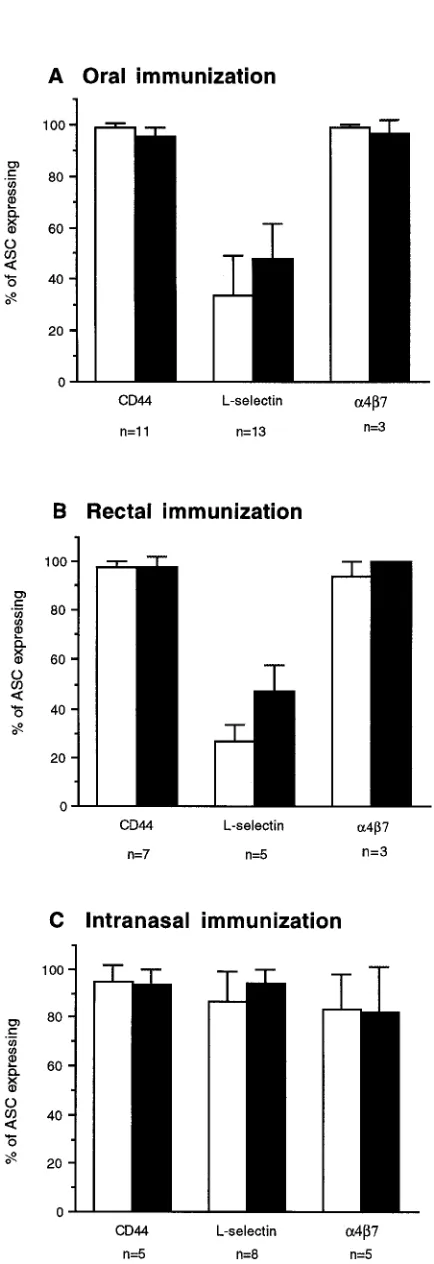
[image:4.612.314.531.28.660.2]Virtually all vaccine-specific ASC, irrespective of mucosal immunization route, expressed CD44. Expression of the PLN homing receptor L-selectin, on the other hand, varied consid-erably between ASC populations induced by different routes of mucosal immunization. Thus, the mucosal homing receptor integrin a4b7 was expressed by the large majority of IgA and IgG ASC induced by p.o. immunization, whereas only a minor fraction of these ASC coexpressed L-selectin (Fig. 1 A). Simi-lar to this, the Simi-large majority of circulating CTB-specific IgA
Table I. Frequencies of Circulating Vaccine-specific ASC after Systemic, p.o., i.n., and Rectal Administration of CTB or TT
Administration Antigen Vaccine-specific ASC/106 MNC
IgG IgA
p.o. CTB 41 (8–516)* 44 (4–406)
Rectal CTB 10 (0–26) 10 (2–21)
i.n. CTB 10 (0–86) 25 (1–292)
s.c. TT 134 (5–872) 5 (0–37)
Intracutaneous CTB 23 (2–162) 12 (2–70)
[image:4.612.56.298.84.185.2]*Frequencies of vaccine-specific ASC, determined 7 d after the last im-munization. Data are expressed as geometric mean and the range of in-dividual data is given in brackets.
and IgG ASC induced by rectal immunization expressed a4b7, with a minority of ASC coexpressing L-selectin (Fig. 1 B).
In contrast with the circulating cells induced by peroral or rectal immunizations, most CTB-specific circulating ASC in-duced by i.n. immunization coexpressed CD44 and a4b7, as well as L-selectin (Fig. 1 C).
Adhesion molecules on ASC induced after systemic immu-nizations. The distribution of L-selectin and a4b7 on blood ASC induced by systemic administration of CTB or TT was al-most reciprocal to that of ASC induced by intestinal vaccina-tion. Virtually all vaccine-specific ASC appearing after
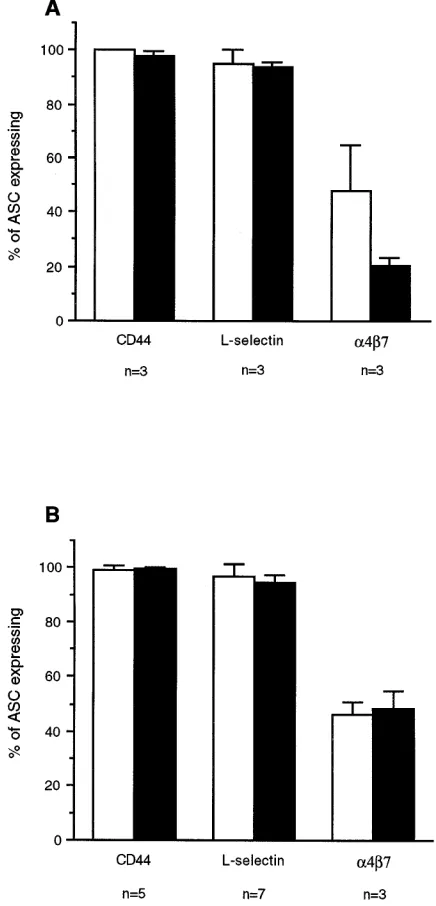
intra-cutaneous CTB-immunization expressed CD44 and L-selectin, while a4b7 expression was observed on , 50% of IgA- and
, 20% of IgG-secreting cells (Fig. 2 A). Similarly, almost all TT-specific ASC isolated after s.c. immunization expressed CD44 and L-selectin, whereas much fewer TT-specific ASC expressed a4b7 (Fig. 2 B).
Discussion
This study demonstrates that human circulating ASC induced by different immunizations express a distinct pattern of tissue-specific adhesion molecules, depending on the route of initial immunization.
It has long been known that parenteral immunization re-sults in the transient appearance of vaccine-specific ASC in pe-ripheral blood (24). The presence of specific ASC in blood af-ter enaf-teric immunization has also been reported (25, 26), an observation supporting the notion of a common mucosal im-mune system (27). According to this concept, progenitors of B cell immunoblasts recruited at mucosal inductive sites are dis-seminated via the circulation to their final destination, mainly in the intestinal mucosa, but also in remote mucosa-associated tissues and exocrine glands. Recently, however, a number of studies have indicated a certain degree of compartmentaliza-tion of immune responses within mucosa-associated lymphoid tissues (7, 28–30). The restricted redistribution of migrating B cell immunoblasts from different inductive sites is predicted to be the result of differential expression of homing receptors on the circulating cells as well as of their ligands on HEV in differ-ent tissues (8, 9).
In this study, CD44 was expressed by virtually all circulat-ing ASC, irrespective of immunization route. CD44 is a wide-spread hyaluronate-binding cell surface molecule that has been reported to play an important role in lymphocyte attach-ment to mucosal HEV in vitro (17, 18). However, its impor-tance in tissue-specific lymphocyte homing has not yet been documented in vivo (31). The results of this study, together with the observation that virtually all circulating immunoglob-ulin-secreting cells, irrespective of antigen specificity, express CD44 (M. Quiding-Järbrink and C. Czerkinsky, unpublished data) indicate that CD44 is not a useful marker of ASC origin or destination.
In contrast with CD44, expression of the tissue-specific ad-hesion molecules integrin a4b7 and L-selectin varied consider-ably between ASC populations induced at different sites. Sys-temic immunizations led to blood ASC responses where almost all ASC expressed L-selectin, whereas L-selectin was expressed only by a minority of ASC induced by peroral im-munizations. That in vitro activation of circulating B cells results in rapid downregulation of surface L-selectin is well documented (22, 32). In addition, L-selectin is differentially expressed during B cell maturation and differentiation (33). We believe, however, that the presence or absence of L-selec-tin on circulaL-selec-ting ASC is relevant to their migratory behavior rather than a reflection of activation or maturation stage. In a recent study, we could demonstrate that almost all circulating ASC induced by p.o. or s.c. immunization were at a similar, late stage of differentiation (34). This was particularly evident for ASC induced by p.o. immunization, which were also the most heterogeneous with respect to L-selectin expression.
[image:5.612.55.273.62.515.2]The expression of a4b7 on vaccine-specific blood ASC in-duced by systemic immunizations was restricted to less than
half of the ASC pool. Since all circulating TT-specific ASC express the a4 integrin chain (34), the a4b72 ASC subset
detected in this study probably express the integrin a4b1. To-gether with L-selectin and LFA-1, a4b1 may facilitate lympho-cyte homing to inflamed nonlymphoid sites and antigen-chal-lenged lymph nodes (9). The fact that systemic immunization with either CTB or TT resulted in ASC with a very similar ex-pression of L-selectin and a4b7 demonstrates that the immu-nization route, rather than the immunogen, determines the type(s) of adhesion molecules expressed by the correspond-ing ASC.
Enteric (p.o. and rectal) immunizations resulted in a recip-rocal distribution of L-selectin and a4b7 as compared with sys-temic immunization. Almost all circulating ASC activated by p.o. or rectal immunization expressed a4b7, whereas less than half of these cells coexpressed L-selectin. A recent study also indicates, although indirectly, a similar pattern of a4b7 expres-sion on ASC induced by diarrheal disease (35). It is possible that the a4b71 and L-selectin2 ASC are bound to extravasate
through flat-walled venules in the intestinal lamina propria, which constitutively express MAdCAM-1 but only little PLN addressin (8, 10, 36). a4b71 and L-selectin1 ASC, on the other
hand, may leave the circulation and migrate to more organized mucosal lymphoid tissues, such as mesenteric lymph nodes (MLN) and Peyer’s patches, whose HEV express both MAd-CAM-1 and PLN addressin (36, 37), and to which L-selectin– dependent homing has been documented (38). In accordance with this notion, our previous studies have shown that MLN harbor large numbers of vaccine-specific ASC after enteric im-munization in monkeys (39).
Preliminary data from our laboratory also indicate that a majority of blood IgA ASC from oral cholera vaccinees dis-play an “intestinal” homing receptor profile even after sys-temic reexposure to the CTB component of the oral vaccine (results not shown). Although preliminary, these results could explain earlier findings indicating that systemic immunization can “boost” a mucosal IgA response (40, 41).
In contrast with ASC detected after enteric immunization, which mainly express a4b7 and little L-selectin, almost all blood ASC induced by nasal immunization coexpressed a4b7 and L-selectin. In keeping with this observation, recent studies have indicated a certain degree of compartmentalization of im-mune responses induced in different mucosa-associated lym-phoid tissues (7, 28, 29). Thus, the palatine tonsils serve poorly as expression sites for B cell responses induced by intestinal immunization. Furthermore, an immune response induced by tonsillar or i.n. antigen exposure and giving rise to large num-bers of ASC in tonsils and in blood, is not reflected in the duodenal mucosa (7). The fact that blood ASC induced by p.o. and i.n. immunization differ with respect to cell surface adhe-sion molecule expresadhe-sion may at least partly explain the com-partmentalization of immune responses initiated in the upper as opposed to the lower aerodigestive tract. We cannot clude, however, that the differences in adhesion molecule ex-pression documented may have resulted from the different amounts of antigen administered by different routes, rather than from the immunization route per se.
Interestingly, the relative distribution of a4b7 and L-selec-tin was similar on both IgA- and IgG-secreL-selec-ting cells, irrespec-tive of immunization route. It has previously been argued that IgG responses induced by p.o. immunizations might largely re-sult from “leakage” of antigen into the systemic compartment.
The observation that a large proportion of CTB-specific IgG ASC expressed a4b7 but no L-selectin after p.o. and rectal im-munization suggests that the IgG response after enteric vacci-nation may actually be derived from mucosal inductive sites in-cluding but not limited to the MLN (39). In spite of the similarities in adhesion molecule expression between IgG and IgA ASC, our earlier studies have shown considerable differ-ences in the distribution of IgA- and IgG-secreting cells in-duced by p.o. immunization. IgA-secreting cells clearly domi-nate in the duodenal mucosa and in salivary glands (42, 43), whereas IgG-secreting cells actually dominate in the colonic mucosa and MLN (39). Therefore, additional recognition events involving molecules other than a4b7 and L-selectin and their counter receptors are likely also to govern the migration of ASC to particular effector sites.
In conclusion, this study demonstrates that human circulat-ing ASC induced by intestinal and systemic immunization, re-spectively, have distinct surface expression of L-selectin and integrin a4b7. This study thus provides the first experimental evidence that effector B cells resulting from mucosal vs. non-mucosal immune responses are segregated into homing recep-tor–defined subsets. In addition, a differential expression of adhesion molecules on circulating ASC after oral and nasal immunization may provide a molecular basis to the compart-mentalization of mucosal immune responses initiated in the upper and lower aerodigestive tract.
Acknowledgments
We thank all volunteers who participated in this study. We thank Drs. A. Rudin and P.-O. Stoltzer and Mrs. I. Hagman and Mrs. K. Olbe for their valuable help with collection of specimens.
This study was supported in part by the Swedish Medical Re-search Council, the European Union (Biomed program), the Magnus Bergvall Foundation, the Tore Nilsson Foundation, and the Åke Wiberg Foundation.
References
1. Mackay, C.R., W.L. Marston, and L. Dudler. 1990. Naive and memory T cells show distinct pathways of lymphocyte recirculation. J. Exp. Med. 171:801– 817.
2. Mackay, C.R., W.L. Marston, and L. Dudler. 1992. Altered patterns of T cell migration through lymph nodes and skin following antigen challenge. Eur.
J. Immunol. 22:2205–2210.
3. Picker, L.J., and E.C. Butcher. 1992. Physiological and molecular mecha-nisms of lymphocyte homing. Annu. Rev. Immunol. 10:561–591.
4. Binns, R.M., S.Y. Licence, and R. Pabst. 1992. Homing of blood, splenic, and lung emigrant lymphoblasts: comparison with the behavior of lymphocytes from these sources. Int. Immunol. 4:1011–1019.
5. McDermott, M.R., and J. Bienenstock. 1979. Evidence for a common mucosal immunologic system. I. Migration of B immunoblasts into intestinal, respiratory, and genital tissues. J. Immunol. 122:1892–1898.
6. Chin, W., and J.B. Hay. 1980. A comparison of lymphocyte migration through intestinal lymph nodes, subcutaneous lymph nodes, and chronic in-flammatory sites of sheep. Gastroeneterology. 79:1231–1242.
7. Quiding-Järbrink, M., G. Granström, I. Nordström, J. Holmgren, and C. Czerkinsky. 1995. Induction of compartmentalized B cell responses in the hu-man tonsils. Infect. Immun. 63:853–857.
8. Bargatze, R.F., M.A. Jutila, and E.C. Butcher. 1991. Distinct roles of L-selectin and integrins a4b7 and LFA-1 in lymphocyte homing to Peyer’s patch-HEV in situ: the multistep model confirmed and refined. Immunity. 3:99– 108.
9. Springer, T.A. 1994. Traffic signals for lymphocyte recirculation and leu-cocyte emigration: the multistep paradigm. Cell. 76:301–314.
10. Berlin, C., R.F. Bargatze, J.J. Campbell, U.H. von Andrian, M.C. Szabo, S.R. Hasslen, R.D. Nelson, E.L. Berg, S.L. Erlandsen, and E.C. Butcher. 1995.
a4 Integrins mediate lymphocyte attachment and rolling under physiological flow. Cell. 80:413–422.
Holz-mann, I.L. Weissman, A. HaHolz-mann, and E.C. Butcher. 1993. a4b7 Integrin medi-ates lymphocyte binding to the mucosal vascular adressin MAdCAM-1. Cell. 74:185–195.
12. Hamann, A., D.P. Andrew, D. Jablonski-Westrich, B. Holzmann, and E.C. Butcher. 1994. Role of a4-integrins in lymphocyte homing to mucosal tis-sues in vivo. J. Immunol. 152:3282–3293.
13. Elices, M.J., L. Osborn, Y. Takada, C. Crouse, S. Luhowskyj, M.E. Hemler, and R.R. Lobb. 1990. VCAM-1 on activated endothelium interacts with the leukocyte integrin VLA-4 at a site distinct from the VLA-4/fibronectin binding site. Cell. 60:577–584.
14. Arroyo, A.G., J.T. Yang, H. Rayburn, and R.O. Hynes. 1996. Differen-tial requirements for a4 integrins during fetal and adult hematopoiesis. Cell. 85: 997–1008.
15. Berg, E.L., M.K. Robinson, R.A. Warnock, and E.C. Butcher. 1991. The human peripheral lymph node vascular addressin is a ligand for LECAM-1, the peripheral lymph node homing receptor. J. Cell Biol. 114:343–349.
16. Streeter, P.R., E.L. Berg, B.N.T. Rouse, R.F. Bargatze, and E.C. Butcher. 1988. A tissue-specific endothelial cell molecule involved in lympho-cyte homing. Nature (Lond.). 331:41–46.
17. Jalkanen, S., R.F. Bargatze, J. de los Toyos, and E.C. Butcher. 1987. Lymphocyte recognition of high endothelium: antibodies to distinct epitopes of an 85–95-kD glycoprotein antigen differentially inhibit lymphocyte binding to lymph node, mucosal, or synnovial endothelial cells. J. Cell Biol. 105:983–990.
18. Jalkanen, S., G.S. Nash, J. de los Toyos, R.P. MacDermott, and E.C. Butcher. 1989. Human lamina propria lymphocytes bear homing receptors and bind selectively to mucosal lymphoid high endothelium. Eur. J. Immunol. 19:63–71. 19. Holmgren, J., A.-M. Svennerholm, I. Lönnroth, M. Fall-Persson, B. Markman, and H. Lundbäck. 1977. Development of improved cholera vaccine based on subunit toxoid. Nature (Lond.). 269:602–604.
20. Lakew, M., I. Nordström, M. Quiding, J. Holmgren, and C. Czerkinsky. 1994. Phenotypic characterization of circulating antibody-secreting cells after mucosal and systemic immunizations in humans. Adv. Exp. Med. Biol. 371: 1451–1453.
21. Lazarovits, A.I., R.A. Mosciki, J.T. Kurnick, D. Camerini, A.K. Bhan, L.G. Baird, M. Erikson, and R.B. Colvin. 1984. Lymphocyte activation anti-gens. I. A monoclonal antibody, anti–Act I, defines a new late lymphocyte acti-vation antigen. J. Immunol. 133:1857–1862.
22. Kishimoto, T.K., M.A. Jutila, and E.C. Butcher. 1990. Identification of a human peripheral lymph node homing receptor: a rapidly down-regulated ad-hesion molecule. Proc. Natl. Acad. Sci. USA. 87:2244–2248.
23. Czerkinsky, C., Z. Moldoveanu, J. Mestecky, L.-Å. Nilsson, and Ö. Ouchterlony. 1988. A novel two colour ELISPOT assay. I. Simultaneous detec-tion of distinct types of antibody-secreting cells. J. Immunol. Methods. 115:31– 37.
24. Stevens, R.H., E. Macy, C. Morrow, and A. Saxon. 1979. Characteriza-tion of a circulating subpopulaCharacteriza-tion of spontaneous antitetanus toxoid antibody producing B cells following in vitro booster immunization. J. Immunol. 122: 2498–2504.
25. Czerkinsky, C., S.J. Prince, S.M. Michalek, S. Jackson, M.W. Russel, Z. Moldoveanu, J.R. McGhee, and J. Mestecky. 1987. IgA antibody-producing cells in peripheral blood after antigen ingestion: evidence for a common mu-cosal immune system in humans. Proc. Natl. Acad. Sci. USA. 84:2449–2453.
26. Kantele, A., H. Arvilommi, and I. Jokinen. 1986. Specific immunoglob-ulin-secreting human blood cells after peroral vaccination against Salmonella typhi. J. Infect. Dis. 153:1126–1131.
27. Mestecky, J. 1987. The common mucosal immune system and current strategies for induction of immune responses in external secretions. J. Clin.
Im-munol. 7:265–276.
28. Nadal, D., B. Albini, C. Chen, E. Schläpfer, J.M. Bernstein, and P.L.
Ogra. 1991. Distribution and engraftment patterns of human tonsillar mononu-clear cells and immunoglobulin-secreting cells in mice with severe combined immunodeficiency: role of Epstein-Barr virus. Int. Arch. Allergy Appl. Immu-nol. 95:341–351.
29. Nadal, D., B. Albini, E. Schläpfer, C. Chen, L. Brodsky, and P.L. Ogra. 1991. Tissue distribution of mucosal antibody-producing cells specific for respi-ratory syncytial virus in severe combined immune deficiency (SCID) mice en-grafted with human tonsils. Clin. Exp. Immunol. 85:358–364.
30. Haneberg, B., D. Kendall, H.M. Amerongen, F.M. Apter, J.-P. Krae-henbuhl, and M.R. Neutra. 1994. Induction of specific immunoglobulin A in the small intestine, colon-rectum, and vagina measured by a new method for collec-tion of secrecollec-tions from local mucosal surfaces. Infect. Immun. 62:15–23.
31. Camp, R.L., A. Scheynius, C. Johansson, and E. Pure. 1993. CD44 is necessary for optimal contact allergic responses but is not required for normal leukocyte extravasation. J. Exp. Med. 178:497–507.
32. Tedder, T.F., A.C. Penta, H.B. Levine, and A.S. Freedman. 1990. Ex-pression of the human leucocyte adhesion molecule, LAM1. Identity with the TQ1 and Leu-8 differentiation antigens. J. Immunol. 144:532–540.
33. Kansas, G.S., G.S. Wood, and E.G., Engleman. 1985. Maturational and functional diversity of human B lymphocytes delineated with anti–Leu-8. J.
Im-munol. 134:3003–3006.
34. Quiding-Järbrink, M., M. Lakew, I. Nordström, J. Banchereau, E. Butcher, J. Holmgren, and C. Czerkinsky. 1995. Human circulating specific an-tibody-forming cells after mucosal and systemic immunizations: differential homing commitments and cell surface differentiation markers. Eur. J. Immu-nol. 25:322–327.
35. Kantele, J.M., H. Arvilommi, S. Kontiainen, M. Salmi, S. Jalkanen, E. Savilahti, M. Westerholm, and A. Kantele. 1996. Mucosally activated circulat-ing human B cells in diarrhea express homcirculat-ing receptors directcirculat-ing them back to the gut. Gastroenterology. 110:1061–1067.
36. Streeter, P.R., B.T.N. Rouse, and E.C. Butcher. 1988. Immunohistologi-cal and functional characterization of a vascular addressin involved in lympho-cyte homing into peripheral lymph nodes. J. Cell Biol. 107:1853–1862.
37. Briskin, M.J., L.M. McEvoy, and E.C. Butcher. 1993. MAdCAM-1 has homology to immunoglobulin and mucine-like adhesion receptor and to IgA1.
Nature (Lond.). 363:461–464.
38. Hamann, A., D. Jablonski-Westrich, P. Jonas, and H.-G. Thiele. 1991. Homing receptors reexamined: mouse LECAM-1 (MEL-14 antigen) is in-volved in lymphocyte migration into gut-associated lymphoid tissue. Eur. J.
Im-munol. 21:2925–2929.
39. Czerkinsky, C., and J. Holmgren. 1994. Exploration of mucosal immu-nity in humans: relevance to vaccine development. Cell. Mol. Biol. 40(Suppl. 1): 37–44.
40. Svennerholm, A.-M., L.Å. Hanson, J. Holmgren, B.S. Lindblad, B. Nils-son, and F. Quereshi. 1980. Different secretory immunoglobulin A antibody re-sponses to cholera vaccination in Swedish and Pakistani women. Infect. Immun. 30:427–430.
41. Lue, C., A. Tarkowski, and J. Mestecky. 1988. Systemic immunization with pneumococcal polysaccharide vaccine induces a predominant IgA2 re-sponse of peripheral blood lymphocytes and increases of both serum and secre-tory anti-pneumococcal antibodies. J. Immunol. 140:3793–3800.
42. Quiding, M., I. Nordström, A. Kilander, G. Anderson, L.Å. Hanson, J. Holmgren, and C. Czerkinsky. 1991. Intestinal immune responses in humans. Oral cholera vaccination induces strong intestinal antibody responses, gamma-interferon production, and evokes local immunologic memory. J. Clin. Invest. 88:143–148.