in the population sciences published by the Max Planck Institute for Demographic Research Konrad-Zuse Str. 1, D-18057 Rostock · GERMANY www.demographic-research.org
DEMOGRAPHIC RESEARCH
VOLUME 18, ARTICLE 20, PAGES 569-610
PUBLISHED 24 JUNE 2008
http://www.demographic-research.org/Volumes/Vol18/20/ DOI: 10.4054/DemRes.2008.18.20
Research Article
On the structural value of children and its
implication on intended fertility in Bulgaria
Christoph Bühler
© 2008 Bühler.
This open-access work is published under the terms of the Creative Commons Attribution NonCommercial License 2.0 Germany, which permits use, reproduction & distribution in any medium for non-commercial purposes, provided the original author(s) and source are given credit.
1 Introduction 570
2 Theoretical considerations 571
2.1 The structural value of children 571 2.1.1 Social networks and reproductive behavior: A mutual relationship 572 2.1.2 The structural value of children 573 2.1.3 The purposeful utilization of the structural value of children 575
2.2 Fertility intentions 576
3 Data and variables 577
3.1 Data 577
3.2 Fertility intentions 578
3.3 The structural value of children 579
3.4 Control variables 580
4 Empirical results 580
4.1 Fertility intentions 581
4.2 The perceived structural benefits of children 583 4.3 The perceived costs of children 585
4.4 Multivariate analyses 587
5 Concluding discussion 591
6 Acknowledgements 594
References 595
Appendix A: Instrument used to measure the expected benefits and costs of children
604
Appendix B.1: Expected benefits of having children by marital status, parity, and gender
605
Appendix B.2: Expected costs of having children by marital status, parity, and gender
606
Appendix C: Variables used in the multivariate analyses and their descriptive statistics
On the structural value of children and its implication on intended
fertility in Bulgaria
Christoph Bühler1
Abstract
Personal networks are receiving increasing recognition as structural determinants of fertility. However, the network perspective also helps to explain personal motivations for having children. Using theories of interpersonal exchange, social capital, and the value of children, it is argued in this article that children can substantively improve their parents’ social networks. Individuals perceive this potential advantageous development as a structural benefit and consider this value in their reproductive decisions. This ar-gument is empirically explored with data from Bulgaria, collected in 2002. The results document the presence of structural evaluations among subjectively perceived child-related benefits. Moreover, structural evaluations matter for the reproductive decision-making of Bulgarian citizens. Women’s fertility intentions are supported by the pros-pect that a child will bring their parents and relatives closer or will improve their secu-rity at old age. Males’ intentions are closely associated with the expectation that a child will provide support when they are old.
1 Max Planck Institute for Demographic Research, Konrad Zuse Str. 1, 18057 Rostock, Germany.
1. Introduction
The assessment of fertility as an outcome of purposeful decision-making has become a widely used model of individual reproduction. One initial position of this concept is that individuals decide and act because of their perceptions of the current situation and their expectations of the future (Turchi 1975). These perceptions and expectations can be integrated into theories of decision-making by representing them as subjective fertil-ity-related costs and benefits (Hollerbach 1983, Bulatao and Arnold 1977). Conse-quently, individuals decide to have a first or another child when they assume that the expected benefits provided by the child outweigh its expected costs to a maximum or satisfying extent (Fawcett 1978, Townes et al. 1977).
Various socioeconomic and psychological approaches address the particular costs and benefits of having children and show their significance for reproductive intentions and behavior. The theory of the Value of Children, however, aims to consider all posi-tive and negaposi-tive incenposi-tives that matter in fertility-related decision-making (Fawcett 1978). Although the theory has its roots in psychology, it incorporates a broad variety of economic, social, and cultural dimensions. It, therefore, offers an integrative view of the motivational determinants of fertility, considering both the personality of the indi-vidual actor and the structures of the social environment (Nauck 2005, Hoffman and Hoffman 1973). By placing particular emphasis on values, i.e., the benefits individuals expect to receive from a child, the theory makes a substantial contribution to the under-standing of the processes of declining fertility and to explanations of why people in modern societies still want to have children (Nauck 2007, Hoffman 1987, Hoffman and Manis 1979, Arnold et al. 1975).
A central aspect of the values supplied by children is the fact that they emerge from interpersonal relationships. Parents receive joy, satisfaction, support, or old age security because of their direct relationships with their children. Moreover, children change their parents’ relationships with relatives or other members of the social envi-ronment. This may improve their parents’ social status or simplify their access to sup-portive resources. However, the relational character of child-induced benefits does not only specify the structural preconditions of the value of children. It also helps in under-standing individuals’ motivations for having a first or another child. These rest, among other things, on the expectation that children alter their parents’ social networks in an advantageous way. People are aware of these benefits and they may purposefully intend to be provided with them through the birth of a child.
relation-ships. These changes underpin both the provision of child-related benefits and the indi-viduals’ positive structural evaluations of having children.
In its empirical section, the article explores the relevance of the structural value of children to reproductive decision-making by analyzing its association with the fertility intentions of Bulgarian citizens. This exploration is meaningful. To our knowledge, an explicit investigation of individuals’ evaluations of children as a means to improve their social networks has, up to now, only been undertaken using data from the United States (Schoen and Tufis 2003, Schoen et al. 1997). Therefore, results from other countries are helpful in determining whether these evaluations are specific to the society of the United States or whether they are also present in different social settings.
These considerations lead to the following structure of the article. The subsequent section develops the theoretical foundations of the structural value of children. It also gives a justification for the analyses of fertility intentions by arguing that child-related evaluations primarily matter for the formulation of reproductive goals. Section 3 reports briefly the Bulgarian data, its sample, and the variables used in the analyses. Section 4 presents, first, the results of the descriptive analyses about the respondents’ fertility intentions and their child-related structural evaluations and, second, discusses the im-pacts of these values on the individual intentions to have a first or second child. Section 5 provides a concluding discussion.
2. Theoretical considerations
2.1 The structural value of children
The theory of the Value of Children intends to understand fertility as an outcome of purposeful decision-making by referring to parental needs being met by children (Bu-latao and Arnold 1977, Hoffman and Hoffman 1973). It, therefore, places a special em-phasis on benefits in order to explain why people intend to have a first or another child. Children may satisfy a broad variety of their parents’ psychological and economic needs (Hoffman and Hoffman 1973). They give adult status to and enhance the social identity of the parents. They expand the Self of the mother and father and they are a visible expression of the fulfillment of cultural moral orders. They strengthen ties within the family, give their parents the opportunity for change and new experiences, increase the power and influence of one or both of their parents, enlarge their parents’ prestige and status, and generate income for their parents’ households.
according to exchange theory, changes in social networks also alter the exchange proc-esses an individual is embedded in. These changes are the basis for the provision of child-related benefits. Third, the theory of social capital shows that individuals person-ally invest in personal relationships in order to influence the related exchange proc-esses. Thus, individuals are motivated to have children because they expect that these children may change their social networks in an advantageous way, i.e., that they in-duce the provision of child-related benefits.
2.1.1 Social networks and reproductive behavior: A mutual relationship
Personal relationships and the structures of social networks are receiving increasing recognition in studies on reproduction. Research in this field perceives fertility-related intentions or behavior to be significantly influenced by the social networks that indi-viduals are embedded in (see, for example, Bernardi, Keim, and von der Lippe 2007, Bühler and Fratczak 2007, Philipov, Spéder, and Billari 2006, Bühler and Philipov 2005, Bühler and Kohler 2004, Bernardi 2003, Casterline 2001, Kohler 2001, Kohler, Behrman, and Watkins 2001, Montgomery and Casterline 1996). However, general theories of action propose that the link between networks and behavior is of mutual causality (Schweizer 1996, Leydesdorff 1991, Burt 1982). On the one hand, social net-works influence behavior by shaping individual preferences and opportunities for ac-tion. On the other hand, this behavior itself causes intended or unintended alterations to networks, for example, by changing their size and composition or by modifying the characteristics of the relationships between network partners.
This link of mutual causality is observable, in particular, in the context of demo-graphic events. From a structural point of view, marriage rests on social networks that, for example, give two actors the opportunity to meet or provide the material resources needed for marriage. However, being married leads to significant changes in the net-works of the marriage partners. It does not only add a husband or wife to their personal networks, but also establishes relationships with the partner’s family members and friends (van der Poel 1993, Hurlbert and Acock 1990, Fischer 1982). Personal relation-ships are a significant cause of migration (Palloni et al. 2001, Haug 2000), but to mi-grate entails both a waning and a loss of personal relationships at the former place of residence and access to new social circles at the new place of living.
1981), children modify the social circles of their parents. Playgrounds, kindergartens, or schools provide access to people whom they probably would not have met otherwise.
2.1.2 The structural value of children
A child changes parents’ social networks and personal relationships. Due to these trans-formations, parents’ access to information, goods, and services alters as well, as does their status and social recognition. To explain this consequence of having a child, one has to step back to a general characterization of personal relationships as processes of interpersonal exchange.
Individuals intend to profit from their activities. Thus, they start or maintain per-sonal relationships under the expectation of gaining utility from them (Coleman 1990) and they are motivated to spend resources on these relationships to secure access to the benefits provided by the relationship partners. If the relationship partners pursue the same motivation, processes of mutual exchange emerge. Interpersonal relationships are, therefore, made up of and characterized by the direct or indirect reciprocal exchange of, for example, information, goods, services, emotions, affection, or recognition (Heady 2007, Diewald 1991, Befu 1977, Emerson 1976, Ekeh 1974, Mitchell 1973).
Consequently, in changing the social networks of their parents, children also alter the exchange relationships that constitute these networks and that are the basis for the provision of child-related benefits. Children are direct exchange partners to their par-ents. The central aspects of child-related intrinsic and material benefits – as they are addressed in the theory of the Value of Children – rest on the idea of direct exchange. In rearing, educating, and feeding a child, parents spend substantial amounts of time, money, energy, and mental resources in the expectation to receive love, affection, fun, satisfaction, support at old age, or material transfers from their children (Hollstein and Bria 1998, Lee and Willis 1997, Cox 1987). Some of the intrinsic values, like fun, satis-faction, or aspects of self-enrichment and development, are primarily generated by the parents themselves. However, they would not arise without a relationship of interaction and exchange with the child. Moreover, due to the very close and highly emotional character of the ties between parents and their children, parents are involved in ex-change processes they would not experience in other relationships.
As reciprocal exchange is a universal element of interpersonal relationships, it also characterizes the relationships between family members (Schulz 1996, Ishii-Kuntz and Seccombe 1989, Nye 1979, Edwards 1969). Consequently, the birth of a child induces changes in these exchange processes as well. There are the intergenerational relation-ships between the child’s parents and its grandparents. The grandparents can become motivated to establish a closer relationship with their grandchild and its parents and to support the growing family. In addition, parents can benefit from their relationships with other family members and kin. Due to their ascribed nature, these relationships enable the generation of stable systems of interpersonal exchange, characterized by norms of indirect postponed reciprocity and the commitment of mutual assistance (Gouldner 1960). Therefore, family members feel obliged to provide support and the parents do not have to repay the members immediately for the assistance they receive.
Finally, children are beneficial in that they change the position and the roles of their parents in the local community. There is empirical evidence from traditional socie-ties that the situation of parenthood, or of being a mother or father of a large family, changes the recognition and evaluation of the parents by the social environment. The new status may provide parents with power in the family or local community or with a social or economic advantage due to an increase in the prestige of the mother and/or father (Hoffman and Hoffman 1973). Parents and their families also gain advantages through their children’s marriages as these strengthen the parental status as well and create new opportunities for interpersonal exchange with the members of the family-in-law or with members of the local community (Heady 2007, Levi-Strauss 1993). It is questionable, however, to what extent these considerations apply to modern societies. Here, the status of parenthood is very much legally defined, as it gives parents and their children access to transfer payments, social insurance services, or tax advantages (Nauck and Klaus 2007).
According to the arguments presented above, the important aspects of the provi-sion of child-related benefits rest on alterations in the parents’ personal networks and the exchange relationships that are induced by the birth of a child. This fact will subse-quently be addressed by the term ‘structural value’ of children. In referring to this struc-tural attribute, the term illustrates that the parents’ access to child-related advantages is not automatically given. Not just the benefits that are directly provided by the child, but also the satisfaction of intrinsic values, depend, among other things, on the quality of the tie between the child and its parents. Moreover, child-induced benefits from the family or the social environment rest on network structures that create opportunities for parental status enhancement, the generation of prestige, or growing influence.
to the needs of their children (Campbell 1988, Fischer and Oliker 1983, Wellman 1986). This reduces contacts with friends and acquaintances and increases the number and intensities of relationships with kin and families with children (Kaufmann et al. 1989). Moreover, if women have to stop or to reduce employment in order to care for their children, they are at risk to weaken or to lose their occupational relations and ties at the work place. Fathers, however, who feel responsible for a growing family, tend to invest more time in employment and occupational relationships (Fischer and Oliker 1983), which may cause tensions between the partners.
However, the subsequent sections will continue to concentrate on the structural value of children. Over the last decades, demographic research has provided deep in-sights on the costs of children and their impact on declining fertility. Compared to this, there is only limited knowledge about the benefits of children. This knowledge has to be improved, as expected benefits are essential for understanding individuals’ motiva-tions for having a first or another child (Nauck 2007, Hechter, Hyojoung, and Bear 2005).
2.1.3 The purposeful utilization of the structural value of children
The structural value of children is not a new concept in the literature on fertility, al-though it was not addressed directly until now. As argued in the previous section, the great variety of values the theory of the Value of Children deals with already considers benefits that emerge from the structural changes in the parents’ social relationships. However, a more recent approach discusses the structural value of children explicitly under the theoretical perspective of social capital (Astone et al. 1999, Schoen et al. 1997). Following a network perspective, this approach perceives social capital as emerging from the goods and services an individual has access to through his or her personal relationships (Bourdieu 1983, Flap 2002, Lin 2001, Coleman 1990). Conse-quently, children contribute to their parents’ social capital as they provide goods and services directly and as they change their parents’ social networks, which give indirect access to resources located with other network members. As social capital is grounded in interpersonal relationships and as it is accumulated through the processes of recipro-cal exchange (Bühler 2007, Astone et al. 1999, Coleman 1990, Bourdieu 1983), child-related social capital is a direct expression of the structural value of children.
(Hof-ferth, Boisjoly, and Duncan 1999). Related to fertility, the latter argument addresses the possibility that parents purposefully utilize their children as a means to alter the struc-tures of their social networks in order to improve their access to resources. More gener-ally speaking, individuals can be aware of the structural value of children and the ex-pectation of advantageous changes in their personal relationships can be a substantive argument in favor of having a child.
This conclusion helps in understanding particular, subjective evaluations as they are expressed by individuals when they are asked about the benefits of a child. These evaluations are not associated with a concrete intrinsic or material profit, but with a general prospect of an improving social environment. For example, Afro-American adolescents who live in precarious social circumstances repeatedly report the expecta-tion that having a child will stabilize their living situaexpecta-tions and motivate members of their social networks to provide support (Geronimus 2003, Schoen and Tufis 2003, Friedman, Hechter, and Kanazawa 1994, McCue et al. 1991). Schoen et al. (1997) show that the perception of children as a means to improve one’s personal relationships in various ways had a strong impact on the fertility motivations of American adults in the 1980s. Of course, individuals are hardly likely to evaluate the abstract changes in their social networks. More probably, they consider the expected, but unspecified, bene-fits due to these alterations. Individuals assume that child-induced modifications of their personal relationships generally improve their personal situations, but they cannot spec-ify these expected advantages in detail.
The subsequent empirical analyses will address the structural value of children in this context. They explore the extent to which individuals associate the birth of a child with a possible improvement in their social environments and the degree to which these evaluations have an impact on their intended fertility. The analyses address Bulgaria. This country has been chosen because of the availability of appropriate quantitative data and the fact that Bulgaria – like other Central and Eastern European countries – has a long tradition of network-based exchange relationships of help and support (Sik 1995). These relationships were essential in overcoming the shortage of goods and services during socialism and they became a central strategy for coping with economic and so-cial uncertainties, poverty, rising prices, or the shortage of money that emerge during the transition processes (O’Brien, Wegren, and Patsiorskovky 2005, O’Brien et al. 1996, Borén 2003, Pickup and White 2003, Salmi 2003, Brown and Kulcsar 2001, Lok-shin and Yemtsov 2001, Ashwin 1998, Sik 1988).
2.2 Fertility intentions
intended fertility, as opposed to observed fertility, is supported by two general arguments. First, there is evidence from sociological and psychological research that values and the evaluation of the consequences of different courses of action stimulate behavior in a cog-nitive and motivational way, but they do not determine behavior directly (Hitlin and Piliavin 2004, Schwartz 1994, Feather 1995). This holds also for child-related evalua-tions (Miller 1994). Values become influential within the process of reproductive deci-sion-making and behavior at a particular stage (Miller 1986, Miller and Pasta 1996, 1993). The process of reproductive decision-making starts with fertility-related motivations that shape particular desires, which are again translated into reproductive intentions. Inten-tions mark the stage at which individuals decide about a reproductive goal and about the means to reach it. These decisions are transferred to proceptive or contraceptive activities that finally lead in dependence of situational forces to desired or undesired outcomes. Be-cause motivations and desires influence fertility-related activities only indirectly via inten-tions, the process can be summarized analytically in two parts. One part is an intentional one that covers the developments of the internal states of motivation, desire, and intention. The other is a behavioral one that draws attention to the instrumental activities to realize an intended reproductive goal. In addition to biological and cultural dispositions as well as individual traits, subjective evaluations of children form a central aspect of the intentional part of this process (Miller 1995, Miller and Pasta 1993).2
Second, the separation between fertility-related decision-making and instrumental be-havior helps in understanding the observed levels of fertility as expressions of intentions and of situational forces, which hinder, slow down, or promote the pursuance of an in-tended reproductive goal (Bongaarts 2001, 1990, Morgan 2003, Quesnel-Vallée and Mor-gan 2003, Schoen et al. 1999). Consequently, knowledge about the determinants of in-tended fertility will help to improve the understanding of observed fertility and the signifi-cance of intervening situational forces in the process.
3. Data and variables
3.1 Data
The empirical analyses use data from the first wave of the Bulgarian panel survey ‘The Impact of Social Capital and Coping Strategies on Reproductive and Marital Behavior’ (Philipov et al. 2007), which was carried out under the responsibility of the Max Planck Institute for Demographic Research and the Bulgarian Academy of Sciences. The first wave took place in the summer of 2002 and the second was undertaken in the autumn of 2005. As the study focuses on the events of leaving the parental home, marriage, and
2 See, however, Nauck (2007) and Liefbroer (2005) for analyses addressing a direct influence of child-related
fertility, the survey’s population is restricted to the age cohorts in which these events normally take place in Bulgaria. Thus, female respondents are aged between 18 and 34. Male respondents are in the same age range if they are unmarried and do not live to-gether with a partner. The age range of married or cohabiting males is 18 to 66. This is because the corresponding spouse or partner was automatically interviewed with each married or cohabiting female respondent. The sample was realized in collaboration with the Bulgarian National Statistical Office. Of the 10,009 individuals that were success-fully interviewed, 5,765 were married or cohabiting and 4,244 were single, divorced, or widowed at the time of the interview.
A sub-population of the respondents will subsequently be analyzed. Ethnic Turks and Roma form a substantive part of the Bulgarian population. Consequently, Turkish and Roma respondents, represent 9.7% and 7.1% of the realized sample. Explorative analyses have shown that fertility behavior and its determinants differ significantly be-tween the respondents with a Turkish, Roma, and Bulgarian ethnic background. Analy-ses separated by ethnic groups would solve this problem, but they are beyond the scope of this article.3 Therefore, 8,093 respondents of Bulgarian ethnicity are considered. Moreover, all of the respondents who knew for certain to be infertile, who were preg-nant, or whose partner was pregnant at the time of the interview are not taken into ac-count. Due to these restrictions, the subsequent analyses start with a population of 3,495 female respondents and 3,961 male respondents.
3.2 Fertility intentions
Individuals formulate fertility-related intentions because of their desires and considera-tions of environmental and situational circumstances. Consequently, intenconsidera-tions may change when the determining circumstances are changing. This does not mean that in-dividuals completely alter their motivations and desires, but that they make new deci-sions and formulate new or modified intentions. Thus, information about long-term fertility intentions, i.e., whether an individual ever intends to have a first or another child, provides a general estimate for future fertility, but its accuracy to predict individ-ual reproductive behavior is limited. Fertility intentions that are related to a short time horizon, and that are subsequently used as dependent variables, promise to reflect re-productive decisions in a more reliable way (Billari and Philipov 2005).
In the questionnaire, these short-term intentions were covered by the question of whether a respondent “intends to have a first or another child within the next two years”. Respondents could choose between the answer categories “definitely yes”, “probably yes”, “probably not”, and “definitely not”.
3 See Koytcheva (2006) for detailed analyses of the differences in demographic behavior between individuals
3.3 The structural value of children
The questionnaire did not address the structural value of children directly or covered all dimensions of positive and negative incentives as they are embraced by the theory of the Value of Children. However, it covers respondents’ attitudes to having a first or another child against the background of the theory of Purposeful Behavior (see Billari and Philipov 2005). The related questions mentioned a variety of basic child-related benefits and costs that also provide information about the structural evaluations of fer-tility.
The attitudes were measured by confronting the respondents with a hypothetical situation: “If you would have a child during the next two years, irrespective of whether you really wish to have a child or not, to what extent do you agree that this would …?” Then the interviewer read out a statement that mentioned a particular child-related benefit or cost and the respondent was asked to evaluate this statement by expressing his or her degree of agreement or disagreement (see Appendix A for the documentation of the statements used in the questionnaire). Three statements cover aspects of the struc-tural value of children: an expected increase in closeness with the partner, growing closeness with parents and relatives, and greater security at old age. The first two state-ments focus on the structural value of children directly by mentioning possible im-provements of relationships. The value of old age security addresses the child as a source of resources, which is an expression of the direct exchange relationship between the parents and the child.
The analyses will highlight the results for these three statements. However, they will also consider some costs attributed to the birth of a child. This is done to evaluate in the multivariate analyses the importance of the structural benefits of children under the control of child-related costs. Although these costs are introduced for the purpose of control, their distributions and associations with the respondents’ reproductive planning show interesting results and, therefore, they will be briefly reported.4 The statements
about costs address economic difficulties arising from having a child, negative conse-quences for a respondent’s working career and/or higher education, and reduced time for personal interests or contacts with friends. The latter statement considers the fact that children can also deteriorate parents’ social networks.
The respondents’ evaluations of child-related costs and benefits are measured on an ordinal scale, which is considered in the subsequent descriptive analyses. For the multivariate analyses, however, the evaluations are summarized by two binary vari-ables. The first covers all respondents who “completely or rather agree” to a particular
4 Because the analyses concentrate on the structural value of children and some child-related costs, the results
statement, the second includes all respondents who “neither agree nor disagree”. The reference category consists of the replies “rather disagree” or “completely disagree”.
3.4 Control variables
The multivariate analyses consider some basic characteristics of the respondents and their households primarily for the purposes of control. Four metric variables cover the respon-dent’s age, the number of his or her siblings, the duration of the relationship (only consid-ered for childless married or cohabiting respondents), and the age of the first child. Two binary variables provide information on whether the respondent has completed tertiary education or whether he or she intends to start on an educational program within the next two years. The fact that the respondent received an income from labor during the last three months before the interview is represented in the same way. A further dummy variable reports the respondent’s degree of self-evaluated religiousness, i.e., whether he or she calls himself or herself “a religious person”. Two variables characterize a respondent’s house-hold: the logarithm of its equivalence income, expressed by the household members’ per capita incomes weighted by the age structure of the household, and a dummy variable that controls for differences in fertility intentions between urban and rural areas.5
4. Empirical results
The empirical results will be separately presented by the respondents’ parity, gender, and marital status. According to marital status, three groups are considered: single re-spondents, respondents with an intimate friend, and respondents living in a marriage or cohabitation. Although the number of consensual unions is increasing in Bulgaria (Hoem et al. 2007, Koytcheva 2006), they only partly form a real alternative to being married. There is a long tradition of cohabitation as a prelude to marriage. Many cou-ples that intend to marry move in together in one of their parents’ houses. However, they turn their cohabitation only into a marriage, if economic or other practical circum-stances allow them to do so (Hoem et al. 2007: 6). This pattern is still to be observed. Consequently, the analyses are not separated by cohabiting and married respondents.
5 Information about a household’s income is covered by an ordinally scaled variable with the following
The division by marital status takes place, because respondents might evaluate the structural values of children systematically different according to their conjugal situa-tion. For example, married or cohabiting individuals probably evaluate the item that a child “would increase the closeness between you and your partner” in dependence from the quality of their current partnership. Single, respondents, however, have to evaluate this item much more hypothetically, because they do not have a partner. A similar ar-gument holds for respondents with an intimate friend. Their partnership has a status that is different from that of married or cohabiting couples, which might, for example, sys-tematically influence their evaluation that a child would increase the closeness to par-ents and relatives.
Each group of respondents that is defined by marital status is additionally sepa-rated by gender and parity. However, as most of the interviewees without a partner or with an intimate friend do not have a child, only childless respondents are considered in these groups.6
The empirical results are presented in two steps. First, distributions of fertility in-tentions as well as of child-related benefits and costs are discussed in order to develop an impression of the respondents’ general willingness to have a first or another child within the next two years and to assess the relevance of the structural value of children. Second, results from regression analyses are reported estimating the association of structural evaluations with the intention to have a first or second child. Due to the ordi-nal character of the dependent variable, these aordi-nalyses are performed by ordiordi-nal logit regressions.
4.1 Fertility intentions
Before the breakdown of Socialism in 1989, fertility in Bulgaria was characterized by almost universal parenthood, high rates of two-child families, and a stable fertility rate at around replacement level (Shkolnikov et al. 2004). These characteristics changed significantly during the transition period. The Total Fertility Rate declined from 1.90 in 1989 to 1.09 in 1997 and increased slightly to a level of 1.29 in 2004 (Max Planck Insti-tute for Demographic Research 2007). Two-child families became less prevalent and the overall decline in fertility was very much the result of a significant reduction in the number of second order births (Philipov and Kohler 2001, Spielauer 2005). However, the aspect of almost universal parenthood remained, i.e., living in a partnership, either married or in cohabitation, is directly associated with having at least one child.
Table 1: Intentions of female and male respondents to have a first or another child within the next two years by marital status and parity
a) Female respondents
Marital status
Single Intimate friend Marriage or cohabitation Parity Parity Parity
Intention to have a/another child within the next two years
0 0 0 1 2 3 or more
Definitely yes 4.3 10.7 36.1 10.1 1.0 2.4 Probably yes 21.0 22.2 32.4 25.5 2.7 2.4 Probably not 33.6 32.0 16.2 31.5 16.4 7.1 Definitely not 41.2 35.0 15.3 32.9 79.9 88.1 Total 100.1 99.9 100.0 100.0 100.0 100.0
N 515 540 216 1,095 603 42
χ2 (3) = 17.568
Sign. = 0.001
Gamma = –0.722
χ2 (9) = 633.600
Sign. = 0.000
b) Male respondents
Marital status
Single Intimate friend Marriage or cohabitation Parity Parity Parity
Intention to have a/another child within the next two years
0 0 0 1 2 3 or more
Definitely yes 3.9 6.1 33.8 9.7 1.1 -- Probably yes 15.8 18.1 33.3 29.8 4.4 1.7 Probably not 34.0 35.7 18.3 35.1 26.6 23.7 Definitely not 46.4 40.0 14.6 25.4 67.9 74.6 Total 100.1 99.9 100.0 100.0 100.0 100.0
N 1,091 557 219 1,020 616 59
χ2 (3) = 8.982
Sign. = 0.030
Gamma = –0.671
χ2 (9) = 585.119
The intentions of female and male respondents to have a first or another child re-flect these developments (see Table 1). More than two-thirds of the childless female (68.5%) and male (67.1%) respondents who are married or cohabiting either definitely or probably want to have a first child within the next two years. However, these inten-tions significantly decline with parity. Only around one-third of the female and male respondents with one child (35.6% and 39.5% respectively) aspires to have a second child and there is only a minority among the respondents with two or more children that intends to have an additional child within a two-years period.
The results also document, that a partnership and the character of that partnership are prerequisites for positive fertility intentions. A comparison of the replies among the childless respondents shows a continuous increase in the number of interviewees who definitely or probably intend to have a first child within the next two years. Among the single female respondents, only 25.3% plan to have a first child. This share increases to 32.7% for female respondents with an intimate friend and to 68.5% for married or co-habiting women. Men show a similar pattern, although their intentions to have a first child become more intense as a consequence of living together with a partner in a mar-riage or cohabitation.
The results in Table 1 have an effect on the subsequent analyses. As the overall number of married or cohabiting respondents with three or more children is very small and as the distributions of the fertility intentions of female and male respondents with two children are very skewed, i.e., only small numbers of these respondents definitely or probably intend to have a third child within the next two years, the estimates will concentrate on the groups of respondents who are childless or who have one child.
4.2 The perceived structural benefits of children
Figure 1: Expected benefits of having a child by gender, marital status, and parity 0% 20% 40% 60% 80% 100%
childless childless childless one child 0% 20% 40% 60% 80% 100%
childless childless childless one child
c u m u la ti v e p e rc e n t single intimate friend married or cohabiting marital status
Increase in closeness between the respondent and his/her partner
Increase in closeness between the respondent and his/her parents and relatives
Increase of respondent‘s assurance that at old age there is someone who cares for him/her
Females Males single intimate friend married or cohabiting marital status 0% 20% 40% 60% 80% 100%
childless childless childless one child 0% 20% 40% 60% 80% 100%
childless childless childless one child
c u m u la ti v e p e rc e n t Females Males single intimate friend married or cohabiting marital status single intimate friend married or cohabiting marital status 0% 20% 40% 60% 80% 100%
childless childless childless one child 0% 20% 40% 60% 80% 100%
childless childless childless one child
c u m u la ti v e p e rc e n t Females Males single intimate friend married or cohabiting marital status single intimate friend married or cohabiting marital status
completely agree rather agree neither agree nor disagree rather disagree completely disagree
0% 20% 40% 60% 80% 100%
childless childless childless one child 0% 20% 40% 60% 80% 100%
childless childless childless one child
c u m u la ti v e p e rc e n t 0% 20% 40% 60% 80% 100%
childless childless childless one child 0% 20% 40% 60% 80% 100%
childless childless childless one child
c u m u la ti v e p e rc e n t single intimate friend married or cohabiting marital status single intimate friend married or cohabiting marital status
Increase in closeness between the respondent and his/her partner
Increase in closeness between the respondent and his/her parents and relatives
Increase of respondent‘s assurance that at old age there is someone who cares for him/her
Females Males single intimate friend married or cohabiting marital status single intimate friend married or cohabiting marital status 0% 20% 40% 60% 80% 100%
childless childless childless one child 0% 20% 40% 60% 80% 100%
childless childless childless one child
c u m u la ti v e p e rc e n t Females Males single intimate friend married or cohabiting marital status single intimate friend married or cohabiting marital status 0% 20% 40% 60% 80% 100%
childless childless childless one child 0% 20% 40% 60% 80% 100%
childless childless childless one child
c u m u la ti v e p e rc e n t Females Males single intimate friend married or cohabiting marital status single intimate friend married or cohabiting marital status single intimate friend married or cohabiting marital status single intimate friend married or cohabiting marital status 0% 20% 40% 60% 80% 100%
childless childless childless one child 0% 20% 40% 60% 80% 100%
childless childless childless one child
c u m u la ti v e p e rc e n t Females Males single intimate friend married or cohabiting marital status single intimate friend married or cohabiting marital status single intimate friend married or cohabiting marital status single intimate friend married or cohabiting marital status
completely agree rather agree neither agree nor disagree completely agree
completely agree rather agreerather agree neither agree nor disagreeneither agree nor disagree rather disagree completely disagree
Many respondents also indicate the prospect that a first child would bring their parents and relatives closer. However, the frequency of this expectation is lower than the expectation of an improved relationship with the partner. Again, this benefit is pri-marily associated with the first child, but the differences between the childless respon-dents, according to their marital status, are less pronounced. The prospect of security at old age is the structural benefit of lowest relevance. Compared to the other expected benefits, many respondents completely or rather disagree with the statement that a first or second child will improve their security at old age. However, hope of receiving this kind of benefit is again attached to the first child by married or cohabiting females and males, but it becomes significantly less important for the second child. Thus, this result does not support insights from other countries where the expectation of old age security is primarily associated with children of higher parity (Bulatao 1981).
4.3 The perceived costs of children
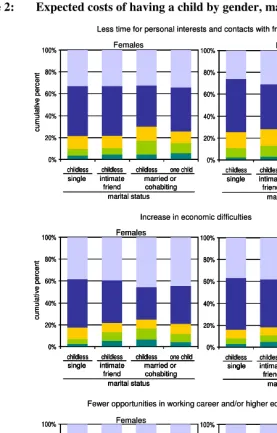
Figure 2 reports the distributions of agreements and disagreements related to the state-ments that address the expected costs of having children. As the first two graphs docu-ment, the majority of female and male respondents expect to be confronted with a dete-rioration of their networks because of the birth of a first or second child. Respondents who are single or who have an intimate friend particularly suppose that a first child will reduce their time for personal interests and contacts with friends. Married or cohabiting respondents show gender specific evaluations. Women tend to expect this kind of cost more often than men do. This holds especially for respondents with one child. Here, 74.3% of all women compared to 60.0% of all men completely or rather agree with the related statement.
Figure 2: Expected costs of having a child by gender, marital status, and parity 0% 20% 40% 60% 80% 100%
childless childless childless one child 0% 20% 40% 60% 80% 100%
childless childless childless one child
c u m u la ti v e p e rc e n t
Less time for personal interests and contacts with friends
Increase in economic difficulties
0% 20% 40% 60% 80% 100%
childless childless childless one child 0% 20% 40% 60% 80% 100%
childless childless childless one child
c u m u la ti v e p e rc e n t
Fewer opportunities in working career and/or higher education single intimate friend married or cohabiting marital status Females Males single intimate friend married or cohabiting marital status 0% 20% 40% 60% 80% 100%
childless childless childless one child 0% 20% 40% 60% 80% 100%
childless childless childless one child
c u m u la ti v e p e rc e n t Females Males single intimate friend married or cohabiting marital status single intimate friend married or cohabiting marital status Females Males single intimate friend married or cohabiting marital status single intimate friend married or cohabiting marital status
completely agree rather agree neither agree nor disagree rather disagree completely disagree
0% 20% 40% 60% 80% 100%
childless childless childless one child 0% 20% 40% 60% 80% 100%
childless childless childless one child
c u m u la ti v e p e rc e n t 0% 20% 40% 60% 80% 100%
childless childless childless one child 0% 20% 40% 60% 80% 100%
childless childless childless one child
c u m u la ti v e p e rc e n t
Less time for personal interests and contacts with friends
Increase in economic difficulties
0% 20% 40% 60% 80% 100%
childless childless childless one child 0% 20% 40% 60% 80% 100%
childless childless childless one child
c u m u la ti v e p e rc e n t 0% 20% 40% 60% 80% 100%
childless childless childless one child 0% 20% 40% 60% 80% 100%
childless childless childless one child
c u m u la ti v e p e rc e n t
Fewer opportunities in working career and/or higher education single intimate friend married or cohabiting marital status single intimate friend married or cohabiting marital status Females Males single intimate friend married or cohabiting marital status single intimate friend married or cohabiting marital status 0% 20% 40% 60% 80% 100%
childless childless childless one child 0% 20% 40% 60% 80% 100%
childless childless childless one child
c u m u la ti v e p e rc e n t Females Males single intimate friend married or cohabiting marital status single intimate friend married or cohabiting marital status 0% 20% 40% 60% 80% 100%
childless childless childless one child 0% 20% 40% 60% 80% 100%
childless childless childless one child
c u m u la ti v e p e rc e n t Females Males single intimate friend married or cohabiting marital status single intimate friend married or cohabiting marital status single intimate friend married or cohabiting marital status single intimate friend married or cohabiting marital status Females Males single intimate friend married or cohabiting marital status single intimate friend married or cohabiting marital status single intimate friend married or cohabiting marital status single intimate friend married or cohabiting marital status
completely agree rather agree neither agree nor disagree rather disagree completely disagree
completely agree rather agree neither agree nor disagree completely agree
completely agree rather agreerather agree neither agree nor disagreeneither agree nor disagree rather disagree completely disagree
4.4 Multivariate analyses
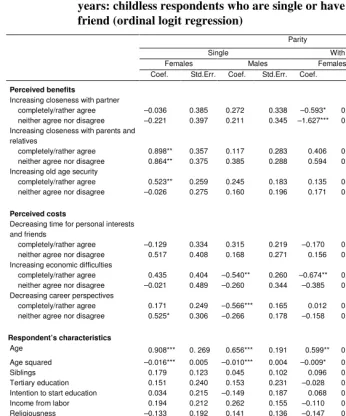
According to the results of the descriptive analyses, a large number of respondents ex-pects that the birth of a first or second child will improve their social environments. However, do these prospects promote the respondents’ intentions to have a child within the next two years? The subsequent multivariate analyses, reported in Tables 2 and 3, aim to provide an answer to this question (see Appendix C for descriptions of the vari-ables used in the multivariate analyses). Table 2 lists the estimates for the respondents who are single or who have an intimate friend; Table 3 presents the results for the mar-ried or cohabiting female and male respondents. 7
Although large proportions of single childless female and male respondents per-ceive the birth of a first child with structural benefits, only the evaluations of single female respondents are significantly associated with their intentions to have a first child (see Table 2). If these women completely or rather agree with the statement that a first child will increase their closeness with parents and relatives or that it would increase their security at old age, then they intend to have this child in the next two years with a higher probability than do respondents who do not perceive these kinds of values. For female and male respondents with an intimate friend, a different pattern of results has to be observed. Here, the expectation of an increasing closeness with the partner is the only relevant benefit. For male respondents, this evaluation has a significant positive association with their willingness to have a first child within a two years period. For female respondents the coefficient is significantly negative. This is a contradictory re-sult as it states that women are not willing to realize a benefit they expect to receive from their first child. However, one has to consider that the dependent variable is about the willingness to have this child within the next two years. Thus, these respondents may intend to postpone its birth, because they perhaps do not need to be supported by a child in order to improve their relationship with the friend or because they do not asso-ciate their current intimate relationship with the prospect of parenthood.
Looking at the perceived costs of having a first child, the expectations of less time for personal interests and contacts with friends do not show any association with the fertility intentions of males and females. Among single males, however, expected eco-nomic difficulties or decreasing career perspectives are a serious argument for not in-tending to have a first child within the next two years. This evaluation changes signifi-cantly, once an intimate partner is present, perhaps because the burden is now distrib-uted between two persons. However, if females with an intimate friend perceive that a first child would increase their economic difficulties, then they intend to postpone the birth of this child.
7 Subsequently, only the effects of the subjectively expected benefits and costs of children are reported. See
Among the childless married or cohabiting female and male respondents who as-sociate the birth of a first child with the expectation of increasing closeness with the partner or with their parents and relatives, only the latter evaluation is significantly re-lated to their intentions to have this child within a two years period (see Table 3). For female respondents, the prospect of increasing closeness with the partner is not corre-lated with their reproductive planning, and for men this perception is an argument to postpone the birth of this child probably. However, males’ fertility intentions increase, if they evaluate a first child as a means to improve their security at old age.
The expected structural benefit of increasing security at old age very much charac-terizes respondents’ motivations to have a second child, as it is significantly associated with both the females’ and males’ intentions of having this child within the next two years. Contrary to the childless respondents, the expectation that a second child will bring the partner closer is now a serious argument for female respondents to have this child, but it does not touch the males’ intentions in any significant way.
Of the expected costs of having a first child, the prospect of decreasing time for personal interests and contacts with friends is not a serious motivation for female and male respondents for not having this child soon. However, the expectation of increasing economic difficulties is negatively associated with the women’s intentions. This is not the case for male respondents. Possible negative impacts on working careers and/or higher education are significant arguments for female respondents to postpone the birth of a first child. Thus, women who perceive a clash between parenthood and their educa-tional or occupaeduca-tional situations tend to give priority to their occupaeduca-tional career.
Table 2: Determinants of intentions to have a first child within the next two years: childless respondents who are single or have an intimate friend (ordinal logit regression)
Parity
Single With an intimate friend
Females Males Females Males
Coef. Std.Err. Coef. Std.Err. Coef. Std.Err. Coef. Std.Err.
Perceived benefits
Increasing closeness with partner
completely/rather agree –0.036 0.385 0.272 0.338 –0.593* 0.342 0.999* 0.533 neither agree nor disagree –0.221 0.397 0.211 0.345 –1.627*** 0.398 0.260 0.590 Increasing closeness with parents and
relatives
completely/rather agree 0.898** 0.357 0.117 0.283 0.406 0.303 –0.146 0.378 neither agree nor disagree 0.864** 0.375 0.385 0.288 0.594 0.329 0.358 0.420 Increasing old age security
completely/rather agree 0.523** 0.259 0.245 0.183 0.135 0.221 0.345 0.240 neither agree nor disagree –0.026 0.275 0.160 0.196 0.171 0.250 –0.283 0.281
Perceived costs
Decreasing time for personal interests and friends
completely/rather agree –0.129 0.334 0.315 0.219 –0.170 0.308 0.018 0.286 neither agree nor disagree 0.517 0.408 0.168 0.271 0.156 0.380 –0.183 0.362 Increasing economic difficulties
completely/rather agree 0.435 0.404 –0.540** 0.260 –0.674** 0.274 0.015 0.324 neither agree nor disagree –0.021 0.489 –0.260 0.344 –0.385 0.385 0.060 0.470 Decreasing career perspectives
completely/rather agree 0.171 0.249 –0.566*** 0.165 0.012 0.213 –0.016 0.219 neither agree nor disagree 0.525* 0.306 –0.266 0.178 –0.158 0.318 –0.004 0.264
Respondent’s characteristics
Age 0.908*** 0. 269 0.656*** 0.191 0.599** 0.278 0.408 0.293
Age squared –0.016*** 0.005 –0.010*** 0.004 –0.009* 0.005 –0.005 0.006
Siblings 0.179 0.123 0.045 0.102 0.096 0.176 –0.104 0.162
Tertiary education 0.151 0.240 0.153 0.231 –0.028 0.224 –0.357 0.287 Intention to start education 0.034 0.215 –0.149 0.187 0.068 0.217 –0.266 0.242 Income from labor 0.194 0.212 0.262 0.155 –0.110 0.212 –0.013 0.220
Religiousness –0.133 0.192 0.141 0.136 –0.147 0.185 0.017 0.187
Household’s characteristics
Equivalence income (log) –0.057 0.145 –0.248** 0.109 –0.362** 0.160 –0.440*** 0.144
Countryside –0.569 0.303 –0.345* 0.176 –0.423 0.280 –0.351 0.278
Cut points
1 12.980 3.427 8.978 2.446 6.154 3.478 5.897 3.746
2 14.678 3.445 10.749 2.452 7.670 3.487 7.625 3.752
3 16.824 3.457 12.680 2.457 9.398 3.492 9.305 3.749
LL –488.193 –930.736 –554.842 –512.575
χ2 (df) 96.51 (21) 172.24 (21) 86.73 (21) 84.43 (21)
N 440 889 457 454
Table 3: Determinants of intentions to have a first or second child within the next two years: respondents who are married or cohabiting (ordinal logit regression)
Parity
0 1
Females Males Females Males
Coef. Std.Err. Coef. Std.Err. Coef. Std.Err. Coef. Std.Err.
Perceived benefits
Increasing closeness with partner
completely/rather agree 0.114 0.635 –1.605** 0.812 0.551** 0.240 0.345 0.281 neither agree nor disagree 0.724 0.713 –2.022** 0.927 0.065 0.247 0.182 0.295 Increasing closeness with parents
and relatives
completely/rather agree 1.212** 0.575 1.560** 0.619 0.168 0.211 0.133 0.234 neither agree nor disagree 0.413 0.594 1.453** 0.660 0.016 0.216 0.070 0.240 Increasing old age security
completely/rather agree –0.376 0.352 0.775* 0.437 0.362** 0.151 0.510*** 0.170 neither agree nor disagree 0.193 0.407 –0.024 0.472 0.387*** 0.165 0.464*** 0.181
Perceived costs
Decreasing time for personal inter-ests and friends
completely/rather agree 0.594 0.394 0.236 0.380 0.036 0.173 –0.380** 0.169 neither agree nor disagree 0.718 0.549 0.101 0.474 –0.059 0.240 –0.208 0.200 Increasing economic difficulties
completely/rather agree –0.822* 0.452 0.350 0.386 –0.883*** 0.193 –0.670*** 0.201 neither agree nor disagree –1.133* 0.655 0.947* 0.567 0.064 0.259 –0.050 0.270 Decreasing career perspectives
completely/rather agree –0.725** 0.326 –0.266 0.431 –0.200 0.137 –0.355** 0.161 neither agree nor disagree –0.893 0.585 0.355 0.406 –0.005 0.199 –0.287* 0.174
Respondent’s characteristics
Age 1.427*** 0.467 0.134 0.263 0.415** 0.200 0.185* 0.102
Age squared –0.027*** 0.009 –0.003 0.004 –0.007** 0.004 –0.003* 0.002
Age of first child -- -- -- -- –0.058*** 0.023 -0.057*** 0.018
Cohabitation 0.035 0.321 –0.421 0.292 -- -- -- --
Duration of partnership –0.099 0.064 –0.073 0.071 -- -- -- --
Siblings –0.087 0.206 –0.189 0.195 0.017 0.078 0.116 0.094
Tertiary education 0.190 0.359 –0.153 0.369 0.201 0.145 0.179 0.171 Intention to start education –0.588 0.404 –0.342 0.492 -- -- -- -- Income from labor 0.629* 0.343 0.888** 0.439 0.161 0.133 –0.094 0.201
Religiousness 0.182 0.293 0.110 0.287 0.218* 0.123 0.230* 0.124
Household’s characteristics
Equivalence income (log) –0.678*** 0.235 –0.265 0.217 0.140 0.100 0.318*** 0.107
Countryside 0.235 0.412 0.508 0.425 –0.130 0.170 0.008 0.176
Cut points
1 15.365 5.993 –0.374 4.120 5.321 2.708 2.463 1.683
2 16.496 6.010 0.798 4.123 6.711 2.711 4.060 1.686
3 18.052 6.033 2.535 4.125 8.419 2.714 5.998 1.691
LL –220.304 –233.088 –1248.061 –1128.814
χ2 (df) 43.08 (23) 43.86 (23) 117.93 (21) 96.55 (21)
N 185 194 994 903
The findings also give some hints about the variation of structural evaluations re-sulting from the respondents’ living situations. Since most Bulgarian females and males have their first child at the beginning of their marriage or cohabitation, they do not need to utilize this child as a means to improve or strengthen their relationships with their partners. This does not apply to individuals with an intimate friend. Their relationships are probably younger and less secure. This may lead to the perception that a first child is an investment in the relationship as it has a high potential to strengthen the bond be-tween the partners. Childless married or cohabiting couples, however, need more likely material and non-material support from their relatives to establish their families and to integrate them in the wider context of kin. Thus, their expectations of closer relation-ships with parents and relatives are significant motivations to have a first child within the next two years. Finally, the significant sensitivity of respondents to the expectation that a child will increase their security at old age refers to the fact that intergenerational transfers tend to have the character of long-term exchange processes in Bulgaria. Many parents expect to receive support from their children when they are old and many chil-dren feel obliged to compensate their parents for the costs and efforts spent on them during their childhood. However, this task is very much associated with the second child.
5. Concluding discussion
The purpose of the foregoing explanations was to discuss the structural value of chil-dren under a theoretical and empirical perspective. The theoretical section introduced the concept by arguing that the substantive aspects of the value of children rest on in-terpersonal exchange relationships between the parents and their children as well as between the parents and their relatives or other members of their social networks. Par-ents are provided with child-related benefits because of the child-induced changes of these relationships. Children are the direct exchange partners of their parents and supply them with a variety of intrinsic and material benefits. Moreover, in reacting to the birth of a first or another child, relatives or other members of the social environment cause changes in the parents’ status, prestige, power, or social recognition. These changes give them access to resources and advantages they did not have before. Therefore, chil-dren have a structural value to their parents as their birth induces direct and indirect alterations in the parents’ social networks, which build the basis for the provision of child-related benefits.
things, on the quality and character of the relationship between the child and its parents, on the values and goals the parents pursue by having a child (as these determine the resources that the parents are willing to spend on the child), as well as on general role models of parents and children. Moreover, the parents’ increase in status, power, or access to resources due to the birth of a child rests on the opportunities offered by the social environment. These opportunities reflect the cultural or social evaluations of par-enthood or ideas of an appropriate family size. Thus, the structural value of children enables the identification of the general meanings and implications of fertility by the characteristics of the parents’ relationships with their children and the reactions of the larger family or the local community to parenthood.
Second, the concept links the value of children with other theoretical approaches. The perception of the relationships between the parents and their children as processes of reciprocal exchange brings together child-related values with theories of intergenera-tional transfers. The aspect of postponed reciprocity highlights the mechanism behind the way in which parents are able to ensure the provision of long-term or future advan-tages. Moreover, as exchange relationships are characterized by exchanges of heteroge-neous material and non-material goods, the concept covers the altruistic as well as the instrumental motivations of the parents to transfer resources to their children. There are also overlaps with network-based theories of social capital. As these theories perceive the accumulation of individual social capital as an outcome of interpersonal exchange processes, they address the same structural mechanisms as does the structural value of children. Thus, the direct or indirect material benefits of children can form a substantive part of the parents’ social capital. Social capital can be built up purposefully and parents can perceive children as a means for its accumulation. This leads to the general conclu-sion that parents can intend to have a first or another child in order to improve their social networks by deliberately forming the structural conditions for the provision of child-related benefits.
Third, by following the conclusion above, the concept of the structural value of children helps in understanding the empirical phenomenon that individuals evaluate the birth of a child in terms of its potential to change their social environments in an advan-tageous way. Of course, individuals hardly evaluate the abstract changes in their social networks. It is more likely that they have the expected outcome of these changes in mind. In this case, structural evaluations work as summarizing assessments, i.e., indi-viduals assume they will profit from the birth of a child without being able to quantify these benefits in detail.
Friedman, Hechter, and Kanazawa 1994). Up to now, this criticism has not been consid-ered intensively in research on fertility. One way to solve this difficulty is the derivation of child-related benefits from the general immanent values all people struggle to fulfill (Nauck 2007, 2005, Nauck and Klaus 2007, Friedman, Hechter, and Kanazawa.1994, Lin-denberg 1990, 1991). In this case, the evaluations of children and the related benefits are expressions of these general values, which individuals intend to accomplish in the living-sphere of their families. Moreover, this general perspective of values enables analyses that address how much benefits that can be accomplished in other living spheres, like work or leisure, compete with the values provided by children.
The empirical section of the article explored the expectations of Bulgarian females and males that children will improve their social environments and analyzed the asso-ciations of these prospects with their intentions to have a child within the next two years. Similar to results from the United States (Schoen and Tufis 2003, Schoen et al. 1997), estimates from multivariate analyses show that structural evaluations are posi-tively correlated with individuals’ motivations to have children. The analyses, however, do not identify an aspect of structural evaluation that exerts a constant association with intended fertility among the different subgroups of respondents. This insight is consis-tent with results from other studies on Bulgaria (Bühler 2005, Bühler and Philipov 2005, Philipov, Spéder, and Billari 2006) that document a high variation by gender and parity of the socioeconomic characteristics influencing individuals’ reproductive plan-ning.
Nevertheless, the positive results for structural, child-related evaluations are re-markable, as the models also consider important child-related costs as well as objective characteristics of the respondents and their households. Thus, although people in Bul-garia associate the birth of a first or second child with substantive costs that are a seri-ous argument for postponing or stopping childbirth, the prospect of an improved social environment is to some extent a counterweight to these considerations. Of course, the analyses do not allow for the conclusion that the expected structural benefits of a child outweigh its expected costs. They do not consider the expected net-benefit of a first or second child, as the data do not cover the whole range of child-related benefits and costs.
6. Acknowledgements
References
Arnold, Fred, Bulatao, Rodolfo A., Buripakdi, Chalio, Chung, Betty Jamie, Fawcett, James T., Iritami, Toshio, Lee, Sung Jin, and Wu, Tsong-Shien (1975). The Value of Children. A Cross-National Study. Volume One: Introduction and Comparative Analysis. Honolulu: East-West Center, East-West Population Insti-tute.
Ashwin, Sarah (1998). “Endless Patience: Explaining Soviet and Post-Soviet Social Stability.” Communist and Post-Communist Studies, 31: 187-198.
Astone, Nan Marie, Nathanson, Constance A., Schoen, Robert, and Kim, Young J. (1999). “Family Demography, Social Theory, and Investment in Social Capital.” Population and Development Review, 25, 1: 1-31.
Becker, Gary S. (1993). A Treatise of the Family. Cambridge: Harvard University Press.
Befu, Harumi (1977). “Social Exchange.” Annual Review of Anthropology, 6: 255-281.
Bernardi, Laura (2003). “Channels of Social Influence on Reproduction.” Population Research and Policy Review, 22: 527-555.
Bernardi, Laura, Keim, Sylvia, and von der Lippe, Holger (2007). “Social Influences on Fertility: A Comparative Mixed Methods Study in Eastern and Western Ger-many.” Journal of Mixed Methods Research, 1: 23-47.
Billari, Francesco C. and Philipov, Dimiter (2005). The Influence of Attitudes, Subjec-tive Norms and Perceived Behavioral Control on Fertility Intentions. Paper pre-sented at the Annual Meeting of the Population Association of America, Phila-delphia, April 2005.
Bongaarts, John (2001). “Fertility and Reproductive Preferences in Post-Transitional Societies.” Population and Development Review, 27: S260-S281.
Bongaarts, John (1990). “The Measurement of Wanted Fertility.” Population and De-velopment Review, 16, 3: 487-506.
Borén, Thomas (2003). What are Friends for? Rationales of Informal Exchange in Rus-sian Everyday Life. In: Arnstberg, Karl-Olov and Borén, Thomas (eds.) Every-day Economy in Russia, Poland and Latvia. Södertörn Academic Studies 16, Stockholm: Almqvist & Wiksell International: 21-36.