www.theoryofgroups.ir
ISSN (print): 2251-7650, ISSN (on-line): 2251-7669 Vol. 2 No. 4 (2013), pp. 43-88.
c
2013 University of Isfahan
www.ui.ac.ir
THE n-ARY ADDING MACHINE AND SOLVABLE GROUPS
J. DA SILVA ROCHA AND S. NAJATI SIDKI∗
Communicated by Alireza Abdollahi
Abstract. We describe under various conditions abelian subgroups of the automorphism group Aut(Tn)
of the regular n-ary treeTn, which are normalized by the n-ary adding machineτ = (e, . . . , e, τ)στ
whereστis then-cycle (0,1, . . . , n−1). As an application, forn=pa prime number, and forn= 4, we
prove that every soluble subgroup of Aut(Tn), containingτis an extension of a torsion-free metabelian
group by a finite group.
1. Introduction
Adding machines have played an important role in dynamical systems, and in the theory of groups
acting on trees : see [1, 6, 7, 3, 5].
An element α in the automorphism group An = Aut(Tn) of the n-ary tree Tn, is represented as α =α|φ = (α|0, . . . , α|n−1)σα where φis the empty sequence from the free monoid M generated by Y = {0,1, . . . , n−1}, where α|i ∈ An, for i∈ Y, are called 1st level states of α and where σα (the activity ofα) is a permutation in the symmetric group Σnon Y extended ‘rigidly’ to act on the tree; ifσα=e, we say that α is inactive.
In applying the same representation to α|0 we produce α|0i for all i ∈ Y and we produce in general {α|u |u∈ M } the set of states of α. Following this notation, the n-ary adding machine is represented as τ = (e, . . . , e, τ)στ where e is the identity automorphism and στ is the regular permutation σ = (0,1, . . . , n−1). In this sense, the adding machine is an infinite variant of the regular permutation which appears often in geometric and combinatorial contexts.
MSC(2010): Primary: 20F05; Secondary: 05C05; 20E08; 20F16.
Keywords: Adding machine, Tree automorphisms, Automata, Solvable Groups. Received: 20 April 2013, Accepted: 4 June 2013.
∗Corresponding author.
A characteristic feature of τ is that its n-th power τn is the diagonal automorphism of the tree (τ, . . . , τ). This fact implies that the centralizer of the cyclic grouphτiinAnis equal to its topological closure hτi in the groupAn when considered as a topological group with respect to the the natural topology induced by the tree. The pro-cyclic grouphτiis isomorphic toZn, the ring ofn-adic integers ξ =P
i≥0aini (0≤ai ≤n−1 for alli).
A large variety of subgroups ofAn which containτ have been constructed, including groups which are torsion-free and just non-solvable without free subgroups of rank 2 (see, [2, 8] and generalizations
thereof [10]). Furthermore, the free group of rank 2 has been represented on the binary tree as a group
generated by two conjugates of the adding machine τ each having a finite number of states [11]. On the other hand, the restricted structure of its centralizer indicate that solvable groups which contain
τ have restricted structure. For nilpotent groups we show
Proposition. Let G be a nilpotent subgroup of An which contains the n-adic adding machine τ.
Then G is a subgroup of < τ > .
The most visible examples of solvable groups containing τ are conjugate to subgroups of those belonging to the infinite sequence of groups
Γ0 = NAn(hτi),
Γi+1 = (×nΓi)oGi+1 (i≥0)
where ×nΓi is a direct product of ncopies of Γi (seen as a subgroup of the 1st level stabilizer of the tree) and where Gi is a solvable subgroup of the symmetric group Σn in its canonical action on the tree and containing the cycle στ. We observe that for all i, the groups Γi are metabelian by ’finite solvable subgroups of Σn’. It was shown by the second author that for n= 2, solvable groups which contain the binary adding machine are conjugate to some subgroups of Γi acting on the binary tree
[9]. This appears to be the general pattern. However, the description for degrees n > 2 requires a classification of solvable subgroups of Σnwhich contain the cycleσ= (0,1, . . . , n−1)[4]. This in itself is an open problem, even for metabelian groups. On the other hand, the answer for primitive solvable
subgroups of Σn is simple and classical. For then,n is a prime numberporn= 4. In casen=p, the solvable subgroups Gi can all be taken to be the normalizer F =NΣn(hσi) of orderp(p−1) and in
case n= 4, the Gi’s can all be taken to be the symmetric group Σ4.
Given this background, the main theorem of this paper is
Theorem A. Let n = p, a prime number, or n = 4. Then any solvable subgroup of Anwhich contains the n-ary machine τ is conjugate to a subgroup of Γi for some i.
The result follows first from general analysis of the conditions [β, βτx] = e (for some β ∈ An and all x ∈Z), then their impact on the 1st level states of the subgroup hβ, τi and on how these in turn translate successively to conditions on states at lower levels. It is somewhat surprising that the process
converges to a clear global description for trees of degrees pand 4.
Theorem B. LetB be an abelian subgroup ofAn normalized byτ,letβ= (β|0, β|1, . . . , β|n−1)σβ ∈ Band define the subgroup H =hβ|i(i∈Y), τi generated by the first level states of β andτ.
(I) Suppose σβ = (στ)s for some integer s. Then H is metabelian-by-finite. More precisely, let m= n
gcd(n,s), define the productπi =β|iβ|i+sβ|i+2s· · ·β|i+(m−1)s(the notationβ|j meansβ|j,where j is the
representative of j in Y modulo n) and define the subgroup
K =
D
[β|i, τk], πi |k∈Z, i∈Y E
Then K is an abelian group and H affords the normal series
H DKhτi(=O)DK
where the quotient group HO is a homomorphic image of a subgroup of the wreath product CmoCn of
the cyclic groups Cm, Cn.
(II) Let n be an even number. Then H is a metabelian group if s= n2 or if σβ is a transposition. Part (I) of Theorem B will be proven in Sections 4 and 5 and part (II) in Section 7.
Let P be a subgroup of Σn. Thelayer closure of P inAn is the groupL(P) formed by elements of An whose states have activities in P. The following result is yet another characterization of the adding machine.
Theorem C. Let n be an odd number and let L =L(hσi), the layer closure of hσi in An. Let s be an integer which is relatively prime to n and let β = (β|0, β|1, . . . , β|n−1)σs ∈ L be such that
[β, βτx] =e for all x∈Z. Then β is a conjugate of τ in L.
2. Preliminaries
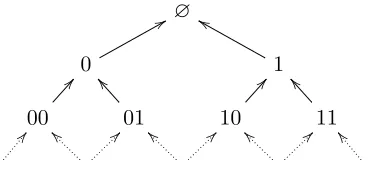
We start by introducing definitions and notation. Then-ary treeTncan be identified with the free monoid M =< 0,1, . . . , n−1 >∗ of finite sequences from Y = {0,1, . . . , n−1}, ordered by v ≤ u provided uis an initial subword of v.
The identity element of M is the empty sequence φ. The level function for Tn, denoted by |m| is the length of m∈ M; the root vertex φhas level 0.
∅
0
8
8
1
f
f
00
A
A
01
]
]
10
A
A
11
]
]
B
B `` >> `` >> `` >> \\
Figure 1. The Binary Tree
representatives i inY, modulon . Permutationsσ in Σn are extended ‘rigidly’ to automorphisms of
An by
(y.u)ρ= (y)σ.u, ∀y∈Y, ∀u∈ M.
An automorphism α ∈ An induces a permutation σα on the set Y. Consequently, α affords the representationα=α0σα whereα0 fixes Y point-wise and for eachi∈Y,α0 inducesα|i on the subtree whose vertices form the set i· M. If j is an integer the α|j will be understood as α|j where j is the representative of j inY modulo n.
Given i in Y, we use the canonical isomorphism i·u 7→ u between i· M and the tree Tn, and thus identify α|i with an automorphism ofTn; therefore, α0 ∈ F(Y,An), the set of functions from Y into An, or what is the same, the 1st level stabilizer Stab(1) of the tree. This provides us with the factorizationAn=F(Y,An)·Σn.
Letα, β, γ ∈ An. Then the following formulas hold
(2.1) σα−1 = (σα)−1, σασβ =σαβ,
(2.2) (α−1)|u =
α|
(u)α−1
−1
,
(2.3) (αβ)|u= (α|u) (γ|u) where γ|u =β|(u)α
(2.4) γ =α−1βα⇔σγ =σα−1σβσα andγ|(i)σα =α| −1
i β|iα|(i)σβ,∀i∈Y
.
(2.5) θ= [β, α] =β−1βα ⇔
σθ= [σβ, σα], θ|(i)σ
αβ = β|(i)σα
−1
(α|i)−1(β|i)α|(i)σ
β
,∀i∈Y.
(2.6) (αm)|i = (α|i) α|(i)σα
α|(i)σ2 α
· · ·α|(i)σm−1 α
(2.7) (βα)|u= β|(u)α−1α |(u)α−1
,whereβ ∈Stab(k) and |u| ≤k.
An automorphismα∈ Ancorresponds to an input-output automaton with alphabetY and with set of states Q(α) ={α|u |u∈ M}. The automatonαtransforms the letters as follows: if the automaton is in state α|u and reads a letter i∈Y then it outputs the letter j= (i)α|u and its state changes to α|ui; these operations can be best described by the labeled edgeα|u
i|j
−→ α|ui. Following terminology of automata theory, every automorphism α|u is called thestate of α atu.
The treeTnis a topological space which is the direct limit of its truncations at then-th levels. Thus the groupAn is the inverse limit of the permutation groups it induces on then-th level vertices. This transformsAninto a topological group. An infinite product of elementsAnis a well-defined element of
action on vertices at levell. Thus, ifα∈ Anand ξ=P
i≥0aini ∈Zn thenαξ=αa0·αna1· · ·αn
ia i· · ·
is a well defined element of An. The notation α|ξ is to be understood asα|i wherei=a0.
The topological closure of a subgroupHinAn will be indicated byH. We note that ifHis abelian then
H ={hξ |h∈H, ξ ∈Zn}.
One of the characterizing aspects of then-ary adding machine is that the centralizer ofτ is a pro-cyclic group; namely,
CAn(τ) =hτi={τξ|ξ ∈Zn}.
Letv =yuwhere y∈Y, u∈ M. The image ofv under the action of α is
(v)α= (yu)α= (y)σα.(u)α|y.
The action extends to infinite sequences (or boundary points of the tree) in the same manner. A
boundary point of the tree c=c0c1c2. . . ,whereci ∈Y for alli, corresponds also to then-adic integer ξ =P
{cini|i≥0} ∈Zn. Thus the action of the tree automorphism α can thus be translated to an action on the ring ofn-adic integers. We will indicatec0 byξ which isξ modulo n. In the case of the
automorphism τ = (e, e, . . . , e, τ)σ, the action of τ on cis
(c)τ = (
(c0+ 1)c1c2. . . if 0≤c0≤n−2,
0(c1c2. . .)τ, ifc0=n−1,
which translates to the n-ary addition
ξτ =ξ+ 1.
τ
1/0
K
K
0/1
/
/ e
0/0,1/1
Figure 2. The binary adding machine
3. Normalizer of the topological closure hτi
An elementξ =P
i≥0aini∈Znis a unit inZn if and only ifξ(=a0) is a unit in Zmodulon. The group of automorphisms ofZnis isomorphic to the multiplicative group of unitsU(Zn). The subgroup of U(Zn) consisting of elementsξ withξ = 1 is denoted by byZ1n. This subgroup has the transversal
{j |1≤j≤n−1,gcd (j, n) = 1} inU(Zn) and therefore has index U(Zn) :Z1n
=ϕ(n) where ϕ is the Euler function.
3.1. Powers of τ. Letξ =P
i≥0aini ∈Zn. Then Pi≥1aini−1 = ξ−nξ. Lemma 3.1. Let ξ∈Zn. Then
τξ= (τξ−an0, . . . , τ ξ−a0
n , τ ξ−a0
n +1, . . . , τ ξ−a0
n +1
| {z }
a0terms
)σa0 τ .
Proof. Forj an integer with 1≤j ≤n−1, we have
τj =
e, . . . , e, τ, . . . , τ
| {z }
jterms
σ
j τ
and τn= (τ, . . . , τ) =τ(1). Given ξ=P
i≥0aini, then
τa0 = (e, . . . , e, τ, . . . , τ
| {z }
a0terms )σa0
τ , (3.1)
τajnj = τ(ajnj−1)n=τajnj−1(1),
(3.2)
τξ = (τξ−an0, . . . , τ ξ−a0
n , τ ξ−a0
n +1, . . . , τ ξ−a0
n +1
| {z }
a0terms
)σa0 τ (3.3)
= (τξ−ξn , . . . , τ ξ−ξ
n , τ ξ−ξ
n +1, . . . , τ ξ−ξ
n +1
| {z }
ξterms
)σξτ. (3.4)
As we have seen, the description of τξ involves the partition of the interval [0, . . . , n−1] into two subintervals. It is convenient to use here the carry 2-cocycle
δ:Zn×Zn→ {0,1} defined by
δ(η, κ) = η+κ−η+κ
n =
(
0, ifη+κ < n 1, otherwise .
We call this 2-valued function by Delta-2 ( later on we will introduce a 3-valued function Delta-3). UsingDelta-2, the notation for the power of τ becomes
(3.5) τξ=
τξ−ξn +δ(i,ξ)
0≤i≤n−1
/
/
O
O
0 1 2 3 iii
1 2 3
jjj
• • •
• •
•
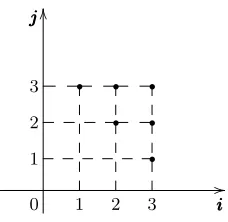
Figure 3. Delta 2 function forn= 4.
3.2. Centralizer of τ.
Lemma 3.2. CAn(τ) =hτi.
Proof. Let α ∈ An commute with τ. Then, [σα, στ] = e and therefore σα = (στ)s0 for some integer 0≤s0 ≤n−1. Therefore,β =ατ−s0 = (β|0, ..., β|n−1) commutes withτ andσβ =e. Now,
βτ = ((β|n−1)τ, β|0, . . . , β|n−2) =β
implies β|i = β|0 for all 0 ≤ i ≤ n−1 and β|0 commutes with τ. Therefore β = (β|0)(1) and β|0
replaces α in the previous argument. Hence, there exists an integer s1 such that 0≤s1 ≤n−1 and
γ =β|0τ−s1 = (γ|0)(1). From this we conclude
α = βτs0 = (β|
0)(1)τs0
=
(γ|0)(1)τs1, . . . ,(γ|0)(1)τs1
τs0
= (γ|0)(2)τns1τs0 = (γ|0)(2)τns1+s0.
We obtain the desired form inductively, α=τξ where
ξ=s0+s1n+s2n2+. . .
The characterization of nilpotent groups which containτ, announced in the introduction, follows.
Proposition 3.3. Let G be a nilpotent subgroup of An which contains the n-adic adding machine τ. Then G is a subgroup of < τ >.
Proof. Suppose G is a nilpotent group of class k > 1 which contains τ. Then, the center Z(G) is contained in hτi. Let j be the maximum index such that Zj(G) ≤ hτi and let α ∈ Zj+1(G)\hτi.
Then [τ, α]∈Zj(G) and therefore [τ, α] =τξ for someξ∈Zn\ {0}. Therefore
[τ,2α] = [τ, α, α] = h
τξ, α i
= [τ, α]ξ=τξ2 ∈Zj−1(G)
and more generally, forl≥1, we have [τ, lα] =τξl ∈Z
j−l+1(G). It follows thatτξ j−1
∈Z0(G) ={e}.
3.3. Normalizer of hτi.
Lemma 3.4. The group Γ0 =NAn
hτi is metabelian. Indeed, the derived subgroupΓ00 is contained in hτi.
Proof. Letα, β ∈Γ0,then τα=τξ andτβ =τη for someη, ξ∈U(Zn). Therefore,
τα =τξ, τ = (τξ)α−1 = (τα−1)ξ,
τα−1 =τξ−1.
Likewise,τβ−1 =τη−1. Thus, τ[α,β]=τ and Γ00 ≤CAn(τ) =hτifollows.
We present properties of the Delta-2 function which we will use in the sequel.
Lemma 3.5. For all 0≤i, j < n and ξ∈Zn we have
n−1
X
i=0
δ(i, j) = j,
δ(i, jξ) = j
ξ−ξ n
−jξ−jξ
n +
j−1
X
k=0
δ(i+kξ, ξ).
Proof. The first assertion is easy to verify. The second is obtained from
(τξ)j|i = (τξ)|i(τξ)|i+ξ· · ·(τξ)|i+(j−1)ξ, by substituting
(τξ)|i=τξ−ξn +δ(i,ξ)
in its right hand side and
τξj|i =τ
jξ−jξ n +δ(i,jξ)
in its left.
Proposition 3.6. Given α ∈ An and ξ ∈ U(Zn). Then the condition τα = τξ is equivalent to
conditions (i), (ii) and (iii) below. (i)
α|i = (α|0)τµi (1≤i≤n−1) where
µi =i (ξ−ξ)
n +
i−1
X
k=0
δ((v(α) +k)ξ, ξ)
and where v(α) is defined by
(ii) (recursion)
τα|0 =τξ; (iii)
(j)σα= (v(α) +j)ξ (0≤j≤n−1).
Furthermore, if ξ∈Z1n, then v(α) = 0, (j)σα=jξ=j and µi=iξ−1n .
Proof. Since σσα
τ =σ ξ
τ, we have an equality between the permutations
((0)σα,(1)σα, . . . ,(n−1)σα) = (0, ξ,2ξ, . . . ,(n−1)ξ).
Therefore, there exists v(α)∈Y such that (0)σα=v(α)ξ and so,
(j)σα= (v(α) +j)ξ, ∀j∈Y.
Now, τα=τξ is equivalent toα=τ−sατsξ for everys∈Z,which in turn is equivalent to α|(i)σs
τ = ((τ
s)|
i)−1(α|i) (τξs)|(i)σα,∀i∈Y,∀s∈Z.
The latter conditions are equivalent to
α|0 = α|(0)σn τ = ((τ
n)|
0)−1(α|0) (τξn)|(0)σα,
α|i = α|(0)σi τ = (τ
i)|
0
−1
α|0(τξi)|(0)σα ∀i∈Y\{0}
and these in turn are equivalent to
α|i = α|0τ ξi−ξi
n +δ(v(α)ξ,ξi) =α|0τµi,
µi = i
ξ−ξ n
+
i−1
X
k=0
δ((v(α) +k)ξ, ξ) ∀i∈Y\{0}.
If ξ∈Z1
n,then
Pi−1
k=0δ(kξ, ξ) =
Pi−1
k=0δ(k,1) = 0. The rest of the assertion follows directly.
Corollary 3.7. Let ξ ∈U(Zn), σα andµi be as above. Then α = (α)(1)(e, τµ1, . . . , τµn−1)σα
conju-gates τ to τξ. In particular, if ξ ∈ Z1
n, then α= (α)(1)(e, τ
ξ−1 n , τ2
ξ−1
n , . . . , τ(n−1) ξ−1
n ) (denoted by λξ) conjugates τ toτξ.
Although we have computed above an automorphism which invertsτ, we give another with a simpler description. Define the permutation
ε= (0, n−1) (1, n−2). . .
n−2 2
,
n+ 1
2
.
Then εinvertsστ = (0,1, . . . , n−1) and
ι=ι(1)ε inverts τ.
Define
Λ = {λξ|ξ∈Z1n},
and call Ψ themonic normalizer ofhτi.
Proposition 3.8. (i) Λ is an abelian group isomorphic to Z1n;
(ii) Ψ = Λnhτi ∼=Z1nn Zn;
(iii) on letting Ψ0 denote the derived subgroup of Ψ, we haveΨ0 =hτni.
Proof. (i) Letξ, θ∈Z1
n.Then, asλξ, λθ andλξθ are inactive, it follows that (λξλθλ−1ξθ)|i = (λξ)|i(λθ)|i((λξθ)|i)−1
=λξτi
ξ−1 n λθτi
θ−1 n
λξθτi
ξθ−1 n
−1
=λξλθλ−1θ τ iξ−n1λ
θτi
θ−1 n τ−i
ξθ−1 n λ−1
ξθ
=λξλθ
τiθξ−n1τi θ−1
n τ−i ξθ−1
n
λ−1ξθ =λξλθλξθ−1,∀i∈ {0, . . . , n−1}. Therefore, λξλθ=λξθ. In addition, λξ =eif and only if ξ= 1.
(ii) This factorization is clear.
(iii) Letθ= 1 +θ0n, η∈Zn. Then
[τη, λθ] = τ−ηλθ−1τηλθ=
τ−ητηθ = τη(θ−1)= (τn)ηθ0.
We prove below the existence of conjugates τα of τ inNAn
hτi, which lie outsidehτi. This fact allows us to construct the first important type of metabelian groups hτi hταi containing τ.
Proposition 3.9. Given ξ, ρ ∈ Z1
n with ξ 6= 1. Then for all n odd and for all n even such that 2n|(ξ−1), an element α= (α|0, . . . , α|n−1) in An satisfiesτα=λξτρ if and only if
α|i+1 = (α|0)λξi+1τ 1 n
ρξi+1ξ−−11−(i+1)
(0≤i≤n−2), τα|0 =λ
ξnτ 1 n
h ρξn−ξ−11
i
.
Proof. Fromτα=λξτ1+κn, we obtain using (2.4), (
λξτi
ξ−1
n +κ = α|−1
i
α|i+1, ifi∈Y − {n−1}
λξτ(n−1)
ξ−1
n +κ+1 = α|−1
n−1
τ(α|0) .
Therefore,
α|i+1= (α|0)λξτκλξτ
ξ−1
n +κ· · ·λξτi ξ−1
n +κ, fori= 0,1, . . . , n−2,
α|0=τ−1(α|n−1)λξτ(n−1)
ξ−1 n +κ+1.
The first equations can be expressed as
α|i+1 = (α|0)λξi+1τκ(
Pi j=0ξj)+
ξ−1 n ξ
i(Pi j=1j(ξ
−1)j)
= (α|0)λξi+1τ 1 n
(1+κn)ξi+1ξ−1−1−(i+1)
α|0 = τ−1(α|0)λξnτ ξ n
(1+κn)ξnξ−−11−1−(n−1)
τ(n−1)ξ−n1+κ+1
= τ−1(α|0)λξnτ 1 n
h
(1+κn)ξn−ξ−11i
.
Now, we need to show that τα|0 = λ ξnτ
1 n
h
(1+κn)ξn−ξ−11
i
satisfies the same conditions as those for α; that is, bothξn, ρ0 = 1nh(1 +κn)ξξn−1−1i∈Z1
n. Of course, ξn ∈ Z1
n,so let us consider ρ(ξn−1)/n(ξ−1). Since ξ ∈ Z1n, we can writeξ = 1 +`n, and then
ξn−1
ξ−1 ≡n+
n 2
`n(modn2), by using the Binomial Theorem. Since ρ≡1 (mod n),it follows that
ρ(ξn−1) n(ξ−1) ≡1 +
n 2
`(modn),
and consequently, ρ(ξn−1)/n(ξ −1) ∈ Z1n if and only if n | n
2
` (that is, if and only if (n−1)` is even). So ρ(ξn−1)/n(ξ−1)∈Z1
n holds for oddn, and for evenn provided that 2n|(ξ−1).
4. Abelian groups B normalized by τ
Let B be an abelian subgroup of An normalized by τ. For a fixed β ∈ B, we define the ‘1st level state closure’ ofhβ, τi as the group
H =hβ|i (i∈Y), τi.
We will be dealing frequently with the following subgroups of H ,
N =
D
[β|i, τki]|ki ∈Z, i∈Y E
M = Nhτi.
When σβ = (στ)s for some integer s,m= gcd(nn,s) and
πi=β|iβ|i+sβ|i+2s· · ·β|i+(m−1)s
we will also be dealing with the subgroups
K = hN, πi|i∈Yi, O = Khτi.
Proposition 4.1. Let n=pk, σ = (0,1, ..., n−1)and P be a Sylow p-subgroup P of Σn which con-tains σ. Then
(i) P is isomorphic to ((...(...Cp)o)Cp)oCp, a wreath product of the cyclic group Cp of orderp iterated k−1 times; the normalizer of P in Σn isNΣn(P) =Phci where c is cyclic of orderp−1;
(ii) P is the unique Sylow p-subgroup P of Σn which contains σ;
(iii) if W is an abelian subgroup ofΣn normalized by σ thenW is contained inP.
Proof. (i) The structure of P as an iterated wreath product is well-known. The center of P is Z = D
z
=σpk−1 E
and CΣn(z) = P. Therefore, NΣn(P) = NΣn(Z) = Phci where c is cyclic of order
p−1.
(ii) If σ∈Pg for some g∈Σn thenzg∈CΣn(σ) =hσi and therefore hzgi=hzi, Pg =P. Thus, P
is the unique Sylowp-subgroup of Σnto contain σ.
(iii) Let W be an abelian subgroup of Σn normalized byσ. LetV =Whσi and V0 be the stabilizer
of 0 in V. Then, since σ is a regular cycle, it follows that V =V0hσi, V0∩ hσi ={e}. Suppose that
there exists a prime q different from p which divides the order of W and let Q be the unique Sylow q-subgroup ofW. Then Qis the unique Sylowq-subgroup ofV andQ≤V0.Therefore, Q={e} and
W is a p-group. Asσ ∈V, we conclude W ≤P.
Lemma 4.2. (a) Let γ∈ An. Conditions (i), (ii) below are equivalent:
(i) [γ, γτk] =e for allk∈Z; (ii) [τk, γ, γ] =e for allk∈Z. Condition (i) implies
(iii) [γ, τk]|k∈Z is a commutative group.
Condition (iii) implies
[γ|u, τk]|k∈Z
is a commutative group for all indices u.
(b) Let n = pk. Then any abelian subgroup B normalized by τ is contained in the layer closure L=L(NΣn(P)).
Proof. (a) First,
[γ, γτk] =γ−1 τ−kγ−1τkγ τ−kγτk =γ−1 τ−kγ−1τkγ
γ γ−1τ−kγτk = [τk, γ]γ[γ, τk]
and so,
[γ, γτk] =e⇔[γ, τk]γ= [γ, τk]. Furthermore, since
for all integers k1, k2, condition (ii) implies
[γ, τk1][γ,τk2] = [γ, τk1]γ−1τ−k2γτk2 = [γ, τk1]τ−k2γτk2 = [γ, τ−k2]−1[γ, τk1−k2]γτ
k2
=[γ, τ−k2]−1[γ, τk1−k2]τ k2
= [γ, τk1].
Finally, we note that by (2.5),
([γ, τnk])|(i)σγ = (γ−1)|(i)σγ(τ−nk)|i(γ|i) (τnk)|(i)σγ
= γ|−1i
τ−k(γ|i)τk = [γ|i, τk].
Since [γ, τkn] is inactive for all k∈ Z, we obtain {[γ|i, τk]|k ∈Z} is a commutative set for all i. The rest of the assertion follows by induction on the tree level.
(b) Letβ ∈B. Since the normal closure ofhσβiunder the action of hστiis an abelian subgroup, it follows thatσβ ∈P. Furthermore, as
[β|u, τk]|k∈Zis an abelian group normalized byτ, it follows that [σβ|u, σ]∈P and therefore σσβ|u ∈P. Thus, we conclude σβ|u ∈NΣn(P) and β ∈L.
Proposition 4.3. Let l≥1 and suppose α, γ∈Stab(l) satisfy [α, γτx] =e for allx∈Z. Then
[α|u,(γ|v)τx] =e,∀u, v∈ M having |u|=|v| ≤l and∀x∈Z.
Proof. We start with the casel= 1. Write x=r+knwherer =x. By (2.4),
γτx|(i)τx = (τx)|−1i
(γ|i) (τx)|i, γτx
|i = τ−k−δ(i−r,r)(γ|i−r)τk+δ(i−r,r).
As [α, γτx] =eand α, γτx ∈Stab(1),we have, for alli, j, r ∈Y and allk, x∈Z, [α|i,(γτx)|i] = e, [α|i,(γ|i−r)τ
k+δ(i−r,r) ] =e, [α|i,(γ|j)τ
x
] = e.
The general case l≥1 follows by induction.
We apply the above proposition to β ∈B.
Corollary 4.4. Let σβ =e. Then for all i, j∈Y and for all x∈Z
[(β|i),(β|j)τx] =e.
We derive further relations inH =hβ|i (i∈Y), τi.
(I)
τv|(i)σ−v τ
−1
β|(i)σ−v
τ τ
v|
(i)σ−vτ σβ β|(i)στ−vσβσvτ
= (β|i)
τv|(i)σ
βσ−vτ
−1
β|(i)σ
βστ−v τ
v|
(i)σβσ−vτ σβ
,
[σβ, σσ
v τ
β ] =e; (II)
[β|i, τv]β
|(i)σβ
= [β|(i)σβ, τv]; (III)
β|(i)σβ β|(i)σ2 β
· · ·β|(i)σsi β
commutes with [β|i, τv]
where si is the size of the orbit of iunder the action of hσβi.
Proof. (I) Clearly [β, βτv] =eimplies [σβ, σσ
v τ
β ] =e. It also implies
β|(i)σ
βτv
−1
βτv|i −1
(β|i)
βτv|(i)σβ=e,
βτv|i β|(i)σ
βτv
= (β|i)βτv|(i)σ
β
,
τv|(i)σ−1 τ v
−1
β|(i)σ−1 τ v τ
v|
(i)(σ−τ v1)(σβ) β|(i)σβτv
= (β|i)τv|(i)(σ
β)(στ v−1)
−1
β|(i)(σ
β)(σ−τ v1) (τ
v)|
(i)σβ(σ−τ v1)σβ
.
(II) On changing v tonvin (I), we obtain:
τ−v(β|i)τvβ|(i)σ
β
= (β|i)τ−vβ|(i)σ
β
τv,
β|(i)σβ−1 β|−1i
τ−v(β|i)τv
β|(i)σβ
= (
β|(i)σβ−1 β|−1i
) (β|i)τ−v
β|(i)σβτv. (III) From (II), we derive
[β|i, τv]
β|(i)σβ
β|(i)σ2
β
···
β|
(i)σsi
β
= [β|(i)σ
β, τ
v]
β|(i)σ2 β
···
β|
(i)σsi
β
=...= [β|i, τv].
5. The case β ∈B with σβ ∈ hστi
This section is devoted to the proof of the second part of Theorem B. For this purpose, we introduce
the following 3-variable combination of Delta-2 functions
∆s(i, t) =δ(i, t−i)−δ(i−s, t−i)
which we call theDelta-3 function.
Lemma 5.1. Let β ∈ An such that[β, βτ
x
] =efor any x∈Z and letσβ =στs for some s∈Y.Then,
τ∆s(i,t)(β|i−s) [β|i−s, τz] (β|t) = (β|t−s) (β|i) [β|i, τz]τ∆s(i+s,t+s), for all i, t∈ {0,1, . . . , n−1}, z∈Z.
Proof. Since σβ =σsτ, we have σβτ x =σβ =σsτ.
From (2.4) and (2.5), we obtain
(5.1) τ
−x−x
n −δ(j−x,x)(β|j−x)τ x−x
n +δ(j−x+s,x)(β|j+s)
= (β|j)τ−
x−x
n −δ(j+s−x,x)(β|j+s−x)τ x−x
n +δ(j+2s−x,x)
Setting k= x−x
n and r=xand using (5.1), we have
(5.2) τ
−k−δ(j−r,r)(β|
j−r)τk+δ(j+s−r,r)(β|j+s) = (β|j)τ−k−δ(j+s−r,r)(β|j+s−r)τk+δ(j+2s−r,r), for all r, j∈Y and all k∈Z.
Also on settingt=j+s, i=j+s−r and z=k+δ(j+s−r, r) (=k+δ(i, t−i)) and using (5.2), we obtain
τ−z+δ(i,t−i)−δ(i−s,t−i)β|
i−sτzβ|t = β|t−sτ−zβ|iτz−δ(i,t−i)+δ(i+s,t−i), for all t, i∈ {0,1, . . . , n−1} and allz∈Z.
It follows that
τδ(i,t−i)−δ(i−s,t−i)(β|i−s) [β|i−s, τz] (β|t) = (β|t−s) (β|i) [β|i, τz]τ−δ(i,t−i)+δ(i+s,t−i)
for all t, i∈ {0,1, . . . , n−1} and allz∈Z.
We develop below some properties of the ∆s function to be used in the sequel.
Proposition 5.2. The Delta-3 function satisfies
(i) ∆s(i, t) =δ(i,−s)−δ(t,−s) =
0, ift, i≥s or t, i < s 1, if t < s≤i
−1, if i < s≤t
(ii) ∆s(i, t) =−∆s(t, i),
(iii) ∆s(i+s, t+s) =−∆−s(i, t), (iv) ∆s(i, t) = ∆s(i, z) + ∆s(z, t),
(v)
n
(s,n)−1
X
k=0
∆s(i+ks, t+ks) = 0,
(vi) n−1
X
k=0
∆s(k, t) = (
n−s, if t < s
−s if t≥s
for all i, t, z∈Z.
Proof.
(i) Using the definition δ(i, j) = i+j−ni+j we have ∆s(i, t) =
i+t−i−t
n −
i−s+t−i−t−s n
= i+−s−i−s
n −
t+−s−t−s n
=δ(i,−s)−δ(t,−s)
=
0, ift, i≥s or t, i < s 1, ift < s≤i
−1, ifi < s≤t
.
(ii) Follows from (i).
(iii) Calculate
∆s(i+s, t+s) =δ(i+s, t−i)−δ(i, t−i) =−(δ(i, t−i)−δ(i+s, t−i)) =−∆−s(i, t).
(iv) This part follows from (i).
(v) From the definition of theDelta-2 function
n
(n,s)−1
X
k=0
δ(i+ks, t−i) =
n
(n,s)−1
X
k=0
δ(i+ (k−1)s, t−i).
(vi) Finally, we have
n−1
X
k=0
∆s(k, t) =Psk−1=0∆s(k, t) +Pnk−1=s∆s(k, t)
(i)
= (
n−s, ift < s
−s, ift≥s .
Proposition 5.3. The following relations are verified in H = hβ|i (i∈Y), τi, for all x, z ∈ Z and
all i, t∈Y :
(I) τ∆s(i,t)(β|i−s) (β|t) = (β|t−s) (β|i)τ∆s(i+s,t+s);
(II) [(β|i−s), τz](β|t)τ
−∆s(i+s,t+s)
= [β|i, τz]; (III) [[β|i, τz],[β|t, τx]] =e.
Proof. Returning to Lemma 5.1, we have
τ∆s(i,t)(β|i−s) [β|i−s, τz] (β|t) = (β|t−s) (β|i) [β|i, τz]τ∆s(i+s,t+s). Consequently,
(5.3) τ∆s(i,t)(β|i−s) (β|t) = (β|t−s) (β|i)τ∆s(i+s,t+s)
and
(5.4) [β|i−s, τz](β|t)τ
−∆s(i+s,t+s)
= [β|i, τz],
for all t, i∈Y and all z∈Z. From (5.4) and (4.1), N =
[β|i, τki]|k
i ∈Z, i∈Y is a normal subgroup of H. Moreover, by applying alternately the above equations, we obtain
[β|i, τz][β|t,τk]= [β|i, τz](β|−t1)τ−k(β|t)τk
= [β|i, τz](τ−∆s(i+s,t+s)τ∆s(i+s,t+s)(β|t−1)τ−k(β|t)τk) (4.1)
= [β|i, τ−∆s(i+s,t+s)]−1.[β|i, τz−∆s(i+s,t+s)]
τ∆s(i+s,t+s) β|−1t
τ−k(β|t)τk
(5.4)
=
[β|i−s, τ−∆s(i+s,t+s)]−1.[β|i−s, τz−∆s(i+s,t+s)]
τ−k(β|t)τk
(4.1)
= [β|i−s, τ
−k]−1.[β|
i−s, τ−k−∆s(i+s,t+s)] −1 [β|i−s, τ−k]−1.[β|i−s, τ−k+z−∆s(i+s,t+s)]
!β|tτk
=[β|i−s, τ−k−∆s(i+s,t+s)]−1.[β|i−s, τ−k+z−∆s(i+s,t+s)]
(β|t)τk
(5.4)
= [β|i, τ−k−∆s(i+s,t+s)]−1.[β|i, τ−k+z−∆s(i+s,t+s)]τ
k+∆s(i+s,t+s)
(4.1)
= [β|i, τz].
Corollary 5.4. Let β ∈ An such that [β, βτ
x
] = e for every x ∈ Z with σβ = σsτ for some s ∈
{0,1, . . . , n−1}.Then
M =
D
[β|i, τki], τ |ki∈Z,0≤i≤n−1 E
is a normal metabelian subgroup of H.
Proof. By Proposition 5.3, N =
[β|i, τki]|k
i∈Z,0≤i≤n−1 is abelian and normal in H. Since N τ ∈Z(H/N), it follows that M =Nhτiis a normal subgroup of H and is clearly metabelian.
We are ready to prove part(I) of Theorem B.
Theorem 5.5. Let β ∈ An be such that [β, βτx] = e,∀x ∈ Z and σβ = στs for some s ∈ Y and H =hβ|0, . . . , β|n−1, τi. Recall πj =β|jβ|j+sβ|j+2s· · ·β|j+(m−1)s. Then,
(i) the group K = h[β|i, τx], πj |i, j∈Y, x∈Zni is an abelian normal subgroup of H and the group O =Khτi is a metabelian normal subgroup of H;
(ii) the quotient group H/O is a homomorphic image of a subgroup ofCmoCn.
In particular, H is metabelian-by-finite.
Proof. (i) Recall
N = D[β|i, τki]|k
i ∈Z, i∈Y E
, K = Nhπj |j ∈Yi
where m= gcd(nn,s). Then, by Proposition 5.3, N is an abelian normal subgroup ofH. By (5.4), we have
[β|i, τz]πj = [β|i+s, τz]τ
∆s(i+2s,j+s)β|j
+s···β|j+(m−1)s
= [β|i+2s, τz]τ∆s(i+2s,j+s)+∆s(i+3s,j+2s)β|j+2s···β|j+(m−1)s
= [β|i, τz]τ( Pm−1
k=0 ∆s(i+(k+1)s,j+ks)) Prop.5.2(v)
= [β|i, τz]. Thus,
(5.5) [[β|i, τz],(βm)|j] =e,∀i, j∈Y,∀z∈Z
Since σβm =e, we have by Corollary 4.4
(5.6) [(βm)|i,(βm)|j] =e,∀i, j∈Y.
Moreover,
(5.7) (βm)|τi = ((βm)|i) [(βm)|i, τ].
Therefore, by (2.5),
e= (βm)|−1(i)σ
(βτx)
(βτx)|−1i (βm)|i(βτx)|(i)σ
βm,∀x∈Z,∀i∈Y.
Now, as σβ =στs and σβm =e, we reach
(5.8) (βm)|i+s= (βm)|(β
τ x)| i
i ,∀x∈Z,∀i∈Y. By (2.4), the following
(βτx)|i= (τx)|−1
(i)στ x−1
β|(i)σ−1 τ x
(τx)|(i)(σ−1
τ x)σβ = (τ
x)|−1
i−x(β|i−x) (τx)|i−x+s holds for all i∈Y and all x∈Z.
From which we derive
(5.9) (βτx)|i=τ−x−xn −δ(i−x,x)(β|i−x)τ x−x
n +δ(i−x+s,x)
for all i∈Y and all x∈Z. Therefore, by (5.8) and (5.9),
(βm)|i+s = (βm)|
τ−x−xn −δ(i−x,x)(β|i−x)τx−xn +δ(i−x+s,x)
i ,
for all i∈Y and all x∈Z..
On writing x=kn+x=kn+r, r∈Zin the above equation, we obtain
(βm)|i+s = (βm)|τ
−k−δ(i−r,r)(β|
i−r)τk+δ(i−r+s,r) i
⇒(βm)|τi+−sk−δ(i−r+s,r) = (βm)|(β|i−r)τ
−k−δ(i−r,r)[τ−k−δ(i−r,r), β|
i−r] i
⇒(βm)|τ
−k−δ(i−r+s,r)[β|
i−r, τ−k−δ(i−r,r)]τk+δ(i−r,r)
i+s = (β
m)|(β|i−r)
i
for all i, r∈Y and all k∈Z.
By (5.5), (5.7) and using the fact thatN is abelian and normal inH, we find
(βm)|iτ+δs(i−r,r)−δ(i−r+s,r)= (βm)|(iβ|i−r) ⇒(βm)|τi+∆−s(s i−r,i−i) = (βm)|(β|i−r)
i for all i, r∈Y.
On settingj=i−r, we get
(5.10) (βm)|iτ+∆−s(s j,i) = (βm)|(iβ|j)
for all i, j∈Y.
Further, by using equations (5.5),(5.6) (5.7), (5.10) and
(5.11) (βm)|i =πi,
Now, O=Khτi is metabelian. Moreover it is normal inH, because
τβ|i =τ τ−1τβ|i =τ[τ, β|i]∈O for all i∈Y.
(ii) Consider the following Fibonacci type group
X=
*
b0, . . . , bn−1|bibj+s=bjbi+s, bibi+s· · ·bi+(n−1)s=e,∀i, j∈Y
+
where the bar notation indicates ´modulo n´. The Equation (5.3) shows that H
O is a homomorphic image ofX. We will prove thatXis isomorphic to a subgroup of the wreath product CmoCn.
As a matter of fact the groupCmoCn has the presentation
D
u, a|um=e, an=e, uaiuaj =uajuaiE. On definingb=asu−1, we have
um=e
⇒ (a−sb)m =e
⇒ (a−sb· · ·a−sb
| {z }
mterms
)a−s+i =e
⇒ baibai+s· · ·bai+(m−1)s =e. Also, the commutation relation
uaiuaj =uajuai implies
(b−1as)ai(b−1as)aj = (b−1as)aj(b−1as)ai
⇒ (a−sb)aj(a−sb)ai = (a−sb)ai(a−sb)aj
⇒ baja−sbai =baia−sbaj
⇒ bajbai+s =baibaj+s.
By using Tietze transformations we conclude thatCmoCn has the presentation
D
a, b|an=e, bajbai+s =baibaj+s, baibai+s· · ·bai+(m−1)s =e,∀i, j∈YE. Then, on introducingbi=ba
i
, i= 0, . . . , n−1, the above presentation is expressed as
D
a, b0, . . . , bn−1 |an=e, bi=ba
i
0 , bjbi+s =bibj+s, bibi+s· · ·bi+(m−1)s=e,
∀i, j ∈Yi.
Lemma 5.6. Let σ = (0,1, ..., n−1) ∈ Σn and let L be the layer closure of hσi in An. Suppose β = (β|0, β|1, . . . , β|n−1)σβ ∈L satisfies [β, βτ
x
] =efor all x∈Z. Write σβ =σs and σβ|i =σmi for all i∈Y. Then for all i, t∈Y, the following congruence holds
(5.12) ∆s(i, t) +mi−s+mt≡mt−s+mi+ ∆s(i+s, t+s) modn.
Proof. Since σβ|i =σmi, we conclude by (5.3),
σ∆s(i,t)+mi−s+mt =σmt−s+mi+∆s(i+s,t+s)
and therefore, ∆s(i, t) +mi−s+mt≡mt−s+mi+ ∆s(i+s, t+s) modn. Lemma 5.7. Maintain the notation of the previous lemma and lets= 1. Then,
σ(βn)|
0 =σ(β|0)(β|1)···(β|n−1)=σ. Proof. The casen= 2 is covered by Proposition 6 of [9].
Now let nbe an odd prime. From
∆1(i, t) +mi−1+mt≡mt−1+mi+ ∆1(i+ 1, t+ 1) modn
we conclude n−2 X i=0 n−1 X
t=i+1
∆1(i, t) +mi−1+mt ≡ n−2 X i=0 n−1 X
t=i+1
mt−1+mi+ ∆1(i+ 1, t+ 1)
modn.
Now, n−2 X i=0 n−1 X
t=i+1
∆1(i, t)
Prop.5.2(i)
=
n−1
X
t=1
∆1(0, t)
Prop.5.2(ii)
=
n−1
X
t=0
∆1(0, t)
Prop.5.2(ii)
=
n−1
X
t=0
−∆1(t,0)
Prop.5.2(vi)
= −(n−1),
n−2
X
i=0
n−1
X
t=i+1
∆1(i+ 1, t+ 1)
Prop.5.2(i)
=
n−2
X
i=0
∆1(i+ 1,0)
Prop.5.2(ii)
=
n−1
X
i=0
∆1(i,0) Prop.5.2(vi)
= (n−1), n−2
X
i=0
n−1
X
t=i+1
mi−1+mt
= 2(n−1)mn−1+ (n−2)
n−2 X k=0 mk and n−2 X i=0 n−1 X
t=i+1
mt−1+mi
=n n−2
X
k=0
mk.
Since nis odd, we have
n−1
X
k=0
and therefore,σ(β|0)···(β|n−1)=σ
m0+···+mn−1 =σ.
Now we prove Theorem C.
Theorem 5.8. Let n be an odd number, σ = (0, . . . , n−1) ∈ Σn and let L be the layer closure of
hσi in An. Let s be an integer relatively prime to n and β = (β|0, β|1, . . . , β|n−1)σs ∈L be such that
[β, βτx] =e for allx∈Z.Then β is a conjugate of τ in An.
Proof. We start with the cases= 1. The element
α(1) = (e, β|−10 ,((β|0) (β|1))−1, . . . ,((β|0)· · ·(β|n−2))−1)∈Stab(1)
conjugates β to
βα(1) = (e, . . . , e,(β|0)· · ·(β|n−1))σ.
By Lemma 5.7 we findσ(β|0)···(β|n−1)=σ.Moreover by Proposition 4.3, [(βn)|0,((βn)|0)τx] = [(β|0)· · ·(β|n−1),((β|0)· · ·(β|n−1))τ
x
] =e,
for all integers x. Therefore (β|0)· · ·(β|n−1) satisfies the hypothesis of the theorem. The process can
be repeated until we obtain a sequence (α(k))k∈Nsuch thatβα(1)α(2)···α(k)···=τ,whereα(k)∈Stab(k) satisfies α(k)|u =α(k)|v for all u, v∈ M with|u|=|v|=k−1.
Now, suppose more generallysis such that gcd (s, n) = 1 and letkbe the minimum positive integer for which sk≡1 mod(n). Then βk satisfies the hypothesis of the first part and so, there existsα∈L such that (βk)α = τ. Since k is invertible in Zn, there exists γ ∈ An such that τγ = τk
−1
. Thus,
βαγ−1 =τ.
6. Solvable groups for n=p, a prime number
We will prove in this section the case n=p of Theorem A.
Let B be an abelian subgroup of Aut(Tp) normalized by τ and let β ∈ B. By Proposition 4.1, σβ ∈ hστiand therefore we have in effect two cases, namely, σβ =e, στ.
Proposition 6.1. Suppose σβ ∈ hστi. Then, σ(β|i)∈ hστi for alli∈Y.
Proof. By Theorem 5.5,K is an abelian normal subgroup ofH and HO is homomorphic to a subgroup of CpoCp forO=Khτi.
By Proposition 4.1, K is a subgroup of hστimodulo Stab(1).So the same is true forO=Khτi. Therefore, H is ap-group modulo Stab(1).Since H is a p-group modulo Stab(1) and since τ ∈H, it follows thatH coincides withhστi modulo Stab(1),by Proposition 4.1. Hence, necessarily we have
σ(β|i)∈ hστi.
Theorem 6.2. Let p be a prime number and β ∈ Aut(Tp) such that σβ = στs for some integer s
Proof. As the second author showed the case p=2 in [9], we will show the case p odd. Supposes= 1. Recall that
α(1) = (e, β|−10 ,(β|0β|1)−1, . . . ,(β|0· · ·β|p−2)−1)∈Stab(1)
conjugates β to its normal form
βα(1)= (e, . . . , e, β|0· · ·β|p−1)σ.
By Lemma 5.7 we haveσβ|0β|1···β|p−1 =στ.Moreover by Proposition 4.3, [βp|0,(βp|0)τx] = [β|0β|1· · ·β|p−1,(β|0β|1· · ·β|p−1)τ
x
] =e,
for all integers x. Therefore β|0β|1· · ·β|p−1 satisfies the condition of the theorem. This process can
be repeated to produce a sequence (α(k))k∈
N such that β
α(1)α(2)···α(k)··· = τ, where α(k) ∈ Stab(k)
satisfies α(k)|u =α(k)|v for all u, v∈ M where|u|=|v|=k−1.
In the general case,sis such that gcd(p, s) = 1. Letkbe the minimum positive integer which is the inverse ofsmodulop. Then,σ|βk =στ andβksatisfies the hypotheses. Thus there existsα∈ Ap such that βkα =τ. Letk−1 be the inverse ofkinU(Zn); thenβα =τk
−1
. There existsγ ∈NAp(< τ >)
which conjugates τ toτk−1 and so, (βα)γ−1 =τ.
Lemma 6.3. Let p be a prime number and β ∈ Aut(Tp) such that [β, βτ
x
] =e for all x ∈Z. Then, there exists a tree level m and a conjugate µof τ such that β ∈ ×pmhµi and there exists an index u of length m such thatβ|u =µ.
Proof. Letmbe the minimum tree level such thatσβ|u 6=efor some|u|=m. Therefore,β ∈Stab(m)
and σβ|u = σ
s
τ for some integer s such that gcd (p, s) = 1. By Proposition 4.3, [β|u, β|τ
k
v ] = e for all indicesvsuch that|v|=mand for allk∈Z.So, by Theorem 6.2,µ=β|uis conjugate toτ in Aut(Tp)
and β|v ∈ hµi for all v such that|v|=m,by Lemma 3.2.
Theorem 6.4. Let p be a prime number, σ= (0,1, . . . , p−1)∈Σp, F =NΣp(hσi), Γ0=NA(< τ >) . Let G be a solvable subgroup of Aut(Tp) which contains the p-adic adding machine τ. Then, there
exists an integer t≥1 such that G is conjugate to a subgroup of
×p(· · ·(×p(×pΓ0oF)o)· · ·)oF,
where ×p appears t times.
Proof. We may supposeGhas derived lengthd≥2. LetB be the (d−1)-th term of the derived series of G.By Lemma 6.3, there exists a level tsuch thatB is a subgroup ofV =×pthµiwhere µ=τα for
someα∈Aut(Tp).
We will show thatG is a subgroup of
˙
Letγ ∈G\J .˙ Then there exists an indexwof lengthtsuch thatγ|w 6∈(Γ0)α. SinceB is an abelian
subgroup normalized by τ and τ is transitive on all levels of the tree, by Lemma 6.3, there exists β ∈B such thatβ|w =µη for someη∈U(Zp).
Write v=wγ. Then,
(βγ)|v
(2.7)
= β|vγ−1
γ| vγ−1
= (β|w)γ|w 6∈ hµi, and this implies βγ6∈B≤ ×
pthµi andγ 6∈G. Hence,Gis a subgroup of ˙J.
Now, since G is a solvable group containingτ, there exist Gi (0≤i≤t) solvable subgroups of Σp containing σ= (0,1, . . . , p−1) such that Gis a subgroup of
Rt(α) =×p(· · ·(×p(×p(Γ0)αoG1)oG2)· · ·)oGt.
Since for all i, we have Gi ≤ F we may substitute every theGi by F. Finally, Rt(α) is a conjugate
of Rt(1) by the diagonal automorphismα(t).
7. Two cases for n even
We prove in this section part (II) of Theorem B.
7.1. The case σβ = (στ)
n
2.
Theorem 7.1. Let n be an even number, β ∈ An such that σβ =σ
n 2
τ and [β, βτ
x
] = e for all x ∈Z.
Then H=hβ|i (0≤i≤n−1), τi is a metabelian subgroup ofAn.
Proof. Denote ∆n
2(i, j) by ∆(i, j). Define the subgroup
R=D[β|t, τk], β|iβ|i+n
2, β|
2
jτ−∆(j,j+
n
2)|k∈Zand i, j, t∈Y E
.
We will prove that R is an abelian normal subgroup ofH. (I) R is normal inH:
–
[β|i, τk]H ≤R:
[β|i+n
2, τ
k]β|j (5= [.4) β|
i, τk]τ
∆(j,i)
;
– D
β|iβ|i+n2
EH
≤R:
(β|iβ|i+n
2)
τk
= β|iβ|i+n 2
.[β|iβ|i+n
2, τ
k]
= β|iβ|i+n 2
[β|i, τk]β|i+n
2[β|i+n
2, τ
k]
(7.1) (β|iβ|i+n2)β|j =
β|−1j β|iβ|i+n2β|j
τ∆(j+n2,i+ n
2)τ−∆(j+
n
2,i+
n
2)
(5.3)
=
β|−1j β|i
τ∆(j,i)
β|j+n
2β|i
τ−∆(j+n2,i+ n
2)
=β|−1j β|iβ|j+n 2
τ∆(j,i).[τ∆(j,i), β|j+n
2].β|iτ
(5.3)
= β|−1j τ∆(j+n2,i+ n
2)
β|jβ|i+n 2
.
[τ∆(j,i), β|j+n
2].β|iτ
−∆(j+n2,i+n2)
= τ∆(j+n2,i+ n
2).[τ∆(j+
n
2,i+
n
2), β|j].
β|i+n
2[τ
∆(j,i), β|
j+n2]β|iτ−∆(j+
n
2,i+
n
2)
P rop.5.2
= τ−∆(j,i)[τ−∆(j,i), β|j].β|i+n2.
[τ∆(j,i), β|j+n
2]β|iτ
∆(j,i)
(5.4)
= τ−∆(j,i)β|i+n
2.[τ
−∆(j,i), β|
j+n2]τ
∆(j,i)
.[τ∆(j,i), β|j+n
2].β|iτ
∆(j,i)
(4.1)
= β|i+n
2β|i
τ∆(j,i) .
– D
β|2
jτ−∆(j,j+
n
2)
EH
≤R:
(β|2
jτ−∆(j,j+
n
2))τk =β|2
jτ−∆(j,j+
n
2).[β|2
jτ−∆(j,j+
n
2), τk]
= β|2
jτ
−∆(j,j+n2).[β|2
j, τk]τ
−∆(j,j+n2) = β|2
jτ−∆(j,j+
n
2) [β|j, τk]β|j.[β|
j, τk]
τ−∆(j,j+n2) By Proposition 5.2 and 5.3, we can show
(7.2) β|2jτ−∆(j,j+n2) β|i
=β|2j+n
2τ
−∆(j+n
2,j)[τ−∆(j+
n
2,j), β|j+n
2]
τ∆(i,j) .
(II) The subgroupR is abelian:
(7.3) [β|i, τk]β|jτt P rop.=5.3[β|
i, τk]τ
tβ| j;
(7.4) [β|i, τk]
β|jβ|j+n
2 (5= [.4) β|i+n
2, τ
k]τ∆(j,i+
n
2)β|j+n
2 (7= [.3) β|i+n
2, τ
k]β|j+n2τ
∆(j,i+n2)
(5.4)
= [β|i, τk]τ
∆(j+n2,i)+∆(j,i+n2) Prop.5.2
= [β|i, τk]
(7.5)
[β|i, τk]β|2jτ
−∆(j,j+n2) (5.4) = [β|i+n
2, τ
k]τ∆(j,i+n2)β|jτ−∆(j,j+n2) (7.3)
= [β|i+n
2, τ
k]β|jτ∆(j,i+ n
2)−∆(j,j+n2) (5.4)
= [β|i, τk]τ
∆(j,i)+∆(j,i+n2)−∆(j,j+n2)
Prop.5.2
β|iβ|i+n2
β|jβ|j+n
2 (7.1)
=
β|i+n
2β|i
τ∆(j,i)β| j+n2
=β|i+n
2β|i
β|j+n
2τ
∆(j,i)[τ∆(j,i),β|
j+n2]
(7.1)
= β|iβ|i+n2
τ∆(j+n2,i+n2)+∆(j,i).[τ∆(j,i),β| j+n2]
Prop.5.2
= β|iβ|i+n 2
[τ∆(j,i),β|j+n
2]
(7.4)
= β|iβ|i+n 2
(β|iβ|i+n
2)
β|2 jτ
−∆(j,j+n2) (7.1) = (β|i+n
2β|i)
τ∆(j,i)β|
jτ−∆(j,j+ n
2)
= (β|i+n
2β|i)
β|jτ∆(j,i)[τ∆(j,i),β|j]τ−∆(j,j+ n
2)
= (β|iβ|i+n
2)
τ∆(j,i+n2)+∆(j,i)[τ∆(j,i),β|j]τ−∆(j,j+n2) Prop.5.2
= (β|iβ|i+n2)[τ
∆(j,i),β|j]τ∆(j+
n
2,j)
(4.1),(7.4)
= β|iβ|i+n2
Let
(7.6) α=β|2jτ−∆(j,j+n2)[τ−∆(j,j+ n
2), β|j].
Then,
β|2
jτ
−∆(j,j+n2)β| 2 iτ
−∆(i,i+n2)
(7.2)
=
β|2
j+n2τ
−∆(j+n2,j).[τ−∆(j+n2,j), β|
j+n2]
τ∆(i,j)β|iτ−∆(i,i+n2)
=β|2j+n
2τ
−∆(j+n
2,j).[τ−∆(j+
n
2,j), β|j+n
2]
β|iτ∆(i,j).[τ∆(i,j),β|i].τ−∆(i,i+ n 2) = β|2j+n
2τ
−∆(j+n2,j)β|i.[τ−∆(j+n2,j), β|
j+n2]β|i
τ∆(i,j).[τ∆(i,j),β|i].τ−∆(i,i+n
2)
(5.4)
=
β|2j+n
2τ
−∆(j+n
2,j)
β|i
.[τ−∆(j+n2,j), β|j]τ
∆(i,j)
τ∆(i,j).[τ∆(i,j),β|i].τ−∆(i,i+n2)
(7.2)
= ατ∆(i,j+
n
2)
.[τ−∆(j+n2,j), β|j]τ∆(i,j)
τ∆(i,j).[τ∆(i,j),β|i].τ−∆(i,i+n2)
=
α.[τ−∆(j+n2,j), β|j]τ
∆(i,j)−∆(i,j+n2)
τ∆(i,j+n2)+∆(i,j).[τ∆(i,j),β|i].τ−∆(i,i+n2)
Prop.5.2
= α.[τ−∆(j+n2,j), β|j]τ
∆(j+n2,j)
τ∆(i,i+n2)[τ∆(i,j),β|i]τ−∆(i,i+n2)
(7.6)
=
β|2jτ−∆(j,j+n2)[τ−∆(j,j+ n
2), β|j][τ∆(j+
n
2,j), β|j]−1
[τ∆(i,j),β|i]τ
−∆(i,i+n
2)
Prop.5.2
= β|2
jτ−∆(j,j+
n
2)
[τ∆(i,j),β|i]τ
−∆(i,i+n2)
(4.1),(7.5)
Moreover, since
R(β|i)R(β|j) =R(β|i) (β|j)
Prop.5.3
= Rτ∆(j,i+n2)β|j+n
2β|i+
n
2τ
∆(j,i+n
2)
=Rβ|j+n
2β|i+
n
2τ
2∆(j,i+n2) =Rβ|−1
j β|
−1
i τ2∆(j,i+
n
2)
=Rβ|−1j β|2
jτ
−∆(j,j+n2)β|−1
i β|2iτ
−∆(i,i+n2)τ2∆(j,i+n2)
=Rβ|jβ|iτ−∆(j,j+
n
2)−∆(i,i+
n
2)+2∆(j,i+ n
2)
Prop.5.2
= Rβ|jβ|i =Rβ|jRβ|i
and
Rβ|i =Rβ|−1i+n
2, Rβ
|2i =Rτ∆(i,i+n2),∀i∈Y, we conclude H
R is a homomorphic image of
Z×C2× · · · ×C2
| {z }
n 2 terms
.
7.2. The case σβ transposition.
Theorem 7.2. Let nbe an even number and B an abelian subgroup ofAn normalized by τ. Suppose β = (β|0, β|1, . . . , β|n−1)σβ ∈B where σβ is a transposition. Then H =hβ|i (0≤i≤n−1), τi is a
metabelian group.
We prove progressively that
N =
D
[β|i, τk]|k∈Z, i∈Y E
,
U = DN, β|j |j 6= 0,n 2 E
,
V =
D
U, β|n
2β|0, τ(β|0)
2E
are normal abelian subgroups ofH, from which it follows that HV is cyclic and thereforeH metabelian.
Lemma 7.3. If the degree of the tree n is even and σβ is a transposition, then σβ ishστi-conjugate
to the transposition 0,n2
.
We go back to part (I) of the Proposition 4.5,
τv|(i)σ−v τ
−1
β|(i)σ−v
τ τ
v|
(i)σ−vτ σβ β|(i)στ−vσβσvτ
= (β|i)
τv|(i)σ
βσ−vτ
−1
β|(i)σ
βστ−v τ
v|
(i)σβσ−vτ σβ
and set in it j= (i)στ−v,v=kn+r,r=vto obtain (τv)|−1j β|j(τv)|(j)σ
ββ|(j)σβσvτ
(7.7)
= β|(j)σv τ(τ
v)|−1 (j)σv
τσβσ−vτ β
|(j)σv
τσβστ−v(τ
v)|
(j)σv
τσβστ−vσβ.
(7.8)
Proposition 7.4. The following cases hold for different pairs (j, r).
• Forj = 0 there are3 subcases
– If r= 0,then
(7.9) [β|0, τk]β|n2 = [β|n
2, τ
k], ∀k∈ Z;
– If r= n2,then
(7.10) β|0τ β|0=β|n
2τ
−1β| n
2,
and
(7.11) [β|0, τk]τ(β|0)= [β|n
2, τ
k],∀k∈ Z.
– If r6= 0 and r 6= n2, then
(7.12) τδ(n2,r)β|0β| (n
2+r) =
β|rτδ(n2,r)β|0,∀r ∈Y − {0,n 2}
and
(7.13) [β|0, τk]β|r = [β|0, τk],∀k∈Z.
• Forj = n2 there are 3 subcases
– If r= 0,then
(7.14) [β|n
2, τ
k]β|0 = [β|
0, τk], ∀k∈Z; – If r= n2, then
(7.15) τ−1β|2n
2 =β|
2 0τ, and
(7.16) [β|n
2, τ
k]
β|n 2
τ−1
– If r6= 0 and r 6= n2, then
(7.17) τ−δ(n2,r)β|n
2β|r =β|
n
2+rτ
−δ(n2,r)β|n
2,∀r∈Y − {0,
n 2}
and
(7.18) [β|n
2, τ
k]β|r = [β|n
2, τ
k],∀k∈
Z,∀r∈Y − {0,n 2}.
• Forj 6= 0 and j6= n2, there are 5 subcases:
– If j6=n−r and j=6 n2 −r, then, by substitution t=j+r, we have
(7.19) β|jβt=β|tβ|j,∀j, t∈Y − {0, n 2}
and
(7.20) [β|j, τk]β|t = [β|j, τk],∀j, t∈Y − {0,n 2}
– If j=n−r and 0< r < n2, then, by substitution t=j−n
2,we have
(7.21) τ−1β|t+n
2τ β|0=β|0β|t,∀t∈ {1,2,· · ·,
n 2 −1}
and
(7.22) [β|t+n
2, τ
k]τ β|0 = [β|
t, τk],∀j ∈ {1,2,· · · , n 2 −1}
– If j=n−r and n2 < r≤n−1, then
(7.23) β|jβ|0=β|0β|n
2+j,∀j ∈ {1,· · ·,
n 2 −1}
and
(7.24) [β|j, τk]β|0 = [β|n
2+j, τ
k],∀k∈
Z,∀j∈ {1,· · · ,n 2 −1}
– If j= n2 −r and 0< r < n2,then
(7.25) β|jβ|n
2 =β|
n
2τ
−1β|
j+n2τ,∀j∈ {1, . . . ,
n 2 −1}
and
(7.26) [β|j, τk]β|n2τ −1
= [β|n
2+j, τ
k],∀k∈
Z,∀j∈ {1, . . . ,n 2 −1}
– If j= n2 −r and n2 < r≤n−1,then
(7.27) β|n
2β|j =β|
n
2+jβ|
n
2,∀j∈ {1,· · ·,
n 2 −1}
and
(7.28) [β|j, τk] = [β|n
2+j, τ
k]β|n
Proof. We will prove (7.19) and (7.20). Asj6∈ {0,n2, n−r,n2 −r}, we have (j)στv = (j)σβστv=j+r,
(j)σβ = (j)στvσβστ−v = (j)στvσβστ−vσβ =j. Therefore,
(τv)|−1j β|j(τv)|jβ|j+r=β|j+r(τv)|−1j β|j(τv)j,∀v∈Z
⇔ τ−k−δ(j,r)β|jτk+δ(j,r)β|j+r =β|j+rτ−k−δ(j,r)β|jτk+δ(j,r),∀k∈Z
⇔ β|j[β|j, τk+δ(j,r)]β|j+r=β|j+rβ|j[β|j, τk+δ(j,r)],∀k∈Z,
(7.29) β|jβt=β|tβ|j,∀j, t∈Y − {0, n 2} and
(7.30) [β|j, τk]β|t = [β|j, τk],∀j, t∈Y − {0, n 2}.
Lemma 7.5. The groupN =
[β|i, τk]|k∈Z, i∈Y
is an abelian normal subgroup of H.
Proof. Define
Ni= D
[β|i, τk]|k∈ZE
for each i∈Y. Then,N =hNi |i∈Yi, each Ni is an abelian subgroup normalized byτ and
(7.31) [β|i, τk]β|−j1 = [β|
i, τk],∀k∈Z,∀i, j∈Y, j 6= 0,n 2 We have [Ni, Nj] = 1,∀i, j∈Y, j 6= 0,n2, because
[β|i, τk][β|j,τ
t]
= [β|i, τk]β|
−1
j τ−tβ|jτt (7= [.31) β|
i, τk]τ
−tβ| jτt (4.1)
= [β|i, τ−t]−1[β|i, τk−t]β|jτ
t
(7.31)
= [β|i, τ−t]−1[β|i, τk−t]τ
t
(4.1)
= [β|i, τk]τ
−tτt
= [β|i, τk],∀k, t∈Z,
∀i, j∈Y, j 6= 0,n2. Furthermore, [N0, Nn
2] = 1, because
[β|n
2, τ
k][β|0,τt] = [β|n
2, τ
k]β|−01τ−tβ|
0τt (7= [.11) β|
0, τk]τ τ −tβ|
0τt
(4.1)
= [β|0, τ−t]−1[β|0, τk−t]τ β|0τ
t
(7.11)
= [β|n
2, τ
−t]−1[β| n
2, τ
k−t]τ
(4.1)
= [β|n
2, τ
k]τ−tτt
= [β|n
2, τ
k],∀k, t∈ Z.
ThereforeN is abelian.
Now, equation (7.31) implies
(7.32) Ni=Nβ
|j
i =N
β|−j1
i ,∀i, j ∈Y, j 6= 0, n 2;
equation (7.11) implies
(7.33)
(
Nn
2 =N
β|n 2
0 , N0=N
β|−1 n 2 n 2
;
equations (4.1), (7.11) imply
(7.34)
Nn
2 =N
β|0
0 , N0 =N
β|−01 n 2
;
equation (7.14) implies
(7.35)
N0=Nβn|0
2 , N
n
2 =N
β|−01
0 ;
equations (4.1), (7.16) imply
(7.36)
(
N0=N
β|n 2 n 2
, Nn
2 =N
β|−n1 2
0 ;
equations (4.1), (7.22) imply
(7.37)
Nj =Nβ
|0
j+n2,Nj+n2 =N β|−01
j ,∀j∈ {1, . . . , n 2 −1};
equation (7.24) implies
(7.38)
Nj+n2 =N
β|0
j , Nj =N β|−01
j+n2 ,∀j∈ {1, . . . ,
n 2 −1};
equations (4.1) and (7.26) imply
(7.39)
(
Nj+n2 =N
β|n 2
j , Nj =N β|−n1
2 j+n
2 ,
∀j∈ {1, . . . ,n 2 −1};
equation (7.28) implies
(7.40)
(
Nj =N β|n
2
j+n2, Nj+n2 =N β|−1
n 2
j ,∀j∈ {1, . . . , n 2 −1}.
Thus (7.31)-(7.40) prove
N = hNi|i∈Yi
= D[β|i, τk]| ∀i, k∈Z E
is an abelian normal subgroup ofH.
Lemma 7.6. The groupU =
N, β|j |j6= 0,n2
Proof. Lemma 7.5 and equations (7.13), (7.18), (7.19) and (7.20) show that U is abelian.
The fact that N is normal in H, together with the following assertions prove that U is normal in H.
LetJ = D
β0, βn
2, τ
E
. Then, forj ∈Y − {0,n2}, we have (I) hβ|jiJ ≤U :
β|τjt =β|j[β|j, τt]; β|β|0
j
(7.23)
= β|j+n
2;
β|β|
−1 0 j
(7.21)
= τ−1β|j+n
2τ =β|j+
n
2[β|j+
n
2, τ];
β|β|n2 j
(7.25)
= τ−1β|j+n
2τ =β|j+
n
2[β|j+
n
2, τ];
β|β
|−n1 2 j
(7.27)
= β|j+n
2;
(II) D
β|j+n 2
EJ
≤U :
β|τj+t n
2 =β|j+
n
2[β|j+
n
2, τ
t];
β|β|0 j+n2
(7.21)
= β|−10 τ β|0β|jβ|−10 τ−1β|0
= [β|0, τ]−1
τ−1
β|τj−1[β|0, τ]τ −1
∈U;
β|β|
−1 0 j+n2
(7.23)
= β|j ∈U;
β|β|n2 j+n2
(7.27)
= β|j ∈U;
β|β|
−1 n 2 j+n2
(7.25)
= β|n
2τ β|
−1 n 2
β|jβ|n
2τ
−1β|−1 n 2
= [β|n
2, τ]
β|−n1
2 τ
−1
β|τj−1[β|n
2, τ]
−1β| −1
n
2 τ
−1 .
Hence,U is a normal abelian subgroup ofH.
Lemma 7.7. V =DU, β|n
2β|0, τ β| 2 0
E
is a normal abelian subgroup of H.
Proof. Lemma 7.6 together with the following assertions proves thatV is a normal abelian subgroup of H.
Given j∈Y − {0,2n}, k∈Z,and J = D
β|0, βn
2, τ
E
, we prove
(I) β|n
2β|0 ∈CH(U) :
(β|j)β|n2β|0 (7= (.25) β|j+n
2)
τ β|0 (7=.21)β| j;
(β|j+n
2)
β|n
2β|0 (7= (.27) β|j)β|0 (7=.23)β|j+n
2;
[β|j, τk]β|n2β|0 = [β|j, τk]β|n2τ −1τ β|
0 (7.26)
= [β|j+n
2, τ
k]τ β|0 (7.22)