Design and Implementation of Robust PI
Controller for Quadrapule Tank Process
C.Ravikumar1, T.Sivakumari 2, Dr.S.Vadivazhagi3
Associate Professor, Dept. of ICE, A.V.C College of Engineering, Mayiladuthurai, Tamilnadu, India1
Assistant Professor, Dept. of ICE, A.V.C College of Engineering, Mayiladuthurai, Tamilnadu, India2
Associate Professor, Dept. of ICE, A.V.C College of Engineering, Mayiladuthurai, Tamilnadu, India3
ABSTRACT:This paper proposes a simple approach to design a robust PI controller for an uncertain MIMO system that will guarantee closed loop stability. The Robust Controller design method used here is based on Small Gain theorem. The controller is designed for a Quadruple tank process which is a good example for an uncertain system. The variable to be controlled is the liquid level in tank2. Inflow into tank1 is considered as the manipulated variable. The performance of the controller is evaluated using Settling time, Rise time and ISE. Simulation is carried out using MATLAB SIMULINK software.
KEYWORDS: Controller, Quadruple Tank, Small Gain Theorem, Closed Loop Stability.
I.INTRODUCTION
Despite the enormous interest that modern control techniques have sparked during the last few decades, PID controllers are still preferred in industrial process control. The reason is that controllers designed with the aid of modern control techniques are usually of high order difficult to implement, and virtually impossible to re-tune on line.
Controllers are always designed based on the information about the dynamic behaviour of the process regardless of the design technique. This information may have a system of coupled partial differential equations or simply the process gain and the settling time experienced by the plant operator. The accuracy of this information varies but is never perfect. Moreover, the behaviour of the plant itself changes with time and these changes are rarely captured in the models. It is most desirable that the controller be insensitive to this kind of model uncertainty that is the controller should be robust.Robust controller design is one way of dealing with uncertainty upon the parameters of the plant model in order to guarantee the stability of the closed loop system and a certain level of performance for the given domain of parameter variations. However for large variations of the plant model characteristics it may become difficult to assure a satisfactory level of performance and even to guarantee the stability.Robust controllers can be designed using various approaches. Robust controller design using Small Gain Theorem is presented in [1]. The optimal control approach is used to design robust controllers in [3]. Dubravska M. and Harsanyi L. [4, 5] have proposed robust controller design procedure for uncertain system. In [6] the author presented robust controller design for uncertain plant with bounded parameters using Kharitonov theorem.
II. DESCRIPTION OF THE PROCESS
The quadruple tank system is a benchmark system used to analyse the nonlinear effects in a multivariable process. This helps in realizing the multi loop systems in industries. The multivariable dynamic property in a quadruple tank system is the way in which each pump affects both the outputs of the system. The quadruple tank system is widely used in visualizing the dynamic interactions and non-linearity exhibited in the operation of power plants, chemical industries and biotechnological fields.
Multivariable system involves a number of control loops which interact with each other where one input not only affects its own output but also influences other outputs of the system.
Mass balance and Bernoulli's law yield,
= - 2 ℎ + 2 ℎ +
= - 2 ℎ + 2 ℎ +
= - 2 ℎ +( )
= - 2 ℎ +( )
Where
cross-section of Tank ; cross-section of the outlet hole;
ℎ
water level., are valve flow co-efficient.
TABLE1
PARAMETERVALUESOFLABORATORYQUADRUPLETANKPROCESS
, [
]
28, [
]
32, [
]
0.071, [
]
0.057[v/cm] 0.50
g [cm/
s ]
9.81A. Minimum Phase System
TABLE 2
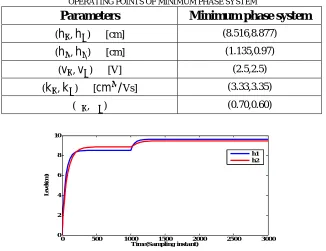
OPERATING POINTS OF MINIMUM PHASE SYSTEM
Parameters
Minimum phase system
(h , h ) [cm] (8.516,8.877)
(h , h ) [cm] (1.135,0.97)
(v , v ) [V] (2.5,2.5)
(k , k ) [cm /Vs] (3.33,3.35)
(
γ
,γ
) (0.70,0.60)Fig.2 Open loop response of the process with 5% change in 1st input
Corresponding transfer functions are,
G
= ..
e
.
G
= ..
e
.
Corresponding transfer functions are,
G
= ..
e
.
G
= ..
e
.
0 500 1000 1500 2000 2500 3000
0 2 4 6 8 10
Time(Sampling instant)
L
ev
el
(c
m
)
h1 h2
0 500 1000 1500 2000 2500 3000 0
2 4 6 8 10 12
Time(Sampling instant)
L
ev
el
(c
m
)
h1 h2
For minimum phase,
(S) =
.
. .
.
. .
.
. .
.
. .
B. Relative Gain Array analysis for Minimum Phase system
=
.. .
+
.
. .
=
.. .
+
.
. .
Ʌ
=
1.495
−
0.495
−
0.495
1.495
Recommended Paring is
with
and with
.
C. Non-Minimum Phase System
When the fraction of liquid entering the upper tanks is less than that of lower tanks then the system is said to be non minimum phase system.
TABLE 3
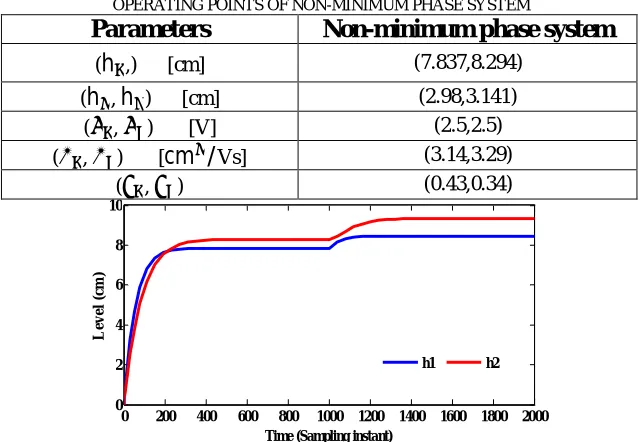
OPERATING POINTS OF NON-MINIMUM PHASE SYSTEM
Parameters
Non-minimum phase system
(h ,) [cm] (7.837,8.294)
(h , h ) [cm] (2.98,3.141)
( , ) [V] (2.5,2.5)
( , ) [cm /Vs] (3.14,3.29)
( , ) (0.43,0.34)
Fig.4 Open loop response of the process with 5% change in 1st input
Corresponding transfer functions are,
G
= ..
e
.
G
= ..
e
.
0 200 400 600 800 1000 1200 1400 1600 1800 2000
0 2 4 6 8 10
Time (Sampling instant)
L
ev
el
(
cm
)
Fig.5 Open loop response of the process with 5% change in 2nd input
Corresponding transfer functions are,
= .
.
.
= .
.
For non-minimum phase,
( ) =
.
. .
.
. .
.
. .
.
. .
D. Relative Gain Array analysis for Non-Minimum Phase system
=
.. .
+
.
. .
=
.. .
+
.
. .
Ʌ =
−
0.612
1.612
1.612
−
0.612
Recommended Paring is
with
and with
.
III.DESIGN OF ROBUST CONTROLLER
The robust PI controller is designed using Small Gain Theorem for Quadruple-Tank process. The parameters of the
controller for minimum and non-minimum phase system are given below.
1. ROBUST- PI USING SMALL GAIN THEOREM
A. Minimum Phase System
For , =47.03, =1 and K is selected as 70 so that the stability condition is satisfied.
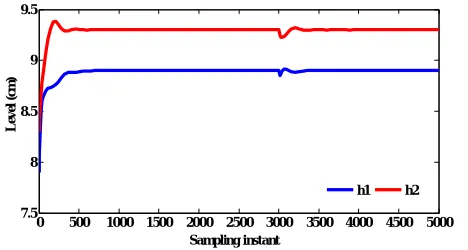
For , =80.12, =1 and K=30. The closed loop servo and regulatory responses of the process under nominal operating condition as well as for another operating condition are obtained and presented in Figures 1 and 2
respectively for a set point change of 1cm from the nominal level and a load change of 10%.
0 200 400 600 800 1000 1200 1400 1600 1800 2000
0 2 4 6 8 10 12
Time (Sampling instant)
L
ev
el
(
cm
)
B. Non-Minimum Phase System
For , =48.9, =1 and K is selected as 50 so that the stability condition is satisfied. For , =69.7,
=1 and K=70. The closed loop servo and regulatory responses of the process under nominal operating condition as well as for another operating condition are obtained and presented in Figures 3 and 4 respectively for a set point change of 1cm from the nominal level and a load change of 10%.
2. ZN-PI CONTROLLER
For
G
,K
=9.78, T=14.98. ForG
,K
=15.68, T=13.32 are obtained using Ziegler Nichol’s method. The closed loop servo and regulatory response of the process is presented in Figures 5. The closed loop servo response of the process with ZN-PI controller for non-minimum phase behaviour is unstable.IV.SIMULATION RESULTS
The performance of the process with the robust PI controller is evaluated using Settling time, Overshoot, ISE through MATLAB Simulink software.
Fig.6 Servo and Regulatory response of the process with Robust PI controller using SGT (Minimum phase system- under nominal operating condition).
Fig.7 Servo and Regulatory response of the process with Robust PI controller using SGT (Minimum phase system- under operating condition , =0.05 & ,
=
0.03).
0 500 1000 1500
8.5 9 9.5 10
Sampling instant
L
ev
el
(
cm
)
h1 h2
0 500 1000 1500
8.5 9 9.5 10
Sampling instant
L
ev
el
(
cm
)
Fig.9 Servo and Regulatory response of the process with Robust PI controller using SGT (Non-minimum phase system-under Operating condition , =0.05 & , =0.03).
Fig.10 Servo and Regulatory response of the process with ZN based PI controller (Under nominal operating condition).
TABLE 4
PERFORMANCE EVALUATION OF THE PROCESS (MINIMUM PHASE) WITH DESIGNED CONTROLLERS
(NOMINAL OPERATING CONDITION)
0 1000 2000 3000 4000 5000 6000
7.5 8 8.5 9 9.5
Sampling instant
L
ev
el
(
cm
)
h1 h2
0 500 1000 1500 2000 2500 3000 3500 4000 4500 5000
7.5 8 8.5 9 9.5
Sampling instant
L
ev
el
(
cm
)
h1 h2
0 200 400 600 800 1000
8.5 9 9.5 10
Sapmling instant
L
ev
el
(
cm
)
h1 h2
Controller Settling time Overshoot (%) ISE
SGT 900 800 - - 19.73 6.407
ZN-PI 400 - - 4.68 1.757 0.04
TABLE 5
PERFORMANCE EVALUATION OF THE PROCESS (MINIMUM PHASE) WITH DESIGNED CONTROLLERS
(Operating condition
,
=
0.05 &,
= 0.03)V. CONCLUSION
The Robust PI controller using Small Gain Theorem is designed and implemented over Quadruple tank process. The design method based on the Small Gain Theorem guarantee the required closed-loop stability degree. The Robust PI controller performance is compared with Z-N based PI controller. The simulation is carried out using MATLAB SIMULINK software. The simulation results are presented along with performance evaluation Table. It is observed from the results that the performance of the process with robust PI controller is better than ZN based PI controller in view of Settling time, Rise time and ISE.
REFERENCES
[1] Supanna S.Kumar, C. Shreesha, “Robust Controller Design for Uncertain Systems,’’ International journal of scientific engineering and technology, vol. 3, no.2, pp. 207-210, February 2014.
[2] Ivan Holic, Vojtech Vesely, “Robust PID Controller Design for Coupled Tank Process,’’ 18th International Conference on Process Control,
June 2011.
[3] Feng Lin, “An Optimal Control Approach to Robust Control Design,’’ INT. J. CONTROL, vol.73, no.3, pp. 177-186.
[4] L. Harsanyi, M. Dubravska, “Robust Controller Design for Linear Systems with Parametric and Dynamic Uncertainties”, J. Electrical Engineering,52 No. 9-10, pp. 307-310, 2001.
[5] Maria Dubravska and Ladislav Harsanyi, “Control of Uncertain systems”, Journal of Electrical Engineering, Vol. 58, No. 4, pp. 228-231, 2007.
[6] Ying J. Huang and Yuan-Jay Wang, “Robust PID tuning strategy for uncertain plants based on the Kharitonov theorem”, ISA Transactions 39, pp. 419-431, 2000.
[7] Kar l Henrik Johanson, “The quadruple Tank Process: A Multivariable Laboratory Process with an Adjustable Zero,” IEEE Transaction on Control Systems Technology. May 2000.
[8] Masaru Katayama, Toru Yamamoto, Yasuhiro Mada, “A Practical Design of Multi Loop Robust PID Control Systems.” Electrical Engineering in Japan 2004.
[9] J.Ackerman, Robust Control System with uncertain physical parameters. Springer-Verlag London Limited, 1997.
[10] M.Grebeck, “ A comparison of Controllers for the quadruple tank system.” Department of Automatic control, Lund Institute of Technology, Lund, Sweden, Tech.Rep., 1998.
[11] S.P Bhattacharyya, H.Chapellat, L.H.Keel. Robust Control: The Parametric Approach. Prentice Hall, 1995. [12] M.Hypiusova, J.Osusky and S. Kajan. “ Robust Controller design using Edge Theorem for Modular Servo System.”
Controller Settling time Overshoot (%) ISE
SGT 1000 1050 - 0.10 17.05 3.625