Development and Impact of a Computerized Pediatric Antiinfective
Decision Support Program
Charles J. Mullett, MD, PhD*‡; R. Scott Evans, PhD*§储; John C. Christenson, MD‡; and J. Michael Dean, MD, MBA‡
ABSTRACT. Objective. Computerized medical deci-sion support tools have been shown to improve the qual-ity of care and have been cited by the Institute of Med-icine as one method to reduce pharmaceutical errors. We evaluated the impact of an antiinfective decision support tool in a pediatric intensive care unit (PICU).
Methods. We enhanced an existing adult antiinfec-tive management tool by adding and changing medical logic to make it appropriate for pediatric patients. Pro-cess and outcomes measures were monitored prospec-tively during a 6-month control and a 6-month interven-tion period. Mandatory use of the decision support tool was initiated for all antiinfective orders in a 26-bed PICU during the intervention period. Clinician opinions of the decision support tool were surveyed via questionnaire.
Results. The rate of pharmacy interventions for erro-neous drug doses declined by 59%. The rate of anti-infective subtherapeutic patient days decreased by 36%, and the rate of excessive-dose days declined by 28%. The number of orders placed per antiinfective course de-creased 11.5%, and the robust estimate of the antiinfec-tive costs per patient decreased 9%. The type of anti-infectives ordered and the number of antiinfective doses per patient remained similar, as did the rates of adverse drug events and antibiotic-bacterial susceptibility mis-matches. The surveyed clinicians reported that use of the program improved their antiinfective agent choices as well as their awareness of impairments in renal function and reduced the likelihood of adverse drug events.
Conclusions. Use of the pediatric antiinfective deci-sion support tool in a PICU was considered beneficial to patient care by the clinicians and reduced the rates of erroneous drug orders, improved therapeutic dosage tar-gets, and was associated with a decreased robust estimate of antiinfective costs per patient. Pediatrics 2001;108(4). URL: http://www.pediatrics.org/cgi/content/full/108/4/ e75; antiinfective agents, decision support systems, drug therapy, medication errors, child, infant.
ABBREVIATIONS. PICU, pediatric intensive care unit; IHC, In-termountain Health Care; PCMC, Primary Children’s Medical Center; HELP, Health Evaluations through Logical Processing; STICU, shock-trauma intensive care unit; LOS, length of stay.
E
rrors in prescription, distribution, and admin-istration of pharmaceutical therapy are a sig-nificant cause of injury to hospitalized patients. Almost 2% of admissions in an adult, tertiary care university facility experienced preventable adverse drug events, costing an average of $4700 per epi-sode.1 Other investigators have publishedmedica-tion prescripmedica-tion error rates of 3.99 errors per 1000 orders in an adult hospital.2Factors associated with
errors included a decline in renal or hepatic function (13.9%); a history of allergy to the same medication class (12.1%); the use of the wrong drug name, dos-age form, or abbreviation (11.4%); incorrect dosdos-age calculation (11.1%); and atypical or unusual dosage frequency (10.8%). Studies in children show similar findings.3,4 Folli et al3 found that pediatric patients
who are younger than 2 years or require treatment in a pediatric intensive care unit (PICU) were at the greatest risk. In their study, dosage errors were the most common medication error, with overdosage exceeding underdosage in frequency. Antibiotics were the most common class of pharmacotherapeu-tics with errant orders.
Technological solutions have been shown to have an impact on error rates. Computerized physician order entry systems for prescription of medications enable the presentation of standard dosages, auto-mated dosage calculations, and presentation of clin-ically important drug– drug, drug–allergy, and drug–laboratory interactions at the time of the phy-sician’s decisions.5–7In addition, these systems
elim-inate the inherent problems associated with hand-writing interpretations and retranscription of orders. Not surprising, the rate of serious medication errors dropped 55% in one analysis of the impact of the implementation of a physician order entry system in a large tertiary care center.8Crude estimates by those
authors suggested that the net savings to the hospital through fewer adverse events and their sequelae amount to $5 million to $10 million per year.
Clinicians must strike a balance when choosing the initial antimicrobial care. Appropriate empiric anti-infective therapy improves outcomes, whereas un-necessarily broad therapy puts the patient at risk for the development of resistant organisms, adverse drug events, and increased cost. Investigators have sought to develop computer-based tools to facilitate the clinician’s decision-making process. The first work in this field was by Shortliffe and col-leagues9 –11 with the MYCIN rule-based infectious
From the Departments of *Medical Informatics and ‡Pediatrics, University of Utah; §Department of Clinical Epidemiology, LDS Hospital, and储 De-partment of Medical Informatics, Intermountain Health Care, Salt Lake City, Utah.
Received for publication Mar 15, 2001; accepted May 22, 2001.
Reprint requests to (C.J.M.) Robert C. Byrd Health Sciences Center, West Virginia University, Box 9214, Morgantown, WV 26506. E-mail: cmullett@ hsc.wvu.edu
disease expert system. Chung and colleagues12,13
used a statistical approach to publish a monthly list of most likely organisms and effective therapies by culture site. Evans et al14 at Intermountain Health
Care (IHC) developed the first tool that automated the data-gathering process and calculated the most probable effective therapy at the time the physician was choosing the antibiotic. Later enhancements to this tool included drug dosage selection assistance, renal function and microbiology results monitoring, and reviews of antibiotic costs and bacterial sensitiv-ity patterns. In adult patients, this computerized an-tiinfective decision support program reduced antibi-otic/bacterial susceptibility mismatches, orders for drugs to which the patient had reported allergies, and alerts of excessive dosage of antiinfective agents.15Benefits to the patients were noted in fewer
adverse drug reactions, fewer total antiinfective doses, and lower antiinfective costs for the hospital. Other, more recent empiric antibiotic decision sup-port systems have been associated with potential improvements in clinical care.16 –18
Given this experience with an adult decision sup-port tool, we anticipated a similar benefit in pediat-rics. We hypothesized that a clinical decision support system designed to account for the therapeutic indi-cation, the age and weight of the patient, the renal function, and the level of prematurity would im-prove antiinfective choices and dosage selections, reduce the rate of adverse drug events, and reduce the cost of antiinfectives used in the care of critically ill infants and children. This article describes the development and clinical evaluation of a pediatric antiinfective decision support tool founded on the adult antiinfective management program developed at IHC.
METHODS Setting
Primary Children’s Medical Center (PCMC) is a 232-bed facility set on the University of Utah medical campus and owned and operated by IHC. It is the primary pediatric teaching facility for the University of Utah School of Medicine. The hospital serves as the tertiary referral center for all of Utah and significant portions of Nevada, Arizona, Montana, Wyoming, and Idaho. PCMC houses a PICU comprising 26 beds and averaging 1700 admissions per year of a broad array of critically ill medical and surgical patients. Pediatric critical care specialists, working together with critical care fellows-in-training, pediatric residents, and nurse practitioners, staff the unit. This team is responsible primarily for the medical patients and co-manages the surgical admissions.
Bedside computer terminals that run the Health Evaluations through Logical Processing (HELP) hospital information system facilitate patient care.19HELP is a fully integrated hospital
infor-mation system that provides data collection and reporting for a broad range of clinical arenas, including laboratory results, phar-macy, radiology, and pathology. The PICU physicians and nurse practitioners use the HELP system primarily for laboratory results review and the generation of a morning summary report of patient vital signs, labs, pharmacology, radiology, and ventilator data. Before the implementation of the pediatric antiinfective decision support tool, all patient care orders from the physicians were handwritten. Antibiotic and other medication orders typically were interpreted by the clerk and rewritten onto the bedside medication administration record. Carbon copies of the handwrit-ten order were physically sent to the pharmacy and read by a pharmacist, who entered the order via the keyboard into the HELP system’s pharmacy module.
Development of the Pediatric Antiinfectives Management Program
Using the adult version from IHC as a template facilitated the task of developing the pediatric antiinfectives management pro-gram. Although the adult edition could be run at PCMC on pediatric patients, its advice usually was inappropriate and some-times harmful. Thus, 2 of the authors (C.J.M. and J.C.C.) reviewed each adult rule governing recommendations for infectious ill-nesses and pathogen culture results and identified which would be safe and beneficial to keep in the pediatric edition. New pedi-atric-specific empiric antiinfective therapy logic was developed and incorporated into the program while maintaining the same framework and overall “look and feel” of the adult tool. For the antiinfective doses, pediatric pharmaceutical texts20,21were
con-sulted first and the list of candidate dosages then was reviewed by the infectious disease specialist (J.C.C.) with modifications made for local experience (eg,, the recommended dose of cefuroxime was increased because of the risk of resistantStreptococcus pneu-moniae). Special doses were developed when indicated for severe disease, such as meningitis or bacteremia, or for atypical patient populations, such as those with cystic fibrosis. The neonatal dos-age recommendations were constructed using standard tables that take into account the postconceptional age (estimated gestational age at birth plus age in weeks since birth) and age in days since birth (postnatal age).22 Dosage adjustments for impairments in
renal function also were standardized for patients who are older than 6 months. Younger patients were excluded because the Schwartz formula for creatinine clearance estimation has been cited as less accurate in neonates and infants who are younger than 6 months.23
Copies of the pediatric antiinfectives medical logic and dosing recommendations were distributed to the other pediatric infec-tious diseases faculty of the University of Utah. Their comments and suggestions were incorporated into the final logic submitted for use in the pediatric antiinfective management program.
The pediatric antiinfective management program subsequently was loaded onto the HELP system as a restricted-access program for testing by the authors. During the summer and fall months of 1998, rigorous daily trials of the pediatric logic were performed on sample populations of patients from the wards and the pediatric and neonatal intensive care units of the children’s hospital. Once the logic and underlying code were judged to be reliable and accurate, plans were made for the installation and evaluation of the effects in the PICU. PICU personnel were readied for initial use through a series of demonstrations and tutorials.
Study Design
A study to measure the impact of the pediatric antiinfectives decision support tool was planned, using 6-month pre- versus postimplementation comparison periods. With an average of 1700 admissions per year and an estimation that 75% would be treated with antibiotics, we anticipated capturing more than 600 patients in each study period. The time periods chosen for the study placed approximately one half of the summer season (with many trauma patients) and one half of the winter season (with many bronchi-olitis patients) in each phase of the evaluation. The institutional review boards of the University of Utah and PCMC approved the study protocol.
For the PICU team of physicians and nurse practitioners, man-datory use of the pediatric antiinfective management tool for ordering antiinfectives was initiated on January 22, 1999. Al-though use of the tool was obligatory, clinicians chose whether to accept its recommendations on antiinfective agents and/or doses. During the last week of each 4-week resident rotation, resident physicians were surveyed using a questionnaire composed of 5-point Likert-type scales. The PICU pediatric nurse practitioners were surveyed once, at the end of the 6-month experimental period.
Analysis
files comparing all administered antiinfective agents to published therapeutic ranges with modifications for age and renal function. This program identified all doses that fell outside the therapeutic ranges and generated a file that contained subtherapeutic and excessive-dosage risk days.
Statistical Methods
Study data were stored and manipulated in Microsoft Access (Microsoft Corp, Redmond, WA). Between-group comparisons were performed using Fisher’s exact test for equality of propor-tions,2test for independence, and 2-tailedttests for comparisons
of means. During the latter analyses (ttests), consideration was given to logarithmic transformations and the use of Tukey’s bi-weight estimator for skewed variances when appropriate for non-normally distributed data.24All2analyses were performed using
Microsoft Excel. The regression analyses were performed using SPSS (SPSS Inc, Chicago, IL). All other analyses were performed using Statit Custom QC (Statware Inc, Corvallis, OR). Statistical significance levels were set atPvalues of .05 a priori.
RESULTS
During the 12-month study period, the PICU ad-mitted 1758 patients: 809 patients during the prein-tervention period and 949 during the inprein-tervention period. The intervention group was more likely to be treated with antimicrobials while in the PICU (66.5% vs 60.2%;P⬍ .05), but the rate of antimicrobial use during the total hospital stay did not differ signifi-cantly.
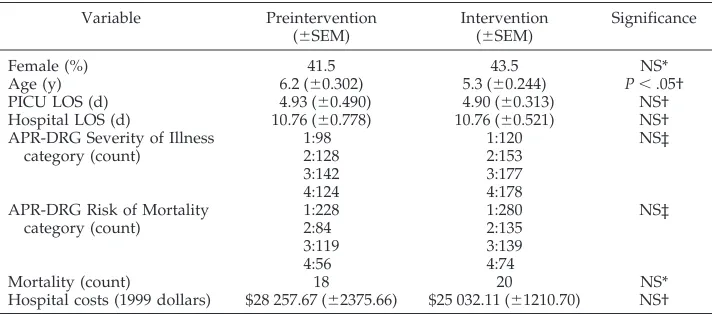
Additional comparisons are limited to “study pa-tients,” defined as those patients with antiinfectives ordered while hospitalized in the intensive care unit during the 2 periods. The intervention group was significantly younger (Table 1). However, the 2 groups were similar with respect to gender, PICU length of stay (LOS), total hospital LOS, All Patient Refined Severity of Illness,25All Patient Refined Risk
of Mortality,25percentage mortality, and total
hospi-tal costs.
Per-patient antiinfective use measurements also were similar between the 2 groups, despite the im-plementation of the new management tool (Table 2). Specifically, there were no differences in the PICU or total hospital count of antiinfectives or antiinfective doses used per patient. There also was no difference in the PICU or total hospital costs of antiinfectives.
However, the number of orders placed per antiinfec-tive course decreased 11.5% from an average of 1.56 to 1.38 orders/patient-antiinfective (P⬍ .01). In ad-dition, application of Tukey’s biweight estimator, which downweights extreme values in non-normal distributions, revealed an underlying 9% decrease in the costs of antiinfectives used for the average inter-vention group PICU patient (Table 2). Logarithmic transformations of non-normal data and application of Tukey’s biweight estimator did not change the interpretations of the other baseline population or antiinfective use measurements between the 2 groups. Total antiinfective use, by a comparison of the count of patients treated with each antiinfective, also was similar between the 2 groups by2analysis.
Therapeutic mismatches between pathogens cul-tured in the microbiology laboratory and the antimi-crobials being used to treat the patients were as-sessed by a time-driven computer alerting program at 1:00pmon the day of published sensitivities. There was no difference in the incidence of mismatches between the 2 groups. Only 1 event was noted dur-ing the control period: a Staphylococcus epidermidis
blood culture that initially was perceived as a con-taminant and therefore was not being treated. Dur-ing the intervention period, only 1 event was noted as well: anEnterococcusspecies urinary tract infection that was being treated with but ultimately found to be resistant to amoxicillin.
The total number of adverse drug reactions re-corded in the PICU for the 12-month study period was 119, with 24 of those secondary to antiinfectives. Twelve events were recorded in each of the 2 study periods. A breakdown of the reactions into the cate-gories of mild (requiring no therapy change), mod-erate (requiring a change in therapy), and severe (potentially life-threatening) found no significant dif-ference. In each group, only 1 of the 12 potentially was preventable secondary to known allergic sensi-tivities. During the intervention period, the poten-tially preventable allergic reaction occurred when a surgery resident, not using the antiinfectives
man-TABLE 1. Population Statistics for Patients With a PICU Antiinfective Order
Variable Preintervention
(⫾SEM)
Intervention (⫾SEM)
Significance
Female (%) 41.5 43.5 NS*
Age (y) 6.2 (⫾0.302) 5.3 (⫾0.244) P⬍.05†
PICU LOS (d) 4.93 (⫾0.490) 4.90 (⫾0.313) NS†
Hospital LOS (d) 10.76 (⫾0.778) 10.76 (⫾0.521) NS†
APR-DRG Severity of Illness category (count)
1:98 1:120 NS‡
2:128 2:153
3:142 3:177
4:124 4:178
APR-DRG Risk of Mortality category (count)
1:228 1:280 NS‡
2:84 2:135
3:119 3:139
4:56 4:74
Mortality (count) 18 20 NS*
Hospital costs (1999 dollars) $28 257.67 (⫾2375.66) $25 032.11 (⫾1210.70) NS†
APR-DRG indicates All Patient Refined–Diagnosis Related Groups; SEM, standard error of the mean; NS, not significant.
* Fisher’s exact test for equality of proportions. † Two-tailed independentttest.
agement program, ordered a cephalosporin on a PICU patient who was known to be allergic to pen-icillins. (Note: Unlike pediatric residents in the PICU, the surgery residents were not involved in the study and were not required to use the pediatric anti-infectives management program.) Had the decision support tool been used, it would have alerted the physician to the allergy history.
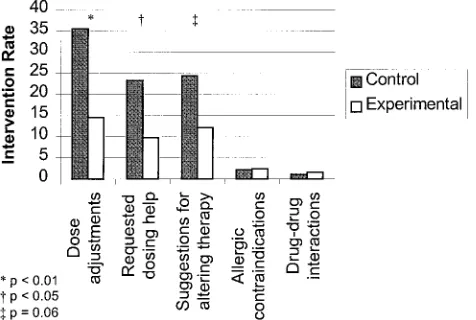
The pharmacists in the PICU serve as a human “safety net” for ordered pharmaceuticals, making interventions on erroneous drug doses and other therapeutic improvement opportunities. In this ca-pacity, they routinely keep a log of their interven-tions on the drugs ordered by the clinicians. During the study period, the interventions for all pharma-ceuticals numbered approximately 1800, with anti-infectives comprising approximately 30%. Analysis of the relevant intervention categories revealed a 59% decrease in the rate of intervention for errone-ous antiinfective doses and a 58% decrease in the rate of clinician requests for antiinfective dosing help (Fig 1).
An analysis of patient antiinfective doses com-pared with published minimum and maximum rec-ommendations for age, weight, and renal function was performed. Days of antiinfective therapy that fell outside the minimum and maximum recommen-dations were called subtherapeutic and excessive-dosage risk days, respectively, and were determined for each patient and analyzed by study day. A
sig-nificant 36% decrease in the rate of subtherapeutic risk days was found for the intervention group when compared with the control group (Table 3). Likewise, a significant 28% decrease was noted in the exces-sive-dosage risk days. The combined effect is a 32% decrease in the rate of antiinfective days that fall outside published recommended parameters.
Questionnaires were returned by 28 of the 31 users (26 pediatric residents, 5 nurse practitioners). Ques-tions were formatted as 5-point Likert-type scales, and a favorable response was defined as 1 on the “beneficial” or “positive effect” side of the neutral response. A majority of the users responded favor-ably to the decision support tool. Specifically, they reported improved overall antibiotic choices, in-creased awareness of renal function, beneficial dos-age calculation assistance, association with fewer ad-verse drug events, and improved quality of care (Table 4). The median estimation of how often the users ordered the recommended antibiotic was 50%, and the estimation of how often they ordered the recommended dose was 75%. Most (79%) reported that they learned something from the system, and nearly all (93%) would recommend it to others.
Two post hoc analyses were performed to answer questions raised by the initial analyses. Was the younger age of the intervention patients responsible for the 5% increase in antimicrobial usage? The an-swer seems to be “no.” Multiple linear regression showed that age did not explain PICU antiinfective usage variability either alone or when controlled for study group. The second question was whether the decrease in PICU antiinfective costs found when an-alyzed using Tukey’s biweight estimator also was secondary to the younger age and presumably size of the intervention patients. Again, multiple linear re-gression did not find age to be a significant predictor of PICU antiinfective costs when controlled by study group or by the combination of study group, severity of illness, and risk of mortality.
DISCUSSION
This study found that implementation of comput-erized antiinfective decision support, provided at the time antiinfectives are ordered, increased the likeli-hood that the dose was on target for the given age, weight, and renal function of the pediatric patient. The tool provided support to the clinician in a
num-TABLE 2. Average Per-Patient Antiinfective Use Measurements
Variable Preintervention
(⫾SEM)
Intervention (⫾SEM)
Significance
Total antiinfective costs ($) 274.79 (⫾28.57) 289.60 (⫾23.47) NS* Total number of antiinfectives used 2.18 (⫾0.066) 2.22 (⫾0.063) NS*
Total doses used 19.8 (⫾1.35) 22.0 (⫾1.33) NS*
PICU antiinfective costs ($) 177.03 (⫾18.02) 183.53 (⫾14.75) NS* Robust estimate PICU antiinfective costs ($) 86.60 (⫾2.98) 78.43 (⫾2.29) P⬍.05†
PICU antiinfective doses 12.8 (⫾0.985) 13.4 (⫾0.777) NS*
PICU number of antiinfectives 1.85 (⫾0.056) 1.97 (0.052) NS*
PICU antiinfective orders per patient-antiinfective course
1.56 (⫾0.060) 1.38 (⫾0.032) P⬍.01*
SEM indicates standard error of the mean; NS, not significant. * Two-tailed independentttest.
† Two-tailed modifiedttest using Tukey’s biweight estimator to downweight extreme observations.
ber of ways that can account for this improvement. The renal function was estimated and updated auto-matically daily, and suggested doses were calculated with adjustments for evidence of impairment. Age and prematurity considerations were factored auto-matically, and doses were calculated without arith-metic errors. Order legibility also was rendered a nonissue. These mechanisms explain the decrease in pharmacy interventions for erroneous doses and also the decreased number of days of therapy that fall outside recommended therapeutic ranges.
The last step in the system’s antiinfective recom-mendations algorithm is to consider costs. The anti-infective management program recommends the less expensive agent when 2 or more drugs are found to be therapeutically equal. We therefore anticipated a cost benefit, as was seen in the adult study. In this pediatric study, the average cost of antiinfectives was no different between the 2 groups. However, appli-cation of Tukey’s biweight estimator, which down-weights extreme observations in non-normal distri-butions, identified a 9% decrease in the robust estimate of the cost of antiinfectives used in the intervention group. Therefore, a longer study may have documented cost savings using more conven-tional analytical methods. Moreover, given that one of the tool’s beneficial effects is to increase the doses administered when clinically indicated and 1 of its documented effects is to minimize the number of
subtherapeutic risk days by increasing antibiotic doses, it would not have been surprising if we had found that the average antiinfective cost per patient was appropriately higher with the use of the tool.
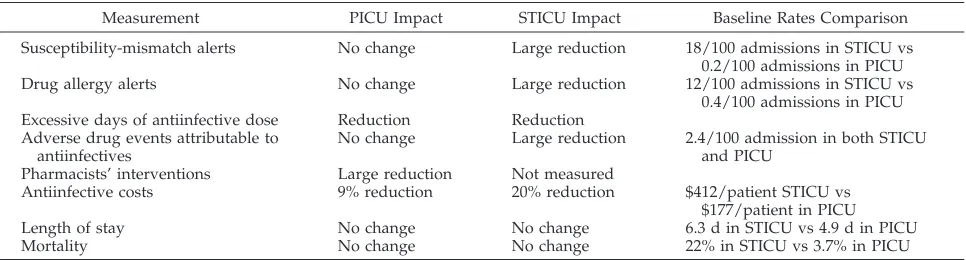
It is instructive to compare the results of this pe-diatric trial with the findings from the evaluation performed in the adult shock-trauma intensive care unit (STICU) at LDS Hospital. As shown in Table 5, in the STICU evaluation, a marked impact was noted in the number of mismatches between the sensitivity patterns of the cultured bacterial pathogens and the antibiotics used for therapy. An improvement was not noted in the current study, but sensitivity mis-matches occur far more frequently in the adult ICU. Thus, the opportunity for improvement in the PICU was diminished. The measures of orders for drugs to which the patient was known to have a history of allergy was improved in the adult study but without change in the pediatric study. The frequency of drug allergy is much higher in adult patients; young chil-dren have not had as much time to have a known history of drug allergy and have had fewer expo-sures to antibiotics than adult patients. We anticipate that our decision support tool would decrease sensi-tivity mismatches and administration of drugs to allergic children significantly with a much larger study population.
A large impact was noted in the rates of pharma-cists’ intervention for erroneous drug orders in the pediatric study. This information was not recorded by pharmacists in the STICU evaluation. In the 2 studies, a similar benefit was noted in the rate of reduction of excessive drug dosage days. In addition, a benefit was seen in underdosage days in the PICU study, but this is less of an issue in adults and was not measured in that study. No change was noted in the rate of adverse drug events in the PICU, but a large benefit was found in the adult study. It is
TABLE 4. User Survey Results
Question Topic % Positive Results
Improved overall antibiotic choices 81
Increased awareness of renal function 79 Beneficial dosage calculation assistance 96 Associated with fewer adverse drug events 89
Improved quality of care 81
TABLE 3. Subtherapeutic and Excessive-Dosage Risk Days
Variable Preintervention
(⫾SEM)
Intervention (⫾SEM)
Significance
Subtherapeutic antiinfective days per 100 patient days
7.350 (⫾0.610) 4.702 (⫾0.441) P⬍.001*
Excessive-dosage antiinfective days per 100 patient days
8.454 (⫾0.460) 6.063 (⫾0.490) P⬍.001*
Total risk days per 100 patient days 15.80 (⫾0.734) 10.766 (⫾0.733) P⬍.0001*
SEM indicates standard error of the mean. * Two-tailed independentttest.
TABLE 5. Comparison of Antiinfective Management Program Impact in Adult and Pediatric Studies
Measurement PICU Impact STICU Impact Baseline Rates Comparison
Susceptibility-mismatch alerts No change Large reduction 18/100 admissions in STICU vs
0.2/100 admissions in PICU
Drug allergy alerts No change Large reduction 12/100 admissions in STICU vs
0.4/100 admissions in PICU Excessive days of antiinfective dose Reduction Reduction
Adverse drug events attributable to antiinfectives
No change Large reduction 2.4/100 admission in both STICU
and PICU
Pharmacists’ interventions Large reduction Not measured
Antiinfective costs 9% reduction 20% reduction $412/patient STICU vs
$177/patient in PICU
Length of stay No change No change 6.3 d in STICU vs 4.9 d in PICU
interesting that the baseline rate of events per 100 admissions was similar in both units. One would surmise that fewer of the events in children are pre-ventable, as they are less likely to be secondary to failing drug metabolism due to hepatic or renal dys-function. The study data support this notion as only 1 of the 12 pediatric events at baseline could be judged as preventable by retrospective evaluation and none of these events could be attributed to failed organs or otherwise poor drug metabolism.
A 20% reduction in the costs of antiinfectives used at baseline was found in the adult study, whereas the pediatric drug costs are, at best, 9% improved. The baseline analysis shows that antiinfective costs aver-aged $412 (1995 dollars) per patient in the adult study and only $177 (1999 dollars) per patient in the pediatric evaluation. Once again, it should be noted that there was less opportunity for improvement in the pediatric case. Last, although the measures of severity of illness used in the 2 studies are different and are not comparable directly, it is instructive to note the 5-fold difference in incidence of death be-tween the 2 units. The adult patients were far more likely to have terminal disease. One may conclude that the adults have more end-organ dysfunction affecting their responses to and internal metabolism of the antiinfective therapy used in the study. There-fore, it should not be a surprise that the impact of the antiinfective management program differs between the 2 units in the process and outcome measures evaluated.
With the improvements in the rate of pharmacy interventions and the number of days outside thera-peutic ranges, one could anticipate a patient benefit in outcomes. Unfortunately, we were not able to document this, given the insensitivity of our patient outcome measures: adverse drug events, LOS, and mortality. However, one can conclude that although the incidence of adverse sequelae from medical er-rors is low, it is not 0, and minimization of outright errors and improvements in therapeutic dosing tar-gets should affect both adverse events and the qual-ity of care, given enough time. It is through consid-erations such as these that a majority of pediatric residents and nurse practitioners reported that they believed that the use of this clinical decision support tool should have a beneficial impact on adverse drug events and the quality of care. This is consistent with the adage that humans and computers working in tandem are better than either one alone.
The findings of this study are likely to be a con-servative assessment of the benefit that would be anticipated from wide-scale implementation of this computerized decision support tool throughout the children’s hospital. A significant portion of the anti-microbial therapy measured in this study was or-dered without the use of the tool— either by pediat-ric residents on the floor before transfer of the patient to the PICU or by surgery and surgery subspecialty residents transferring patients from either the floor or the operating room. Therefore, once these groups become users of the system, the doses ordered also would have the benefit of the elimination of calcula-tion errors, plus the careful consideracalcula-tion of the
in-dication, age, weight, and renal function rendered by the antiinfective management program.
After the completion of the study, by joint decision of the members of the medical, pharmacy, and nurs-ing staffs, use of the pediatric antiinfectives manage-ment program remained mandatory for ordering an-tiinfectives within the PICU. Usage also spread to other areas of the children’s hospital. Although the pediatric antiinfectives management program is not transferrable without the HELP hospital information system, the implementation of a clinical computer-ized physician order entry system combined with a comprehensive system of antiinfective decision sup-port rules likely would provide similar benefit in other pediatric institutions.
CONCLUSION
Implementation of a pediatric antiinfective deci-sion support tool had a positive impact on the anti-infective therapeutic milieu of a PICU through better dosage selection, as documented by fewer pharmacy interventions on antiinfective orders and fewer anti-infective subtherapeutic and excessive-dosage risk days. These findings are supported by the survey of users who reported that use of the tool would result in fewer adverse drug events and improved quality of care.
ACKNOWLEDGMENTS
Direct and indirect support was provided by the University of Utah, Intermountain Health Care Corporation, and the National Library of Medicine (NLM Grant T15-LM07-124, University of Utah Medical Informatics Training Grant to C.J.M.). This project would not have been possible without the assistance of Reed M. Gardner, PhD, Chairman of the Department of Medical Informat-ics at the University of Utah; Jared Cash, RPh, and partners in the PCMC PICU pharmacy; and Mary B. Price, MBA, PCMC CQI Coordinator.
REFERENCES
1. Bates DW, Spell N, Cullen DJ, et al. The costs of adverse drug events in hospitalized patients. Adverse Drug Events Prevention Study Group.
JAMA. 1997;277:307–311
2. Lesar TS, Briceland L, Stein DS. Factors related to errors in medication prescribing.JAMA. 1997;277:312–317
3. Folli HL, Poole RL, Benitz WE, Russo JC. Medication error prevention by clinical pharmacists in two children’s hospitals.Pediatrics. 1987;79: 718 –722
4. Wilson DG, McArtney RG, Newcombe RG, et al. Medication errors in paediatric practice: insights from a continuous quality improvement approach.Eur J Pediatr. 1998;157:769 –774
5. Schiff GD, Rucker TD. Computerized prescribing: building the elec-tronic infrastructure for better medication usage. JAMA. 1998;279: 1024 –1029
6. Nightingale PG, Adu D, Richards NT, Peters M. Implementation of rules based computerised bedside prescribing and administration: in-tervention study.BMJ. 2000;320:750 –753
7. Wyatt J, Walton R. Computer based prescribing. BMJ. 1995;311: 1181–1182
8. Bates DW, Leape LL, Cullen DJ, et al. Effect of computerized physician order entry and a team intervention on prevention of serious medica-tion errors.JAMA. 1998;280:1311–1316
9. Shortliffe EH, Axline SG, Buchanan BG, Merigan TC, Cohen SN. An artificial intelligence program to advise physicians regarding antimicro-bial therapy.Comput Biomed Res. 1973;6:544 –560
11. Yu VL, Fagan LM, Wraith SM, et al. Antimicrobial selection by a computer. A blinded evaluation by infectious diseases experts.JAMA. 1979;242:1279 –1282
12. Chung SJ, Chung RY. Choice of antimicrobial drugs by the site of infection.Comput Methods Programs Biomed. 1987;24:47– 62
13. Chung SJ, Gosnell WO, Purkey MS. Choice of antibiotics by the site of infection in a community hospital.Int J Biomed Comput. 1995;40:31–39 14. Evans RS, Classen DC, Pestotnik SL, Lundsgaarde HP, Burke JP.
Im-proving empiric antibiotic selection using computer decision support.
Arch Intern Med. 1994;154:878 – 884
15. Evans RS, Pestotnik SL, Classen DC, et al. A computer-assisted man-agement program for antibiotics and other antiinfective agents.N Engl J Med. 1998;338:232–238
16. Leibovici L, Gitelman V, Yehezkelli Y, et al. Improving empirical anti-biotic treatment: prospective, nonintervention testing of a decision sup-port system.J Intern Med. 1997;242:395– 400
17. Warner H Jr, Blue SR, Sorenson D, et al. New computer-based tools for empiric antibiotic decision support.Proc AMIA Annu Fall Symp. 1997; 238 –242
18. Warner H Jr, Reimer L, Suvinier D, Li L, Nelson M. Modeling empiric antibiotic therapy evaluation of QID.Proc AMIA Symp. 1999;440 – 444 19. Gardner RM, Pryor TA, Warner HR. The HELP hospital information
system: update 1998.Int J Med Inf.1999;54:169 –182
20. Nelson JD.Pocket Book of Pediatric Antimicrobial Therapy. 12th ed. Balti-more, MD: Williams & Wilkins; 1996
21. Taketomo CK, Hodding JH, Kraus DM.Pediatric Dosage Handbook. 5th ed. Cleveland, OH: Lexi-Comp Inc.; 1998
22. Young TE, Mangum OB.Neofax ’95: A Manual of Drugs Used in Neonatal Care. 8th ed. Columbus, OH: Ross Products Division, Abbott Laboratories; 1995
23. Schwartz GJ, Brion LP, Spitzer A. The use of plasma creatinine concen-tration for estimating glomerular filconcen-tration rate in infants, children, and adolescents.Pediatr Clin North Am. 1987;34:571–590
24. Hoaglin DC, Mosteller F, Tukey JW.Understanding Robust and Explor-atory Data Analysis. New York: John Wiley & Sons Inc.; 1983 25. Iezzoni LI, Shwartz M, Ash AS, Mackiernan YD. Using severity
DOI: 10.1542/peds.108.4.e75
2001;108;e75
Pediatrics
Charles J. Mullett, R. Scott Evans, John C. Christenson and J. Michael Dean
Support Program
Development and Impact of a Computerized Pediatric Antiinfective Decision
Services
Updated Information &
http://pediatrics.aappublications.org/content/108/4/e75
including high resolution figures, can be found at:
References
http://pediatrics.aappublications.org/content/108/4/e75#BIBL
This article cites 19 articles, 3 of which you can access for free at:
Subspecialty Collections
hnology_sub
http://www.aappublications.org/cgi/collection/health_information_tec
Health Information Technology
following collection(s):
This article, along with others on similar topics, appears in the
Permissions & Licensing
http://www.aappublications.org/site/misc/Permissions.xhtml
in its entirety can be found online at:
Information about reproducing this article in parts (figures, tables) or
Reprints
http://www.aappublications.org/site/misc/reprints.xhtml
DOI: 10.1542/peds.108.4.e75
2001;108;e75
Pediatrics
Charles J. Mullett, R. Scott Evans, John C. Christenson and J. Michael Dean
Support Program
Development and Impact of a Computerized Pediatric Antiinfective Decision
http://pediatrics.aappublications.org/content/108/4/e75
located on the World Wide Web at:
The online version of this article, along with updated information and services, is
by the American Academy of Pediatrics. All rights reserved. Print ISSN: 1073-0397.