Engine
S.Jafarmadar1
1.Mechanical Engineering Department, Technical Education Faculty, Urmia University, Urmia, West Azerbaijan 57561-15311, Iran
Abstract
In this research, back-propagation (BP) and generalized regression (GR) GR neural networks are developed for predicting the performance and emissions of direct injection diesel engine fuelled with the mixtures of diesel and castor oil fuels. The neural network models for the engine were trained by using some of the experimental data. Experimental test are carried out on a semi-heavy duty Motorsazan MT4.244 direct injection diesel engine fuelled with blends of diesel fuel with 0%, 5%,10%,15%,20%, 30% of Castor oil%(by volume) at various speeds and loads. Then, the performance of these neural networks predictions are compared by comparing predictions with the experimental results which were not used in the training process. The comparison of the predicted values shows that the computational accuracy of both GR and BP neural networks are appropriate, however the GR presents slightly better performance with very faster training compared with the BP. therefore, it can be concluded that GR can be used to predict performance and emissions with high accuracy and faster training.
Keywords:neural network, back-propagation, generalized regression, emission, performance, biodiesel
.
1. Introduction
Despite growth of fuel demand, dwindling resources is a crisis for science and technology [1, 2]. Diesel fuel is respected in commerce of countries due to it uses in comprehensive range as heavy-duty transport vehicles, rail transportation systems, agricultural machineries and construction equipments[3]. Nowadays, most of developed countries have found a suitable approach to overcome the fuel sources leakage and environment pollution, with mass production and commercialization of bioenergy [1, 2]. Biodiesel is one of the biofuels that is known as an alternative biofuel in order to reduce emissions produced from combustion engines [4, 5]. Biodiesel is produced from transestrification reaction of vegetables oil (fresh or waste) or animal fats with alcohol in presence of a catalyst [5, 6]. Biodiesel fuel has positive influence on engine emissions. It reduces particular matter (PM), CO and SOx [3].
NOx emissions increase as a drawback of biodiesel fuel blends, depending on its percentage in fuel, [3, and 7]. Also biodiesel has other disadvantages including lower calorific value and power output which should be improved [7]. Biodiesel will be more industrialized and
commercialized when it is produced from non-edible and cheap raw oil sources [5]. Monyem et al. [8] showed that fuel properties of biodiesel might be varied by oxidation after the biodiesel was stored for a period of time. They found that after the heating and bubbling oxygen, the commercial biodiesel had a shorter ignition delay and lower hydrocarbons (HC) emission. Dorado et al. [9] carried out experimental test in a direct injection diesel engine with olive oil methyl ester and reported a same combustion efficiency for methyl ester of olive oil and diesel, a slight reduction in brake specific fuel consumption (BSFC), reduction of 58.9% in CO, 8.9% in CO2, 37.5% in NO and 32% in NOx for olive oil methyl ester as compared to diesel. Puhan et al. [10] tested mahua oil ethyl ester in a four-stroke naturally aspirated direct injection diesel engine and have reported an increase in BSFC for mahua oil ethyl ester compared to diesel. Also, a slight increase in brake thermal efficiency, reduction in CO emission, increase in CO2 emission, 63% reduction in HC emission, reduction in NOx and 70% reduction in smoke are reported. Buyukkaya [11] tested neat rapeseed oil and its blends of 5%, 20% and 70%, and standard diesel fuel in a diesel engine and concluded that the use of biodiesel produces lower smoke
1000 A comparative analysis of …
International Journal of Automotive Engineering Vol. 5, Number 2, June 2015 opacity, and higher brake specific fuel consumption
(BSFC) compared to diesel fuel and the measured CO emissions of B5 and B100 fuels were found to be 9% and 32% lower than that of the diesel fuel, respectively. Jiafeng et al. [12] showed that lower heating value, lower volatility, higher viscosity, generally higher oxides of nitrogen (NOx) and high production cost, are some of biodiesel’s negative attributes. Rao et al. [13] studied the effects of the percentage of used cooking oil methyl ester (UCOME) on combustion characteristics (ignition delay, peak cylinder pressure, heat release rate). It was observed that the ignition delay periods of UCOME and its blends are significantly lower than that of diesel and decrease with increase in the percentage of UCOME. Also, the results show that the peak cylinder pressure is slightly higher for UCOME-diesel blends compared to diesel. This shows that the peak pressure is not very much affected using UCOME and its blends compared to diesel. The maximum heat release rate decreases with increase in percentage of UCOME in the blend. It can also be observed that maximum heat release rate occurs earlier with the increase in the percentage of UCOME in the blend. Tsolakis et al. [14] studied the combustion characterizes of rapeseed methyl ester (RME) pure or blended with ultra-low sulphur diesel (ULSD) at 20% and 50% by volume (B20 and B50) in a single-cylinder direct injection diesel engine with pump–line–nozzle injection system. The combustion of RME, B20 and B50 resulted in advanced combustion compared to ULSD. The advanced RME combustion resulted in the reduction of smoke, HC and CO while both NOx emissions and fuel consumption were increased. The combustion of different fuel blends did not affect significantly the engine efficiency. The increased amount of oxygen in the RME molecule and hence in the locally fuel-rich combustion zones is believed to be an additional reason for the reduced smoke. The increase of the fuel consumption is mainly due to the lower calorific value (LCV) of RME compared to ULSD. The use of EGR was more effective in the case of biodiesel blends combustion compared to ULSD combustion. The NOx emissions were reduced at levels similar to those of ULSD with the use of similar volumetric percentages of EGR while the smoke was kept low. Manufacturing and application engineering always wants to know the emissions and performance parameters of a diesel engine fuelled with the various mixtures of diesel and biodiesel fuels. These requirements can be realized by performing various experimental tests or modeling the engine operations. Testing the engine at all operating conditions and various fuel mixtures are time consuming and
expansive. Besides, developing an accurate model for the operation of dual fuel diesel engine is too difficult due to the complex process involved. As an alternative, performance and emissions of a dual fuel engine can be modeled using by neural networks. This modeling technique can be applied for predicting desired parameters when the enough experimental data is provided for training. The neural network modeling has been used to predict of performance of different thermal systems [15-20]. The use of neural networks for modeling the various operations of internal combustion engines is a more recent progress. Theses modeling were used for predicting of performance and emissions and air-fuel ratio of a diesel engine [21-24]. Wai Kean Yap et al. [25] presented a comparison of predictive models for the estimation of engine power and tailpipe emissions for a 4 kW gasoline scooter. They used three emissions predictive models in their study; direct and series artificial neural network (ANN) models and a MATLAB dynamic model. They were compared and analyzed two multilayered networks; the back propagation (BP) and optimization layer-by-layer (OLL) algorithms for the ANN models. It was found that the OLL network properly can predict with a maximum mean relative error of 1.78% and 1.38% for the direct and series predictive model respectively. Also they showed that the series neural network model gives the most accurate predictions, with MRE of 0.63% and 0.47% for the engine power and emissions respectively.
As can be seen in the relevant literature, there are a no attempts about the using GR neural network model for predicting of performance and emissions formation in dual fuel DI diesel engines up to now. In the present work, beside the BP neural network, the GR model is also developed to predict performance and emissions of DI engine fuelled with the mixture of diesel and biodiesel fuels. The numerical results demonstrate the computational advantages of the GR in comparison with the BP. The experimental data for B0 B5, B15, B20 and B30 at various loads and speeds are used for training and the test of these neural networks carried out by B10.
2. Experimental setup and methodology
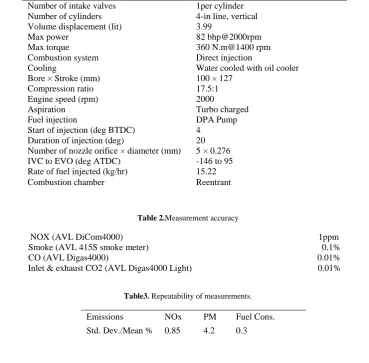
This study is done in Motorsazan.Co and the engine under study is a commercial DI, water cooled four cylinders, in-line, turbocharged aspirated diesel engine whose major specifications are shown in table 1. The experiments were carried out at various loads(25%,50%,75% and 100%) and speeds( 1200, 1400,1700,2000rpm) with the mixtures of diesel and biodiesel having 0%,5%,10%,15%, 20% and 30%
volumetric proportions of biodiesel were named as diesel fuel,B0 B5,B10,B15, B20 and B30, respectively.
Figure1 shows schematic diagram of experimental set-up. An eddy current dynamometer with a load cell was coupled to the engine and used to load the engine. An AVL GU 13G pressure transducer, mounted at the cylinder head and connected via an AVL Micro IFEM piezo amplifier to a data acquisition board, was used to record the cylinder pressure. The crankshaft position was measured using an AVL 365C digital shaft encoder. The test rig included other standard engine instrumentation such as thermocouples to measure oil, air, inlet manifold and exhaust temperatures and pressure gauges mounted at relevant points. Normal engine test bed safety features were also included. Atmospheric conditions (humidity, temperature, pressure) were monitored during the tests. The maximum fuel injection pressure was measured using another pressure transducer that is fitted to the high pressure
fuel pipe between the pump and the injector. Data acquisition and combustion analysis were carried out using in-house developed Lab VIEW-based software. An AVL DiCom4000 gas analyzer was used to measure NOx, CO, and CO2, by NDIR (non-dispersive infrared gas analysis), and oxygen (O2) concentrations in the exhaust manifold (electrochemical method). Smoke measured using an AVL 415S smoke meter. Table 2 shows measurement accuracy of instruments involved in the experiment for various parameters. The emission measurements at each mode were repeated five times. The averaged values of repeated measurements were used in the analysis. From the repeated data points, the repeatability of the engine experiments can be estimated. The standard deviations over the means of the emission data are shown in table3. It can be seen from table3 that NOx emission measurement repeatability is excellent, whereas all other measurements have good repeatability.
Table 1. MT4.244 engine specifications.
Table 2.Measurement accuracy
NOX (AVL DiCom4000) 1ppm Smoke (AVL 415S smoke meter) 0.1% CO (AVL Digas4000) 0.01% Inlet & exhaust CO2 (AVL Digas4000 Light) 0.01%
Table3. Repeatability of measurements.
Emissions NOx PM Fuel Cons.
Std. Dev./Mean % 0.85 4.2 0.3
Number of intake valves 1per cylinder
Number of cylinders 4-in line, vertical
Volume displacement (lit) 3.99
Max power 82 bhp@2000rpm
Max torque 360 N.m@1400 rpm
Combustion system Direct injection
Cooling Water cooled with oil cooler
Bore × Stroke (mm) 100 × 127
Compression ratio 17.5:1
Engine speed (rpm) 2000
Aspiration Turbo charged
Fuel injection DPA Pump
Start of injection (deg BTDC) 4
Duration of injection (deg) 20
Number of nozzle orifice × diameter (mm) 5 × 0.276
IVC to EVO (deg ATDC) -146 to 95
Rate of fuel injected (kg/hr) 15.22
Combustion chamber Reentrant
1002 A comparative analysis of …
International Journal of Automotive Engineering Vol. 5, Number 2, June 2015 Fig1.Schematic diagram of experimental set-up
3. Neural Networks
In this study, BP and GR neural networks are employed for predicting the performance and emissions of direct injection diesel engine fuelled with the mixtures of diesel and castor oil fuels. A brief description of the theoretical aspects of the above mentioned employed neural networks is given below.
3.1. Back-Propagation Neural Networks
For training of back-propagation (BP) neural networks the gradient descent algorithms are usually employed. Second-order methods, such as Newton’s method, often converge faster than first-order methods, such as conjugate gradient methods. Using the second-order methods the weights are adjusted as follows:
where W is a vector of current weights, k Gkis the
current gradient, and 1
k
A is the Hessian matrix of the
performance index at the current values of the weights.
Unfortunately, it is complex and expensive to compute the Hessian matrix for feed-forward neural networks. In this study, Levenberg-Marquardt (LM) [26] algorithm is employed to adjust the weights. The LM algorithm was designed to approach second-order training speed without having to compute the Hessian matrix. When the performance function has the form of a sum of squares, then the Hessian matrix can be approximated as:
Err
GJT (3)
where J is the Jacobian matrix that contains first derivatives of the network errors with respect to the weights, and Err is a vector of network errors.
The LM algorithm uses this approximation to the Hessian matrix in the following Newton-like update equation:
where μ is a correction factor. The value of μ is decreased after each successful step and is increased only when a tentative step would increase the performance function. In this way, the performance function is always reduced at each iteration of the algorithm [27].
In this paper to prevent from over-fitting the performance function of the network is modified by adding a term that consists of the mean of the sum of squares of the network weights as follows:
n 1 j 2 j 1 i 2 i reg n ) γ 1 ( ) Err ( γ Err W m m(5) Whereγ
size of Erri and the number of network weights, respectively.
Using this performance function causes the network to have smaller weights, and it forces the network response to be smoother and less likely to overfit [28]. The structure of BP network is shown in Figure 2.
Generalized regression (GR) neural networks due to their fast training, generality and simplicity are popular. They are two layers feed-forward networks. The hidden layer consists of RBF neurons with Gaussian activation functions. The outputs of RBF neurons have significant responses to the inputs only over a range of values called the receptive field. The radius of the receptive field allows the sensitivity of the RBF neurons to be adjusted. During the training, the receptive field radius of RBF neurons is such determined as the neurons could cover the input space
k
1 k k 1
k W G
W A (1)
J J
H T (2)
Err
]
μ
[
W
W
k1
k
J
TJ
I
1J
T (4)properly. The output layer neurons produce the linear weighted summation of hidden layer neurons responses.
To train the hidden layer of RBF networks no training is accomplished and the transpose of training input matrix is taken as the layer weight matrix [29].
T
1 Λ
W (6)
where, W1 and ΛT are input layer weight and training input matrices, respectively.
The second layer weight matrix is set to the desired output (target).
T
W2 (7) in which Tis the target matrix, and W2 is the output layer weight matrix.
GR algorithm is based on nonlinear regression theory, a well-established statistical technique for function estimation. Simple structure of the GR enables learning in stages, gives a reduction in the training time, and this has led to the application of such networks to many practical problems. The structure of GR network is shown in Figure 3.
Fig2.The structure of BP network
Fig3.The structure of GR network
4. Result and discussions
A computer code is developed in MATLAB to implement the present ANN models. Two types of networks are chosen to predict the performance and
emissions of DI engine fuelled with the mixture of diesel and biodiesel fuels. The predictions of two ANN models for the performance and emissions formation parameters of the dual fuel DI diesel engine are shown in figures 4-13
1004 A comparative analysis of …
International Journal of Automotive Engineering Vol. 5, Number 2, June 2015 In order to evaluate the accuracy of approximate
parameters predicted by the BP and GR networks, two evaluation metrics are used: the relative root mean square (R-rmse) error and R-square (R2) statistic measurement. The R-rmse error between the exact and predicted parameters is computed as follows:
0.5 1 1 2 1 2 ] ) ) ( 1 ) ) ( 1 -1 [( rmse R
r i i r i i i λ r ( λ ~ λr (8)
Where, λi and i
~
are the ith component of the exact
and predicted parameters, respectively. The vectors dimension is expressed by r.
To measure how successful fitting is achieved between exact and approximate parameters, the R-
square statistic measurement is employed. Statistically, the R-square is the square of the correlation between the predicted and the exact parameters. It is defined as follows:
1 1 2 1 2 ) ) ( )( ) ( ( 1 square R
r i i r i ii λ λ λ
~ λ
(9)
where
is the mean of exact vectors component. A summary of results are given in Table 4 in terms of R-rmse and R-square associated with parameters predicted by BP and GR neural networks.The results demonstrate that the generalization ability of both BP and GR neural networks are good and GR presents slightly better accuracy compared with GR.
Fig4.Comparison of excess air ratio coefficient predictions by GR and BP neural networks with experimental data for B10.
Fig5.Comparison of bsfc predictions by GR and BP neural networks with experimental data for B10.
Fig6.Comparison of brake power predictions by GR and BP neural networks with experimental data for B10.
Fig7.Comparison of torque predictions by GR and BP neural networks with experimental data for B10.
Fig8.Comparison of exhaust gas temperature predictions by GR and BP neural networks with experimental data for B10.
Fig9.Comparison of CO2 concentration predictions by GR and BP neural networks with experimental data for B10.
1006 Acomparative analysis of …
International Journal of Automotive Engineering Vol. 5, Number 2, June 2015 Fig10. Comparison of O2 concentration predictions by GR and BP neural networks with experimental data for B10.
Fig11. Comparison of CO concentration predictions by GR and BP neural networks with experimental data for B10.
Fig12. Comparison of NOx emission predictions by GR and BP neural networks with experimental data for B10.
Fig13. Comparison of PM emission predictions by GR and BP neural networks with experimental data for B10.
5. Conclusions:
BP and GR neural networks are utilized to approximate the performance and emissions of direct injection diesel engine fuelled with the mixtures of diesel and castor oil fuels. The comparison of the predicted values shows that the generality accuracy of GR is better than that of the BP. however both neural network models provide good results. But speed of training process of the GR is very high compared with the BP. Finally, it can be concluded that GR can be used to predict performance and emissions with high accuracy at very fast training. It is necessary to mention that the training time of the BP and GR neural networks are 12 min and 0.1 min, respectively. This clearly indicates that the training process of GR can be achieved very faster than that of the BP neural network.
References
:
[1]. Xue J, Grift T.E, Hansen A.C. Effect of biodiesel on engine performances and emissions. Renewable and Sustainable Energy Reviews, 15, 1098–1116.
[2]. Agarwal A. Biofuels (alcohols and biodiesel) applications as fuels for internal combustion engines. Progress in Energy and Combustion Science 33 (2007) 233 – 271.
[3]. Kumar A.S, Maheswar D., Kumar R., Eddy K.V. Comparison of Diesel Engine Performance and Emissions from Neat and Transesterified Cotton Seed Oil. Jordan Journal of Mechanical and Industrial Engineering, 3, 190 – 197. [4]. McCarthy P., Rasul M.G., Moazzem S.
Analysis and comparison of performance and emissions of an internal combustion engine fuelled with petroleum diesel and different bio-diesels. Fuel, 90, 2147–2157.
[5]. Lin C.Y., Li R.J. Engine performance and emission characteristics of marine fish-oil biodiesel produced from the discarded parts of marine fish. Fuel Processing Technology,90, 883–888.
[6]. Keskin A., Metin G.r., Altıparmak D. Biodiesel production from tall oil with synthesized Mn and Ni based additives: Effects of the additives on fuel consumption and emissions. Fuel, 86, 1139–1143.
[7]. Buyukkaya E. Effects of biodiesel on a DI diesel engine performance, emission and combustion characteristics. Fuel, 89, 3099– 3105, 2010.
[8]. Monyem A, Van Gerpen JH, Canakci M. The effect of timing and oxidation on emissions from biodiesel-fueled engines. ASAE 2001; 44:35–42.
1008 A comparative analysis of …
International Journal of Automotive Engineering Vol. 5, Number 2, June 2015 [9]. Dorado MP, Ballesteros E, Arnal JM, Gomez J,
Lopez FJ. Exhaust emissions from a diesel engine fuelled with transesterified waste olive oil. Fuel 2003; 82:1311–5.
[10].Puhan S, Vedaraman N, Sankaranarayanan G, Bopanna V, Bharat R. Performance and emission study of mahua oil ethyl ester in a four stroke natural aspirated direct injection diesel engine. Renew Energy 2004:1–10.
[11].Buyukkaya E. Effects of biodiesel on a DI diesel engine performance, emission and combustion characteristics. Fuel 89 (2010) 3099–3105.
[12].Jiafeng S, Jerald A.C, and Timothy J.J. Oxides of nitrogen emissions from biodiesel-fuelled diesel engines. Progress in Energy and Combustion Science 36 (2010) 677e695. [13].Rao G.L.N, Sampath S, and Rajagopal K.
Experimental studies on the combustion and emission characteristics of a diesel engine fuelled with used cooking oil methyl ester and its diesel blends. Int J Appl Sci Eng Tech 2008; 64–70.
[14].Tsolakis A, Megaritis A, Wyszynski M.L, and Theinnoi K. Engine performance and emissions of a diesel engine operating on diesel-RME (rapeseed methyl ester) blends with EGR (exhaust gas recirculation). Energy 32 (2007) 2072–2080.
[15].Kalogirou S.A. Application of artificial neural-networks for energy systems. Applied Energy, 67 (2000), pp. 17–35.
[16].Pacheco-Vega A, Sen M, Yang K.T., McClain R.L. Neural network analysis of fin-tube refrigerating heat exchanger with limited experimental data International Journal of Heat Mass Transfer, 44 (2001), pp. 763–770 . [17].Prieto M.M, Montanes E, Menendez O. Power
plant condenser performance forecasting using a non-fully connected ANN. Energy, 26 (2001), pp. 65–79.
[18].Chouai A, Laugeier S, Richon D. Modeling of thermodynamic properties using neural networks – application to refrigerants. Fluid Phase Equilibria, 199 (2002), pp. 53–62. [19].Sozen A, Arcaklioglu E, Ozalp M. A new
approach to thermodynamic analysis of ejector-absorption cycle: artificial neural networks. Applied Thermal Engineering, 23 (2003), pp. 937–952.
[20].Hosoz M, Ertunc H.M .Artificial neural network analysis of an automobile air conditioning system. Energy Conversion and Management, 47 (2006), pp. 1574–1587.
[21].M. Golcu, Y. Sekmen, P. Erduranli, S. Salman. Artificial neural network based modeling of variable valve-timing in a spark ignition engine. Applied Energy, 81 (2005), pp. 187–197. [22].Cenk Sayina, Metin Ertuncb H, Murat Hosozc,
Ibrahim Kilicaslanc, Mustafa Canakci. Performance and exhaust emissions of a gasoline engine using artificial neural network. Applied Thermal Engineering Volume 27, Issue 1, January 2007, Pages 46–54.
[23]. Talal F. Yusafa, D.R. Buttswortha, Khalid H. Saleha, B.F. Yousifb. CNG-diesel engine performance and exhaust emission analysis with the aid of artificial neural network. Applied EnergyVolume 87, Issue 5, May 2010, Pages 1661–1669.
[24].Necla Kara Togun, Sedat Baysec . Prediction of torque and specific fuel consumption of a gasoline engine by using artificial neural networks. Applied Energy Volume 87, Issue 1, January 2010, Pages 349–355.
[25].Wai Kean Yapa ,Author Vitae, Vishy Karrib. Comparative analysis of artificial neural networks and dynamic models as virtual sensors. Applied Soft Computing ,Volume 13, Issue 1, January 2013, Pages 181–188.
[26].Hagan MT, Menhaj M. Training feed-forward networks with the Marquardt algorithm. IEEE Transaction on Neural Networks, 1999; 5: 989-993.
[27].Hagan MT, Demuth HB, Beal MH. Neural Network Design. PWS Publishing Company, Boston, 1996.
[28].The Language of Technical Computing. MATLAB. Math Works Inc, 2009.
[29].Celikoglu HB, Cigizoglu HK. Public transportation trip flow modeling with generalized regression neural networks. Adv Eng Softw, 2007; 38: 71–79.