http://www.scirp.org/journal/ojs ISSN Online: 2161-7198
ISSN Print: 2161-718X
Efficient Shrinkage Estimation about the Partially
Linear Varying Coefficient Model with Random
Effect for Longitudinal Data
Wanbin Li
School of Mathematics and Statistics, Yancheng Teachers University, Yancheng, China
Abstract
In this paper, an efficient shrinkage estimation procedure for the partially linear va-rying coefficient model (PLVC) with random effect is considered. By selecting the significant variable and estimating the nonzero coefficient, the model structure spe-cification is accomplished by introducing a novel penalized estimating equation. Under some mild conditions, the asymptotic properties for the proposed model se-lection and estimation results, such as the sparsity and oracle property, are estab-lished. Some numerical simulation studies and a real data analysis are presented to examine the finite sample performance of the procedure.
Keywords
Partially Linear Varying Coefficient Model, Mixed Effect, Penalized Estimating Equation
1. Introduction
With the effort to reduce the risk of model misspecification, more flexible nonlinear and non/semiparametric models have been proposed for independent and subject- dependent data. See, for example, [1] introduced the varying coefficient model. Refer-ence [2] and [3] studied the partially linear varying coefficient (PLVC) model and sin-gle index model, respectively, for longitudinal data. For longitudinal data, see [4] for an intensive review.
As a natural extension of [5], which used marginal model for longitudinal data anal-ysis, a random effect method is developed when considering within-subject correlation and further shrinkage estimation. In the literatures in longitudinal data study, random effect method has received relatively enough attention. See, for example, [6]-[9] and so How to cite this paper: Li, W.B. (2016)
Efficient Shrinkage Estimation about the Partially Linear Varying Coefficient Model with Random Effect for Longitudinal Data. Open Journal of Statistics, 6, 862-872. http://dx.doi.org/10.4236/ojs.2016.65071
Received: August 13, 2016 Accepted: October 18, 2016 Published: October 21, 2016
Copyright © 2016 by author and Scientific Research Publishing Inc. This work is licensed under the Creative Commons Attribution International License (CC BY 4.0).
on. Some advantages of random effect method were mentioned in [3] including its computation efficiency.
For the special case of PLVC model with random effect, an important problem is to choose the significant covariant variable. Shrinkage estimation based on regularization has attracted lots of interest. See, for example, [10]-[13]. Also, some extensions of the variable selection under the regularization framework to varying coefficient models in-clude, [5][14]-[16]. In this article, the variable selection problem for PLVC model with random effect is investigated. Because of the obvious simplicity and wide usage, a pena-lized estimating equation based shrinkage estimation procedure is introduced, follow-ing the idea of [17].
The rest of this article is organized as follows. In Section 2, the model, estimation procedure and statistical properties of the estimators are introduced. In Section 3, the practical computational issues are discussed and some numeric simulations and a real data analysis for the finite sample performance are illustrated in Section 4.
2. Estimation and Asymptotic Property
2.1. Penalized Estimating Equation
Let
(
X Z W U Yi, i, i, i, i)
be the observed data associated with the ith subject in alongitu-dinal study. We consider the partially linear varying coefficient mixed effect model (PLVCMeM)
( )
T T T
, 1, , ; 1, , ,
ij ij ij ij ij i ij
Y =X β+Z θ U +W ν ε+ i= n j= m
(1)
where β is a q×1 coefficient vector, νi is a l×1 vector of random effect with
mean 0 and covariance matrix D, θ
( )
⋅ is an unknown smoothing p×1 functionvector and εij is a random variable with mean 0 and variance
2
0
σ > .
Assume that
( )
(
( )
( )
)
T1 , , kn h 1
b u = b u b + + u is a set of B-spline basis functions of
order h+1 with kn quasi-uniform internal knots. Then, each θl
( )
u can beex-pressed with a linear combination of normalized B-spline basis function
( )
1( )
T( )
,
1 ,
n
k h
l u s b us l s b u l
θ + + γ γ
=
=
∑
= where(
)
T,1, ,n 1
l l l k h
γ = γ γ + + is the spline
coeffi-cient vector. Therefore, with the given spline basis b u
( )
, model (1) can beapprox-imated as
( )
1
T T T T T
, , ,
1 1 1
,
n
k h
p q
ij ij l s ij l s ij s s ij i ij ij ij ij i ij
l s s
Y Z b U γ X β W ν ε B γ X β W ν ε
+ +
= = =
≈
∑ ∑
+∑
+ + ≈ + + + (2)where T T T
( )
,
ij ij p
B =Z ⋅ ⊗I b u Bi =
(
Bi1,,Bim)
T,( )
, ,kn
p l s R
γ = γ ∈
(
1 .)
n
k n
p = p k + +h Hence, the estimators for β and γ can be derived with the following weighted least square equation
(
)
{
}
T 1{
}
1
1
, ,
p
i i i i i i i
l
Q Y B X Y B X
n
γ β γ β − γ β
=
=
∑
− − Ω − − (3)where T 2
i W DWi i σεIm
Ω = + is the variance-covariance matrix.
enhance model prediction and interpretability. To achieve the simultaneous estimation and variable selection, a shrinkage penalty function is developed based on estimating equation with a regularization based shrinkage estimation being defined with the fol-lowing penalized estimating equation, which is similarly introduced in [17] as
(
)
{
}
1(
( )
)
2( )
TT 1
1 1 1
1
, ,
k l
p q
n
i i i i i k l
i k l
Q Z Y B X n q B n q
n λ λ
γ β − γ β γ β
= = =
=
∑
Ω − − +∑
⋅ +∑
(4)where Zi=
(
B Xi, i)
. Alternatively, when denoting(
)
T
T T
,
α= γ β , it follows that
( )
T 1{
}
1,
n P
i i i i
i
U α Z − Y Zα nqλ α
=
=
∑
Ω − + (5)where qλ is a penalty function used to penalize the coefficients of nonsignificant va-riables, λ is a tuning parameter.
Among many choices of the penalty function qλ, the smoothly clipped and devia-tions (SCAD) penalty function is adopted as
( )
( )
(
) (
(
) (
)
)
, 1a x
q x p x I x I x
a
λ λ
λ
λ λ − + λ
′
= = ≤ + >
− (6)
where x>0 and a=3.7, which is suggested by [10]. Since the SCAD penalty is a
spline function on an interval near zero and constant outside, it can shrink small value of an estimation to zero while having no impact on the large one.
2.2. Estimators of the Variance Components
An efficient estimation for the parameters of interest in model (5) depends on estima-tors for the variance component, therefore a consistent estimaestima-tors for them is required. Suppose that the variance covariance matrix for model (1) is
2 T 2
1 1 ,
i σν m m σεIm
Ω = + (7)
where 1m represents a m×1 vector of ones and Im is the m m× identity matrix.
Model (7) is called a variance component model and is very popular in longitudinal analysis. See, for example, [3] [6] [9] and so on. Furthermore, let εi =
(
εi1,,εim)
(
i=1,,n)
with εij = +ν εi ij. Hence, it follows that a moment estimator for variance component(
2 2)
,
ν ε
σ σ of Ωi is derived as
(
)
1 2 11 1 2 1
2 2 2 2
1 1 1 1
1 1
ˆ ˆ ˆ
ˆ , ˆ ˆ .
1
n m n m
ij ij ij
i j j j i j
nm nm nm
ν ν ν
σ ε ε σ ε σ
= = ≠ = =
= = −
−
∑ ∑ ∑
∑ ∑
(8)where by the estimator β and θ
( )
u obtained from (3) without the weight Ωi, the residual εˆij is defined as( )
T T
ˆij Yij Xij Zij Uij ,
ε = − β− θ
(9)
Therefore, the estimator for Ωi is defined as
2 T 2
ˆ ˆ 1 1 ˆ .
i σν m m σεIm
Ω = + (10)
2.3. Asymptotic Properties about the Estimators
para-metric, nonparametric and variance component as well. Throughout the article, the following assumptions are needed to facilitate the technical details, although they may not be the weakest conditions. Let β0 and θ0
( )
u be the true value of the corres-ponding parameters β and θ( )
u .(C1) For some r≥2, θl
( )
u ,l=1, 2,,p are rth continuously differentiable.(C2) The density function f(u), which genernates the sequence of design points Uij,
is bounded away from 0 and infinity on [0, 1]. And assume that f(u) is continuously differentiable on (0, 1).
(C3) The number of measurements m is bounded.
(C4) For an s>2, assume that E X 2s < ∞,, and E Z 2s < ∞.
(C5) Let
( )
{
T 1}
( )
{
T 1}
1 , 2 .
G u =E Z Ω−Z U =u G u =E X Ω− X U =u The eigenvalues of G u1
( )
and G2( )
u are bounded away from infinity and zero for sufficiently large n.Firstly, we present that the estimators given by (8) are asymptotic normal. Theorem 1 Suppose that conditions (C1)–(C5) hold, then
(
2 2)
(
)
(
2 2)
(
)
ˆ D 0, , and ˆ D 0, ,
n σν −σν →N Vν nm σε −σε →N Vε (11)
where
( )
2 2(
2)
( )
42 2
1 11
4 2 2
and .
1 1
V Var V Var
m m m m
ν ε ε ε
ν = ν + σ σ + σ ν = ε + σ
− −
To obtain the consistency and oracle property about the estimators, additional con-ditions are required as follows, which are similar to that used in [10] and [15].
(C6) Let bn=maxk l,
{
pλ′′1k(
γk0 H)
,pλ′′1k( )
βl0 :βl0≠0,γk0≠0}
, then bn →0 , asn→ ∞.
(C7) 2
( )
1 2 0
lim inf lim inf 0,
l l
l l
n β + λ pλ β
−
→∞ → ′ > and 1
(
)
1 1 0
lim inf lim inf k 0,
k H
k k H
n γ +λ pλ β
−
→∞ → ′ > where
1, , ,
l= +s q k= +d 1,, .p
Theorem 2 Under the conditions (C1)-(C7) and the number of knots
( )
(
1 2 1)
.
r
n p
k =O n + Then,
i) 2 1
0
ˆ ,
r r
n
O n a
β β− = −+ +
(12)
ii)
( )
( )
2 1 0ˆ ,
r r
l l O n an
θ ⋅ −θ ⋅ = −+ +
(13)
where an =maxk l,
{
pλ′1k(
γk0 H)
,pλ′1k( )
βl0 :βl0 ≠0,γk0 ≠0}
, and r is defined in (C1).Theorem 2 ensures the convergence rate of the weighted estimators for not only the parametric component, but also the nonparametric component. Furthermore, the fol-lowing two theorems provide us with the oracle property of the consistent estimators.
Theorem 3 Under the conditions (C1)-(C7) and the number of knots
( )
(
1 2 1)
.
r
n p
k =O n +
Let λmax =maxk l,
{
λ λ1,k, 2,l}
, and λmin =maxk l,{
λ λ1k, 2l}
.If λmax →0, and2 1
min ,
r r
as n→ ∞. Then, with probability tending to 1, βˆ and θˆ
( )
⋅ satisfy i) ˆ 0, 1, , ,l l s q
β = = + (14)
ii) ˆ
( )
0, 1, , ,l k d p
θ ⋅ = = + (15)
According to Remark 1 in [10], the variable selection procedure can specify the mod-el correctly and efficiently. Next theorem further shows us that under some conditions, the nonzero coefficient estimators of the parametric component have the same asymp-totic distribution as that based on true model.
Let *
(
)
T *(
)
T1, , s , 1, , s
β = β β θ = θ θ , and *
0
β and * 0
θ be the true values of β∗
and θ∗, respectively. Therefore, the following theorem about the asymptotic
distribu-tion of the estimator βˆ∗ is established.
Theorem 4 Under the conditions (C1)-(C7) and the number of knots
( )
(
1 2 1)
.
r
n p
k =O n + Then
(
ˆ* *)
(
* 1)
0, ,
n β −β →N Σ− (16)
where Σ* is defined by (A.10) in Appendix.
3. Practical Computational Issues
Denote that Ωi and Ωˆi are the true and estimated covariance matrix within the ith
subject. With a given initial value ˆ( )0
(
ˆT 0( ) ˆT 0( ))
T,
α = γ β , we can refine the regularized estimators αˆ according to the following iterative algorithms.
Step 1. Calculate the estimator Ωi by the formula (10) with the given value αˆ0. Step 2. Solve the penalized estimators αˆ for the parametric and nonparametric
component by the Equation (5) with the within-subject covariance matrix interpolated by the covariance matrix estimated in Step 1.
Step 3. Replace the estimator αˆ0 in Step 1 with the one αˆ in Step 2 and iterate between Step 1 and Step 2 until the convergence criterion is met. Consequently, the re-quired estimator can be solved with this iterative procedure.
Remark 1. This modified penalized estimation procedure inherits the computational efficiency and sparsity of Lasso type solutions. And the computational details can be referred to [13].
Although our theoretical results give technical conditions on kn and λ, in
prac-tice, these parameters is always chosen based on data to enhance the adaptive property. It follows that the cross validation method is used to choose the optimal kn and λ.
However, in the real application, the parameter kn and λ λ1k, 2l is chosen by
mini-mizing the following cross-validation score
(
)
{
( )}
T{
( )}
1 T 11 1 21 2
1
ˆ ˆ
, , , , , , ,
n
i i
T
n p q i i i i i
i
CV k λ λ λ λ Y Z α − − Y Z α −
=
=
∑
− Ω − (17)
where αˆ( )−i is the solution to the function (3) with the ith subject being deleted. Con-sidering the character of the turning parameter, in practice, the turning parameter λ is used as ( )0
1k ˆk H
λ =λ γ and ( )0
2l ˆl ,
λ =λ β where ( )0
ˆk
γ and ˆ( )0
l
4. Empirical Study
We now use two examples to illustrate the superiority of the proposed weighted shrin-kage estimation to that one without considering within-subject correlation.
Example 1. Consider a partially linear varying coefficient mixed effect model
( )
T T
, 1, , ; 1, , ,
ij ij ij ij i ij
Y = X β+Z θ U + +ν ε i= n j= m (18)
where β=
(
β1,,β10)
with β =4 3, β =5 1.5, and β =6 2,( )
u(
1( )
u , , 10( )
u)
θ = θ θ with θ1
( )
u = +8 0.3exp 2(
u−1)
and θ2( )
u =2 sin( )
πu and other parametric and nonparametric component coefficients are zero. Moreover, it is further assumed that Xijk N( )
0, 4 , k=1, 2,,10 and(
0,1.5 ,)
1, 2, ,10.ijk
Z N k= Meanwhile, denote that νi N
(
0,σν2)
and(
2)
0,
ij N ε
ε σ ,where
(
2 2)
,
ν ε
σ σ is set to be (2,0.5) and (1,0.5). It is assumed that the number of observed subject and repeated measurement within each subject are n = 50 and m = 3, 4, respectively.
To illustrate the estimation accuracy of the proposed method, we define generalized mean squared errors (GMSE) and the square root of average square error (RASE) to be
(
)
T(
)
(
)
T
0 0
ˆ ˆ
GMSE= β β− E XX β β− , and
( )
0( )
1 1
1 ˆ
RASE .
p N
k s k s
s k
u u
N = = θ θ
= −
∑∑
(19)And for the purpose of a intensive comparison, in addition to the proposed method in this article, two other estimation methods are also required, that are the “naive” ap-proach based on the working independence method, and the “ideal” one based on the true within-subject covariance. And the estimator, obtained by the “naive” approach, the proposed method in this article and the “ideal” approach, are denoted to be βˆ,
ˆW
β and βW, respectively. During the simulations, it is assumed that “C” and “I”
means the average number of the zero coefficients being correctly set to zero and the average number of the nonzero coefficients being incorrectly set to zero, respectively.
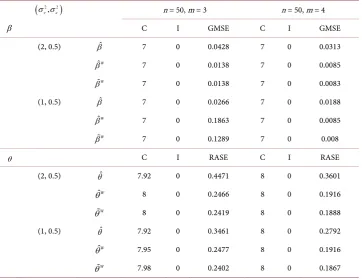
The results about variable selection, based on 100 replications, are included in Table 1.
Table 1 shows that the proposed method can select the true model quite well and leads to smaller GMSE and RASE values. Table 2 reports a satisfactory estimation for the va-riance component. As the sample increase, the performance becomes better.
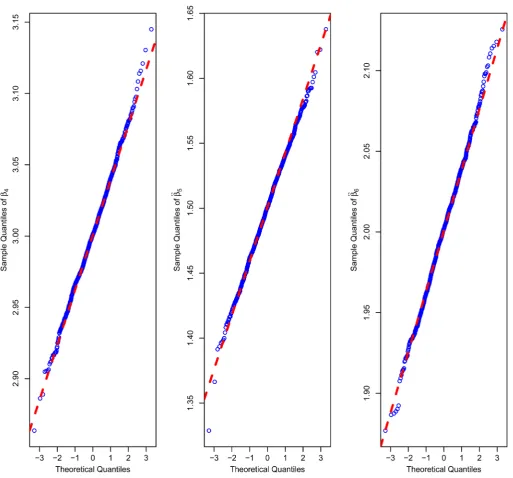
Secondly, the variance, bias and mean square error of the estimators for the nonzero parameters, denoted to be “V”, “Bias” and “MSE”, are listed in Table 3. From Table 3, all the three methods can obtain consistent estimators with small bias. Moreover, the values of “V” and “MSE” also argue that the newly proposed method and the “ideal” method can derive a more efficient estimator than the “naive” method does. What’s more, the asymptotic normality of the estimators for the parametric component is shown with Quantile-Quantile plot in Figure 1.
Table 1. Simulation results for the variable selection.
(
2 2)
,
ν ε
σ σ n = 50, m = 3 n = 50, m = 4
β C I GMSE C I GMSE
(2, 0.5) βˆ 7 0 0.0428 7 0 0.0313
ˆW
β 7 0 0.0138 7 0 0.0085
W
β 7 0 0.0138 7 0 0.0083
(1, 0.5) βˆ 7 0 0.0266 7 0 0.0188
ˆW
β 7 0 0.1863 7 0 0.0085
W
β 7 0 0.1289 7 0 0.008
θ C I RASE C I RASE
(2, 0.5) θˆ 7.92 0 0.4471 8 0 0.3601
ˆW
θ 8 0 0.2466 8 0 0.1916
W
θ 8 0 0.2419 8 0 0.1888
(1, 0.5) θˆ 7.92 0 0.3461 8 0 0.2792
ˆW
θ 7.95 0 0.2477 8 0 0.1916
W
[image:7.595.193.558.399.529.2]θ 7.98 0 0.2402 8 0 0.1867
Table 2. Simulation results for the estimators of the variance components 2 2
, ν ε
σ σ .
(
2 2)
,
ν ε
σ σ n = 50, m = 3 n = 50, m = 4
2
ν
σ M V MSE M V MSE
(2, 0.5) 1.6 0.27 0.418 1.64 0.42 0.54
(1, 0.5) 0.7 0.12 0.206 0.64 0.13 0.25
2
ε
σ M V MSE M V MSE
(2, 0.5) 0.5 0.02 0.025 0.53 0.02 0.022
(1, 0.5) 0.4 0.08 0.008 0.50 0.01 0.01
Table 3. Simulation results ×100 for β β β4, 5, 6 with n = 50 and m = 3.
(
2 2)
,
ν ε
σ σ β4 β5 β6
Var Bias MSE Var Bias MSE Var Bias MSE
(2, 0.5) βˆ 0.498 7.063 0.997 0.494 6.456 0.911 0.484 6.140 0.861
ˆW
β 0.159 5.191 0.428 0.168 6.519 0.593 0.149 0.502 0.152
W
β
0.150 5.090 0.409 0.157 6.457 0.576 0.138 0.231 0.139 (1, 0.5) βˆ 0.286 −4.931 0.529 0.304 −11.76 1.688 0.291 −5.826 0.630
ˆW
β 0.153 −4.128 0.323 0.152 −4.408 0.346 0.161 −5.328 0.445
W
[image:7.595.188.555.561.705.2]Figure 1. Q-Q plot of the estimator ˆ4, ˆ5 ,ˆ6
W W W
β β β .
Example 2. To illustrate the effectiveness of the proposed estimation procedure, we shall apply it to the analysis of a longitudinal AIDS data set, which is reported by [18]
and comprises HIV status of 283 homosexual males who were infected with HIV dur-ing a follow-up period between 1984 and 1991. The focus in this application is to probe into the trend of the mean CD4 percentage depletion over time and evaluate the effects of cigarette smoking, preHIV infection CD4 percentage and age at infection on the mean CD4 percentage after infection.
For the jth measurement of the ith subject, let Yij be the mean CD4 percentage, tij
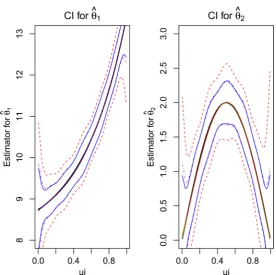
Figure 2. The estimated average curve for the nonparametric component θ1
( ) ( )
⋅ ,θ2 ⋅ and their95% pointwise confidence interval with three coincident curves being the estimated ones for the nonparametric component, and the red dotted, the coincident solid and dotted-dashed ones be-ing the estimated confidence intervals by the “naive”, the “ideal” and the proposed method, re-spectively.
2 ,2 ,1.
i i
X =X Zi,1 be the centered age at HIV infection and Zi,2=Zi2,1. Let Zi,3 be the smoking status taking a value of 1 or 0. Hence, assume the following model
( )
( )
( )
T T0 ,1 1 ,2 2( ) ,3 3 ,1 1 ,2 2 ,
ij ij ij ij ij ij ij ij ij ij i ij
Y =θ t +Z θ t +Z θ t +Z θ t +X β +X β ν ε+ + (20)
where the baseline of CD4 percentage θ0
( )
t is used to represent the mean CD4per-centage of t years after the infection. The random effect νi, representing the
with-in-subject correlation, is also included in the assumed model.
By the analysis, there are two variables θ0
( )
t and Xi,1 with nonzero estimators, which indicate the significant effect on the response variable Yij. Other variables’coef-ficients are zero and have no significant effect. Moreover, the estimated curve in Figure 3
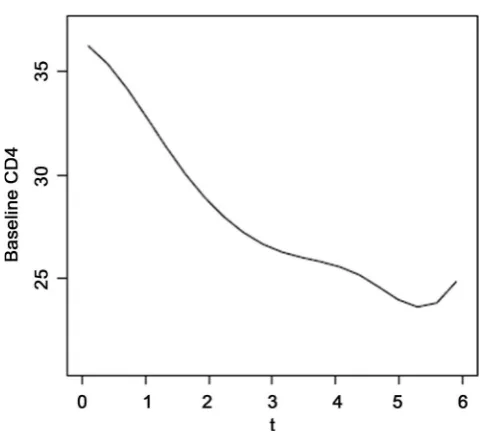
shows the trend of the mean CD4 percentage depletion over time.
5. Conclusion and Discussion
Figure 3. The estimators for the mean CD4 percentage θ0
( )
t ,indicating the changing tendency with t.
model under a more general within-subject covariance matrix.
Acknowledgements
This work was partially supported by the National Statistical Science Research Project of China [Grant No. 2014LZ14 and 2015LZ27] and the Yancheng Teachers’ Professor and Doctors’ Research Project [Grant No. 14YSYJB0108].
References
[1] Hastie, T. and Tibshirani, R. (1993) Varying Coefficient Models. Journal of the Royal Statis-tical Society: Series B, 55, 757-796.
[2] Ahmad, I., Leelahanon, S. and Li, Q. (2005) Efficient Estimation of a Semiparametric Par-tially Linear Varying Coefficient Model. Ann. Statist., 33, 258-283.
http://dx.doi.org/10.1214/009053604000000931
[3] Pang, Z. and Xue, L.G. (2012) Estimation for the Single-Index Models with Random Effects.
Computational Statistics and Data Analysis, 56, 1837-1853.
http://dx.doi.org/10.1016/j.csda.2011.11.007
[4] Xue, L.G. and Zhu, L.X. (2007) Empirical Likelihood for a Varying Coefficient Model with Longitudinal Data. Journal of the American Statistical Association, 102, 642-652.
http://dx.doi.org/10.1198/016214507000000293
[5] Zhao, P.X. and Xue, L.G. (2010) Variable Selection for Semiparametric Varying Coefficient Partially Linear Errors-in-Variable Models. Journal of Multivariate Analysis, 101, 1872- 1883. http://dx.doi.org/10.1016/j.jmva.2010.03.005
[6] Ruckstuhl, A.F., Welsh, A.H. and Carroll, R.J. (2000) Nonparametric Function Estimation of Estimation of the Relationship between Two Repeatedly Measurement Variables. Statis-tica Sinica, 10, 51-71.
[image:10.595.252.495.64.280.2][8] Su, L. and Ullah, A. (2007) More Efficient Estimation of Nonparametric Panel Data Models with Random Effects. Economics Letters, 96, 375-380.
http://dx.doi.org/10.1016/j.econlet.2007.02.018
[9] You, J. and Zhou, X. (2009) Partially Linear Models and Polynomial Spline Approximations for the Analysis of Unbalanced Panel Data. Journal of Statistical Planning and Inference, 139, 679-695. http://dx.doi.org/10.1016/j.jspi.2007.04.037
[10] Fan, J. and Li, R. (2001) Variable Selection via Nonconcave Penalized Likelihood and Its Oracle Properties. Journal of the American Statistical Association, 96, 710-723.
http://dx.doi.org/10.1198/016214501753382273
[11] Zou, H. (2006) The Adaptive Lasso and Its Oracle Properties. Journal of the American Sta-tistical Association, 101, 1418-1429. http://dx.doi.org/10.1198/016214506000000735
[12] Yuan, M. and Lin, Y. (2006) Model Selection and Estimation in Regression with Grouped Variables. Journal of the Royal Statistical Society: Series B, 68, 49-67.
http://dx.doi.org/10.1111/j.1467-9868.2005.00532.x
[13] Zou, H. and Li, R.Z. (2008) One Steps Sparse Estimates in Noncave Penalized Likelihood Models. Annals of Statistics, 36, 1509-1533. http://dx.doi.org/10.1214/009053607000000802
[14] Liang, H. and Li, R.Z. (2009) Variable Selection for Partially Linear Models with Measure-ment Errors. Journal of the American Statistical Association, 104, 234-248.
http://dx.doi.org/10.1198/jasa.2009.0127
[15] Zhao, P.X. and Xue, L.G. (2009) Variable Selection for Semiparametric Varying Coefficient Partially Linear Models. Statistics and Probability Letters, 79, 2148-2157.
http://dx.doi.org/10.1016/j.spl.2009.07.004
[16] Li, G., Lai, P. and Lian, H. (2014) Variable Selection and Estimation for Partially Linear Single-Index Models with Longitudinal Data. Statistics & Computing, 25, 579-593.
http://dx.doi.org/10.1007/s11222-013-9447-8
[17] Johnson, B., Lin, D. and Zeng, D. (2008) Penalized Estimating Functions and Variable Se-lection in Semiparametric Regression Models. Journal of the American Statistical Associa-tion, 103, 672-680. http://dx.doi.org/10.1198/016214508000000184
[18] Kaslow, R.A., Ostrow, D.G., Detels, R., Phair, J.P., Polk, B.F. and Rinaldo, C.R. (1987) The Multicenter AIDS Cohort Study: Rationale, Organization and Selected Characteristics of the Participants. American Journal of Epidemiology, 126, 310-318.
http://dx.doi.org/10.1093/aje/126.2.310
Appendix
Submit or recommend next manuscript to SCIRP and we will provide best service for you:
Accepting pre-submission inquiries through Email, Facebook, LinkedIn, Twitter, etc. A wide selection of journals (inclusive of 9 subjects, more than 200 journals)
Providing 24-hour high-quality service User-friendly online submission system Fair and swift peer-review system
Efficient typesetting and proofreading procedure
Display of the result of downloads and visits, as well as the number of cited articles Maximum dissemination of your research work
Submit your manuscript at: http://papersubmission.scirp.org/