IPA
International Journal of Psychology Vol. 10, No. 1, Winter & Spring 2016
PP. 100-117
Iranian Psychological Association
Designing a Native Pattern for Improving
Counselors' Performances in Schools
Loghman Ebrahimi, PhD*
Department of Psychology University of Zanjan
Neda Varghaei, MA
Department of Education University of Zanjan
Khadijeh Bispar, MA
Department of Teachers’ Education of Piran Shahr
Asie Eftekhari, MSc
Department of Psychology Zanjan, Islamic Azad
University
The main goal of this study was to design a model to empower school counselors.The sample included 370 subjects. Interviews and researcher-designed questionnaires were used for data collection. The analysis is based on the data obtained and the parameters of interest in the initial model. There was another questionnaire used to validate the model.The quantitative results ofmulti-variable regression analysis indicated that the correlations between Intrapersonal, Meta-personal and Interpersonal factors with traumatic factors were equal to.296. The coefficient of determination was.088 which means these three variables together explained 8.8 percent of the traumatic variable variance.The severity of the impact and significance of the coefficient of determination was also significant (p=.05،β =.124). The qualitative findings revealed that interpersonal factors more than other factors predict the vulnerability of the counseling activities. This suggests that among the types of traumas, the most traumasare related to the interpersonal counseling activities of school counselors’ performance. Accordingly, the development and introduction of a performance improvement model for the school counselors can lead to empowerment of school counselors.
Rapid progresses in science and technology in recent decades have influenced all social systems and have brought about several challenges. Schools, as the heart of educational systems, have important roles in the development of this system (Ahghar, 2007).
Regarding the expansion of sciences and the emergenceof extremelyvaried scientific fields as well as the need to provide and promote the psychological health of students, qualitative and quantitative development of thecounseling services can be considered as an indicator of development in education programs (Hamzei, 2001). Running counseling programs properlyleads to the enrichment of the educational system and not only facilitates reaching academic aims, but also solves many of the problems rooted in this system (Mohammadi, 2006).
Since students' mental health needs are so vast and accessing counseling services restricted, schools can becomean important field for counselors. Findings of scientific research on the effectiveness of counseling services for students confirm this reality (Frideman, Katz-Leavy, Manderscheid & Sondheimer, 1996; Forrest, 2004; Gysbers, 2004; Romano & Kachgal, 2004; Sabella, 2004; Whiston, 2004; Tolan & Dodege, 2005; Weisz, McCarty & Valeri, 2006).
Counseling activities in schools are the best type of cooperation in schools that try to solve social, familial, academic, behavioral and psychological problems of students. Problems of students are identified by the help of parents and schoolstaff while counselors have key roles in this process (Ranje bazu, 2008).
academic field, providing them job information, harmonizing educational activities in order to help students, identifying students' problems and familiarizing themwiththe process of referring to professions, and follow up the results of referrals and counseling sessions. However, efficient school counselors should be creative and find new ways ofdoing their professional duties and not confining themselves to these assignments (Shafi Abadi, 2002; Navvabi Nezhad, 2008)
Since having an efficient human source is an important factor for achieving goals in any program, investigating the effectiveness of counselors' performances and the way they perform counseling programs in schools guide us toward finding problems that exist in the qualitative and quantitative process of counseling and may finally result in modifying these problems (Mohammadi, 2006).
Interventions designed for promoting organizations and their programs are derived from pathology and include special proceedings that attempt to solve problems, eliminate obstacles and damages, and finally, improve organizational performances (Qming and Orerly, 1997). In the pathology of staffs performance and activities and organization, and in interaction amongstaffs and environmental necessities, organizations have to use new strategies and be more flexible when responding to internal and external pressures. Experts of organizational management and psychology suggest the creationof the culture of staff empowerment to confront these worries and challenges (Abdollahi & Naveh Ibrahim, 2006).
in increasing of carrier satisfaction and commitment; finally, it improves staffsperformance (Lui & Chiu, 2007; Bogler & Somech, 2004; Osborn, 2002; Thomas & Velthouse, 1990, Sayyadi, 2009; Amoupour, 2011; Asqari et Staff’s al, 2008). Believing in applying the empowerment theory for the role of professional school counselors and presenting extensive and multicultural programs for guidance in schools indicate hopefulness for giving more efficient services to students (Sayyadi, 2010). Shafi Abadi (2009) believes that empowering counselors in order to help clients achieve self-scrutiny, fulfill their needs properly, and make correctand timely decisions has a significant impact on job consent and prosperity.
Since necessary mental structures have not been shaped yet, the structure of counseling in schools is defective (Kavyani et al, 2002) and if this assumption and other challenges and damage factors are true identifying problem dimensions as a necessity guides us toward solving them. Therefore, it is necessary to design a proper performance pattern for school counselors to prevent role bewilderment and to help them reach their counseling goals by optimum usage of their professional efficiencies and present facilities.
counselor selection more efficient in high school grades. The present study was conducted with the aim of designing a native pattern for improving counselor performances in Iranian schools.
Method
Regarding the nature of the issue and research goals, this study was an applied research considering the procedure; it was done by mixed methods (ground theory). Its aim was to design a proper pattern for improving performances of school counselors in Iran. The study population consisted of all high schools principals, counselors, teachers, and students of Western Azerbaijan province in the academic year 2012-13. For selecting the sample population in quantitative part, multistage cluster random sampling and stratified random sampling were used. Finally, 370 individual (50 principals, 52 counselors, 150 teachers, and 118 students) were chosen for this part. Non-random and Saturation method (saturated comment) was used to select the sample of the qualitative part that included 48 individuals (12 principals, 16 counselors, 12 teachers, and 8 students). The study was done in 3 steps.
In the first step, the study agents (including principals, counselors, teachers, and students) were determined and their ideas about counselor' performance were investigated by using interviews and questionnaires; damage factors were extracted and information about these dimensions and components were gathered.
Then, the final form of the questionnaire was designed based on experts' ideas in order to test the pattern, and the final pattern was designed by using the field method and Delphi technique (30 individuals including professors, counseling experts, and school counselors).
Traumatic factors of school counseling activities, and the empowerment of counselors was identified by open questions, semi-structured interviews of principals, counselors, teachers and students. Factors that should begiven to school counselors in order to improve their performanceand reduce traumatic factors were determined by open coding, selected coding, and finally they were developed as a basis for the learning model.
Measuring Tools
In the qualitative data collection, to determine and identify traumatic factors for school counselor activities, semi-structured interviews were used.In the quantitative part, a researcher-made questionnaire was used.
sample group (principals, counselors, teachers and students), according to their position in the counseling programs, was different. The first questions for the principals, counselors, teachers, students were, respectively “what are your expectationsof school counselor activities?”, “what are the factors you assume affect the performance of school counselors?”, “what is the role of consultant activities inschool?”, “what characteristics do you expect ofa school counselor?”Then the next question based on the answers of the participants asked, for example “referring to the individual factors of counselors, could you explain it more?”“What do you mean by the personal factor you mentioned before and how could they affect school counselor functions?”When the participants were not focused on the main subject, leading questions were used such as “the issue of psychological and interpersonal factors of the counselors that you mentioned is very important,could you explain more about it?”, or “you talked about a very interesting feature of organizational consultants,would you talk about it a bit more?”The time of an interview according to the circumstances, tolerance, the interest of participants was between 45-75 minutes.
Results
Regarding the results of the interviews with counseling administrators in schools as well as findings of the researcher-made questionnaire, it was revealed that vulnerabilities in counseling activities are derived from interpersonal, intrapersonal, and transpersonal damage factors. All these factors have somehow disturbed counselor performances inschools.
Descriptive results indicate that the means and standard deviations ofthe interpersonal, transpersonal, and intrapersonal were 42.58–3.12, 41.2-2.02, and 32.47-1.79, respectively (Table 1).
Table 1
Indicators of Traumatic Factors Consultancy Activities
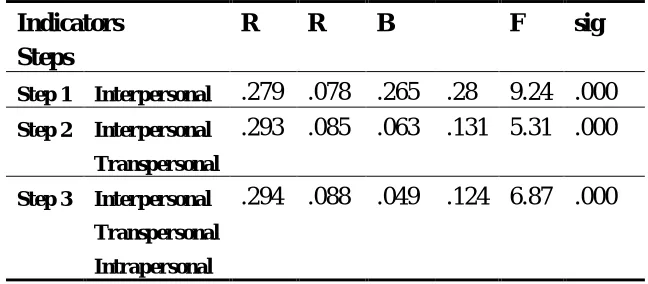
Multiple stepwise regression was used to check how much traumatic factors of interpersonal, intrapersonal, and transpersonal factors predict school counseling activity vulnerability. This method is based on the highest amount of correlation between the predictor and the criterion variables. It means that the predictor and the criterion variables entered the model; respectively. By entering each of the variables, the previous coefficient was reviewed and was inserted in the related step (Table 3).
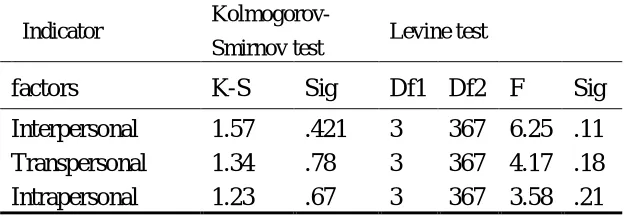
Homogeneity of variance and the normality of statistical data were the basic requirements for the test. To check this issue in the three factors, the Levin test, and the Kolmogrov-Smirnov
Traumatic Factors Mean Standard Deviation
Interpersonal 42.58 3.12
Transpersonal 41.2 2.o2
test were used.The results show that the three factors of interpersonal,transpersonal, and intrapersonal in the Levine test were (F=6.25), (Sig= .11); (F=4.17), (Sig= .18); (F=3.58), (Sig= .21) and in the Kolmogrov-Smirnov were (K-S= .157), (K-S= .134), (Sig=.78), (K-S=.123), (Sig=.67), respectively. They are not significant at the level of .05.Therefore, it can be said with 98% confidence that the variance is homogenous and the data isnormal. Hence, the multiple regression analysis can be used(Table 2).
Table 2
Results of Kolmogorov-Smirnov and Levine Tests
Levine test Kolmogorov-Smirnov test Indicator Sig F Df2 Df1 Sig K-S factors .11 6.25 367 3 .421 1.57 Interpersonal .18 4.17 367 3 .78 1.34 Transpersonal .21 3.58 367 3 .67 1.23 Intrapersonal
The results of multiple regression analysis show that in the first step, the relationship between the interpersonal and vulnerability factor was equal to .279 (r=.279). This variable entered the model. The coefficient of determination between these two variables was .078 which means that this variable alone explained 7.8% of variance vulnerability of counseling activities. Beta value (β=.28) indicated the severity of the impact of these predictions. F(3,361)=9.24 was also used to determine the significance of the coefficient of determination at the level of .05 (P=0.05). In other words, the interpersonal factor is the predictor for vulnerability of the counseling activities.
transpersonal with vulnerability variable obtained .279 (r=.279). The coefficient of determination in common was .085. It means that these three variables togetherexplain 8.8% of the variable variance vulnerability for counseling activities.At this step, the Beta value (β=.124) also indicates the magnitude of these predictions.The F value F (3,367) = 5.31 was done for the significance of the coefficient of determination and it was significant at the level of .05 (P=.05).
In the third step the relationship between interpersonal, transpersonal, and intrapersonal with vulnerability variable obtained .296 (r=.296). The coefficient of determination in common was .088. It means that these three variables together explain 88% of the variable variance vulnerability for counseling activities. At this step Beta value (β=.124) also indicates the severity of the impact of these forecasts. The F value F (3,367) =6.87 was done for the significance of coefficient of determination and it was significant at the level of .05 (P=0.05). (Table3).
Table 3
Results of Multiple Regression Analysis with a Stepwise Method for Predicting Vulnerability Counseling Activities of the Three Factors
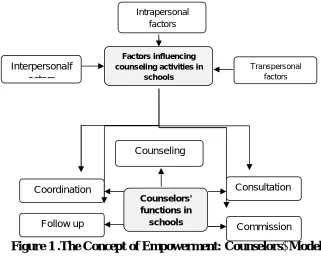
Findings of this study reveal that most damages of counseling activities in schools were derived from interpersonal damage factors, although other factors were engaged, too. Intrapersonal damage factors include all personal, emotional, cognitive, and characteristic factors as well as counseling scientific and practical experiences. Based on the comparison between the present status and favorable status, by perusing scientific grounds on the most important standards of school counseling such as consultation, guidance, coordination, commission, and persuasion (Shafi Abadi, 2004; Salimi Bjestani, 2008) as well as occupational empowerment of counselors, a three-dimensional pattern was designed. Some aspects of this pattern were not confirmed by the specialists and other aspects were combined by their ideas. In this study a primary theoretical model is designed that is actually a heuristic and native model appropriate for counseling activities in schools. The pattern for improving school counselor' performances are as follows:
Figure 1 .The Concept of Empowerment: Counselors’ Model
Factors influencing counseling activities in
schools Intrapersonal
factors
Interpersonalf actors
Transpersonal factors
Counselors' functions in
schools
Counseling
Coordination Consultation
Commission
Conclusion
The aim of this study was to design a native pattern for improving counselors' performances in Iranian schools. A shortlook at the research findings show that on the one hand, the favorable status of counseling activities with respect to theoretical and experimental basis of this issue is important and it should be attended carefully to facilitate reaching the aims of the education system. On the other hand, the present status of counseling activities in schools is unfavorable, and there is a gap between the present and the favorable status of counseling activities in schools and the greatest gaps are in intrapersonal and transpersonal dimensions, respectively.
gap between the present and the favorable status of counseling factors in schools. This gap is caused by vulnerabilities in the counseling process in schools and it has disturbed counselors' performances in schools. Regarding this fact, it is essential to attend carefully to find reasons for this inefficiency and to try hard toeliminate obstacles in order to facilitate reaching educational goals. Therefore, by considering the present status and components of the intrapersonal dimension of counseling activities, it is necessary that school counselors attempt to prevent delaying problem consequences, reducing the effects of problems, enriching knowledge, improving individual attitudes and behaviors in order to retain and revive emotional and physical welfare, gain familial, social, and group supports that are effective in the improvement of the individuals' welfare. Also, to facilitate reaching organizational goals in transpersonal dimension, principals should supervise the organization’s atmosphere and by providing suitable work places they should promote counselor performances and efficiencies. Moreover, in the interpersonal dimension of damage factors of counseling activities, pressure resources should be surveyed and for this purpose, the total range of psychological, social, and physiological issues of school environments that influence counselors should be studied carefully.
In summary, the results of this research show that identifying and categorizing damage factors of counseling activities, assessing counselors' teaching needs, empowering counselors' professionally and psychologically, teaching professional efficiencies to administrators of counseling activities in schools based on counseling standards, and scheduling counseling activities in schools may lead to the improvement of counseling performances in schools.
negative attitudes of some teachers and administrators to the school counselors and their roles inschools affected the assessments of the counselors’ activities. This factor is proposed as a limitation to the generalizability of results. Another limitation factor is the small statistical population and sample size. It is difficult to assess the knowledge of participants in this qualitative study and this can be another limitation factor for the generalizability of the results. Based on the results of this study, it is suggested that officials and policy makers in the field of education advice consider these damages andthink about appropriate solutions to improve the activities of counseling and school counselor performances. It is better to teach the content of this model at monthly meetings of school counselors all over the country or to educate them as in-service training. It is also recommended that training centers and universities use the results of the present study for selection and for the training of students in counseling and psychology, especially with school orientation.
References
Abdollahi, B., Naveh ebrahim, AR (2006). Empower Employees. Tehran: the Nashr publication.
Ahghar, GH. (2007). Study with the aim of the role of organizational school climate on job stress consultants.
Journal of Counseling and Psychotherapy, 9(37), 61-55. Akhavan Tafti, M. (2008). A study of student satisfaction and
client testimonials from National University ofApplicant counseling centers in Tehran. Journal of Counseling and Psychotherapy, 10(36), 87-74.
Gilan province. Engineering Management Magazine, 43, 42-53.
Amiri, M. (2005). Prepare a pattern of selection of school counselors at high schools based on personality characteristics. Master thesis counseling, Allameh Tabatabaei University in Tehran.
Asghari, A., khoda panahi, MK., & Sedgh pour, B. (2008). The relation between empowering and self skilled with job satisfaction. Psychology Magazine, 46, 15-25. (4)
Baggerly, N., & Osborn, M. (1998). Career commitment in Enginerring Effects of Gender, Environment, and personality.
Bogler, R., & Somech, A. (2004). Influence of teacher empowerment on teachers' organizationalcommitment, professional commitment and organizationalcitizenship behavior in schools. Teaching and Teacher Education, 20, 277-289.
Friedman, R., Katz-Leavy, J., Manderscheid, R., & Sondheimer, D. (1996). Prevalence of serious emotional disturbance in children and adolescents.In R. W. Manderscheid & M. A. Sonnenschein (Eds.), Mental health, United States, 1996 (pp. 71-88). Rockville, MD: Center for Mental Health Services.
Forrest, L. (2004). Moving out of our comfort zones: School counseling/counseling psychology partnerships. The Counseling Psychologist, 32, 225-234.
Foy, N. (1997). Empowering People at work; Cambridge:
Gower Publishing, 1997, London.
Ghorbani, M., Asgarzade, H., & Abasi, B. (2010).Introducing the empowerment in management and its patterns. The Journal of Management Studies, 39.
counseling partnership: Overlooked? Underutilized? But needed! The Counseling Psychologist, 32, 245-252.
Hamzei, M. (2001). The position of counselors in education.Training Magazine, 3.
Hoseinian, S., & Momeni Javid, M. (2010). The role of the Counseling supervision on professional growth facilitating, increase competence and promoting accountability consultants. Journal of Counseling and Psychotherapy, 11(42), 48-43.
Kaviani, H., Pornash, M., & Golfam, M. (2002). The status of school counselors and Barriers to Counseling: quality review. Cognitive Science News, 4(1).
Kiani, A., Navabi Nejad, SH., & Ahmadi, KH. (2009). Investigation of factors related to observance of professional ethics by counselors and Psychologists. Journal of Counseling and Psychotherapy, 10(40), 45-39.
Liu, M. M, Anita Chiu, W. M., & Fellows, R. (2007). Enhancing commitmentthrough work empowerment. Journal of Engineering, Construction and Architectural Management, 14(6), 568-580.
Melchert, T. P., Hays, V. L, Willjanen, L. M., & Koloceck, A. K. (1996). Testing modeles of counselor development with a measure of counseling self efficacy. Journal of Counseling and Development, 74, 650-655.
Mohammadi, SH. (2006). Evaluation of the effectiveness and performance of the Psychiatry and psychiatric services of counseling advising centers for students of the Department of education. Journal of Counseling and Psychotherapy, 5(19).
Navabi Nejad, SH. (2008). Secondary Advice. Tehran: a Moaser publication. Third printing.
they differently relate to employee job satisfaction,
organizational commitment and intent to leave the job, 1-2. Pazargadi, M., Afzali, M., Javad Zadeh, Z., & Alavi Majd, H.
(2005). The proposed pattern presented for evaluation of performance of head nurses in the hospitals of Tehran University of medical sciences subsidiary. Medical Research (Journal of the Faculty of Medicine, research)
University of medical sciences and health services, Tehran, 29(2), 187-193.
Qming, K., Orerly, M. (1997). Organizational Development, N.I, Prentic Hall.
Romano, JL., Kachgal, M. M. (2004). Counseling psychology and school counseling: An underutilized partnership. The Counseling Psychologist, 32, 184-215.
Sabella, RA. (2004). A reaction to counseling psychology and school counseling: An underutilized partnership. The Counseling Psychologist, 32, 263-269.
Salimi Bjestani, H. (2008). Group counseling strategies in schools: tips and advice services in the schools. School Counselor Magazine. Roshd publishing, 4(1), 37-4
Sayadi, A. (2010). Psychological empowerment-based compilation model chandmehori shafiabadi job and compare the effectiveness of the cognitive model with Thomas and the waltahos between counselors in Rasht. Doctoral thesis counseling. Allameh Tabatabaei University in Tehran.
Shafia Abadi, A. (2004). Secondary education and career counseling: concepts and applications. Tehran: The Samt publishing.
advice. Tehran: Besat.
Thomas, K. W., Velthouse, B. A. (1990). Cognitive elements of empowerment: an"interpretive" model of intrinsic task motivation. Acad Manage Rev, 15(4), 666-81.
Tolan PH, Dodge, KA. (2005). Children’s mental health as a primary care and concern. American Psychologist, 60, 601-614.
Urboniene, S. N. (2008). Professional counselling in higher School: Principles and directions of activities. Journal of Pegagogoka, 3.
Velsor, PV. (2009). Counselor as social emotional learning counsultonts Professional. Journal of school counseling, 12.
Weisz, JR., McCarty, C. A., & Valeri, S. M. (2006). Effects of psychotherapy for depression in children and adolescents: A meta-analysis. Psychological Bulletin, 132, 132-149.
Whiston S. C. (2004). Counseling psychology and school counseling: Can a stronger partnership be forged? The Counseling Psychologist, 32, 270-277.