Available Online at www.ijpret.com 1333
INTERNATIONAL JOURNAL OF PURE AND
APPLIED RESEARCH IN ENGINEERING AND
TECHNOLOGY
A PATH FOR HORIZING YOUR INNOVATIVE WORK
A SURVEY ON CLOUD BASED MOBILE MULTIMEDIA RECOMMENDATION SYSTEM
WITH USER BEHAVIOR INFORMATION
MISS. ANURADHA R. KOKATE1, PROF. MISS. P. P. DESHMUKH 2
1.Department of Computer Science and Engineering, P. R. Pote (Patil) College Of Engineering, Amravati, Maharashtra, India. 2.HOD, Department of Computer Science and Engineering, P. R. Pote (Patil) College Of Engineering, Amravati, Maharashtra, India.
Accepted Date: 05/03/2015; Published Date: 01/05/2015
Abstract:Mobile device challenges such as storage limitation have however introduced the problem of mobile multimedia overload to users. In order to tackle this problem, researchers have developed various techniques that recommend multimedia for mobile users. A cautious analysis of existing research reveals that the implementation of proactive, sensor-based and hybrid recommender systems can improve mobile multimedia recommendations. Nevertheless, there are still challenges and open issues such as the incorporation of context and social properties, which need to be tackled in order to generate accurate and trustworthy mobile multimedia recommendations. There are many filtering algorithms has been proposed, among them Collaborative filtering (CF) is most widely used and almost popular. Recommendation systems mainly focus on three specific domain like that CB
filtering, CF-based filtering and Context-aware filtering.
Keywords:Mobile Multimedia, cloudcomputing, Recommendation System
Corresponding Author: MISS. ANURADHA R. KOKATE
Access Online On:
www.ijpret.com
How to Cite This Article:
Available Online at www.ijpret.com 1334 INTRODUCTION
To capture the interests of users in a ubiquitous environment, more and more contextual information, such as user opinions, watching times, and video ages, is logged in the recommendation system [1]. How to help mobile users obtain their favorite content lists from millions of Webpages in a short time is very challenging [2]. Internet users post a many large number of audio, video clips on audio, video-sharing websites and social network (Face book, Twitter) applications everyday [3]. The number of audio, video may be duplicate, similar, related, or quite different. The user facing billions of multimedia web-pages, online users are usually very hard time finding their favorites videos. This situation is very hard for mobile users because of screen limit and low bandwidth. Some video-sharing websites recommend video lists for end users according to video classification, video description tags, or watching history. The existing recommendation algorithms, the typical system consists of two essential components: 1) a content recommender that takes charge of user interest identification, user interest recommendation, and result reranking and 2) various collectors that collect user context and activities, content attributes, and updates. In recommendation system initialization, a few contextual information, e.g., time and location, is collected User interests and content clustering are often used to narrow the searching range of related content.
The system is implemented on the Hadoop platform to satisfy the huge computation
requirements for real-time recommendation systems. Hadoop1 provides a distributed
filesystem and a framework for the analysis and transformation of very large data sets using the
Map Reduce [4] paradigm. While the interface to HDFS is patterned after the Unix file system,
faithfulness to standards was sacrificed in favor of improved performance for the applications at hand. An important characteristic of Hadoop is the partitioning of data and computation across many (thousands) of hosts, and the execution of application computations in parallel close to their data. A Hadoop cluster scales computation capacity, storage capacity and I/O bandwidth by simply adding commodity servers. Hadoop clusters at Yahoo! span 40,000 servers, and store 40 petabytes of application data, with the largest cluster being 4000 servers. One hundred other organizations worldwide report using Hadoop. The Hadoop platform is used in the proposed multimedia recommendation system. On the platform, user clusters and multimedia content are collected, distributed, and stored into the Hadoop distributed file system (HDFS).
Available Online at www.ijpret.com 1335 LITERATURE REVIEW:
We survey the importance and relevance of mobile multimedia recommendation systems for three smart communities, namely, mobile social learning, mobile event guides and context-aware services. Furthermore, we present an overview of mobile multimedia recommendation systems from the perspective of applications, architectures and algorithms. Through careful examination of the state-of-the-art, we outline challenges and open issues that require attention so that recommendations generated for mobile users will be more accurate, reliable, efficient and trustworthy. The members of a smart community are objects that can be human individuals, as well as physical things such as a desk, a watch, a pencil, a door and a key. It is also possible that some other living things (i.e. besides human beings) might be included, for example, a plant and a cat. In most cases, these objects have implicit links among them. As a result of factors such as societal challenges of the elderly and extraordinary population ageing with the unavoidable consequences related to disability and care issues as well as recent technologies resulting in the combination of both CPS and social computing, building smart communities is very important for a society.
The recommender systems are classified into the following types, which take account on ratings, user preferences, history and other factors:
The recommender systems are classified into the following types, which take account on ratings, user preferences, history and other factors:
Content-based recommender systems: In this recommendation system prediction is done based on content information which is stored in the system about each item to be recommended. It used to recommend with similarity of items of the user had previously preferred, based on similarity with respect to user preferences and similarity of certain items are to each other[7]. The system pays attention to two type of information on creation of user profile, such as model of user’s preferences and history of their interactions. Issues in content-based filtering [8] is learning as a pressurizing, focus on probability of the system, is able to learn user preferences from user's actions and use them across other content types. The user profile is learnt regarding contextual independence, so a constraint satisfaction problem is considered.
Available Online at www.ijpret.com 1336 analyzable content is one of the demerits of filtering techniques but the collaborative filtering approach does not rely on that information and so it is an important advantage of CF system [10]. Therefore, the accuracy of prediction increases with capability to recommend complex items [11].
Hybrid recommender systems: The hybrid is platform is a cross breed. This model is an approach of combining collaborative filtering with content-based filtering. This method can be more effective in some cases where recommendation will be precious. The implementation of this approach can be made either by merging content-based or collaborative based recommendation with hybrid separately or unifying both the approach together with hybrid systems as one model [12]. The gain of performance is the effect of this approach. Netflix a social network is a good example of hybrid systems.
Fig.1 General Recommendation system
From the above methods, as we know each systems have their own merits and demerits. Most of approaches of recommender system problem have been deployed, using methods from machine learning capabilities, approximation theory, and various heuristics algorithms. The recommendation systems are used based on how the prediction results are obtained, independently of the techniques used. The only focus is to provide a dynamic system, to help the viewers in this competitive environment. These approaches are generally implemented for cloud environment, these are cloud based recommenders. The general recommendation diagram is show above in figure 1.
Available Online at www.ijpret.com 1337
Very hard to reuse video-tag module.
Payment for combination of Physical Hosting and Hardware is demanded by the Web
Hosting.
Lack of scalability in identified Servers.
Very hard to dedicated the Spammers in online.
Noise and inconsistencies inherent to the data, and determine the hard of the task.
Increasing total amount by provider on the monthly basis.
RELATED WORK
Cloud-based mobile multimedia recommendation systems which speed up the recommendation process the users are classified into several groups according to their context types and values. Also Cloud-based mobile multimedia recommendation system which can reduce network overhead User clusters are collected instead of detailed user profiles. To avoid the explosion of network overhead, user-behavior-based clustering is performed first, and the collectors calculate User clusters according to the clustering rules and then report the user cluster to the recommender only [13].
The context details are not necessary to compute, and the huge network overhead is reduced. Moreover, user contexts, user relationships, and user profiles are collected from video-sharing websites to generate multimedia recommendation.
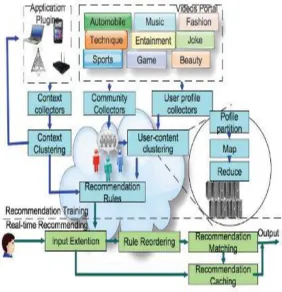
Available Online at www.ijpret.com 1338 Figure 2. Workflow of cloud-assisted mobile multimedia recommendation.
CB recommendation: The content-based systems make recommendation based on the content
names, tags, or explanations. Some systems determine user-interested items based on user’s individual reading history in term of content. CB recommender systems are very easy to implement. In the content based systems are provided by automatically matching a user’s interests with item contents. In content based recommendation very similar items to previous items consumed by the user are recommended which creates a problem of overspecialization [14].
Available Online at www.ijpret.com 1339
Context-aware recommendation: The Context-aware systems provide stable recommendation
without considering user context information. The user interests vary according to location, time, and emotion. Context-aware recommendation systems complement user context sensed on Smartphone and long-time user profile to assist the user in selecting better services, photographs, or videos dynamically [15]. Context is Avery difficult concept to capture and explain; fuzzy ontologism and semantic reasoning are used to augment and enrich the explanation of context.
Graph-based recommendation: The Graph –based recommendation built in the systems to determine the correlation between filtration objects. The filtration problem turns into a node selection problem on a graph. Incorporating conversion content and contextual information, links on video pages are converted to undirected weighted graph. With the huge increase of user numbers, user contexts, user profiles, and video contents, filtration systems require more and more computation capacity. To resolve the huge computation requirements, CF algorithms and context-aware algorithms have been implemented on cloud-computing platforms to improve performance and scalability of the recommender system.
CONCLUSIONS
Available Online at www.ijpret.com 1340 REFERENCES
1. X. Wu, Y. Zhang, J. Guo, and J. Li, “Web video recommendation and long tail discovering,” in
Proc. IEEE ICME, 2008, pp. 369–372.
2. K.-D. Chang, C.-Y. Chen, J.-L. Chen, and H.-C. Chao, “Challenges to next generation services in
IP multimedia subsystem,” J. Inf. Process. Syst., vol. 6, no. 2, pp. 129–146, Jun. 2010.
3. C.-F. Lai, Y.-M. Huang, and H.-C. Chao, “DLNA-based multimedia sharing system for OSGI
framework with extension to P2P network,” IEEE Syst. J., vol. 4, no. 2, pp. 262–270, Jun. 2010.
4. Jeffrey Dean and Sanjay Ghemawat:" MapReduce: Simplified Data Processing on Large
Clusters". Proc. Sixth Symposium on Operating System Design and Implementation, 2004.
5. W.Z. Khan, Y. Xiang, M.Y. Aalsalem, and Q. Arshad, “Mobile Phone Sensing Systems: A
Survey,” IEEE Commun. Survey and Tutorials vol. 15, no. 1, pp. 403-427, 2013.
6. N.D. Lane, E. Miluzzo, H. Lu, D. Peebles, T. Choudhury, and A.T. Campbell, “A Survey of
Mobile Phone Sensing,” IEEE Commun. Mag., vol. 48, issue 9, pp. 140-150, Sept. 2010.
7. M. J Pazzani and D. Billsus, “Content-Based Recommendation Systems,” The Adaptive Web,
Springer Berlin Heidelberg, pp. 325-341, 2007.
8. D. Li, X. Xie, L. Shang, H. Xia, T. Lu, and N. Gu, “Interest based real-time content
recommendation in online social communities,” Knowledge.-Based Syst., vol. 28, pp. 1–12, Apr. 2012.
9. X. He and W. Hu, “An Innovative Web-based Collaborative Model and Application Structure,
“in Proc. of the IEEE Int. Conf. on Comput. Sci. and Software Eng., pp. 56-59, 2008.
10.C. Cheong, V. Bruno, and F. Cheong, “Designing a Mobile-app-based Collaborative Learning
System,” J. of Inform. Technology Educ.: Innovative in Practice, vol. 11, pp. 97-119, 2012.
11.X. Su and T. M. Khoshgoftaar, “A Survey of Collaborative Filtering Techniques,” Advances in
Artificial Intell., (4), 2009.
12.R. Burke, “Hybrid Web Recommender Systems,” The Adaptive Web, Springer Berlin
Available Online at www.ijpret.com 1341
13.G. Vavoula and M. Sharples, “Meeting The Challenges in Evaluating Mobile Learning: a
3-level Evaluation Framework,” Int. J. of Mobile and Blended Learning, vol.1, no. 2, pp. 54-75, 2009.
14.Good, N., Schafer, B., Konstan, J., Borchers, A., Sarwar, B., Herlocker, J., and Riedl, J. (1999).
Combining Collaborative Filtering With Personal Agents for Better Recommendations. In Agents for Better Recommendations. In Proceedings of the AAAI'99 conference, pp. 439-446Proceedings of the AAAI'99 conference, pp. 439-446.
15.Y. Shi, M. Larson, and A. Hanjalic. Mining mood-specific movie similarity with matrix