ISSN: 1942-9703 / © 2017 IIJ Abstract—Nowadays, research on intelligent humanoid robot
for education focuses on face and speech recognition systems in order to be able to teach and interact with students naturally. In this research, we would like to propose behavior-based humanoid robot with the feature of face and speech recognition based on Indonesian language and small vocabularies for teaching basic mathematics. This kind of robot can be used in schools. The humanoid robot should consider the behavior of students in elementary school and conclude the answer through conversation under unreliable automatic speech in noisy environment. In our scenario, robot will detect user’s face and accept commands from the user to do an action such as giving tutorial and questions, specifically in teaching basic mathematics, where the answer from user will be processed to the Google Translator and the result will be compared with vocabularies defined on the system. POMDP (Partially Observable Markov Decision Process) used for improving the accuracy of the speech recognition. We describe how this formulation establish a promising framework by empirical results using subjects randomly. The comparative experiments with samples from students are presented.
Index Terms—intelligent humanoid robot, behavior-based robotics, speech recognition, psychology, human robot interaction
I. INTRODUCTION
owadays, the development of humanoid robots with totally autonomous for a variety of tasks such as for teaching and learning, from elementary school to undergraduate courses to graduate education, has become a popular research topic. In the constructionist approach, students learn from designing and assembling their own robots. Since robots capture the imagination of many younger people, they have been validated as useful aids for the teaching of mathematics and science. As lecturer and researchers in robotics, we have had many experiences helping teams of
Manuscript received 4 November, 2016. This work was supported in part by the Toray Science and Technology Research Grant, 2016.
Widodo Budiharto is with the School of Computer Science, Bina Nusantara University, Jakarta (phone:+628569887384; e-mail: [email protected]).
Anggita Dian Cahyani, is with Psychology Department, Bina Nusantara University, Jakarta. (phone:+62215345830 e-mail: [email protected]).
students solve technological design problems in robotic and in designing formal classroom curricula intended to teach STEM concepts through robotics.
With the evolution of robotics hardware and subsequent advances in processor performance in recent years, the temporal and spatial complexity of feature extraction algorithms to solve this task has grown accordingly. In the case of humanoid robot for education, vision systems are one of the main sources for environment interpretation.
Many problems have to be solved such as voice and face recognition. First of all, the robot has to get information from the environment, mainly using the camera. The robot has to self-localize and decide the next action: move, walking, search another object, etc. It makes no sense within this environment to have a good localization method if that takes several seconds to compute the robot position or to decide the next movement in few seconds based on the old perceptions. To build systems that can handle the uncertainty of the real world, it is important for robot engineer and researcher to look at how humans are able to perform in such a wide range of situations that is traditionally the purview of cognitive Psychology. psychology can play a role is for human robot interaction. Optimality of an action is less relevant when dealing with human, worse, they can be badly perceived.
The concept of BBR was introduced in the mid 1980s, and was championed by Rodney Brooks [1] with the subsumption architecture for building robot control systems. Most behavior-based systems are also reactive, which means they need no programming of internal representations of what kind of surface the robot is moving on. Instead all the information is gleaned from the input of the robot's sensors. The robot uses that information to gradually correct its actions according to the changes in immediate environment. Behavior-based robots (BBR) usually show more biological-appearing actions than their computing-intensive counterparts, which are very deliberate in their actions [2]. Recently, the behavior-based approach for humanoid robot is used by researchers worldwide, by imitating the behavior of human, and psychological benchmarks to measure success in building increasingly human like robots. By psychological benchmarks we mean categories of interaction that capture conceptually fundamental aspects of human life, specified abstractly enough to resist their identity as a mere psychological instrument, but capable of being translated into testable empirical propositions [3].
Behavior-Based Humanoid Robot for Teaching
Basic Mathematics
Widodo Budiharto,
Member, IEEE
and Anggita Dian Cahyani
Human actions and gestures are important communication tools used by humans. People sometimes communicate by using body movements such as hands or head rather than speaking [4]. Human action recognition is a task of analyzing human action that occurs in a video, such as using Relevance Vector Machine (RVM) and Support Vector Machine (SVM) [5]. But, for humanoid robot for teaching a subject such as mathematics, the ability for speech recognition is more important.
Some teachers in elementary schools believe that if mathematics is integrated into technology education lessons, then students will become mathematically competent. We agree that many activities commonly found in technology classrooms have the potential to develop students’ mathematical literacy [6]. The basic courses of mathematics proposed in the robotics system for elementary students such as addition, multiplication, subs traction and addition. In this paper, we propose a simple model of behavior-based humanoid robot for teach Math. Figure 1 show our humanoid robot with the height about 70cm.
Fig. 1. Intelligent humanoid robot for teaching Mathematics in Indonesian language. The face and speech recognition system s developed using Python and OpenCV [17]
II. BEHAVIOR-BASED OF HUMANOID ROBOT
Psychology is the scientific study of the mind and behavior. Psychology is a multifaceted discipline and includes many sub-fields of study such areas as human development, sports, health, clinical, social behavior and cognitive processes [7]. Learning for many adults is a routine part of life, however in the developing minds of elementary grade students, learning is a relatively new concept. Basically, Human Robot Interaction (HRI) should consider psychological aspects in
order to work naturally and accepted by young students at class. In case of humanoid robot for teaching Math, it's important that robot should provide clear feedback on student responses so that the class knows which answers are right, which are wrong, and which are somewhere in between. The need for humanoid robots with natural interaction in the future is very high. So we need to imitated the teacher ability and behavior for teaching students to the robot. The issue at hand then becomes, psychologically speaking, how do we measure success in building humanoid robot. One approach might be to take findings from the psychological scientific disciplines, and seek to replicate them in human– robot interaction. Our first approximation for what we mean by psychological benchmarks is as follows: categories of interaction that capture conceptually fundamental aspects of human life [3]. So, in our research, we limit our focus on how robot to be able to detect and recognize face, give a lecturer, give questions and correct responses to students.
III. PROPOSED METHOD
A. Architecture of the humanoid robot
Teachers have also been using the robots to develop skills, knowledge and understanding in the new Digital Technologies Curriculum. BBR approaches intelligence in a way that is very different from the classical AI approach, many of which may be running simultaneously in a given robotic brain, giving suggestions concerning which actions the robot ought to take [11]. For BBR, any number of behaviors may be involved, such as face detection, teaching the students and speech recognition as shown in Figure 2:
Fig. 2. Model of Behavior-based humanoid robot
A behavior will be defined simply as a sequence of actions performed in order to achieve some goal. The humanoid robot with Indonesian language is intended to be able detect human face and recognize the face of people in front to make interaction with the students. The behaviors of human that imitated by our humanoid robot are teaching, asking students then giving the good response. The aspects of considering young students in elementary school by giving the good response whether answer is correct or wrong should be
Face recognition
Speech recognition
Teaching the students sensors
actuators
ISSN: 1942-9703 / © 2017 IIJ considered. When the student give a completely wrong answer,
robot should give a correction, but do so in a softened way. To communicate naturally, the robot should have speech recognition capability. Thus our systems is designed with input both from camera and microphone from the tablet. We improve our previous research [8] such as the software and Tablet PC with onboard camera that used for image and speech processing. Furthermore, Arduino and relays for controlling the robot used in this research as shown in Figure 3.
Fig. 3. Architecture of our intelligent humanoid robot based on Python and Google technology
Real sensors such as microphone and camera are very noisy. They do not give the same sort of simple mapping from actual world state to a clean input vector that we are used to expecting after using simulated robots. We implement probabilistic robotics for the robot by implementing Partially Observable Markov Decision Process (POMDP) using [9][10]. Partial observability implies that the robot has to estimate a posterior distribution over possible world states. At each discrete time step, the agent receives some stochastic observation related to the state of the environment, as well as a special reward signal. Based on this information, the agent can execute actions to stochastic-ally change the state of the environment. The goal of the agent is then to maximize the overall (and typically time-discounted) reward. For face detection and recognition, we use Principal Component Analysis (PCA) [15].
B. Flowchart and Algorithm
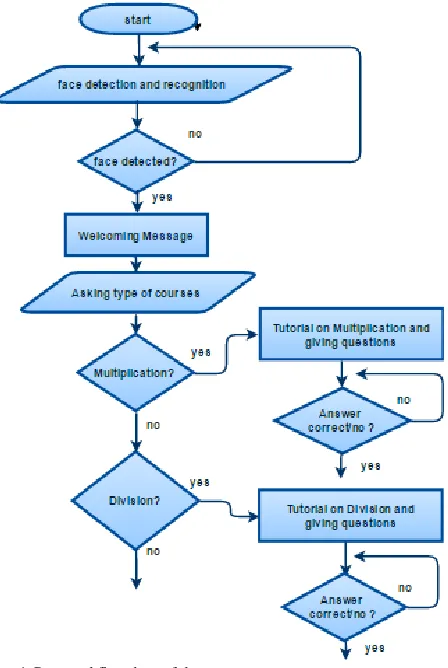
Not much paper show the development of humanoid robot specially for teaching basic mathematics using face and robust speech recognition systems. We propose an efficient flowchart and algorithm of humanoid robot for education. In general, the important part of flowchart of the system shown in the Figure 4, the program will loop as long as the student want to listen the tutorial and answer the question from robot:
Fig. 4. Proposed flowchart of the systems
The algorithm is proposed as shown below:
Algorithm 1. Algorithm of the intelligent humanoid robot for
teaching mathematics
Get input image from the camera Detect and recognize face using PCA If face detected then
do
Welcoming message and asking the user Get answer from user (.WAV file)
Choose Singing, story telling or teaching(learning Math) If option==”teaching” then
If option==”multiplication” or ”addition or “division” or “addition” then
Robot explain concept of mathematics based on the option Recognize each speech using Google Speech Recognition API
Check answer based on simple vocabulary If answer is in simple vocabulary then Give response to user
If finished then Robot standby endif
else Ask again Endif
If option==”test” then Camera and Tablet
Windows
Asking and Get answer from user endif
Robot Standby loop
else
Robot standby Endif
C. List of vocabulary from user
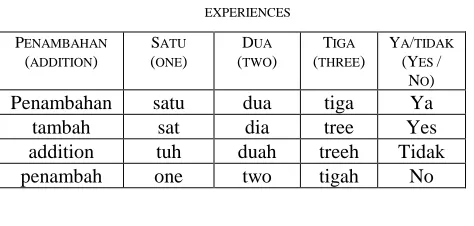
Speech recognition is an challenge task in robotics [11][12]. We propose a small vocabulary for the possibility of words that will be used by user for answering the robot, such as numeric, metrics and answer yes/no. The translation in our system is based on the Google Technology [16], and the demo of our systems is shown at [17]. The list is based on the experience when taking the data from the experiments such as option and numeric answers as shown in table I:
TABLE I.
EXAMPLE OF PROPOSED LIST OF VOCABULARY FROM USERS BASED ON EXPERIENCES
IV. EXPERIMENTAL RESULTS
TThe experiment conducted at our robotics laboratory. We check the effect of the distance with noise, it shows on Figure 5 that the signal with noise have different pattern and many noise and will cause bad words translation.
(a)
(b)
Fig. 5(a) Without noise and distance between robot and a user is 50cm, and (b) with noise and the distance is 120cm
The comparative experiment with 3 persons show at table II, we see that without noise and distance 50cm is the best accuracy. If the machine did not get the correct answer compared with the vocabulary, it will ask again, so the average accuracy reach 84,7%. But with noise, may be because the environment very noisy, the system asks twice but still do not get the correct answer. It can be seen that the reduced signal will cause error in words translation. Overall, the robot able to hear speech of students and giving the good response. Robot will response the wrong answer with some words that make students keep enthusiastic to give the new answer.
TABLE II.
ACCURACY WITH 3 PERSONS AND VARYING THE DISTANCE OF USERS.
To increase the chances of student participation, solicit a collection of answers before designating the right or best one, and let the class argue the merits of various answers on the way to identifying a good answer. Emotion from students also very important. So, for next investigation, we will investigate the machines that could help students in making right decisions by recognizing emotions, especially in irrational situations where decisions have to be made faster than a rational performing mind, as proposed in [13]. These aspects should be consider for future work.
PENAMBAHAN (ADDITION)
SATU (ONE)
DUA (TWO)
TIGA (THREE)
YA/TIDAK (YES /
NO)
Penambahan satu dua tiga Ya
tambah sat dia tree Yes
addition tuh duah treeh Tidak
penambah one two tigah No
SUBJECTS
QUITE NOISY
50CM 120CM 50CM 120CM subject1 93,3% 86,7% 86,7% 80%
subject2 80% 73,3% 66,7% 46,7% subject3 100% 93,3% 86,7% 66,7%
Average
ISSN: 1942-9703 / © 2017 IIJ V. CONCLUSION
The overlapping interests of behavior-based humanoid robot and cognitive psychology has proven fruitful so far. Autonomy and imitation are some of the psychological benchmarks to measure the level of success of the development of humanoid robots. Mechanisms like face and speech recognition systems, can provide robots with techniques to make their behavior more flexible. We successfully implemented the speech recognition with simple vocabulary for humanoid robot with fun, because kids learn best when they are relaxed and focused and gave good impact on student learning. The experimental results showed that the robot hears answer from users at the distance 50-120 cm is enough. For the future work, the robot will be challenged with more complex spoken interaction due to more variation of actions to do, and next, additional features such as recognizing emotions, especially in irrational situations where decisions have to be made faster than a rational performing mind.
ACKNOWLEDGMENT
This work is fully supported by Toray Science and Research Grant 2016 and Research Lab. Robotics and Intelligent Systems from Bina Nusantara University, 2016.
REFERENCES
[1] R.A. Brooks, “A Robot that Walks: Emergent Behavior form a Carefully Evolved Network,” Neural Computation, vol. 1, pp. 253-262, 1989. [2] J.L. Jones, Robot Programming: A practical guide to Behavior-Based
Robotics, McGraw Hill, 2004.
[3] Peter H. Khan et al, “What is a human? Toward psychological benchmarks in the field of human–robot interaction,” Interaction Studies, vol. 8(3), pp. 363–390, 2007.
[4] K. K. Biswas, “Gesture Recognition using Microsoft Kinect,” in Proc. 5th International Conference on Automation, Robotics and Applications, New Zealand, vol. 2, 2011, pp. 100–103.
[5] V. Ayumi and Mohamad I. Fanany, “A Comparison of SVM and RVM for Human Action Recognition,” Internetworking Indonesia Journal, vol. 8(1), pp 29-33, 2016.
[6] L.S Litowitz, “Addressing mathematics literacy through technology, innovation, design, and engineering,” The Technology Teacher, vol. 69(1), pp. 19-22, 2009.
[7] McLeod, S.A., “What is Psychology?”. accessed at http://www.simplypsychology.org/whatispsychology.html, 2011.
[8] W. Budiharto, Meiliana and A.A.S. Gunawan, “Development of coffee maker service robot using speech and face recognition systems using POMDP,” 1st International Workshop on Pattern Recognition, 11-13 May, Tokyo, 2016, pp. 10011101-10011105.
[9] J.D. Williams and S. Young, “Partially observable Markov decision processes for spoken dialog systems,” Journal Computer Speech and Language, vol. 21(2), pp 393-422, 2007.
[10] S. Young. M. Gašić, B. Thomson and J.D. Williams, “POMDP-Based Statistical Spoken Dialog Systems: A Review,” Proc. of the IEEE, vol 101(5), pp. 1160 – 1179, 2013.
[11] D. Fox, S. Thrun and W. Burgard, Probabilistic Robotics, MIT Press, 2005.
[12] L. Gorin, G. Riccardi and J.H. Wright, “How may I Help You?,” Speech Communication , vol. 23 pp. 113-127, 1997.
[13] Lugović, I. Dunđer and M. Horvat, “Techniques and Applications of Emotion Recognition in Speech,” MIPRO 2016, pp. 1278-1283, 2016. [14] R.C. Arkin, Behavior-Based Robotics, 3rd Edition, Bradford Book
Publisher, 2000.
[15] C. Tarunajaya et al, Development of Humanoid Robot with Face Recognition Features, IPTEK, The Journal for Technology and Science, vol. 26. no. 6, 2015, pp. 28-34.
[16] Google Translator, www.translate.google.com
[17] Intelligent humanoid robot for teaching Math, https://www.youtube.com/watch?v=4E6Ns-DpCuM
Widodo Budiharto (P’95–IT’01–E’08) received his B.Sc. degree in Physics from University of Indonesia, Indonesia in 2000, and his Ph.D. degree in Robotics from Institute of Technology Sepuluh November Surabaya (ITS) in 2012. He is a senior researcher ad Robotics and Intelligent Systems Lab., School of Computer Science, Bina Nusantara University. His research interest includes robot vision, machine learning and image processing.
Dr. Budiharto is an IEEE Member general chair of 1st ICCSCI 2015..
Anggita Dian Cahyani (P’08) received her B.Psy. degree in Psychology from Gadjah Mada University, Indonesia in 2008, and her M.A. degree in Social Psychology from Gadjah Mada University in 2012. She is a researcher at Psychology Department, Bina Nusantara University.
![Fig. 1. Intelligent humanoid robot for teaching Mathematics in Indonesian language. The face and speech recognition system s developed using Python and OpenCV [17]](https://thumb-us.123doks.com/thumbv2/123dok_us/8755083.1749708/2.612.109.278.309.551/intelligent-humanoid-teaching-mathematics-indonesian-language-recognition-developed.webp)