Available Online at www.ijpret.com 442
INTERNATIONAL JOURNAL OF PURE AND
APPLIED RESEARCH IN ENGINEERING AND
TECHNOLOGY
A PATH FOR HORIZING YOUR INNOVATIVE WORK
HIGH STRENGTH SELF COMPACTING CONCRETE USING GGBFS
ZEESHAN ADIB AHMED1, DR. S. H. MAHURE2 1. Dept. of Civil Engineering, B. N. College of Engineering, Pusad-445215, Maharashtra, India.
2. Professor and Head, Dept. of Civil Engineering, B. N. College of Engineering,
Accepted Date: 15/03/2016; Published Date: 01/05/2016
\
Abstract:Self-Compacting Concrete, born in Japan in late 80’s to solve problems of pouring and setting concrete in high rebar densities structures, has slowly spread all over the world, showing many other characteristics and attracting attention first in laboratories and then in application. The development of high-strength self-compacting GGBFS concrete is a positive contribution to sustainable concrete technology. Experimental studies has been carried out to understand the fresh and hardened properties of high strength self-compacting concrete (HSSCC) in which cement is replaced by Ground granulated blast furnace slag (GGBFS) in different fractions for M70 grade concrete.
Keywords: HSSCC, GGBFS, Super Plasticizer, Rheological Parameters, Strength Properties, Nan-Su method for mix proportion.
Corresponding Author: ZEESHAN ADIB AHMED
Access Online On:
www.ijpret.com
How to Cite This Article:
Zeeshan Adib Ahmed, IJPRET, 2016; Volume 4 (9): 442-453
Available Online at www.ijpret.com 443 INTRODUCTION
Recently a new term “High Strength Self Compacting Concrete” is used for concrete mixture which possesses high workability, high strength, High density and low permeability. The High performance concrete Called High strength self-compacting concrete has denser microstructure with low inherent “porosity” and “permeability”, because of lower water cement material ratio and use of mineral admixture in concrete.
With growing population, industrialization and urbanization, there is corresponding growth in the demand for infrastructure. Several studies have shown that the performance of concrete can be significantly increased by using mineral additives and specially, some industrial by products. Granulated blast furnace slag is among the most effective mineral additives used in cement or concrete because of its cementations or pozzolanic properties.
Usually high strength self-compacting concrete mixtures have a high cement content that enhance the heat of hydration and may cause increased shrinkage that result in a potential of cracking and low durability. To overcome these problems cement can be replaced by pozzolanic material which can reduce heat of hydration and hence shrinkage. HSSCC mix always contain a powerful super plasticizer which necessary for producing a highly fluid concrete mix, while powder materials are required to maintain sufficient stability of the mix, hence reducing bleeding, segregation and settlement.
High strength self-compacting concrete having advance viscosity and workability can easily fill the mold without the necessity of using vibrators. High volume of mineral powdered is necessary for a proper self-compacting concrete design. In this study the effect of mineral admixture (GGBFS) on the fresh and hardened properties of high strength self-compacting concrete has been investigated.
In this investigation High strength self-compacting concrete is prepared with GGBFS using Nan-Su method for mix proportion.
Available Online at www.ijpret.com 444 I. MATERIALS AND METHODS
Materials:
Cement:Ordinary Portland cement 53 from Deccan cement Ltd. Conforming to IS: 12269 having specific gravity 3.15
Aggregates:
All types of aggregates are suitable. Locally available natural sand with 4.75 mm maximum size was used as fine aggregate and crushed stone with 16mm maximum size were used as coarse aggregates.
GGBFS:
Ground Granulated Blast Furnace Slag powder is a white dust. It is made from Blast Furnace slag a byproduct of iron and steel. Chemical properties and physical properties of GGBFS are mentioned in table 1 and table 2 respectively.
TABLE1: Chemical properties of GGBFS
Available Online at www.ijpret.com 445 Admixture:
The new generation polycarboxylated ether particularly used for HSSCC. Master Glenium Sky 8276 procured from BASF company has been used as super plasticizer. The properties are given in table. 3
TABLE 3: BASF Master Glenium Sky 8276
Water:
Ordinary potable water available in the laboratory has been used.
Quantities of Materials for 1m3 of HSSCC with GGBFS:
TABLE4: Quantities of Materials for 1m3 of HSSCC with GGBFS
Methodology:
Effect of GGBS on following properties of HSSCC:
Fresh Properties:
a) Filling ability: The property of HSSCC to fill all corner of a formwork under its own weight is known as filling ability.
b) Passing ability: The property of HSSCC to flow through reinforcing bars without segregation or blocking.
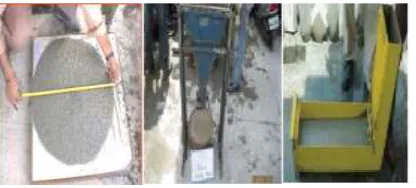
Available Online at www.ijpret.com 446 Several method are available to evaluate these main characteristic of HSSCC, the test have not been standardized by national or international organization. The more common test used for evaluating the characteristics of fresh HSSCC are listed below.
1. The slump flow test
2. V-Funnel test
3. L-Box test
Fig 2: Slump flow, V-funnel, L-box test
Acceptance Criteria for HSSCC:
TABLE 5: HSSCC - Acceptance Criteria
Hardened Properties:
The tests used for evaluating the characteristics of hardened HSSCC are:
a) Compressive Strength Test
b) Split Tensile Strength Test
Available Online at www.ijpret.com 447 Fig. 3: Compressive strength testing machine.
Fig. 4: Split Tensile Strength Test
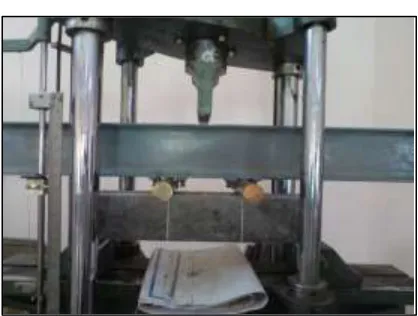
Fig. 5: Flexural Strength Test
II. MIX PROPORTIONING
Available Online at www.ijpret.com 448 Mix-A: - 0% Replacement of Cement with GGBFS
Mix-B: - 10% Replacement of Cement with GGBFS
Mix-C: - 20% Replacement of Cement with GGBFS
Mix-D: - 30% Replacement of Cement with GGBFS
TABLE 6: Mix proportioning for 1m3of HSSCC with GGBFS
III. RESULT AND DISCUSSION
Effects on Fresh property of self-compacted concrete using GGBFS:
GGBFS was used to replace the cement content by three various percentages (0, 10, 20 and 30%). The partial replacement with GGBFS was carried out for M70 grades of concrete. It is observed that the workability tests performed in this investigation as per EFNARC guidelines. They are Slump flow, L-box, and V-funnel. The results of workability tests on high strength SCC are shown in Table 7.
Available Online at www.ijpret.com 449 Graph 1: Slump Flow Value with GGBFS
Graph 2: V-funnel Value with GGBFS
Available Online at www.ijpret.com 450 Effects on hardened properties of self-compacted concrete using GGBFS:
Compressive Strength:
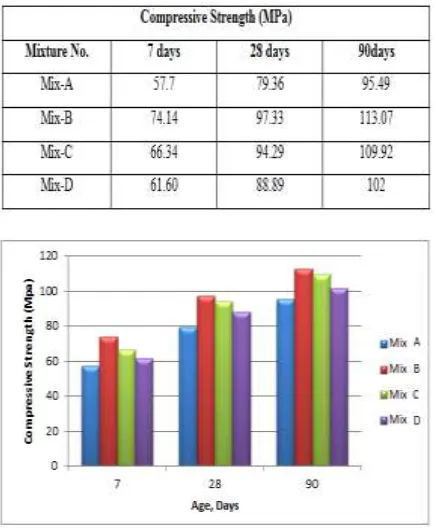
In order to study the effect on compressive strength, when GGBFS is added into High strength SCC as replacement of cement, the cube containing different proportion of GGBFS (0%, 10%, 20% & 30%) were prepared and kept for curing for 7, 28 and 91days. It is observed that 20% replacement of GGBFS gives the higher strength that is 74.14MPa, 97.33MPa and 113.07MPa at 7, 28 and 90 days respectively as compare to 0%, 20% and 30% replacement of GGBFS. The 10% replacement of GGBFS gives optimum strength but 30% replacement gives optimum strength for M70 grade of concrete. Fig shows variation of split tensile strength with different mixes and age.
TABLE 8: Results of Compressive Strength of HSSCC with GGBFS for 7, 28 & 90 days
Graph 4: Variation of Compressive Strength with Age
Flexural Strength:
Available Online at www.ijpret.com 451 replacement of GGBFS gives the higher strength that is 4.49MPa, 6.90MPa and 9.54MPa at 7, 28 and 90 days respectively as compare to 0%, 20% and 30% replacement of GGBFS. The 10% replacement of GGBFS gives optimum strength but 30% replacement gives optimum strength for M70 grade of concrete.
TABLE9: Results of Flexural Strength of HSSCC with GGBFS for 7, 28 & 90 days
Graph 5: Variation of Flexural Strength with Age
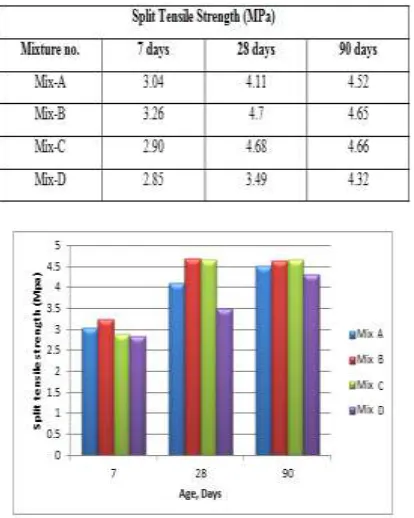
Split Tensile Strength
Available Online at www.ijpret.com 452 TABLE 10: Results of Split Tensile Strength of HSSCC with GGBFS for 7, 28 & 90 days
Graph 6: Variation of Split Tensile Strength with Age
IV. CONCLUSION
1) HSSCC mix was proportioned by conducting experimental trials in the laboratory, considering the guidelines evolved by the various researchers and EFNARC specifications.
2) HSSCC mix which incorporates GGBFS requires high dosage of super plasticizer to produce acceptable workability.
3) The characteristics of HSSCC mix was achieved by using high powder content, optimizing water to powder ratio, a high volume of fine aggregate as compared to coarse aggregate.
4) It is seen that workability decreases with increase in content of GGBFS in HSSCC. Self-compatibility is retained up to 30% of replacement of cement with GGBFS.
5) The results derived from compressive strength tests showed that GGBFS cement are more effective in terms of early strength gain beyond 28 days strength.
Available Online at www.ijpret.com 453 7) The addition of GGBFS in High strengthSCC up to 10% gives highest compressive strength, flexural strength and split tensile strength.
8) The addition of GGBFS in HSSCC up to 30% gives target strength for M70 grade of concrete.
REFERENCES
1. The European Guidelines for Self-Compacting Concrete”, May 2005.
2. Hajime okamura, Masahiro ouchi, “Self Compacting Concrete” Journal of Advanced Concrete
Technology, Vol. 1, 2003, pp 5-15
3. Nan Su, Kung-Chung Hsu and His-Wen Chai, “A simple mix design method for self-compacting concrete”, Cement and Concrete Research, 31, 2001, pp 1799- 1807
4. Tarun R. Naik, Rakeshkumar, “Development of high strength, economical self-consolidation concrete”.
5. Mallikarjuna Reddy, SeshagiriRao M V, Srilakshmi P, Sateesh Kumar, “Effect of W/C Ratio on Workability and Mechanical Properties of High Strength Self Compacting Concrete (M70 Grade)”.
6. Dr. S. C. Maiti, “Self Compacting Concrete”, National Council for Cement & Building Materials.
7. Dr. R. Sri Ravindrarajah, D. Siladyi and B. Adamopoulos, “Development of High-Strength Self Compacting Concrete with reduced Segregation Potential” Vol.1, pp 1048, ISBN: 2-912143-42.
8. VenkateswaraRao, M.V. SeshagiriRao and P. Rathish Kumar, “Effect of Size of Aggregate and Fines on Standard and High Strength Self Compacting Concrete”, Journal of Applied Sciences Research, 6(5), 2010, pp 433-442.
9. P. Ramanathan, “Strength and workability character of self-compacting concrete with GGBFS, FA and SF”, International Journal of Emerging trends in Engineering and Development ISSN 2249-6149, Issue 2, Vol.2, ( March-2012).
10. M.S.Shetty,“ConcreteTechnology”, S. Chand and company Ltd. 2008. “Code of practice for