The Facebook Feedback Hypothesis of personality
and social belonging
Samantha Stronge
,
Danny Osborne
,
Tim West-Newman, Petar Milojev,
Lara M. Greaves, Chris G. Sibley
University of Auckland, New Zealand
Marc S. Wilson
Victoria University, Wellington, New Zealand
The growing use of social networking sites raises important questions about the value of social media-based interaction. We test a novel Facebook Feedback Hypothesis of personality and social belonging in a national probability sample (N = 6,428), and show that Facebook usage is not equally beneficial to everyone. Our findings indicate that introverted people with a Facebook profile had lower levels of social capital (felt belongingness) than those without a profile. Extraverted people, in contrast, were higher in social capital regardless of whether or not they used Facebook. Other dimensions of Big-Five personality interacted with Facebook usage. This research raises concerns that new mediums of online social connection may be detrimental to those who are not highly oriented toward sociability.
Keywords: Big-Five personality, Facebook, social capital, belonging, extraversion, social networks.
Social networking sites such as Facebook are used daily by over 70% of the American online population (Duggan & Smith, 2013), and 65% of New Zealands online population (Bascand, 2013). Such sites sell themselves by claiming to help you “connect and share with the people in your life” (Facebook, 2014). The growing popularity of Facebook and other social networking sites is at the heart of a debate surrounding meanings of modern society, and how social networking may be affecting our sense of community, connectedness, and belonging. In his book Bowling Alone: America’s Declining Social Capital, Putnam (2000) argues that our collective social capital - the sum of our meaningful social ties with each other - is decreasing as evidenced by the weakening of our relationships with family, friends and community (Putnam, 2000). Such observations raise the question: is Facebook, and the growing use of online social media in general, helping, hindering or hurting the way we connect with each other? Here we seek to contribute to research examining this
topical issue by focusing specifically
on whether the relationship between online social media usage and social capital differ across individuals, and are contingent upon the basic personality traits that regulate social interaction across numerous contexts. Put another
way: is Facebook beneficial for some,
but detrimental for others?
Like the use of any communication medium, social network use is not good or bad on its own, and so it is important to examine the individual differences of social network users and how these differences moderate psychosocial outcomes (McKenna & Bargh, 2000). In this research, we employ a large, nationally representative sample of adult New Zealanders to examine the possible interactions between Facebook use and the Five Factor Model of personality (Goldberg, 1990; McCrae & Costa, 1997) in predicting social capital outcomes. In particular, we examine Extraversion as it reflects the extent to which people invest in engagement in social endeavours, and
reflects the traits of sociability, liveliness
and exhibition (Ashton & Lee, 2007; Sibley et al., 2011). As Ashton and Lee (2007) argued, Extraversion should have
different adaptive benefits and costs,
depending on one’s social environment. On the one hand, a high level of Extraversion should be beneficial to the extent that it helps facilitate social gains in the form of friends, mates, and alliances with others. On the other hand, a high level of Extraversion may also have costs in terms of expenditure of energy and time, and also increased risks from the social environment when interacting with unfamiliar others. Here, we examine the moderating effects of Extraversion on the relationship between Facebook usage and felt belongingness. Felt belongingness is a general measure of how included and accepted someone feels, and is widely used in the psychological literature as an indicator of social capital and connection with others (Baumeister & Leary, 1995).
How might Facebook usage be differentially related to the level of social capital enjoyed by extraverts and introverts? There are currently two major theories surrounding the use of social technology: the social enhancement hypothesis and the social compensation hypothesis (Kraut et al., 2002). The social enhancement perspective argues that individuals high in Extraversion will use social networking sites in the same way as they
socialize offline, and thus will receive greater social benefits from the use of
these sites relative to more introverted individuals (i.e., the ‘rich get richer’). According to this theory, the time and energy committed to interacting with others on social media should pay off for extraverts in much the same way as it does in other contexts.
to establish or maintain offline (i.e.,
‘poor get richer’; Zywica & Danowski, 2008). Thus, according to this theory, online social media may change the
balance of costs and benefits of social
interaction, and reduce the risks from the social environment to the point where
introverts may experience benefits on
par with their more extraverted peers. However, both of these hypotheses assume positive outcomes from Facebook use. Applying sociometer theory (Leary, Tambor, Terdal, & Downs, 1995), we propose an alternative ‘poor get poorer’ effect where introverted people who use Facebook will have lower feelings of belongingness than non-users, while extraverted people will not. We call this the Facebook Feedback Hypothesis. According to this hypothesis, exposure to a stream of information from other’s lives provides social cues to exclusion that can further decrease the lower levels of felt belongingness generally experienced by more introverted people.
Sociometer Theory and the Facebook Feedback Hypothesis
The belongingness hypothesis states that all humans have an evolved need to form and maintain intimate, long-term relationships (Baumeister & Leary, 1995); relationships that would have ensured survival through the protection of other group members. In order to track one’s inclusionary status in these relationships, an individual must continuously monitor cues relating to rejection and exclusion. Sociometer theory proposes that self-esteem, which
largely reflects an individual’s beliefs about how others see them, fulfils this
monitoring role. Cues to exclusion can be anything that make social exclusion appear possible to the individual, whether it is real, potential, or their own perception. Perceived social exclusion is said to cause a drop in state self-esteem that works in two ways: (a) as an affective mechanism that warns the individual about the change in their social status, and (b) as a motivating force to restore the individual’s social status or form new relationships (Leary et al., 1995). We argue that the Facebook newsfeed (a constantly updating list of posts from other Facebook users) becomes a set of cues to social exclusion. People’s
online social networks are much larger
than their offline social networks (Acar,
2008), and Facebook users tend to share more social information online than offline, present their lives as more positive than they really are, and attempt to represent their ideal selves (Christofides, Muise, & Desmarais, 2009; Qiu, Lin, Leung, & Tov, 2012; Zhao, Grasmuck, & Martin, 2008). Thus Facebook users could be exposed to a stream of depictions of positive social interaction in other people’s lives that they would not normally see.
Thus, Facebook users who do not actively engage with their Facebook friends, but still passively consume information about other people’s social events, could experience a sense of decreased belonging. Bohn, Nuchta, Hornik and Mair (2014) examined data from over 400,000 Facebook users and concluded that access to social capital was most readily available to those who used active and directed communication. Though some have found gains in social support and social capital from Facebook use for shy users and users with low self-esteem (Baker
& Oswald, 2010; Steinfield, Ellison, &
Lampe, 2008), this is only true for those who use Facebook intensely. When Deters and Mehl (2012) specifically instructed Facebook users to post more frequent status updates for a week, users reported lower loneliness at the end of the experiment, mediated by increased social connectedness. Both Ryan and Xenos (2011) and Burke, Marlow and Lento (2010) reported that active and communicative use of Facebook (such as sending messages or writing on friends’ Facebook walls) was linked to lower loneliness and higher social capital, respectively, whereas passive use of Facebook and consumption of social information (such as playing games or liking pages) had the opposite results.
Because the trait of Extraversion measures an individual’s tendency to seek out social interaction, form new relationships, and enjoy socializing (Goldberg, 1990; McCrae & Costa, 1997), those low in Extraversion tend to be the more passive Facebook users. Extraversion positively predicts active social contributions, while negatively predicting passive engagement (Ryan
& Xenos, 2011). Relative to introverted people, extraverted people are more likely to use the synchronous and communicative features of Facebook (Ryan & Xenos, 2011), take a more central role in social networks (Wehrli, 2008), and are less likely to use Facebook just to pass the time (Sheldon, 2008). Extraverted people also write more status updates (Ong et al., 2011), are involved in more Facebook groups (Ross et al., 2009), have more Facebook friends (Amichai-Hamburger & Vinitzky, 2010) and communicate with friends more (Seidman, 2013) than their introverted counterparts. Thus, more extraverted Facebook users should not experience a decrease in felt belonging as they are likely to be actively involved with their Facebook friends and the events depicted on Facebook. In comparison, the more introverted Facebook users may be vulnerable to experiencing a sense of decreased belonging.
Support for a Facebook Feedback Hypothesis
Research into social comparison on Facebook provides important evidence for the link between Facebook use, consumption of positive information about others, and lower wellbeing. Qiu, Lin, and Leung (2010) showed that for participants who were low in narcissism, comparing one’s life to others mediated the relationship between browsing Facebook and higher levels of loneliness and negative affect. Similarly, Chou and Edge (2012) found that the more hours people spent on Facebook, the more they believed that others were happier and generally had better lives than them. Krasnova, Wenninger, Widjaja and Buxmann (2013) found that passive consumption of information on Facebook was related to lower life satisfaction, mediated by feelings of envy. Finally, university students who engaged in greater levels of self-comparison with others on Facebook felt more negative about such comparisons (Lee, 2014).
offline (Amiel & Sargent, 2004), the
steps they take to avoid social exclusion may lead them back to Facebook. Research supports this idea, showing that wanting to belong to a group (Amiel & Sargent, 2004) and avoid loneliness (Amichai-Hamburger & Vinitzky, 2010) are some of the motivating factors behind more introverted peoples’ use of the internet and Facebook. Loneliness is associated with holding more positive attitudes towards Facebook, spending more time on Facebook (Jin, 2013; Lemieux, Lajoie, & Trainor, 2013) and wanting to use Facebook to compensate for weak social ties and reduce loneliness (Teppers, Luyckx, Klimstra, & Goossens, 2013). Indeed, visiting a social networking site is a logical step towards relationship formation and social compensation. Yet this process could cause a vicious cycle if introverted people continue to feel socially excluded. Sheldon, Abad, and Hinsch (2011) measured connection (relatedness-need satisfaction), disconnection, and Facebook use and reported that Facebook use increased feelings of both connection and disconnection. However, feelings of connection faded after time spent away from Facebook, whereas feelings of disconnection persisted and drove further Facebook use.
In contrast with the predominantly cross-sectional studies reported above, Teppers et al. (2013) have reported similar cyclical findings in a longitudinal study. They found that the motive to use Facebook as a form of social compensation predicted later loneliness, which, in turn, predicted using Facebook for social compensation later on. Similar cycles have been found for general internet use whereby loneliness is both the cause and effect of socially compensatory behaviour (Kim, LaRose, & Peng, 2009). In fact, simply having a social compensation motive suggests that users will be more vulnerable to experiencing exclusion – the desire to compensate indicates they already feel they do not belong, which makes individuals more sensitive to cues to exclusion (Dandeneau & Baldwin, 2004). Additionally, users who are lonely or have low self-esteem are more likely to accept friend requests from strangers (Acar, 2008) or have a high ratio of strangers in their online
social network (Jin, 2013; Skues et al., 2012). This is consistent with the theory that low self-esteem motivates relationship formation behaviour (Baumeister & Leary, 1995). More friends on Facebook, however, most likely indicates a concomitantly higher ratio of strangers in users’ network with whom they do not feel a personal sense of belonging.
Together, this evidence demonstrates that, consistent with the sociometer hypothesis, Facebook use is associated with (and may lead to) negative affect and poor social outcomes when used in a passive manner – behaviour typical of more introverted users (e.g., Burke et al., 2010; Ryan & Xenos, 2011). Facebook use is also associated with a tendency to compare oneself negatively to others (e.g., Qiu et al., 2010). Additionally, for some users Facebook use is driven by feelings of disconnection, loneliness and the desire for social compensation (e.g., Sheldon et al., 2011; Teppers et al.,
2013)—findings that are consistent with
the idea that a low sense of belonging creates a motivation to maintain or form new relationships. Unfortunately, in the studies described above, using Facebook for these reasons predicts further loneliness, as these motives are associated with behaviour that exposes one to even more cues of exclusion (e.g., Forest & Wood, 2012).
Facebook and Big Five personality
Research into the factors of the Big-Five model of personality (Goldberg, 1990) and social networking sites or Facebook use has found that users tend to have lower Conscientiousness (being diligent and organized; Ryan & Xenos, 2011; Wehrli, 2008), and higher Neuroticism (low emotional stability; Hughes, Rowe, Batey, & Lee, 2012) than non-users. Moreover, time spent using Facebook is positively associated with Neuroticism (Moore & McElroy, 2010; Ryan & Xenos, 2011) and negatively associated with Conscientiousness (Gosling, Augustine, Vazire, Holtzman, & Gaddis, 2011; Ryan & Xenos, 2011; Wilson, Fornasier, & White, 2010). Finally, Facebook use tends to be uncorrelated with Agreeableness (being tolerant and forgiving) or Openness to
Experience (being curious and broad-minded; Moore & McElroy, 2010; Ross et al., 2009; Wehrli, 2008).
F a c e b o o k u s e r s t y p i c a l l y have significantly higher levels of Extraversion compared to non-users (Hughes et al., 2012; Ryan & Xenos, 2011), as do users of social networking sites in general (Wehrli, 2008; Wilson et al., 2010). Higher levels of Extraversion have also been found to correlate with spending more time on social networks, (Correa, Hinsley, & de Zúñiga, 2010; Wilson et al., 2010) including Facebook (Acar, 2008; Gosling et al., 2011; Ong et al., 2011). Unlike general social internet use, where people make their friends online and then meet them in person later, Facebook appears to demonstrate
an ‘offline to online’ trend in which
people’s existing social networks create their online social networks
(Ellison, Steinfield, & Lampe, 2007).
Therefore, those who are more sociable
offline, such as extraverted people, use
online social media the most. However several studies found no relationship between Extraversion and time spent on Facebook (Moore & McElroy, 2010; Ross et al., 2009; Ryan & Xenos, 2011; Skues et al., 2012).
Some of these contradictory results may be due to the use of small sample sizes and dichotomized continuous variables in this research area, which can lead to a loss of power and lower
the likelihood of a significant result.
Overview and Guiding Hypotheses
We predict that more introverted people will show evidence of the Facebook Feedback Hypothesis.
Because of its offline-to-online nature,
Facebook should be an attractive social option to those high in Extraversion. As such, Extraversion should predict a higher likelihood of being a Facebook user versus a non-user. We also predict that Extraversion will moderate the relationship between having a Facebook
profile and felt belongingness. Because
Facebook provides a stream of cues to
exclusion that can exacerbate deficits
in one’s sense of belonging, more introverted people with a Facebook profile should report decreased belonging whereas more extraverted
people with a Facebook profile will not.
The competing social compensation hypothesis would be supported if those low in Extraversion with a
Facebook profile show higher levels of
belongingness relative to those without
a profile.
Method
Sampling procedure
This study analysed data from the Time 3 (2011) wave of the New Zealand Attitudes and Values Study. The Time 3 (2011) NZAVS contained responses from 6,884 participants. 3,915 of these participants were retained from the initial Time 1 national probability sample, sampled from the 2009 New Zealand electoral roll (a 60.0% retention rate over two years). Participants were posted a copy of the questionnaire, with a second postal follow-up two months later. Participants who provided an email address were also emailed and invited to complete an online version if they preferred.
To boost sample size at Time 3 and compensate for sample attrition, a booster sample was recruited through an unrelated survey posted on the website of a major New Zealand newspaper in 2011. A total of 3,208 participants registered an initial expression of interest in being contacted to participate in the NZAVS via this survey. Participants in
this non-random booster sample were emailed an invitation to participate in an online version of the NZAVS, and those who did not respond to the email were also sent a postal version of the questionnaire. A total of 2,962 participants completed the questionnaire when subsequently contacted (response rate = 92.4%). This yielded a total sample size for the Time 3 (2011) NZAVS of 6,884 (3,915 retained from Time 1, 3 additions retained from Time 2, 2,962 additions at Time 3, and 4 opt-ins at Time 3).
We limited our analyses to the 6,428 participants (93% of the full sample) who provided complete responses to the questions analysed here (measures of personality, demographics, and responses to the question about having a
Facebook profile). All subsequent results
and samples detailed refer to these 6,428 participants (2,423 men, 4,005 women). The majority of the sample (59.9%, N = 3,850) reported that they
had a Facebook profile (the remaining
40.1%, N = 2,578 did not). The sample
consisted of 69% Pākehā/New Zealand
Europeans (N = 4,460), 11% Māori
(Indigenous New Zealanders; N = 690),
2% Pacific Nations (N = 136), and 3% Asians (N = 219). Participants’ mean age was 50.42 (SD =15.82), and their average household income was $97,173 (SD = 16,129).
In terms of other demographics, 40% of participants described themselves as religious (N = 2,544), 72% of the sample were parents (N = 4,663), 70% had a partner (N = 4,502), and 76% were employed (N = 4,879). These variables were included as standard demographic controls.
Questionnaire measures
Facebook profile status was measured using the following question: ‘Do you have a Facebook profile?’
(yes/no response option). Big-Five
personality was assessed using the Mini-IPIP. This is a 20-item scale developed by Donnellan, Oswald, Baird, and Lucas (2006) using items from Goldberg’s (1999) International Personality Item Pool. Items were rated from 1 (very inaccurate) to 7 (very accurate) and
averaged to give scale scores for each trait. The Mini-IPIP personality markers have been previously validated for use in New Zealand and show good internal reliability (Sibley et al., 2011), temporal stability (Milojev, Osborne, Greaves, Barlow, & Sibley, 2013) and item response properties (Sibley, 2012). Felt belongingness was measured with three items adapted from Cutrona and Russell’s (1987) Social Provisions Scale. These items were, ‘I know that people in my life accept and value me’, ‘I feel like an outsider’, and ‘I know that people around me share my attitudes and beliefs’.
Religiosity was measured by a single item that asked participants if
they ‘identify with a religion and/or a spiritual group’ (yes/no response).
Parenthood was measured using an open-ended question that asked participants to indicate the number of ‘children [they have] given birth to, fathered, or adopted’. Responses were coded as 0 for no children and 1 for children. Partnership was measured by asking participants to indicate their ‘relationship status.’ Possible responses listed were single, dating,
living together/de facto, married, or
other. Responses were coded as 0 for single and 1 for those with a partner. Employment was measured by having participants indicate their ‘current employment situation.’ Responses were coded as 1 for those who chose employed full-time, employed part-time, self-employed, or who owned their own business. Those who were unemployed were coded as 0, including students and the retired.
Results
Demographic and personality differences in Facebook users versus non-users
C h i - s q u a r e t e s t s o f independence for gender and ethnicity
were conducted with Facebook profile status. A significant relationship between
gender and Facebook use was found such that women were more likely
than men to have a Facebook profile
(69% vs. 49%, respectively (χ2(1)= 199.89, p < .001). There was also a
significant relationship between
self-reported ethnicity and Facebook use
(χ2(4)= 50.37, p < .001). Specifically, Asians were the most likely to have a
Facebook profile (78%), followed by Pacific Nations (66%), Māori (60%), and finally Pākehā/New Zealand
European (58%). In addition, those
with a Facebook profile were younger
on average (M = 45.02, SD = 15.02)
than those without a profile (M = 58.48, SD = 13.37, t = 37.61, p < .001). Means and standard deviations for personality differences between users and non-users are presented in Table 2. Those with a
Facebook profile scored significantly
higher on Extraversion, Agreeableness, Neuroticism, and Openness to
Experience, and significantly lower in
Conscientiousness, when compared to
those without a profile.
Regression model predicting felt belongingness
The analyses were conducted in Mplus version 7.3 (Muthen & Muthen, 1998-2014). The full regression model assessing the unique concurrent effects of all predictors on felt belongingness is presented in Table 3. We tested for the moderating effect of having a Facebook profile on the association between
Extraversion and felt belongingness by entering the product term of these two variables, after centering, into the model. For completeness, we also tested the interaction with the other four personality dimensions. This adjusted for the effects of the other dimensions of personality in all analyses, thus allowing us to derive a ‘pure’ estimate of the effect of Extraversion on felt belongingness. The predicted interactions of having a
Facebook profile with Extraversion held
in a baseline model with no controls. Regression parameters are reported in Table 3. The full regression model predicted 33.3% of the variance in felt belongingness, while the interaction term for Facebook and Extraversion explained .1% of the variance on its own,
reflecting research that demonstrates
interaction effects as being difficult to detect (Aiken and West, 1991; McClelland & Judd, 1993).
As reported in Table 3,
Pacific ethnicity, religiosity, parental
and partnered status, and income all significantly predicted greater felt belongingness, while gender (women) and Facebook membership predicted weaker felt belongingness. Extraversion
significantly predicted increased levels
[image:5.595.51.557.79.298.2]of felt belongingness. Agreeableness and Conscientiousness also both significantly predicted increased levels of belongingness, whereas Neuroticism significantly predicted decreased levels of belongingness. No Table 2. Differences in Big-Five personality for New Zealanders with and without a
Facebook profile
Facebook Profile No Profile t
M SD M SD
Extraversion 4.056 1.186 3.797 1.112 -8.897** Agreeableness 5.476 0.932 5.236 0.943 -10.071** Conscientiousness 4.910 1.049 5.119 1.002 7.943** Neuroticism 3.465 1.163 3.248 1.076 -7.662** Openness to Experience 5.081 1.098 4.737 1.094 -12.328**
[image:5.595.52.381.538.630.2]Note. ** p < .01
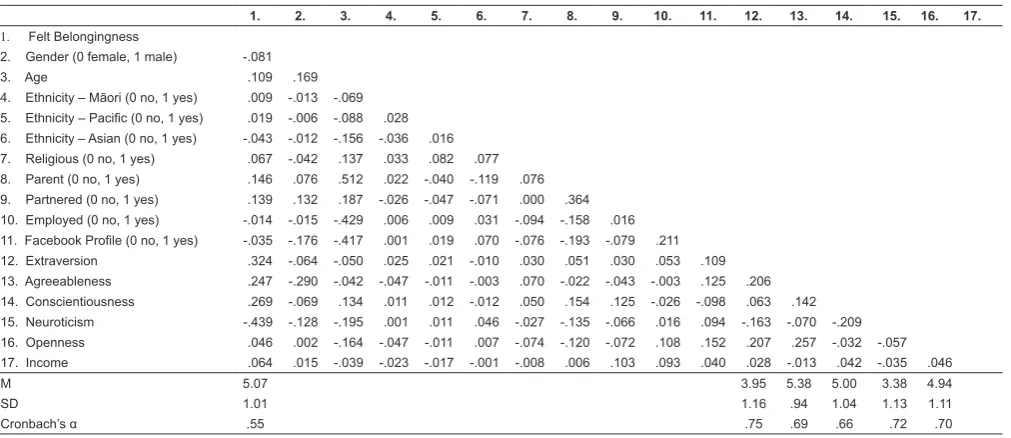
Table 1. Bivariate correlations between all scale variables.
1. 2. 3. 4. 5. 6. 7. 8. 9. 10. 11. 12. 13. 14. 15. 16. 17.
1. Felt Belongingness
2. Gender (0 female, 1 male) -.081
3. Age .109 .169
4. Ethnicity – Māori (0 no, 1 yes) .009 -.013 -.069 5. Ethnicity – Pacific (0 no, 1 yes) .019 -.006 -.088 .028 6. Ethnicity – Asian (0 no, 1 yes) -.043 -.012 -.156 -.036 .016 7. Religious (0 no, 1 yes) .067 -.042 .137 .033 .082 .077 8. Parent (0 no, 1 yes) .146 .076 .512 .022 -.040 -.119 .076 9. Partnered (0 no, 1 yes) .139 .132 .187 -.026 -.047 -.071 .000 .364 10. Employed (0 no, 1 yes) -.014 -.015 -.429 .006 .009 .031 -.094 -.158 .016 11. Facebook Profile (0 no, 1 yes) -.035 -.176 -.417 .001 .019 .070 -.076 -.193 -.079 .211 12. Extraversion .324 -.064 -.050 .025 .021 -.010 .030 .051 .030 .053 .109 13. Agreeableness .247 -.290 -.042 -.047 -.011 -.003 .070 -.022 -.043 -.003 .125 .206 14. Conscientiousness .269 -.069 .134 .011 .012 -.012 .050 .154 .125 -.026 -.098 .063 .142 15. Neuroticism -.439 -.128 -.195 .001 .011 .046 -.027 -.135 -.066 .016 .094 -.163 -.070 -.209 16. Openness .046 .002 -.164 -.047 -.011 .007 -.074 -.120 -.072 .108 .152 .207 .257 -.032 -.057 17. Income .064 .015 -.039 -.023 -.017 -.001 -.008 .006 .103 .093 .040 .028 -.013 .042 -.035 .046
M 5.07 3.95 5.38 5.00 3.38 4.94
SD 1.01 1.16 .94 1.04 1.13 1.11
Cronbach’s α .55 .75 .69 .66 .72 .70
significant relationship with Openness
to Experience was observed. Facebook
use (whether or not people had a profile) significantly predicted decreased levels
of belongingness, indicating that generally, people with a Facebook
profile report less belonging than those
without a profile. Critically, and as hypothesized, the interaction between Extraversion and having a Facebook
profile was significant (b = .05, se = .02,
t = 2.44, p = .015). This indicates that the extent to which Extraversion predicted levels of felt belongingness differed depending upon whether or not people
have a Facebook profile. There were no significant interactions between any of
the other Big-Five personality traits and
Facebook profile on belongingness.
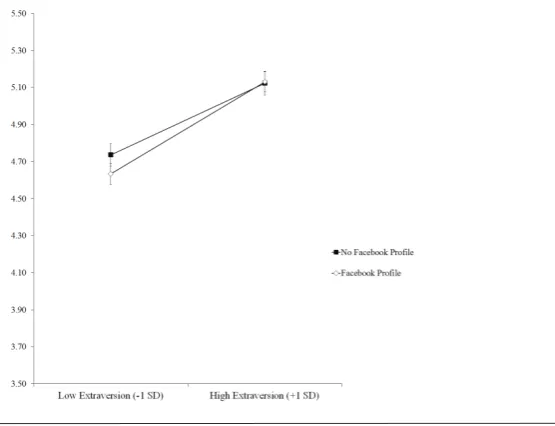
As shown in Figure 1, analysis of simple slopes indicated that the
relationship between Extraversion and felt belongingness was stronger for
those with a Facebook profile (b = .21, se = .01, t = 18.09, p < .001), relative
to those without a profile (b = .17, se = .02, t = 10.88, p < .001). Critically, those low in Extraversion (-1 SD below the mean and lower) who also had a
Facebook profile reported significantly
lower levels of belongingness than those with similarly low levels of Extraversion
who did not have a profile (b = -.10, se = .03, t = -3.18, p = .001). Conversely, for those high in Extraversion, having
or not having a Facebook profile did
not make a difference in their mean levels of felt belongingness (b = .01, se = .03, t = .24, p = .813). These results support the proposed Facebook Feedback Hypothesis and indicate
that Facebook use is not beneficial for
all users. Rather, while extraverted people experience higher levels of belongingness regardless of their Facebook use, introverted people with a Facebook profile experience lower levels of belonging than their
counterparts without a profile.
Discussion
As relationships with family, friends and the community decline (Putnam, 2000), Facebook plays a central role in the way people socialise in our modern society. This study sought to examine how Facebook affects our social ties with one another, and whether the connection it claims to offer is attainable by all users. Results showed that Facebook use differed depending on personality traits and demographic variables. We also observed the predicted ‘poor get poorer’ effect whereby introverted people experienced lower levels of social capital (felt belongingness) if
they had a Facebook profile relative
to introverted people who do not
have a profile. Those who were more
extraverted showed a higher overall level of felt belongingness regardless of whether or not they used Facebook.
Facebook Feedback Hypothesis
[image:6.595.44.371.94.392.2]Our results supported the predicted Facebook Feedback Hypothesis, and were inconsistent with an alternative social compensation hypothesis. Our findings are thus consistent with a Table 3. Regression model assessing the effects of having a Facebook profile,
demographics, and personality on felt belongingness
b se β t
Gender (0 female, 1 male) -.165 .023 -.079 -7.111** Age .000 .001 .001 0.101
Ethnicity - Māori (0 no, 1 yes) .027 .034 .008 0.803
Ethnicity - Pacific Islander (0 no,
1 yes) .140 .066 .022 2.101* Ethnicity - Asian (0 no, 1 yes) -.067 .056 -.012 -1.199 Religious (0 no, 1 yes) .046 .022 .022 2.130* Parent (0 no, 1 yes) .065 .029 .029 2.262* Partnered (0 no, 1 yes) .201 .025 .091 8.158** Employed (0 no, 1 yes) -.014 .027 -.006 0.615
Facebook Profile (0 no, 1 yes) -.047 .024 -.023 -1.970*
Extraversion .166 .015 .192 10.879**
Agreeableness .167 .019 .156 8.850** Conscientiousness .151 .017 .155 8.879** Neuroticism -.332 .016 -.374 -21.072**
Openness to Experience -.024 .016 -.027 -1.565
Income .002 .001 .038 3.654**
Extraversion x FB .047 .019 .043 2.443*
Agreeableness x FB -.012 .024 -.008 -0.491
Conscientiousness x FB -.040 .021 -.032 -1.868
Neuroticism x FB .016 .020 .015 0.833
Openness to Experience x FB -.022 .020 -.018 -1.088
Note. * p < .05, ** p < .01
Figure 1. Interaction graph for the association between Extraversion and felt belongingness for people with and without a Facebook Profile. Extraversion is
[image:6.595.51.329.585.798.2]body of research showing a ‘poor get poorer’ effect for socially isolated Facebook users (Kim et al., 2009; Ryan & Xenos, 2011; Teppers et al., 2013). Having a Facebook profile had a small, negative association with lower felt belongingness. However when moderated by Extraversion, introverted people with a Facebook profile reported lower levels of felt belongingness than their counterparts without a profile, while extraverted Facebook users did not. We argue that Facebook use may negatively affect felt belongingness of more introverted people. Because introverted people had low levels of felt belonging overall and tend to be less active on Facebook than their extroverted counterparts (e.g., Ryan & Xenos, 2011), they should be more likely to perceive cues to exclusion when using Facebook. These cues should, in turn, further decrease their sense of belonging. In contrast, extraverted people experience higher levels of belonging overall, which does not vary on the basis of their Facebook usage. These results are consistent with sociometer theory as those who are high in belonging are less sensitive to cues to exclusion than those low in belonging (Dandeneau & Baldwin, 2004). Additionally, because people who already feel included and have their need to belong met do not show further gains in belonging (Leary et al., 1995), those high in Extraversion with
a Facebook profile do not have higher
levels of felt belonging.
These results have interesting implications for our understanding of Extraversion. Social media, whether in the form of Facebook or any of the myriad of social networking sites, is unlikely to go away any time soon. As traditional forms of communication and our collective social capital decline (Putnam, 2000), adopting new technology such as Facebook is important. Highly extraverted people, because they are oriented towards engagement in social endeavours, may quickly and easily make use of any avenue that allows them to manage their social life (Wehrli, 2008). In terms of time and energy, Facebook offers a ‘cheap’ way of creating and maintaining large networks and accompanying social capital. An extraverted person’s
use of Facebook demonstrates their interactional adaptability in the face of a changing society; they are willing—and able—to use different mediums in the same manner as more traditional forms of communication.
As has been suggested by a number of other studies, socially ‘poor’ users do use Facebook, but not to its full potential (Forest & Wood, 2012; Ryan & Xenos, 2011). Introverted people feel less belonging than extraverted people in general, and, as we have shown here, this difference increases when looking at Facebook users. Despite popular belief (e.g., Amichai-Hamburger & Vinitzky, 2010), it appears that Facebook is not a good place for those low in Extraversion to look for social compensation. Indeed, our results suggest that, rather than helping all users find connection, Facebook is geared towards a certain type of socialising; Facebook works best for extraverted peoples’ larger social circles and need to manage many weak ties. More introverted users may fair better by focusing their Facebook usage on a smaller circle of friends who they know well, thus mirroring their
offline social networks, or by making
a conscious effort to be a more active user (e.g. Deters & Mehl, 2012). Future research could investigate what kinds of online social interaction do function as a form of social compensation for introverts; some research has shown that online-exclusive interaction can in fact
be beneficial to introverts (Zalk, Branje,
Denissen, Aken, & Meeus, 2011). The poor-get-poorer effect may reflect
Facebook’s unique ‘offline to online’
pattern of use (Ellison et al., 2007).
Personality, Demographics, and Facebook usage in New Zealand
Although our focus was on the use of Facebook, Extraversion, and felt belongingness, our results provide other insights into New Zealand Facebook users. Results from our national sample indicated that having a Facebook
profile is associated with higher levels
of Extraversion, Neuroticism, and Agreeableness, and with lower levels of Conscientiousness. Overall, 60% of our sample used Facebook. Consistent with previous research (Bascand, 2013; Hargittai, 2008), women were
much more likely to have a Facebook
profile than were men. Indeed, nearly
two thirds of women had a Facebook profile, whereas slightly less than half of men did. Facebook users were also younger than non-users; yet the average age of the Facebook user was 45. This demonstrates the importance of assessing the effects of Facebook usage on non-student populations.
Significant differences in
self-identified ethnicity were also found,
with Asians being the most likely to use
Facebook, followed by Pacific peoples, Māori, and finally Pākehā/Europeans.
While differences in ethnicity and social network use have been shown before (Hargittai, 2008), this research
provides the first comprehensive look
at Facebook use and demographic differences in New Zealand. Despite demographic differences, these results indicate that Facebook is widely used by New Zealanders, across gender, ethnicity and age.
Strengths, Limitations, and Future Research
The data in this study are from a nationally representative sample and cover a variety of age groups and ethnicities, thereby providing insight into Facebook use in contemporary New Zealand society. Much of the current research on Facebook use and personality has employed undergraduate samples. However, Facebook has grown exponentially in recent years and is no longer solely used by students; the average age of the American Facebook user is now 38 (Brenner, 2012), and usage by older adults is rapidly growing (Bascand, 2013; Duggan & Smith, 2013). As such, it is no longer appropriate to use student samples if we wish to generalise research results or discuss the ‘average’ user.
Because these data are cross-sectional, we are unable to infer causality. Indeed, it is possible that introverted users who are low in belonging are more
likely to create a Facebook profile in
2002), so more longitudinal research is needed in this area. In comparison, the Facebook Feedback Hypothesis predicts that introverted peoples’ lower sense of belonging could lead to further Facebook use, thereby increasing the gap between introverted and extraverted peoples’ social outcomes over time. Future longitudinal research into Facebook and belonging will be able to tell us whether Facebook use causally decreases levels of felt belonging for those low in Extraversion as hypothesised.
The results we present here are derived from the Facebook Feedback Hypothesis, however, we have been unable to examine the effect directly. Nonetheless, a body of evidence is beginning to accumulate documenting distinct motives for Facebook use and subsequent behaviour and outcomes. Previous literature strongly supports the idea that Extraverts use Facebook more actively than Introverts (e.g., Amichai-Hamburger & Vinitzky, 2010; Gosling et al., 2011) and that passive consumption of information on Facebook is associated with negative outcomes (e.g., Qiu et al., 2010). However, future research should examine the link between Facebook use, feeling excluded, and low belonging more directly. Although we do not examine the mechanisms here, we demonstrate that poorer social outcomes are associated with Facebook users as compared to non-users, across a large representative sample in a natural setting.
Finally, it is worth emphasizing that the relationship predicted by the Facebook Feedback Hypothesis is extremely subtle. The interaction between Extraversion and Facebook usage on social belonging is reliable in a national population sample of New Zealanders, but it is not large. Nor would we necessarily expect it to be.
Our findings point to one specific factor
potentially linked to differences in social belonging among a vast array of complex and interconnected factors in people’s environments. That said, we show that the relationship is statistically reliable in a national sample as of 2011. From our point of view, this documents a new and interesting disparity in the social outcomes experienced by Extraverts and Introverts at the beginning of the rise of
social media. Social media represents one of the biggest changes in the ways we connect with others to have occurred in recent times. While the hypothesised relationship was detectable but subtle in 2011, we wonder whether it may strengthen, and thus the gap between Extraverts and Introverts may widen, as social media becomes an increasingly central part of our social environment. Future research tracking these trends over time is needed in order to answer this intriguing question. Such research could also use a wider and more reliable set of indicators of social capital, as our three-item measure of social belongingness had a relatively low internal reliability, which may also have attenuated the size of the association we observed.
Concluding comments
We began this article with the observation offered by Putnam (2000) that our collective social capital - the sum of our meaningful social ties with each other - is decreasing as our relationships with family, friends and community weaken. Here, we sought to examine whether Facebook might contribute to or ameliorate this effect, and moreover, whether the positive or negative associations between Facebook usage and social capital (felt belongingness) depend upon people’s general personality and their level of Extraversion in particular. Using data from a large national probability sample, we showed that Facebook usage is not
beneficial to everyone. Rather, our data
show that those high in Extraversion experienced consistently high levels of social capital regardless of Facebook use, whereas those low in Extraversion experienced lower levels of social
capital if they had a Facebook profile.
These data provide a snapshot of the links between personality, Facebook usage and felt belongingness at a single point in time and indicate that new mediums of online social connection such as Facebook may be detrimental to those who are not highly oriented toward sociability (i.e., introverted people)
References
Acar, A. (2008). Antecedents and Consequences of Online Social Networking Behavior: The Case of Facebook. Journal of Website
Promotion, 3(1-2), 62-83. doi:
10.1080/15533610802052654
Aiken, L. S., & West, S. G. (1991). Multiple regression: Testing and interpreting
interactions. Thousand Oaks, CA: Sage
Publications, Inc.
Amichai-Hamburger, Y., & Vinitzky, G. (2010). Social network use and personality. Computers in Human
Behavior, 26(6), 1289-1295. doi:
10.1016/j.chb.2010.03.018
Amiel, T., & Sargent, S. L. (2004). Individual differences in Internet usage motives.
Computers in Human Behavior, 20(6),
711-726. doi: 10.1016/j.chb.2004.09.002
Ashton, M. C., & Lee, K. (2007). Empirical, Theoretical, and Practical Advantages of the HEXACO Model of Personality Structure. Personality and Social
Psychology Review, 11(2), 150-166. doi:
10.1177/1088868306294907
Baker, L. R., & Oswald, D. L. (2010). Shyness and online social networking services.
Journal of Social and Personal
Relationships, 27(7), 873-889. doi:
10.1177/0265407510375261
Bascand, G. (2013). Statistics New Zealand - Household Use of Information and Communication Technology: 2012. Retrieved from http://www.stats. govt.nz/browse_for_stats/industry_ sectors/information_technology_and_ communications/HouseholdUseofICT_
HOTP2012.aspx
Baumeister, R. F., & Leary, M. R. (1995). The Need to Belong: Desire for Interpersonal Attachments as a Fundamental Human Motivation. Psychological Bulletin, 117(3), 497-529.
Bohn, A., Buchta, C., Hornik, K., & Mair, P. (2014). Making friends and communicating on Facebook: Implications for the access to social capital. Social Networks, 37, 29-41. doi:
10.1016/j.socnet.2013.11.003
Brenner, J. (Mar 29, 2012). Pew Internet: Social Networking (full detail). Retrieved from http://pewinternet.org/
Commentary/2012/March/Pew-Internet-Social-Networking-full-detail.aspx Burke, M., Marlow, C., & Lento, T. (2010).
Social Network Activity and Social Well-Being. In CHI ‘10: Proceedings of the SIGCHI Conference on Human Factors
Burke, M., Kraut, R., & Marlow, C. (2011). Social capital on Facebook: Differentiating uses and users. In CHI ‘11: Proceedings of the SIGCHI Conference on Human Factors in Computing Systems.
New York: ACM.
Chou, H.-T. G., & Edge, N. (2012). ‘‘They Are Happier and Having Better Lives than I Am’’: The Impact of Using Facebook on Perceptions of Others’ Lives. Cyberpsychology, Behavior, and
Social Networking, 15(2), 117-121. doi:
10.1089/cyber.2011.0324
Christofides, E., Muise, A., & Desmarais,
S. (2009). Information Disclosure and Control on Facebook: Are They Two Sides of the Same Coin or Two Different Processes? CyberPsychology &
Behavior, 12(3), 341-345. doi: 10.1089/
cpb.2008.0226
Correa, T., Hinsley, A. W., & de Zúñiga, H. G. (2010). Who interacts on the Web?: The intersection of users’ personality and social media use. Computers in Human Behavior, 26(2), 247-253. doi: 10.1016/j.
chb.2009.09.003
Cutrona, C.E., & Russell, D. (1987). The provisions of social relationships and adaptation to stress. In W. Jones, & D. P. (Eds.). Advances in personal
relationships (pp. Vol. 1. pp. 37-67).
Greenwich, Conn: JAI Press.
Dandeneau, S. D., & Baldwin, M. W. (2004). The Inhibition of Socially Rejecting Information Among People with High versus Low Self-Esteem: The Role of Attentional Bias and the Effects of Bias Reduction Training. Journal of Social
and Clinical Psychology, 23(4), 584-603.
doi: 10.1521/jscp.23.4.584.40306
Deters, F. g., & Mehl, M. R. (2012). Does Posting Facebook Status Updates Increase or Decrease Loneliness? An Online Social Networking Experiment. Social Psychological and
Personality Science, 4(5), 579-586. doi:
10.1177/1948550612469233.
Donnellan, M. B., Oswald, F. L., Baird, B. M., & Lucas, R. E. (2006). The mini-IPIP scales: Tiny-yet-effective measures of the Big Five factors of personality.
Psychological Assessment, 18(2),
192-203. doi: 10.1037/1040-3590.18.2.192
Duggan, M., & Smith, A. (2013). Social
Media Update 2013. Retrieved from
www.pewinternet.org/2013/12/30/social-media-update-2013/
Ellison, N. B., Steinfield, C., & Lampe, C. (2007). The Benefits of Facebook ‘Friends:’ Social Capital and College Students’ Use of Online Social Network Sites. Journal of Computer-Mediated
Communication, 12(4), 1143-1168. doi:
10.1111/j.1083-6101.2007.00367.x
Facebook. (2014). Welcome to Facebook --
Log in, sign up or learn more. Retrieved
March 19, 2014, from https://www. facebook.com/
Forest, A. L., & Wood, J. V. (2012). When Social Networking Is Not Working : Individuals With Low Self-Esteem
Recognize but Do Not Reap the Benefits
of Self-Disclosure on Facebook.
Psychological Science, 23(3), 295-302.
doi: 10.1177/0956797611429709
Goldberg, L. R. (1990). An Alternative ‘Description of Personality’: The Big-Five Factor Structure. Journal of Personality and Social Psychology, 59(6), 1216-1229.
Goldberg, L. R. (1999). A Broad-Bandwidth, Public-Domain, Personality Inventory Measuring the Lower-Level Facets of Several Five-Factor Models. In I. Mervielde, I. Deary, F. De Fruyt, & F. Ostendorf (Eds.), Personality Psychology in Europe, Vol. 7. (pp. 7-28). Tilburg, The Netherlands: Tilburg University Press. Gosling, S. D., Augustine, A. A., Vazire,
S., Holtzman, N., & Gaddis, S. (2011). Manifestations of Personality in Online Social Networks: Self-Reported Facebook-Related Behaviors and Observable Profile Information.
Cyberpsychology, Behavior, and Social
Networking, 14(9), 483-488. doi:
10.1089/cyber.2010.0087
Hargittai, E. (2008). Whose Space? Differences Among Users and Non-Users of Social Network Sites. Journal of Computer-Mediated Communication, 13(1), 276-297.
doi:10.1111/j.1083-6101.2007.00396.x
Hughes, D. J., Rowe, M., Batey, M., & Lee, A. (2012). A tale of two sites: Twitter vs. Facebook and the personality predictors of social media usage. Computers in
Human Behavior, 28(2), 561-569. doi:
10.1016/j.chb.2011.11.001
Jin, B. (2013). How lonely people use and perceive Facebook. Computers in
Human Behavior, 29(6), 2463-2470. doi:
10.1016/j.chb.2013.05.034
Kim, J., LaRose, R., & Peng, W. (2009). Loneliness as the Cause and the Effect of Problematic Internet Use: The Relationship between and Psychological Well-Being. CyberPsychology &
Behavior, 12(4), 451-455. doi: 10.1089/
cpb.2008.0327
Krasnova, H., Wenninger, H., Widjaja, T., & Buxmann, P. (2013). Envy on Facebook: A Hidden Threat to Users’ Life Satisfaction? Wirtschaftsinformatik
Proceedings 2013, Paper 92.
Kraut, R., Kiesler, S., Boneva, B., Cummings, J., Helgeson, V., & Crawford, A. (2002). Internet Paradox Revisited. Journal
of Social Issues, 58(1), 49-74. doi:
10.1111/1540-4560.00248
Leary, M. R., Tambor, E. S., Terdal, S. K., & Downs, D. L. (1995). Self-Esteem as an Interpersonal Monitor: The Sociometer Hypothesis. Journal of Personality and
Social Psychology, 68(3), 518-530.
Lee, S. Y. (2014). How do people compare themselves with others on social network sites?: The case of Facebook. Computers
in Human Behavior, 32, 253-260. doi:
10.1016/j.chb.2013.12.009
Lemieux, R., Lajoie, S., & Trainor, N. E. (2013). Affinity-Seeking, Social Loneliness, and Social Avoidance among Facebook Users. Psychological Reports, 112(2), 545-552. doi: 10.2466/07.
pr0.112.2.545-552
McClelland, G., & Judd, C. (1993). Statistical difficulties of detecting interactions and moderator effects.
Psychological Bulletin, 114(2), 376-390.
doi: 10.1037/0033-2909.114.2.376.
McCrae, R. R., & Costa, P. T. (1997). Personality Trait Structure as a Human Universal. American Psychologist, 52(5), 509-516.
McKenna, K. Y. A., & Bargh, J. A. (2000). Plan 9 From Cyberspace: The Implications of the Internet for Personality and Social Psychology. Personality and Social
Psychology Review, 4(1), 57-75. doi:
10.1207/S15327957PSPR0401_6
Milojev, P., Osborne, D., Greaves, L. M., Barlow, F. K., & Sibley, C. G. (2013). The Mini-IPIP6: Tiny yet highly stable markers of Big Six personality. Journal of
Research in Personality, 47(6),936-944.
doi: 10.1016/j.jrp.2013.09.004
Moore, K., & McElroy, J. C. (2010). The influence of personality on Facebook usage, wall postings, and regret.
Computers in Human Behavior, 28(1),
267-274. doi: 10.1016/j.chb.2011.09.009
Muthén, L. K., & Muthén, B. O. (1998-2014). Mplus user’s guide. Los Angeles, CA: Muthén & Muthén.
Ong, E. Y. L., Ang, R. P., Ho, J. C. M., Lim, J. C. Y., Goh, D. H., Lee, C. S., & Chua, A. Y. K. (2011). Narcissism, extraversion and adolescents’ self-presentation on Facebook. Personality
and Individual Differences, 50(2),
180-185. doi: 10.1016/j.paid.2010.09.022
Putnam, R. D. (2000). Bowling Alone: The Collapse and Revival of American
Community. New York: Simon &
Schuster.
Advances in Computer Entertainment
Technology – ACE ‘10. New York, NY:
ACM
Qiu, L., Lin, H., Leung, A. K., & Tov, W. (2012). Putting their best foot forward: emotional disclosure on Facebook.
Cyberpsychology, Behavior, and Social
Networking, 15(10), 569-572. doi:
10.1089/cyber.2012.0200
Ross, C., Orr, E. S., Sisic, M., Arseneault, J. M., Simmering, M. G., & Orr, R. R. (2009). Personality and motivations associated with Facebook use. Computers
in Human Behavior, 25(2), 578-586. doi:
10.1016/j.chb.2008.12.024
Ryan, T., & Xenos, S. (2011). Who uses Facebook? An investigation into the relationship between the Big Five, shyness, narcissism, loneliness, and Facebook usage. Computers in Human
Behavior, 27(5), 1658-1664. doi:
10.1016/j.chb.2011.02.004
Seidman, G. (2013). Self-presentation and belonging on Facebook: How personality influences social media use and motivations. Personality and
Individual Differences, 54(3), 402-407.
doi: 10.1016/j.paid.2012.10.009.
Sheldon, P. (2008). The Relationship Between Unwillingness-to-Communicate and Students’ Facebook Use. Journal of Media Psychology: Theories, Methods,
and Applications, 20(2), 67-75. doi:
10.1027/1864-1105.20.2.67
Sheldon, K. M., Abad, N., & Hinsch, C. (2011). A Two-Process View of Facebook Use and Relatedness Need-Satisfaction: Disconnection Drives Use, and Connection Rewards It. Journal of Personality and Social Psychology, 100(4), 766-775. doi: 10.1037/a0022407
Sibley, C. G., Luyten, N., Purnomo, M., Moberly, A., Wootton, L. W., Hammond, M. D., Sengupta, N., …& Robertson, A. (2011). The Mini-IPIP6: Validation and extension of a short measure of the Big-Six factors of personality in
New Zealand. New Zealand Journal of Psychology, 40(3), 142-159.
Sibley, C. G. (2012). The Mini-IPIP6: Item Response Theory analysis of a short measure of the big-six factors of personality in New Zealand. New
Zealand Journal of Psychology, 41(3),
21-31.
Skues, J. L., Williams, B., & Wise, L. (2012). The effect of personality traits, self-esteem, loneliness, and narcissism on Facebook use among university students. Computers in Human Behavior, 28(6), 2414-2419. doi: 10.1016/j.
chb.2012.07.012
Steinfield, C., Ellison, N., & Lampe, C. (2008). Social capital, self-esteem, and use of online social network sites: A longitudinal analysis. Journal of Applied
Developmental Psychology, 29(6),
434-445. doi: 10.1016/j.appdev.2008.07.002
Teppers, E., Luyckx, K., Klimstra, T. A., & Goossens, L. (2013). Loneliness and Facebook motives in adolescence: A longitudinal inquiry into directionality of effect. Journal of Adolescence
37(5), 691-699. doi: 10.1016/j.
adolescence.2013.11.003
Wehrli, S. (2008). Personality on Social Network Sites: An Application of the Five Factor Model. ETH Zurich Sociology Working Papers 7.
Wilson, K., Fornasier, S., & White, K. M. (2010). Psychological Predictors of Young Adults’ Use of Social Networking Sites. Cyberpsychology, Behavior, and
Social Networking, 13(2), 173-177.
doi:10.1089/cyber.2009.0094
Zalk, M. H., Branje, S. J., Denissen, J., Aken, M. A., & Meeus, W. H. (2011). Who Benefits From Chatting, and Why? The Roles of Extraversion and Supportiveness in Online Chatting and Emotional Adjustment. Personality and
Social Psychology Bulletin, 37(9),
1202-1215. doi: 10.1177/0146167211409053.
Zhao, S., Grasmuck, S., & Martin, J. (2008). Identity construction on Facebook: Digital empowerment in anchored relationships. Computers in Human
Behavior, 24(5), 1816-1836. doi:
10.1016/j.chb.2008.02.012
Zywica, J., & Danowski, J. (2008). The Faces of Facebookers: Investigating Social Enhancement and Social Compensation Hypotheses; Predicting FacebookTM
and Offline Popularity from Sociability
and Self-Esteem, and Mapping the Meanings of Popularity with Semantic Networks. Journal of
Computer-Mediated Communication, 14(1), 1-34.
doi:10.1111/j.1083-6101.2008.01429.x
Acknowledgements:
This manuscript is based on Samantha Stronge’s honours research project supervised by Chris Sibley. This research was supported by a Templeton World Charity Foundation Grant (ID: 0077). Mplus syntax for the models reported here will be posted on the NZAVS website upon acceptance of this article. Syntax and data are also available upon request for reviewing
purposes. www.psych.auckland.ac.nz/ uoa/NZAVS
Address for Correspondence Samantha Stronge
School of Psychology University of Auckland Private Bag 92019, Auckland,
New Zealand.