www.biogeosciences.net/12/1257/2015/ doi:10.5194/bg-12-1257-2015
© Author(s) 2015. CC Attribution 3.0 License.
Positive feedback of elevated CO
2
on soil respiration
in late autumn and winter
L. Keidel1, C. Kammann1, L. Grünhage1, G. Moser1, and C. Müller1,2 1Department of Plant Ecology, Justus Liebig University Gießen, Gießen, Germany
2School of Biology and Environmental Science, University College Dublin, Dublin, Ireland
Correspondence to: L. Keidel ([email protected])
Received: 22 April 2014 – Published in Biogeosciences Discuss.: 12 June 2014 Revised: 8 January 2015 – Accepted: 20 January 2015 – Published: 26 February 2015
Abstract. Soil respiration of terrestrial ecosystems, a ma-jor component in the global carbon cycle is affected by el-evated atmospheric CO2 concentrations. However, seasonal
differences of feedback effects of elevated CO2 have rarely
been studied. At the Gießen Free-Air CO2Enrichment
(Gi-FACE) site, the effects of +20 % above ambient CO2
con-centration have been investigated since 1998 in a temper-ate grassland ecosystem. We defined five distinct annual sea-sons, with respect to management practices and phenological cycles. For a period of 3 years (2008–2010), weekly mea-surements of soil respiration were carried out with a survey chamber on vegetation-free subplots. The results revealed a pronounced and repeated increase of soil respiration under elevated CO2 during late autumn and winter dormancy.
In-creased CO2 losses during the autumn season (September–
October) were 15.7 % higher and during the winter season (November–March) were 17.4 % higher compared to respi-ration from ambient CO2plots.
However, during spring time and summer, which are char-acterized by strong above- and below-ground plant growth, no significant change in soil respiration was observed at the GiFACE site under elevated CO2. This suggests (1) that
soil respiration measurements, carried out only during the growing season under elevated CO2may underestimate the
true soil-respiratory CO2 loss (i.e. overestimate the C
se-questered), and (2) that additional C assimilated by plants during the growing season and transferred below-ground will quickly be lost via enhanced heterotrophic respiration out-side the main growing season.
1 Introduction
The atmospheric concentration of CO2 has increased from
pre-industrial values of 275–285 ppm (Raynaud and Barnola, 1985) to 400 ppm in 2013 (Monastersky, 2013). Projections of future atmospheric CO2 concentration in the year 2100
range between 490 and 1370 ppm depending on representa-tive concentration pathways (Moss et al., 2010). As the major radiative forcing component (IPCC, 2013), atmospheric CO2
is positively correlated with air temperature and is therefore an important component for global warming. Additionally, indirect effects of elevated atmospheric CO2(eCO2), which
are altering carbon (C) fluxes in ecosystems, may impose a feedback to climate change. About half of photosyntheti-cally assimilated C returns immediately to the atmosphere as plant-respired CO2 (autotrophic respiration) (Chapin et al.,
2002). Portions of the net carbon gain (net primary produc-tion) are transferred to the soil via root exudates, fine root growth and turnover or other litter, providing the substrate for soil organic carbon (SOC) buildup (Kirschbaum, 2000).
Soil functions as an important C reservoir within the global carbon cycle and stores about 1500 Gt of C (Amund-son, 2001; Lal, 2004; Batjes, 1996), which is about twice the amount of C in the atmosphere (Schils et al., 2008).
Soil respiration, the sum of autotrophic root respiration and heterotrophic respiration from microorganisms and soil meso- and macrofauna, accounts for two-thirds of the total C loss from terrestrial ecosystems (Luo, 2006). Enhanced net C losses undereCO2cause a positive feedback.
Many past studies focused on soil–atmosphere CO2
ob-served winter CO2maximum in the atmosphere (Raich and
Potter, 1995). Accordingly, analysis of CO2data from an air
sampling network identified seasonal oscillation with highest concentrations occurring each winter when respiration ex-ceeds photosynthesis (Keeling et al., 1996). This emphasizes the necessity to study seasonal dynamics of soil respiration under future CO2conditions to gain a better understanding of
how soil respiration responds to changing atmospheric CO2
concentrations.
A meta-analysis of Zak et al. (2000) revealed a 51 % in-crease of soil respiration as a mean response in a grass-land ecosystem under elevated CO2, Janssens and
Ceule-mans (2000) provided evidence for consistent stimulation of soil respiration under a variety of tree species. However, the majority of studies, to date, are based on short-term exposure (less than 5 years) with eCO2, often using open-top
cham-ber experiments (Zak et al., 2000). Results from these ex-periments should be analysed with appropriate caution be-cause of the known “chamber effect” on the microclimate (Leadley and Drake, 1993) and their relevance to natural ecosystems in which longer-term biogeochemical feedbacks operate (Rastetter et al., 1991). Since soil respiration is a product of several rhizospheric processes i.e. root exudation, root respiration, and root turnover, as well as decomposition of litter and bulk soil organic matter from various pools with different characteristic turnover times, short- and long-term responses toeCO2may be quite different (Luo et al., 2001).
The most suitable approach for conducting ecosystem CO2experiments under natural conditions are Free Air CO2
enrichment (FACE) experiments, where intact ecosystems are exposed in situ to a higher atmospheric CO2
concen-tration. However, it has been reported that the sudden in-crease in atmospheric CO2 (CO2 step increase) at the
be-ginning of a CO2-enrichment, may cause certain short-term
responses of the ecosystem that differ from long-term re-sponses (Luo, 2001; Newton et al., 2001). Accordingly, Kammann et al. (2005) showed that yield responses toeCO2,
in the Gießen Free-Air CO2Enrichment (GiFACE), were
dif-ferent in the initial compared to the subsequent years. Moover, plants may undergo micro-evolutionary changes in re-sponse to eCO2 (Ward and Kelly, 2004), which may also
be reflected in belowground processes (Klironomos et al., 2005). Consequently, to avoid misinterpretations due to in-sufficient experimental duration, results from long-term ex-posure studies are required. In the GiFACE this was after ap-proximately 5–6 years (Kammann et al., 2005). In the follow-ing we use the expression “short-term” for CO2enrichment
durations < 5 years and “long-term” for durations > 5 years. Based on a literature overview, we found 13 other FACE studies, from a wide variety of ecosystems, where in-situ soil respiration under eCO2 has been investigated. All of
these FACE studies operated at higher CO2enrichment
con-centrations than the GiFACE experiment (with+20 % CO2
above ambient), i.e. they imposed larger initial step increases (Klironomos et al., 2005). Klironomos et al. (2005) have
demonstrated that ecosystem responses to eCO2 may
dif-fer between using a sudden step increase and a gradual rise in the CO2concentration. However, in any CO2enrichment
study a step increase – also if lower than usual – cannot be avoided. Thus, experimental FACE results are more in-dicative for future predictions. However, experimental stud-ies with durations of > 10 years are scarce (Carol Adair et al., 2011; Jackson et al., 2009). To our knowledge, 10 of the 16 investigations on soil respiration across these 13 FACE stud-ies were carried out within the first 5 years of exposure, thus reporting short-term responses (Craine et al., 2001; King et al., 2001; Allen et al., 2000; Andrews and Schlesinger, 2001; Selsted et al., 2012; Masyagina and Koike, 2012; Soe et al., 2004; Lagomarsino et al., 2013; Liu et al., 2006; Nakayama et al., 1994). All short-term study results pointed towards a consistent stimulatory effect ofeCO2on soil respiration.
The average increase ranged from 12 % under a sweet gum plantation (King et al., 2004) to 70 % under a mixed plan-tation of Populus species (Lagomarsino et al., 2013). In two of the short-term studies, significant effects were only ob-served on days with high photosynthetic activity (Masyagina and Koike, 2012; Soe et al., 2004); measurements during dor-mancy were not carried out.
Three of the short-term studies conducted measurements during winter dormancy with contrasting results (Allen et al., 2000; Andrews and Schlesinger, 2001; Selsted et al., 2012; Lagomarsino et al., 2013). In a temperate heathland (CLI-MAITE study), soil respiration was significantly increased under eCO2 during three consecutive winter seasons
(Sel-sted et al., 2012). Allen et al. (2000) detected a significant effect of eCO2 on soil respiration during December 1997
in the Duke Forest FACE study but not during the previous growing season beneath the loblolly pine forest. Andrews and Schlesinger (2001) reported from the same site greater increases of soil respiration during fumigation periods (26– 59 %) than during non-fumigated periods (8–15 %). Fumiga-tion was stopped when ambient air temperature dropped be-low 5◦C for more than 1 hr. In line with these results, much larger percentage enhancements of the soil CO2efflux were
observed during the growing season (up to 111 %) than dur-ing dormant season (40 %) from a mixed plantation of Popu-lus species exposed toeCO2(EUROFACE) (Lagomarsino et
al., 2013). CO2enrichment was provided from bud burst to
leaf fall at this site.
Out of six long-term studies on soil respiration (Carol Adair et al., 2011; Pregitzer et al., 2008; Jackson et al., 2009; Pendall et al., 2001; Bader and Körner, 2010; Dawes et al., 2013), only one study reported measurements throughout the dormant season, showing that after 10 years ofeCO2during
ecosys-tem with a green canopy e.g. in a permanent grassland, the stimulation may theoretically continue on a higher level.
Reports from other long-term FACE studies in temper-ate ecosystems (disregarding the dormant season) were con-sistent by reporting an increase in soil respiration under
eCO2, with the exception of the Swiss Canopy Crane
exper-iment in an old-growth, mixed deciduous forest. Bader and Körner (2010) reported that soil respiration from the site was only stimulated when volumetric water content was≤40 % at soil temperatures above 15◦C.
In summary, only fragmented information is available on how soil respiration responds to eCO2 during
vegeta-tion as well as dormant periods after long-term eCO2. To
our knowledge, no long-term FACE study in a grassland ecosystem exists which has investigated soil CO2 fluxes
across several years. Consequently, it is difficult to gener-alize temporal patterns of soil respiration undereCO2, and
thus the soil respiratory response toeCO2at all.
Based on the available studies and earlier observations at our site, where whole-ecosystem respiration including the green canopy was increased under eCO2, mainly during
non-growing season (Lenhart, 2008), we hypothesized that (1) long-term (> 10 years) moderate CO2enrichment causes
increased soil respiration, (2) soil respiration is more en-hanced in the growing season than during vegetation dor-mancy (winter), and (3) soil respiration is significantly en-hanced in winter undereCO2in the GiFACE where the CO2
enrichment is continuing during winter.
2 Materials and methods
2.1 Study site and design
The Gießen Free Air Carbon Enrichment (GiFACE) exper-iment is located on permanent semi-natural grassland. It is situated near Gießen, Germany (50◦320N and 8◦41.30E) at an elevation of 172 m above sea level.
The set-up and performance of the GiFACE system has been described in detail by Jäger et al. (2003). In brief, from May 1998 until present, atmospheric CO2
concentra-tions were enriched by 20 % above ambient, all-year-round during daylight hours. At present the GiFACE experiment is still ongoing.
The CO2enrichment was applied in three rings, each 8 m
in diameter (E plots). Three equally-sized control plots were maintained at ambient atmospheric CO2levels (A plots). The
experimental design was a randomized block design. A block consisted of two plots to which ambient and eCO2
treat-ments were randomly assigned. A characteristic attribute of the study site is a soil moisture gradient, resulting from a gradual terrain slope (2–3◦) and varying depths of a subsoil clay layer. Within each of the three blocks, soil moisture con-ditions were relatively homogeneous (Jäger et al., 2003).
The vegetation is an Arrhenatheretum elatioris Br.Bl. Filipendula ulmaria subcommunity, dominated by Arrhen-aterum elatium, Galium mollugo and Geranium pratense. At least 12 grass species, 15 non-leguminous herbs and 2 legumes are present within a single ring. For at least 100 years, the grassland has not been ploughed. For sev-eral decades, it was managed as a hay meadow with two cuts per year, and fertilized in mid-April with granular mineral calcium-ammonium-nitrate fertilizer at the rate of 40 kg N ha−1yr−1. Before 1996, fertilizer was applied at a rate of 50–100 kg N ha−1yr−1(Kammann et al., 2008).
The soil of the study site is classified as a Fluvic Gleysol (FAO classification) with a texture of sandy clay loam over a clay layer (Jäger et al., 2003).
Observations in this study were carried out from January 2008–December 2010 (i.e. more than 9 years after the onset of CO2enrichment). During the observation period the mean
annual temperature was 9.2◦C and mean annual precipita-tion was 562 mm, which was identical to the average rain-fall since the beginning of recording in 1995. Rainrain-fall was recorded at the site in 30 min intervals with 20 randomly dis-tributed “Hellmann” samplers. Air temperature was recorded continuously at two locations at the site at 2 m height and av-eraged 9.5◦C since 1995.
2.2 Measurement of soil CO2fluxes at the field site
In each of the six FACE plots, soil respiration rates were measured using an automated closed dynamic chamber sys-tem with an infrared gas analyzer (LI-COR 8100, LI-COR, Inc., Lincoln, Nebraska, USA) with a patented vent for pres-sure equilibration between the closed chamber and the atmo-sphere (McDermitt et al., 2005). Carbon dioxide fluxes were reported in µmol CO2m−2s−1. The measurements were
per-formed at four permanently installed PVC soil collars per FACE ring, to cover the spatial heterogeneity within each ring. The soil collars had a diameter of 20.3 cm (8 inch) and were about 11 cm high. A bevelled edge at one end facili-tated the insertion into the soil, which took place on 9 May 2006 and the vegetation cover, including surficial rhizomes, was removed manually. Subsequently, the surface was held vegetation-free by removing germinated seedlings weekly. Due to uneven soil conditions, soil collars varied±1 cm in their insertion depth. Generally, the insertion was chosen to be as shallow as possible, minimizing the trenching effect (Heinemeyer et al., 2011) while maintaining an airtight con-nection between soil and chamber. A foam gasket and rubber seal between the bottom of the chamber and the top of the soil collar minimized leaks between the collar and the chamber. Before each measurement, the distance between the soil sur-face and the top of each soil collar (i.e. chamber offset) was measured and entered into the LI-COR software to enable correct flux calculations (=total chamber volume). After in-stallation in May 2006, soil CO2efflux measurements were
and disturbance effects (Fig. S1 in the Supplement). The in-vestigation period spanned over 3 years (January 2008 until December 2010), after the collars were well established and held vegetation free for 1.5 years, allowing a die-back and decomposition of trenched roots, and in-growth of new roots from the outside vegetation. This ensured that soil respira-tion measurements in a dense, closed grassland canopy were taken as unbiased as possible. Measurements of soil respi-ration were carried out weekly in the evening, except in July 2009. From May to July 2010 and from October to December 2010, measurements were carried out every second week. No measurements were carried out in November and December 2008.
During the measurement, a pump provided circulating air flow from the closed chamber on its collar to the infrared gas analyzer for thorough mixing of the systems’ inner vol-ume. Chamber closure time was between 1 and 3 min, de-pending on the season (i.e. the strength of the CO2 efflux
and thus the detection limit). CO2 and H2O concentrations
were measured simultaneously. The software calculated soil respiration rates by using the changes in CO2concentration
over a period of time, taking the dilution of water vapour into account. Rates were calculated either by linear regres-sion (lin_flux) or as the efflux rate at timet0at chamber
clo-sure using an exponential CO2efflux function (exp_flux)
(LI-COR, 2007). The latter takes the diminishing CO2
concen-tration gradient between the soil and the chamber headspace into account (Hutchinson and Mosier, 1981) and is imple-mented by LI-COR in the LI-8100 to avoid underestimations of the CO2efflux. We used the following algorithm to choose
between these two types of flux calculation for the subse-quent processing of all obtained flux data. The use of the exp_flux calculation was only allowed when (1) theR2of the exp_flux calculation was better than that of the lin_flux calculation, and (2) when the number of iterations necessary for the exp_flux calculation was lower than five. By applying these comparatively strict criteria (stricter than those that are inbuilt by the manufacturer) we minimized miscalculations caused either by large initial CO2concentration fluctuations
at chamber closure (when the exp_flux calculation is used) or underestimations of the true soil CO2efflux (when only
the lin_flux calculation is used). The algorithm was applied to each measurement with the same settings. In general, CO2
flux rates with an R2 below 0.90 were excluded. This was the case in 0.6 % of all measurements taken in this study throughout the 3-year investigation period.
Soil moisture was measured in each FACE plot as the volumetric water content (VWC) with time-domain-reflectometry (TDR) probes (Imko, Ettlingen, Germany, type P2G). The probes were permanently installed (in March 1998) within the top 15 cm. The probes were monitored man-ually once a day, except on weekends or holidays. Soil tem-perature was logged in every plot at 10 cm depth as 15 min means (Imko, Ettlingen, Germany, Pt-100 sensors).
2.3 Data analyses
In order to describe changes in soil respiration during dif-ferent seasons and to test for differences in soil respiration between ambient and elevated CO2, we performed a linear
mixed-effect model analysis with SPSS version 18. We used all measured data of 3 years for the linear mixed-effect model analysis to obtain seasonal estimates of soil respiration. CO2
treatment was considered as a fixed effect in the model. Cod-ing variables were introduced to indicate the hierarchical or-der of the data. The six mean fluxes taken in one measure-ment cycle received the same numerical code; this variable (“measurement cycle”) was considered as a random effect in the linear mixed effect model. A further variable (“ringrepli-cate”) was introduced to define the ring where the measument was taken (1–6). ”Ringreplicate” was selected as a re-peated measure in the SPSS software using linear mixed ef-fect model analysis. Maximum likelihood was used as the estimation method for the parameters in the model. The total observational data set was split by season to analyse seasonal CO2-response patterns. Therefore, we distinguished the
fol-lowing five seasons (1–5), depending on major dates of phe-nology and management practices at the grassland study site (Fig. 1): 1 is winter (November–March); 2 is the start of vegetation period up to the date of spring fertilizer applica-tion (March–middle of April); 3 is spring until first biomass harvest (middle of April–end of May); 4 is regrowth and summer growing season (end of May–beginning of Septem-ber); 5 is regrowth and autumn growing season (beginning of September–end of October).
The start of the vegetation period for the grassland ecosys-tem was identified according to the calculations defined by Wasshausen (1987). The date of leaf discoloration of Quer-cus robur in the nearby phenological garden was used to identify the beginning of winter dormancy. All other dates were chosen according to the management practices at the study site (Fig. 1); the exact dates varied by a few days be-tween the years.
2.4 Soil respiration model
We applied a temperature response model to fill gaps in the measured data set. Therefore a function was fitted according to Lloyd and Taylor (1994) (Eq. 1) to 20 % of the data that were randomly selected. We defined values for coefficients
E0(=62.16), T0(=262.47) and R10(=2.85) for the first run of the model. Subsequently,E0,T0 andR10 were fitted for each treatment (ambient andeCO2)by using the dynamic
fit function in the SigmaPlot 11.0 software package (Systat Software, San Jose, CA, 2008). Mean soil temperature values were converted from◦C to K.
f =R10eE0
1 (283.15−T0)−
1 (x−T0)
Figure 1. Seasonal patterns and the five defined seasons at the
Gi-FACE grassland study site.
withE0 =activation-energy-type empirical coefficient,T0 =lower temperature limit for soil respiration in K,R10= respiration rate at 10◦C.
Consequently, the quality of the soil respiration model was evaluated by plotting modelled soil respiration rates against the remaining 80 % of the observed respiration values to test if the linear trend line meets the requested slope of 1 (Fig. 5).
2.5 Annual estimates of soil respiration
To obtain annual sums of soil respiration, measured data was used whenever available, and modelled data for data gaps. Modelled soil respiration rates were calculated, based on the almost continuous data set of soil temperature in 10 cm depth measured at 2–3 positions per ring. We received modelled fluxes for every 15 min over the 3-year period for all gaps where no observational data were available. Estimates of an-nual sums were then calculated with the observational data and the modelled data per ring and averaged between treat-ments as true steps (n=3). Differences in annual soil res-piration between the CO2 treatments were tested by using
a paired t test. Further, the absolute difference and relative change of monthly mean soil respiration rates under eCO2
were calculated in comparison to soil respiration under am-bient CO2, based on observational and modelled data. For
calculating the relative change ambient soil respiration was set to 0 %.
3 Results
3.1 Annual variability of soil respiration
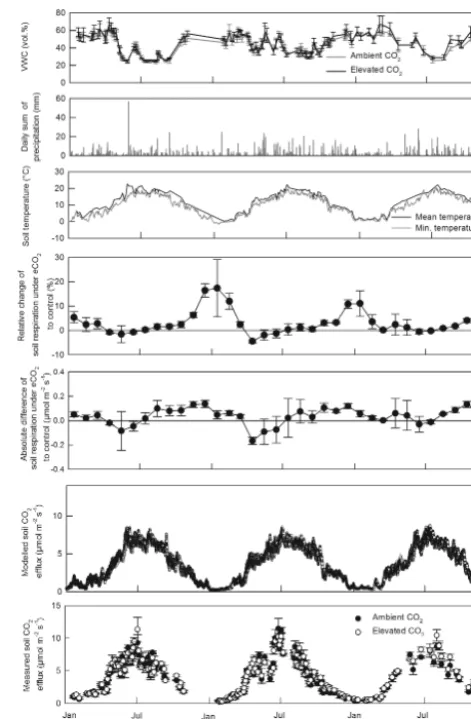
From 2008 to 2010, soil respiration rates at the GiFACE experiment showed distinct annual dynamics, following the seasonal temperature cycle with lowest soil respiration ef-fluxes during winter months and highest efef-fluxes during mid-summer (Fig. 2c, g). Thus, soil respiration rates responded to abiotic factors in particular temperature and moisture. This is exemplified by the high CO2efflux rates in June 2009 which
Figure 2. Volumetric water content under ambient and elevated
CO2(a), daily sums of precipitation at the GiFACE (b), mean soil temperature during soil respiration measurements and minimum daily soil temperature at 10 cm depth (c), the relative mean monthly change of soil respiration under elevated CO2based on measured and modelled data (d), the absolute mean monthly difference in soil respiration under elevated CO2 based on measured and modelled data (e), modelled soil respiration under ambient and elevated CO2 from 2008 to 2010 (f) and measured soil respiration under ambi-ent and elevated CO2from 2008 to 2010 (g). Data are presented as averages (n=3)±1 SE.
occurred shortly after a period of high precipitation while soil temperatures were > 20◦C (Fig. 2g).
The relative and absolute change of soil respiration un-dereCO2(Fig. 2d, e) followed a seasonal pattern with
great-est increases undereCO2during autumn and winter. During
midsummer, when the largest absolute soil respiration rates occurred, the relative increase due to the CO2 enrichment
was lowest or non-existent. A linear mixed effect model anal-ysis confirmed that soil respiration rates undereCO2 were
significantly higher compared to rates under ambient CO2
[image:5.612.51.284.66.187.2]Table 1. Results of fitting the temperature-dependence model
af-ter Lloyd and Taylor (1994) to 20 % of our observation data under ambient and elevated CO2.
CO2treatment R R2 AdjustedR2 Standard error of estimate
[image:6.612.48.289.104.373.2]Ambient CO2 0.87 0.75 0.75 1.35 Elevated CO2 0.91 0.82 0.82 1.19
Figure 3. Mean soil respiration rates during the five defined
sea-sons under ambient and elevated CO2averaged over 3 years from 2008–2010. Error bars show±1 SE associated by averaging across the three replicates per treatment (n=3) (1) is winter dormancy; (2) is the start of vegetation period; (3) is spring; (4) is summer; (5) is autumn (for details see methods).P values indicate the dif-ference between treatments obtained by a linear mixed-effect model analysis.
2), spring (season 3) and summer (season 4)), covering most of the vegetation period, a trend towards higher soil respira-tion, but no significant CO2effect was observed witheCO2
(Fig. 3).
3.2 Model performance and parameter estimation
By comparing modelled soil respiration with observed soil respiration for all observation dates from 2008–2010 a sig-nificant linear relationship was observed with a slope of 1.02 (Fig. 5).
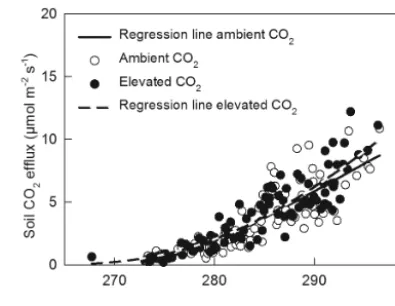
Based on the temperature-respiration function by Taylor and Lloyd (1994), soil respiration was significantly corre-lated to soil temperature under ambient as well as eCO2
(p=<0.0001). From 2008 to 2010, 75 % of the variability of soil respiration rates was explained by soil temperature under ambient CO2and 82 % undereCO2(Fig. 4, Table 1).
Soil respiration rates did not differ in their relationship to soil temperature between the treatments (Fig. 4).
Figure 4. Relationship between soil respiration rate and soil
tem-perature under ambient and elevated CO2. Equation of dynamic fit
(Lloyd and Taylor, 1994):f=R10eE0
1 (283.15−T0)−
1 (x−T0)
.
Figure 5. Observed versus modelled soil respiration rates under
am-bient and elevated CO2.
3.3 Annual sums of soil respiration
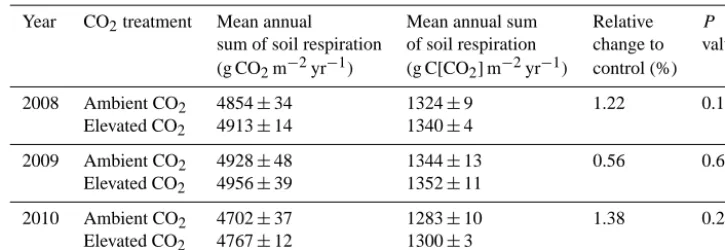
Comparing annual sums of soil respiration, no mean treat-ment effect of elevated CO2 (over all seasons) was
ob-served in any of the observation years (Table 2). Mean annual estimates of soil respiration under ambient CO2
ranged from 1283 to 1344 and undereCO2 from 1300 to
1352 g C [CO2] m−2yr−1(Table 2).
4 Discussion
4.1 Annual sums of soil respiration
In contrast to our initial hypotheses, annual estimates of soil respiration were not different between the CO2
[image:6.612.341.510.285.456.2]Table 2. Annual sums of soil respiration under ambient and eCO2from 2008–2010. Data are presented as averages (n=3)±standard error (SE).P values indicate the difference between treatments per year obtained by a pairedttest.
Year CO2treatment Mean annual Mean annual sum Relative P sum of soil respiration of soil respiration change to value (g CO2m−2yr−1) (g C[CO2] m−2yr−1) control (%)
2008 Ambient CO2 4854±34 1324±9 1.22 0.17 Elevated CO2 4913±14 1340±4
2009 Ambient CO2 4928±48 1344±13 0.56 0.64 Elevated CO2 4956±39 1352±11
2010 Ambient CO2 4702±37 1283±10 1.38 0.23 Elevated CO2 4767±12 1300±3
1331±16 g C m−2yr−1 under elevated CO2. Raich and
Schlesinger (1992) estimated much lower rates of annual soil respiration, reporting 400 to 500 g C m−2yr−1for temperate grasslands. Annual soil respiration sums from a sandstone and serpentine grassland were 485 and 346 g C m−2yr−1 (Luo et al., 1996). These soil respiration rates were lower than those from the wet grassland site investigated here due to the larger net primary productivity of the wet temperate grassland with a year-round more or less moist climate, com-pared e.g. to a seasonally dry Mediterranean-type grassland. A lower net ecosystem productivity (NEP) will automatically result in lower overall soil respiratory C losses. Methodolog-ical differences may have been to a lesser extent responsi-ble, because the studies of Luo et al. (1996) and Raich and Schlesinger (1992) may have overestimated rather than un-derestimated the annual soil respiration. Their measurements did not exceed 2 years in duration and soil respiration was less frequently measured for a portion of the year. Other re-cent studies reported higher rates of annual soil respiration which are closer to our estimates; however climatic factors are different from our site: in a tallgrass prairie in Oklahoma annual soil respiration rates were 1131 and 877 g C m−2yr−1 in 2002 and 2003 respectively (Zhou et al., 2006). In a Texas grassland annual soil respiration rates increased with annual precipitation and were 1600, 1300, 1200, 1000, 2100 and 1500 g C m−2yr−1in 1993 through 1998 respectively (Miel-nick and Dugas, 2000). At the Texas grassland site measure-ments were conducted year-round with a high time resolu-tion. Consequently annual rates could be estimated by more measured (than gap-filled) data compared to other studies. However the most important factors were likely the annual precipitation, its distribution over the year, and the annual mean temperature: High annual rainfall, a long growing sea-son and large soil organic C contents explained the higher soil respiration rates (as a consequence of a higher NEP) at the Texas study site. Mean annual precipitation at the Gi-FACE study site (562 mm) was close to the mean precipi-tation reached in 1995 at the Texas grassland with 657 mm,
when annual soil respiration averaged 1200 g C m−2yr−1at the Texas grassland.
4.2 Seasonality of soil respiration
Also, contrary to our initial hypotheses is the observation that soil respiration was not significantly affected during the growing season (start of vegetation period, spring and summer) by moderate long-term CO2enrichment. This
indi-cates that any increase in the ecosystem respiration (Lenhart, 2008) during this season will not have been due to enhanced soil (root-derived) respiration but rather to increases in the respiration of the green canopy.
The majority of long-term FACE studies reported sig-nificantly increased soil respiration undereCO2during the
growing season (Pregitzer et al., 2008; Jackson et al., 2009; Pendall et al., 2001; Dawes et al., 2013; Carol Adair et al., 2011), whereas Bader and Körner (2010) reported that 7 years of eCO2 failed to stimulate cumulative soil
respi-ration significantly during the growing season. Among the mentioned long-term FACE experiments, the GiFACE oper-ates at the lowest CO2enrichment step increase (20 % above
ambient CO2), which may have contributed to this result.
However, in line with our hypotheses, the results revealed that 10 years of moderate CO2 enrichment increased soil
respiration during winter and autumn (Fig. 3). These sea-sonal stimulations of soil respiration undereCO2 were not
observed by comparing the annual sums of soil respiration (Table 2). This may be because soil respiration fluxes were lower in winter and autumn compared to fluxes from the other seasons where no differences in soil respiration be-tween the CO2treatments were observed. However, within
the winter and autumn season differences in soil respiration may play an important role concerning the global C balance. Increased rates of winter soil respiration undereCO2may
in-crease the observed winter CO2maximum in the atmosphere
(Raich and Potter, 1995; Keeling et al., 1996) when respi-ration exceeds photosynthesis. Another reason why annual sums of soil respiration were not different between the CO2
respiration fluxes (> 10 µmol m−2s−1). However these fluxes
occurred only in 1.72 % of all observations. Our model did not take soil moisture into account. The high variability of observed soil respiration during summer may be partly due to differing soil moisture conditions, which were not signifi-cantly different between ambient andeCO2plots (Kammann
et al., 2005, 2008).
In most FACE studies which reported the effect ofeCO2
on soil respiration, the winter was excluded since fumigation during this period was mostly switched off (often in response to sub-zero freezing temperatures or deciduous forest ecosys-tems). This was the case in the Swiss FACE study, where seeded grassland was exposed to 600 ppm CO2(de Graaff et
al., 2004), the BioCON FACE, also a grassland study (Craine et al., 2001; Carol Adair et al., 2011), the Aspen FACE, an aspen forest enriched witheCO2(Pregitzer et al., 2008; King
et al., 2001), a Japanese model forest ecosystem exposed to 550 ppm CO2(Masyagina and Koike, 2012) and in a
9-year FACE study of an alpine tree line ecosystem (Dawes et al., 2013). In the Swiss Canopy Crane study soil respiration was measured during the beginning of the dormant season but not over the complete dormant season while fumigation was switched off (Bader and Körner, 2010). In the Maricopa FACE, where a wheat field was exposed toeCO2, no
win-ter measurements were carried out because this season was a fallow season (Pendall et al., 2001). Outside the cultiva-tion period no soil respiracultiva-tion measurements were made on a cotton plantation exposed toeCO2(Nakayama et al., 1994).
Increased winter soil CO2 fluxes are in line with
re-sults from Selsted et al. (2012), who reported stimulated rates during three consecutive winter periods in a Danish N-limited Calluna-Deschampsia-heathland exposed to FACE at 510 ppm (CLIMAITE study). Fumigation was carried out all year round except during periods with full snow cover. Contrary to our results, in the CLIMAITE study, the stimu-latory effect of eCO2on soil respiration persisted
through-out most of the year, i.e. also in summer and not only dur-ing winter. However, in the CLIMAITE study, monthly soil respiration measurements were carried out within the first 3 years after the experimental start and may therefore reflect short-term responses, driven by the initial CO2step increase
(Klironomos et al., 2005). Thus the results are not completely comparable to this study where measurements were carried out in the eleventh to thirteenth year of CO2enrichment.
To our knowledge, the Duke Forest FACE is the only other FACE experiment where soil respiration was measured in an evergreen ecosystem year-round for several years and af-ter long-af-term fumigation with eCO2 (+200 ppm). On
aver-age, soil respiration was significantly higher by 23 % under
eCO2. Jackson et al. (2009) summarized, after 10 years of
CO2 enrichment, that the greatest stimulation of soil
respi-ration under eCO2 occurred from midsummer to early fall,
in contrast to our observations, during winter the CO2
re-sponse of soil respiration was weakest. However, fumigation
was stopped at the Duke Forest FACE when ambient air tem-perature dropped below 5◦C for more than 1 hr.
After short-term enrichment with eCO2 (550 ppm) on
a mixed plantation of Populus species (EUROFACE; in the fourth and fifth year of enrichment), Lagomarsino et al. (2013) recorded much larger stimulation of soil respira-tion during the vegetarespira-tion (up to 111 % enhancement) than dormant season (40 % enhancement), when fumigation was stopped, which is also contrary to our results. However, ex-perimental setup and climate differed from our site. While minimum soil temperatures reached−1.7◦C in the GiFACE experiment during winter (Fig. 2b), comparably warm and mild winters without sub-zero temperatures were typical at the EUROFACE site located in Italy. Moreover, the Populus plantation was a fertilized agro-ecosystem, where coppicing was carried out every 3 years, while the GiFACE was an old established, species-rich ecosystem where N-supply was lim-ited.
In line with results from the EUROFACE but in contrast to our findings, Volk and Niklaus (2002) did not observe any wintertime increase in the ecosystem CO2efflux from a
cal-careous grassland in response to 3 years of CO2enrichment
(600 ppm) with a screen-aided CO2enrichment facility.
Investigations from the GiFACE experiment showed that N2O emissions also exhibited a “seasonality response”, with
the greatest stimulation of N2O emission under eCO2
be-ing observed in late-summer and autumn (Kammann et al., 2008). These findings support the hypothesis that the driving mechanism of theeCO2 seasonality responses of enhanced
microbial activity may have been related to the mineraliza-tion of previously accumulated organic matter, fuelling den-itrification (Kammann et al., 2008).
4.3 Root-derived soil respiration
Increased root biomass was frequently recorded undereCO2
(Rogers et al., 1994; Jastrow et al., 2000; Lukac et al., 2009), potentially affecting soil respiration rates (Zak et al., 2000). However, at the GiFACE, root biomass, picked with forceps (for set time intervals per sample,n=3 per FACE ring), was only different in December 2005 between the CO2treatments
but not at other dates during 2004–2007 (Lenhart, 2008) or in November 2011 (unpublished results). Lenhart (2008) observed in the GiFACE eCO2 plots, using Keeling plots
and two-component mixing models that the fraction of root-derived CO2(root- and root-exudate respiration and fine root
decay), as part of the total soil CO2efflux was lower in
ter than during the growing season. Accordingly, during win-ter, the soil CO2efflux originated mainly from microbial soil
respiration.
Higher fine root turnover undereCO2, resulting in higher
C input via root necromass could explain increased autumn soil respiration but unlikely the winter increase in soil CO2
Al-ternatively, differences in the root necromass could already have been decomposed at this time of sampling or may be observed later in the year, so that “enhanced fine root decom-position” as a cause of the autumn and winter soil respiration increase undereCO2cannot be ruled out.
4.4 N availability
Since soil microorganisms require C as well as N for mainte-nance and growth (De Graaff et al., 2006; Zak et al., 1993), N availability plays an important role in determining soil CO2
efflux. Root respiration rates were observed to correlate with tissue nitrogen concentration (Burton et al., 1996, 1998). In the GiFACE, eCO2 caused reduced tissue N concentrations
and higher C:N-ratios of aboveground plant biomass (Kam-mann et al., 2008). Through freezing effects in winter, min-eral N, which was immobilized into the microbial biomass shortly after fertilizer application in spring, became partly available again (Müller et al., 2003). It is possible that N, as a limiting factor in the temperate grassland, may partly be responsible for the increase in soil C loss during the autumn and winter season undereCO2.
4.5 Microbial community
Multiple observations from the GiFACE indicated that in-creases in winter soil respiration under eCO2 were largely
associated with microbial respiration (including rhizosphere microbiota). Recent studies from other FACE sites detected differences between microbial communities at eCO2
com-pared to ambient CO2 (Drigo et al., 2008, 2009). At the
GiFACE, stimulated rhizosphere-C utilization by arbuscular mycorrhizal fungi were found under eCO2by a13C-PLFA
study (Denef et al., 2007), which may have contributed to al-tered soil respiration. Recent measurements in 2013 did not indicate any differences in the abundance of bacteria and ar-chaea between the ambient and eCO2plots (K. Brenzinger,
personal communication, 2014) so that this can be ruled out as a cause for differed soil respiration between the CO2
treat-ments if this observation persists throughout autumn and winter.
4.6 Soil moisture
Several studies showed that eCO2 can affect soil moisture
(Niklaus et al., 1998; Field et al., 1995; Hungate et al., 1997), which in turn regulates soil respiration. However, large ef-fects are only expected and were detected at the dry end of the spectrum (Moyano et al., 2012; Guntinas et al., 2013; Rodrigo et al., 1997). During the investigation period, the volumetric water content ranged from 20 to 80 vol. % at the GiFACE site, with an average of 44 % during 2008–2010, and 39 % over the vegetation periods of these years. Thus, the soil moisture effect is likely not to be large. Moreover, no significant effect ofeCO2on the soil water content was
observed either during the first 5 years of enrichment
(Kam-mann et al., 2005) or after 13 years of enrichment (Meine, 2013). Consequently, a CO2-induced soil moisture effect is
unlikely governing increased soil respiration rates.
However, it can be assumed that annual dynamics of soil moisture with wettest conditions in winter, i.e. close to satu-ration, and driest conditions in summer (Fig. 2a) contributed to the seasonal dynamics of soil respiration undereCO2due
to diffusion limitations. Previous results from the GiFACE site show that in periods when soil moisture in the main root-ing zone was low (0.3 m3m−3), soil continued to produce N2O from deeper soil layers (20–50 cm), where soil
mois-ture remained high (ca. 0.6 m3m−3)(Müller et al., 2004). The production of N2O at deep soil layers seemed to
coin-cide with the production of CO2during summer, which was
also characterized by a homogenousδ13CO2profile during
vegetation period at our study site (Lenhart, 2008). However, a detailed investigation on layer-specific CO2production was
beyond the scope of this study. At times of high soil mois-ture CO2diffusion was slowed down, coinciding with
lim-ited oxygen supply (Skopp et al., 1990). At these times, soil respiration was likely to be originating mainly from the top-soil. However, increased autumn soil respiration undereCO2
cannot be attributed to this phenomenon since soil water con-tent is relatively low at this season (Fig. 2a). We suggest that increased substrate supply undereCO2 from end-of-season
dieback of roots and enhanced root-associated microbiome activity may explain stimulated soil respiration rates in au-tumn.
4.7 Plant community
Another aspect which may have contributed to altered soil respiration rates undereCO2is a shift in the plant community
composition. Grüters et al. (2006) observed that summer-greens decreased, whereas eversummer-greens increased undereCO2
in the GiFACE experiment. Since soil respiration is con-trolled by substrate supply via rhizodeposition (Verburg et al., 2004; Wan and Luo, 2003; Craine et al., 1999), higher photosynthetic activity ineCO2plots during mild winter may
have contributed to the observed increase in soil respiration. In addition, since the vegetative aboveground growth is dor-mant and does not provide an assimilate sink, the relative proportion of assimilate partitioned below-ground towards the root-associated microbiota may increase, contributing to the relative increase undereCO2during winter. The higher
abundance of evergreens at eCO2 also underlines the
im-portance of a year-round CO2 enrichment strategy in such
ecosystems with the respective climatic conditions. To date, increased winter soil respiration ateCO2was only found in
5 Conclusions
In conclusion, our results demonstrate the importance of win-ter soil respiration measurements, by showing that soil respi-ration was increased during autumn and winter after mod-erate long-term eCO2. Measurements and year-round CO2
enrichment should not be neglected, at least in winter-green temperate ecosystems. Studies in such ecosystems excluding measurements during the dormant season may thus under-estimate the effect of eCO2 on annual soil-respiratory CO2
losses (i.e. leading to an overestimation of C sequestered). Consequently, winter soil CO2fluxes may play a crucial role
in determining the carbon balance and dynamics of temperate grassland ecosystems. Our results indicate that temperate Eu-ropean grasslands which are characterized by a greenhouse gas balance near zero (Soussana et al., 2007) may gradu-ally turn into greenhouse gas sources with rising atmospheric CO2due to enhanced CO2losses during autumn and winter,
in particular if N2O emissions are significantly increased as
well as observed in the GiFACE (Kammann et al., 2008; Re-gan et al., 2011).
To generalize and explain the variation in the temporal dy-namics of soil respiration undereCO2more studies of winter
C dynamics under long-term eCO2 are required. For such
future studies it is advisable to include frequent samplings of root biomass, including the fine root fraction and necro-mass, in particular during the autumn/winter period under
eCO2. Another beneficial research strategy may be combined
(pulse) labelling of15N and13C to elucidate gross C and N turnover processes after long-term (> 10 years) of CO2
en-richment to study the C-N gross dynamics and associated carbonaceous gas losses.
The Supplement related to this article is available online at doi:10.5194/bg-12-1257-2015-supplement.
Acknowledgements. We are grateful to both, the Hessian Agency for the Environment and Geology (HLUG) for long-term financial support, and to the Hessian Ministry for Science and Arts for fi-nancial funding within the LOEWE research project FACE2FACE. The technical assistance of J. Senkbeil, J. Franz, T. Strohbusch and B. Lenz at the Gießen FACE site is gratefully acknowledged, as well as the assistance of M. Daum, C. Eckhard, C. von Bredow and Y. Kühnel. We gratefully acknowledge the long-term engagement of H.-J. Jäger († 18.8.2013) who initiated and nourished the Gießen FACE study over more than a decade.
Edited by: J.-A. Subke
References
Allen, A. S., Andrews, J. A., Finzi, A. C., Matamala, R., Richter, D. D., and Schlesinger, W. H.: Effects of free-air CO2enrichment (FACE) on belowground processes in a Pinus taeda forest, Ecol. Appl., 10, 437–448, doi:10.2307/2641105, 2000.
Amundson, R.: The carbon budget in soils, Annu. Rev. Earth Pl. Sc., 29, 535–562, 2001.
Andrews, J. A. and Schlesinger, W. H.: Soil CO2dynamics, acidifi-cation, and chemical weathering in a temperate forest with exper-imental CO2enrichment, Global Biogeochem. Cy., 15, 149–162, doi:10.1029/2000gb001278, 2001.
Bader, M. K. F. and Körner, C.: No overall stimulation of soil respiration under mature deciduous forest trees after 7 years of CO2 enrichment, Global Change Biol., 16, 2830–2843, doi:10.1111/j.1365-2486.2010.02159.x, 2010.
Batjes, N. H.: Total carbon and nitrogen in the soils of the world, Eur. J. Soil Sci., 47, 151–163, doi:10.1111/j.1365-2389.1996.tb01386.x, 1996.
Burton, A. J., Pregitzer, K. S., Zogg, G. P., and Zak, D. R.: Latitu-dinal variation in sugar maple fine root respiration, Can. J. For. Res., 26, 1761–1768, doi:10.1139/x26-200, 1996.
Burton, A. J., Pregitzer, K. S., Zogg, G. P., and Zak, D. R.: Drought reduces root respiration in sugar maple forests, Ecol. Appl., 8, 771–778, doi:10.1890/1051-0761(1998)008[0771:drrris]2.0.co;2, 1998.
Carol Adair, E., Reich, P. B., Trost, J. J., and Hobbie, S. E.: Elevated CO2 stimulates grassland soil respiration by increasing carbon inputs rather than by enhancing soil moisture, Global Change Biol., 17, 3546–3563, doi:10.1111/j.1365-2486.2011.02484.x, 2011.
Chapin III, F. S., Matson, P. A., and Mooney, H. A.: Principles of terrestrial ecosystem ecology, Springer, New York, 436 pp., 2002.
Craine, J. M., Wedin, D. A., and Chapin, F. S.: Predominance of ecophysiological controls on soil CO2flux in a Minnesota grass-land, Plant Soil, 207, 77–86, 1999.
Craine, J. M., Wedin, D. A., and Reich, P. B.: The resonse of soil CO2flux to changes in atmospheric CO2, nitrogen supply and plant diversity, Global Change Biol., 7, 947–953, 2001. Dawes, M. A., Hagedorn, F., Handa, I. T., Streit, K., Ekblad, A.,
Rixen, C., Korner, C., and Hattenschwiler, S.: An alpine tree-line in a carbon dioxide-rich world: synthesis of a nine-year free-air carbon dioxide enrichment study, Oecologia, 171, 623–637, doi:10.1007/s00442-012-2576-5, 2013.
de Graaff, M.-A., Six, J., Harris, D., Blum, H., and van Kessel, C.: Decomposition of soil and plant carbon from pasture sys-tems after 9 years of exposure to elevated CO2: impact on C cycling and modeling, Global Change Biol., 10, 1922–1935, doi:10.1111/j.1365-2486.2004.00862.x, 2004.
de Graaff, M.-A., Van Groenigen, K.-J., Six, J., Hungate, B. A., and Van Kessel, C.: Interactions between plant growth and soil nutri-ent cycling under elevated CO2: a meta-analysis, Global Change Biol., 12, 2077–2091, 2006.
Drigo, B., Kowalchuk, G. A., and van Veen, J. A.: Climate change goes underground: effects of elevated atmospheric CO2on mi-crobial community structure and activities in the rhizosphere, Biol. Fertil. Soils, 44, 667–679, doi:10.1007/s00374-008-0277-3, 2008.
Drigo, B., Van Veen, J. A., and Kowalchuk, G. A.: Spe-cific rhizosphere bacterial and fungal groups respond differ-ently to elevated atmospheric CO22, Isme J., 3, 1204–1217, doi:10.1038/ismej.2009.65, 2009.
Field, C. B., Jackson, R. B., and Mooney, H. A.: Stomatal response to increased CO2: implications from the plant to the global scale, Plant Cell Environ., 18, 1214–1225, 1995.
Grüters, U., Janze, S., Kammann, C., and Jäger, H.-J.: Plant func-tional types and elevated CO2: a method of scanning for causes of community alteration, J. Appl. Bot. Food Qual., 80, 116–128, 2006.
Guntinas, M. E., Gil-Sotres, F., Leiros, M. C., and Trasar-Cepeda, C.: Sensitivity of soil respiration to moisture and tempera-ture, J. Soil Sci. Plant Nutr., 13, 445–461, doi:10.4067/s0718-95162013005000035, 2013.
Heinemeyer, A., Di Bene, C., Lloyd, A. R., Tortorella, D., Baxter, R., Huntley, B., Gelsomino, A., and Ineson, P.: Soil respiration: implications of the plant-soil continuum and respiration cham-ber collar-insertion depth on measurement and modelling of soil CO2efflux rates in three ecosystems, Eur. J. Soil Sci., 62, 82–94, doi:10.1111/j.1365-2389.2010.01331.x, 2011.
Hungate, B. A., Chapin III, F. S., Zhong, H., Holland, E. A., and Field, C. B.: Stimulation of grassland nitrogen cycling under car-bon dioxide enrichment, Oecologia, 109, 149–153, 1997. Hutchinson, G. L. and Mosier, A. R.: Improved soil cover method
for field measurement of nitrous oxide fluxes, Soil Sci. Soc. Am. J., 45, 311–316, 1981.
Jackson, R. B., Cook, C. W., Pippen, J. S., and Palmer, S. M.: In-creased belowground biomass and soil CO2fluxes after a decade of carbon dioxide enrichment in a warm-temperate forest, Ecol-ogy, 90, 3352–3366, doi:10.1890/08-1609.1, 2009.
Jäger, H.-J., Schmidt, S. W., Kammann, C., Grünhage, L., Müller, C., and Hanewald, K.: The University of Gießen Free-Air Car-bon Dioxide Enrichment Study: Description of the experimental site and of a new enrichment system, J. Appl. Bot., 77, 117–127, 2003.
Janssens, I. A. and Ceulemans, R.: The response of soil CO2 ef-flux under trees grown in elevated atmospheric CO2: A literature review, Phyton-Ann. REI Bot., 40, 97–101, 2000.
Jastrow, J. D., Miller, R. M., and Owensby, C. E.: Long-term ef-fects of elevated atmospheric CO2on below-ground biomass and transformation to soil organic matter in grassland, Plant Soil, 224, 85–97, 2000.
Kammann, C., Grünhage, L., Grüters, U., Janze, S., and Jäger, H.-J.: Response of aboveground grassland biomass and soil moisture to moderate long-term CO2enrichment, Basic Appl. Ecol., 6, 351– 365, 2005.
Kammann, C., Müller, C., Grünhage, L., and Jäger, H.-J.: Ele-vated CO2 stimulates N2O emissions in permanent grassland, Soil Biol. Biochem., 40, 2194–2205, 2008.
Keeling, C. D., Chin, J. F. S., and Whorf, T. P.: Increased activity of northern vegetation inferred from atmospheric CO2 measure-ments, Nature, 382, 146–149, 1996.
King, J. S., Pregitzer, K. S., Zak, D. R., Sober, J., Isebrands, J. G., Dickson, R. E., Hendrey, G. R., and Karnosky, D. F.: Fine-root biomass and fluxes of soil carbon in young stands of paper birch and trembling aspen as affected by elevated atmospheric Co-2 and tropospheric O-3, Oecologia, 128, 237–250, 2001.
King, J. S., Hanson, P. J., Bernhardt, E., DeAngelis, P., Norby, R. J., and Pregitzer, K. S.: A multiyear synthesis of soil res-piration responses to elevated atmospheric CO2from four for-est FACE experiments, Global Change Biol., 10, 1027–1042, doi:10.1111/j.1529-8817.2003.00789.x, 2004.
Kirschbaum, M. U. F.: Will changes in soil organic carbon act as a positive or negative feedback on global warming?, Biogeochem., 48, 21–51, doi:10.1023/a:1006238902976, 2000.
Klironomos, J. N., Allen, M. F., Rillig, M. C., Piotrowski, J., Makvandi-Nejad, S., Wolfe, B. E., and Powell, J. R.: Abrupt rise in atmospheric CO2overestimates communitiy response in a model-plant soil system, Nature, 433, 621–624, 2005. Lagomarsino, A., Lukac, M., Godbold, D. L., Marinari, S., and
De Angelis, P.: Drivers of increased soil respiration in a poplar coppice exposed to elevated CO2, Plant Soil, 362, 93–106, doi:10.1007/s11104-012-1261-0, 2013.
Lal, R.: Soil carbon sequestration impacts on global climate change and food security, Science, 304, 1623–1627, 2004.
Leadley, P. W. and Drake, B. G.: Open top chambers for exposing plant canopies to elevated CO2 concentration and for measuring net gas-exchange, Vegetatio, 104, 3–15, doi:10.1007/bf00048141, 1993.
Lenhart, K.: The effects of long-term Free Air CO2 Enrichment (FACE) on soil aggregation, soil carbon input, and ecosystem CO2dynamics in a temperate grassland ecosystem, Department of Plant Ecology, Justus-Liebig University, Gießen, 134 pp., 2008.
LI-COR: LI-8100 Instruction Manual, LI-8100 automated soil CO2 flux system., Li-COR, Inc, Lincoln, NE, USA 68504, 2007. Liu, Q., Edwards, N. T., Post, W. M., Gu, L., Ledford, J., and
Lenhart, S.: Temperature-independent diel variation in soil res-piration observed from a temperate deciduous forest, Global Change Biol., 12, 2136–2145, 2006.
Lloyd, J. and Taylor, J. A.: On the temperature-dependence of soil respiration, Funct. Ecol., 8, 315–323, doi:10.2307/2389824, 1994.
Lukac, M., Lagomarsino, A., Moscatelli, M. C., De Angelis, P., Cotrufo, M. F., and Godbold, D. L.: Forest soil carbon cycle un-der elevated CO2– a case of increased throughput?, Forestry, 82, 75–86, doi:10.1093/forestry/cpn041, 2009.
Luo, Y., Jackson, R. B., Field, C. B., and Mooney, H. A.: Elevated CO2increases belowground respiration in California grasslands, Oecologia, 108, 130–137, doi:10.1007/bf00333224, 1996. Luo, Y.: Transient ecosystem responses to free-air CO2enrichment
(FACE): experimental evidence and methods of analysis, New Phytol., 152, 3–8, 2001.
Luo, Y., Wu, L., Andrews, J. A., White, L., Matamala, R., Schäfer, K. V. R., and Schlesinger, W. H.: Elevated CO2differentiates ecosystem carbon processes: deconvolution analysis of Duke for-est data, Ecol. Monogr., 71, 357–376, 2001.
Luo, Y. and Zhou, X.: Soil Respiration and the Environment, Aca-demic/Elsevier, San Diego, 328 pp., 2006.
Atmo-sphere (Hokkaido Island, Japan), Russ. J. Ecol., 43, 24–28, doi:10.1134/s1067413611060099, 2012.
McDermitt, D., Xu, L., Gracia, R., Madsen, R., and Anderson, D.: On equalizing pressure in a soil respiration chamber with pres-sure in the ambient air under windy conditions, Geophysical Re-search Abstracts, 7, 05841, 2005.
Meine, M.: Charakterisierung und Quantifizierung der mikro-biellen Bodenrespiration eines Grünlandbodens unter erhöhten atmosphärischen CO2-Konzentrationen, diploma, Geography, Phillipps-Universität Marburg, Marburg, 101 pp., 2013. Mielnick, P. C. and Dugas, W. A.: Soil CO2 flux in a tallgrass
prairie, Soil Biol. Biochem., 32, 221–228, doi:10.1016/S0038-0717(99)00150-9, 2000.
Monastersky, R.: Global carbon dioxide levels near worrisome milestone, Nature, 497, 13–14, 2013.
Moss, R. H., Edmonds, J. A., Hibbard, K. A., Manning, M. R., Rose, S. K., van Vuuren, D. P., Carter, T. R., Emori, S., Kainuma, M., Kram, T., Meehl, G. A., Mitchell, J. F. B., Nakicenovic, N., Riahi, K., Smith, S. J., Stouffer, R. J., Thomson, A. M., Weyant, J. P., and Wilbanks, T. J.: The next generation of scenarios for climate change research and assessment, Nature, 463, 747–756, 2010. Moyano, F. E., Vasilyeva, N., Bouckaert, L., Cook, F., Craine, J.,
Curiel Yuste, J., Don, A., Epron, D., Formanek, P., Franzlueb-bers, A., Ilstedt, U., Kätterer, T., Orchard, V., Reichstein, M., Rey, A., Ruamps, L., Subke, J.-A., Thomsen, I. K., and Chenu, C.: The moisture response of soil heterotrophic respiration: in-teraction with soil properties, Biogeosciences, 9, 1173–1182, doi:10.5194/bg-9-1173-2012, 2012.
Müller, C., Kammann, C., Ottow, J. C. G., and Jäger, H.-J.: Nitrous oxide emission from frozen grassland soil and during thawing periods, Z. Pflanzenern. Bodenk., 166, 46–53, 2003.
Müller, C., Stevens, R. J., Laughlin, R. J., and Jäger, H.-J.: Mi-crobial processes and the site of N2O production in a temperate grassland soil, Soil Biol. Biochem., 36, 453–461, 2004. Nakayama, F. S., Huluka, G., Kimball, B. A., Lewin, K. F., Nagy,
J., and Hendrey, G. R.: Soil carbon dioxide fluxes in natu-ral and CO2-enriched systems, Agric. For. Met., 70, 131–140, doi:10.1016/0168-1923(94)90052-3, 1994.
Newton, P. C. D., Clark, H., Edwards, G. R., and Ross, D. J.: Exper-imental confirmation of ecosystem model predictions comparing transient and equilibrium plant responses to elevated atmospheric CO2, Ecol. Lett., 4, 344–347, 2001.
Niklaus, P. A., Spinnler, D., and Korner, C.: Soil moisture dynam-ics of calcareous grassland under elevated CO2, Oecologia, 117, 201–208, doi:10.1007/s004420050649, 1998.
Pendall, E., Leavitt, S. W., Brookes, T., Kimball, B. A., Pinter, P. J., Jr, Wall, G. W., LaMorte, R. L., Wechsung, G., Wechsung, F., Adamsen, F., Matthias, A. D., and Thompson, T. L.: Elevated CO2stimulates soil respiration in a FACE wheat field, Bas. App. Ecol., 2, 193–201, 2001.
Pregitzer, K. S., Burton, A. J., King, J. S., and Zak, D. R.: Soil res-piration, root biomass, and root turnover following long-term ex-posure of northern forests to elevated atmospheric CO2and tro-pospheric O3, New Phytol., 180, 153–161, doi:10.1111/j.1469-8137.2008.02564.x, 2008.
Raich, J. W. and Potter, C. S.: Global patterns of carbon dioxide emissions from soils, Global Biogeochem. Cy., 9, 23–36, 1995.
Raich, J. W. and Schlesinger, W. H.: The global carbon dioxide flux in soil respiration and its relationship to vegetation and climate, Tellus, 44B, 81–99, 1992.
Rastetter, E. B., Ryan, M. G., Shaver, G. R., Melillo, J. M., Nadel-hoffer, K. J., Hobbie, J. E., and Aber, J. D.: A general biogeo-chemical model describing the response of the C and N cycles in terrestrial ecosystems to changes in CO2, climate, and N deposi-tion, Tree Phys., 9, 101–126, 1991.
Raynaud, D. and Barnola, J. M.: An Antarctic ice core reveals at-mospheric CO2 variations over the past few centuries, Nature, 315, 309–311, 1985.
Regan, K., Kammann, C., Hartung, K., Lenhart, K., Muller, C., Philippot, L., Kandeler, E., and Marhan, S.: Can differences in microbial abundances help explain enhanced N(2)O emissions in a permanent grassland under elevated atmospheric CO(2)?, Global Change Biol., 17, 3176–3186, doi:10.1111/j.1365-2486.2011.02470.x, 2011.
Rodrigo, A., Recous, S., Neel, C., and Mary, B.: Modelling tem-perature and moisture effects on C-N transformations in soils: comparison of nine models, Ecol. Mod., 102, 325–339, 1997. Rogers, H. H., Runion, G. B., and Krupa, S. V.: Plant responses
to atmospheric CO2enrichment with emphasis on roots and the rhizosphere, Environ. Pollut., 83, 155–189, 1994.
Schils, R. L. M., Kuikman, P., Liski, J., van Oijen, M., Smith, P., Webb, J., Alm, J., Somogyi, Z., van den Akker, J., Billett, M., Emmett, B. A., Evans, C. D., Lindner, M., Palosuo, T., Bellamy, P. H., Jandl, R., and Hiederer, R.: Review of existing informa-tion on the interrelainforma-tions between soil and climate change, Al-terra, Wageningen, 208, p. 23, available at: http://ec.europa.eu/ environment/soil/review_en.htm, 2008.
Selsted, M. B., van der Linden, L., Ibrom, A., Michelsen, A., Larsen, K. S., Pedersen, J. K., Mikkelsen, T. N., Pilegaard, K., Beier, C., and Ambus, P.: Soil respiration is stimulated by ele-vated CO2and reduced by summer drought: three years of mea-surements in a multifactor ecosystem manipulation experiment in a temperate heathland (CLIMAITE), Glob. Change Biol., 18, 1216–1230, doi:10.1111/j.1365-2486.2011.02634.x, 2012. Skopp, J., Jawson, M. D., and Doran, J. W.: Steady-State
Aerobic Microbial Activity as a Function of Soil Wa-ter Content, Soil Sci. Soc. Am. J., 54, 1619–1625, doi:10.2136/sssaj1990.03615995005400060018x, 1990. Soe, A. R. B., Giesemann, A., Anderson, T. H., Weigel, H. J., and
Buchmann, N.: Soil respiration under elevated CO2and its parti-tioning into recently assimilated and older carbon sources, Plant Soil, 262, 85–94, doi:10.1023/B:PLSO.0000037025.78016.9b, 2004.
Soussana, J. F., Fuhrer, J., Jones, M. B., and Van Amstel, A. R.: The greenhouse gas balance of grasslands in Europe, Agric. Ecosyst. Environ., 121, 1–4, 2007.
Verburg, P. J., Arnone III, J. A., Obrist, D., Schorran, D. E., Evans, R. D., Leroux-Swarthout, D., Johnson, D. W., Luo, Y., and Cole-man, J. S.: Net ecosystem carbon exchange in two experimental grassland ecosystems, Glob. Change Biol., 10, 498–508, 2004. Volk, M. and Niklaus, P. A.: Respiratory carbon loss of calcareous
grasslands in winter shows no effects of 4 years’ CO2 enrich-ment, Funct. Ecol., 16, 162–166, 2002.
Global Biogeochem. Cy., 17, 1054, doi:10.1029/2002gb001971, 2003.
Ward, J. K. and Kelly, J. K.: Scaling up evolutionary responses to elevated CO2: lessons from Arabidopsis, Ecol. Lett., 7, 427–440, 2004.
Wasshausen, W.: Frühjahrspflege auf dem Grünland: Zehn Punkte beachten, Landwirtschaftsblatt Weser-Ems, 8, 6–8, 1987. Zak, D. R., Pregitzer, K. S., Curtis, P. S., Teeri, J. A., Fogel, R.,
and Randlett, D. L.: Elevated atmospheric CO2 and feedback between carbon and nitrogen cycles, Plant Soil, 151, 105–117, 1993.