Original Article
Journal of Advances in Medical Education & Professionalism
The effects of team-based learning on learning outcomes in a course
of rheumatology
SEYEDEH TAHEREH FAEZI1, KAMRAN MORADI1,2, ALI GHAFAR RAHIMI AMIN3,
MASSOOMEH AKHLAGHI1, FATEMEH KESHMIRI4*
1Rheumatology Research Center, Tehran University of Medical Sciences, Tehran, Iran; 2Evidence-Based Medicine and Critical Thinking
Group, Endocrine and Metabolism Research Institute, Shariati Hospital, Tehran University of Medical Sciences, Tehran, Iran; 3Students’
Scientific Research Center (SSRC), Tehran University of Medical Sciences, Tehran, Iran; 4Medical Education Department, Educational
Development Center, Faculty of Health, Shahid Sadoughi University of Medical Sciences, Yazd, Iran
Introduction: We evaluated the effects of implementing Team-Based Learning (TBL) on student engagement, accountability, satisfaction, and preference for lecture or team-based learning. Moreover, we assessed the effect of TBL on knowledge retention and application over time through short answer questions based on clinical scenarios addressing history taking and diagnosis skills in medical students.
Methods: The study was conducted in a quasi-experimental design. The study population were all of the third-year medical students (n=84) participating in a course of rheumatology in Shariati
Hospital, which is a teaching hospital affiliated to Tehran University
of Medical Sciences. We compared TBL with the conventional lecture-based method. The assessments were performed after implementation of TBL by the Classroom Engagement Survey (CES) and Team-Based Learning Student Assessment Instrument (TBL-SAI). The assessment for application of knowledge was conducted in 3 time-points through short answer questions on rheumatic diseases. The comparison of results was made by Student’s t-test and repeated-measures analysis of variance (RM-ANOVA) using SPSS software, version 16.
Results: The CES scores indicated a high level of engagement in TBL (Mean±SD=26.7±3.70, p=0.0001) but not in the lecture-based sessions (Mean±SD=23.80±4.35, p=0.09). The total mean score (SD) for TBL-SAI was 159.68 (14.14) for TBL sessions indicating a favorable outcome (p=0.0001). The student scores obtained from the short answer questions showed that over time the students’
scores had declined significantly less for the TBL sessions in
comparison to the lecture-based sessions, F (2, 166)=4.624, p=0.011.
Conclusion: The results indicated higher student engagement, satisfaction and long term learning by TBL.
*Corresponding author: Fatemeh Keshmiri, Medical Education Department, Educational Development Center, Faculty of Health, Shahid Sadoughi University of Medical Sciences, Yazd, Iran
Tel: +98-35-38265558
Email:
[email protected] Please cite this paper as:
Faezi ST, Moradi K, Ghafar Rahimi Amin A, Akhlaghi M, Keshmiri F. The effects of team-based learning on learning outcomes in a course of rheumatology. J Adv Med Educ Prof. 2018;6(1):22-30 Received: 3 June 2017 Accepted: 18 October 2017
Keywords: Learning; Team-based learning; Outcome
A
bs
tr
ac
t
Introduction
I
n recent decades, many educational institutions have emphasized the necessity of shifting fromeducation (1). TBL was first introduced by
Michaelsen, et al. for business courses (2). Due
to its specific features that made it suitable for
medical education, TBL was later adopted by various medical schools (3). TBL is based on the pedagogical principles and the constructivist learning theory (4). The principles of student-centered learning and supportive scaffolding are essential in the constructivist learning theory (4). Based on these principles, the learner is
defined as an individual that is responsible for
his/her learning and the learner is required to determine his/her own educational needs, guide the process of learning for his/her own learning, and actively participate in solving the problems in the group. In TBL, the learning process occurs with combining the information from the new learning experience (i.e. second and third phases of learning in TBL) with the
previous information (i.e. first phase of TBL and
the activities prior to the class).Learners must process the new subjects and integrate them with their existing ‘information structure’ to form or restructure the cognitive schema, which is unique to them based on their learning process. Also, supportive scaffolding is emphasized as a tool for supporting peers in small groups. In these groups, the learners have the opportunity to discuss the challenging subjects in team readiness assurance tests (TRAT) and group application exercises.
TBL also possesses the advantages of the social family model and the cooperative learning approach (5). The social family model emphasizesthe tasks that enhance social interaction and academic learning (6). Cooperative learning promotes group interactions for analyzing the
problems, finding solutions, taking decisions,
and reporting the decisions as a team (1, 5, 7-10). Moreover, TBL focuses on knowledge application in a collaborative environment, increases the motivation for learning, and creates a concept map that would lead to deep learning (11-13). In group application exercises the individuals can develop and improve their critical thinking abilities in a
process of active learning. Reflection in action,
which is a crucial factor in effective learning, is improved in TRAT and in solving the case problems in the group application exercises (4).
The seven core elements in TBL include (a) team formation, (b) readiness assurance, (c) immediate feedback, (d) sequencing of in-class problem solving, (e) structure for developing team application tasks (i.e. the “four Ss”), (f) incentive structure, and (g) peer evaluation (14). These elements lead to improvement of self-directed learning, critical thinking, team-work,
interpersonal communication, peer learning, and problem-solving skills in the TBL participants (5, 8, 11, 14-22).
In recent years, various medical schools have applied TBL as an interdisciplinary and integrated approach to education for pre-clinical courses (11, 23, 24), internship (25, 26), and residency (27) programs as well as continuing medical education programs (28). According to Inuwa, et al. implementation of TBL leads to deep understanding, and improvement of creative thinking and analysis skills of the learners (8). In a study by Koles, et al. (29) it was shown that TBL can effective elyenhance the performance of
weaker students in the final exams. Moreover, a
study by Pogge has shown that application of TBL
could improve the students’ confidence in patient
counseling and improve their communication and team-work skills (30). In a study in an anatomy course, Vasan, et al. predicted that using clinical cases for TBL leads to the learners’ improved ability to apply anatomy knowledge for a longer period in clerkship years (1). They also piloted this prediction in a small section of the biochemistry course, while retaining most of the lectures, and their results were encouraging.
A systematic review study in 2013 which evaluated the effectiveness of TBL on learning outcomes in health professions education underlined the positive effects of TBL in improving knowledge scores (31). However, the study found mixed results in the literature with respect to the learning reactions of the learners to the TBL method. Moreover, the review found no reports in the literature evaluating the effect of TBL on knowledge retention over time. The study also recommended further research on learner satisfaction and accountability in TBL. In addition, this study highlighted the need for further research to evaluate the effect of TBL on higher level learning outcomes such as knowledge application.
In the present study, we have assessed the effect of TBL on accountability, recall, attention levels, and satisfaction of the students. Moreover, the learners’ engagement with TBL was compared with the conventional lecture-based method in a course of rheumatology. In addition, in this study we evaluated the effect of TBL on knowledge retention over time. We also assessed the knowledge application skills of the learners through short answer questions based on the clinical scenarios on history taking and diagnosis skills.
Methods
of the third year medical students (n=84) who
were participating for the first time in a course
of rheumatology at Shariati Hospital, Tehran
University of Medical Sciences.
Educational interventions
Educational interventions were comprised of TBL and lecture-based sessions, concerned with the history taking, physical examination, and diagnosis skills in the rheumatic diseases. TBL was implemented in sessions for rheumatic fever and periartheritis (3 sessions) and was compared to the conventional lecture-based sessions for systemic lupus erythematosus and ankylosing spondylitis (3 sessions). Each session lasted for about 3 hours and the sessions were held at one week intervals.
We conducted both interventions on the same group of participants. Lecture-based sessions were held at the beginning of the course before TBL sessions. The students had no prior exposure to the course content (i.e. the skills and the knowledge that was presented in the course). Coordination sessions about the course content and the teaching methods were held before the courses had started. The team of instructors was comprised of three rheumatologists and a specialist in medical education. Planning and design of the course as well as the preparation of group activities, educational cases, and readiness assurance tests and the short answer questions (SAQ) were developed by these instructors.
In order to implement the TBL, an orientation session was held for the learners to introduce them to the different steps in a TBL session. Then, the educational intervention was applied
through the following steps: The first step was
“preparation”. Prior to the commencement of the session, the students were provided with reading assignments that were based on the educational content for each session. The students were asked to study the material that was provided to them and to get prepared for the TBL session. At the beginning of each session, groups were formed. As the students were previously familiar to each other they were allowed to choose their team members to form a group comprising of six members. In the second step, Individual Readiness Assurance Test (IRAT) was conducted. IRAT in the current study was comprised of 11 multiple-choice questions (MCQs) that were based on the intended educational material for the course. In the third step, we conducted the Team Readiness Assurance Test (TRAT). Immediately after the individual tests, the students were asked to retake the same MCQ test but this time in a group. At this stage, the students were expected
to discuss the questions with group members to reach an answer. At the end of the TRAT the answers provided by each group were corrected by the facilitator and immediate feedback was provided to the groups. Individual and team readiness tests were performed to promote learning and teamwork skills. “Appeals” was the next step. At this point, the teams were allowed and encouraged to refer to their assigned reading materials to appeal for any missed questions in order to reason and defend their answers. After
the test the students could fill in appeal forms
for their missed questions at TRAT. In the present study, no appeals were submitted by the students. In the next step, the faculty members (i.e. facilitators) provided feedback to the students. At this stage the questions that raised more discussion among the students were further discussed. The last step was Team Application (TAP). It is the most important step in TBL that provides the grounds for group interactions in
order to analyze the problems, find solutions,
take decisions, and report back the decisions in a team. The assignments in this step involved the application of reading contents through scenarios that engaged higher-level cognitive processes (1, 5, 7-10, 21). At this step, all groups worked on the same scenarios (i.e. problems) and were asked to simultaneously report back their answers
(5). Students were asked to find the problem in
the case, decide on the key history questions and physical examinations, and provide a list of differential diagnoses.
Assessments
a) Team-Based Learning Student Assessment Instrument (TBL-SAI)
Team-Based Learning Student Assessment
Instrument (TBL-SAI) was filled in by each
participant after the TBL intervention. TBL-SAI is a 39-item instrument using a 5-point Likert scale from strongly disagree to strongly agree as possible response options (32). Three domains of accountability (13 questions), preference for lecture or team-based learning (16 questions) including student recall, and attention levels, and student satisfaction (10 questions) are measured by TBL-SAI. Accountability “occurs when students prepare in advance for a class and/or contribute to other members of the team” and is measured by the accountability subscale. Student recall refers to “the ability of students to retrieve previously learned knowledge for use
at a later time” and is operationally defined by
on the course content during the conventional lecture or TBL activities” are measured by questions in preference for lecture or team-based learning subscale. Student satisfaction includes “positive feelings toward either TBL activities or the conventional lecture” and is measured by student satisfaction subscale (20, 32, 33). b) Classroom Engagement Survey (CES)
The Classroom Engagement Survey (CES) is an 8-item questionnaire that evaluates student engagement in the class (34). Two types of engagement were considered in this regard: a) engagement with content that “occurs as the student thinks about the course content” and, b) engagement with peers that “occurs when the students interact with each other and participate in discussions and course activities”. CES was
filled in by the participants after the TBL and
lecture-based sessions.
Validity and reliability of the TBL-SAI and
CES instruments were confirmed in a study by the
authors. The instruments had shown acceptable internal consistency and reproducibility as measured by Cronbach’s alpha and Intra class
correlation coefficient (ICC). Cronbach’s alpha
and ICC for the TBL-SAI instrument were 0.79 and 0.82, respectively. In addition, Cronbach’s alpha and ICC for the CES instrument were 0.71 and 0.75, respectively (35).
c) Short answer questions based on the clinical scenarios
We developed the short answer questions (SAQs) to assess the “know-how” of history taking, examination, and diagnosis skills among the participants. We selected SAQ as it allows appropriate content coverage and provides a higher chance for the assessment of clinical reasoning and decision making capability (36). The assessment of higher levels of learning and the students’ skills for knowledge application
were assessed by five SAQs based on clinical
scenarios. According to the educational content for each session, SAQs were developed based on a similar stem and structure by an expert panel. The questions related to rheumatic fever and periartheritis were intended for TBL sessions and the questions on systemic lupus erythematosus and ankylosing spondylitis were developed for lecture-based sessions by the panel (see the Methods section for further description about the expert panel). In the present study, pre-testing was not conducted in order to keep away from pre-test bias effect on the study results. The students were tested in the intervention and control groups at three time points i.e. immediately after the
sessions, at two weeks, and at four weeks after each session.
Statistical methods
The frequency and percentages were used for the description of sample characteristics. Mean and standard deviations (SD) were calculated for all instrument scores. One-sample t-test was used for the comparison of TBL-SAI subscale and total scores as well as CES scores with the reference values (20, 33). We used repeated-measures analysis of variance (RM-ANOVA) to evaluate the effect of educational interventions (i.e. TBL vs. conventional lecture-based sessions) on knowledge retention over time (i.e. at 0, 2, and 4 weeks after the intervention) in a within-subjects design. In this regard, the “Type of Education Intervention” and the “Time of Assessment” were regarded as repeated measures variables and the students’ scores obtained from the SAQs as the outcome measure. We used repeated contrasts for post hoc analysis. P-values less than 0.05
were considered statistically significant. We used partial eta squared (ηp2) for effect size calculations. We used ηp2 as a quantitative
measure of the strength of the observed effects in RM-ANOVA. According to a general “rule
of thumb” ηp2 effect sizes equal to 0.01, 0.06
and 0.14 are considered small, medium, and large effect sizes, respectively (37). We used SPSS software, version16 for statistical calculations.
Results
Eighty-four medical students from Tehran
University of Medical Sciences participated in
the study. The participants had a mean age±SD of 22±2.0 years. There were thirty males (34.88%)
and fifty-six females (65.11%).
a) Readiness assurance tests
The mean score for IRAT was 8.53 out of 11. The mean score at the group stage (i.e. TRAT) was 10.25 out of 11 showing a statistically
significant improvement (p=0.001).
b) Team-Based Learning Student Assessment Instrument (TBL-SAI)
Table 1 shows the mean scores of the participants at different domains of TBL-SAI after the TBL intervention.
c) The Classroom Engagement Survey (CES) The mean scores for the student engagement were 26.7±3.70 and 23.80±4.35 for the TBL and lecture-based sessions, respectively. The comparison of results with the reference score
engagement in the TBL group (p=0.0001). However, the difference from the reference value
was not statistically significant in the
lecture-based sessions (p=0.09). There were also no association between the CES scores and the SAQ scores in the TBL group (p=0.08).
d) Short answer questions based on the clinical scenarios
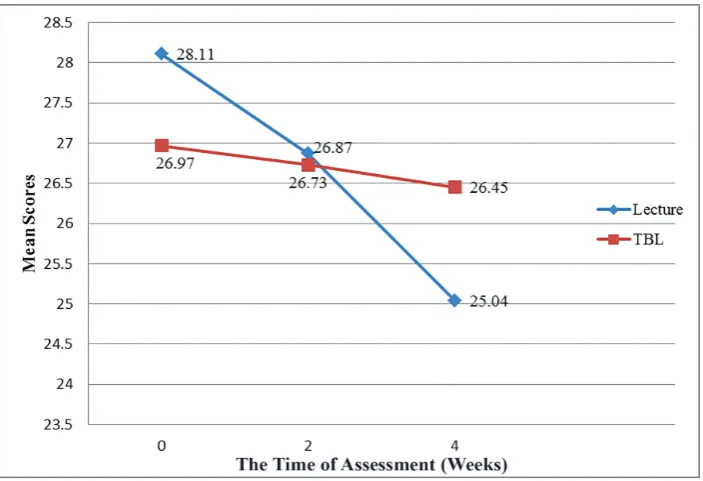
The mean scores for the SAQs obtained from the students after the TBL sessions were 26.97±5.01, 26.73±6.28, and 26.45±8.66 at the
first, second and third assessments, respectively.
After the lecture-based sessions, the mean scores
obtained from the students at the first, second and
third assessments were 28.11±5.96, 26.87±5.64, and 25.04±6.67 respectively (Figure 1). The results of RM-ANOVA showed that there was
not a significant ‘main effect’ of the Type of
Education (p=0.845) and the Time of Assessment (p=0.191) on the students’ SAQ scores (Table 2).
We found a significant interaction effect between
the time of assessment and the type of educational
intervention, (p=0.011, ηp2=0.05, Table 2). The
significant interaction effect between the Type
of Education and the Time of Assessment in this study indicated that the decline in SAQ scores
over time had been significantly different across
the educational methods (i.e. TBL vs. lecture-based sessions). In other words, although the students’ SAQ scores after the teaching sessions had naturally declined over time, the students’
SAQ scores had a significantly slower rate of
decline after the TBL sessions in comparison to the lecture-based sessions. The slower decline in SAQ scores after the TBL sessions indicated
a significantly better retention of knowledge over
time after the TBL sessions. Planned contrasts revealed that the decline in the student scores after the TBL and lecture-based sessions (i.e. the difference in the rate of decline across the educational interventions) had not been
significantly different at two weeks (p=0.099), but had become statistically significant at 4 weeks (p=0.004, ηp2=0.10) after the educational
intervention (Table 2). These results indicated that the effect of TBL on knowledge retention had become more pronounced over time.
Table 1: The mean scores of participants obtained from the Team-Based Learning Student Assessment Instrument (TBL-SAI)
TBL-SAI domains NO. Mean±SD Reference value * Max p
Accountability 13 46.43±6.54 39 65 0.0001
Preference for lecture or
team-based learning 16 51.90±5.50 48 80 0.0001
Student satisfaction 10 38.08±4.02 30 50 0.0001
TBL-SAI (Total) 39 159.68±14.14 117 195 0.0001
One-sample t test was used to compare the mean scores of the participants with the reference values which indicate the neutral value for each domain of the instrument.
*Reference values are obtained from (33).
Discussion
The results of the current study showed a favorable outcome with regard to the accountability, satisfaction and recall of the participants in the TBL sessions. Our results also demonstrated a downward trend for the student test scores obtained from SAQs that had
a significantly slower rate after the TBL sessions
in comparison to the lecture-based sessions. In the current study, the comparison of student scores with the reference values for the instrument (32, 33) showed that the student ratings obtained from the different domains of
TBL-SAI had been significantly high for the TBL
sessions. The accountability subscale in TBL-SAI concerns the students’ preparation prior to the class and their contribution to the other team members. TBL requires prior reading and having enough mastery of the subject so that the learners can actively participate in the group discussions and analyze and solve the group assignments and the clinical scenarios. The students’ engagement in the teaching and learning process resulted in reaching a higher level of understanding (38). The results of the current study, demonstrated a favorable accountability for the TBL group that was comparable to the results by Corbridge et al. (16) and Mennenga (20). The current study also demonstrated the learners’ preference for TBL to the lecture-based sessions that was in line with the other reports (11, 16, 20, 22, 30, 39). The teamwork and the students’ engagement in the process of learning in small groups have led to students’ preference for TBL.
Learners’ satisfaction and collaborative environment are among other factors that
influence effective learning. The learner
reaction and satisfaction from TBL have been a debated subject in the literature (31). Fatmi, et al. hypothesized that the “increased student workload” and “shift in culture towards peer assessment” and “accountability” could negatively affect student reaction to TBL (31). In the present
study, the learners showed positive reactions to the TBL that could be partly explained by the positive effects of having an interactive learning experience in a small group. The TBL sessions provided the opportunity for peer learning in the small groups and familiarized the learners with their peers’ approaches to history taking and physical examination. In this study, peer learning in the small groups could possibly have had synergistic effects on the students’ learning experience (40, 41) and the improvement of their teamwork and clinical skills led to satisfaction with TBL. Moreover, as the educational system in Iran is based on the didactic teaching methods, experiencing interactive teaching in the course of rheumatology and facing with practical cases in the process of teaching could have possibly affected the students’ learning experience and satisfaction with the TBL. However, performing a qualitative study is recommended to explore the factors that affect learner’s satisfaction. The
results of the current study showed significant
improvement in the readiness assurance test scores at the group stage. Further, the results
of the study showed a significantly higher
student engagement for the participants in the TBL sessions. These results are in line with
other reports that have confirmed the role of
TBL in creating a favorable environment for collaborative learning (11, 15-16, 19-20, 22). The different components of TBL, such as developing an interactive team and engaging the learner in the process of learning, positively affect the process of learning, learner’s satisfaction, and accountability. Different studies have shown various effects of TBL on the cognitive domains (11, 15, 22, 30). The aim of implementing TBL is not necessarily to improve students’ knowledge but it is to also improve communication and problem-solving skills, interprofessional collaboration, and life-long learning that are achieved by the teamwork (42, 43). Therefore, in TBL, it is expected that by putting emphasis on
Table 2: Effects of educational methods on the participant’s short answer question (SAQ) scores over time
Main effects and interaction effect
Within-subjects variable Sum of squares dfM1 dfR2 F p ηp4
Type of Education 2.431 1 83 0.03 0.84 NS3
Time of Assessment 154.51 2 166 1.70 0.19 NS3
Type of Education * Time of Assessment 256.12 2 166 4.62 0.01 0.05
Planned contrasts 5
1st assessment vs. 2nd assessment 300.96 1 83 2.77 0.09 NS3
1st assessment vs. 3rd assessment 1022.01 1 83 8.79 0.004 0.10
1df
M= degrees of freedom forthe effect of the model,2dfR= degrees of freedom for the residuals of the model, 3NS = not significant,
4η
p= partial eta-squared
5Panned contrasts are only reported for the significant interaction effect of Time of Assessment * Type of Education.
pre-reading techniques, self-directed learning, and working in small groups improvement in higher level knowledge is also achieved. In this regard, the application of individual tests before group sessions facilitates problem solving during a group session that leads to improvement in the group scores and reduction in the time spent on group activities (17). Improvement in the TRAT scores in comparison to the IRAT scores in the present study is in line with many reports that have emphasized the synergistic effects of group work and peer-learning in this regard (16, 17, 20, 22-23, 30, 39). Therefore, it is possible to expect that in the small groups of TBL, with adequate understanding of the clinical scenarios, the learners can develop better problem solving, clinical reasoning, and teamwork skills.
The results of our study showed a significant
difference in the trends of decline over time in the SAQ scores obtained after TBL sessions versus lecture-based sessions (Figure 1). In this study,
we observed a statistically significant interaction
effect between the time of assessment and the type of educational intervention, which indicated a different rate of decline in the SAQ scores over time across the educational interventions. The contrasts revealed that although the decline
in the SAQ scores had not been significantly
different between the TBL and lecture-based
sessions, at two weeks, it had become significant
at four weeks. In the TBL sessions, the learners attempt—both individually and in the group—to solve the problems related to the clinical cases, and providing feedback by the facilitator, positively affect their learning and the knowledge retention in learners. Therefore, it is possible to predict that the application of TBL would result in a more long-term learning and retrieval of information. This is in line with a study by Imanieh et al., where the problem-based learning (PBL) led
to a significant improvement in learning and
recalling output as compared to the traditional method over time (44). It has been shown that learning in PBL could be improved by active participation of learners in the homogeneous small groups (45). A study conducted by Clark, et al. among 70 undergraduate nursing students, with the application of TBL in a 7-week educational course, led to improvement in problem solving and communication skills of the learners (11). In a study by Koles, et al., related to the education of “Pathology-Based Content” in two separate semesters with different content materials, a comparison was made between TBL and other educational methods (16). The results showed higher knowledge test scores for TBL in comparison to the other methods. According to
Koles, et al. the students in the lowest academic
quartile benefited more from TBL sessions than
the students in the highest quartile. These results also emphasize the positive long-term effects (for two semesters) of TBL that would lead to better academic performance over time (19). Improvement in knowledge scores has been more prominent in the studies where TBL was applied for a longer period or when MCQs were used for knowledge testing (15, 22, 30, 46, 47).
Limitations
One of our limitations was the quasi-experimental design of the study. However, since the purpose of this study was evaluating the effect of TBL on knowledge retention over time (which is presumably very much affected by the cognitive abilities of the learner) using a quasi-experimental time series design allowed us to control for the individual difference among the learners in retention of knowledge. In the present study, we applied TBL for a short period of time. Also, the number of TBL sessions and assessments in our study were limited. Therefore, although the results of the present study concerning better “knowledge retention” after the TBL sessions are very promising, further research is still required to evaluate the long-term learning effects of TBL for an extended period of time (i.e. after four weeks).
Conclusion
TBL is a learner-centered method that can be implemented in integrated educational programs and interprofessional training in different disciplines in medical sciences. The results of this study showed that implementing TBL increases learners’ participation and satisfaction with the course. This could lead to deeper learning, long-term knowledge retention and better performance regarding the practical knowledge. Therefore, it is recommended to apply TBL in interprofessional educational programs and in pre-clinical courses by using real clinical cases.
Conflict of Interest: None declared.
References
1. Vasan NS, DeFouw DO, Holland BK. Modified use of
team-based learning for effective delivery of medical gross anatomy and embryology. Anatomical sciences education. 2008;1(1):3-9.
2. Michaelsen LK, Fink LD, Knight A. Designing effective group activities: Lessons for classroom teaching and faculty development. Professional and Organizational Development Network in Higher Education. 1997; 16:385.
professions education. Team-Based Learning for Health Professions Education. 2008;23(1):47-8. 4. Hrynchak P, Batty H. The educational theory basis of
team-based learning. Med Teach. 2012;34(10):796-801. 5. Michaelsen LK, Parmelee DX, McMahon KK. Team-based learning for health professions education: A guide to using small groups for improving learning.
USA: Stylus Publishing, LLC.; 2008.
6. Joyce B, Calhoun E, Hopkins D. Models of learning,
tools for teaching. UK: McGraw-Hill Education; 2008.
7. Buljac-Samardzic M, Dekker-van Doorn CM, Van Wijngaarden JD, Van Wijk KP. Interventions to improve team effectiveness: a systematic review. Health policy (Amsterdam, Netherlands). 2010;94(3):183-95. 8. Inuwa IM, Al-Rawahy M, Roychoudhry S, Taranikanti
V. Implementing a modified team-based learning strategy in the first phase of an outcome-based
curriculum--challenges and prospects. Med Teach. 2012;34(7):e492-9.
9. Parmelee DX, Michaelsen LK, Cook S, Hudes PD. Team-based learning: a practical guide: AMEE guide no. 65. Med Teach. 2012;34(5):e275-87.
10. Motlagh MK, Najarkolai AR, Keshmiri F. Team-Based
Learning in Medical Universities: Infrastructure and
Requirements. Thrita. 2015;4(3):1-6.
11. Clark MC, Nguyen HT, Bray C, Levine RE. Team-based learning in an undergraduate nursing course. The Journal of nursing education. 2008;47(3):111-7. 12. Kelly PA, Haidet P, Schneider V, Searle N, Seidel
CL, Richards BF. A comparison of in-class learner engagement across lecture, problem-based learning, and team learning using the STROBE classroom observation tool. Teaching and learning in medicine. 2005;17(2):112-8.
13. O’Malley KJ, Moran BJ, Haidet P, Seidel CL, Schneider V, Morgan RO, et al. Validation of an observation instrument for measuring student engagement in health professions settings. Evaluation & the health professions. 2003;26(1):86-103.
14. Farland MZ, Sicat BL, Franks AS, Pater KS, Medina MS, Persky AM. Best practices for implementing team-based learning in pharmacy education. American journal of pharmaceutical education. 2013;77(8):177. 15. Allen RE, Copeland J, Franks AS, Karimi R,
McCollum M, Riese DJ, et al. Team-based learning
in US colleges and schools of pharmacy. American
journal of pharmaceutical education. 2013;77(6):115. 16. Corbridge SJ, Corbridge T, Tiffen J, Carlucci
M. Implementing team-based learning in a nurse practitioner curriculum. Nurse educator. 2013;38(5):202-5.
17. Gopalan C, Fox DJ, Gaebelein CJ. Effect of an individual readiness assurance test on a team readiness assurance test in the team-based learning of physiology. Advances in physiology education. 2013;37(1):61-4. 18. Haller CR, Gallagher VJ, Weldon TL, Felder RM.
Dynamics of peer education in cooperative learning workgroups. Journal of Engineering Education. 2000;89(3):285-93.
19. Koles P, Stolfi A, Borges NJ, Nelson S, Parmelee
DX. The impact of team-based learning on medical students’ academic performance. Acad Med. 2010;85(11):1739-45.
20. Mennenga HA. Student engagement and examination performance in a team-based learning course. The Journal of nursing education. 2013;52(8):475-9. 21. Michaelsen LK, Sweet M. The essential elements of
team-based learning. New Directions for Teaching and Learning. 2008;2008(116):7-27.
22. Shellenberger S, Seale JP, Harris DL, Johnson JA, Dodrill CL, Velasquez MM. Applying team-based learning in primary care residency programs to increase patient alcohol screenings and brief interventions. Acad Med. 2009;84(3):340-6.
23. Pileggi R, O’Neill PN. Team-based learning using an audience response system: an innovative method of teaching diagnosis to undergraduate dental students. Journal of dental education. 2008;72(10):1182-8. 24. Seidel CL, Richards BF. Application of team
learning in a medical physiology course. Acad Med. 2001;76(5):533-4.
25. Hunt DP, Haidet P, Coverdale JH, Richards B. The effect of using team learning in an evidence-based medicine course for medical students. Teaching and learning in medicine. 2003;15(2):131-9.
26. Levine RE, O’Boyle M, Haidet P, Lynn DJ, Stone MM, Wolf DV, et al. Transforming a clinical clerkship with team learning. Teaching and learning in medicine. 2004;16(3):270-5.
27. Haidet P, O’Malley KJ, Richards B. An initial experience with “team learning” in medical education. Acad Med. 2002;77(1):40-4.
28. Kuhne-Eversmann L, Fischer MR. Improving knowledge and changing behavior towards guideline based decisions in diabetes care: a controlled intervention study of a team-based learning approach for continuous professional development of physicians. BMC research notes. 2013;6:14.
29. Koles P, Nelson S, Stolfi A, Parmelee D, Destephen
D. Active learning in a Year 2 pathology curriculum. Med Educ. 2005;39(10):1045-55.
30. Pogge E. A team-based learning course on nutrition
and lifestyle modification. American journal of
pharmaceutical education. 2013;77(5):103.
31. Fatmi M, Hartling L, Hillier T, Campbell S, Oswald AE. The effectiveness of team-based learning on learning outcomes in health professions education: BEME Guide No. 30. Med Teach. 2013;35(12):e1608-24. 32. Mennenga HA. Team-based learning: Engagement
and accountability with psychometric analysis of a
new instrument [dissertation]. Las Vegas: University
of Nevada;2010.
33. Mennenga HA. Development and psychometric testing of the Team-Based Learning Student Assessment Instrument. Nurse educator. 2012;37(4):168-72. 34. Classroom Engagement Survey. Team learning in
medical education workshop handbook. Houston, Texas: Baylor College of Medicine; 2001.
35. Keshmiri F, Rahmati A, Amin AG, Faezi T. Validating and Assessing the Reaction of Medical Students Toward Team-Based Learning. Acta Medica Iranica. 2017;54(12):806-11.
36. Amin Z, Chong YS, Khoo HE. Practical guide to medical student assessment. Singapore: World
Scientific; 2006.
sciences. Hillsdale, New Jersey: Lawrence Erlbaum Associates; 1988.
38. Shirani Bidabadi N, Nasr Isfahani A, Rouhollahi A, Khalili R. Effective teaching methods in higher education: requirements and barriers. Journal of Advances in Medical Education & Professionalism. 2016;4(4):170-8.
39. Beatty SJ, Kelley KA, Metzger AH, Bellebaum KL, McAuley JW. Team-based learning in therapeutics workshop sessions. American journal of pharmaceutical education. 2009;73(6):100.
40. Gupta ML. Enhancing student performance through cooperative learning in physical sciences. Assessment & Evaluation in Higher Education. 2004;29(1):63-73. 41. Topping KJ. Trends in peer learning. Educational
psychology. 2005;25(6):631-45.
42. Sibley J, Parmelee DX. Knowledge is no longer enough: Enhancing professional education with team-based learning. New Directions for Teaching and Learning. 2008;2008(116):41-53.
43. Wiener H, Plass H, Marz R. Team-based learning in
intensive course format for first-year medical students.
Croatian medical journal. 2009;50(1):69-76.
44. Imanieh M, Dehghani S, Sobhani A, Haghighat M. Evaluation of problem-based learning in medical students’ education. Journal of Advances in Medical Education & Professionalism. 2014;2(1):1-5.
45. Kojuri J, Shekarchi B, Motshaker Arani M, Farhadi P, Amini M, Dehghani M. The effects of homogeneous
small groups on the efficacy of problem-based
learning. Journal of Advances in Medical Education & Professionalism. 2013;1(3):89-93.
46. Lake DA. Student performance and perceptions of a lecture-based course compared with the same course utilizing group discussion. Physical therapy. 2001;81(3):896-902.
47. Nyindo M, Kitau J, Lisasi E, Kapanda G, Matowo J, Francis P, et al. Introduction of team-based learning
(TBL) at Kilimanjaro Christian Medical University