Effects of Citalopram on Learning and Memory
in the Mouse and Rat
Nasser Naghdi and Nahid Majlessi
*Department of Physiology & Pharmacology, Pasteur Institute of Iran, Tehran 13164, Iran
ABSTRACT
Data on the effects of serotonin reuptake inhibitors on learning and memory processes are not consistent. In the present study, the effects of citalopram, a very potent and completely selective inhibitor of the serotonin reuptake on spatial discrimination in the T-maze and Morris water maze, were assessed in mice and/or rats. Animals received different doses of citalopram (1, 2, 4, 8 or 16 mg/kg, i.p.) or its vehicle (saline) 30 min before training each day. The results showed no significant effects of citalopram on T-maze discrimination task in mice and rats. However, there was dose-dependent increases in latencies to find the invisible platform and traveled distances in citalopram received groups compared to the control group with the peak effect at doses of 4 and 8 mg/kg in Morris task. Therefore, it appears that citalopram can cause learning deficits in complex spatial tasks. Iran. Biomed. J. 4: 21-29, 2000
Keywords: Serotonin, Citalopram, Spatial learning
INTRODUCTION
Serotonin (5-hydroxytryptamine, 5-HT) plays a significant role in learning and memory processes. But, data on the effects of 5-HT on these processes are inconsistent. However, despite the incon-sistencies, the preponderance of evidence shows that stimulation of 5-HT activity in the brain impairs, whereas impedance of its activity enhances learning and memory [1, 2].
One contributor to the advance in knowledge about brain serotonin neurons and their physiological roles has been a group of compounds that selectively inhibit 5-HT reuptake into the nerve terminals. Fluoxetine, zimelidine, sertraline, paroxetine, fluvo-xamine, indalpine and citalopram are the selective inhibitors of the serotonin reuptake (SSRIs) that have been most widely studied [3]. By blocking the membrane uptake carrier, which transports serotonin from the extracellular space to inside the 5-HT nerve terminals, these compounds raise synaptic concen-trations of serotonin and presumed to increase serotonergic transmission [1]. Serotonin uptake blockers exert antidepressant-like effects in the animal models of depression [4, 5]. Some of them have been therapeutically useful in treating mental
depression, bulimia and obsessive-compulsive disorder in humans, and therapeutic benefit has been claimed in additional diseases as well. Apart from their therapeutic applications in humans, SSRIs have been useful research tools for experiments in laboratory animals [3]. A number of these drugs were studied for their effects on learning and memory. Surprisingly, in most instances these studies showed that treatment with SSRIs improved performance on learning tasks in animals and humans [1, 3, 6-8]. However, inconsistent and contrary results do exist [9, 10].
Citalopram is a potent and selective inhibitor of the 5-HT reuptake mechanism [3, 11-13], increases the extracellular concentrations of serotonin [3, 14-18] and its effect is not associated with changes in catecholamines [11, 14]. Due to the selective action on 5-HT uptake, citalopram seems to be a valuable tool in studying the role of central serotonergic system in experimental neuropharmacology [11]. Citalopram like other SSRIs showed antidepressant effects in animal models of depression [4, 5]. It was effective in the treatment of alcoholism [19, 20], panic disorder and school phobia [21] and relieved the symptoms of diabetic neuropathy [22]. Patients with Alzheimer disease or senile dementia of
Alzheimer type treated with citalopram showed a significant improvement in emotional disturbances, but not in cognitive impairment [23]. However, it has been reported that both cognitive and emotional functioning improved significantly in the citalopram-treated elderly depressed patients [24].
There are few animal studies showing the effects of citalopram on learning and memory. However, there is a report indicating acquisition deficits caused by citalopram in a two-way active avoidance task [25]. Thus, the present study was conducted to assess the effects of citalopram on different learning tasks including T-maze and Morris water maze in rats and mice.
MATERIALS AND METHODS
Subjects. Male albino Wistar rats (200-250 g) and
male N.MRI mice (25-30 g), bred in Pasteur Institute of Iran, were used. They were housed six per cage in a constant temperature room (24±1°C), with lights on from 06:30 to 18:30 h. All of the animals had free access to food and water except for animals which were used for T-maze that were food deprived throughout the experimental period to maintain 85% of normal body weight.
Drug. Citalopram, HBr (Lundbeck Co., Denmark)
was dissolved in 0.9% isotonic saline. Rats received different doses of citalopram (1, 2, 4, 8 and 16 mg/kg, i.p.). Control animals received equal volume (2 ml/kg) i.p. injections of saline.
Behavioral assessment. All tests were conducted
between 0900 and 1300 h.
T-maze for mouse. The T-maze for mouse was
wooden with stem and arms 35 × 10 cm × 25 cm high. The start box (10 × 12 cm) was separated from the stem and the stem was separated from the arms by vertical sliding doors. The protocol for this test was similar to that of File et al. [26]. Briefly, testing was preceded by two free exploration sessions (one daily) of 10 min each, in order to familiarize animals with the apparatus. On the following 2 days, mice were given successive trials as follows: at the start of a trial, the mouse was placed in the start box; after 30 s, the door to the stem was opened. When the mouse entered one of the arms, the door to that arm was closed. The chosen arm and the time, which
elapsed between the opening of the stem-door and the closing of the arm-door (running latency), were noted. After a 30 s confinement in the chosen arm (whether or not it was reinforced, see below), the mouse was removed and placed in a start box for the following trial, which began with a 30 s confinement. On the first day animals were given successive trials in order to evaluate their rate of spontaneous alternation (first six trials) and then acquisition of spatial discrimination on the following trials. For this purpose, the first five trials were performed with both arms reinforced (one food pellet); on the following trials only one arm (right or left for different animals) was reinforced and trials continued until the mouse reached a criterion of five consecutive correct (reinforced) choices. Twenty-four hours later, animals were tested for retention of the discrimination; accordingly, they were given successive trials under the same conditions as during acquisition and until they reached the same criterion. Citalopram was administered 30 min prior to both test days (day 1: alternation + acquisition of the discrimination; day 2: retention of the dis-crimination). The number of animals in each group was 9-11.
T-maze for rat. The T-maze for rats was also
wooden with 15 cm high walls and start and goal boxes 16.5 × 16.5 cm was used. The 50-cm long stem led to two L-shaped arms. The first part of each arm was 36 cm long and the second part, which led to the goal box, 30 cm long. Guillotine doors separated the start box from the stem and the stem from the arms. The protocol for this test was similar to that Annett et al. [27] had used. Briefly, preliminary training took place on days 1 to 3 to familiarize animals with the apparatus and testing. On days 4 and 5 (spontaneous alternation), food was available in both of the goal boxes on every trial. Each rat was confined to the start box for 10 s before being allowed to choose one of the goal boxes, where it was confined for a further 20 s Eleven consecutive trials were given per day and the choice of right or left goal box was recorded, as was the latency between leaving the start box and entering the chosen arm. On days 6 to 8 (spatial discrimination and reversal), Only one of the goal boxes was rewarded and the rats had to learn which was correct. Trials continued until the criterion of 5 consecutive correct responses had been achieved. The choice of arm and latency between leaving the
start box and entering the chosen arm were recorded on every trial. Immediately after reaching criterion the contingencies were reversed so that the previously unreinforced goal box was now correct. Training continued until the new response had been learnt, again to a criterion of 5 consecutive correct responses. On day 9 (extinction), after a spatial discrimination had been completed to 5 consecutive correct responses, an extinction stage was introduced. The food pellets were removed from the T-maze, the goal box choices and the start box to arm latencies were recorded over a further 10 trials. Rats received different doses of citalopram 30 min before testing on days 4-9. The number of animals in each group was 5-7.
Morris water maze. The Morris task was assessed
in a water tank which consisted of a circular black tub (diameter 136 cm, depth 60 cm), filled with 25 cm of water at a temperature of 20 ± 1°C. The escape platform was made of clear Plexiglas (diameter 10 cm), submerged 1.5 cm below the surface of the water. An infrared camera was mounted in the center above the circular pool. An infrared LED was attached to each rat and the movement of animals were pictured and sent to a computer. The protocol for this test was similar to that of van der Staayet al. in 1994 (Department of Gerontopharmacology, Institute for Neurobiology, Troponwerke GmbH & Co. KG, Cologne, Germany). Briefly, the animals received four trials during five daily acquisition sessions. A trial was started by placing a rat into the pool, facing the wall of the tank. Each of four starting positions (north, east, south and west) was used once in a series of four trials; their order was randomized. The platform was always in the same quadrant (southwest). A trial was terminated as soon as the rat had climbed onto the escape platform or when 90 s had elapsed. A rat was allowed to stay on the platform for 20 s. Then, it was taken from the platform and the next trial was started. Rats that did not find the platform within 90 s were put on the platform by the experimenter and were allowed to stay there for 20 s after the completion of the fourth trial a rat was gently dried with a towel, kept warm for an hour and returned to its home cage. The path of each rat on each trial was automatically recorded by a computerized system and then analyzed by computing several parameters, e.g. latency to find the platform, traveled distance, swim speed, heading angle, etc.
Citalopram was administered 30 min prior to testing each day. The number of animals in each group was 6-8.
Statistics. All data were initially subjected to a
Kruskal-Wallis nonparametric analysis of variance (ANOVA) followed, where appropriate, by post-hoc
tests using Dunn’s test. In all comparisons, p<0.05
was used as the criteria for statistical significance.
RESULTS
T-maze (mouse).
Spontaneous Alternation. Citalopram had no significant effects on spontaneous alternation (Fig. 1A).
Discrimination Learning. There was no significant effects on the number of trials needed to achieve criterion (Fig. 1B), the number of errors (Fig. 1C) and latencies to enter the chosen arm (Fig. 1D) in acquisition of spatial discrimination and retention of the discrimination.
T-maze (rat).
Spontaneous Alternation. There was no significant
difference in the percentage of alternate choices and latencies between leaving the start box and entering the chosen arm among the groups (not
shown).
Spatial Discrimination and Reversal. The number
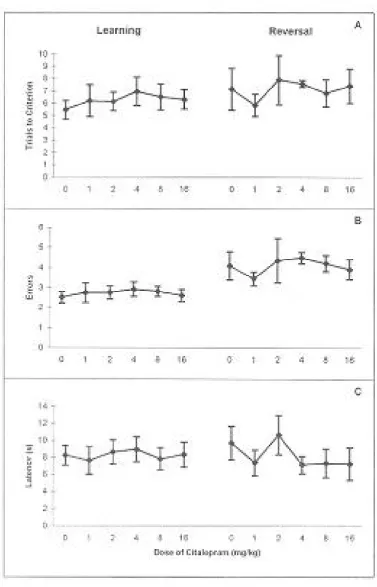
of trials to reach criterion (Fig. 2A), the number of errors while achieving criterion (Fig. 2B) and latencies to enter the chosen arm were not significantly different in the citalopram received groups on both learning and reversal trials (Fig. 2C).
Extinction. Over the ten extinction trials, there
were no significant differences in the percentage of previously reinforced arm choices and latencies to reach the chosen arm from the start box among the groups (not shown).
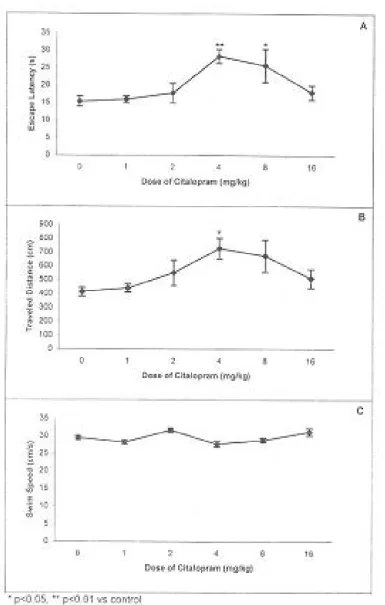
Morris water maze. The results showed
dose-dependent increases in latencies to find the invisible platform (Fig. 3A) and traveled distances (Fig. 3B) in citalopram received groups compared to the control group with the peak effect at doses of 4 and
Fig. 1. Effects of citalopram on spontaneous alternation (A), acquisition and retention (B: Trials to criterion, C: Errors, D: Latency) of T-maze discrimination in mice. Bars represent ± SEM. The number of animals in each group is 9-11.
Fig. 2. Effects of citalopram on rats performance in the T-maze. A: Mean number of trials to reach criterion (i.e. up to, but excluding 5 consecutive correct responses). B: Mean number of errors while reaching criterion. C: Mean latencies from leaving the start box to entering the chosen arm. Bars represent ± SEM. The number of animals in each group is 5-7.
Fig. 3. Effects of different doses of citalopram on rats performance in Morris water maze. A: Mean latencies, B: Mean traveled distances, C: Mean swim speeds to find the invisible platform. Error bars indicate ± SEM. The number of animals in each group is 6-8. * P<0.05, ** P<0.01 vs control.
8 mg/kg. The swimming speeds were not significantly different among the groups (Fig. 3C).
DISCUSSION
The results obtained in this study indicated that citalopram did not have any significant effect on T-maze alternation tasks in rats and mice. However, it caused dose-dependent increases in latencies and traveled distances to find the invisible platform in Morris water maze in rats. Since, it did not change the swimming speeds of the animals, the observed effect can be attributed to spatial learning.
There are few animal studies showing the effects of SSRIs and 5-HT release enhancers in complex tasks. Many studies have used simple procedures such as passive or active avoidance, in which performance changes can be attributed to a number of non-specific effects [9]. The results of these studies indicate a positive effect of SSRIs on performance [3, 7, 8, 28-30]. However, there is a report indicating that zimelidine, citalopram and fluoxetine caused disruptions of the two-way active avoidance acquisition [25]. The results of studies on the effects of SSRIs in complex tasks conflict with the reports indicating memory-enhancing effects of these compounds in simple procedures. For instance, it has been shown that alaproclate dose-dependently impaired water maze performance of rats [10]. In another study, fluoxetine showed no memory improving effects on short-term spatial memory in delayed matching to position and delayed non-matching to position procedures [9]. Apparently, contradictory effects of 5-HT uptake inhibitors have been observed, depending on the particular behavioral task employed [2].
Citalopram is probably the most highly selective of the compounds in vitro in respect to inhibiting serotonin uptake not norepinephrine or dopamine uptake. Citalopram is without effect on monoamine oxidase (MAO) and does not possess anticholinergic and antihistaminergic properties [12]. It increases extracellular concentrations of serotonin and amplifies signals sent by serotonin neurons [3]. In these experiments, citalopram had no significant effects on simple spatial tasks such as T-maze, but in Morris water maze, which is a complex spatial discrimination task, citalopram impaired acquisition of place navigation in rats. The Morris water maze is a useful tool assessing the spatial memory abilities
of rodents [31]. It has been recommended as superior to other more traditional procedures such as the T-maze or the radial-arm maze for several reasons. For example, the demands placed upon the spatial localization system are much stronger than in a T-maze and traditional sensory motivators like electrical shocks or nutrient deprivation, which might obscure the interpretation of studies, are unnecessary in this task [32]. It is believed that Morris water maze holds a great promise for improving our understanding of normal and disturbed memory processes in humans. It requires a high degree of sophisticated information processing and an accurate recollection of specific details of past experiences [31].
SSRIs have been used clinically in the treatment of several mental diseases. They are the treatment of choice for many indications, including major depression, dysthymia, panic disorder, obsessive-compulsive disorder, eating disorders and premenstrual disphoric disorder [33]. Therefore, it is important to assess their effects on cognitive function. In fact, it has been reported that fluoxetine caused a reversible cognitive dysfunction in a woman with a major depressive disorder and after discontinuing the drug; her cognitive functioning was significantly improved [34].
The results of the present and previous studies suggest that in water maze acquisition increased serotonergic activity modulates mechanisms related to place navigation performance. Since impaired memory has been mentioned as a side effect of
SSRIs [33], it should be considered in
pharmacotherapy of mood and other disorders especially in elderly patients with or without dementia such as Alzheimer disease.
REFERENCES
1. McEntee, W.J. and Crook, T.H. (1991) Serotonin, memory, and the aging brain. Psychopharmacology
103: 143-149.
2. Al-Zahrani, S.S.A., Ho, M.Y., Velazquez Martinez, D.N., Lopez Cabrera, M., Bradshaw, C.M. and Szabadi, E. (1996) Effect of destruction of the 5-hydroxytryptaminergic pathways on the acquisition of temporal discrimination and memory for duration in a delayed conditional discrimination task.
Psychopharmacology 123: 103-110.
3. Fuller, R.W. (1995) Serotonin uptake inhibitors: uses in clinical therapy and in laboratory research. Prog.
Drug Res. 45: 167-204.
4. Massol, J., Martin, P. and Puech, A.J. (1989) Antidepressant effects of tricyclic antidepressants and selective serotonin-uptake blockers in diabetic rats.
Diabetes 38: 1161-1164.
5. Martin, P., Soubrie, P. and Puech, A.J. (1990) Reversal of helpless behavior by serotonin uptake blockers in rats. Psychopharmacology 101: 403-407. 6. Lee, E.H.Y., Lin, W.R., Chen, H.Y., Shiu, W.H. and
Liang, K.C. (1992) Fluoxetine and 8-0H-DPAT in the lateral septum enhances and impairs retention of an inhibitory avoidance response in rats. Physiol.
Behav. 51: 681-688.
7. Meneses, A. and Hong, E. (1995) Effect of fluoxetine on learning and memory involves multiple 5-HT systems. Pharmacol. Biochem. Behav. 52: 341-346. 8. Hong, E. and Meneses, A. (1995) The activation of
serotonergic 5-HT1A presynaptic receptors or an
enhancement of 5-HT postsynaptic activity increase learning. Proc. West. Pharmacol. Soc. 38: 85-86. 9. Jansen, J.H.M. and Andrews, J.S. (1994) The effects
of serotonergic drugs on short-term spatial memory in rats. J. Psychopharmacol. 8: 157-163.
10. Riekkinen, P.J.R., J akala, P., Sirviِ, J. and Riekkinen, P. (1991) The effects of increased serotonergic and decreased cholinergic activities on spatial navigation performance in rats. Pharmacol.
Biochem. Behav. 39: 25-29.
11. Hyttel, J. (1977) Neurochemical characterization of a new potent and selective serotonin uptake inhibitor: Lu 10-171. Psychopharmacology 51: 225-233. 12. Christensen, A.V., Fjalland, B., Pedersen, V.,
Danneskiold-Samsoe, P. and Svendsen, O. (1977) Pharmacology of a new phthalane (Lu 10-171), with specific 5-HT uptake inhibiting properties. Eur. J.
Pharmacol. 41: 153-162.
13. Hyttel, J. (1978) Effect of a specific 5-HT uptake inhibitor, citalopram (Lu 10-171), on 3H-5-HT uptake in rat brain synaptosomesin vitro. Psychopharmacology 60: 13-18.
14. Tohgi, H., Abe, T., Nakanishi, S., Furuichi, H., Takahashi, S., Mtatsumura, T. and Kurimoto, T. (1995) Effects of citalopram, a synthetic serotonin uptake inhibitor, on indoleamine and catecholamine concentrations in the cerebrospinal fluid of freely moving rats. J. Neural. Transm. Park. Dis. Dement.
Sect. 9: 111-119.
15. Romero, L., Herv s, I. and Artigas, F. (1996) The 5-HT1Aantagonist WAY-100635 selectively potentiates
the presynaptic effects of serotonergic antidepressants in rat brain. Neurosci. Lett. 219:
123-126.
16. Hjorth, S., Bengtsson, H.J. and Milano, S. (1996) Raphe 5-HT1Aautoreceptors, but not postsynaptic
5-HT1A receptors or β-adrenoceptors, restrain the
citalopram-induced increase in extracellular
5-hydroxytryptamine in vivo. Eur. J. Pharmacol. 316:
43-47.
17. Invernizzi, R., Bramante, M. and Samanin, R. (1995) Extracellular concentrations of serotonin in the dorsal hippocampus after acute and chronic treatment with citalopram. Brain Res. 696: 62-66.
18. Sharp, T., Bramwell, S.R., Clark, D. and Grahame-Smith, D.G. (1989) In vivo measurement of extracellular 5-hydroxytryptamine in hippocampus of the anaesthetized rat using microdialysis: Changes in relation to 5-hydroxytryptaminergic neuronal activity. J. Neurochem. 53: 234-240.
19. Naranjo, C.A., Sellers, E.M., Sullivan, J.T., Woodley, D.V., Kadlec, K. and Sykora, K. (1987) The serotonin uptake inhibitor citalopram attenuates ethanol intake. Clin. Pharmacol. Ther. 41: 266-274. 20. Tiihonen, J., Ryynنnen, O.P., Kauhanen, J., Hakola,
H.P.A. and Salaspuro, M. (1996) Citalopram in the treatment of alcoholism: a double-blind placebo-controlled study. Pharmacopsychiatry 29: 27-29. 21. Lepola, U., Leinonen, E. and Koponen, H. (1996)
Citalopram in the treatment of early-onset panic disorder and school phobia. Pharmacopsychiatry 29:
30-32.
22. Sindrup, S.H., Bjerre, U., Dejgaard, A., Brsen, K., Aaes-Jrgensen, T. and Gram, L.F. (1992) The selective serotonin reuptake inhibitor citalopram relieves the symptoms of diabetic neuropathy. Clin.
Pharmacol. Ther. 52: 547-552.
23. Nyth, A.L. and Gottfries, C.G. (1990) The clinical efficacy of citalopram in treatment of emotional disturbances in dementia disorders. Br. J. Psychiatry
157: 894-901.
24. yth, A.L., Gottfries, C.G., Lyby, K., Smedegaard-Andersen, L., Gylding-Sabroe, J., Kristensen, M., Refsum, H.E., Ofsti, E., Eriksson, S. and Syversen, S. (1992) A controlled multicenter clinical study of citalopram and placebo in elderly depressed patients with and without concomitant dementia.
ActaPsychiatr. Scand. 86: 138-145.
25. Archer, T., Ogren, S.O., Johansson, G. and Ross, S.B. (1984) The effect of acute zimeldine and alaproclate administration on the acquisition of two-way active avoidance: comparison with other antidepressant agents, test of selectivity and sub-chronic studies. Psychopharmacology 84: 188-195. 26. File, S.E., Mabbutt, P.S., Bontempi, B., Destrade, C.
and Jaffard, R. (1993) Effects of S 9977 on learning and memory in the mouse and rat. Drug Dev. Res.
28: 478-487.
27. Annett, L.E., McGregor, A. and Robbins, T.W. (1989) The effects of ibotenic acid lesions of the nucleus accumbens on spatial learning and extinction in the rat. Behav. Brain Res. 31: 231-242.
28. Strek, K.F., Spencer, K.R. and Denoble, V.J. (1989) Manipulation of serotonin protects against an
hypoxia-induced deficit of a passive avoidance response in rats. Pharmacol. Biochem. Behav.
33: 241-244.
29. Flood, J.F. and Cherkin, A. (1987) Fluoxetine enhances memory processing in mice.
Psychopharmacology 93: 36-43.
30. Altman, H.J., Nordy, D.A. and Ogren, S.O. (1984) Role of serotonin in memory: facilitation by alaproclate and zimeldine. Psychopharmacology 84:
496-502.
31. McNamara, R.K. and Skelton, R.W. (1993) Theneuropharmacological and neurochemical basis
of place learning in the Morris water maze. Brain
Res. Rev. 18: 33-49.
32. Brandeis, R., Brandys, Y. and Yehuda, S. (1989) The use of the Morris water maze in the study of memory and learning. Intern. J. Neuroscience 48: 29-69. 33. Masand, P.S. and Gupta, S. (1999) Selective
serotonin-reuptake inhibitors: an update. Harv. Rev.
Psychiatry 7: 69-84.
34. Mirow, S. (1991) Cognitive dysfunction associated with fluoxetine. Am. J. Psychiatry 148: 948-949.