GaPP2, a multicentre randomised
controlled trial of the efficacy of
gabapentin for the management of
chronic pelvic pain in women: study
protocol
Katy Vincent,1 Andrew Baranowski,2 Siladitya Bhattacharya,3 Judy Birch,4 Ying Cheong,5 Roman Cregg,2 Jane Daniels,6 Catherine A Hewitt,6
Gary J Macfarlane,7 Lee Middleton,6 Wojciech Szubert,8 Irene Tracey,9 Amanda C de C Williams,10 Andrew W Horne8
To cite: Vincent K,
Baranowski A, Bhattacharya S, et al. GaPP2, a multicentre randomised controlled trial of the efficacy of gabapentin for the management of chronic pelvic pain in women: study protocol. BMJ Open 2018;8:e014924. doi:10.1136/ bmjopen-2016-014924 ►Prepublication history for this paper is available online. To view these files, please visit the journal online (http:// dx. doi. org/ 10. 1136/ bmjopen- 2016- 014924).
Received 26 October 2016 Revised 23 September 2017 Accepted 2 October 2017
For numbered affiliations see end of article.
Correspondence to
Dr Andrew W Horne; andrew. horne@ ed. ac. uk
AbstrACt
Introduction Chronic pelvic pain (CPP) affects more than
1 million UK women with associated healthcare costs of £158 million annually. Current evidence supporting interventions when no underlying pathology is identified is very limited and treatment is frequently inadequate. Gabapentin (a GABA analogue) is efficacious and often well tolerated in other chronic pain conditions. We have completed a successful pilot randomised controlled trial Gabapentin for Pelvic Pain 1 (GaPP1) and here describe the protocol for our definitive multicentre trial to assess the efficacy of gabapentin in the management of CPP in women Gabapentin for Pelvic Pain 2 (GaPP2).
Methods and analysis We plan to perform a
double-blind placebo-controlled randomised multicentre clinical trial, recruiting 300 women with CPP from up to 40 National Health Service hospitals within the UK. After randomisation, women will titrate their medication (gabapentin or placebo) over a 4-week period to a maximum of 2700 mg or placebo equivalent and will then maintain a stable dose for a 12-week period. Response to treatment will be monitored with validated questionnaires and coprimary outcome measures of average and worst pain scores will be employed. The primary objective is to test the hypothesis that treatment with gabapentin has the potential to provide an effective oral treatment to alleviate pain in women with CPP in the absence of any obvious pelvic pathology.
Ethics and dissemination Ethical approval has been
obtained from the Coventry and Warwick Research Ethics Committee (REC 15/WM/0036). Data will be presented at international conferences and published in peer-reviewed journals. We will make the information obtained from the study available to the public through national bodies and charities.
trial registration number ISRCTN77451762; Pre-results.
IntroduCtIon
Chronic pelvic pain (CPP) affects more than 1 million women in the UK.1–3 It is associated
with significantly reduced quality of life (QoL),4 5 a 45% reduction in work
produc-tivity and it has been estimated that caring for women with CPP in the UK costs £158 million annually.6 7 CPP can be associated with
under-lying pathology such as endometriosis, but in up to 55% of women no obvious cause can be identified at laparoscopy.6 Management of
CPP is difficult when no pathology is identi-fied, as no established gynaecological treat-ments are available. Due to its effectiveness in other chronic pain conditions, gabapentin (a GABA analogue), is increasingly being prescribed for CPP in both primary and secondary care.8 However, there is no good
quality evidence in CPP specifically on which to base this practice.9 To our knowledge, there is only one study evaluating the use of gabapentin for CPP, which did not have a placebo arm.10 This small study in 56 women,
compared gabapentin with amitriptyline and showed gabapentin to have greater efficacy at improving pain scores at 12 months. However, efficacy of gabapentin has been proven in other chronic pain conditions. A recent high-quality review showed the number needed to treat to be 5.8 (95% CI 4.3 to 9.0) to achieve at least 50% pain intensity reduction in painful diabetic neuropathy (829 patients); 7.5 (95% CI 5.2 to 14) to achieve at least 50% pain intensity reduction in postherpetic neuralgia (892 patients) and 5.4 (95% CI 2.9 to 31) to achieve at least 30% pain intensity reduction in fibromyalgia (150 patients).8 Moreover, it is a drug that is very well tolerated: all-cause withdrawal rates are similar to placebo (gabapentin: 20%; placebo: 19%; number of studies: 17; number of participants: 3063).8
on September 22, 2020 by guest. Protected by copyright.
Given the clinical need for a medical treatment for CPP with no identifiable underlying pathology and the strong evidence supporting the acceptability and effi-cacy of gabapentin in other chronic pain conditions, we considered that further investigation of gabapentin as a potential treatment for CPP in women was warranted. We hypothesise that treatment of women with CPP in the absence of any obvious pelvic pathology with gabapentin will alleviate pain and improve physical and emotional functioning. We initially performed a successful pilot randomised controlled trial (RCT) (GaPP1).11 12 Here,
we describe the protocol for our definitive multicentre trial to assess the efficacy of gabapentin in the manage-ment of CPP in women (GaPP2).
objectives
Primary objective
The primary objective is to test the hypothesis that treat-ment with gabapentin has the potential to provide an effective oral treatment to alleviate pain in women with CPP in the absence of any obvious pelvic pathology.
Secondary objective
The secondary objective is to test the hypothesis that treatment with gabapentin has the potential to improve physical and emotional functioning in women with CPP in the absence of any obvious pelvic pathology.
outcomes
Primary outcome
We will employ coprimary outcome measures of average and worst pain scores recorded on a Numerical Rating Scale (NRS). To capture the cyclicity that may occur with CPP, weekly pain scores (on a 0–10 scale) will be recorded during the final 4 weeks of treatment (weeks 13–16 postrandomisation), in the form of: (1) ‘average pain this week’ and (2) ‘worst pain this week’.
The composite ‘average’ pain score will be taken as the average of the four weekly average pain scores submitted, and the composite ‘worst’ pain score as the worst of the four weekly worst pain scores submitted.
Secondary outcomes
► Physical and emotional function and QoL. ► Satisfaction with treatment.
► Patient estimate of whether on active treatment or on placebo group, and confidence in and reasons for estimate.
► Adherence to trial treatments, as reported by the participants.
► Concomitant analgesic use, as reported by the
participants.
► Adverse events, as reported by participants (prin-cipally those that are serious and detailed in the summary of product characteristics and those that are unexpected).
► General practitioner/hospital consultations, as
reported by the participants. ► Time off work and ‘presenteeism’.
MEthods And AnAlysIs study design
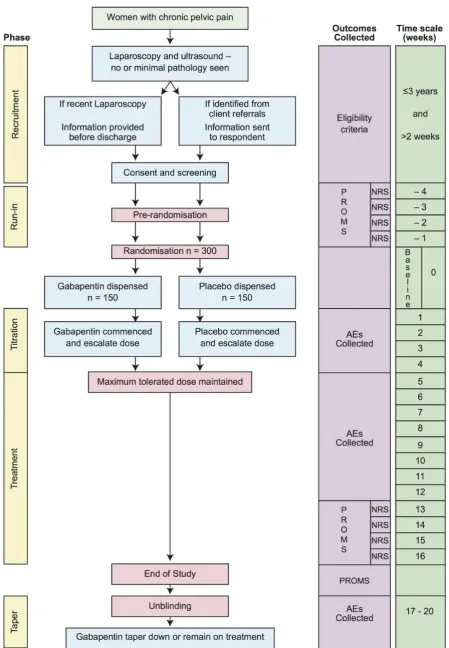
GaPP2 is a double-blind placebo-controlled randomised multicentre clinical trial (figure 1). We will screen women with CPP from up to 40 National Health Service hospi-tals within the UK. Women will return weekly NRS pain scores to the trials office for 4 weeks after initial consent. Those women meeting the inclusion criteria at the end of these 4 weeks will be randomised. We will randomise 300 women (150 to gabapentin, 150 to placebo). After rando-misation and titration, participants will receive treatment with the maximum tolerated dose for 12 weeks. Partici-pants and the healthcare team will be unblinded at the end of their treatment.
Participants
A total of 300 women with a history of CPP with no obvious pelvic pathology detected at laparoscopy will be recruited to the trial.
Inclusion criteria
► Women aged between 18 and 50 years.
► CPP (with or without dysmenorrhoea or dyspareunia) of >3-months duration.
► Pain located within the true pelvis or between and below anterior iliac crests.
► No obvious pelvic pathology at laparoscopy (laparos-copy must have taken place at least 2 weeks ago, but no more than 36 months prior to screening).
► Using or willing to use effective contraception if necessary to avoid pregnancy.
► Able to give informed consent.
► For both the worst and average prerandomisation NRS questions, at least three of the four weekly scores returned to the trials office. At least two of the worst pain scores should be ≥4/10. Potential participants who have been on a stable dose of an analgesic, other than gabapentin or pregabalin, for at least 4 weeks prior to screening will be eligible.
Exclusion criteria
► Dysmenorrhoea alone
► known pelvic pathology:
– endometriosis (macroscopic lesions)
– complex or >5 cm ovarian cyst
– fibroid >3 cm
– dense adhesions
► current malignancy under treatment ► current use of gabapentin/pregabalin
► taking Gonadotrophin Releasing Hormone (GnRH)
agonists and unable/unwilling to stop ► surgery planned in the next 6 months ► history of significant renal impairment ► previous allergic reaction to gabapentin ► breast feeding
► pregnant
► planning pregnancy in next 6 months
on September 22, 2020 by guest. Protected by copyright.
Figure 1 Study flow chart. AE, adverse event; NRS, Numerical Rating Scale; PROM, patient-reported outcome measure.
on September 22, 2020 by guest. Protected by copyright.
► pain suspected to be of gastrointestinal origin (posi-tive Rome III Diagnostic Criteria)
► coenrolment in another Clinical Trial of an Investiga-tional Medicinal Product.
Participant enrolment
Research nurses (dedicated or through the National Insti-tute for Health Research’s Clinical Research Network, depending on the site) will be employed for the duration of the study to approach eligible women, provide them with patient information sheets and offer them the oppor-tunity to discuss the trial, and obtain informed consent for screening. Consent will only be taken once the patient has had ample time to read the patient information sheet and had her questions answered.
study settings
We will recruit patients from gynaecology outpatient clinics, gynaecology wards and day surgery units and CPP clinics within the UK.
Intervention and randomisation
Randomisation to gabapentin or placebo will occur once written informed consent has been obtained, final eligibility established from the pain responses provided during the screening phase and baseline questionnaires completed. The Birmingham Clinical Trials Unit (BCTU) will provide third-party web-based randomisation with telephone backup. A minimisation procedure using a computer-based algorithm will be used to avoid chance imbalances in treatment allocation and the following potentially important variables:
1. presence or absence of dysmenorrhoea (a pain score of ≥4/10 will be considered significant);
2. psychological distress measured by the General Health Questionnaire (GHQ) (scored as 0–12 with a cut-off of 0–1 and 2–12 for minimisation);
3. use of sex hormonal treatments (combined oral con-traceptive, progestogens, levonorgestrel-releasing in-trauterine system (Mirena));
4. centre.
A ‘random element’ will be included in the minimi-sation algorithm, so that each patient has a probability (unspecified here) of being randomised to the oppo-site treatment that they would have otherwise received. Full details of the algorithm used will be stored in a confidential document at BCTU. Both participants and the research team will remain blind to allocation.
dose regimen
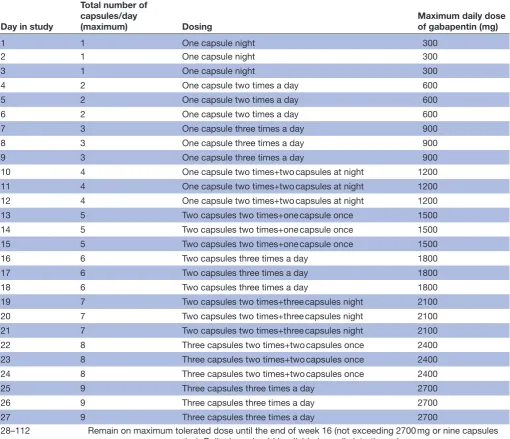
After randomisation, participants will be allocated a trial treatment pack from the hospital pharmacy containing either gabapentin or placebo oral tablets, both of identical appearance. Participants will start on one capsule (300 mg) daily and will increase by one capsule (300 mg) increments every 3 days until they perceive that they are gaining adequate pain relief, or report side effects (eg, dizziness, somnolence, mood changes, appetite and poor concentration)
that preclude them from further increases, up to a maximum dose of nine capsules (2700 mg), as shown in table 1. The titration phase will last a maximum of 4 weeks. If necessary they will be advised to titrate down to the last tolerated dose with minimal side effects. They will be asked to maintain their best tolerated dose until the end of week 16. Patients will be advised and given written instructions regarding their dosing regimen by a member of the research team. It will be recommended that the drug should be taken in three equally divided doses daily. The same protocol will be used for the placebo. When the participant stops treatment, the dose will be reduced according to a dose reduction chart and written instructions will be given. Patients will be allowed to use other medication (including analgesics, self-medication and alternative treatments, eg, acupuncture) throughout the study period.
data collection
Data storage
All the data generated from the study will be stored in a bespoke database, which will be password protected. All paperwork will be kept in a locked filing cabinet in a locked office. All data will be stored in accordance with the Data Protection Act.
Screening
A member of the research team will assess the woman for eligibility to enter the screening phase. All data will be recorded on a case report form (CRF) and trans-ferred to a secure database, which will trigger the start of the weekly collection of pain scores.
Participant log
The clinical research team will keep an anonymised electronic log of women who fulfil the eligibility criteria, women who are invited to participate in the study, women recruited and women who leave the trial early. Reasons for non-recruitment (eg, non-eligibility, refusal to participate and administrative error) will also be recorded. During the course of the study, we will document reasons for withdrawal from the study and lost to follow-up if available.
Pain scores
Pain NRS will be collected by an automated text messaging system. Two texts will be sent to the women’s mobile phone, asking about average and worst pain, respectively, and the woman will be asked to reply to the text message with her pain score, rating it from 0 (for no pain at all) to 10 (being worst pain imaginable). To capture cyclicity, these will be collected weekly during the eligibility phase (weeks −1 to −4) and during the last 4 weeks of the treatment phase (weeks 13–16).
Treatment diaries
Participants will be provided with a treatment diary at the same time as their medication pack is dispensed.
on September 22, 2020 by guest. Protected by copyright.
The following measures will be completed by the participant daily from day 1 of treatment until week 16: ► dose of gabapentin taken
► reason for any change in trial medication dose ► alternative therapies used
► any visits to a healthcare professional.
Questionnaires
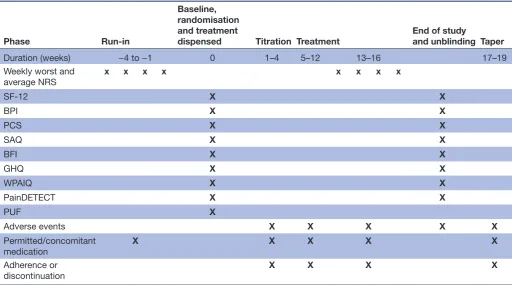
A questionnaire will be given to all participants before randomisation but after screening (baseline) and at 16 weeks postrandomisation (see table 2 for full schedule of assessments). This will include the following vali-dated tools:
► 12-Item Short-Form Health Survey (SF-12): a QoL measure.13
► Brief Pain Inventory (BPI)14: a tool to measure pain intensity and interference of pain in a patient’s life. ► Brief Fatigue Inventory (BFI).15
► GHQ16: to identify psychological distress.
► Work and Productivity Activity Impairment
Questionnaire (WPAIQ).17
► Pain Catastrophising Scale (PCS).18
► Sexual Activity Questionnaire (SAQ).19
► PainDETECT: to identify a neuropathic component to pain.20
► Pelvic Pain and Urinary/Frequency Patient Symptom Scale (PUF) (at baseline only).
The questionnaire at baseline will include questions to capture the baseline demographic and clinical char-acteristics of the participants.
Table 1 Dose escalation schedule for GaPP2
Day in study
Total number of capsules/day
(maximum) Dosing Maximum daily dose of gabapentin (mg)
1 1 One capsule night 300
2 1 One capsule night 300
3 1 One capsule night 300
4 2 One capsule two times a day 600
5 2 One capsule two times a day 600
6 2 One capsule two times a day 600
7 3 One capsule three times a day 900
8 3 One capsule three times a day 900
9 3 One capsule three times a day 900
10 4 One capsule two times+two capsules at night 1200
11 4 One capsule two times+two capsules at night 1200
12 4 One capsule two times+two capsules at night 1200
13 5 Two capsules two times+one capsule once 1500
14 5 Two capsules two times+one capsule once 1500
15 5 Two capsules two times+one capsule once 1500
16 6 Two capsules three times a day 1800
17 6 Two capsules three times a day 1800
18 6 Two capsules three times a day 1800
19 7 Two capsules two times+three capsules night 2100
20 7 Two capsules two times+three capsules night 2100
21 7 Two capsules two times+three capsules night 2100
22 8 Three capsules two times+two capsules once 2400
23 8 Three capsules two times+two capsules once 2400
24 8 Three capsules two times+two capsules once 2400
25 9 Three capsules three times a day 2700
26 9 Three capsules three times a day 2700
27 9 Three capsules three times a day 2700
28–112 Remain on maximum tolerated dose until the end of week 16 (not exceeding 2700 mg or nine capsules
per day). Daily dose should be divided equally into three doses.
GaPP2, Gabapentin for Pelvic Pain 2. on September 22, 2020 by guest. Protected by copyright.
All questionnaires will be anonymised and completed in private.
Adverse events
Participants will collect information about adverse events in their treatment diaries. However, they will be instructed to contact the clinical research team at any time after consenting to join the trial if they have an event that requires hospitalisation or an event that results in persistent or significant disability or incapacity. Any serious adverse events (SAEs) that occur after joining the trial will be reported in detail in the participant’s medical notes and followed up until resolution of the event. The assessment of seriousness, causality and expectedness will be conducted assuming that the participant received gabapentin, with the blinding not broken. All SAEs will be reported to the Academic and Clinical Central Office for Research and Development (ACCORD) Research Governance (http://www. accord. ed. ac. uk) and Quality Assurance Office based at the University of Edinburgh immediately or within 24 hours. ACCORD will onward report all SAEs to BCTU within 7 days.
Termination of study
Participants will be unblinded at the end of the study and if taking gabapentin will have the option to continue on treatment or will be tapered off treatment. Participants who have been on placebo will be given the choice to start on gabapentin, which will be prescribed by their clinician.
Participants will be given an emergency contact card to carry while participating in the study. The blinding code will only be broken in emergency situations for reasons of patient safety, where knowledge of the treatment adminis-tered is necessary for the treatment of a SAE. Participants whose randomisation codes are broken will cease treat-ment with the study drug, but will continue to be followed up. Participants may discontinue from the trial at any time at their own request, or they may be withdrawn at any time at the discretion of the research team for safety, behavioural or administrative reasons. Data collection is envisaged to be complete in September 2018.
sample size
We have based our sample size on being able to detect a minimally important difference (MID) in NRS scores with high levels of power. Studies have shown the MID in this population to be around 1 point on a 0–10 scale.21
Our pilot study showed worst and average pain scores to have SDs between 2.0 and 2.5. If the SD is at the lower end of these estimates, 86 patients in each group (172 in total) would be required to have 90% power (P=0.05) to detect a difference of 1 point. If the SD is at the higher end, we could detect the same difference with 80% power (P=0.05) with 100 patients in each group. We have assumed the latter SD (2.5) to be conservative. To account for any increase in the risk of type I error that may be asso-ciated with having coprimary outcome measures, we have Table 2 Schedule of outcome assessments for GaPP2
Phase Run-in
Baseline, randomisation and treatment
dispensed Titration Treatment End of study and unblinding Taper
Duration (weeks) −4 to −1 0 1–4 5–12 13–16 17–19
Weekly worst and
average NRS x x x x x x x x
SF-12 X X
BPI X X
PCS X X
SAQ X X
BFI X X
GHQ X X
WPAIQ X X
PainDETECT X X
PUF X
Adverse events X X X X X
Permitted/concomitant medication
X X X X X
Adherence or discontinuation
X X X X
BFI, Brief Fatigue Inventory; BPI, Brief Pain Inventory; GHQ, General Health Questionnaire; NRS, Numerical Rating Scale; PCS, Pain Catastrophising Scale; PUF, Pelvic Pain and Urinary/Frequency Patient Symptom Scale; SAQ, Sexual Activity Questionnaire; SF-12, 12-Item Short-Form Health Survey; WPAIQ, Work and Productivity Activity Impairment Questionnaire.
on September 22, 2020 by guest. Protected by copyright.
applied a Bonferroni correction (alpha reduced to 0.025 from 0.05), which increases the sample size to 120 per group. Furthermore, to account for an expected average 20% lost to follow up, we will randomise 150 per group, 300 patients in total.
Proposed analyses
Data analysis will be by intention to treat. Every attempt will be made to gather data on all women randomised, irrespective of compliance with the treatment protocol. Appropriate baseline characteristics, split by treatment group, will be presented for each outcome. Point esti-mates, 95% CIs and P values from two-sided tests will be reported.
Primary analysis
We will use a linear regression model to estimate differ-ences in worst and average NRS scores between the two treatment groups, including baseline score and the mini-misation variables as covariates. The P value from the associated χ2 test will be produced and used to
deter-mine statistical significance. A Bonferroni correction will be applied as there are two primary outcomes. Further analysis using a repeated measures (multilevel) model will also be performed incorporating all eight recorded scores.
Secondary analysis
Data from the other continuous measures (SF-12, BPI, PCS, SAQ, WPAIQ, BFI, PainDETECT and GHQ) will be analysed in a similar manner to the primary measure. Other outcome measures (use of permitted analgesic medication, satisfaction) will be analysed using standard methods (tests for trend, absolute/relative risks). Further analysis on pain scores will include an examination of the proportion of women that have a 30% and a 50% reduction in average and worst score from baseline as the outcome. A log-binomial regression model will be used here to generate adjusted relative risks. Subgroup anal-yses will be limited to the same variables that were used as minimisation variables. Tests for statistical heterogeneity (eg, by including treatment group by subgroup interac-tion parameter in the linear regression model) will be performed prior to any examination of effect estimate within subgroups. In addition, we will investigate up to nine clinical variables measured at baseline to determine whether they correlate with response to treatment. These will include the minimisation variables (the presence of dysmenorrhoea/psychological distress/current use of hormonal treatment) along with measures of inten-sity and of nature of pain (eg, PainDETECT), number of functional systems involved (as a measure of organ specific versus generalised pelvic pain syndrome) and PUF score.
Missing data and sensitivity analyses
Every attempt will be used to collect full follow-up data on all women. In particular, participants will continue to be followed up even after protocol treatment violation.
It is thus anticipated that missing data will be minimal. Patients with completely missing primary outcome data or with only one of four pain scores recorded will not be included in the primary analysis. Secondary sensitivity analyses will be performed to investigate the impact of missing data for the primary outcome: this will include a worst score assumption. We will also simulate missing responses using a multiple imputation approach.
research governance
We shall adopt the standard approach used for moni-toring RCTs and have a Trial Steering Committee (TSC) of at least four independent members, including pain specialist, a gynaecologist, trial methodologist and a Patient and Public Involvement (PPI) representa-tive. There will also be a Data Monitoring Committee (DMC) comprising three independent members (a pain specialist, a gynaecologist and a statistician with extensive trial experience) who will review interim anal-yses. The terms of reference and charter for this DMC will be guided by the DAMOCLES project, and we antic-ipate the DMC and TSC will meet biannually.
dIsCussIon
CPP is a major public health issue for women throughout the developed world.2 As with other chronic pain
condi-tions, it is associated with a marked reduction in QoL and significant financial costs for the woman, her family and society as a whole.4 5 When CPP is associated with
under-lying pathology such as endometriosis, therapies targeting the pathology can be initiated. However, in more than 50% of women, no underlying cause is identified.6 For
these women, not only is it difficult to comprehend and come to terms with how there can be no associated pathology,22 there are also no available evidence-based
treatments to consider.
The efficacy of a number of pharmacological and inter-ventional therapies has been investigated for other chronic pain syndromes. There is increasing evidence that women with CPP demonstrate central changes similar to those associated with other forms of chronic pain23 24 and thus it
is likely that such therapies would also be effective for CPP. Moreover, recent work demonstrates a neuropathic compo-nent in a significant proportion of women with CPP,25
further supporting the investigation of drugs currently recommended for neuropathic pain26 in women with CPP.
The multicentre placebo-controlled RCT described here aims to contribute to the evidence base by assessing the effi-cacy of gabapentin in women with CPP with no underlying pathology.9 This trial is designed in line with the Initiative
on Methods, Measurement, and Pain Assessment in Clinical Trials (IMMPACT) recommendations for the design of trials in chronic pain conditions21 27 28 and builds on a successful
pilot study.11 12 Women with CPP were surveyed to
iden-tify whether reduction in average or worst pain was most important to them. As there was no clear consensus (average 43.4%, worst 56.6%) coprimary outcomes of average and
on September 22, 2020 by guest. Protected by copyright.
worst pain scores have been chosen. We envisage the find-ings being of relevance to both primary and secondary care clinicians managing women with CPP.
Author affiliations
1Nuffield Department of Obstetrics and Gynaecology, University of Oxford, Oxford,
UK
2Pain Management Centre, The National Hospital for Neurology and Neurosurgery,
London, UK
3Institute of Applied Health Sciences, School of Medicine, Medical Sciences and
Nutrition, University of Aberdeen, Aberdeen, UK
4Pelvic Pain Support Network, Poole, UK
5Faculty of Medicine, University of Southampton, Southampton, UK 6Birmingham Clinical Trials Unit, University of Birmingham, Birmingham, UK 7Epidemiology Group, School of Medicine, Medical Sciences and Nutrition,
University of Aberdeen, Aberdeen, UK
8MRC Centre for Reproductive Health, Queen’s Medical Research Institute,
Edinburgh, UK
9Nuffield Department of Clinical Neurosciences, University of Oxford, Oxford, UK 10Research Department of Clinical, Educational and Health Psychology, University
College London, London, UK
Acknowledgements We gratefully acknowledge the other investigators that contributed to the design of the RCT: Jayna Holroyd-Leduc, Danielle Southern, Ward Flemons, Maeve O'Beirne, Michael Hill, Alan Forster and Deborah E White.
Contributors KV: research, contribution of original material, drafting, editing and approval of final manuscript; AWH, SB, RC, JD, LM, WS: research, contribution of original material, editing and approval of final manuscript; AB, IT, JB, YC, GJM, ACCW: contribution of original material, editing and approval of final manuscript.
Funding GaPP2 is funded by a grant from the NIHR/MRC Efficacy and Mechanism Evaluation (EME) Programme, Reference: 13/52/04.
Competing interests KV has received research funding from Pfizer Pharmaceuticals and Bayer HealthCare, honoraria from Bayer HealthCare and consultancy fees from Grünenthal GmbH. AWH receives grant funding from the NIHR and the Medical Research Council. AB has no competing issues as no direct funding from industry. AB is currently President of the British Pain Society. JB declares no competing interests. SB receives grant funding from NIHR and Chief Scientist Office Scotland. He has been a speaker at a number of conferences that have received funding from the pharmaceutical industry. His clinical colleagues receive industry support for travel and for Departmental Seminars. ACCW has received a consulting fee from Astellas. GJM is Chief Investigator of the British Society for Rheumatology (BSR) Biologics Register in Ankylosing Spondylitis. This is funded by the BSR who receive funds from Pfizer, AbbVie and UCB. YC receives grant funding from NIHR. RC has secured research funding from Allergan and is a member of Allergan’s scientific advisory panel. He also receives grant funding from the NIHR via UCL Biomedical Research Centre. IT is supported by grants from NIHR Oxford Biomedical Research Centre, Medical Research Council of Great Britain and Northern Ireland, the Wellcome Trust.
Patient consent Obtained.
Ethics approval Ethics approval has been obtained from the Coventry and Warwick Research Ethics Committee (REC 15/WM/0036).
Provenance and peer review Not commissioned; externally peer reviewed.
open Access This is an Open Access article distributed in accordance with the terms of the Creative Commons Attribution (CC BY 4.0) license, which permits others to distribute, remix, adapt and build upon this work, for commercial use, provided the original work is properly cited. See: http:// creativecommons. org/ licenses/ by/ 4. 0/
© Article author(s) (or their employer(s) unless otherwise stated in the text of the article) 2018. All rights reserved. No commercial use is permitted unless otherwise expressly granted.
rEFErEnCEs
1. Zondervan KT, Yudkin PL, Vessey MP, et al. Prevalence and incidence of chronic pelvic pain in primary care: evidence from
a national general practice database. Br J Obstet Gynaecol 1999;106:1149–55.
2. Latthe P, Latthe M, Say L, et al. WHO systematic review of prevalence of chronic pelvic pain: a neglected reproductive health morbidity. BMC Public Health 2006;6:177.
3. Donaldson L. 150 years of the Annual Report of the Chief Medical Officer: On the state of public health 2008. London: Department of Health, 2009.
4. Breivik H, Collett B, Ventafridda V, et al. Survey of chronic pain in Europe: prevalence, impact on daily life, and treatment. Eur J Pain 2006;10:287–333.
5. Ayorinde AA, Macfarlane GJ, Saraswat L, et al. Chronic Pelvic Pain in Women: An Epidemiological Perspective. Womens Health 2015;11:851–64.
6. Daniels JP, Khan KS. Chronic pelvic pain in women. BMJ 2010;341:c4834.
7. Cheong Y, William Stones R. Chronic pelvic pain: aetiology and therapy. Best Pract Res Clin Obstet Gynaecol 2006;20:695–711. 8. Wiffen PJ, Derry S, Moore RA, et al. Antiepileptic drugs for
neuropathic pain and fibromyalgia - an overview of Cochrane reviews. Cochrane Database Syst Rev 2013;11:CD010567. 9. Horne AW, Vincent K, Cregg R, et al. Is gabapentin effective
for women with unexplained chronic pelvic pain? BMJ 2017;358:j3520.
10. Sator-Katzenschlager SM, Scharbert G, Kress HG, et al. Chronic pelvic pain treated with gabapentin and amitriptyline: a randomized controlled pilot study. Wien Klin Wochenschr 2005;117:761–8. 11. Horne AW, Critchley HO, Doust A, et al. GaPP: a pilot randomised
controlled trial of the efficacy of action of gabapentin for the management of chronic pelvic pain in women: study protocol. BMJ Open 2012;2:e001297.
12. Lewis SC, Bhattacharya S, Wu O, et al. Gabapentin for the Management of Chronic Pelvic Pain in Women (GaPP1): A Pilot Randomised Controlled Trial. PLoS One 2016;11:e0153037. 13. Ware J, Kosinski M, Keller SD. A 12-Item Short-Form Health Survey:
construction of scales and preliminary tests of reliability and validity. Med Care 1996;34:220–33.
14. Cleeland CS, Ryan KM. Pain assessment: global use of the Brief Pain Inventory. Ann Acad Med Singapore 1994;23:129–38.
15. Mendoza TR, Wang XS, Cleeland CS, et al. The rapid assessment of fatigue severity in cancer patients: use of the Brief Fatigue Inventory. Cancer 1999;85:1186–96.
16. Goldberg DP. Manual of the General Health Questionnaire. Windsor, England: NFER Publishing, 1978.
17. Reilly MC, Zbrozek AS, Dukes EM. The validity and reproducibility of a work productivity and activity impairment instrument. Pharmacoeconomics 1993;4:353–65.
18. Sullivan MJL, Bishop SR, Pivik J. The Pain Catastrophizing Scale: Development and validation. Psychol Assess 1995;7:524–32. 19. Thirlaway K, Fallowfield L, Cuzick J. The Sexual Activity
Questionnaire: a measure of women’s sexual functioning. Qual Life Res 1996;5:81–90.
20. Freynhagen R, Baron R, Gockel U, et al. painDETECT: a new screening questionnaire to identify neuropathic components in patients with back pain. Curr Med Res Opin 2006;22:1911–20. 21. Dworkin RH, Turk DC, Wyrwich KW, et al. Interpreting the clinical
importance of treatment outcomes in chronic pain clinical trials: IMMPACT recommendations. J Pain 2008;9:105–21.
22. Grace VM. Problems women patients experience in the medical encounter for chronic pelvic pain: a New Zealand study. Health Care Women Int 1995;16:509–19.
23. Brawn J, Morotti M, Zondervan KT, et al. Central changes associated with chronic pelvic pain and endometriosis. Hum Reprod Update 2014;20:737–47.
24. Kaya S, Hermans L, Willems T, et al. Central sensitization in urogynecological chronic pelvic pain: a systematic literature review. Pain Physician 2013;16:291–308.
25. Whitaker LH, Reid J, Choa A, et al. An Exploratory Study into Objective and Reported Characteristics of Neuropathic Pain in Women with Chronic Pelvic Pain. PLoS One 2016;11:e0151950. 26. Neuropathic pain in adults: pharmacological management in
non-specialist settings NICE Clinical Guideline. BMJ 2013;340:707–9. 27. Dworkin RH, Turk DC, Farrar JT, et al. Core outcome measures
for chronic pain clinical trials: IMMPACT recommendations. Pain 2005;113:9–19.
28. Dworkin RH, Turk DC, Peirce-Sandner S, et al. Research design considerations for confirmatory chronic pain clinical trials: IMMPACT recommendations. Pain 2010;149:177–93.
on September 22, 2020 by guest. Protected by copyright.