Review on Superconducting Fault Current Limiter
Pravin S. Chaudhari, Prabhod kumar Khampariya
SSSIST, Sehore, Madhya Pradesh, India
Abstract- In this paper, different current limiting
techniques are explained which are used to
suppress the excess magnitude of fault current
during fault. A various types of fault Current
limiters (FCL) are used to suppress fault current
and hence saving in the investment of high
capacity circuit breakers. It uses variety of new
techniques for limiting excess fault current. The
focus is on superconducting technologies i.e.
Superconducting Fault Current Limiters
(SFCL). The various types of superconducting
fault current limiters are explained with their
advantages, disadvantages and applications. This
paper reviews, various concepts related to
superconducting fault current limiters and
present research and developments in SFCL. At
present, SFCLs are not commercially available
in electrical power market but, present research
and some successful field trials shows that it will
be available for commercial applications soon.
Keywords- Fault current Limiter, Transition,
Superconducting Fault current Limiter.
I.INTRODUCTION
Now adays there is dramatic growth in power system
and interconnected networks. This growth is
expected to continue in future. When there is
occurrence of an accidental events like lightning or
downed power lines, a large amount of power
flows through the grid which results in a failure of
the electric system. These faults can generate surge
currents more than one hundred times the normal
operating current, hence damage the expensive
grid-connected equipments. Therefore protection of the
system is an important consideration to avoid harm
to the system parameters and system equipments
from large amount of current during fault [1] [3]. A
Fault Current Limiter (FCL) is a device which limits
the short circuit current during fault in a power
transmission network. Fault current limiters (FCL)
provides an effective way to suppress fault current
and result in considerable saving in the investment
of high capacity circuit breakers. A various types of
fault current limiters uses variety of new techniques
for limiting excess fault current [4]. However focus
is on superconducting technologies i.e.
Superconducting Fault current Limiters (SFCL).
Whereas non-superconducting technologies contain
devices like simple inductors or variable resistors are
also known as Fault Current Controllers. Due to the
rapid growth in the power generation systems there
is a growth in fault current level, which may cross
the rated capacity of available circuit breaker.
Replacement of this existing switchgears due to
increased fault level will not be the feasible option
by considering cost parameter. By considering all
these parameters it is necessary to use some reliable
means to minimize fault current level and hence
allow the circuit breaker to operate at lower fault
Currents. Superconducting Fault current Limiters
provides an effective way to suppress fault current
[3], [6]. current limiting behavior of these
superconductors depends on their non-linear
characteristics with Temperature, current and
one of these three parameters can cause transition of
superconducting state to normal state. As per the
development of superconducting materials SFCLs
are of three types [3],
Low Temperature SFCL
High Temperature SFCL
Superconducting Film Type SFCL
Recently there is a significant progress in
Research and Development of SFCL [3]. This
paper reviews different SFCL concepts,
classification and their performance comparison.
Also, it highlights the technological R & D status
of SFCL.
II. CONVENTIONAL METHODS TO LIMIT
FAULT CURRENT
Growth in power system and interconnected
network causes increase in level of fault current.
This increased fault current results in adverse effect
on power system equipments. Such as,
• Increase in dynamic influence of current • Increase in thermal influence
• Capability of circuit breaker to interrupt current
may exceed [3].
Therefore it is necessary to minimize this level of
fault current. Power system operators can use
different techniques to minimize fault current level.
III. TECHNOLOGIES
A. Non-Superconducting:- Fault Current Limiters
that do not depend on Superconducting materials to
perform the current limiting action. It contains
current limiting fuses, solid-state devices & many
other[3].
B. Superconducting:- Fault current Limiters that
depend on Superconducting material to perform the
current limiting action. More specifically, the current
limiting behavior depends on the non-linear
characteristics of superconductors with temperature,
current and magnetic field variations. If we increase
any one of these parameters can cause transition
from superconducting to normal state[3]
IV. CLASSIFICATION AND COMPARISION
4.1 Classification
4.1.1 Resistive type SFCL
A generic configuration of a resistive-type SFCL is
provided in figure 1. The figure includes HTS
elements (superconducting part) in a vacuum
insulated vessel filled with coolant (usually liquid
nitrogen, LN2), a pair of current leads (to connect
HTS elements at cryogenic temperature to room
temperature bushings), and a cooling system. The
HTS elements are inserted in series with the line
being protected. During a fault, the critical current
(IC) is surpassed and their resistance increases
rapidly, leading to quenching of HTS elements
before the first peak of short-circuit current is
reached. In 50 or 60 Hz AC systems, HTS elements
quench within 1-2 ms after initiation of a fault,
depending on the ratio of prospective fault current to
normal current. Dimensions of the bushings and
cryostat are substantial for achieving adequate
voltage standoffs, particularly at the transmission
voltage levels [5].
Prototype FCL concepts have been built and tested
with varying degrees of success. Resistive SFCL
works with the concept of zero resistance under
normal operating conditions i.e. current is below a
critical value IC and temperature below a critical
value TC. Under fault conditions, when the current
exceeds IC, the resistance of superconductor
significantly increases due to quenching and this
S-N transitions then acts like a limiter switch [6]. This
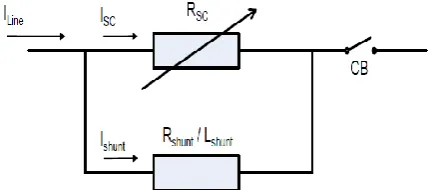
version of the SFCL utilizes a resistor in parallel
with the superconducting material that protects the
superconductor from hotspots that may develop
during the quench, as well as avoiding over voltages.
Resistive SFCLs are considered fail safe and can be
built to exhibit negligible impedance during normal
system operation. A recovery time is however
required following a quench, which can range from
one second to one minute, depending on the
superconducting material employed. One of the
disadvantages is that there is energy loss in the
current leads coming from room temperature to
cryogenic temperature. According to [7], this will
result in approximately 40-50 W/kA heat loss per
current lead at cold temperature. This would equate
to a maximum operating loss of approximately
80kW for a three phase SFCL operating in series
with a 10MW generator connected at 11kV.From the
point of view of power systems, the resistive SFCL
is preferable because it increases the decay speed of
the fault current by reducing the time constant of the
decay component of the fault currents, and can also
make system less inductive [8]. Advantages: Smaller
and lighter than inductive SFCL. Disadvantages:
Energy Loss
4.1.2 Inductive type SFCL [9]
Inductive SFCLs come in many designs; the
simplest design is a transformer with a closed
superconducting ring as the secondary. In unfaulted
operation, there is no resistance in the secondary
and so the inductance of the device is low. The
inductive limiter can be modeled as a transformer
(Figure 2).
Figure 2: Inductive type SFCL
The impedance of this limiter in the steady state is
nearly zero, since the zero impedance of the
secondary (HTS) winding is reflected to the
primary. In the event of a fault, the large current in
the circuit induces a large current in the secondary
winding cause’s loss of superconductivity. The
resistance in the secondary is reflected into the
primary circuit and limits the fault. The advantage
of this design is that there is no heat ingress through
current leads into the superconductor, and so the
cryogenic power load may be lower. However, a
large amount of iron is required and hence inductive
SFCLs are much bigger and heavier than resistive
SFCLs [9].
4.1.3 Inductive FCL with Shielded-Core
Figure 3: Shielded iron core SFCL [6]
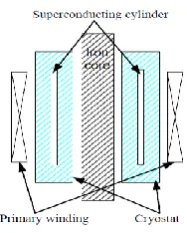
One of the first SFCL designs developed for grid
deployment was the shielded-core design. Figure 4
which is made up of a primary winding around an
iron core with a superconducting cylinder in
between. This SFCL is also called an inductive
SFCL because its structure is similar to a
transformer with a short circuit secondary winding.
During normal operation, the current in the
superconducting cylinder is lower than its critical
current and it screens all the flux from the iron core.
The impedance of the device, which consists of the
resistance of the primary winding and the stray
inductance, is very low. In the event of a fault, the
current in the superconducting cylinder exceeds the
critical current and the cylinder starts to develop a
resistance. The magnetic flux penetrates into the
iron core, so the inductance of the primary winding
increases. The equivalent impedance of the device
becomes the inductance of the primary winding and
the referred cylinder resistance to the primary in
parallel
Figure 4: Shielded-Core SFCL Concept [6]
According to [10], shielded iron core FCLs have the
following advantages: no current leads are needed,
and since the number of turns of the secondary
winding can be much smaller than the primary
turns, only short superconductors are needed and the
voltage drop in the cryogenic part of the device is
very low. However, their main drawbacks are their
relatively large volume and high weight.
4.1.4 Inductive FCL with Saturated Iron Core
Unlike resistive and shielded-core SFCLs, which
rely on quenching of superconductors to achieve
increased impedance, saturable core SFCLs utilize
the dynamic behavior of the magnetic properties of
iron to change the inductive reactance on the AC
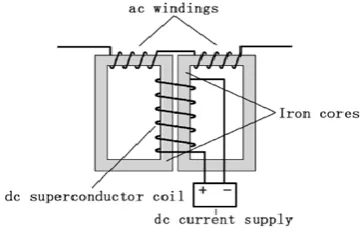
line [9]. The saturated iron - core concept utilizes
two iron cores per phase as shown in Figure 5. A
conventional copper coil could be used to saturate
the cores during normal operation. However, in
order to reduce I 2 R losses in the copper coil and to
make the device acceptable to the users, developers
have opted to use a superconducting coil for
saturating the core. The most attractive feature of
this FCL is simplicity and a fail - safe mode of
operation. Faults of long durations can be handled
and recovery from a fault is instantaneous, enabling
the device to handle multiple successive faults in
rapid succession, such as auto - recloses on a
protected line or circuit breakers with existing
reclosing logic. Explained below is the principle of
operation [11]. During normal operation, large
ampere - turns created with DC in the secondary
superconducting HTS coil drive the core into
saturation. This lowers impedance of the copper coil
in the primary AC side near to that of an air - core
coil. During a fault, a large fault current
demagnetizes the core and drives it from the
saturated to unsaturated state (Linear B – H region).
Figure 5: Inductive FCL concept with saturated iron
Figure 6: Saturable-Core superconducting fault
current limiter [12]
This increases the primary AC coil impedance. The
increased impedance limits the fault current to the
desired level. Since an AC wave has both positive
and negative peaks to magnetize the iron core, it
becomes necessary to employ two separate cores for
each phase. Each core has a normal (copper) coil in
series with the line being protected. One core works
with the positive peak of the AC and the other with
the negative peak. A three - phase arrangement of
this concept is shown in Figure 5 , which has six
primary copper coils (two for each phase) and a
common secondary DC HTS coil for saturating all
cores simultaneously. This device, installed in the
Avanti Circuit of Southern California Edison in
March 2009, became the first SFCL to operate in a
US utility system. Abbott [13] has described
operation of such a limiter. A major drawback of
saturable-core SFCL technology is the volume and
weight associated with the heavy iron core;
however, manufacturers hope to improve this issue
in future prototypes. Zenergy has recently tested a
prototype saturable core SFCL based on an entirely
new design concept that is four times smaller than
its predecessor. Grid ON, an Israeli-based startup
company, is in the process of developing
saturable-core concept intent on reducing size and weight to
more accommodating levels for commercial use
[12]. Advantages: No heat ingress. Disadvantage:
Large amount of iron is required, bigger in size
hence heavier.
4.1.5 DC biased iron core type SFCL
In this type of construction contains two iron-core
coils, which goes into saturation when DC-biased
current is introduced under normal condition. These
two cores are placed in series path of fault. When
these two cores are operating in saturation mode
there inductances are low. When there is occurrence
of fault these coils come out of saturation and the
coil inductance increases rapidly [18]. Advantages:
Requires less superconductor material, small
cryognic cooling system required. Disadvantages:
Bulky due to use of iron core.
4.1.6 Resistive Magnetic type SFCL
This type of SFCL works on a principle of parallel
inductance. While making setup for this type of
SFCL, normal conducting coil is placed outside a
superconducting tube [18].
4.1.7 The Bridge SFCL [15]
The concept of bridge-type SFCL by the LANL and
the U.S. power company Westinghouse in 1983
made. The limiter works is not based on
superconducting materials from the superconducting
state to normal state transition, but to use a
superconducting material in the DC state of
unimpeded carrier characteristics. This SFCL
employs solid state technology to control the flow
of current through a superconducting inductance.
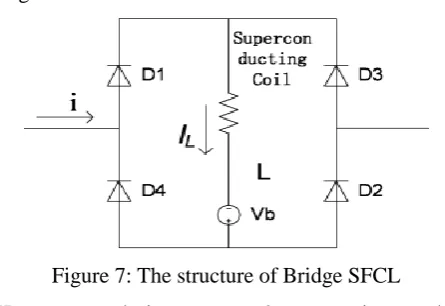
Figure 7 for the bridge type SFCL single-phase
circuit. It consists of diode bridge D1-D4, the
superconducting coil L and the composition bias
supply Vb, Vb for the superconducting coil to
provide bias current IL. In a failed state, when i
amplitude increased to I0 when i was a half weeks
the negative half weeks in the Dl and D2 is not
conducting, superconducting coils in series on the
line is automatically , fault current was limited by a
large inductance L.
Figure 7: The structure of Bridge SFCL
However, during normal operation, the
superconducting coil current amplitude by more
than the DC circuit, so by the introduction of low
loss current leads large. It also needs the power
diode bridge and the bias power, the system is more
complex [16]. The inductor does not have to be
made of superconducting material, but
superconducting material can be used to minimize
the losses. In addition, during normal conditions,
the inductor only carries DC current, which makes a
superconductor an ideal choice. Thyristors can be
used to replace the diodes, so it is possible for them
to turn off the current at the next current
zero-crossing after a fault occurs. Advantages: No AC
losses in the superconducting coil because it is
operating with DC current. Fast recovery after the
fault clears because the coil remains in the
superconducting state during the fault. The trigger
current level can be adjusted by the DC current
source. Does not require a room
temperature/cryogenic interface in the power line.
Disadvantages [17]: AC losses in the
semiconductors are relatively high. No fail safe
mechanism. If one of the semiconductors fails and
creates a short circuit, the SFCL cannot limit the
fault current.
4.1.8 Magnetic fault current limiter (MFCL)
It uses laminated iron-core with demagnetized
magnet in air gap. At normal condition reactance is
low. During fault, due to the high magnitude of fault
current, magnet gets magnetized and reactance of
MFCL increases [19].
4.1.9 Fault current controller type SFCL [19]
Some power electronic components have ability to
interrupt the current. By using this property and
ability to adjust trigger level, fault current can be
controlled completely. Therefore these SFCLs offer
adjustable trigger current and complete fault current
interruption, hence named fault current controller.
4.1.10 Interphase power controllers (IPC)
It contains two parallel phase shifting transformer
and series combination of reactors and capacitors
are connected in each parallel branch [18].
Disadvantages: High capital investment required.
4.2 FCL Comparison criteria given as:
1. Normal Operation
2. Operation During the fault limiting action
3. Recovery period.
4.3 Criteria of SFCL Performance comparison
1. Quench Recovery: Quench recovery is depends
upon, Superconducting material, heat emission
condition, refrigeration capability.
2. Working Current: It is the value of critical line
current which causes SFCL to transit from zero
impedance to high impedance state.
3. Equivalent Fundamental Frequency impedance:
It is the ratio of fundamental frequency
component through it. Denoted by Zeq.
4. Response time: This is one of the important
performance. Shorter response time is better.
Response time is equal to quench time
5. Losses: The electrical losses due to AC
currents.
6. Steady-State Impedance: The impedance under
normal operating conditions.
7. Triggering: It is the method of initiation of fault
response. Active FCLs uses sensors and control
schemes to trigger whereas Passive FCLs
respond to faults through changes in material
properties associated with increased current or
magnetic field
8. Recovery: It is the time required for FCL to
come to its original state after limiting action.
9. Size/Weight: It should be compact.
10.Distortion: Related with the uneven shape of the
AC current waveform [3].
V CONCLUSION
Utilities always look for ways to get more out of
their existing equipment. The HTS FCLs present an
option to rein in the fault current levels to within the
capability of existing equipment. To help address
these problems, with R & D funding from the US
Department of Energy, equipment manufacturers,
electric utilities, and researchers from private
industry, universities, and national laboratories are
teaming up to spur innovation and development of
new technologies, tools, and techniques. Because of
these efforts, the future electric grid will likely
incorporate technologies very different from those
that have been traditionally employed. The S FCL is
one of these technologies, and the first units are
already being deployed commercially.
Manufacturers and users are already working on
developing standards for FCLs under IEEE. With
the use of 2G HTS, SFCLs have to compete with
the conventional breakers in cost, size, long
operation feasibility and cryogenic reliability. The
most compact SFCL at distribution voltage levels
are viable in the near future. Some projects have
already started recently to develop SFCL prototypes
for transmission voltage levels. To commercialize
SFCLs, it is essential to further improve their
properties (e.g. superconductor AC loss) and
reliable, compact and low-cost cryocoolers. There
are many possible locations in power systems where
FCLs installation offers technical and economical
benefits. The bus-tie position appears to be the most
economical option among other alternatives.
REFERENCES
[1]. D. Pham, Y. Laumond, “Towards the
superconducting fault current limiter,” IEEE
Trans. Power Del., Vol. 6, pp. 801– 808,
Apr.1991.
[2]. M. Noe, B. R. Oswald, “Technical and
Economical Benefits of superconducting
fault current limiters in power systems”, IEEE
Trans. Applied super Cond. Vol.9,no.2,June
1999
[3]. Yu Jiang, Shi Dongyuan, Duan Xianzhong,
“Comparison of Superconducting Fault Current Limiter in Power System”.2001.
[4]. Electric Power Research Institute:
Superconducting Fault Current Limiters:
Technology Watch 2009, 1017793, Technical
Update, December 2009.
[5]. Swarn Singh Kalsi, “Fault Current Limiters”,
in Applied Superconductivity: Handbook on
Devices and Applications, Paul Siedel(Ed),
Wiley VCH, pp. 632, 2005.
[6]. Mathias Noe and Michael Steurer, “High
Temperature Superconductor Fault Current
Development Status” Super Cond. Sci.
Technol. Vol. 20, R15, 2007
[7]. AREVA T&D Research & Technology Center;
Buker HTS GmbH: “Inductive and Resistive
HTS Fault Current Limiters: Prototyping,
Testing, Comparing”, 2009.
[8]. P. G. Slade, et al, "The Utility Requirements
for A Distribution Fault Current Limiters",
IEEE Transactions on Power Delivery, Vol. 7,
No. 2, 507-515, April 1992.
[9]. V.V. Rao and Soumen Kar, “Superconducting
Fault Current Limiters - A Review”, Indian
Journal of Cryogenics, Vol. 36, No. 1-4,
pp.14-25, 2011.
[10]. BERR, Department for Business Enterprise
and Regulatory Reform: Application of Fault
Current Limiters contract no.: DG /DTI /00077
/06 /REP, 2007.
[11]. Swarn S. Kalsi. (8 April 2011). Applications of
High Temperature Superconductors to Electric
Power Equipment, A JOHN WILEY & SONS,
Inc., Hoboken, New Jersey.
[12]. S. Eckroad, "Survey of Fault Current Limiter
(FCL) Technologies," Electric Power Research
Institute (EPRI), 1017793, 2009.
[13]. S. B. Abbott , D. A. Robinson , S. Perera , F.
A. Darmann , C. J. Hawley , and T. P. Beales ,
“ Simulation of HTS Saturable Core - Type FCLs for MV Distribution Systems , ” IEEE
Trans. Power Delivery 21 ( 2 ): 1013 , 2006
[14]. S. Elschner, F. Breuer, H. Walter, and J. Bock,
"Magnetic Field Assisted Quench Propagation
as a New Concept for Resistive Current
Limiting Devices," in 7th European
Conference on Applied Superconductivity,
Vienna, Austria, 2006.
[15]. Linmang Wang, Pengzan Jiang, Dada Wan.
(2012) Summary of Superconducting Fault
Current Limiter Technology in Sabo Sambath
ana EguiZhu. Frontiers in computer education,
(Eds.). Published: Berlin; New York: Springer,
cop., Pp.819, 2012.
[16]. Zhang. Z., “The Research of Bridge Type High
Temperature Superconductivity Current
Limiter,” Chinese Academy of Science
Postdoctoral Work Report, 2006.
[17]. Xiaoze Pei, “Superconducting Fault Current
Limiter with Integrated Vacuum Interrupter,”
PhD Thesis, University of Manchester, United
Kingdom, 2012.
[18]. Indian journal of cryogenics, Super Cond. And
low temp. Physics, Oct.2010.
[19]. J. Bock, A. Hobl, “Superconducting fault
current Limiters-A new device for future smart
grids”, International conf. on Electricity
Distribution, Sept.2012
[20]. T. Ackermann, G. Anderson, L. Söder,
“Distributed generation: a definition,” Electric
Power Systems Research, 57, 195–204 (2001).
[21]. Y. G. Hegazy, M. M. A. Salama, and A. Y.
Chikhani, “Adequacy Assessment of
Distributed Generation Systems using Monte
Carlo Simulation,” IEEE Trans. Power Syst.,
vol. 18, no. 1, pp. 48–52, Feb. 2003.
[22]. Dugan R.C., McDermott T.E. and G.J. Ball,
“Planning for Distributed Generation", IEEE
Industrial Application Magazine, Vol. 7, pp.
![Figure 4: Shielded-Core SFCL Concept [6]](https://thumb-us.123doks.com/thumbv2/123dok_us/514382.2050912/4.595.348.509.576.686/figure-shielded-core-sfcl-concept.webp)