A Framework for a Computer System to
Support Distributed Cooperative Learning
CHIUNG-HUI CHIU AND CHIH-CHAO HSU
National Tainan Teachers College, Taiwan, Republic of China
To develop a computer system to support cooperative learning among distributed students; developers should consider the foundations of cooperative learning. This article examines the basic elements that make cooperation work and proposes a framework for such computer supported cooperative learning (CSCL) systems. This framework consists of five main components to support cooperative group structures, tive task structures, cooperative incentive structures, coopera-tive space structures, and individual accountability structures. To further guarantee successful cooperative learning, the mechanics to teach or reinforce appropriate cooperative skills should be added. This article provides concrete guidelines to the developers of CSCL systems.
Shaped by Vygotsky’s theory (Vygotsky, 1978, 1981) as well as situated cognition (Brown, Collins, & Duguid, 1989; Lave & Wenger, 1991), stressing the social dimension of the construction of knowledge, many effective approaches have been developed to exploit the potential of social interac-tion for enhancing learning and performance in school. Cooperative learning has been one of the most recommended methods. It is the instructional use of small groups so that students can work together to maximize their own and each others’ learning (Johnson, Johnson, & Smith, 1991a; Johnson, Johnson, & Smith, 1991b). With the exponential growth of the Internet, such cooperative learning can be activated among students not necessarily in the
same room or at the same time. They can cooperate with any geographically separated person whenever they like. The attributes of time- and place-independent communications make group interaction and cooperation in this medium distinctive. Many educators have shown enthusiasm for distributed cooperative learning (Harasim, 1994). Although cooperative learning on the Internet has been experimental and not practicable in school education thus far, it is foreseeable that this will gradually become practical and even widespread in education once the supporting systems are mature and widely available. Many have been devoted to the development of such computer supported cooperative learning (CSCL) systems. However, numbers of developers claim their systems support “cooperative learning,” but only collaboration—not cooperative learning. This makes developing a frame-work for a CSCL system desirable because an incorrect design can lead to an unhelpful system and the development time expended would be wasted. This article proposes a concrete framework for CSCL systems. To under-stand what the framework for a CSCL system should incorporate, the basics that make cooperative learning work are examined first.
ESSENTIALS OF COOPERATIVE LEARNING
For several years, many studies have attempted to measure and understand the effects of cooperative learning. This research has extensively shown the effects on student achievement, attitudes, self-esteem, inter-group relations, acceptance of academically handicapped students, and the ability to work collaboratively (Johnson & Johnson, 1989; Johnson & Johnson, 1994; Slavin, 1991b). Johnson and Johnson (1989) analyzed high-quality studies selected from 375 studies conducted over the past ninety years and found that cooperative learning tends to promote higher achievement and more positive attitudes toward the subject area, instructional experience, and continuing motivation to learn more for all age levels, all subject areas, and a variety of tasks.
the cooperative group in one study. Tateyama-Sniezek (1990) reviewed 12 studies comparing cooperative learning to individual instruction and found only 6 reported significant results favoring cooperative learning. Not all forms of collaborative learning appear equally effective for all goals. This discrepancy led researchers to seek conditions under which collaborative learning appears to be effective. A wide range of conditions or independent variables have been studied. These conditions can be clustered into four categories, including positive interdependence, face-to-face interaction, individual accountability and cooperative skills. Many researchers regard these four as essential elements of cooperative learning (Johnson & Johnson, 1989; Johnson, Johnson, & Holubec, 1993; Johnson, Johnson, Holubec, & Roy, 1984).
Positive Interdependence
Positive interdependence is the heart of cooperative learning (Johnson & Johnson, 1989, 1992a, 1992b). Positive interdependence is the perception that one is linked with others in a way that one cannot succeed unless the group succeeds (Johnson & Johnson, 1992a), that is, the awareness that they sink or swim together. This promotes a situation in which students work together in small groups to maximize the learning of all members, sharing their resources, providing mutual support, and celebrating their joint success.
combine member resources to achieve its goal. If group members are assigned complementary and interconnected roles (such as reader, checker, encourager, and elaborator; or astronomer, meteorologist, historian, and geologist), and labor is divided among group members, a group member cannot complete the group task except through other members fulfilling their responsibilities. Thus shared resources, complementary roles, and divided tasks lead individuals to recognize that the accomplishment of group members is mutual (Johnson & Johnson, 1992a). Group identity would define the interests, values and nature of the group and unite the group members. Group identity can be established through a group name, symbol, or meeting area (Brush, 1998; Johnson & Johnson, 1991), or by constructing a competi-tive environment among groups (Aronson & Patnoe, 1997; Johnson & Johnson, 1991; Miller & Harrington, 1992; Slavin, 1995).
Face-To-Face Interaction
In a cooperative learning situation, group members work together to achieve some goals, complete assignments, and promote one another’s success. Members are expected to meet face-to-face to provide one another with efficient and effective help and assistance, exchange needed information or materials, discuss the concepts and strategies being learned, decide how to solve problems, and encourage and support one another’s efforts to learn (Johnson & Johnson, 1992a; Johnson & Johnson, 1994). Face-to-face interaction will not only avoid ambiguity and promote richness in communi-cation, but also help build personal relationships (Johnson & Johnson, 1994; Graves & Graves, 1985).
Individual Accountability
Individual accountability means that students must be held individually responsible and accountable for doing their share of the work and for mastering the targeted content and skills (Aronson & Patnoe, 1997; Brush, 1997; Slavin, 1995). Researchers generally agree that individual accountabili-ty is essential if cooperative learning is to increase achievement (Watson, 1992). If individual accountability is structured into cooperative learning activities, it will ensure that group members know who needs more assis-tance, support, and encouragement, and know that they cannot “hitch-hike” on the work of others (Johnson & Johnson, 1994). Cooperative learning will then have its greatest effects as Slavin (1983) pointed out after reviewing cooperative learning research.
Common ways to incorporate individual accountability into cooperative learning include arranging for group members to have exclusive roles and look into whether students function properly; having members perform unique tasks in order to complete an overall group project and evaluating students based on unique tasks (Slavin, 1983); giving individual exams to each member or a randomly selected member and holding the group account-able for the results (Aronson & Patnoe, 1997; Johnson & Johnson; 1975; Slavin, 1995); or determining individual grades based on peer evaluations of all group members (Slavin, 1995).
Cooperative Skills
Many students have never worked cooperatively in learning situations and lack the needed interactive skills. Merely placing students in groups and expecting them to cooperate does not mean that students will automatically use these skills. As Johnson and Johnson (1991) stated, “students who have never been taught how to work effectively with others can not be expected to do so.” Theorists and researchers (such as Brush, 1998; Johnson & Johnson, 1994; Slavin, 1995) suggested that these skills have to be taught just as purposefully and precisely as academic skills. Teachers may need to show these expected skills to students and provide opportuni-ties for students to practice them prior to starting cooperative learning activities (Aronson & Patnoe, 1997; Sharan & Sharan, 1992). During the cooperative learning activities, prompts could be given to remind students to use cooperative skills (Kagan, 1985; Sherman & Klein, 1995; Slavin, 1995). Teachers may give bonus points or feedback to individual students or cooperative groups if students practice the targeted skills (Johnson & Johnson, 1990, 1991). Another strategy is to have students reflect on their use of cooperative skills after a cooperative work period (Aronson & Patnoe, 1997; Johnson & Johnson, 1994; Sharan & Sharan, 1992). Teachers may have group members discuss what member actions are helpful and unhelpful and make decisions about what to continue or change. An alternative approach is to have members individually respond to a checklist for cooperative skills usage (Aronson & Patnoe, 1997). Such reflection will enable learning groups to focus on group maintenance, facilitate the learning of cooperative skills, ensure that students receive feedback on their participation, and reinforce the consistent practice of cooperative skills (Johnson & Johnson, 1994). In addition, Johnson and Johnson (1990, 1991) suggested that an individual or group award be used to reinforce skills usage.
FRAMEWORK OF CSCL SYSTEMS
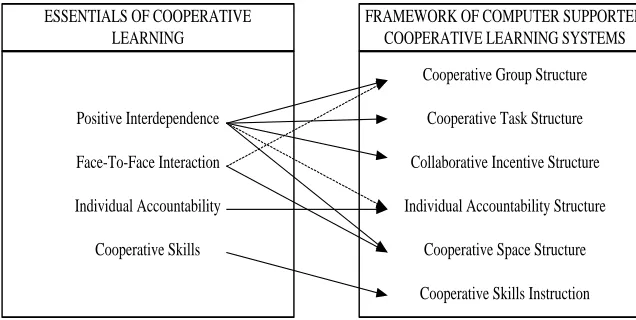
Internet technology certainly does not incorporate any inherent cooperative learning elements. To make use of the Internet to support a cooperative learning activity among distributed students; a special computer system built on the Internet is required. In addition, this system must incorporate the four essentials of cooperative learning into its design. However, these elements, such as positive interdependence, are too vague to be directly converted into a system design for most developers. After the experience of developing a CSCL prototype system, these four elements are decomposed into the following more concrete components: cooperative group structure, cooperative task structure, cooperative incentive structure, individual accountability structure, cooperative space structure, and cooperative skills instruction. Figure 1 represents the relationship between the components of CSCL systems and the essential elements of traditional cooperative learning.
Figure 1. Relationship between components of CSCL system and elements of cooperative learning
Cooperative Group Structure
The first thing teachers have in mind to implement cooperative learning is having students work in small groups. How to support a cooperative group structure is an important consideration for developing a CSCL system. Cooperative group structure involves the size, the composition, and the period of activity for the learning groups.
ESSENTIALS OF COOPERATIVE LEARNING
Positive Interdependence
Face-To-Face Interaction
Individual Accountability
Cooperative Skills
FRAMEWORK OF COMPUTER SUPPORTED COOPERATIVE LEARNING SYSTEMS
Cooperative Group Structure
Cooperative Task Structure
Collaborative Incentive Structure
Individual Accountability Structure
Cooperative Space Structure
Small groups seem to function better because the members can interact more intimately and become cohesive. In a large group, some members tend to “sleep” or become excluded from the interactions (Mulryan, 1992; Salomon & Globerson; 1989). Harasim and Riel (Harasim, 1993; Riel & Harasim, 1994) suggested three to five persons as the preferred group size for a network mediated activity. Seven to fifteen groups are appropriate since the aggrega-tion is then big enough to provide a variety in thought and approach.
The composite members of a group should be heterogeneous in age, gender, race, intelligence, development, performance, attitude, and leadership (Riel & Levin, 1990; Watson & Marshall, 1995). If the members are grouped from distant locations, satisfying this condition will usually not be a problem. To assist in the establishment of interdependency, specific roles can be designed and designated to group members. In addition, a unique name or symbol can be given to a group to create the feeling of a group identity and further interdependence (Brush, 1998; Johnson & Johnson, 1991).
It is usually recommended that groups should be reorganized and roles for group members be reassigned after an activity has been completed (Brush, 1998). This would provide each student with the opportunity to cooperate with diverse persons and perform different roles. However, it should be noted that many of the positive affective, social skills, attitudes, and academic benefits of cooperative learning tend to emerge and are retained only after students have spent four or more weeks together in the same heterogeneous group.
role. This can be achieved if the system traces student role status through-out the activities.
Cooperative Task Structure
Classroom cooperative learning always includes a cooperative task structure (Slavin, 1986). The cooperative task structure is a way to establish positive interdependency (Aronson & Patnoe, 1997). Cooperative task structures are situations in which two or more students are allowed, required, or encour-aged to work together toward the completion of some task. To complete the task, group students must coordinate their efforts. Two task structures are commonly used: task specialization and group study (Watson & Marshall, 1995). In task specialization, each group member is given responsibility for a unique part of the task. In group study, all members of a group work
together and responsibility is not rigidly separated. Task specialization helps insure that all members participate because certain responsibilities are given to each, while group study causes all members to study and become equally familiar with the same information (Slavin, 1983).
Collaborative Incentive Structure
Most cooperative learning tasks carry a cooperative incentive structure. An incentive structure is a way of motivating students to perform and continue the learning task (Slavin, 1983). A cooperative incentive structure can provoke two or more individuals to become interdependent for a joint goal or reward. The typical method for establishing cooperative incentives in a traditional classroom is rewarding the group (Watson, 1992). In theory, rewarding a group based on group performance should create group norms and peer sanctions favoring high performance (Slavin, 1984; 1991a). Hooper and Hannafin (1991), Slavin (1984) according to a research review, and Watson and Marshall (1995) found that group rewards are likely to have positive or neutral effects on increasing motivation and performance. Hooper and Hannafin (1991) further found that learners in group reward situations cooperated more frequently than learners in individual reward situations. To establish collaborative incentive structures, a CSCL system should be able to trace group activities concerning group members’ connec-tion, interacconnec-tion, devoconnec-tion, cooperaconnec-tion, progress, work contribuconnec-tion, and produced works. The data could then serve as the base for providing group rewards. Ideally, the system should provide teachers with methods for analyzing the group data. The system could present the analyzed results to group members and all participants in written graph/chart form as feedback and praise. This would further strengthen incentive since group members would favor high accomplishment.
Individual Accountability Structure
evalua-during the cooperative work, with the requirement that each member or a randomly selected member in the group take the tests individually. The test items must be aligned directly with the content focus of the learning tasks. The system could have functions to assist in collecting and managing the test items. It should be noticed that network channels allowing for communi-cation and assistance among the group members should be blocked during test implementation. Third, individual task accomplishment and test results should be used in the overall assessment of the group. Individual grades could be determined based on individual test results, peer evaluations by group members or the required individual unique tasks. Ideally, the system should have the ability to track individual progress through all activities and individual tests. This would allow precise decisions on how the individual performance is accountable for the over all group performance. Methods for analyzing the data from each member could be embedded. The system could feedback the results to each group member. This would remind group members to take their responsibilities to the group seriously.
Cooperative Space Structure
further facilitate the feeling of group identity. However, to support coopera-tion or competicoopera-tion among groups, the system should also provide an inter-group space. Using this inter-inter-group space, inter-groups can get together to cooperate or compete with one another.
Cooperative Skills Instruction
SUMMARY AND SUGGESTIONS
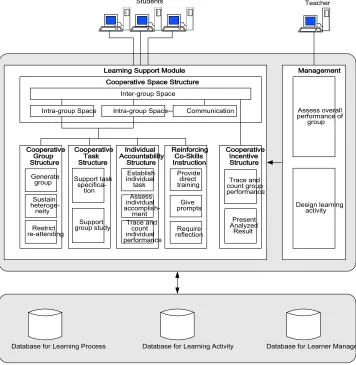
This article redefined the essentials of cooperative learning, and converted them into the six components of CSCL systems to support a cooperative group structure, cooperative task structure, cooperative incentive structure, individual accountability structure, cooperative space structure, and cooperative skills instruction respectively. These components could constitute a framework for a CSCL system and serve as guidelines for CSCL system developers. Figure 2 illustrates an example system developed according to this framework. This system adopted a centralized architecture instead of a replicated architecture because of its simplicity at managing concurrency (Ahuja, Ensor, & Lucco, 1990; Greenberg, 1990; Patterson, Hill, Rohall, & Meeks, 1990). It is a web-based system so that a group of geo-graphically dispersed students can collaborate and learn synchronously and asynchronously through a web browser.
While there have been a few studies that examined the academic and social impact of CSCL, which components (structures) are more or less important and effective could not be determined. Maybe not every one of these components must be used every time CSCL developers design a system. However, a system without these components would be rather like a general groupware than a CSCL system. Such a system would be applicable for mature people to cooperate, but would not be suitable for schoolchildren to cooperate and learn. Unless the assistance of a teacher, who is proficient in cooperative learning strategies and technology usage skills, using a general groupware, just as in a traditional classroom, opportunities for effective interaction and learning could not be guaranteed. In summary, the develop-ment of CSCL systems requires careful attention to the essentials of
Figure 2. Architecture of a CSCL system Learning Support Module
Cooperative Space Structure
Cooperative Incentive Structure Cooperative Group Structure Intra-group Space Inter-group Space Management Restrict re-attending Reinforcing Co-Skills Instruction Individual Accountability Structure Cooperative Task Structure Trace and count group performance Present Analyzed Result Assess overall performance of group Design learning activity
Database for Learning Process Database for Learning Activity Database for Learner Manage Generate
References
Ahuja, S. R., Ensor, J.R., & Lucco, S.E. (1990, April). A comparison of appli-cations sharing mechanisms in real-time desktop conferencing systems. In
Proceedings of the ACM COIS Conference on Office Information Systems
(pp. 238-248). Boston.
Archer-Kath, J., Johnson, D.W., & Johnson, R.T. (1994). Individual versus group feedback in cooperative groups. Journal of Social Psychology, 134(5), 681-94.
Aronson, E., & Patnoe, S. (1997). The jigsaw classroom. New York: Addison Wesley Longman.
Brown, J.S., Collins, A., & Duguid, P. (1989). Situated cognition and the cul-ture of learning. Educational Researcher, 18(1), 32-42.
Brush, T.A. (1997). The effects on student achievement and attitudes when us-ing integrated learnus-ing systems with cooperative pairs. Educational Tech-nology Research and Development, 45(1), 51-64.
Brush, T.A. (1998). Embedding cooperative learning into the design of integrat-ed learning systems: Rationale and guidelines. Educational Technology Re-search and Development, 46(3), 5-18.
Denning, R., & Smith, P.J. (1997). Cooperative learning and technology. Jour-nal of Computers in Mathematics and Science Teaching, 16(2/3), 177-200. Ellis C. A., & Gibbs, S. J. (1989). Concurrency control in groupware systems.
In Proceedings of the ACM SIGMOD’89 Conference on the Management of
Data (pp. 399-407). Seattle.
Graves, N.B., & Graves, T.D. (1985). Creating a cooperative learning environ-ment: An ecological approach. In R. Slavin, S. Sharan, S. Kagan, R. H. Laz-arowitz, C. Webb, & R. Schmuck (Eds.), Learning to cooperate, cooperat-ing to learn (pp. 403-436). New York: Plenum.
Greenberg, S. (1990, April). Sharing views and interactions with single-user ap-plications. In Proceedings of the ACM COIS Conference on Office Informa-tion Systems (pp. 227-237). Boston.
Harasim, L.M. (1993). Collaborating in cyberspace: Using computer conferenc-es as a group learning environment. Interactive Learning Environments, 3(2), 119-130.
Harasim, L.M. (1994). Computer networking for education. In T. Husen & T. N. Postlethwaite (Eds.), The international encyclopedia of education Vol. 2. (2nd ed., 977-982). Oxford, England: Pergamon.
Hill, S., & Hill, T. (1990). The collaborative classroom: A guide to co-operative learning. Armadale, Victoria, Australia: Eleanor Curtain.
Hooper, S. (1992). Cooperative learning and computer-based instruction. Edu-cational Technology Research and Development, 40(3), 21-38.
Johnson, D.W., & Johnson, R.T. (1975). Learning together and alone: Cooper-ation, competition and individualization. Englewood Cliffs, NJ: Prentice-Hall.
Johnson, D.W., & Johnson, R.T. (1989). Cooperation and competition: Theory and research. Edina, MN: Interaction Book Company.
Johnson, D.W., & Johnson, R.T. (1990). Cooperative learning and achievement. In S. Sharan (Ed.), Cooperative Learning: Theory and Research. New York: Praeger.
Johnson, D.W., & Johnson, R.T. (1991). Learning together and alone. Engle-wood Cliffs, NJ: Prentice Hall.
Johnson, D.W., & Johnson, R.T. (1992a). Positive interdependency: Key to ef-fective cooperation. In R. Hertz-Lazarowitz & N. Miller (Eds.), Interac-tion in cooperative groups: The theoretical anatomy of group learning (pp. 174-199). Cambridge, England: Cambridge University Press.
Johnson, D.W., & Johnson, R.T. (1992b). Positive interdependency: The heart of cooperative learning. Edina, MN: Interaction.
Johnson, D.W., & Johnson, R.T. (1994). Cooperation and the use of technolo-gy. In Jonassen, D. H. (Ed.), Handbook of Research for Educational
Com-munications and Technology (pp. 1017-1044). New York: Macmillan
LI-BRARY Reference USA Simon & Schuster Macmillan.
Johnson, D.W., Johnson, R.T., & Holubec, E. (1993). Circles of learning (4th ed.). Edina, MN: Interaction Book Company.
Johnson, D.W., Johnson, R.T., & Smith, K.A. (1991a). Cooperative learning: Increasing college faculty instructional productivity. ASHE-ERIC Report on Higher Education. Washington, DC: The George Washington University. Johnson, D.W., Johnson, R.T., & Smith, K.A. (1991b). Active learning:
Coop-eration in the college classroom. Edina, MN: Interaction Book Company. Johnson, D.W., Johnson, R.T., Holubec, E.J., & Roy, P. (1984). Circles of
learning. Alexandria, VA: Association for Supervision and Curriculum De-velopment.
Kagan, S. (1985). Cooperative learning: Resources for teachers. Riverside, CA: University of California.
Karsenty, A., & Beaudouin-Lafon, M. (1993). An algorithm for distributed groupware applications. In Proceedings of the 13th Annual Conference On
Distributed Groupware Computing Systems ICDCS’93, IEEE (pp.
195-202). Pittsburgh.
Lave J., & Wenger. E. (1991). Situated learning: Legitimate peripheral partici-pation. Cambridge: Cambridge University Press.
Miller, N., & Harrington, H. J. (1992). Positive interdependency: Key to effec-tive cooperation. In R. Hertz-Lazarowitz & N. Miller, (Eds.), Interaction
in cooperative groups: The theoretical anatomy of group learning (pp.
203-227). Cambridge, England: Cambridge University Press.
Patterson, J.F., Hill, R.D., Rohall, S L., & Meeks, W.S. (1990, October). Ren-dezvous: An architecture for synchronous multi-user applications. In Pro-ceedings of the ACM CSCW Conference on Computer Supported Coopera-tive Work, Los Angeles, California.
Putnam, J.W., Rynders, J.E., Johnson, R.T., & Johnson, D.W. (1989). Collabo-rative skill instruction for promoting positive interactions between mental-ly handicapped and nonhandicapped children. Exceptional Children, 55, 550-557. Riel, M., & Harasim, L. (1994). Research perspectives on network learning.
Machine-Mediated Learning, 4(2&3), 91-113.
Riel, M., & Levin, J. (1990). Building electronic communities: Successes and failures in computer networking. Instructional Science, 19(2), 145-169. Rysavy, S., & Sales, G.C. (1991). Cooperative learning in computer-based
in-struction. Educational Technology Research and Development, 39(2), 70-79. Salomon, G., & Globerson, T. (1989). When teams do not function the way
they ought to. International Journal of Educational Research, 13(1), 89-100. Sharan, Y., & Sharan, S. (1992). Expanding cooperative learning through group
investigation. New York: Columbia University.
Sherman, G.P., & Klein, J.D. (1995). The effects of cued interaction and ability grouping during cooperative computer-based science instruction. Educa-tional Technology Research and Development, 43(4), 5-24.
Slavin, R.E. (1983). Cooperative learning. New York: Longman.
Slavin, R.E. (1984). Students motivating students to excel: Cooperative incen-tives, cooperative tasks, and student achievement. The Elementary School Journal, 85(1), 53-65.
Slavin, R.E. (1986). Using student team learning (3rd ed.). Baltimore: Johns Hopkins University, Center for Research on Elementary and Middle Schools.
Slavin, R.E. (1991a). Group rewards make groupwork work. Educational Lead-ership, 48(5), 89-91.
Slavin, R.E. (1991b). Synthesis of research on cooperative learning. Educational Leadership, 48(5), 71-82.
Slavin, R.E. (1993). Cooperative learning and achievement: An empirically-based theory. Paper presented at the annual meeting of the American Edu-cational Research Association, Atlanta, GA.
Slavin, R.E. (1995). Cooperative learning: Theory, research, and practice. Bos-ton: Allyn and Bacon.
Stahl, R.J. (1994). The essential elements of cooperative learning in the class-room. ERIC Digest. Abstract from: ERIC Clearinghouse for Social Studies/ Social Science Education Bloomington, IN: ED 370 881. Retrieved October 9, 2000 from: http://www.ed.gov/databases/ERIC_Digests/ed370881.html Tateyama-Sniezek, K.M. (1990). Cooperative learning: Does it improve the
Vygotsky, L.S. (1978). Mind in society: The development of higher psychologi-cal processes. Cambridge, MA: Harvard University Press.
Vygotsky, L.S. (1981). The genesis of higher mental functions. In J. V. Wertsch (Ed.), The concept of activity in Soviet psychology (pp. 144-188). New York: Sharpe.
Watson, S.B. (1992). The essential elements of cooperative learning. The Amer-ican Biology Teacher, 54(2), 84-86.
Watson, S.B., & Marshall, J.E. (1995). Effects of cooperative incentives and heterogeneous arrangement on achievement and interaction of cooperative learning groups in a college life science course. Journal of Research in Sci-ence Teaching, 32(3), 291-299.
Acknowledgement