R E S E A R C H
Open Access
Exploiting contextual information for prosodic
event detection using auto-context
Junhong Zhao
1,2*, Wei-Qiang Zhang
3, Hua Yuan
3, Michael T Johnson
4, Jia Liu
3and Shanhong Xia
1Abstract
Prosody and prosodic boundaries carry significant information regarding linguistics and paralinguistics and are important aspects of speech. In the field of prosodic event detection, many local acoustic features have been
investigated; however, contextual information has not yet been thoroughly exploited. The most difficult aspect of this lies in learning the long-distance contextual dependencies effectively and efficiently. To address this problem, we introduce the use of an algorithm called auto-context. In this algorithm, a classifier is first trained based on a set of local acoustic features, after which the generated probabilities are used along with the local features as contextual information to train new classifiers. By iteratively using updated probabilities as the contextual information, the algorithm can accurately model contextual dependencies and improve classification ability. The advantages of this method include its flexible structure and the ability of capturing contextual relationships. When using the
auto-context algorithm based on support vector machine, we can improve the detection accuracy by about 3% and F-score by more than 7% on both two-way and four-way pitch accent detections in combination with the acoustic context. For boundary detection, the accuracy improvement is about 1% and the F-score improvement reaches 12%. The new algorithm outperforms conditional random fields, especially on boundary detection in terms of F-score. It also outperforms an n-gram language model on the task of pitch accent detection.
Keywords: Prosodic event detection; Auto-context; Pitch accent; Boundary; Support vector machines
1 Introduction
Speech is often characterized across two levels of expres-sion: the segmental level encompassing basic phonetic meaning and the prosodic level with additional supraseg-mental information. The prosodic level expression plays a crucial role in speech communication, carrying much linguistic and paralinguistic information. Prosody enables listeners to recover word meanings, emphasis, and speaker intent and attitude. In addition, prosody carries information about the speaker’s emotional state. Prosody primarily manifests itself as pitch accent, pause, variations in speaking rate, and intonation. These prosodic events are realized by modulating acoustical correlates such as duration, pitch, and intensity at a syllable, word, or whole utterance level.
*Correspondence: [email protected]
1State Key Laboratory of Transducer Technology, Institute of Electronics, Chinese Academy of Sciences, No.19 North west Rd., Beijing 100190, China 2University of Chinese Academy of Sciences, No. 19A Yuquan Road, Beijing 100190, China
Full list of author information is available at the end of the article
In spoken language processing, the detection of prosodic events is a primitive step needed for comput-ers to access the critical high-level information regard-ing human speech interaction. As such, this task has wide application. It can provide assistance for auto-matic prosody annotation. Since the manual annotation of prosody for speech synthesis or speech understand-ing is time-consumunderstand-ing and laborious, the detection of prosodic events can provide substantial time savings. For second language learning, there is potential for computer-assisted language learning (CALL) systems to incorporate prosodic event detection to help detect learner mispro-nunciations at a prosodic level and provide feedback for improving pronunciation naturalness. Prosodic event detection can also be used as foundation for the down-stream spoken language processing tasks such as speech summarization and topic segmentation.
Due to the suprasegmental nature of prosody, contex-tual information is very important for prosodic event recognition. Here, ‘context’ refers to the correlation between each prosodic unit and its surroundings. There
are several types contextual information, including nearby acoustic appearances (‘acoustic context’), nearby prosodic event distributions (‘prosodic context’), and nearby lexi-cal and syntactic appearances (‘textual context’). In this paper, we focus only on acoustic context and prosodic context, but do not address linguistic effects. Perceptually, pitch accent is perceived when the related acoustic fea-tures of a syllable stand out from its surroundings. In addition to the influence of the adjacent syllables, the overall surface realization of accent is also affected by many other broader-scale phenomena such as the presence of phrasal boundary, phrase structure, and topic [1,2].
In this paper, we investigate the utilization of contex-tual information for pitch accent and boundary
detec-tion by using the auto-context algorithm, which was
first proposed in [3] for high-level computer vision tasks like image segmentation. In this algorithm, the classi-fication probabilities obtained from the preceding iter-ation are used to provide possible contextual clues, together with acoustic features to improve the next iter-ation. Each detection object is supported by combi-nations of contextual probabilities from any contextual range. Our experimental results show that this algorithm enhances detection performance for both pitch accent and boundary detection tasks.
2 Related work
Many approaches have been explored for prosodic event detection. The target unit used to indicate the prosodic events can be a phone, syllable or word, with acoustic features typically modeled by statistical machine learning methods. In [4], Conkie et al. used short-frame speaker-normalized pitch and energy as acoustic representations modeled by prosodic context-dependent HMMs. In [5], Ananthakrishnan and Narayanan modeled the frame-level acoustic features using coupled hidden Markov models (CHMMs) to detect pitch accent and boundary in binary modes.
This work assumed that the modulation of prosody-related acoustic parameters, such as increase of the local energy, extension of the duration, and exaggeration of pitch movements, were all asynchronous and could be modeled by CHMMs with multiple data streams. In [6], bagging and boosting ensemble machine learning meth-ods were adopted based on a decision tree learning algo-rithm. Both methods improved the overall accuracy of four-category pitch accent classification.
The work in [7] utilized a decision tree to model acous-tic features. Using the posterior probabilities provided by the decision tree, a bigram prosodic label sequence model was combined to detect pitch accent and bound-ary tones at the syllable level. In [8], Ananthakrishnan
and Narayanan used a maximum a posteriori (MAP)
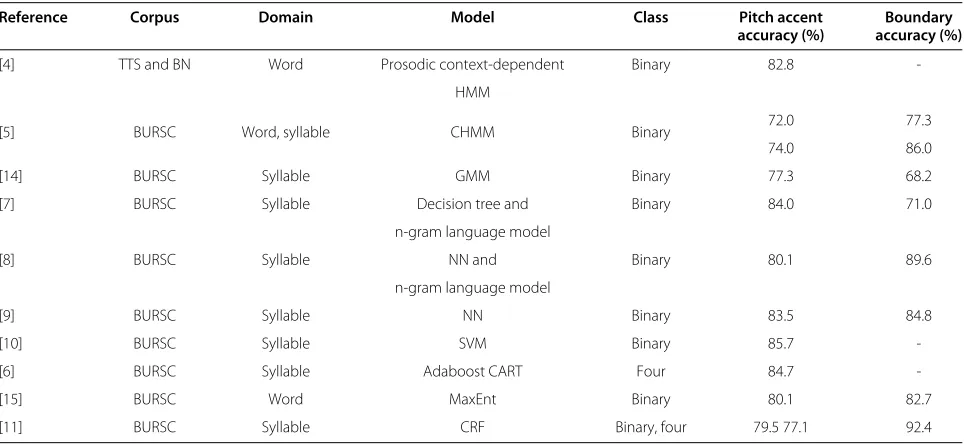
framework with multiple classifiers including GMMs, linear decision discriminants, and neural networks (NNs) to detect pitch accent and boundary, with NNs giving the best performance. When combined with 4-gram de-lexicalized language model, this method achieved an accu-racy of 80.1% on binary pitch accent classification and 89.6% on boundary detection. Jeon and Liu used NNs [9] and support vector machines (SVMs) [10] for acoustic modeling. With NNs, pitch accent and boundary detec-tion accuracy reached 83.5% and 84.8%, respectively. The performance of the SVM classifier was better than that of NNs, achieving 85.7% accuracy for pitch accent detection. Recently, conditional random fields (CRFs) have become popular in prosodic event detection. In [11], acoustic fea-tures were modeled by a linear-chain CRF as well as a two-level factorial CRF. Linear-chain CRF has been used extensively in recent work [2,12,13]. These refer-ence approaches to prosodic event detection have been summarized in Table 1.
To investigate the importance of contextual information in prosodic event detection, the work in [16] examined the detection performance of pitch accent at word, sylla-ble, and vowel levels, respectively. When using a constant amount of context, the results showed that detection in the word domain achieved the best performance, showing that acoustic excursions exist beyond syllable range. In [1], the contextual influence of local coarticulatory constraints and broader range phrasal effects were investigated for the detection of prominence. The results showed that the incorporation of local acoustic context can significantly improve the detection performance, with phrasal effects less significant.
Table 1 Summary of different approaches for prosodic event detection
Reference Corpus Domain Model Class Pitch accent Boundary
accuracy (%) accuracy (%)
[4] TTS and BN Word Prosodic context-dependent Binary 82.8
-HMM
[5] BURSC Word, syllable CHMM Binary 72.0 77.3
74.0 86.0
[14] BURSC Syllable GMM Binary 77.3 68.2
[7] BURSC Syllable Decision tree and Binary 84.0 71.0
n-gram language model
[8] BURSC Syllable NN and Binary 80.1 89.6
n-gram language model
[9] BURSC Syllable NN Binary 83.5 84.8
[10] BURSC Syllable SVM Binary 85.7
-[6] BURSC Syllable Adaboost CART Four 84.7
-[15] BURSC Word MaxEnt Binary 80.1 82.7
[11] BURSC Syllable CRF Binary, four 79.5 77.1 92.4
3 Corpus and tasks
The data corpus used in this work is the Boston University Radio Speech Corpus (BURSC) [17], a standard corpus for prosody event detection and prediction studies. This cor-pus is composed of news stories read by seven FM radio news announcers. Each paragraphed-size utterance typi-cally consists of several sentences and is hand-annotated with the orthographic transcription, phonetic alignments, part-of-speech (POS) tags, and prosodic labels based on ToBI conventions. Utterances from two females (F1, F2) and two males (M1, M2) constitute the training and test-ing dataset used here. The distribution of these utterances is listed in Table 2.
There are four parallel tiers for ToBI annotation conven-tions to describe the prosodic events [18]. Among these, the tone tier annotates the presence of pitch accent (* suf-fix) and phrase boundaries. There are two basic types of accent, high (H) and low (L), which can be further divided into subclasses such as downstepped accent (! prefix). The
X
Y
X
Y
(a)
N-gram model(b)
Linear-chain CRFFigure 1The relational structures adopted by n-gram and CRF models.Here, X represents the features, and Y represents the labels which are being predicted.(a)N-gram model.(b)Linear-chain CRF.
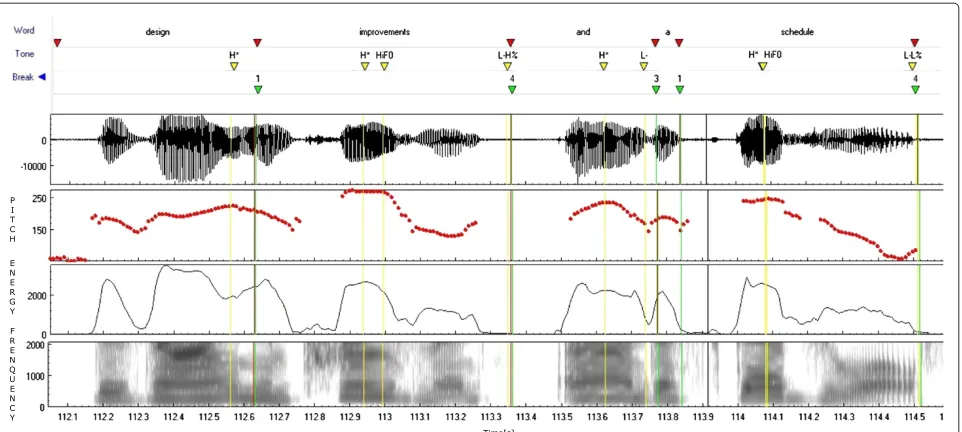
phrase boundaries include intermediate phrase bound-ary (- suffix) and intonational phrase boundbound-ary (% suffix), which follow the different types of phrase accent and boundary tones. The break tier is used to describe the dis-juncture between words. The degree of disdis-juncture from weak to strong is marked by break indices ranging from 0 to 4. The phrase boundary locations usually score 3 or above, where ‘3’ indicates an intermediate phrase bound-ary and ‘4’ indicates a full intonational phrase boundbound-ary. These two kinds of boundaries are different in their degree of salience. Figure 2 shows a ToBI annotation example for the phrase ‘design improvement and schedule’. The top three layers are the orthographic tier, the tone tier, and the break tier, respectively.
In our work, we have implemented syllable partitions and take the syllable as the domain of pitch accent and boundary detection. Using the detailed representation of prosodic types from the ToBI annotation framework can
Table 2 The distribution of the dataset used in our experiment
F1 F2 M1 M2
Number of utterances 74 166 72 51
Number of sentences 279 1,176 391 209
Number of words 3,993 12,060 5,059 3,608
Number of syllables 6,580 20,836 8,168 5,915
Number of accents 2,253 7,063 2,564 1,933
Number of boundaries 977 3,702 1,092 882
Accent occupancy (%) 34.3 33.9 31.4 32.7
Figure 2An example of ToBI annotation for the phrase ‘design improvement and schedule’.The example includes the acoustic appearances of pitch, energy, and frequency spectrum.
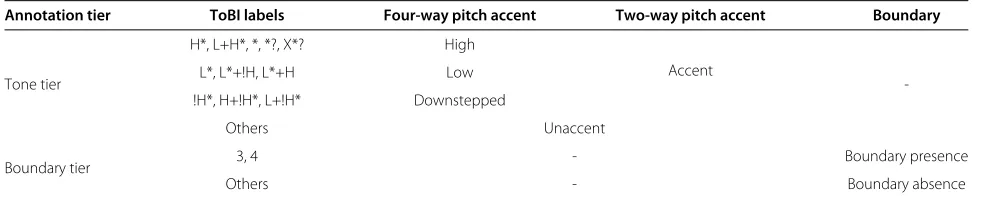
cause serious data sparsity problems since there are only a few examples for some prosodic types. Considering a bal-ance between the amount of the training data and detec-tion fineness, in this work, we implement pitch accent detection tasks in two-way and four-way modes, following previous approaches [8,9,11,13]. For the two-way task, we divide the syllables into accented and unaccented based on the presence of an asterisk mark. As Table 2 shows, in this classification case, the percentage of the accented syllables is about 33%. For the four-way task, we decompose the pitch accent into three types: high, low, and downstepped, in addition to the unaccented type. Four-way classifica-tion increases the detecclassifica-tion complexity and fineness, but causes some data sparsity. For boundary detection, we set our detection task as a binary (presence/absence) clas-sification problem, which identifies whether the syllable is followed by a boundary or not. Although intonational phrase boundaries can be more reliably detected and have been widely applied in many downstream spoken lan-guage processing tasks such as speech summarization, intermediate phrase boundaries are also important ele-ments for phrasal analysis and prosodic annotation. Here, we treat the intonational and intermediate phrase bound-aries equally and group the break indices of ‘3’ and ‘4’ together to represent our ‘boundary’ category, as has been done in some previous works [8,13,19]. As shown in Table 2, the syllables with boundary presence repre-sent about 15% of the dataset. The boundary detection results obtained in this way can be used directly or as pre-liminary information that can be followed by a further identification of the boundary salience at the presence
positions. We summarize the clusters of ToBI labels and their mapping relationships with prosodic categories for detection in Table 3.
4 Prosodic event detection method: auto-context In this paper, the auto-context algorithm is introduced for prosodic event detection. The basic objective of the auto-context algorithm is to maximizep(yi|X)for all samples, whereX = (x1,· · ·,xn)is the input feature vector, andyi is the class label for samplei. The auto-context algorithm provides an iterative way to asymptotically approach this objective as follows: Given a set of training samples with ground truth labelsS= {(Yi,X(i)),i=1,. . .,m}, a classi-fier is first trained using local features so the probabilities of classes for each sample can be obtained. In the ensu-ing iterative process, the probabilities of both the current and surrounding samples obtained in the current itera-tiontare combined together as a probability vectorPt(i). This is then concatenated with the original acoustic fea-tures to construct a new feature vector. The new feature vectors of all the samples compose the training setSt+1= {Yi, [X(i),Pt(i)]} for iterationt + 1. Using this updated training set, the new model is trained.
Table 3 Mapping between clusters of ToBI labels and prosodic categories for detection
Annotation tier ToBI labels Four-way pitch accent Two-way pitch accent Boundary
Tone tier
H*, L+H*, *, *?, X*? High
Accent
-L*, L*+!H, L*+H Low
!H*, H+!H*, L+!H* Downstepped
Others Unaccent
Boundary tier 3, 4 - Boundary presence
Others - Boundary absence
with a monotonically decreasing training error, as shown in [3].
We adopt this algorithm to explore contextual informa-tion for pitch accent and boundary detecinforma-tion. We choose syllables from one to five syllables away from the cen-tral syllable as contextual regions to conduct our analysis. In our tasks, the posterior probabilitiesP(i) are used as the prosodic context (as opposed to ‘acoustic context’) since they present the likelihoods of syllables belonging to different prosodic events. Acoustic features can include not only local features but also acoustic context. Corre-spondingly,X(i)can be decomposed as the local features vectorXlocal(i)and acoustic context vectorXcontext(i), as
Eq. (1) denoted. Here, we will consider both of them. The local acoustic feature Xlocal(i) used in this work will be described in detail in Section 5.1. The first-order differen-tial values are used as the acoustic contextXcontext(i). We
use the following steps to implement the algorithm:
1. The acoustic features, including local features
Xlocal(i)and acoustic contextXcontext(i), are used to train the initial acoustic model. After the first round of training and testing, we obtain the class
probabilities.
X(i)=[Xlocal(i),Xcontext(i)] , (1)
2. The contextual information of each syllable is incorporated by combining the probabilities from its neighbors for the next iteration. The probability vectorP(i)for thei th sample is constructed as follows:
P(i)=[C∗(i−n),· · ·,C∗(i−1),C∗(i),C∗(i+1),· · ·,
C∗(i+n)] ,
(2)
whereC∗(i)represents any collection of
classification probabilities for thei th syllable, and n is the range parameter controlling the extent of the context. After extension, the new training set for the second stage becomes
S(i)= {yi, [X(i),P(i)] ,i=1, 2, 3,. . .,m} (3)
3. Using theS(i)training set, we train the next acoustic model and updateP(i).
4. Steps 2 and 3 are repeated until convergence to let the algorithm recursively learn the informative pitch accent context automatically.
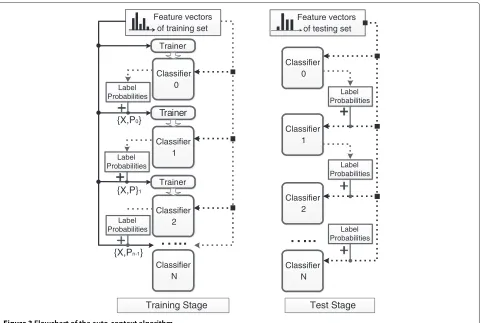
The flowchart of the algorithm is depicted in Figure 3.
5 Acoustic representation 5.1 Features for pitch accent
Pitch accent typically correlates with a higher level of pitch and energy and an increased duration. We extracted acoustic features based on these acoustic measurements in syllable regions to detect pitch accent. These features can be categorized into two groups: frame-averaged fea-tures, including the mean values of pitch, energy and duration; and TILT features provided by parameterizing the pitch contour using the TILT model. In addition, the forward and backward difference values for both frame-averaged features and TILT features are extracted as acoustic contextual information. In the following section, we describe how to extract these features in detail.
5.1.1 Frame-averaged features
Loudness Pitch accent is closely related to human audi-tory characteristics. For perceptual accuracy, loudness can be used instead of intensity to detect pitch accent [20]. Here, we use a loudness model proposed by Zwicker and Fastl [21] to extract the loudness feature. This starts with using the short-time Fourier transform (STFT) to trans-fer the signal from the temporal to the frequency domain. The linear-scale frequency is grouped into a critical band rate scale to model the human hearing mechanism. This mapping relationship is given by
z(Bark)=T(f)=13 tan−10.00076f+3.5 tan−1
f
7500 2
,
(4)
Feature vectors of training set
Classifier 0 Trainer
Label Probabilities
Classifier 1 Trainer
Label Probabilities
…...
Classifier2 Trainer {X,P0}
{X,P}1
{X,Pn-1}
Classifier N
Feature vectors of testing set
Classifier 0
Classifier 1
…...
Classifier2
Classifier N
Label Probabilities
Label Probabilities
Label Probabilities Label
Probabilities
Training Stage Test Stage
Figure 3Flowchart of the auto-context algorithm.
(z−0.5,z+0.5)and then by calculating the correspond-ing sound pressure level (SPL) accordcorrespond-ing to
I(z)=10 log ⎛ ⎝
H(z) L(z) I(f)df
I0
⎞
⎠dB,
whereH(z)=T−1(z+0.5), L(z)=T−1(z−0.5). (5)
Here, I0 = 10−12 W/m2 is the standard threshold of
hearing at 1 kHz.
Stevens pointed out that the relationship between inten-sity and perceptual loudness obeys the power law [22]. Following this law, we calculate the loudness of per Bark based onI(z)by
L(z)=0.08
IQ(z) I0
0.23
0.5+0.5 I(z)
IQ(z) 0.23
−1
,
(6)
whereL(z)denotes the specific loudness in thezth Bark, and IQ(z) is the correponding threshold of intensity in quiet enviroment. The total loudness L of the frame is given by the summation of every critical band loudness
L=24z=1L(z).
Semitone Based on a similar perceptual consideration, we transform the pitch values in Hertz to the semitone scale to better match with human perception [23]. Raw pitch values are calculated first using Praat [24], then a log-scale transformation is conducted according to the following equation:
S=69+12 log2
f
440
, (7)
wheref is the fundamental frequency in Hz, andSis in semitones.
Spectral emphasis Previous studies have shown that midfrequency energy is more effective in accent classifica-tion than full-range distributed energy [25]. Midfrequency refers to the frequencies between 500 and 2,000 Hz. In this work, we use a finite impulse response (FIR) fil-ter with Kaiser window to extract the energy within this bandwidth as a spectral emphasis feature.
Among these four features, the loudness, spectral emphasis, and semitone values are all extracted at a frame-by-frame level in the first iteration. After this, the loudness and the spectral emphasis are averaged across a ble scope, while the semitone is averaged across a sylla-ble nucleus to obtain frame-averaged values. In order to reduce the negative impact caused by different speakers and speaking rates, these features are all normalized by the mean value across the whole sentence.
5.1.2 TILT features
We follow the rise/fall/connection (RFC) model proposed in [26] to extract the TILT parameters as the repre-sentation of the pitch variation [27]. As an intonation model, the RFC model first categorizes the F0 contour into rise (R), fall (F), and connection (C) cases accord-ing to pitch trend and then continuously parameterizes the contour based on this classification. Here, we still use the semitone-scaled F0 contour of each syllable nuclei to extract the TILT features.
Linear interpolation is implemented to smoothen the contour. Then, a labeling procedure is conducted to mark the contours with one of the three kinds of categories. Labels of successive frames are merged together to be a single interval. Within the range of these divided areas, the amplitude-related measurement (tilta) is calculated by
tilta= |
Arise| − |Afall| |Arise| + |Afall|
, (8)
the duration-related measurement (tiltd) is calculated by
tiltd=
Drise−Dfall
Drise+Dfall
, (9)
and the overall measurement of tilt (tiltt) is calculated by
tiltt= |
Arise| − |Afall|
2(|Arise| + |Afall|) +
Drise−Dfall
2(Drise+Dfall)
. (10)
AriseandAfallare the sum of the rise and fall amplitudes,
respectively, andDrise andDfallrepresent the sum of the
rise and fall durations, respectively. We extracted these features using the Edinburgh Speech Tools Library (EST). In addition, we also included the maximum semitone that can be calculated directly by EST as one of the tilt features.
5.2 Features for boundary
As discussed in [28], the presence of a phrase bound-ary typically correlates with the presence of silence, the reset of pitch and energy, and the lengthening of pre-boundary duration. Each of these play a role in perception of increased disjuncture. We assume that acoustic varia-tions caused by boundary phenomenon exist only within the region of syllables, and extract acoustic features for
boundary detection using a syllable unit, as has been done in [7,8,19]. We assume that the region affected by the boundary covers the end of the pre-syllable, the silence interval (possibly absent), and the beginning of the post-syllable, while the candidate result of this region is assigned to the pre-syllable. The acoustic features include the acoustic measurement of the preceding and follow-ing syllables and their differential features across syllable boundaries for boundary detection. There are 25 feature dimensions in total, as follows:
1. The duration of the two syllables and their ratio value (3) 2. The duration of the two syllable nuclei and their ratio
values (3)
3. The silence duration between the two syllables (1) 4. The means and maxima of pitch of the two syllables,
and their differential values (6)
5. The loudness and spectral emphasis mean of the two syllables, and their differential values (6)
6. The amplitude, duration, and overall measurements of the TILT features of the two syllables (6).
Although one can describe a linguistic grammar that only word-final syllables can contain a boundary, we choose to take no linguistic constraints into the imple-mentation of our algorithm and allow all possibilities for all syllables. We just let the algorithm itself to make decisions according to acoustic features and contextual information.
6 Experiments
We conduct a number of prosodic event detection exper-iments in this section. First, a classifier selection is con-ducted. The performances of the different classifiers are investigated, and the one with best performance is cho-sen as the baseline classifier for the auto-context experi-ments. The auto-context algorithm is then implemented for two-way and four-way pitch accent detections and for boundary detection. In these experiments, the effec-tiveness of the auto-context approach is verified from different aspects. Finally, comparisons are made between the auto-context, CRF, and n-gram methods.
Table 4 Performance of prosodic event detection by NN and SVM classifiers using all combined features
Two-way (%) Four-way (%) SL boundary (%) WL boundary (%)
Accuracy F-score Accuracy F-score Accuracy F-score Accuracy F-score
NN 80.5 66.8 75.0 58.9 87.7 43.7 80.3 44.1
SVM 81.2 70.8 76.3 59.9 88.1 45.3 81.2 46.2
Here ‘Two-way’ and ‘Four-way’ mean the pitch accent detection tasks in two-way and four-way modes, respectively, and ‘SL boundary’ and ‘WL boundary’ mean the boundary detection tasks measured at the syllable-level and word-level, respectively.
folds. Acoustic model parameters for both baseline and proposed methods are optimized using a development dataset. This development dataset is constructed from the F3 and M3 data of the BURSC corpus, including 57 utter-ances, 282 sentences, and about 8,000 syllables. All exper-iments are implemented by first optimizing the methods using the development data and then testing with fivefold cross-validation over the primary dataset.
6.1 Classifier selection
As mentioned in Section 4, the auto-context algorithm produces a sequence of classifiers through an iterative process. The performance of the chosen classifier will play a vital role in determining the final performance. The auto-context algorithm is not dependent on any specific classifier and can use either SVM or NN approaches. Since each of these have been used extensively in prosodic event
Figure 4Performance of the auto-context algorithm for two-way pitch accent detection without acoustic features.(a)Accuracy
Figure 5Performance of the auto-context algorithm on test dataset for four-way pitch accent detection without acoustic features. (a)Accuracy performance on test data.(b)F-score performance on test data.
detection, we will first conduct the investigation for their performance here.
We use LIBSVM with a radial basis function (RBF) kernel to implement SVM classification [29]. In the four-way pitch accent detection, the one-versus-the-rest mode is adopted to decompose multi-class classification into binary. For NN, we use a three-layer network with a fully connected structure. The sigmoid activation function is chosen for network nodes. The classical backpropa-gation is adopted to minimize the cross entropy error between outputs and targets. Many options related to the two classifiers, such as the number of hidden nodes, the learning rate, the momentum for NN and the cost, the gamma value of RBF function for SVM, are opti-mized with the development dataset. The results of the prosodic event detection by the two classifiers are given in Table 4.
We can see from Table 4 that on this task, SVM outper-forms NN. Another advantage of SVM is that it has fewer parameters to tune and thus is not as sensitive to them as NN. Therefore, considering efficiency and accuracy, we adopt the SVM as our basic classifier in the follow-ing experiments. Durfollow-ing the iterative process, the same configuration is used for all SVM classifiers. The poste-rior probabilities that the auto-context algorithm uses are obtained by mapping the distance between the sample and the classifying hyperplane with a sigmoid function.
6.2 Auto-context algorithm for pitch accent detection We conduct the following experiments to investigate the ability of the auto-context algorithm to model contextual information for the task of pitch accent detection. The first experiment investigates the effect of prosodic con-text utilized by auto-concon-text for pitch accent detection.
Performance is verified only in independent-syllable con-ditions, where no acoustic context has been used in the baseline. Based on this, a further investigation is then con-ducted to identify the effect of different contextual loca-tions, e.g., preceding and following contexts. In the final experiment, acoustic differential features are employed to investigate the combination effect of prosodic context and acoustic context.
6.2.1 Auto-context algorithm without acoustic context
To perform this experiment, we select the number of con-textual syllables before and after the current syllable to
range from M = 1 to M = 5, where M is the
max-imum contextual extent. For each selected syllable, the probabilities of all classes were included.
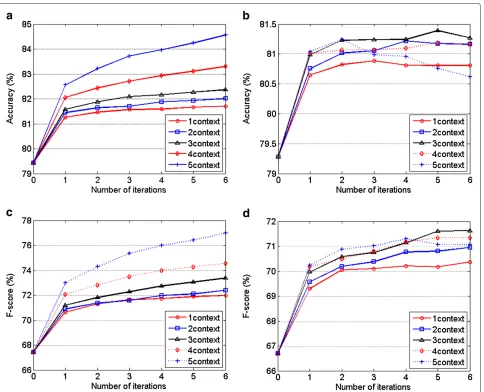
Figure 4a,b shows the average detection accuracy of the auto-context algorithm calculated across the training and test sets of the fivefold cross-validation. For each case, the training set accuracy increases with each iteration, and the wider the contextual range, the better the performance. Correspondingly, the test set accuracy also increases grad-ually across iterations, as illustrated in Figure 4b. This suggests that the auto-context algorithm is able to itera-tively capture informative prosodic context. The larger the
Table 5 Accuracy performance of the auto-context algorithm using contextual information from different locations
Auto-context (%) None Preceding Following Both
Two-way (M=3) 79.3 80.4 80.1 81.2 (M=3 itr = 3)
Four-way (M=2) 74.2 75.3 75.0 75.7 (M=2 itr = 6)
Figure 6Performance of the auto-context algorithm on test dataset for two-way pitch accent detection with acoustic features. (a)Accuracy performance on test data.(b)F-score performance on test data.
range is, the greater ability this algorithm has to model these useful relationships.
Additionally, we can see that the greatest performance gain is often obtained in the first iteration. In our exper-iment, the first iteration produces no less than 1.5% net accuracy improvement (more than 70% of the total improvement) on test data. This is because it is at this stage that the context is first added to a baseline without any prior contextual information. It can also be observed that sometimes there is performance degradation on the test set when the classifiers are iterated too many times, which indicates the over-fitting of the model. To avoid this problem in practice, a development dataset needs to be used to tune and determine an appropriate configuration
before each implementation. In our experiment under the fivefold cross-validation scenario, the optimal configura-tion is determined by the average performance of the development dataset. Final results are obtained under the constraint of the chosen configuration. In order to fully show the change trend, the curves shown in the figures are not preset with any stopping criterion. From Figure 4b, we can also see thatM=3 gives the best performance. This is consistent with statistics, showing that most pitch accent events occur once every two or three syllables. The final result is obtained atM=3 and iteration number itr=3, achieving accuracy of 81.2%.
The F-score performance on the training and test datasets are fully shown in Figure 4c,d, respectively. As
Table 6 Performance comparison of auto-context, acoustic context, and their combinations
No Acoustic Auto-context Combination context context
Two-way (%)
Accuracy 79.3 81.2 81.2 (M=3 itr = 3) 82.0 (M=3, itr = 4)
F-score 66.7 70.8 71.1 (M=3 itr = 4) 73.0 (M=3, itr = 4)
Four-way (%)
Accuracy 74.2 76.3 75.7 (M=2 itr = 6) 77.0 (M=2, itr = 1)
F-score 54.3 59.9 59.5 (M=2 itr = 6) 63.0 (M=24, itr = 4)
with accuracy, we see a similar increasing trend. The first iteration again gives the most salient improvement, more than 3% net, representing more than 60% of the total improvement. The F-score improvement is more signifi-cant than the accuracy improvement. In our experiment, auto-context improves the F-score from 66.7% to 71.1% at
M=3 and itr=4 on the test data.
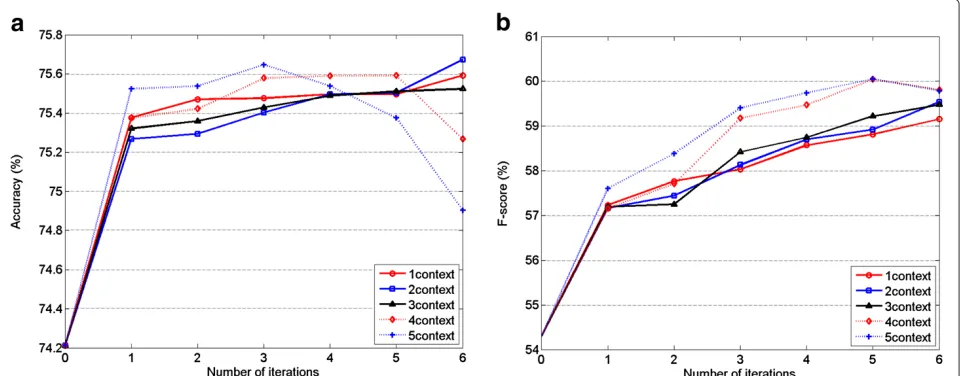
The test accuracy and F-score performance on the four-way pitch accent detection are fully shown in Figure 5a,b. From this figure, we can see that the auto-context can substantially impact the four-way pitch accent detection result as well. In our experiments, it can improve the
accu-racy from 74.2% to 75.7% atM = 2 and itr = 6, and
improve the F-score from 54.3% to 59.5% atM = 2 and
itr=6.
6.2.2 Effect of contextual location
Auto-context is sensitive to the choice of context. Section 6.2.1 has discussed the performance variation associated with contextual range influence. In this experiment, we
conducted further analysis about how different contex-tual locations impact the auto-context effectiveness. The contextual location was split into preceding and following based on the position relative to the current syllable. We
chose an upper contextual limit ofM = 3 for the
two-way task andM= 2 for the four-way task, based on the results of the previous experiments. In each experiment, only the preceding or following probabilities are used. The final results are given in Table 5. We see that both the preceding and following contexts are useful for the tasks of two-way and four-way extent detection. As expected, combining both of them gives the best performance.
6.2.3 Auto-context algorithm with acoustic context
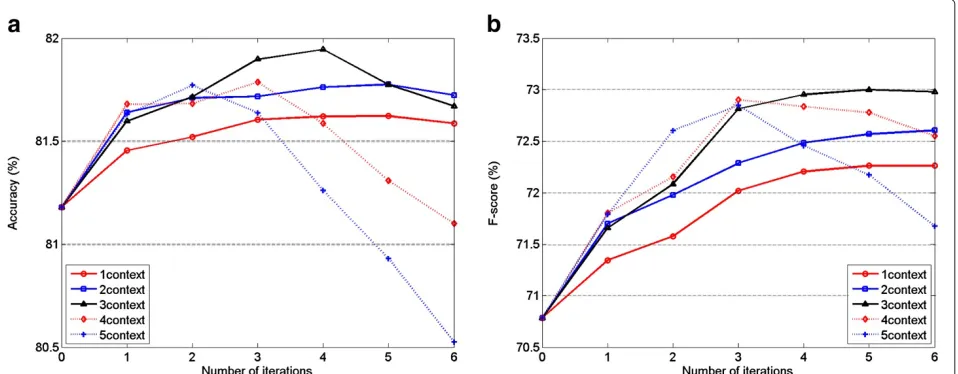
The auto-context algorithm has the potential to explore relationships between prosodic events across a wider extent and combine these with acoustic information in a unified framework. In this experiment, under the same experiment setups to Section 6.2.1, we implement the auto-context algorithm based on not only local acous-tic features but also acousacous-tic context to investigate the combination effect between prosodic context and acous-tic context. The testing accuracy and F-score results on the two-way task are shown in Figure 6a,b, and the test-ing performance of the four-way classification is shown in Figure 7a,b.
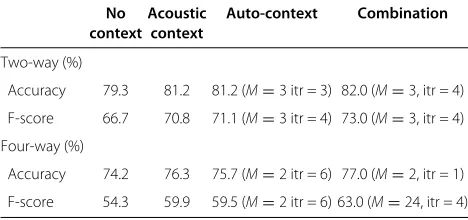
The final results are listed in Table 6. From these results, we can see that although the prosodic contexts used by auto-context achieves comparable performance to direct acoustic context when used separately, the combination of them yields further improvement. Based on the fea-ture set that has included acoustic context, auto-context can give a further accuracy improvement on both of the
Figure 9Performance of the auto-context algorithm on test dataset for word-final boundary detection.(a)Accuracy performance on test data.(b)F-score performance on test data.
pitch accent detection tasks. It improves the accuracy of
two-way detection from 81.2% to 82.0% at M = 3 and
itr =4, and improves the accuracy of four-way detection from 76.3% to 77.0% atM = 2 and itr= 1. It also gives a F-score improvement of more than 2% (from 70.8% to
73.0% at M = 3 itr = 4) for the two-way task and 3%
(from 59.9% to 63.0% atM= 2 itr= 4) for the four-way task. The addition of acoustic context improve the overall performance of auto-context as well, compared to the case of only utilizing prosodic context. For example, without acoustic context information, auto-context can achieve an accuracy of 75.7% on four-way pitch accent detec-tion. When combined with acoustic context, however, the performance improves to 77.0%. These improvements also have been shown in other detection tasks and con-firmed by F-score measurements. This demonstrates that prosodic context and acoustic context provide comple-mentary contextual information and that the auto-context algorithm can effectively combine them together.
6.3 Auto-context on boundary detection
This experiment investigates the performance of auto-context algorithm on boundary detection. Using the boundary-related features introduced in Section 5.2, we obtain a syllable-level accuracy of 88.1% and F-score of
Table 7 Performance of boundary detection when using the auto-context algorithm
Auto-context (%) Accuracy (%) F-score (%) None Auto-context None Auto-context
SL boundary 88.1 89.0 (M=4, itr = 4) 45.3 57.3 (M=5, itr = 6)
WL boundary 81.2 82.9 (M=3, itr = 7) 46.2 58.9 (M=5, itr = 7)
Here, ‘None’ means not using auto-context.
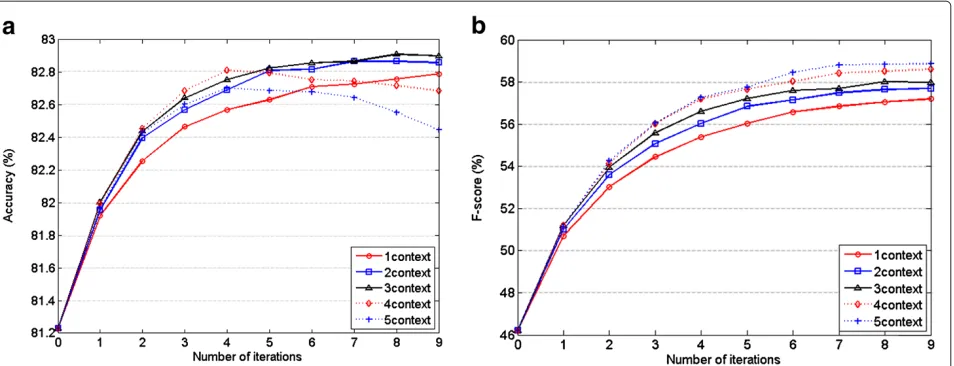
45.3% using overall statistics, and a word-level accuracy of 81.2% and F-score of 46.2% using word-final statistics. On this baseline, we implemented the auto-context algo-rithm across different contextual extents. The syllable-level accuracy and F-score performances are shown in Figure 8a,b, and the corresponding results of the word-level performance are shown in Figure 9a,b.
The final results are listed in Table 7. As we can observe, for boundary detection, the auto-context algorithm yields a nearly 1% improvement using overall statistics and 1.6% improvement using word-final statistics. For the former, it achieves an accuracy of 89.0% atM = 4 and itr = 4, while for the latter, it achieves accuracy of 82.9% atM=3 and itr= 7. Similarly to pitch accent detection, the auto-context algorithm achieved a larger improvement on F-score than the accuracy for the boundary detection task, improving the F-score by about 12% for both statistics. It
Table 8 Performance comparisons of n-gram, CRF, and auto-context methods
N-gram [8] CRF Auto-context
Accuracy (%)
Two-way 80.1 81.1 82.0
Four-way - 76.9 77.0
SL boundary 89.6 88.2 89.0
WL boundary 84.0 82.2 82.9
F-score (%)
Two-way - 72.5 73.0
Four-way - 62.9 63.0
SL boundary - 55.1 57.3
achieves a syllable-level F-score of 57.3% and word-level F-score of 58.9%, respectively.
6.4 Methods comparison
In this section, we compare the performance of our SVM-based auto-context system with two other alternative methods, including an n-gram language model and the CRF approach. For the n-gram approach, we referred to the results of the representative work [8], in which the same two-way pitch accent detection and binary bound-ary detection are implemented on the BURSC dataset using the syllable-level acoustic features of F0, timing cues, and energy. This work used an NN as the clas-sifier and applied the n-gram language model in the rescoring stage in order to utilize context information. The experiments were conducted without considering acoustic dependencies across syllables, and a five-fold cross-validation is used for the measurement of detection accuracy. By using a 4-gram language model, the accuracy of pitch accent detection was substantially improved from 74.1% to 80.1%. However, there was a slight performance degradation for the boundary detection accuracy from 90.0% to 89.6%. We conducted the CRF-related experi-ments using the CRF++ toolkit [30] with the same data and acoustic features (include first-order differential fea-tures), as were used in the auto-context experiments. The The CRF tool does not support continuous features, so we discretized them with a k-means approach. The linear chain CRF model with bigram mode was used, with the model trained using the limited memory BFGS algorithm. Options like cut-off threshold and number of quantized brackets for acoustic features are also optimally tuned using the development dataset. The final results are listed in Table 8. We can observe that the SVM-based auto-context system achieves better performance than CRF, especially in terms of F-score performance for bound-ary detection, which surpasses the CRF algorithm by 2%. There is also an advantage in binary pitch accent detection compared with the n-gram language model based on NN, although the performance on binary boundary detection is not improved.
7 Conclusions
In this paper, we introduce a flexible and effective algo-rithm called auto-context for prosodic event detection. This algorithm uses an iterative approach to incorpo-rate the contextual information to improve prosodic event detection. The probabilities of neighboring syllables are integrated with acoustic features to recursively boost the classification performance of the acoustic models. The experiments on two-way and four-way pitch accent detection and binary boundary detection show that auto-context improves the performance both in terms of accu-racy and F-score measurements. The combination of both
prosodic and acoustic context together gives the best per-formance. For two-way pitch accent detection, accuracy is improved from 79.3% to 82.0% and F-score from 66.7% to 73.0%. For four-way pitch accent detection, accuracy is improved from 74.2% to 77.0% and F-score from 54.3% to 63.0%. Similar improvement is also shown for bound-ary detection. Using the overall statistical method, the detection accuracy is improved from 88.1% to 89.0% and F-score from 45.3% to 57.3%, while using the word-final statistical method, the detection is improved from 46.2% to 58.9%.
Competing interests
The authors declare that they have no competing interests.
Acknowledgements
This work was supported by the National Natural Science Foundation of China under grant nos. 61370034, 61273268, and 61005019.
Author details
1State Key Laboratory of Transducer Technology, Institute of Electronics,
Chinese Academy of Sciences, No.19 North west Rd., Beijing 100190, China. 2University of Chinese Academy of Sciences, No. 19A Yuquan Road, Beijing
100190, China.3National Laboratory for Information Science and Technology, Department of Electronic Engineering, Tsinghua University, Haidian, Beijing 100084, China.4Department of Electrical Engineering, Marquette University, 250 W Wisconsin Ave., Milwaukee, WI 53201, USA.
Received: 14 June 2013 Accepted: 18 December 2013 Published: 28 December 2013
References
1. GA Levow, Context in multi-lingual tone and pitch accent recognition. Paper presented in the 9th International Speech Communication Association conference (Lisbon, Portugal, 4–8 Sept 2005), pp. 1809–1812 2. ML Gregory, Y Altun, Using conditional random fields to predict pitch
accents in conversational speech. Paper presented in the 42nd meeting of the Association for Computational Linguistics (Barcelona, Spain, 21–26 July 2004), pp. 677–683
3. Z Tu, X Bai, Auto-context and its application to high-level vision tasks and 3d brain image segmentation. IEEE Trans. Pattern Anal. Mach. Intell.
32(10), 1744–1757 (2009)
4. A Conkie, G Riccardi, RC Rose, Prosody recognition from speech utterances using acoustic and linguistic based models of prosodic events. Paper presented in sixth European conference on speech communication and technology (Budapest, Hungary, 5–9 Sept 1999), pp. 523–526 5. S Ananthakrishnan, SS Narayanan, An automatic prosody recognizer
using a coupled multi-stream acoustic model and a syntactic-prosodic language model. ICASSP1, 269–272 (2005)
6. X Sun, Pitch accent prediction using ensemble machine learning. Paper presented at the 7th international conference on spoken language processing (Denver, Colorado, 16–20 Sept 2002), pp. 953–956 7. CW Wightman, M Ostendorf, Automatic labeling of prosodic patterns.
IEEE Trans. Speech Audio Process.2, 469–481 (1994)
8. S Ananthakrishnan, S Narayanan, Automatic prosodic event detection using acoustic, lexical and syntactic evidence. IEEE Trans. Audio Speech Lang. Process.16, 216–228 (2008)
9. JH Jeon, Y Liu, Automatic prosodic events detection using syllable-based acoustic and syntactic features. Paper presented at the IEEE international conference on acoustics, speech and signal processing (Taipei, 19–24 April 2009), pp. 4565–4568
10. JH Jeon, Y Liu, Syllable-level prominence detection with acoustic evidence. Paper presented at the 11th annual conference of the International Speech Communication Association (Makuhari, Chiba Japan, 26–30 Sept 2010), pp. 1772–1775
12. R Fernandez, B Ramabhadran, Discriminative training and unsupervised adaptation for labeling prosodic events with limited training data. Paper presented at the 11th annual conference of the International Speech Communication Association (Makuhari, Chiba, Japan, 26–30 Sept 2010), pp. 1429–1432
13. Y Qian, Z Wu, X Ma, F Soong, Automatic prosody prediction and detection with conditional random field models. Paper presented in the 7th international symposium on Chinese spoken language processing (Tainan, Taiwan, 29 Nov–3 Dec 2010), pp. 135–138
14. K Chen, M Hasegawa-Johnson, A Cohen, An automatic prosody labeling system using ANN-based syntactic-prosodic model and GMM-based acoustic prosodic model. ICASSP1, 509–512 (2004)
15. VKR Sridhar, S Bangalore, SS Narayanan, Exploiting acoustic and syntactic features for automatic prosody labeling in a maximum entropy framework. IEEE Trans. Audio Speech Lang. Process.16, 797–811 (2008) 16. A Rosenberg, J Hirschberg, Detecting pitch accents at the word, syllable
and vowel level. Paper presented in the annual conference of the North American Chapter of the Association for Computational Linguistics: human language technologies (Boulder, Colorado, 31 May–5 June 2009), pp. 81–84
17. M Ostendorf, P Price, S Shattuck-Hufnagel,The Boston University Radio News Corpus(Linguistic Data Consortium, Philadelphia, 2013) 18. K Silverman, M Beckman, J Pitrelli, M Ostendorf, C Wightman, P Price,
J Pierrehumbert, J Hirschberg, ToBI: A standard scheme for labeling prosody. Paper presented at the international conference on spoken language processing (Banff, Alberta, Canada, 13–16 Oct 1992), pp. 867–869
19. JH Jeon, Y Liu, Automatic prosodic event detection using a novel labeling and selection method in co-training. Speech Commun.54(3), 445–458 (2012)
20. K Li, S Zhang, M Li, WK Lo, H Meng, Prominence model for prosodic features in automatic lexical stress and pitch accent detection. Paper presented in the 12th annual conference of the International Speech Communication Association (Florence, Italy, 27–31 Aug 2011), pp. 2009–2012
21. E Zwicker, H Fastl,Psychoacoustics—Facts and Models(Springer, New York, 1999)
22. SS Stevens, On the psychophysical law. Psychological64(3), 153–181 (1957)
23. S Nooteboom, The prosody of speech: melody and rhythm, inThe Handbook of Phonetic Sciences, ed. by WJ Hardcastle, J Laver (Wiley, New York, 1997), pp. 640–673
24. P Boersma, A Praat, system for doing phonetics by computer. Glot Int.
5(9–10), 341–345 (2001)
25. AMC Sluijter, VJ van Heuven, Acoustic correlates of linguistic stress and accent in Dutch and American English. ICSLP2, 630–633 (1996) 26. P Taylor, The rise/fall/connection model of intonation. Speech Commun.
15, 169–186 (1994)
27. P Taylor, The tilt intonation model. Paper presented in ICSLP (Sydney, Australia, 30 Nov–4 Dec 1998), pp. 1383–1386
28. A Rosenberg, Automatic detection and classification of prosodic events. PhD thesis (Columbia University, 2009)
29. RE Fan, PH Chen, CJ Lin, Working set selection using second order information for training support vector machines. J. Mach. Learn. Res.
6, 1889–1918 (2005)
30. CRF++: Yet another CRF toolkit. http://crfpp.sourceforge.net/. Accessed 25 March 2012
doi:10.1186/1687-4722-2013-30
Cite this article as: Zhaoet al.:Exploiting contextual information for
prosodic event detection using auto-context.EURASIP Journal on Audio, Speech, and Music Processing20132013:30.
Submit your manuscript to a
journal and benefi t from:
7Convenient online submission
7Rigorous peer review
7Immediate publication on acceptance
7Open access: articles freely available online
7High visibility within the fi eld
7Retaining the copyright to your article