R E S E A R C H A R T I C L E
Open Access
A minimally-intrusive fully 3D separated
plate formulation in computational
structural mechanics
Giacomo Quaranta
1, Mustapha Ziane
1, Eberhard Haug
1, Jean-Louis Duval
1and Francisco Chinesta
2**Correspondence:
[email protected] 2PIMM, ENSAM ParisTech & ESI GROUP Chair on Advanced Modeling and Simulation of Manufacturing Processes, 151 Boulevard de l’Hopital, 75013 Paris, France
Full list of author information is available at the end of the article
Abstract
Most of mechanical systems and complex structures exhibit plate and shell
components. Therefore, 2D simulation, based on plate and shell theory, appears as an appealing choice in structural analysis as it allows reducing the computational complexity. Nevertheless, this 2D framework fails for capturing rich physics compromising the usual hypotheses considered when deriving standard plate and shell theories. To circumvent, or at least alleviate this issue, authors proposed in their former works an in-plane–out-of-plane separated representation able to capture rich 3D behaviors while keeping the computational complexity the one of 2D simulations. In the present paper we propose an efficient integration of fully 3D descriptions into existing plate software.
Keywords: Plate and Shells theories, In-plane–out-of-plane separated representations, PGD, Dynamics
Introduction
We consider the linear elastostatic problem defined in the plate domain=xy×z, with xy = [0, Hx]×[0, Hy] and z = [0, Hz] in which the thickness (out-of-plane)
dimension is much lower than the other ones, i.e.HzHx, Hy.
The linear elastic behavior relating the Cauchy’s stressσand the strainεusing Voigt notation reads
σ=Cε, (1)
whereCis the elasticity matrix. The relation between strainεand displacementu(with componentsu=(u, v, w)) writes
ε= ∇su=Gu, (2)
whereG= ∇s• =12(∇ • +∇T•) is the symmetric gradient operator.
©The Author(s) 2019. This article is distributed under the terms of the Creative Commons Attribution 4.0 International License (http://creativecommons.org/licenses/by/4.0/), which permits unrestricted use, distribution, and reproduction in any medium, provided you give appropriate credit to the original author(s) and the source, provide a link to the Creative Commons license, and indicate if changes were made.
Considering an homogeneous and isotropic material the behavior writes
C= E
(1+ν)(1−2ν)
⎡ ⎢ ⎢ ⎢ ⎢ ⎢ ⎢ ⎢ ⎢ ⎣
1−ν ν ν 0 0 0
ν 1−ν ν 0 0 0
ν ν 1−ν 0 0 0
0 0 0 (1−22ν) 0 0
0 0 0 0 (1−22ν) 0
0 0 0 0 0 (1−22ν)
⎤ ⎥ ⎥ ⎥ ⎥ ⎥ ⎥ ⎥ ⎥ ⎦
. (3)
Withg(x) the body forces, the displacement fieldu(x) forx ∈ is described by the linear momentum balance equation
∇ ·σ+g=0. (4)
The domain boundary∂is partitioned into Dirichlet,D, and Neumann,N, bound-aries, where displacementug and tractionsTare enforced respectively. In what follows
and without loss of generality we assumeT=0
The problem weak form associated to the strong form (4) lies in looking for the dis-placement fielduverifying the Dirichlet boundary conditions such that the weak form
ε(u∗)·(C·ε(u))dx=
u∗·gdx, (5)
fulfills for any test functionu∗, with the trial and test fields defined in appropriate func-tional spaces.
Plate theory
The Reissner–Mindlin theory is based on the following fundamental hypotheses [1]: (i) on the middle plane (z=0) the in-plane displacements vanish, i.e.u(x, y, z=0)=v(x, y, z=
0)=0 that implies that points located in the middle-plane only moves vertically; (ii) the plate thickness remains unchanged; (iii) the plane stress assumption remains valid, i.e.
σzz = 0 and (v) a straight line normal to the undeformed middle plane remains straight but not necessarily orthogonal to the middle plane after deformation.
From these assumptions the displacement field can be written as:
⎧ ⎪ ⎪ ⎨ ⎪ ⎪ ⎩
u(x, y, z)= −zθx(x, y)
v(x, y, z)= −zθy(x, y)
w(x, y, z)=w(x, y)
(6)
wherewis the vertical displacement (deflection) of the points on the middle plane and the rotationsθxandθycoincide with the angles followed by the normal vectors contained in the planesxzandyzrespectively in their motions.
We define the generalized displacement vector ˆu ˆ
u=[θx,θy, w]T (7) defined at any point on the middle plane.
Injecting plate theory assumptions into the 3D elastostatic problem weak form, Eq. (5) reduces to the following 2D formulation
xy
ˆ
ε( ˆu∗)·Cˆˆε( ˆu)dx=
xy ˆ
whose standard finite element discretization leads to
KxyU=Bxy (9)
where for notational simplicity the hat symbol (ˆ•) is omitted. In the previous expression (9),Kxyis the stiffness matrix andUandBxyare the vector of the generalized displacements
and forces, the former containing nodal rotations and deflections and the last the dual quantities: the nodal moments and vertical nodal forces. The 3D displacement field can be then recovered by using the relations (6).
In many cases, the complexity of the solution makes impossible the introduction of pertinent hypotheses for reducing the dimensionality of the model from 3D to 2D. In that case a fully 3D descriptions seem compulsory, and the in-plane–out-of-plane separated representations become particularly suitable.
PGD-based in-plane–out-of-plane decomposition
The in-plane–out-of-plane separated representation was applied in our former works to efficiently solve 3D elastic problems in plate geometries [2–4]. The elastic problem was defined in a plate domain = xy ×z with (x, y) ∈ xy, xy ⊂ R2 andz ∈ z,
z ⊂R. The separated representation of the displacement fieldu =(u, v, w) consists in a finite sum decomposition onN terms, each one of them consisting in the product of two unknown functions, one depending on the in-plane coordinates (x, y) and one on the out-of-plane coordinatez, i.e.:
u(x, y, z)=
⎛ ⎜ ⎜ ⎝
u(x, y, z)
v(x, y, z)
w(x, y, z)
⎞ ⎟ ⎟ ⎠≈
N
i=1
⎛ ⎜ ⎜ ⎝
uixy(x, y)·uiz(z)
vi
xy(x, y)·viz(z) wixy(x, y)·wzi(z)
⎞ ⎟ ⎟
⎠. (10)
Expression (10) can be written in a more compact form by using the Hadamard (component-to-component) product:
u(x, y, z)≈
N
i=1
Ui
xy(x, y)◦Uzi(z). (11)
Enriched formulations
As reported in the previous section plate kinematics can be written as a single-term separated decomposition
⎧ ⎪ ⎪ ⎪ ⎪ ⎨ ⎪ ⎪ ⎪ ⎪ ⎩
u(x, y, z)=θx(x, y)fx(z)
v(x, y, z)=θy(x, y)fy(z)
w(x, y, z)=w(x, y)fz(z)
, (12)
withfx(z)= −z,fy(z)= −zandfz(z)=1.
For the sake of generality we are considering generic functionsfx(z),fy(z) andfz(z) assumed known, but than can be different to the ones related to the standard Reissner– Mindlin plate theory, and its associated 3D kinematics given by Eq. (12). Consequently
The displacements gradient becomes
∇u= ⎛ ⎜ ⎜ ⎜ ⎜ ⎜ ⎜ ⎜ ⎜ ⎜ ⎜ ⎜ ⎜ ⎜ ⎜ ⎜ ⎜ ⎜ ⎜ ⎜ ⎜ ⎝ ∂u ∂x ∂u ∂y ∂u ∂z ∂v ∂x ∂v ∂y ∂v ∂z ∂w ∂x ∂w ∂y ∂w ∂z ⎞ ⎟ ⎟ ⎟ ⎟ ⎟ ⎟ ⎟ ⎟ ⎟ ⎟ ⎟ ⎟ ⎟ ⎟ ⎟ ⎟ ⎟ ⎟ ⎟ ⎟ ⎠ = ⎛ ⎜ ⎜ ⎜ ⎜ ⎜ ⎜ ⎜ ⎜ ⎜ ⎜ ⎜ ⎜ ⎜ ⎜ ⎜ ⎜ ⎜ ⎜ ⎜ ⎜ ⎝ ∂θx ∂x ∂θx ∂y θx ∂θy ∂x ∂θy ∂y θy ∂w ∂x ∂w ∂x w ⎞ ⎟ ⎟ ⎟ ⎟ ⎟ ⎟ ⎟ ⎟ ⎟ ⎟ ⎟ ⎟ ⎟ ⎟ ⎟ ⎟ ⎟ ⎟ ⎟ ⎟ ⎠ ◦ ⎛ ⎜ ⎜ ⎜ ⎜ ⎜ ⎜ ⎜ ⎜ ⎜ ⎜ ⎜ ⎜ ⎜ ⎜ ⎜ ⎜ ⎜ ⎜ ⎜ ⎜ ⎝ fx fx dfx(z)
dz fy
fy dfy(z)
dz fz fz dfz ∂z ⎞ ⎟ ⎟ ⎟ ⎟ ⎟ ⎟ ⎟ ⎟ ⎟ ⎟ ⎟ ⎟ ⎟ ⎟ ⎟ ⎟ ⎟ ⎟ ⎟ ⎟ ⎠ , (13)
that allows defining the strain separated form, that taking into account its symmetry reads
ε= ⎛ ⎜ ⎜ ⎜ ⎜ ⎜ ⎜ ⎜ ⎜ ⎜ ⎜ ⎜ ⎝ ∂u ∂x ∂v ∂y ∂w ∂z ∂u ∂y+ ∂∂vx ∂u ∂z + ∂∂wx ∂v ∂z+∂∂wy
⎞ ⎟ ⎟ ⎟ ⎟ ⎟ ⎟ ⎟ ⎟ ⎟ ⎟ ⎟ ⎠ = ⎛ ⎜ ⎜ ⎜ ⎜ ⎜ ⎜ ⎜ ⎜ ⎜ ⎜ ⎜ ⎝ ∂θx ∂x ∂θy ∂y w ∂θx ∂y θx θy ⎞ ⎟ ⎟ ⎟ ⎟ ⎟ ⎟ ⎟ ⎟ ⎟ ⎟ ⎟ ⎠ ◦ ⎛ ⎜ ⎜ ⎜ ⎜ ⎜ ⎜ ⎜ ⎜ ⎜ ⎜ ⎜ ⎝ fx fy dfz dz fx dfx dz dfy dz ⎞ ⎟ ⎟ ⎟ ⎟ ⎟ ⎟ ⎟ ⎟ ⎟ ⎟ ⎟ ⎠ + ⎛ ⎜ ⎜ ⎜ ⎜ ⎜ ⎜ ⎜ ⎜ ⎜ ⎜ ⎜ ⎝ 0 0 0 ∂θy ∂x ∂w ∂x ∂w ∂y ⎞ ⎟ ⎟ ⎟ ⎟ ⎟ ⎟ ⎟ ⎟ ⎟ ⎟ ⎟ ⎠ ◦ ⎛ ⎜ ⎜ ⎜ ⎜ ⎜ ⎜ ⎜ ⎜ ⎜ ⎜ ⎝ 0 0 0 fy fz fz ⎞ ⎟ ⎟ ⎟ ⎟ ⎟ ⎟ ⎟ ⎟ ⎟ ⎟ ⎠ (14)
=1(x, y)◦F1(z)+2(x, y)◦F2(z). (15) In the case of a general material the Hooke tensor can also be written as
C(x, y, z)=
M
i=1
Ci
xy(x, y)◦Ciz(z). (16)
For an homogenous material we have simply
C=Ci
xy◦Ciz. (17)
whereCzis given by Eq. (3) andCxyis a tensor whose all the entries are 1,
Cxy= ⎡ ⎢ ⎢ ⎢ ⎢ ⎢ ⎢ ⎢ ⎢ ⎣
1 1 1 1 1 1
1 1 1 1 1 1
1 1 1 1 1 1
1 1 1 1 1 1
1 1 1 1 1 1
1 1 1 1 1 1
⎤ ⎥ ⎥ ⎥ ⎥ ⎥ ⎥ ⎥ ⎥ ⎦ . (18)
Taking this into consideration the method that we are going to explain can be used both for homogenous and not homogenous materials. For the sake of simplicity we are going to present it in the case where in expression (16) only one term appears in the sum, but it can be easily extended to involve more terms. The virtual work principle, expressed using a matrix notation, involves the internal work
ε∗Tσ=ε∗TCε
= {1∗(x, y)◦F1(z)+2∗(x, y)◦F2(z)}T{C
{1(x, y)◦F1(z)+2(x, y)◦F2(z)}
=1∗T(x, y){C
xy(x, y)◦Cˆ11z (z)}1(x, y)+1∗T(x, y){Cxy(x, y)◦Cˆ12z (z)}
2(x, y)+2∗T(x, y){C
xy(x, y)◦Cˆ21z (z)}1(x, y)+2∗T(x, y)
{Cxy(x, y)◦Cˆz22(z)}2(x, y). (19)
In the previous expression matrices ˆCijz(z) results
ˆ
Cijzkl(z)=Czkl(z)F
i k(z)F
j
l(z), i, j∈[1,2] &k, l∈[1,· · ·,6]. (20)
Now, the virtual work integral reads
xy×z 2
i=1 2
j=1
i∗T(x, y){C
xy(x, y)◦Cˆijz(z)}j(x, y)dz dx dy
=
xy 2
i=1 2
j=1
i∗T(x, y)Dij(x, y)j(x, y)dx dy, (21)
where
Dij(x, y)=C
xy(x, y)◦
z ˆ
Cij
z(z)dz. (22)
Now, if we assume an approximation based on a piecewise linear interpolation on a triangular finite element, related to an in-plane mesh ofxy = ∪E
e=1exy, with the shape
functions defined byNie(x, y), i=1,2,3;e=1,. . .,E; it results
⎧ ⎪ ⎪ ⎨ ⎪ ⎪ ⎩
θx,e(x, y)=Ne
1(x, y)θ
x,e
1 +N2e(x, y)θ
x,e
2 +N3e(x, y)θ
x,e
3
θy,e(x, y)=Ne
1(x, y)θ
y,e
1 +N2e(x, y)θ
y,e
2 +N3e(x, y)θ
y,e
3
we(x, y)=N1e(x, y)we1+N2e(x, y)w2e+N3e(x, y)we3
(23)
Using that approximation we can express vectorsi(x, y) in each elementefrom the
generalized nodal displacements
UeT =(θx,e
1 ,θ
y,e
1 , we1,θ2x,e,θ
y,e
2 , we2,θ3x,e,θ
y,e
3 , w3e), (24)
from
i((x, y)∈e
xy)=Bi,e(x, y)Ue, (25)
where Bi,e(x, y) contains the shape functions and theirs derivatives, according to the expressions involved in the components ofi(x, y), i=1,2.
Thus, integral (21) reads
E
e=1
Ue∗T ⎧ ⎨ ⎩ e xy 2
i=1 2
j=1
Bi,eT(x, y)Dij(x, y)Bj,e(x, y)dx dy ⎫ ⎬ ⎭Ue
=
E
e=1
Ue∗TKe
xyUe=U∗TKxyU. (26)
Now, if we consider the virtual work of the body forcesg(x), it involves
u∗Tg(x), (27)
where without loss of generality we assume
withVT =(θx,θy, w) andWT =(fx(z), fy(z), fz(z)), and the single-mode decomposition
of the body forces given by
g(x, y, z)=G◦H, (29)
withGT =(Mx(x, y), My(x, y), T(x, y)) andHT =(hx(z), hy(z), hz(z)). The fact of consid-ering a single mode in the decomposition of the body force is not restrictive as discussed later.
The virtual work (27) can be expressed as
u∗Tg(x)=V∗T(x, y)ˆJ(z)G(x, y), (30)
where matrix ˆJreads ˆ
Jkl(z)=IklWk(z)Hl(z), (31) withIthe identity matrix.
Now, the integral results
xy×z
u∗Tg(x)dz dx dy=
xy
V∗T(x, y)JG(x, y)dx dy, (32)
with
J=
z ˆ
J(z)dz, (33)
Integrating in the meshxy = ∪E
e=1exy,
xy
V∗T(x, y)JG(x, y)dx dy=
E
e=1
e xy
Ve∗T(x, y)JGe(x, y)dx dy, (34)
whereVe(x, y) andGe(x, y) are approximated respectively from
Ve(x, y)=N(x, y)Ue, (35)
and
Ge(x, y)=N(x, y)Re, (36)
withRe containing the nodal values ofG(x, y) andN(x, y) = [N1(x, y)N2(x, y)N3(x, y)], and
Ni= ⎛ ⎜ ⎝
Nie(x, y) 0 0
0 Nie(x, y) 0 0 0 Nie(x, y)
⎞ ⎟
⎠. (37)
Thus, it results
E
e=1
e xy
Ve∗T(x, y)JGe(x, y)dx dy=
E
e=1
Ue∗T ⎧ ⎪ ⎨ ⎪ ⎩
e xy
NTJNdx dy ⎫ ⎪ ⎬ ⎪ ⎭R
e
=
E
e=1
Ue∗TAe xyRe=
E
e=1
Ue∗TBe
xy=U∗TBxy, (38)
from which, the principle of virtual works reads
U∗TK
Remark 1 In general the displacement decomposition within the PGD rationale involves more than a single mode, however, within the updating process, when calculating then
mode, then−1 already computed move to the right hand member, acting as generalized body force.
Remark 2 Thus, the in-plane functions determining the kinematics can be obtained from a standard plate theory software by using the elementary rigidity and forces given respec-tively byKe
xyandBexyconsidered in expression (26) and (38).
Remark 3 If tractionT=0the same procedure can be applied to treat the corresponding terms.
Calculation of the out-of plane functions
The expression of solution obtained in the previous section is given by
u(x, y, z)=
⎛ ⎜ ⎝
u(x, y, z)
v(x, y, z)
w(x, y, z)
⎞ ⎟ ⎠=
⎛ ⎜ ⎝
θx(x, y)fx(z) θy(x, y)fy(z) w(x, y)fz(z)
⎞ ⎟
⎠=V(x, y)◦W(z), (40)
where
V(x, y)=
⎛ ⎜ ⎝
θx(x, y) θy(x, y) w(x, y)
⎞ ⎟
⎠ (41)
and
W(z)=
⎛ ⎜ ⎝
fx(z)
fy(z)
fz(z) ⎞ ⎟
⎠. (42)
Now, we proceed to updated the out-of-plane functions involved inW(z) from the just calculated in-plane functionsV(x, y) by considering again the principle of virtual work
xy×z
ε(u∗)·(C·ε(u)dx=
xy×z
u∗·fdx (43)
where now in Eq. (40) the in-plane functions are assumed known and we look for the ones involved in the out-of-plane contributionW(z). Thus, the previous integral form can be integrated onxy, and then Eq. (43) reduced to a one dimensional problem inz involving as unknown functionsfx(z),fy(z) andfz(z).
The same rationale that was previously addressed when performing the in-plane calcu-lations is considered again but now with the test functions given by
ε∗=1(x, y)◦F1∗(z)+2(x, y)◦F2∗(z), (44)
and
u∗(x, y, z)=V(x, y)◦W∗(z). (45)
Fig. 1 The problem taken into consideration
Table 1 Model parameters
Hx: Length in thexdirection (mm) 250
Hy: Length in theydirection (mm) 250
Hz: Length in thezdirection (mm) 250
E: Young modulus (N/m2) 2·1011
ν: Poisson coefficient 0.25
Numerical results
The problem taken into consideration is depicted in Fig.1. The geometrical and mechan-ical properties of the plate domain=[0, Hx]×[0, Hy]×[0, Hz] are defined in Table1
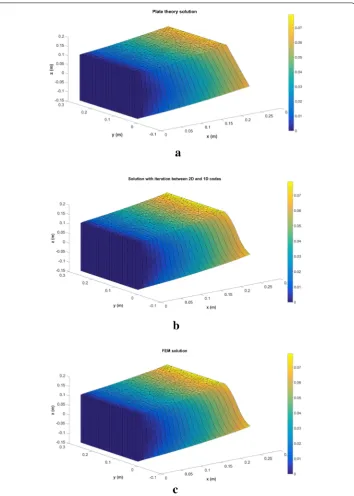
On the right boundary face of the domain (the blue zone in Fig.1) a vertical traction is enforced, T = (0,0,8·109)N/m2 and on the opposite face homogeneous Dirichlet boundary conditions are imposed. No volumetric body forces are considered. As in the considered domain the thickness (out-of-plane) dimension is not much lower than the other ones (in-plane dimensions), the linear variation of the displacement field along the thickness described by (2) is not more true as we can notice in Fig.2that compares the plate solution from the fully 3D solution assumed as reference. However using the just proposed minimally-intrusive fully 3D separated plate formulation we can notice how the solution is improved. Figure 3 shows the error of the solution respect to the 3D FEM solution, computed as
ξ(u)=
(u−uFEM)2dx 1 2
(uFEM)2dx 1
2
, (46)
as a function of the number of modes. The error of the plate theory solution results
ξ(uplate)=0.0633.
Fig. 2 Displacement field using: plate theory (a), minimally-intrusive fully 3D separated plate formulation (b), 3D FEM (c)
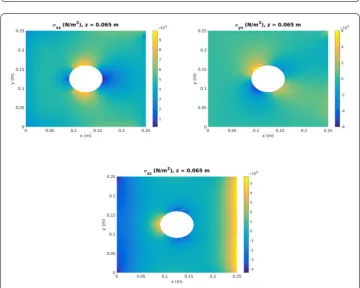
in plate theory, and to obtain the parabolic evolution around the thickness for theσxzand
σyztypical of a 3D solution (Fig.7).
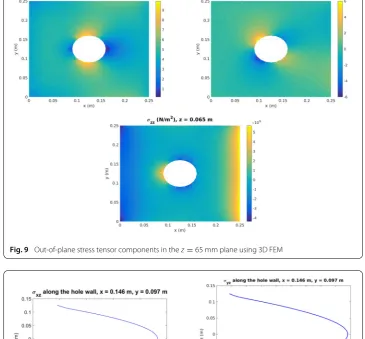
In Figs.8,9and10the same quantities are computed using a 3D finite element method, proving the good accuracy of the proposed method.
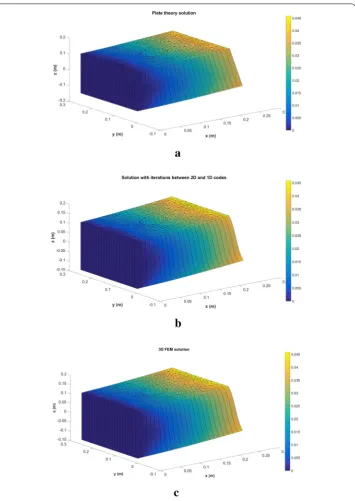
Again, in Fig.11shows the error of the solution respect to the 3D FEM solution as a function of the number of modes. The error of the plate theory solution beingξ(uplate)=
0 10 20 30 40
number of modes
0 0.01 0.02 0.03
0.04 Error respect to the 3D solution
Fig. 3 Error of the enriched solution respect to the 3D solution for different number of modes
Extension of the method to elasto-plastic dynamics
In this section we extend the method to dynamics problem in which plastic behavior can occur. Withg(x, t) the body forces, the displacement field evolutionu(x, t) in the domain
and time intervalt∈I=(0, T] is described by the linear momentum balance equation
ρu¨(x, t)= ∇ ·σ+g, (47)
whereρis the density (kg/m3).
The boundary∂is decomposed according to∂=D∪Nwhere displacement and tractionsT(t) are prescribed.
The behavior relating the Cauchy’s stressσand the elastic strainεereads [5]
σ=Cεe=C(ε−εp), (48)
whereCis the Hooke tensor,εis total strain andεpis the plastic strain.
The problem weak form associated with the strong form (47) results in looking for the displacement fielduverifying the initial and Dirichlet boundary conditions, and fulfilling
ρ
u∗·u¨dx+
ε(u∗)·(C (ε(u)−εp(u)))dx=
u∗·gdx+
N
u∗·T(t)dx
(49)
for any test functionu∗in an appropriate functional space.
We consider at timetj+1the standard explicit time integration [6] (widely considered in commercial codes) given by
ρ
u∗·uj+1−2uj+uj−1
t2 dx+
ε(u∗)·
C ε(uj)−εp(uj)
dx
=
u∗·gjdx+
N
u∗·Tjdx, (50)
Fig. 4 Displacement field using: plate theory (a), minimally-intrusive fully 3D separated plate formulation (b), 3D FEM (c)
ρ
u∗·uj+1dx=ρ
u∗·2uj−uj−1dx
−t2 ⎛ ⎜ ⎝
ε(u∗)·
Cε(uj)−εp(uj)
dx+
u∗·gjdx+
N
u∗·Tjdx ⎞ ⎟ ⎠.
Fig. 5 Out-of-plane stress tensor components around the hole using the minimally-intrusive fully 3D separated plate formulation
Fig. 7 Out-of-plane stress tensor components around the hole forx=146 mm andy=97 mm using the minimally-intrusive fully 3D separated plate formulation
Fig. 9 Out-of-plane stress tensor components in thez=65 mm plane using 3D FEM
0 5 10 15 20 25 30
number of modes
0 0.01 0.02 0.03 0.04
0.05 Error respect to the 3D solution
Fig. 11 Error of the enriched solution respect to the 3D solution for different number of modes
Recalling (28) we can write
uj+1(x, y, z)=Vj+1◦Wj+1. (52)
Supposing the out-of-plane functions known, the left hand side term in (51) can be expressed as
u∗Tuj+1(x)=Vj+1,∗T(x, y)ˆJj+1(z)Vj+1(x, y), (53) where matrix ˆJj+1reads
ˆ
Jj+1
kl (z)=IklWjk+1(z)W j+1
l (z), (54)
withIthe identity matrix. Now, the integral results
ρ
u∗·uj+1dz dx dy=
xy
Vj+1,∗T(x, y)Jj+1Vj+1(x, y)dx dy, (55)
with
Jj+1=
z ˆ
Jj+1(z)dz, (56)
Integrating in the meshxy = ∪E
e=1exy,
xy
Vj+1,∗TJj+1Vj+1dx dy=
E
e=1
e xy
Vj+1,e∗TJj+1Vj+1,edx dy, (57)
whereVj+1,e(x, y) is approximated from
Vj+1,e(x, y)=N(x, y)Uj+1,e, (58)
withN(x, y)=[N1(x, y)N2(x, y)N3(x, y)], and
Ni= ⎛ ⎜ ⎝
Nie(x, y) 0 0
0 Nie(x, y) 0 0 0 Nie(x, y)
⎞ ⎟
Fig. 12 The elasto-plastic dynamical problem taken into consideration
Table 2 Model parameters
Hx: Length in thexdirection (mm) 250
Hy: Length in theydirection (mm) 250
Hz: Length in thezdirection (mm) 20
E: Young modulus (N/m2) 6.68·1010
ν: Poisson coefficient 0.35
ρ: Density (kg/m3) 2700
Thus, it results
E
e=1
e xy
Vj+1,e∗TJj+1Vj+1,edx dy=
E
e=1
Uj+1,e∗T ⎧ ⎪ ⎨ ⎪ ⎩
e xy
NTJj+1Ndx dy
⎫ ⎪ ⎬ ⎪ ⎭U
j+1,e
=
E
e=1
Uj+1,e∗TMj+1,e
xy Uj+1,e=Uj+1,∗TMjxy+1Uj+1. (60)
The different terms at the right hand side of (51) can be treated in a similar way, as already explained for the static case, so that at each time stepjthe virtual work principle reads
Uj+1,∗TMj+1
xy Uj+1=Uj+1,∗TBjxy. (61)
Remark 4 As for the static case, the in-plane functions determining the kinematics can be obtained from a standard plate theory software by using the elementary mass and forces given respectively byMjxy+1,eandBj,exy.
Remark 5 Again the out-of-plane functions can be obtained in a similar manner as already explained in the static case.
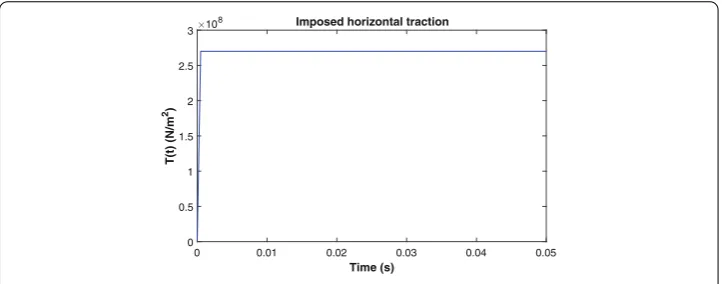
For evaluating the performances of the method we consider the problem defined in Fig.12. The geometrical and mechanical properties of the plate domain are defined in Table2. On the right boundary face of the domain (the blue zone in Fig.12) an horizontal traction is enforced, T = (2.7·108,0,0)N/m2and on the opposite face homogeneous Dirichlet boundary conditions are imposed. No volumetric body forces are considered. For the sake of simplicity, we use the Von Mises criterion [7], assuming a Krupkowski isotropic hardening [8] given by the formula:
¯
σ =Kε¯0+εp¯
p
(62)
where ¯ε0=0.008 is the initial equivalent plastic strain, ¯εpis the equivalent plastic strain,
0 0.01 0.02 0.03 0.04 0.05
Time (s)
0 0.5 1 1.5 2 2.5 3
T(t) (N/m
2)
108 Imposed horizontal traction
Fig. 13 Horizontal loading for the elasto-plastic dynamical problem
Fig. 14 Displacement field using the three methods fort=0.1 ms andt=0.5 ms
Fig. 15 Displacement field using the three methods fort=1 ms andt=5 ms
⎧ ⎪ ⎪ ⎨ ⎪ ⎪ ⎩
u(x, y, z)=u0(x, y)−zθx(x, y)
v(x, y, z)=v0(x, y)−zθy(x, y)
w(x, y, z)=w0(x, y)
(63)
where u0, v0 and w0 are the displacements of the points on the middle plane along
x, y and z respectively and the rotations θx and θy coincide with the angles fol-lowed by the normal vectors contained in the planes xz and yz respectively in their motions.
Again the solution computed using the proposed method is able to get a 3D behavior (as the one of the 3D FEM solution) with the striction along the thickness in the zone with a smaller section, which is typical of a 3D plastic solution.
Conclusions
Fig. 16 Displacement field using the three methods fort=10 ms andt=30 ms
1D problems extremely simple and cheap, is externalized and ensured by a function called by the plate solver.
The different numerical examples prove the procedure efficiency that allows computing 3D solutions while keeping the computational cost the one characteristic of standard 2D plate and shell calculations.
Authors’ contributions
GQ, MZ, EH, JLD and FC authors participated in the definition of techniques and algorithms. All authors read and approved the final manuscript.
Author details
1ESI Group, Parc Icade, Immeuble le Seville, 3 bis, Saarinen, CP 50229, 94528 Rungis Cedex, France,2PIMM, ENSAM ParisTech & ESI GROUP Chair on Advanced Modeling and Simulation of Manufacturing Processes, 151 Boulevard de l’Hopital, 75013 Paris, France.
Acknowledgements
Authors acknowledge the support of the ESI Group through its research chair at ENSAM ParisTech.
Funding
This project has received funding from the European Union’s Horizon 2020 research and innovation programme under the Marie Skłodowska-Curie Grant Agreement No. 675919.
Availability of data and materials
Interested reader can contact authors.
Competing interests
Appendix A: Calculation of the out-of plane functions in a minimally-intrusive manner
We write the virtual work principle
ε∗Tσ=ε∗TCε
= {1(x, y)◦F1∗(z)+2(x, y)◦F2∗(z)}T{C
xy(x, y)◦Cz(z)} {1(x, y)◦F1(z)+2(x, y)◦F2(z)}
=F1∗T(x, y){Cˆ11
xy(x, y)◦Cz(z)}F1(x, y)+F1∗T(x, y){Cˆ12xy(x, y)◦Cz(z)}
F2(x, y)+F2∗T(x, y){Cˆ21
xy(x, y)◦Cz(z)}F1(x, y)+F2∗T(x, y) {Cˆ22
xy(x, y)◦Cz(z)}F2(x, y). (64)
In the previous expression matrices ˆCijxy(x, y) results
ˆ
Cij
xykl(x, y)=Cxykl(x, y)
i k(x, y)
j
l(x, y), i, j∈[1,2] & k, l∈[1,· · ·,6]. (65)
Now, the virtual work integral reads
xy×z 2
i=1 2
j=1
Fi∗T(z){Cˆij
xy(x, y)◦Cz(z)}Fj(z)dz dx dy
=
z 2
i=1 2
j=1
Fi∗T(z)Pij(z)Fj(z)dz, (66)
where
Pij(z)=C z(z)◦
xy ˆ
Cij
xy(x, y)dx dy. (67)
Now, if we assume for instance an approximation based on piecewise linear interpola-tions on the 1D finite element mesh ofz = ∪Qq=1qz, with the shape functions defined
byNiq(z), i=1,2; q=1,. . .,Q; it results
⎧ ⎪ ⎪ ⎨ ⎪ ⎪ ⎩
fx,q(z)=N1q(z)f1x,q+N2q(z)f2x,q
fy,q(z)=N1q(z)f1y,q+N2q(z)f2y,q
fz,q(z)=N1q(z)f1z,q+N2q(z)f2z,q
(68)
Using that approximation we can express vectorsFi(z) in each elementq zfrom
LqT =(fx,q
1 , f
y,q
1 , f
z,q
1 , f
x,q
2 , f
y,q
2 , f
z,q
2 ), (69)
and
Fi(z∈q
z)=Ti,q(z)Lq, (70)
Thus, integral (66) reads
Q
q=1
Lq∗T ⎧ ⎪ ⎨ ⎪ ⎩ q z 2
i=1 2
j=1
Ti,qT(z)Pij(z)Tj,q(z)dz ⎫ ⎪ ⎬ ⎪ ⎭L q = Q
q=1
Lq∗TKq
zLq=L∗TKzL. (71)
The virtual work (27) of the body forces can be expressed as
u∗Tg(x)=W∗T(z) ˆO(x, y)H(z), (72)
where matrix ˆOreads ˆ
Okl(x, y)=IklVk(x, y)Gl(x, y), (73)
withIthe identity matrix. Now, the integral results
xy×z
u∗Tg(x)dz dx dy=
z
W∗T(z)OH(z)dz, (74)
with
O=
xy ˆ
O(x, y)dx dy, (75)
Integrating in the meshz= ∪Qq=1qz,
z
W∗T(z)OH(z)dz=
Q
q=1
q z
Wq∗T(z)OHq(z)dz, (76)
whereWq(z) andHq(z) are approximated respectively from
Wq(z)=S(z)Lq, (77)
and
Hq(z)=S(z)Mq, (78)
withMqcontaining the nodal values ofH(z) andS(z)=[N1(z)N2(z)], and
Ni=
Niq(z) 0 0 Niq(z)
. (79)
Thus, it results
Q
q=1
q
Wq∗T(z)OHq(z)dz=
Q
q=1
Lq∗T ⎧ ⎪ ⎨ ⎪ ⎩ q z
STOSdz ⎫ ⎪ ⎬ ⎪ ⎭M q = Q
q=1
Lq∗TAq zMq=
Q
q=1
Lq∗TBq
z =L∗TBz, (80)
from which, the principle of virtual works reads
L∗TK
zL=L∗TBz. (81)
Thus, the out-of-plane functions determining the kinematics can be obtained from a standard 1D software by using the elementary rigidity and forces given respectively byKzq andBqz considered in expression (71) and (80).
References
1. Oñate E. Structural analysis with the finite element method. Linear statics, vol. 2., Beams, plates and shellsNew York: McGraw-Hill; 2010.
2. Bognet B, Bordeu F, Chinesta F, Leygue A, Poitou A. Advanced simulation of models defined in plate geometries: 3D solutions with 2D computational complexity. Comput Methods Appl Mech Eng. 2012;201:1–2.
3. Bognet B, Leygue A, Chinesta F. Separated representations of 3D elastic solutions in shell geometries. Adv Model Simul Eng Sci. 2014;1(1):4.
4. Quaranta G, Bognet B, Ibañez R, Tramecon A, Haug E, Chinesta F. A new hybrid explicit/implicit in-plane-out-of-plane separated representation for the solution of dynamic problems defined in plate-like domains. Comput Struct. 2018;210:135–44.
5. Owen DRJ, Hinton E. Finite elements in plasticity: theory and practice. Swansea: Pine Ridge Press; 1980. 6. Bathe KJ. Finite element procedures, vol. 2. 2006.
7. Mises RV. Mechanik der festen Krper im plastisch-deformablen Zustand. Nachrichten von der Gesellschaft der Wis-senschaften zu Gottingen. Mathematisch-Physikalische Klasse. 1913;1913:582–92.
8. Siser M, Slota J. Material Model of AW 5754 H11 Al alloy for numerical simulation of deep drawing process, vol. 20. 2016.
9. Wilkins ML, Streit RD, Reaugh JE. Cumulative-strain-damage model of ductile fracture: simulation and prediction of engineering fracture tests. San Leandro: Science Applications; 1980.
Publisher’s Note