R E S E A R C H
Open Access
Optimization of algal methyl esters using RSM and
evaluation of biodiesel storage characteristics
Annam Renita A
1*, Nurshaun Sreedhar
1and Magesh Peter D
2Abstract
Background:This paper deals with the production of biodiesel from the brown seaweedSargassum myriocystum, a third-generation biodiesel from the Gulf of Mannar, Rameshwaram, India. The optimization of reaction parameters was done using Design-Expert software version 8.0.7.1. Algal oil was transesterified using methanol and sodium hydroxide. The effect of oil:alcohol ratio, catalyst amount, temperature, and time on biodiesel yield was investigated by response surface methodology using central composite design.
Results:It was found that the maximum biodiesel yield was obtained at 60°C for 1:6 (v/v) oil:alcohol ratio, 0.4 (w/w) catalyst amount, and 120 min. TheR2, adjustedR2, and predictedR2values are 0.9977, 0.9956, and 0.9923, respectively, which implies that experimental values are in good agreement with predicted values. The fatty acid profile ofS. myriocystumbiodiesel was determined using gas chromatography. Algal biodiesel was stored in dark and light conditions. Fuel properties like kinematic viscosity and acid value were determined. It was found that the samples exposed to light led to an increase in kinematic viscosity and acid value with some sediment formation.
Conclusions:The acid value and kinematic viscosity of the samples stored in the dark environment had only marginal increase in fuel properties which were within the range specified by the American Society of Testing Materials (ASTM D6751).
Keywords:Brown seaweed; Transesterification; Biodiesel; Optimization; RSM; Fatty acid profile; Storage properties
Background
India consumes almost five times more diesel fuel than gasoline and burns about 450 million barrels a year of diesel [1]. So in India, search for alternatives is an im-portant criterion to meet current and future energy re-quirements. India's tropical climate is ideal for the growth of algal species which serves as an advantage over other countries. Approximately 841 species of marine algae are found in both intertidal and deep water regions of the Indian coast [2]. Less than 100 species have been explored for biodiesel extraction. There are two global biorenew-able liquid transportation fuels that might replace gasoline and diesel fuel in the future. These are bioethanol and bio-diesel [3]. Biobio-diesel is a processed fuel derived from the esterification and transesterification of free fatty acids and triglycerides, respectively, that occur naturally in renew-able biological sources such as plant oils and animal fats
[4]. Different countries use the oil which is abundant in that particular country. India, being a peninsula, has a rich source of seaweeds. Algae are classified as microalgae and macroalgae. The potential value of microalgal fuel produc-tion is widely recognized [5-11]. Macroalgae, which are also known as seaweeds, have comparatively low lipid content. Nevertheless, they are a potential raw material for biofuel production. Biodiesel has good biodegradabil-ity, and it is expected to degrade over 98% biologically within 3 weeks while commercial diesel will only degrade 50% biologically within the same period [12]. In Indian waters, species ofSargassumare the most abundant algae [13]. The seaweeds detach themselves from the rocky sub-strates and are frequently washed ashore. Though details of the phytoprofile [2], antioxidant activity, free scavenger property [14], and fatty acid profile of Sargassum have been reported, optimization of biodiesel yield and storage properties have not been reported regarding its suitability as a raw material for biodiesel. Hence, this paper deals with the production of biodiesel from the brown seaweed Sargassum myriocystumas a potential resource for biodiesel. * Correspondence:[email protected]
1
Department of Chemical Engineering, Sathyabama University, Jeppiaar Nagar, Rajiv Gandhi Salai, Chennai TN 119, India
Full list of author information is available at the end of the article
Algal oil extracted from the brown seaweedS. myriocystum was transesterified to biodiesel. Analysis of the biodiesel sample was done using gas chromatography-mass spec-trometry (GC-MS). The GC-MS of the biodiesel sample in-dicated the presence of low amounts of unsaturated fatty acids [15]. Since the fatty acid profile predicted low concen-tration of unsaturated fatty acids, the biodiesel sample was tested for storage properties. Biodiesel production from algae is hindered by its production cost. This can be over-come by optimizing the reaction parameters to achieve maximum production of biodiesel with minimum cost of raw materials. For this research work, optimization of reac-tion condireac-tions was done by Design-Expert software version 8.0.7.1 (Stat-Ease Inc., Minneapolis, MN, USA). Central composite design (CCD) was applied to optimize the cata-lyzed transesterification reaction variables like oil:alcohol ra-tio, catalyst amount, time, and temperature. Regression analysis and analysis of variance (ANOVA) tested the signifi-cance of the model.S. myriocystumis also rich in proteins and sugars. It is being used in food and pharmaceutical in-dustries [16]. By applying the biorefinery concept, all valu-able end products can be extracted from S. myriocystum, thus making the cost of algal biodiesel economically viable. This study will enable the seaweed to be considered as a po-tential option as a biorefinery crude.
Methods
Raw materials
The brown seaweed S. myriocystum belonging to the class Phaeophyceae was obtained from the Gulf of Mannar, Rameshwaram, India. The seaweed species was chosen be-cause of its availability and lipid profile. It is available all through the year and shows high productivity during the months of July and September. The samples were first washed with seawater and the debris was removed manu-ally. Then they were washed with distilled water, shade dried under the sun, and finally dried in an oven at 60°C. Ten kilograms of wet algae was collected, and after drying, 8.8 kg of dry algae was obtained. Hexane (≥85%), chloro-form (≥98%), methanol (≥99%), and sodium hydroxide (≥98%) used for the experiments were of analytical grade.
Experimental method
The dried algae, which were chopped into fine pieces, were ground into fine powder which passes through 200 mesh size. Two solvent extraction systems were tested to find out the best suitable solvent for extraction of lipids. In one system, the solvent system was hexane and the second solvent system was chloroform:methanol (2:1v/v). The solvent extraction was done by a Soxhlet apparatus, and the extracted algal oil was vacuum evapo-rated in a rotary evaporator to obtain pure algal oil. The chloroform:methanol solvent system extracted lipids bet-ter than hexane. Using the chloroform:methanol solvent
system, 5.2 kg of algal oil was extracted. The viscosity of the algal oil has to be reduced in order to be an accept-able fuel for running an engine. The most possible method of reducing the viscosity and the commercially accepted method is the chemical transesterification method. In this process, the pure algal oil was reacted with methanol in the presence of sodium hydroxide catalyst to produce fatty acid methyl esters (FAME), which more closely resemble petroleum-based diesel fuel, and glycerol is obtained as a co-product. Sodium hydroxide was dissolved in methanol and stirred for 20 min prior to transesterification to ensure the complete dissolution of sodium hydroxide pellets. Algal oil and premixed mixture of catalyst and alcohol are kept in a round-bottom flask fitted with a reflux condenser to maintain isothermal operation. The round-bottom flask was mounted on top of a magnetic stirrer, and the reac-tion was carried out with continuous stirring. Experi-ments were done with different feed ratios of oil:alcohol, catalyst amounts, temperatures, and times to obtain the highest yield of biodiesel. Experiments on volume basis for oil:alcohol ratio were done on trial and error analysis. The volume ratio was chosen for ease of application in commercial processes. All the experiments were done in triplicate to ensure the reproducibility of the data. The error of analysis for the experimental procedure is ap-proximately ±5%. The product mixture is biodiesel and glycerol. Both phases were separated using a gravity separ-ator. The biodiesel which was obtained as the upper layer was washed with hot water and cold water alternately to remove impurities like sodium hydroxide, methanol, and foam. The sample was fan dried and stored for analysis. The yield of biodiesel is estimated from Equation 1:
Yield of biodiesel ¼ Weight of algal oil=Weight of raw material 100
ð1Þ
Statistical analysis
intensity, and organic solvents [19]. The CCD of the RSM was employed to evaluate the effect of reaction time, reaction temperature, catalyst amount, and oil:al-cohol ratio on biodiesel yield. The coded values for the variables are shown in Table 1.
The empirical formula to find the optimal biodiesel yield is given by Equation 2:
Y ¼β0þβ1Aþβ2Bþβ3Cþβ4Dþβ5ABþβ6AC þβ7ADþβ8BCþβ9BDþβ10CDþβ11A2þβ12B2 þβ13C2þβ14D2
ð2Þ
where Y is the measured response in percentage yield (biodiesel yield). A, B, C, and D are the coded independ-ent inputs.β0is the intercept term andβ1,β2,β3, and β4 are the coefficients showing the linear effects.β5, β6,β7, β8, β9, andβ10 are the cross-product coefficients show-ing the interaction effects. β11, β12, β13, andβ14 are the quadratic coefficients showing the squared effects.
Table 1 Coded levels for variables used in the experimental design
Factors Symbol Coded levels
−1 0 +1
Oil:alcohol ratio (v/v) A 4 6 8
Catalyst amount (w/w) B 0.1 0.3 0.5
Time (min) C 30 90 150
Temperature (°C) D 50 70 90
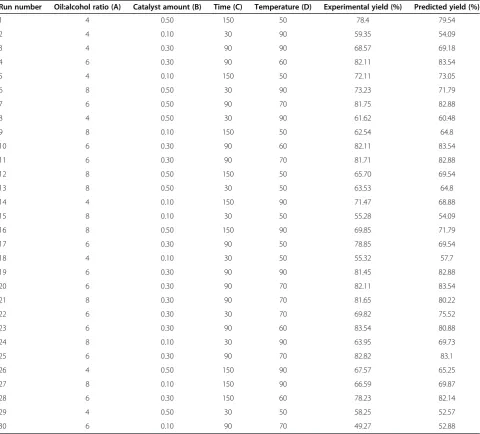
Table 2 Central composite design matrix forSargassum myriocystumbiodiesel
Run number Oil:alcohol ratio (A) Catalyst amount (B) Time (C) Temperature (D) Experimental yield (%) Predicted yield (%)
1 4 0.50 150 50 78.4 79.54
2 4 0.10 30 90 59.35 54.09
3 4 0.30 90 90 68.57 69.18
4 6 0.30 90 60 82.11 83.54
5 4 0.10 150 50 72.11 73.05
6 8 0.50 30 90 73.23 71.79
7 6 0.50 90 70 81.75 82.88
8 4 0.50 30 90 61.62 60.48
9 8 0.10 150 50 62.54 64.8
10 6 0.30 90 60 82.11 83.54
11 6 0.30 90 70 81.71 82.88
12 8 0.50 150 50 65.70 69.54
13 8 0.50 30 50 63.53 64.8
14 4 0.10 150 90 71.47 68.88
15 8 0.10 30 50 55.28 54.09
16 8 0.50 150 90 69.85 71.79
17 6 0.30 90 50 78.85 69.54
18 4 0.10 30 50 55.32 57.7
19 6 0.30 90 90 81.45 82.88
20 6 0.30 90 70 82.11 83.54
21 8 0.30 90 70 81.65 80.22
22 6 0.30 30 70 69.82 75.52
23 6 0.30 90 60 83.54 80.88
24 8 0.10 30 90 63.95 69.73
25 6 0.30 90 70 82.82 83.1
26 4 0.50 150 90 67.57 65.25
27 8 0.10 150 90 66.59 69.87
28 6 0.30 150 60 78.23 82.14
29 4 0.50 30 50 58.25 52.57
Evaluation of storage properties
A good fuel should have low amounts of unsaturated fatty acids. The fatty acid profile was determined by GC-MS. SinceS. myriocystumbiodiesel has low amounts of unsat-urated fatty acids, the fuel was investigated for its storage properties. Fuel properties like kinematic viscosity and acid value were determined at different time intervals to determine the shelf life of S. myriocystum biodiesel. The samples were stored for a period of 5 months from March to July, which is the average summer period in India. The samples were stored in two different conditions. Two li-ters of sample was kept in a stoppered amber glass bottle and exposed to sunlight for a period of 5 months, and properties like kinematic viscosity and acid value were de-termined in an interval of 1 month. Another 2 l of sample was kept in a stoppered amber glass bottle in a dark room for a period of 5 months, and properties like kinematic viscosity and acid value were determined at an interval of 1 month.
Results and discussion
Response surface methodology
The Design-Expert software developed a 24 factorial CCD resulting in 30 runs with eight axial points and six replicates. The second-order polynomial equation pre-dicted by the model for maximum algal biodiesel is given by Equation 3:
Percentage yield¼92:88þ0:52Aþ1:33Bþ3:43C þ1:96Dþ1:61AB−2:22AC þ1:30AD−1:45BCþ0:025BD
−1:21CD−3:19A2−2:94B2−8:94C2
−3:24D2
ð3Þ
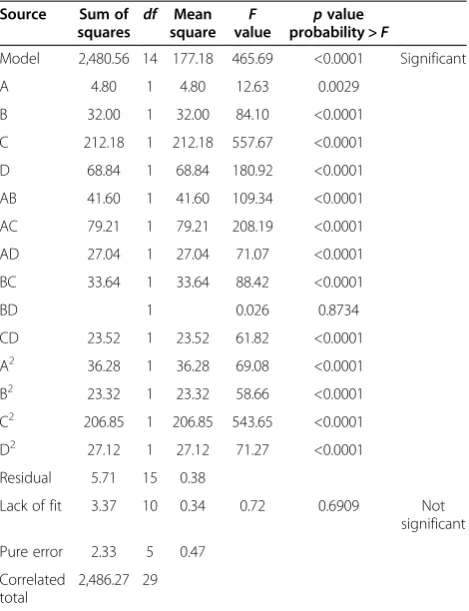
where A, B, C, D are the coded forms of oil:alcohol ratio, catalyst amount, time, and temperature, respectively. AB, AC, AD, BC, BD, and CD are the interaction terms, and A2, B2, C2, and D2are the squared terms of the in-dependent variables. The CCD matrix is represented by Table2. Table3shows ANOVA.
The results of ANOVA for the predicted values fit well with the experimental values. The goodness of fit of the model is predicted by the determination coefficient value of 0.9977 and the adjustedR2values of 0.9956. The pre-dicted value is also in good agreement with adjusted R2 value implying the significance of the model. Only 0.23% of the sample variance could not be satisfactorily ex-plained by the model. Hence, the predictability of the model is at 99% confidence interval. Lack of fit is also not significant, indicating the goodness of fit of the model. The pvalue serves as a tool to check the significance of
each coefficient. The smaller the p value and the larger theFvalue, the more significant is the parameter reflect-ing the relative importance of the term attached to that parameter [20]. ANOVA for the response surface quad-ratic model gave anF value of 465.69, with a pvalue of <0.0001, implying its significance.
Two-dimensional (contour) and three-dimensional (sur-face) plots indicate the effect of interaction of the different test variables on the predicted response. The three-dimensional graphs and contour graphs are the common graphical representation of the regression equation which shows the optimal values of each dependent variable [21]. Four surface and contour plots are shown to indicate the effect of interaction of oil:alcohol ratio, catalyst amount, time, and temperature on biodiesel yield. From the shape of contour plots, one could estimate the significance of the mutual interactions between the independent variables in that an elliptical profile of the contour plots indicates a remarkable interaction between the independent variables [22]. Figures 1a and 2a show the interaction between temperature and time on biodiesel yield. They show the interaction between time and temperature at a catalyst amount of 0.4 (w/w) and oil:alcohol ratio of 1:6 (v/v). The midpoint of the plots gives the maximum value of 81.79% which is obtained at 1:6 (v/v) oil:alcohol ratio Table 3 ANOVA forSargassum myriocystumbiodiesel and regression coefficient estimate
Source Sum of squares df Mean square F value pvalue probability >F
Model 2,480.56 14 177.18 465.69 <0.0001 Significant
A 4.80 1 4.80 12.63 0.0029
B 32.00 1 32.00 84.10 <0.0001
C 212.18 1 212.18 557.67 <0.0001
D 68.84 1 68.84 180.92 <0.0001
AB 41.60 1 41.60 109.34 <0.0001
AC 79.21 1 79.21 208.19 <0.0001
AD 27.04 1 27.04 71.07 <0.0001
BC 33.64 1 33.64 88.42 <0.0001
BD 1 0.026 0.8734
CD 23.52 1 23.52 61.82 <0.0001
A2 36.28 1 36.28 69.08 <0.0001
B2 23.32 1 23.32 58.66 <0.0001
C2 206.85 1 206.85 543.65 <0.0001
D2 27.12 1 27.12 71.27 <0.0001
Residual 5.71 15 0.38
Lack of fit 3.37 10 0.34 0.72 0.6909 Not significant
Pure error 2.33 5 0.47
Correlated total
2,486.27 29
R2
0.9977; adjustedR2
0.9956; predictedR2
and 120 min. For low oil:alcohol ratio, the yield value is marginally low at 49.18%. High oil:alcohol ratios are not economically and environmentally viable. More-over, excessive methanol amounts may reduce the con-centration of the catalyst in the reactant mixture and retard the transesterification reaction [23]. Figures 1b and 2b show the interaction between time and oil:alcohol ratio on biodiesel yield. The biodiesel yield progressively increases as temperature increases and shows a decline after 60°C. This could be due to the fact that the solvent tends to evaporate after 60°C since it exceeds its boiling point. Figures 1c and 2c show the interaction between temperature and catalyst amount on biodiesel yield. At low catalyst concentration, the biodiesel yield shows a de-cline till 0.3 wt% and starts increasing from 0.4 to 0.5 wt%. After 0.4 wt%, the washing of the biodiesel layer developed more foam because of the residual catalyst. Figures 1d and 2d show the interaction between catalyst amount and oil: alcohol ratio on biodiesel yield. The biodiesel yield pro-gressively increases as oil:alcohol ratio increases and starts decreasing after 1:7. At low oil:alcohol ratio, phase separ-ation between biodiesel and glycerol layer was not ob-served, and as the ratio increased, a good phase separation was achieved.
The optimum values of the variables as predicted by the model are 1:6 (v/v) oil:alcohol ratio, 0.4 (w/w) catalyst
amount, 120 min, and 60°C. Experiments were carried out to validate the optimum conditions indicated by the model. The experimental result obtained was 79.5% bio-diesel yield with a 3.6% error to the value of 83.54% predicted by the model. The experiment was done in triplicate. Since the error was not significant, it can be stated that the optimum conditions are 1:6 (v/v) oil:al-cohol ratio, 0.4 (w/w) catalyst amount, 120 min, and 60°C.
Fatty acid profile
The composition of the algal biodiesel was analyzed using gas chromatography. Of the sample mixed with 10 ml of methyl heptadecanoate solution, 250 mg was injected into a flame ionization detector at 250°C. The capillary column of length 30 m and internal diameter 0.32 m was coated with polyethylene glycol. The carrier gas was helium with a flow of 1 to 2 ml/min at a pres-sure of 30 to 100 kPa.
of saturated fatty acids, indicating it to be a good prospect-ive source for biodiesel [12].
Storage properties
A major disadvantage of widespread biodiesel commer-cialization is its low oxidation stability [24]. Conven-tional biodiesel is a hydrocarbon molecule having no oxygen integrated in its molecular structure, whereas algal biodiesel has fuel-bound oxygen atoms; hence, there is a lot of possibility of oxidation problems when it is exposed to air. The degree of unsaturation of biodiesel makes it susceptible to thermal and oxidative degrad-ation leading to problems of injection in fuel systems [25]. Bouaid et al. studied the storage properties of high
high if the degree of unsaturation is high. Algal biodiesel has fuel-bound oxygen for combustion to be complete which ensures complete oxidation of pollutant gases.
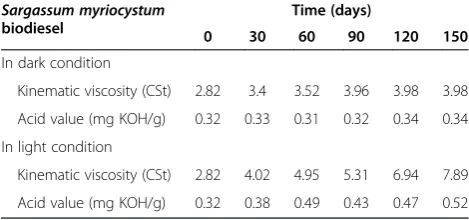
Table 4 shows the storage tests done on biodiesel stored in dark and light conditions for a period of 150 days. The samples were periodically taken out at an interval of 30 days and were checked for both kinematic viscosity and acid value. Kinematic viscosity is an important prop-erty of all fuels. High viscosity results in negative impact on fuel injection system performance. The specified range of viscosity of the American Society of Testing Materials (ASTM D6751) is 2.5 to 6. Kinematic viscosity was mea-sured by an Ostwald viscometer. High viscosity leads to decreased atomization, fuel vaporization, and combustion. Samples stored in dark conditions showed only a marginal increase in kinematic viscosity for all samples which did not exceed the specified limits of ASTM D6751 as indi-cated by Table 4. For samples stored in light conditions, there was a sharp increase in viscosity values which exceeded the standard specifications. The viscosity rises during storage owing to the formation of polymers and to the hydrolytic cleavage of methyl esters into fatty acids [25]. Hence, the properties of the biodiesel samples stored in dark conditions are comparable to conventional diesel properties. Acid number indicates the corrosive nature of the fuel. The acid number for biodiesel should be lower than 0.50 mg KOH/g according to ASTM D6751. Acid value was measured in the laboratory by mixing the sam-ple with ethanol and heating in water bath and titrating it with potassium hydroxide using phenolphthalein as indi-cator. For samples stored in dark conditions, the acid values did not exceed the prescribed value after a period of 150 days and showed only a small difference from the initial value. The acid value is low for the samples stored in light conditions for a month but the value exceeds the prescribed limit after 150 days, indicating that the fuel had become very corrosive. This is in agreement with earlier studies [25,27]. There was sediment formation in the glass bottles after a period of 90 days, indicating that it cannot be stored and used as a fuel after 4 months. This could be due to the breakdown of molecular bonds and sample degradation. If the quality of biodiesel is not good and
contains high degree of unsaturated fatty acids, it would tend to polymerize with the lubricating oil, forming sludge, and increasing engine wear [28]. Storage prob-lems will be more for algal biodiesel than commercial diesel and shelf life is much reduced. The problems en-countered in storing biodiesel for a long duration are mainly due to auto-oxidation, photo-oxidation, hydrolytic degradation, and oxidative degradation. This could be due to the fact that light can oxidize the oil. Degradation of the fuel has a profound influence on engine performance. The fuel was tested for calorific value before and after the test for both conditions of exposure to light and in the dark. The calorific value tested according to ASTM D6751 before the test was 41,499 kJ/kg. The calorific value of the sample kept in the dark after a period of 150 days is 38,700 kJ/kg, and that of the sample kept in light after a period of 150 days is 24,520 kJ/kg. The calorific value has drastically reduced because of mo-lecular breakdown owing to degradation. A lower calo-rific value leads to more fuel consumption for the same amount of work done by a reference fuel. The engine will have high specific fuel consumption for the maintenance of a constant power output in maximum load conditions. Hence, it can be suggested that suit-able additives can be added to the fuel to increase its shelf life and storage characteristics. Some additives for biodiesel storage found in literature are pyrimidi-nols [29], butylated hydroxytoluene, butylated hydro-xyanisol, tert-butyl hydroquinone, propyl gallate, ethylenediaminetetraacetic acid, citric acid, phosphoric acid, and amino acids [30].
Conclusions
The brown seaweed S. myriocystum is a potential re-source for biodiesel production. To make the process of making biodiesel cost effective, optimization of parame-ters was done using Design-Expert software version 8.0.7.1. RSM gave the optimum values of 120 min, 60°C, 1:6 (v/v) oil:alcohol ratio, and 0.4 (w/w) catalyst amount. Maximum yield of biodiesel was achieved at the optimum conditions. The fuel was further investigated for its stor-age properties. It was found that the fuel deteriorated when exposed to air after a period of 4 months and started forming deposits with high increase in acid value. The fuel which was not exposed to air did not show a drastic change in kinematic viscosity and acid value but main-tained a slow and progressive increase in the properties which did not exceed the limits prescribed by ASTM D6751. The calorific value of the fuel had drastically de-creased to a lower value on exposure to light after a period of 150 days. It can be suggested that biodiesel prepared from S. myriocystum seaweed is best stored without any contact with air or suitable additives should be added to enhance the storage properties. In India, S. myriocystum Table 4 Storage test results in dark and light conditions
Sargassum myriocystum
biodiesel
Time (days)
0 30 60 90 120 150
In dark condition
Kinematic viscosity (CSt) 2.82 3.4 3.52 3.96 3.98 3.98
Acid value (mg KOH/g) 0.32 0.33 0.31 0.32 0.34 0.34
In light condition
Kinematic viscosity (CSt) 2.82 4.02 4.95 5.31 6.94 7.89
seaweed is used in food and pharmaceutical industries. Since this paper substantiates its biofuel property which also meets ASTM D6751, it is an ideal crude for biorefineries.
Competing interests
The authors declare that they have no competing interests.
Authors' contributions
AR carried out the extraction, reaction, and optimization studies of the paper. NS performed the storage tests. MP identified the species and helped in the extraction of algal oil. All authors read and approved the final manuscript.
Acknowledgements
The authors wish to thank the Director of the National Institute of Ocean Technology, India, for the assistance provided. The authors also thank the editor and reviewers for their suggestions, thus improving the quality of the manuscript.
Author details
1Department of Chemical Engineering, Sathyabama University, Jeppiaar Nagar, Rajiv Gandhi Salai, Chennai TN 119, India.2Department of Marine
Biotechnology, National Institute of Ocean Technology, Velacherry-Tambaram Main Road, Chennai 100, India.
Received: 15 July 2014 Accepted: 7 October 2014
References
1. Shakeel A, Khan R, Mir Z, Hussain PS, Banerjee UL (2009) Prospects of biodiesel production from microalgae in India. Renew Sustain Energy Rev 13:2361–2372
2. Jeyabalan JPP, Johnson Marimuthu A (2012) Preliminary phytochemical analysis ofSargassum myriocystumJ.Ag. andTurbinaria ornata(Turner) J.Ag. from the southern coast of Tamil Nadu, India. Asian Pac J Trop Biomed 2:1–4 3. Fatih Demirbas M (2009) Biorefineries for biofuel upgrading: a critical
review. Appl Energy 86:S151–S161
4. Mcneff CV, McNeff LC, Bingwen Y, Nowlan DT, Rasmussen M, Gyberg AE, Krohn BJ, Fedie RL, Hoye TR (2008) A continuous catalytic system for biodiesel production. Appl Catal Gen 343:39–48
5. Sharma R, Chisti Y, Banerjee UC (2001) Production, purification, characterization and applications of lipases. Biotechnol Adv 19:627–62 6. Roessler PG, Brown LM, Dunahay TG, Heacox DA, Jravis EE, Schneider JC
(1994) Genetic engineering approaches for enhanced production of biodiesel fuel from microalgae. ACS Symp Ser 566:255–270
7. Sawayama S, Inoue S, Dote Y, Yokoyama SY (1995) CO2fixation and oil production through microalga. Energy Convers Manag 36:729–731 8. Hu Q, Sommerfeld M, Jravis E, Ghirardi M, Posewitz M, Seibert M (2008)
Microalgal triacylglycerols as feedstocks for biofuel production: perspectives and advances. Plant J 54:621–639
9. Schenk PM, Thomas Hall SR, Stephens E, Marx UC, Mussgnug JH, Posten C (2008) Second generation biofuels: high-efficiency microalgae for biodiesel production. Bioenerg Res 54:621–639
10. Maeda K, Owada M, Kimura N, Omata K, Kraube I (1995) CO2fixation from the flue gas on coal-fired thermal power plant by microalgae. Energy Convers Manag 36:717–720
11. Patil V, Tran KQ, Giselrod HR (2008) Towards sustainable production of biofuels from microalgae. Int J Mol Sci 9:1188–1195
12. Williamson AM, Badr O (1998) Assessing the viability of using rape methyl ester (RME) as an alternative to mineral diesel fuel for powering road vehicles in the UK. Appl Energy 59:187–214
13. Sobha V, Surendran M, Vasudevan Nair T (1992) Heavy metal and biochemical studies of different groups of algae form Cape Comorin and Kovalam. Seaweed Res Util 15(1&2):77–85
14. Badrinathan S, Suneeva SC, Shiju TM, Girish Kumar CP, Pragasam V (2011) Exploration of a novel hydroxyl radical scavenger fromSargassum myriocystum. J Pharm Res 5(10):1997–2005
15. Annam Renita A, Joshua Amarnath D (2011) Multifaceted applications of marine macro algaeSargassum myriocystum. J Pharm Res 4(11):3871–3872
16. Tressler DK (1951) Marine products of commerce. Reinhold, New York 17. Nadyaini WN, Omar W, Aishah N, Amin S (2011) Optimization of
heterogeneous biodiesel production from waste cooking palm oil via response surface methodology. Biomass Bioenergy 35:1329–1338 18. Ferella F, Di Celso M, De Michelis I, Stanisci V, Veglio F (2010) Optimization
of the transesterification reaction in biodiesel production. Fuel 89(1):36–42 19. Meher LC, Sagar V, Naik SN (2006) Technical aspects of biodiesel production
by transesterifcation - a review. Renew Sustain Energy Rev 10:248–268 20. Khuri A, Cornell JA (1987) Response surfaces: design and analysis. Marcel
Dekker, New York
21. Jang MG, Kim DK, Park SC, Lee JS, Kim SW (2012) Biodiesel production from crude canola oil by two-step enzymatic process. Renew Energy 42:99–104 22. Chen X, Wei D, Liu D (2008) Response surface optimization of biocatalytic
biodiesel production with acid oil. Biochem Eng J 40:423–429 23. Zhang S, Zu YG, Fu YJ, Luo M, Zhang DY, Effreth T (2010) Rapid
microwave-assisted transesterification of yellow horn oil to biodiesel using a heteropolyacid solid catalyst. Bioresour Technol 101:931–936 24. Karavalakis G, Hilari D, Givalou L, Karonis D, Stournas S (2011) Storage
stability and ageing effect of biodiesel blends treated with different antioxidants. Energy 36:369–374
25. Mittelbach M, Gangl S (2001) Long storage stability of biodiesel made from rapeseed and used frying oil. JAOCS 78(6):573–577
26. Abderrahim B, Martinez M, Aracil J (2007) Long storage stability of biodiesel from vegetable and used frying oils. Fuel 86:2596–2602
27. Das LM, Bora DK, Pradhan S, Malaya K, Naik NSN (2009) Long-term storage stability of biodiesel produced from Karanja oil. Fuel 88:2315–2318 28. Leung DYC, Koo BCP, Guo Y (2006) Degradation of biodiesel under different
storage conditions. Bioresour Technol 97:250–256
29. Wijtmans M, Pratt DA, Brinkhorst J, Serwa R, Valgimigli L, Pedulli GF, Porter NA (2004) Synthesis and reactivity of some 6-substituted-2,4-dimethyl-3-pyridinols, a novel class of chain-breaking antioxidants. J Org Chem 69:9215–9223 30. Knothe G (2007) Some aspects of biodiesel oxidative stability. Fuel Process
Technol 88:669–677
doi:10.1186/s40643-014-0019-3
Cite this article as:Renita Aet al.:Optimization of algal methyl esters
using RSM and evaluation of biodiesel storage characteristics.Bioresources
and Bioprocessing20141:19.
Submit your manuscript to a
journal and benefi t from:
7Convenient online submission
7Rigorous peer review
7Immediate publication on acceptance
7Open access: articles freely available online
7High visibility within the fi eld
7Retaining the copyright to your article