ORIGINAL ARTICLE
A Modified Iterated Greedy Algorithm
for Flexible Job Shop Scheduling Problem
Ghiath Al Aqel, Xinyu Li and Liang Gao
*Abstract
The flexible job shop scheduling problem (FJSP) is considered as an important problem in the modern manufacturing system. It is known to be an NP-hard problem. Most of the algorithms used in solving FJSP problem are categorized as metaheuristic methods. Some of these methods normally consume more CPU time and some other methods are more complicated which make them difficult to code and not easy to reproduce. This paper proposes a modified iterated greedy (IG) algorithm to deal with FJSP problem in order to provide a simpler metaheuristic, which is easier to code and to reproduce than some other much more complex methods. This is done by separating the classical IG into two phases. Each phase is used to solve a sub-problem of the FJSP: sequencing and routing sub-problems. A set of dispatching rules are employed in the proposed algorithm for the sequencing and machine selection in the construction phase of the solution. To evaluate the performance of proposed algorithm, some experiments including some famous FJSP benchmarks have been conducted. By compared with other algorithms, the experimental results show that the presented algorithm is competitive and able to find global optimum for most instances. The simplicity of the proposed IG provides an effective method that is also easy to apply and consumes less CPU time in solving the FJSP problem.
Keywords: Iterated greedy, Flexible job shop scheduling problem, Dispatching rules
© The Author(s) 2019. This article is distributed under the terms of the Creative Commons Attribution 4.0 International License (http://creat iveco mmons .org/licen ses/by/4.0/), which permits unrestricted use, distribution, and reproduction in any medium, provided you give appropriate credit to the original author(s) and the source, provide a link to the Creative Commons license, and indicate if changes were made.
1 Introduction
The optimization of production scheduling can bring in considerable improvements in the manufacturing effi-ciency [1]. Job-shop scheduling problem (JSP) is basically an NP-complete challenge [2]. JSP considers no flexibil-ity of any resources (such as machines and tools) for each operation [1].
Modern manufacturing systems contain many flexible machines to increase the production efficiency. These machines are capable of processing several types of the operations. This gives the permission to break the defi-nition of JSP where an operation can be processed by a single machine [1].
As an extension of the JSP, Flexible Job-shop Sched-uling Problem (FJSP), which is known to be NP-hard [3], considers the flexible machines for each operation.
Furthermore, the FJSP is considered to be more compli-cated in comparison to the traditional JSP, as it dictates an extra decision level for the same scale in addition to the sequencing one, such as the operations routes [2].
Many approaches have been proposed to solve FJSP since first presented in 1990 [4]. The current methods for solving FJSP can be mainly categorized into; exact algo-rithm, dispatching rules (DR), evolutionary algorithm (EA), swarm intelligence (SI) based approaches, local search (LS) algorithms, and so on [5].
While exact algorithms tend to be inefficient with large scale FJSP, other methods, such as EA and SI, are much more expensive regarding the consumption of computa-tion time. Many of these algorithms are also complicated and in many cases they are too difficult to reproduce. This makes it difficult to apply these methods in real-life problems.
In this research, we try to present a modified iterated greedy (IG) algorithm, a simpler metaheuristic that is easier to code and reproduce. The classical IG is sepa-rated into two phases to deal with the two sub-problems
Open Access
of FJSP and it’s combined with a set of dispatching rules (DRs) to solve the FJSP. The simplicity and the effi-ciency of IG and DRs shall result in an effective method which consumes less computation time and is easy to implement.
The remainder of this paper is arranged as follows. Lit-erature review and problem definition are presented in Section 2. IG approach and the modified iterated greedy (MIG) is proposed in Section 3. Experimental studies are discussed in Section 4. Section 5 provides the conclu-sions and future work.
2 Literature Review and Problem Definition
2.1 Literature Review
Several methods have been used to deal with the FJSP. These techniques are classified into two groups; the exact methods and the approximation methods [1]. Exact algorithms include mathematical programming (MP), while the approximation algorithms include some dis-patching rules (DRs) and artificial intelligence (AI) based approaches.
Brucker and Schlie [4] proposed a polynomial graphi-cal algorithm when they first presented the FJSP with two jobs. Demir and İşleyen [6] evaluated some mathematical models of the FJSP. However, it’s been proved by Pezzella et al. [7] that exact algorithms are ineffective when deal-ing with large scale problems of FJSP.
Baykasoğlu and Özbakır [8] analyzed the effects of several DRs on the scheduling performance of job shops with different levels of flexibility and with different sizes of the problem. They proved that the performances of these DRs were approximately similar when dealing with high machine flexibility. On the other hand, different performances were obtained for zero machine flexibility. Ingimundardottir and Runarsson [9] created an auto-selection of combined DR by converting them into meas-urable contribution factors in the optimizing process of scheduling problems. Huang and Süer [10] adopted GA to explore the best combination of DR and used a “Hold” strategy for multi-objective JSS.
Evolutionary algorithms, such as genetic algorithm (GA), are an effective type of meta-heuristic methods. Zhang et al. [11] proposed a bi-level GA in an attempt to keep the advantages of preceding generations and reduce the disturbance of genetic operators. Later, an improved GA were proposed by Zhang et al. [12] targeting a bet-ter initialization and fasbet-ter convergence. Huang et al. [13] developed an improved GA using opposition-based learning. The method used a multi-parent precedence operation crossover and a modified neighbor search mutation with opposite inverse mutation.
Swarm intelligence (SI) algorithms mainly include ant colony optimization (ACO), particle swarm optimization
(PSO) algorithm, and artificial bee colony (ABC). Xu et al. [14] used bat algorithm to solve a dual flexible job shop problems (DFJSP). That algorithm used crossover and mutation as well as an adjusted value of the inertia weight with a linear decreasing strategy to enforce the search ability of the algorithm. Wu et al. [15] proposed a hybrid algorithm based on ACO while providing a mod-eling method based on 3D disjunctive graph.
Local search (LS) methods have been employed widely in solving the FJSP as well. The design of the neighbor-hood structure contributes directly to the efficiency of the method [1]. Sobeyko and Mönch [16] developed an iterative local search approach to deal with the objec-tive of total weighted tardiness in large-scale FJSP. The algorithm used SA acceptance criterion to avoid getting trapped in local optimum.
Many researchers attempted to combine several algo-rithms to create some effective hybrid algoalgo-rithms (HA) for FJSP. Palacios et al. [17] also combined GA with TS and added heuristic seeding. The hybrid algorithm was used to solve the fuzzy FJSP. Gaham et al. [18] presented an operations permutation-based discrete harmony search method. That method adopted an integration of the solution harmony with a dedicated improvisation operator. In addition to an integrated modified intelligent mutation operator.
In short, exact algorithm cost less CPU time, but most of these algorithms were not able to give competitive solution quality in comparison with other methods. On the other hand, metaheuristics, such as evolutionary algorithms (EA) and swarm intelligence based algorithms (SI) have given effective solutions and better quality. However, such metaheuristics algorithms cost much more computation time.
In this research, we propose a modified iterated greedy algorithm (MIG) to reduce the cost by consuming less CPU time. MIG provides a simple and easily applicable method that can compete with more complex meta-heuristics. The proposed algorithm MIG consists of two phases, each phase is derived from the classical IG to solve the two sub-problems of FJSP. Both phases use a set of dispatching rules (DRs) to solve the FJSP.
2.2 Flexible Job Shop Problem Definition
For processing n jobs on m machines, the problem is to find the best solution that achieves the minimum or max-imum value for an objective function. In the FJSP, there are a set of machines A= M1,…, Mm, and a set of jobs,
the operations on the machines. In this paper, the objec-tive function is to minimize the makespan (maximal completion time) of all jobs.
In this research the following assumptions are considered:
1) All machines are available at time 0; 2) All jobs are released at time 0;
3) Each machine can process only one operation at a time;
4) Each operation can be processed without interrup-tion on one of a set of available machines;
5) Recirculation occurs when a job could visit a machine more than once;
6) The order of operations for each job is predefined and cannot be modified.
The FJSP has been classified by Kacem et al. [19] into partial flexible job shop (P-FJSP) and total flexible job shop (T-FJSP). The flexibility of problems is partial when there exists a subset Ai,j of A (Ai,j⊂ A) for at least one operation Oi,j, and it is total when Ai,j= A for all operations. For the same number of machines and jobs, although the T-FJSP has the larger solution space, the P-FJSP is more difficult to solve than the T-FJSP [19].
3 Modified Iterated Greedy
3.1 Classical Iterated Greedy
This algorithm was first proposed by Ruiz and Stützle [20] to solve traditional permutation flow shop schedul-ing problems. The traditional IG consists of two distinct iterative phases; destructing some a part of the solution, and reconstructing this part by some greedy techniques including local search to improve the solution [20, 21]. The original IG has adopted NEH heuristics of Nawaz et al. [22] as its greedy constructive method.
Many works have been done later with IG; Ruiz and Stützle [23] used IG to solve FSP with sequence depend-ent setup times, and it’s been used for node placemdepend-ent in street networks by Toyama et al. [24], and for sin-gle machine scheduling problems by Tasgetiren et al. [25], and as a local search method for unrelated parallel machine scheduling by Fanjul-Peyro and Ruiz [21].
The simple IG has proved to be effective and able to obtain state-of-the-art outcomes for a variety of JSP with different objectives [26].
3.2 Presented Algorithm (MIG)
The classical IG algorithm has been used in a wide range of scheduling problems according to Pan and Ruiz [26]. Although the algorithm was proposed to solve flow shop problems, some researchers used IG to deal with more complex problems like the hybrid flexible flow line
problem as in Refs. [27, 28] and the blocking job shop scheduling problem by Pranzo and Pacciarelli [29].
Shop scheduling problems basically differs from each other by having different types or numbers of flexibility. By definition, operation flexibility is the possibility of per-forming an operation on more than a machine, sequenc-ing flexibility is the possibility of interchangsequenc-ing the sequence in which required manufacturing operations are performed and processing flexibility is possibility of producing the same manufacturing feature with alterna-tive operations or sequence of operations.
According to this definition, we can consider that the main difference between flexible job shop schedul-ing problem and job shop schedulschedul-ing problem (JSP) is that flexible job shop problem dictates operation flex-ibility. The FJSP could be separated into two sub-prob-lems: routing (assigning operations to machines) and scheduling (sequencing the assigned operations on each machine) [30]. Hence, the modified iterated greedy must deal with both of the sub-problems. Basically, that is achieved by separating both of destruct and construct phases in the algorithm into two stages in which both sides of FJSP are resolved. Pan and Ruiz [31] stated that IG dictates an effective greedy reconstruction in order to outperform other algorithms. The NEH heuristics gives no contribution on decision making of machine selec-tion, and it also has limited solution variety while study-ing the FJSP. Therefore, NEH heuristics is replaced with a set of dispatching rules (DRs), to help with both decisions of sequencing and machine selection in reconstruction phase.
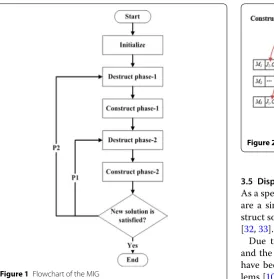
Figure 1 shows the flowchart of the MIG. The working of the algorithm is described below:
Step 1: Initialization, which is done randomly
Step 2: (Phase one) Destruct part of the solution machine selection
Step 3: (Phase one) Reconstruct machine selection Step 4: (Phase two) Destruct sequence and machine
selection for some operations
Step 5: (Phase two) Reconstruct the sequence and the machine selection for these operations
Step 6: Repeat the steps 2 through 5 until a stopping criterion is met.
3.3 Destruct Phase
This is done by removing some consecutive operations in from their sequence and dissociating them from their machines, later both sequence and machine selection will be reconstructed.
The destructed part is selected in one of either two ways:
1. The sequence is split into two parts and either one of these two part is destructed.
2. A number of consecutive operations are selected ran-domly along the sequence to be destructed.
3.4 Reconstruct Phase
In the first phase, reconstructing is to reassign the destructed operations from the existing sequence to machines using a set of dispatching rules as shown in Figure 2. This is done by comparing the quality of the sub-solution according to a randomly selected DR for all possible machines to process the operation. Then, the machine that achieves the sub-solution is selected.
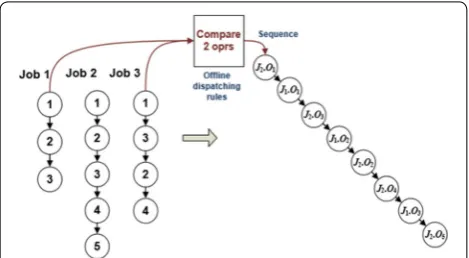
Reconstructing in the second phase is to regenerate the destructed part of the sequence as in Figure 3. This is done by selecting two operations at a time. A DR is randomly selected and used to assess sequencing each of the two operations. The operation that results in a better sub-sequence is eventually selected.
3.5 Dispatching Rules
As a special case of priority rules, dispatching rules (DRs) are a simple scheduling heuristic, which gradually con-struct solutions by scheduling a single operation at a time [32, 33].
Due to their simplicity, sensitive nature, ease of use and the ability to fit a wide range of problem scale, DRs have been widely employed in solving scheduling prob-lems [10, 33, 34]. DRs do not dictate high computational and information requirements [33]. Another important characteristic of DRs is their ability to adjust to dynamic changes [35]. These features encourage us to use DRs instead of NEH as the main heuristic to perform with IG for optimizing the FJSP.
It’s been proved that a random assigning of the oper-ations to the machines gives no better convergence. Besides that there isn’t any dispatching rule that is alone capable to push forward the optimization process for any scheduling problem [36]. Thus, to make the selec-tion procedure more intelligent, a set of dispatching rules (DRs) is used to assist machine selection procedure for each operation. Moreover, a favoring mechanism adopted by Ausaf et al. [37] is used to give more chance to more effective dispatching rules.
In general, researchers classified DRs into two main categories; online dispatching rules (dynamic DRs) and offline dispatching rules (static DRs) [38, 39].
3.5.1 Offline Dispatching Rules
According to these dispatching rules, each operation will have a fitness value based on some analysis on the prob-lem’s data. In this research, offline dispatching rules are used to optimize and construct the sequence of operation therefore the scheduling in FJSP. When two operations are selected, the fitness value is calculated according to an offline DP rule, and then the operation with the best value is placed in the sequence while these other Figure 1 Flowchart of the MIG
operation is kept with ready operations. The set of ready operations is updated and another two operations are selected after that and the procedure is repeated till the construction phase of the sequence is completed. The fitness value of an offline DP rule is calculated directly from the problem’s data before the optimization process. Hence, this fitness value remains constant for each pair of operation-DP rule. In this research, three offline dis-patching rules are used as in Figure 4.
3.5.2 Online Dispatching Rules
According to these dispatching rules, each pair machine-operation will have a fitness value based on an analysis made on the current status of the machines in the sub-solution. This fitness value can be calculated only right before assigning this operation to a machine. Hence, for the same pair machine-operation, it varies along itera-tions due to the changes in the current sub-solution while constructing phase. In this research, 10 online dis-patching rules are used (Figure 5).
The used dispatching rules can be categorized accord-ing to the use in this research as below:
a) Dispatching rules used to select a machine for an operation: where all the available machines are considered for each operation, and then only one machine is selected according to the following.
1. Shortest processing time (SPT), selects the machine that does the operation within the shortest processing time.
2. Earliest start (ES), selects the machine that will start with this operation earlier.
3. Earliest finish (EF), selects the machine that is able to finish the operation earlier.
4. Least utilized machine (LUM), selects the machine that currently has the minimum work-load.
5. Minimum idle time (MIT), selects the machine that achieves the least idle time.
6. Earliest machine interval (EMI), selects the machine with the minimum current interval. 7. Minimum gap per job (MGJ), selects the machine
on which the gap between the operation and its preceding (the time that the job will be waiting for the machine) one is the smallest.
8. Combined rules (CR), in combined dispatching rules two or more rules are performed together. The function value of the first rule is calculated for both operations. In case both operations have the same function value for this rule, another rule is used to choose the best operations.
b) Dispatching rules used to select an operation in sequencing: Two operations are selected and com-pared according to these rules, and then one of them is placed in the sequence. During this selection, the operations are already assigned to machines.
1. Shortest processing time (SPT), selects the opera-tion with the shorter processing time.
Figure 3 Construct phase–sequencing
Figure 4 Using offline dispatching rules to build the sequence
2. Maximum processing time per job (MPJ), selects the operation which belongs to the job with the longer processing time.
3. Least utilized machine (LUM), selects the oper-ation which is done by the machine with the greater workload.
4. Latest machine interval (LMI), selects the opera-tion that is done by the machine with the greater processing time interval.
5. Combined rules (CR), two or more rules are combined as in (b).
The first four of these dispatching rules were adopted previously by Ausaf et al. [37]. Only four dispatching rules of the mentioned above are offline rules; SPT, MPJ, LUM (b) and LMI.
3.6 Techniques Used to Control the Algorithm
1. Adjusting the split point position
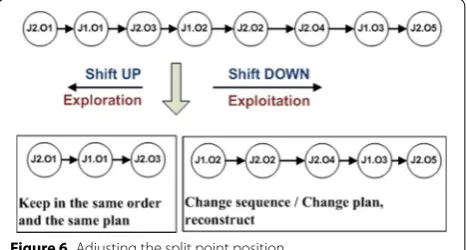
A special function is used to adjust the split point. In case of exploitation, the split point is shifted to the right side, while in case of exploration; the split point is shifted to the left side. As is shown in Figure 6. 2. Adjusting the size of destructed part:
Increasing the number of destructed operations will give the exploration that is needed in the algorithm, while decreasing this number will support exploita-tion process. The minimum and maximum sizes of
the destructed part are determined initially for the instance. During the run, the algorithm starts with the minimum size, and increases gradually if the solution is not improving, when it reaches the maxi-mum limit, the size decreases again for local search as in the previous Technique.
4 Experiments and Discussion
The algorithm MIG has been coded in C++, and per-formed by a computer with 3.2 GHz processor and with 4.0 GB RAM memory. Three experiments of in total 35 benchmark problems are used to test the performance of the proposed algorithm. The objective considered in this paper is to minimize the makespan. The best solutions are shown in bold red font in each experiment.
4.1 Experiment 1
The data in this experiment includes 5 problems adopted from [40]. The results are compared in Table 1 with 6 other algorithms; HA, GATS, TABC, HHS, HDE-N2 and hGA proposed by Li and Gao [1], Nouri et al. [41], Gao et al. [42], Yuan et al. [43], Yuan and Xu [44], and Gao et al. [45] respectively. The proposed (MIG) obtained the global optimum for all instances.
Table 2 shows the CPU time compared with the same algorithms. It’s clear that MIG consumed the lowest CPU time among other algorithms.
4.2 Experiment 2
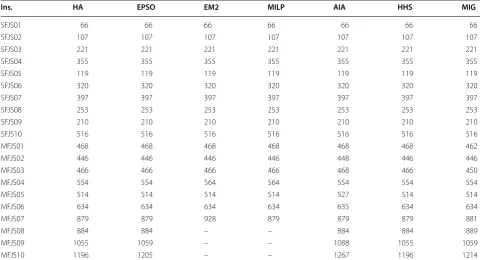
The data includes 20 instances adopted from Fattahi et al. [46]. The first ten consecutive instances are considered as small-scale FJSP, while the remaining ten instances are categorized as medium- and large-scale FJSP. The results are compared in Table 3 with 6 algorithms; HA, EPSO, EM2, MILP and HHS proposed by Li and Gao [1], Teekeng et al. [47], Demir and İşleyen [6], Birgin et al. [48] and Yuan et al. [43] respectively. The data of AIA results are also taken from Yuan et al. [43].
The proposed algorithm (MIG) performed well on both small- and medium-scale instances. It obtains all opti-mum solutions for small-scale instances. For medium-scales problems, MIG outperforms HA, EPSO and HHS in two instances, and outperforms EM2 and MILP in Figure 6 Adjusting the split point position
Table 1 Results of Kacem data (experiment 1)
n×m HA GATS TABC HHS HDE-N2 hGA MIG
4 × 5 ‒ 11 11 ‒ 11 ‒ 11
10 × 7 ‒ 11 11 ‒ 11 ‒ 11
10 × 10 7 7 7 7 7 7 7
8 × 8 14 14 14 14 14 14 14
3 instances. And finally, MIG outperforms AIA in 5 instances. In short, for medium-scale problems MIG outperforms all algorithms in literature in two instances (MFJS01 and MFJS03). The obtained solutions for large-scale instances were less competitive. For Large-large-scale problems, results for MIG are dominated by HA, EPSO and HHS. The Gantt charts for instances (MFJS01 and MFJS03) are shown in Figure 7 and Figure 8, respectively.
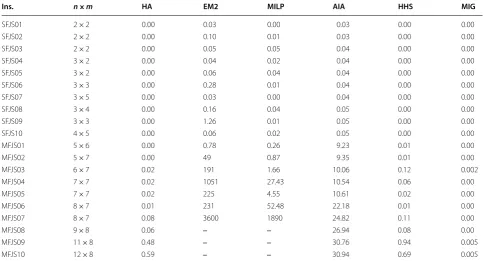
Table 4 shows that MIG consumed the least CPU time for all instances among the above mentioned algorithms.
4.3 Experiment 3
The data in this experiment is adopted from Brandimarte [49], it contains 10 instances with number of jobs ranges from 10 to 20, and the number of machines ranges from 6 to 15. We compared the results with 11 algorithms from literature; HA, HTGA, GATS, TABC, Heuristic, AMMA,
HHS, hGA, TS, and IACO. These algorithm were pro-posed by Li and Gao [1], Chang et al. [50], Nouri et al. [41], Gao et al. [42], Ziaee [51], Zuo et al. [52] and Yuan et al. [43]. Results of AIA and TS are taken from Yuan et al. [43].
Table 2 CPU time comparison for instances in experiment 1
n×m HA GATS TABC HHS HDE-N2 hGA MIG
4 × 5 ‒ 0.05 0.47 ‒ 0.09 ‒ 0.00
10 × 7 ‒ 0.72 1.2 ‒ 0.46 ‒ 0.00
10 × 10 0.01 1.51 1.4 0.01 0.37 43.1 0.00
8 × 8 0.00 0.36 1.19 0.00 0.31 22.4 0.00
15 × 10 0.33 29.71 2.97 0.42 2.19 112.2 0.07
Table 3 Results of experiment 2
Ins. HA EPSO EM2 MILP AIA HHS MIG
SFJS01 66 66 66 66 66 66 66
SFJS02 107 107 107 107 107 107 107
SFJS03 221 221 221 221 221 221 221
SFJS04 355 355 355 355 355 355 355
SFJS05 119 119 119 119 119 119 119
SFJS06 320 320 320 320 320 320 320
SFJS07 397 397 397 397 397 397 397
SFJS08 253 253 253 253 253 253 253
SFJS09 210 210 210 210 210 210 210
SFJS10 516 516 516 516 516 516 516
MFJS01 468 468 468 468 468 468 462
MFJS02 446 446 446 446 448 446 446
MFJS03 466 466 466 466 468 466 450
MFJS04 554 554 564 564 554 554 554
MFJS05 514 514 514 514 527 514 514
MFJS06 634 634 634 634 635 634 634
MFJS07 879 879 928 879 879 879 881
MFJS08 884 884 – – 884 884 889
MFJS09 1055 1059 – – 1088 1055 1059
MFJS10 1196 1205 – – 1267 1196 1214
We can see in Table 5 that the proposed MIG out-performs each of; Heuristic in 9 instances, GATS in 7 instances, HTGA and AIA in 3 instances, TS in 2 instances, and finally TABC in one instance. On the other hand, HA, AMMA, and HHS dominates MIG in 3 instances, while TS and TABC outperforms MIG in 2 instances as HTGA and AIA in one instance. Table 6 shows the CPU time for each instance compared with CPU consumed by the above mentioned algorithms. MIG consumed less CPU time than all other algorithms. Only heuristic method is competitive with MIG regard-ing the CPU time. Heuristic method consumed less CPU Figure 8 Gantt chart of instance MFJS03 (experiment 2)
Table 4 CPU time comparison for instances in experiment 2
Ins. n×m HA EM2 MILP AIA HHS MIG
SFJS01 2 × 2 0.00 0.03 0.00 0.03 0.00 0.00
SFJS02 2 × 2 0.00 0.10 0.01 0.03 0.00 0.00
SFJS03 2 × 2 0.00 0.05 0.05 0.04 0.00 0.00
SFJS04 3 × 2 0.00 0.04 0.02 0.04 0.00 0.00
SFJS05 3 × 2 0.00 0.06 0.04 0.04 0.00 0.00
SFJS06 3 × 3 0.00 0.28 0.01 0.04 0.00 0.00
SFJS07 3 × 5 0.00 0.03 0.00 0.04 0.00 0.00
SFJS08 3 × 4 0.00 0.16 0.04 0.05 0.00 0.00
SFJS09 3 × 3 0.00 1.26 0.01 0.05 0.00 0.00
SFJS10 4 × 5 0.00 0.06 0.02 0.05 0.00 0.00
MFJS01 5 × 6 0.00 0.78 0.26 9.23 0.01 0.00
MFJS02 5 × 7 0.00 49 0.87 9.35 0.01 0.00
MFJS03 6 × 7 0.02 191 1.66 10.06 0.12 0.002
MFJS04 7 × 7 0.02 1051 27.43 10.54 0.06 0.00
MFJS05 7 × 7 0.02 225 4.55 10.61 0.02 0.00
MFJS06 8 × 7 0.01 231 52.48 22.18 0.01 0.00
MFJS07 8 × 7 0.08 3600 1890 24.82 0.11 0.00
MFJS08 9 × 8 0.06 ‒ ‒ 26.94 0.08 0.00
MFJS09 11 × 8 0.48 ‒ ‒ 30.76 0.94 0.005
MFJS10 12 × 8 0.59 ‒ ‒ 30.94 0.69 0.005
Table 5 Results of experiment 3
Ins. n×m HA HTGA GATS TABC Heuristic AMMA AIA HHS TS IACO MIG
MK01 10 × 6 40 40 40 40 42 40 40 40 40 40 40
MK02 10 × 6 26 26 27 26 28 26 26 26 26 26 26
MK03 15 × 8 204 204 204 204 204 204 204 204 204 204 204
MK04 15 × 8 60 60 64 60 75 60 60 60 60 60 60
MK05 15 × 4 172 173 173 173 179 172 173 172 173 173 172
MK06 10 × 10 57 61 65 60 69 57 63 58 58 60 60
MK07 20 × 5 139 141 144 139 149 139 140 139 144 140 140
MK08 20 × 10 523 523 523 523 555 523 523 523 523 523 523
MK09 20 × 10 307 307 311 307 342 307 312 307 307 307 307
time than MIG in only three instances; MK5, MK6, and MK10. On the other hand, MIG obtained better solutions for these instances than heuristic methods.
4.4 Analysis Summary
In this paper, a modified iterated greedy is proposed for solving the flexible job shop problem. In the experi-ments, 35 instances in total have been used from 3 differ-ent benchmarks to test MIG. We divide these instances into three categories; small-scale instances (10 instances), medium-scale instances (13 instances), and large-scales instances (12 instances).
The results for small-scale instances prove that MIG is able to obtain global optimum for all instances as many previous algorithms actually did before. Figure 9 shows the results of MIG in comparison with minimum and maximum value of makespan that are obtained by other algorithms.
For medium-scale instances, MIG has obtained the best results for all instances and has outperformed all
algorithms in literature for 2 instances (MFJS01 and MFJS03) of experiment 2. Figure 10 illustrates the per-formance of MIG in comparison with minimum and maximum makespan obtained by other algorithms.
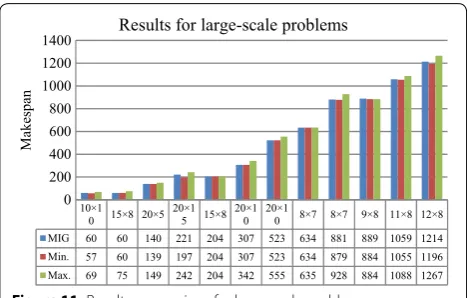
While dealing with large-scale instances, MIG is able to obtain near-optimum solutions for many instances, but it has got trapped in local optimum for some oth-ers. Figure 11 shows the performance of MIG for 12 large-scales instances. It can be observed that the curve of MIG includes worse results for larger problems.
Experiments shows that MIG consumes less CPU time in comparison to all other algorithms included in this study. For only 3 instances of large-scale problems, only one algorithm (Heuristic) consumed less CPU time than MIG, but MIG on the other hand obtained much better solutions. This confirms that MIG is an effective method which costs the least CPU time.
The outstanding performance of MIG for small and medium-scale problems encourages us to make further development in the global search technique in future.
Table 6 CPU time comparison for instances in experiment 3
Ins. n×m HA GATS TABC Heuristic AIA HHS MIG
MK01 10 × 6 0.06 0.93 3.36 0.09 97.21 3.87 0.002
MK02 10 × 6 0.59 1.18 3.72 0.17 103.46 5.79 0.005
MK03 15 × 8 0.16 1.55 1.56 0.52 247.37 36.60 0.00
MK04 15 × 8 0.49 4.36 66.58 0.20 152.07 13.30 0.04
MK05 15 × 4 4.57 8.02 78.45 0.20 171.95 35.78 0.32
MK06 10 × 10 53.82 110.01 173.98 0.45 245.62 111.65 2.38
MK07 20 × 5 20.01 19.73 66.19 0.39 161.92 26.16 0.04
MK08 20 × 10 0.02 11.50 2.15 0.66 392.25 171.10 0.00
MK09 20 × 10 0.86 79.68 304.43 0.94 389.71 172.24 0.42
MK10 20 × 15 33.21 185.64 418.19 1.20 384.54 437.69 1.42
4×5 2×2 2×2 3×2 3×3 2×2 3×4 3×3 3×2 3×5 MIG 11 66 107 119 210 221 253 320 355 397 Min. 11 66 107 119 210 221 253 320 355 397 Max. 11 66 107 119 210 221 253 320 355 397
0 50 100 150 200 250 300 350 400 450
Makespan
Results for small-scale problems
Figure 9 Results comparison for small-scale problems
10×7 10×10 15×10 8×8 10×6 10×6 15×4 5×7 6×7 5×6 7×7 4×5 7×7
MIG 11 7 11 14 40 26 172 446 450 462 514 516 554
Min. 11 7 11 14 40 26 172 446 466 468 514 516 554
Max. 11 7 11 14 42 28 179 448 468 468 527 516 564
0 100 200 300 400 500 600
Ma
ke
sp
an
Results for medium-scale problems
5 Conclusions and Future Work
In this paper, a modified iterated greedy is proposed for solving the flexible job shop scheduling problem. The experimental results show that the algorithm can find the global optimum solution for small and medium scale instances. MIG outperforms all other algorithms for 4 medium-scale instances. For large scale instances, the proposed algorithm has obtained optimum solutions for some instances and only near optimum solutions for some other instances. The main contribution of the proposed algorithm is to provide a simple and effective algorithm that can be easily employed in the real-life problems, and furthermore, it has insignificant CPU time cost in comparison with other metaheuristics that are widely used in this field.
In future, we will continue developing this algorithm to perform better on large-scale problems. The global search in the proposed algorithm will be developed for this purpose. Finally, multi-objective flexible job shop scheduling problem will be considered a good challenge for the developed version. Another option is to hybridize MIG with another algorithm.
Authors’ Contributions
LG was in charge of the whole trial; Ghiath Al Aqel wrote the manuscript; XL assisted with the algorithm design. All authors read and approved the final manuscript.
Authors’ Information
Ghiath Al Aqel, born in 1984, is currently a PhD candidate at Huazhong University of Science and Technology, China. He received his Master’s degree on Industrial Engineering from Huazhong University of Science and Technology, China, in 2013.
Xinyu Li, born in 1985, is currently an associate professor at State Key Laboratory of Digital Manufacturing Equipment and Technology, Huazhong University of Science and Technology, China. He received his PhD degree on Industrial Engineering from Huazhong University of Science and Technology, China, in 2009.
Liang Gao, born in 1974, is currently a professor at State Key Laboratory of Digital Manufacturing Equipment and Technology, Huazhong University of Science and Technology, China. He received his PhD degree on Industrial Engi-neering from Huazhong University of Science and Technology, China, in 2002.
Competing interests
The authors declare that they have no competing interests.
Funding
Supported by National Natural Science Foundation of China (Grant Nos. 51825502, 51775216), Hubei Provincial Natural Science Foundation of China (Grant No. 2018CFA078), and Program for HUST Academic Frontier Youth Team.
Received: 22 November 2017 Accepted: 1 March 2019
References
[1] X Li, L Gao. An effective hybrid genetic algorithm and tabu search for flexible job shop scheduling problem. International Journal of Production Economics, 2016, 174: 93-110.
[2] A Muthiah, A Rajkumar, R Rajkumar. Hybridization of artificial bee colony algorithm with particle swarm optimization algorithm for flexible job shop scheduling. Energy Efficient Technologies for Sustainability (ICEETS), 2016 International Conference on, 2016: 896-903.
[3] H Chen, J Ihlow, C Lehmann. A genetic algorithm for flexible job-shop scheduling. Robotics and Automation, 1999. Proceedings. 1999 IEEE Interna-tional Conference on, 1999: 1120-1125.
[4] P Brucker, R Schlie. Job-shop scheduling with multi-purpose machines.
Computing, 1990, 45: 369-375.
[5] H E Nouri, O B Driss, K Ghédira. A classification schema for the job shop scheduling problem with transportation resources: State-of-the-art review. Artificial Intelligence Perspectives in Intelligent Systems, Springer, 2016: 1-11.
[6] Y Demir, S K İşleyen. Evaluation of mathematical models for flexible job-shop scheduling problems. Applied Mathematical Modelling, 2013, 37: 977-988.
[7] F Pezzella, G Morganti, G Ciaschetti. A genetic algorithm for the flexible job-shop scheduling problem. Computers & Operations Research, 2008, 35: 3202-3212.
[8] A Baykasoğlu, L Özbakır. Analyzing the effect of dispatching rules on the scheduling performance through grammar based flexible scheduling system. International Journal of Production Economics, 2010, 124: 369-381. [9] H Ingimundardottir, T P Runarsson. Evolutionary learning of linear
composite dispatching rules for scheduling. Computational Intelligence, Springer, 2016: 49-62.
[10] J Huang, G A Süer. A dispatching rule-based genetic algorithm for multi-objective job shop scheduling using fuzzy satisfaction levels. Computers & Industrial Engineering, 2015, 86: 29-42.
[11] C Zhang, Y Rao, P Li, et al. Bilevel genetic algorithm for the flexible job-shop scheduling problem. Chinese Journal of Mechanical Engineering, 2007, 19(4): 020.
[12] G Zhang, L Gao, P Li, et al. Improved genetic algorithm for the flexible job-shop scheduling problem. Journal of Mechanical Engineering, 2009, 45(7): 026 (in Chinese).
[13] M Huang, W Mingxu, L Xu. An improved genetic algorithm using opposition-based learning for flexible job-shop scheduling problem.
Cloud Computing and Internet of Things (CCIOT), 2016 2nd International Conference on, 2016: 8-15.
[14] H Xu, Z Bao, T Zhang. Solving dual flexible job-shop scheduling problem using a Bat Algorithm. Advances in Production Engineering & Management, 2017, 12: 5.
[15] J Wu, G Wu, J Wang. Flexible job-shop scheduling problem based on hybrid ACO algorithm. International Journal of Simulation Modelling (IJSIMM), 2017, 16(3): 497-505.
[16] O Sobeyko, L Mönch. Heuristic approaches for scheduling jobs in large-scale flexible job shops. Computers & Operations Research, 2016, 68: 97-1096.
[17] J J Palacios, M A González, C R Vela, et al. Genetic tabu search for the fuzzy flexible job shop problem. Computers & Operations Research, 2015, 54: 74-89.
10×1
0 15×8 20×5 20×15 15×8 20×10 20×10 8×7 8×7 9×8 11×8 12×8
MIG 60 60 140 221 204 307 523 634 881 889 1059 1214
Min. 57 60 139 197 204 307 523 634 879 884 1055 1196
Max. 69 75 149 242 204 342 555 635 928 884 1088 1267
0 200 400 600 800 1000 1200 1400
Makespan
Results for large-scale problems
[18] M Gaham, B Bouzouia, N Achour. An effective operations permutation-based discrete harmony search approach for the flexible job shop sched-uling problem with makespan criterion. Applied Intelligence, 2017: 1-19. [19] I Kacem, S Hammadi, P Borne. Pareto-optimality approach for flexible
job-shop scheduling problems: hybridization of evolutionary algorithms and fuzzy logic. Mathematics and Computers in Simulation, 2002, 60: 245-276. [20] R Ruiz, T Stützle. A simple and effective iterated greedy algorithm for the
permutation flowshop scheduling problem. European Journal of Opera-tional Research, 2007, 177: 2033-2049.
[21] L Fanjul-Peyro, R Ruiz. Iterated greedy local search methods for unrelated parallel machine scheduling. European Journal of Operational Research, 2010, 207: 55-69.
[22] M Nawaz, E E Enscore, I Ham. A heuristic algorithm for the m-machine, n-job flow-shop sequencing problem. Omega, 1983, 11: 91-95.
[23] R Ruiz, T Stützle. An iterated greedy heuristic for the sequence dependent setup times flowshop problem with makespan and weighted tardi-ness objectives. European Journal of Operational Research, 2008, 187: 1143-1159.
[24] F Toyama, K Shoji, J Miyamichi. An iterated greedy algorithm for the node placement problem in bidirectional manhattan street networks. Proceed-ings of the 10th Annual Conference on Genetic and Evolutionary Computa-tion, 2008: 579-584.
[25] M F Tasgetiren, Q K Pan, Y C Liang. A discrete differential evolution algorithm for the single machine total weighted tardiness problem with sequence dependent setup times. Computers & Operations Research, 2009, 36: 1900-1915.
[26] Q K Pan, R Ruiz. An effective iterated greedy algorithm for the mixed no-idle permutation flowshop scheduling problem. Omega, 2014, 44: 41-50. [27] T Urlings, R Ruiz. A new algorithm for multidimensional scheduling
problems. The 9th Workshop on Models and Algorithms for Planning and Scheduling Problems, 2009: 20.
[28] T Urlings, R Ruiz, T Stützle. Shifting representation search for hybrid flex-ible flowline problems. European Journal of Operational Research, 2010, 207: 1086-1095.
[29] M Pranzo, D Pacciarelli. An iterated greedy metaheuristic for the blocking job shop scheduling problem. Journal of Heuristics, 2016, 22: 587-611. [30] G Zhang, L Gao, X Li, et al. Variable neighborhood genetic algorithm for
the flexible job shop scheduling problems. International Conference on Intelligent Robotics and Applications, 2008: 503-512.
[31] Q K Pan, R Ruiz. Local search methods for the flowshop scheduling problem with flowtime minimization. European Journal of Operational Research, 2012, 222: 31-43.
[32] R Haupt. A survey of priority rule-based scheduling. OR Spectrum, 1989, 11: 3-16.
[33] J Branke, S Nguyen, C W Pickardt, et al. Automated design of production scheduling heuristics: A review. IEEE Transactions on Evolutionary Compu-tation, 2016, 20: 110-124.
[34] Y Mei, M Zhang. A comprehensive analysis on reusability of GP-evolved job shop dispatching rules. Evolutionary Computation (CEC), 2016 IEEE Congress on, 2016: 3590-3597.
[35] S Nguyen, M Zhang. A PSO-based hyper-heuristic for evolving dispatch-ing rules in job shop scheduldispatch-ing. Evolutionary Computation (CEC), 2017 IEEE Congress on, 2017: 882-889.
[36] T C Chiang, L C Fu. Using dispatching rules for job shop scheduling with due date-based objectives. International Journal of Production Research, 2007, 45: 3245-3262.
[37] M F Ausaf, L Gao, X Li, et al. A priority-based heuristic algorithm (PBHA) for optimizing integrated process planning and scheduling problem. Cogent Engineering, 2015, 2: 1070494.
[38] H L Fan, H G Xiong, G Z Jiang, et al. Survey of the selection and evaluation for dispatching rules in dynamic job shop scheduling problem. Chinese Automation Congress (CAC) 2015, 2015: 1926-1931.
[39] K C Ying, S W Lin, C C Lu. Effective dynamic dispatching rule and con-structive heuristic for solving single-machine scheduling problems with a common due window. International Journal of Production Research, 2017, 55: 1707-1719.
[40] I Kacem, S Hammadi, P Borne. Approach by localization and multiobjec-tive evolutionary optimization for flexible job-shop scheduling problems.
IEEE Transactions on Systems, Man, and Cybernetics, Part C (Applications and Reviews), 2002, 32: 1-13.
[41] H E Nouri, O B Driss, K Ghédira. Genetic algorithm combined with Tabu search in a holonic multiagent model for flexible job shop scheduling problem. ICEIS (1), 2015: 573-584.
[42] K Z Gao, P N Suganthan, T J Chua, et al. A two-stage artificial bee colony algorithm scheduling flexible job-shop scheduling problem with new job insertion. Expert Systems with Applications, 2015, 42: 7652-7663. [43] Y Yuan, H Xu, J Yang. A hybrid harmony search algorithm for the
flex-ible job shop scheduling problem. Applied Soft Computing, 2013, 13: 3259-3272.
[44] Y Yuan, H Xu. Flexible job shop scheduling using hybrid differential evolu-tion algorithms. Computers & Industrial Engineering, 2013, 65: 246-260. [45] J Gao, L Sun, M Gen. A hybrid genetic and variable neighborhood
descent algorithm for flexible job shop scheduling problems. Computers & Operations Research, 2008, 35: 2892-2907.
[46] P Fattahi, M S Mehrabad, F Jolai. Mathematical modeling and heuristic approaches to flexible job shop scheduling problems. Journal of Intel-ligent Manufacturing, 2007, 18: 331.
[47] W Teekeng, A Thammano, P Unkaw, et al. A new algorithm for flexible job-shop scheduling problem based on particle swarm optimization.
Artificial Life and Robotics, 2016, 21: 18-23.
[48] E G Birgin, P Feofiloff, C G Fernandes, et al. A MILP model for an extended version of the Flexible Job Shop Problem. Optimization Letters, 2014, 8: 1417-1431.
[49] P Brandimarte. Routing and scheduling in a flexible job shop by tabu search. Annals of Operations Research, 1993, 41: 157-183.
[50] H C Chang, Y P Chen, T K Liu, et al. Solving the flexible job shop schedul-ing problem with makespan optimization by usschedul-ing a hybrid Taguchi-genetic algorithm. IEEE Access, 2015, 3: 1740-1754.
[51] M Ziaee. A heuristic algorithm for the distributed and flexible job-shop scheduling problem. The Journal of Supercomputing, 2014, 67: 69-83. [52] Y Zuo, M Gong, L Jiao. Adaptive multimeme algorithm for flexible job