154
In vitro anthelmintic activity of roots of
capparis zeylanica
linn.
Ravindra D. Bendgude*1, Manish S. Kondawar2, Sandeep B. Patil2, Rupali V.Hirave3
1. SVERI’S College of Pharmacy, Pandharpur, Maharashtra, India.
2. Appasaheb Birnale College of Pharmacy, Sangli, Maharashtra, India.
3. Sahydri College of Pharmacy Methawade,Sangola,Maharashtra, India.
*Corresponding author: [email protected]
ABSTRACT:
Helminth infections are among the most common infections in man; in developing
countries they pose a large threat to public. These infections can affect most population
in endemic areas with major economic and social consequences. The Capparis zeylanica
Linn is commonly known as ‘Indian caper’. The all parts of plant being used from the
period of Susruta as acrid, anthelmintic, analgesic, antipyretic, antimicrobial,
immunomodulatory effect. The present study was undertaken to evaluate anthelmintic
activity of different extracts of roots Capparis zeylanica Linn. [Cappardiaceae] The
different successive extracts namely petroleum ether, ethanol and aqueous using
Pheretima posthuma as test worms. The different concentrations (0.1%, 0.2% and 0.5%)
of various extracts were tested in the bioassay which involved determination of the time
of paralysis (P) and time of death (D) of the worms. Albendazole was included as
standard reference and normal saline as control. The results of present study indicated
that the crude ethanolic extract and aqueous extracts significantly demonstrated
paralysis and also caused death of worms in dose dependent manner, as compared to
standard reference albendazole. While petroleum ether extract shows weak anthelmintic
effect further studies are in process to isolate the active principles responsible for the
activity.
Key words: Capparis zeylanica Linn, anthelmintic activity, Phertima posthuma,
albendazole.
INTRODUCTION:
The Capparis zeylanica Linn is commonly known as ‘Indian caper’. The roots of plants
were widely used in small pox, gout, sedative purpose [1]. Capparis species has been
reported to have counter-irritant, febrifuge, diuretic, piles [2] antimicrobial,
155
phytochemical screening of the plant has shown the presence of fatty acids [8] ,
flavonoid [9] and alkaloids[10] in its leaves . An attempt was made to evaluate the
anthemintic activity of different extracts of Capparis zeylanica Linnroots. The roots of
Capparis zeylanica Linn were collected in month of July 2009 from rural area of
Solapur district .The plant was authenticated by approved botanist. The powdered root
(500gm) was extracted successively with petroleum ether, ethanol and aqueous using a
soxhelet apparatus.
MATERIAL AND METHODS:
Plant Material
The root of Capparis zeylanica Linn were collected from the local areas of Solapur
district, Maharashtra, India and authenticated by approved botanist and specimen
voucher was deposited in the same institute.
Preparation of Extracts-
500g of shade dried coarsely powdered root of Capparis zeylanica Linn was extracted
exhaustively for 72 hours in a soxhelet apparatus with petroleum ether, ethanol and
water extract was carried out by maceration process.
Experimental methods:
The anthelmintic assay was carried out as per the method of described [11, 12] with
minor modification. The assay was performed on adult Indian earthworm Phertima
posthuma due to its anatomical and physiological resemblance with the intestinal
roundworm parasite of human beings. 0.1%, 0.2%and 0.5% dilutions of petroleum
ether extract, ethanol prepared in propylene glycol, and aqueous extract were prepared
in normal saline. Albendazole with normal saline to obtain 0.1%, 0.2%, 0.5% solution
used as standard. Normal saline and propylene glycol served as control. All dilutions of
test, standard, and control were prepared into different Petri dishes. Six earthworm of
nearly equal size were placed in each of there Petri dishes at room temperature. The
time taken for complete paralysis and death was recorded. External stimuli were
applied to ascertain the paralysis time. The time taken by worm to become motionless
was considered as paralysis time and lethal time was ascertained by death of
motionless worm.
RESULT AND DISCUSSION:
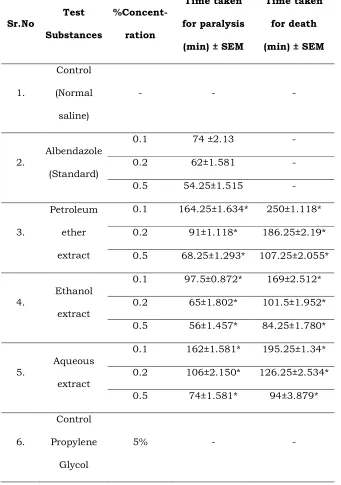
The results of anthelmintic activity are shown in Table no.1. In the present study it was
156
anthelmintic activity. Where as ethanol extract of plant shown significant activity as
compare to standard.
Table No. 1: Anthelmintic Activity of different extracts of Capparis zeylanica
Linn. Sr.No Test Substances %Concent-ration Time taken for paralysis
(min) ± SEM
Time taken
for death
(min) ± SEM
1. Control (Normal saline) - - - 2. Albendazole (Standard)
0.1 74 ±2.13 -
0.2 62±1.581 -
0.5 54.25±1.515 -
3.
Petroleum
ether
extract
0.1 164.25±1.634* 250±1.118*
0.2 91±1.118* 186.25±2.19*
0.5 68.25±1.293* 107.25±2.055*
4.
Ethanol
extract
0.1 97.5±0.872* 169±2.512*
0.2 65±1.802* 101.5±1.952*
0.5 56±1.457* 84.25±1.780*
5.
Aqueous
extract
0.1 162±1.581* 195.25±1.34*
0.2 106±2.150* 126.25±2.534*
0.5 74±1.581* 94±3.879*
6.
Control
Propylene
Glycol
5% - -
157
CONCLUSION:
In conclusion, Traditional uses of plant Capparis zeylanica Linn as powerful
anthelmintic activity has been confirmed and ethanol extract displayed profound
anthelmintic activity in study. Further, it would be interesting to isolate the possible
phytoconstituents which may be responsible for the anthelmintic activity and to
possible mechanism of action.
REFERENCES:
1. Bakshi D N, Sensarma P and Pal DC, A lexicon of medicinal plants of India, Vol 1,
Calcutta: Naya Prakashan; 1999, 360-365.
2. Kirtikar KR, Basu BD, Indian Medical plants, Vol I, Dehradun: International Book
Publication Distribution; 1987, 195-201.
3. Mali R.G., Hundiwale J. C., Sonawane R.S., Patil R.N., Hatapakki B.C. ,Evaluation
of Capparis deciduas Linn for anthelmintic and antimicrobial activities, Indian
Journal of Natural Product., 2004, 20(4),10-12.
4. Chaudhary S.R., Chavan M.J. and Gaud R.S., Anti-inflammatory and analgesic
activity of Cappris Zeylanica Linn root extracts, Indian Journal of Natural
Product,2004,20(1),36-39.
5. Chopra R.N., Chopra I.C., Handa K.L. and Kapur L.D., Indigenous Drugs of India,
Calcutta: UN Dhar and Sons Ltd;1950.
6. Bawaskar H.S. and Bawaskar P.H. , Call for global snakebite control and
procurement funding, Lancet, 2001,357,1132-37.
7. Bawaskar HS, Snake Venoms and Antivenoms; Critical Supply Issues, JAPI, 2004,
52, 11-13.
8. Ekramul Haque, M Mohmud,Haque, Mulhlesur, Raheman and satyajit D.S.,
E-Octodec-7-en-5 ynoic acid from the root of capparis Zeylanica, Fitoterapia,
2004,75,130-133.
9. Sabhi M, Ramezanian M, Jaffari G, Haravi G ,Bahaeddini F, Aynehi Y, Survey of
Indian plants for saponins Alkaloids, Flavonoids and Tannins, the plant of
Capparidaceae, International Journal of Crude Drug Research, 1985,
158
10.Cordell G.A., Introduction to the Alkaloids Biogenetic Approach., New York : John
Wiley and Sons Publication; 1981, 892.
11.Nargund VLG. Anthelmintic activity of 8-Fluoro-9 substituted (1,3)-
Benzothiazolo(5,1-b)-1,3,5-triazoles on Pheretima postuma. Indian Drugs 1999;
36(2):137-39.
12.Nayak B.S., Jena P. K., Sahu N. P., Nayak U. K. and Patro K B, Comparative study
of anthelmintic activity between Aqueous and ethanolic extract of solanum
surattense Linn. International Journal of Pharmacy and Pharmaceutical Sciences,