This is an open access journal, and articles are distributed under the terms of the Creative Commons Attribution-Non Commercial-ShareAlike 4.0 License, which allows others to remix, tweak, and build upon the work non-commercially, as long as appropriate credit is given and the new creations are licensed under the identical terms.
© 2019 Journal of Advanced Pharmacy Education & Research | Published by SPER Publication
149
Modern trends in the development of qualification assessment
of graduates of professional educational organizations
Yury Alexandrovich Svirin
1,2*, Svetlana Evgenyevna Titor
2, Liudmila Valentinovna
Inogamova-Khegai
3, Oleg Olegovich Ivannikov
4, Sergej Nikolaevich Shestov
51 All-Russian State University of Justice (RLA of the Ministry of Justice of Russia), Asovskaya st., 2/1, Moscow, 117638, Russia, 2State University of Management, Ryazan
Avenue, 99, Moscow, 109542, Russia, 3 Kutafin Law State University, Sadovaya-Kudrinskaya Str., 9, Moscow,125993 Russia, 4 graduate student, Chair of Civil Law and Process Ows in “Academy of Labour and Social Relations”, Lobachevskogo Avenue, 90, Moscow, 119454, Russia, 5 Institute of Economics and Law “Academy of Labor and Social Relations” in Sevastopol, Balaklavskaya st. 11, Sevastopol, 299011, Russia.
Correspondence: Yury Alexandrovich Svirin, All-Russian State University of Justice (RLA of the Ministry of Justice of Russia), Asovskaya st., 2/1, Moscow, 117638, Russia. Email: [email protected].
ABSTRACT
The article discussed the current issues of trends in the development of professional assessments of graduates of educational institutions. For many years, national projects to improve professional education have been implemented; new training methods have been tested and introduced. The assessment of the prospects for the development of a demo exam as a form of certification of graduates of professional educational organizations was made. Methods: The study was conducted on the basis of the comparative analysis of Russian and foreign scientific doctrines. The leading approach to the analysis of the studied phenomena was the method of system analysis. Along with the method of system analysis, the methods of structural-functional, statistical analysis, as well as general scientific methods of cognition were used. The purpose of this study was to define the concept of the "demo exam" and its essence, necessity, content, prevalence, and expediency. Results: The results of this article suggested that the outcome of a practice-oriented (dual) approach to training was to conduct the final certification in the form of a public (demo) exam, with the participation of business representatives, employers (and/or the defense of final qualifying work). However, for holding a demo exam, it is necessary to create interregional and regional competence centers located in separate colleges, where demo exams should actually be held. Practical significance: The materials of the article can be used to develop state policy in the field of improving the education quality of graduates of professional educational organizations.
Keywords: demo exam, final certification of graduates, professional education, WorldSkills
Introduction
According to the Ministry of Labour and Social Development of Russia, only 8.0% of graduates are ready to fulfil their official duties, the rest of them need additional training in the workplace to some extent.[1] Therefore, the professional community is concerned about the need to train highly qualified, globally
competitive professional staff. Direct employers are ready to take an active part in the training of such personnel.
Human resources constitute the foundation of health systems. If the plans and projects related to training of human resources are not compatible with the health and social conditions of a country
it will not be able to raise people’s health to a level where they
can economically and socially have productive lives.[2] One of the first attempts to train highly qualified personnel was the implementation of the System Project by the Agency for Strategic Initiatives to promote new projects in 2013 "Training of personnel that meets the requirements of high-tech industries based on dual education". According to the results of this project, professional education is switching to a practice-oriented (dual) content. This is a type of professional education in which the practical part of the training takes place in the workplace, while the theoretical part is located in an educational organization; the practical part of training is between 50 percent and more of the total training time. Education is considered a main filed of focus, Access this article online
Website: www.japer.in E-ISSN: 2249-3379
How to cite this article: Yury Alexandrovich Svirin, Svetlana Evgenyevna Titor, Liudmila Valentinovna Inogamova-Khegai, Oleg Olegovich Ivannikov, Sergej Nikolaevich Shestov.Modern trends in the development of qualification assessment of graduates of professional educational organizations. J Adv Pharm Edu Res 2019;9(2):149-155.
Journal of Advanced Pharmacy Education & Research | Apr-Jun 2019 | Vol 9 | Issue which creates and promotes knowledge and skill and improves
human resource attitude and performance.[3] The educational systems of all the countries in the world are in search of new models, approaches, and concepts and the complexity of the constructive problems of the present determines the educational attitudes and priorities.[4]
The result of the practice-oriented (dual) approach to training was the conduction of final certification in the form of a public (demo) exam with the participation of business representatives and employers (and/or the defense of a final qualifying work).
Methods
In the research process, the following methods were used: system analysis; scientific research as an institutional-structural element of the practice-oriented education system; structural-functional and statistical analysis; theoretical methods (analysis; synthesis; specification; generalization; method of analogies); the empirical method, as well as general scientific methods of cognition.
Literature Review
Distinctive features of such final certification in comparison to the usual traditional certification are as follows:
• an independent assessment by direct consumers (potential employers, business representatives) of graduates' knowledge and skills;
• the possibility of adding to the learning process and the final certification task, the corporate modules, and business participation in the preparation of assessment tools;
• the possibility to demonstrate graduates' knowledge and skills directly in real working conditions.
The positive effect of this approach on learning and final certification is obvious. A graduate obtains not only theoretical knowledge but also practical skills, which he/she acquires directly at the real production site, not on modelled simulators. In 2012, Russia joined the international professional movement WorldSkills International (WSI). The WorldSkills movement originated in Spain in 1947, when the world was sorely lacking skilled workers. The mission of the movement was to popularize the working professions, increase their prestige, and develop high world professional standards. WorldSkills today is the Olympic movement of professional skills. World Championships are held once every two years. For competitions, assessment tools and tasks have been developed, the level of which corresponds to world standards by complexity. WorldSkills project in Russia has been coordinated by the Union "Agency for the Development of Professional Communities and Skilled Workers "Young Professionals" (WorldSkills Russia)". The Order of The Government of the Russian Federation dated March 3, 2015, No. 349-r approved a set of measures aimed at improving the system of secondary professional education for the
period of 2015-2020.[5] In pursuance of these instructions, the Union "Agency for the Development of Professional Communities and Skilled Workers "Young Professionals" (WorldSkills Russia)" has been conducted a pilot testing of a demo exam according to WorldSkills Russia standards since 2017 as a part of the state final certification.
For conducting a demo exam, a set of assessment tools was developed taking into account the world standards in terms of complexity of WorldSkills championship competitions. The Order of the WorldSkills Russia Union No. PO/19 dated November 30, 2016, approved the "Methodology of Organizing and Conducting a Demo Exam According to the Standards of WorldSkills Russia".[6] For the first time in this document, the definition of a "demo exam" was given as a form of assessment of the level of knowledge and skills of students and graduates mastering training programs for skilled workers, employees, and middle-level specialists, which allowed them to carry out professional activities in a particular field and (or) perform the work by specific profession or specialty in accordance with WorldSkills Russia standards.
A new form of graduates' certification in the form of a demo exam was further developed in the regulations.
The Order of the Ministry of Labour and Social Protection of the Russian Federation No. 831 dated November 2, 2015, formed a list of the 50 most demanded in the labour market, new and promising occupations that required secondary professional education (hereinafter – TOP-50).[7] By the end of 2016, new federal state educational standards of secondary professional education (hereinafter – SPE FSESs) were approved for the training of highly skilled workers and TOP-50 specialists. All new TOP-50 SPE FSESs were provided for the state final certification in the form of a demo exam.
Each TOP-50 SPE FSES determined a type (form) of the state final certification in its own way. Such forms were as follows:
• defense of final qualifying work in the form of a demo exam (for example, SPE FSES 43.01.09 "Cook, confectioner", approved by the Order of the Ministry of Education and Science of the Russian Federation of December 9, 2016, No. 1569.[8]
• a state exam in the form of a demo one (for example, SPE FSES 43.02.13 "Technology of Hairdressing Art", approved by the Order of the Ministry of Education and Science of the Russian Federation of December 9, 2016, No. 1558.[9]
• final practical qualification work and a written examination paper or a demo exam – for graduates who master training programs for qualified workers and employees;
• thesis (thesis project) and (or) a demo exam – for graduates who master a training program for mid-level specialists.
At the same time, the SFE Procedure did not define the concept of a "demo exam", only indicated a demo exam;
• provided for the simulation of real production conditions for graduates to solve practical tasks of professional activity;
• the tasks were developed on the basis of professional standards (if any) taking into account the assessment materials (if any), developed by the Union of "Agency for the Development of Professional Communities and Skilled Workers "Young Professionals" (WorldSkills Russia)";
• in the case of a demo exam, the State Examination Commission also included experts of the Union of "Agency for the Development of Professional Communities and Skilled Workers "Young Professionals" (WorldSkills Russia)" (hereinafter referred to as the Union "Young Professionals (WorldSkills Russia)").
Thus, amendments to the SFE Procedure have introduced a new understanding of the "demo exam" – this was the certification with the simulation of real working conditions during the examination for graduates to solve practical tasks of professional activity.
At the same time, not in all fields of study, the tasks were formed taking into account the requirements of WorldSkills Russia standards. This was sensible since professional competitions according to the world standards WorldSkills were not held for all professions and specialties. Currently, WorldSkills Russia holds competitions in the following areas of competence:
• services sector;
• design and creativity;
• transport sector;
• building technologies;
• production engineering;
• communication technologies.
Thus, for example, SPE FSES in specialty 38.02.07 "Banking", however, the SFE Procedure provides for the participation of the Union "Young Professionals (WorldSkills Russia)" during all demo exams. The authors assumed that the participation of the Union "Young Professionals (WorldSkills Russia)" in conducting SFE in the form of a demo exam in those fields of study that did not participate in WorldSkills Russia competitions was not advisable.
Approved by the Order of the Ministry of Education and Science of Russia dated February 5, 2018 No. 67. [11] SPE FSES in
specialty 38.02.06 "Finance", approved by the Order of the Ministry of Education and Science of Russia dated February 05, 2018 No. 65, [12] also provides for the final certification in the form of a demo exam. Actually, a "here-and-now" demo exam is probably necessary and in demand. One of the skills of graduates should be quick decision-making and quick response to the task. It is not by chance that employers primarily make demands on a worker for adaptation mobility, contact, resistance to stress, etc., and only then – for a high qualification level. Preparing graduates for the demo public exam just brings up such qualities.
However, is there a need for participation and, most importantly, the formation of assessment tools in the above-mentioned areas by the Union "Young Professionals (WorldSkills Russia)"?
Journal of Advanced Pharmacy Education & Research | Apr-Jun 2019 | Vol 9 | Issue of them have world-class skills to teach them to students. It is
assumed that interregional competence centers would primarily prepare highly qualified teachers and the centers would implement additional professional education programs for them. However, again, the capacities of the centers, which were created mainly in 2016 do not allow rapid implementation of the plan to improve the qualifications of teachers of the SPE system. This is not by chance. Thus, the working group of the Federal Educational and Methodical Association in the secondary professional education system on an integrated group of professions, in specialties 43.00.00 "Service and Tourism", profession 43.01.09 "Cook, confectioner", approved an approximate basic educational program (hereinafter referred to as "ABEP") in the field of study 43.01.09 "Cook, confectioner", which, by virtue of the current legislation, is mandatory for the application by professional educational organizations, for their licensing and accreditation. Among the required equipment for laboratories to be equipped with, the ABEP provides such equipment as hovoli (equipment for brewing coffee in the sand) and a set of tools for carving (carving is the art of cutting vegetables and fruits). It is not a secret that graduates with a working profession of a cook are usually employed in the social fields: kindergartens, hospitals, health resorts, schools where they can never apply their skills using these tools. The authors assume that in approving the FSES and ABEP for the profession of a cook, it would be necessary to conduct an analysis of the labour market for the need for such high skills. It is important to remember that the training of workers for the profession of a cook is usually carried out from budget funds. Is it really necessary to spend budget funds to train workers with such skills that they will never need? Certainly, a chef working at a restaurant or even at a cafe should have the skills to use these tools. However, the number of such trained professionals should be limited in view of the demand in the labour market. If necessary, one can always fill in the missing skills by means of an additional professional education system, which is relevant. In addition, in distant regions, small municipal centers, where the training on the profession of a cook is usually conducted exclusively for local social needs, even in local cafes and restaurants (if any) one will not see such equipment for using dishes. This means that students, even when doing practical training, will not gain practical skills in working with this equipment. This re-emphasizes the doubtfulness of its obligatory use for mass training of workers in the profession of a cook. The second critical remark is made by the experts regarding the assessment tools. It has been assumed that for conducting the WorldSkills exam, those test and measurement materials are used in the WorldSkills competition, but adapted for the state final examination, where they will be exclusively used. However, during testing, many tasks reproduced exactly WorldSkills tender documentation and did not undergo any adaptation or adjustment to the requirements of secondary professional education programs. Because of that, there were inconsistencies in what the students were trained for and what materials were used for checking their level of training. For this reason, many students did not cope with the tasks. Recall that
updated TOP-50 SPE FSESs and other standards imply a demo exam as a state final examination. The first graduation upon the new FSESs will begin in 2019. This will no longer be an experiment, but a valid final examination, according to the results of which graduates will get a diploma of an appropriate level of education. Analyzing the results of the pilot project on conducting a demo exam, taking into account the still not formed logistics base, not fully trained teachers, apprentice training masters, there are some doubts about whether all graduates will cope at a high level with the problem set at a demo exam. If they cannot show positive results on the final certification, the possibility of issuing an education certificate to them will be called into question. The legal framework has not currently provided a way out of this situation.
Experts pointed out another problem. As the authors noted earlier, there are competitive tasks of the WorldSkills movement not for all professions and competencies. For a number of professions and specialties, these assessment tasks had to be specially developed for the demo exam. Since there is no uniform methodology for the development of these assessment tasks, educational organizations obviously faced certain problems. As the authors noted earlier, the need for participation in the preparation of assessment tools by the Union "Young Professionals (WorldSkills Russia)" is in doubt.
The passport of the national project "Education", approved by the Presidium of the Presidential Council for Strategic Development and National Projects, protocol dated December 24, 2018 No. 16, [14] provided for the phased introduction of a demo exam: in 2019, it has been planned to involve only 5% of students in the final certification using the mechanism of a demo exam, in 2020 – 6%, in 2021 – 8%, in 2022 – 13%, in 2023 –
18%, in 2024 – 50%.
The targets did not correspond to the actual situation. Since all the SPE FSESs were provided for a final demo exam, it is obvious that all 100% of students will pass this form of attestation. The logical chain of planned indicators with actual processes is not clear.
The Moscow Department of Education organizes the training of upper-formers under additional general developmental programs at the in-depth level.[15] Programs involve the mastering of professional skills and abilities. As a result of the students' training, the program is also provided for a demo exam. Upon successful completion of the exam, students get a certificate with personal differentiated assessment. The examination commission includes the representatives of Moscow universities and colleges. Students are credited with passing the demo exam as an individual achievement of a student with additional points when entering a university.
Obviously, in this case, a demo exam has a completely different essence and meaning than the demo exam as the final examination for SPE programs.
Along with the development of a public demo exam, another type of independent assessment of graduates has emerged. Since January 1, 2017, Federal Law dated July 03, 2016 No. 238-FZ "On Independent Qualification Assessment" came into force.[16] The Law was formed by the employers' associations of a voluntary system of qualification assessment for compliance with professional standards, based on the confidence in the quality of this assessment in the labour market.
By virtue of the law, the independent assessment of the qualifications of workers or individuals applying for a certain type of work in the form of a professional exam has been a procedure
for confirming that an applicant’s qualifications comply with the provisions of a professional standard or qualification requirements established by federal laws and other regulatory legal acts of the Russian Federation, carried out by a qualification assessment center.
In accordance with Article 195.1 of the Labour Code of the Russian Federation,[17] a professional standard is a characteristic of the qualifications necessary for an employee to perform a certain type of professional activity, including the performance of a certain labour function. Until now, about 1,300 professional
standards for various competencies have been developed and approved.
Professional standards have been developed by the employers themselves. Only employers know what level of qualification professional workers should have in the modern economy. Obviously, the employees' competence should also be assessed by employers.
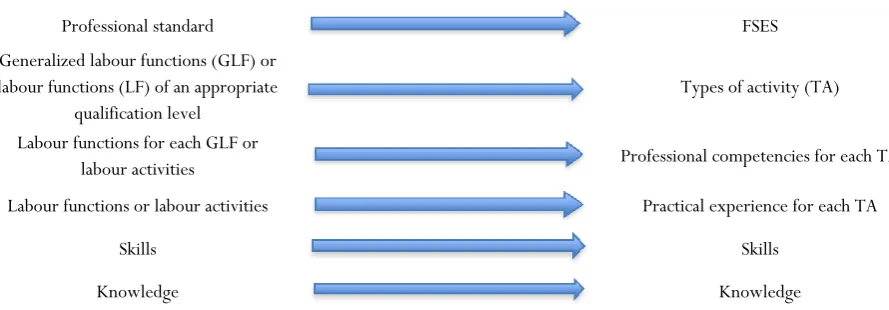
Qualification assessment centers and assessment tools for conducting a professional exam approves Guidelines for Professional Qualification by a specific industry. A feature of these centers is that they cannot be created at educational organizations. The content of assessment tools meets the requirements for the level of qualification, knowledge, skills, and abilities laid down in professional standards. A certificate issued to applicants who have passed such professional exams will open up more opportunities for an employee in the labour market. The development of professional education is on the path of updating the FSES in accordance with the newly implemented professional standards. The following scheme are used (see Fig. 1):
Professional standard FSES
Generalized labour functions (GLF) or labour functions (LF) of an appropriate
qualification level
Types of activity (TA)
Labour functions for each GLF or
labour activities Professional competencies for each TA
Labour functions or labour activities Practical experience for each TA
Skills Skills
Knowledge Knowledge
Figure 1: The scheme of professional education development.
Proposals to combine the procedure of state final certification and independent assessment of qualifications are relevant. In 2018, the National Agency for the Development of Qualifications began implementing a project on the use of tools for an independent assessment of qualifications in the process of state final certification of students completing the mastering of SPE programs.
According to experts,[18] combining procedures for an independent assessment of qualifications and state final certification will provide a number of advantages:
• for professional educational organizations: the possibility of "feedback" from employers, the independent assessment of the quality of training on implemented educational programs and further –
passing professional-public accreditation, increasing competitiveness in the educational market, and the possibility of obtaining extrabudgetary income through the activities of the examination platform;
• for enterprises: the possibility of selecting the most qualified graduates, saving costs associated with assessing the qualification of candidates, reducing the timing and financial resources allocated for finishing the training and initial adaptation of personnel.
• for graduates: the possibility of entering the labour market with professional qualification certificates recognized by employers, the improvement of conditions for employment, lowering the threshold for successful professional adaptation.
Journal of Advanced Pharmacy Education & Research | Apr-Jun 2019 | Vol 9 | Issue nor professional educational organizations can pay for the
professional exam since they do not have appropriate funds for this. For future employers, the financing of the independent assessment of qualifications of all graduates of professional educational organizations is not of interest: it looks like a blind bargain to them.
Results
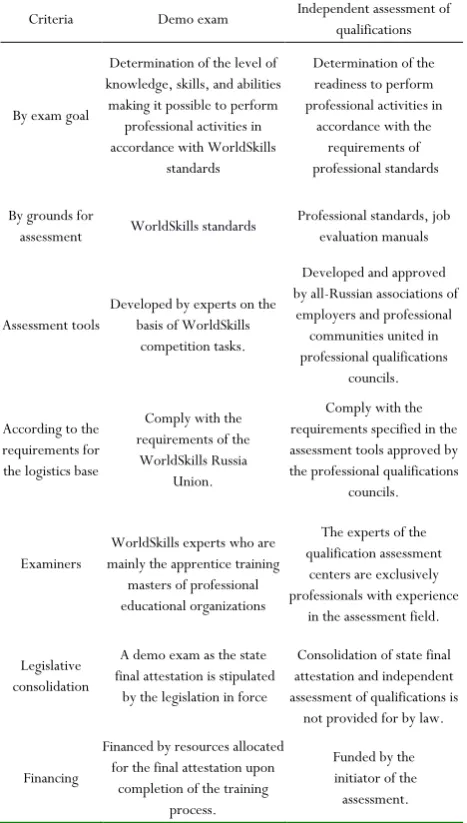
As a result of the study, the authors identified the following differences of the WorldSkills competence demo exam from the independent assessment of qualifications (see Table 1).
Table 1: Differences of the demo exam from the independent assessment of qualifications
Criteria Demo exam Independent assessment of
qualifications
By exam goal
Determination of the level of knowledge, skills, and abilities
making it possible to perform professional activities in accordance with WorldSkills
standards
Determination of the readiness to perform professional activities in
accordance with the requirements of professional standards
By grounds for
assessment WorldSkills standards
Professional standards, job evaluation manuals
Assessment tools
Developed by experts on the basis of WorldSkills
competition tasks.
Developed and approved by all-Russian associations of
employers and professional communities united in professional qualifications
councils.
According to the requirements for the logistics base
Comply with the requirements of the WorldSkills Russia
Union.
Comply with the requirements specified in the assessment tools approved by the professional qualifications
councils.
Examiners
WorldSkills experts who are mainly the apprentice training
masters of professional educational organizations
The experts of the qualification assessment
centers are exclusively professionals with experience
in the assessment field.
Legislative consolidation
A demo exam as the state final attestation is stipulated
by the legislation in force
Consolidation of state final attestation and independent assessment of qualifications is
not provided for by law.
Financing
Financed by resources allocated for the final attestation upon
completion of the training process.
Funded by the initiator of the
assessment.
As for the utility, in the authors' opinion, the employer is more interested in the procedure of independent assessment of qualifications than in the WorldSkills Demo Exam.
Considering that the concept of a "demo exam" has not been legally defined as long as it is conducted in a trial version, the authors assumed that it would be possible to more accurately determine its content and essence, taking into account the interests of direct employers.
Conclusion
The study resulted in the following conclusions:
Modern technological changes in the economy require the search for new approaches to train professionally qualified personnel. The study showed that such search has been conducted, including in terms of the final attestation of graduates of professional educational organizations. New approaches to training professional personnel dictate the need for the participation of the direct consumer of professional personnel – the employer. New forms of employers' participation in the certification of graduates have been introduced into professional education: a demo exam as an independent assessment of qualifications. Both forms of assessment of professional skills have already been applied in practice; however, there are some uncertainties in the concept and essence of new forms of certification.
It is proposed to define the concept of the "demo exam". The study showed that a demo exam has been understood in different situations in different ways; however, its characteristic features have been defined: publicity, independence of assessment, a special order of assessment tools, and the participation of professional employers in conducting the exam.
Both assessment mechanisms considered – a demo exam and an independent assessment of qualifications –are relevant in the application; the positive effect of their application is obvious. However, the authors assumed that it is necessary to distinguish between their application by the field of study and relevance. It is quite possible to provide a final certification as an alternative for the choice of the form by graduates or a professional educational organization.
Both assessment forms have so far been used as pilot projects. For their further application, amending the existing regulations is required.
References
1. Svirin YA, Titor SE, Petrov AA, Smirnov EN, Morozova EA, Scherbakova OY. Practice-Oriented Model of Professional Education in Russia. International Journal of Environmental and Science Education. 2016;11(15):7368-80.
2. Dehghani H, Nasiriani K. Cardiac Care Unit Nurses' Perception of Educational Competencies (Modified Delphi Method). International Journal Of Pharmaceutical And Phytopharmacological Research. 2017 Oct 1;7(5):22-8. 3. Dahmarde H, Khodabakhshi M, Rad GM. Birjand Teaching
Hospitals Nurses' attitude towards Personal Development Plan. Pharmacophore. 2018;9(3):25-9.
4. Saltanati, A. Zhando, A. Dusembinova, A. Galiya, S. & Aigul, M. Preparation of Future Teachers for Primary
Schools to Develop the Schoolchildren’s Health Culture. Örgütsel Davranış Araştırmaları Dergisi Journal of Organizational Behavior Research. 2019;4(1):33–42. 5. A Set of Measures Aimed at Improving the Secondary
2015-2020. (2015 March 3). Approved by the Decree of the Government of the Russian Federation No. 349-r. 6. Methods of Organizing and Conducting a Demo Exam
According to the Standards of WorldSkills Russia. (2016 November 30). Approved by the Order of the WorldSkills Russia Union No. PO/19.
7. Order of the Ministry of Labour and Social Protection of the Russian Federation No. 831 "On Approval of the List of the 50 Most Popular in the Labour Market, New and Promising Professions Requiring Secondary Vocational Education". (2015 November 2).
8. Order of the Ministry of Education and Science of the Russian Federation No. 1569 "On Approval of the Federal State Educational Standard of Secondary Vocational Education by Profession 43.01.09 Confectioner". (2016 December 9).
9. Order of the Ministry of Education and Science of the Russian Federation No. 1558 "On Approval of the Federal State Educational Standard of Secondary Vocational Education in Specialty 43.02.13 Technology of Hairdressing". (2016 December 9).
10. Order of the Ministry of Education and Science of Russia No. 1138 "On Amendments to the Procedure for Conducting State Final Certification for Educational Programs of Secondary Professional Education, Approved by the Order of the Ministry of Education and Science of the Russian Federation dated August 16, 2013 No. 968". (2017 November 17).
11. Order of the Ministry of Education and Science of Russia No. 67 "On Approval of the Federal State Educational Standard of Secondary Vocational Education in Specialty 38.02.07 Banking". (2018 February 5).
12. Order of the Ministry of Education and Science of Russia No. 65 "On Approval of the Federal State Educational Standard of Secondary Vocational Education in Specialty 38.02.06 Finance". (2018 February 5).
13. Demo Exam as a New Format of Assessing the Results of Training; [2017 November 21; retrieved 2019 July 16].
Avaliable from
https://academy-prof.ru/blog/demonstracionny-ekzamen-v-spo
14. Passport of the National Project "Education". Approved by the Presidium of the Presidential Council for Strategic Development and National Projects, Protocol No. 16. (2018 December 24).
15. Demo Exam; [2019; retrieved 2019 July 16]. Avaliable at https://vg.mskobr.ru/znachimye_meropriyatiya/demon stracionnyj_e_kzamen/#novosti
16. Federal Law No. 238-FZ "On Independent Qualification Assessment". (2016 July 3).
17. Labour Code of the Russian Federation. (2001).