*Valli. S
Mohamed Sathak College of Arts and Science, Sholinganallur, Chennai-119
Email: [email protected]/[email protected]
Address for correspondence
Access this article online www.japer.in
Anticryptococcal activity of
Terminalia chebula
against clinical
and environmental isolates of
Cryptococcus neoformans
INTRODUCTION
AIDS has become a devastating epidemic in the world. In the recent decades, Up to 90% of all HIV patients contract fungal infections during the course of the disease, of which 10-20% die as a direct consequence of fungal infections [1,2] Cryptococcosis is the most common opportunistic fungal infection in HIV /AIDS patients and management of this infection is difficult due to growing resistance to antifungal agents, drug toxicity and high cost[3] Therefore there is a need to search for alternative therapeutic agents by the exploration of medicinal plants [4,5,6]used in local dictum and traditional medicines by the local population as important source of new, active and renewable antifungal drugs.
Terminalia chebula
Retz (family combretaceae) is a flowering evergreen tree distributed widely in India and
different parts of this tree has germinated substantial compounds to cure various diseases The active compounds present in fruit bark and leaves are tannins, triterpenes, saponins and mucous substances. The fruit extracts have been reported to possess antiviral, antibacterial, anti-cancerous and antioxidant activity[7] The present work was carried out to examine the antifungal potential of crude extracts of fruits of Terminalia chebula against clinical and environmental isolates of Cryptococcus neoformans
MATERIALS AND METHODS Preparation of Extract:
The fruits of T Chebula were purchased commercially and the identification was authenticated by a botanist. .From dried fruits, seeds were separated and the remaining part was made into coarse powder .The coarse powder was then extracted with ethanol by Soxhlet apparatus . The extract was filtered using Whatmann filter paper, concentrated in vacuum and air dried.
Anti-cryptococcal activity of ethanolic fruit extract of Terminalia chebula:
Research Research Research
Research ArticlArticlArticlArticleeee
The increasing prevalence of multidrug resistant strains of fungi and the recent appearance of strains with reduced susceptibility to antifungal agents raises the specter of untreatable fungal infections and adds urgency to the search for new infection-fighting strategies which involves the utilization of bioactive phytochemicals from plants. The ethanolic extract obtained from the fruit of Terminalia chebula was assessed for their antifungal activity against clinical and environmental isolates of C neoformans. Extracts were prepared from the fruits by standard techniques and phytochemical analysis of the extract was performed.to study the bioactive compounds The compounds were identified by GC MS .analysis and the functional groups were identified by FTIR. Of the 10 isolates tested the clinical isolates were more susceptible than the environmental isolates. C5and E3 was found to be more susceptible with the zone of inhibition 25mm at a concentration of 4mg/ml.. Mass spectrometric analysis revealed the presence of phenolic compounds and tannins. FTIR analysis revealed the presence of alkanes alkynes esters carboxylic acids etc. as chemical groups constituting the bioactive compounds .
Keywords: Terminalia chebula, Cryptococcus neoformans, antifungal, pyrogallol,benzenetriol , GC MS FTIR
ABSTRACT ABSTRACT ABSTRACT ABSTRACT Valli S1* & S Gokulshankar2
1 Research Scholar, Department of Biotechnology Acharya Nagarjuna University, Guntur, Andhra Pradesh & Assistant Professor Microbiology, Mohamed Sathak College, Chennai 2Department of Biotechnology Acharya Nagarjuna University, Guntur, Andhra Pradesh and Unit of Microbiology, Faculty of Medicine, AIMST University
The anticryptococcal activity of crude alkaloids was evaluated by disc diffusion method of NCCLS[8] In brief, Activated cultures of 10 isolates of
C .neoformans in Sabouraud Dextrose broth were
adjusted to 0.5 McFarland standard. 100µl of the inoculum was introduced to molten Sabouraud dextrose agar and poured into sterile petriplates Sterile filter paper discs were impregnated with varying concentrations of ethanolic fruit extract ranging from 1mg to 4mg per disc dissolved in DMSO and dried. The discs were placed on yeast seeded plates and incubated at 37˚C for 48hrs. Disc impregnated with only 100% DMSO served as negative control Amphotericin B (100 units/disc) was used as positive control. Following incubation, antifungal activity was evaluated by measuring zones of inhibition of fungal growth. Clear zone within which fungal growth was absent were measured and recorded as the diameter (mm) of complete inhibition. Experiments were conducted in triplicates
MIC of ethanolic fruit extract of Terminalia chebula
The broth dilution method was used to determine the minimum inhibitory concentration of the extract against C neoformans Minimum inhibitory concentrations of the extract was prepared by serial doubling dilution of the extract to obtain concentrations in the range 100-1000µg/ml. Equal volume of the extract and Mueller – Hinton broth i.e. 0.5ml each were dispensed into sterilized test tubes. 0.1 ml of standardized inocula (3.3 X 10 CFU/ml) was added to each of the test tubes above. The tubes were incubated aerobically at 350C for 24 h. Tubes containing broth and plant extracts without inoculum served as positive control while tubes containing broth and inoculum served as negative control. The tubes were observed after 24 h of incubation to determine minimum inhibitory concentration, the lowest concentration that showed no evidence of growth (NCCLS, 2008)
TLC profile of ethanolic fruit extract of Terminalia chebula:
TLC of crude extract was carried out on TLC glass plates coated with 0.2mm thickness silica gel 60 .10µl of crude extract was applied on the glass plates at equal distance with the help of micropipette. The plates were kept in a chromatographic chamber after drying. Chloroform: Ethyl acetate: Formic acid (2.0: 2.0: 0.8) was used as the solvent system. The plate was removed from the chamber, when the solvent front had reached the predetermined height and the solvent front was marked precisely with pencil. Then the plate was dried and observed under UV light. The plate was sprayed with 5% ferric chloride in methanol. Rf of the band separated was noted
Phytochemical analysis of ethanolic fruit extract of
Terminalia chebula
Phytochemical screening of Terminalia chebula for the presence of alkaloids flavanoids, hydrolysable tannins, coumarins, phenols, sugar etc
was carried out as per standardprocedures [9]
GC MS analysis of ethanolic fruit extract of
Terminalia chebula
FTIR analysis was done to identify chemical groups present in the bioactive compounds The samples were scanned using infrared in the range 5000-500 cm-1 The spectral data obtained were compared with the reference chart to identify the functional groups present in the sample
RESULTS
The dried fruit pulp of Terminalia chebula
was extracted with ethanol and the residue was recovered using a rotary evaporator
Anticryptococcal activity of ethanolic fruit extract of Terminalia chebula: (Table 1& 2)
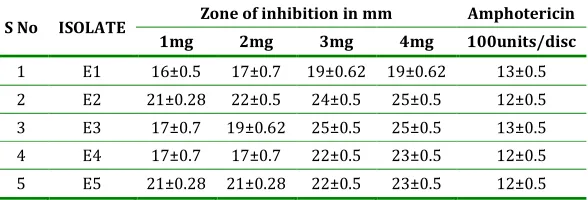
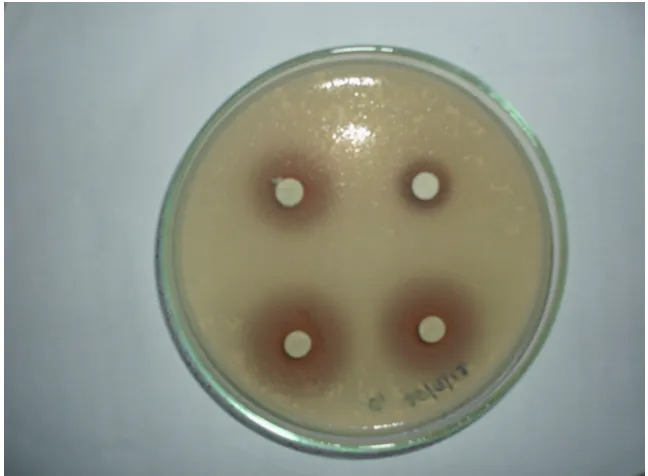
The ethanolic fruit extract of Terminalia chebula was tested for its antifungal activity against 5 clinical and 5 environmental isolates of C neoformans. At the highest concentration tested 4mg/ml, of all the 5 clinical isolates maximum zone of inhibition was shown by C5(25mm±0.5)followed by C2and C3 (24mm±0.5) and C1 and C4(23±0.5) Of all the 5 environmental isolates E2 and E3 showed maximum zone of inhibition (25±0.5) followed by E4and E5 (23.5±0.5) E1 showed less zone of inhibition comparatively (19±0.62).
MIC of ethanolic fruit extract of Terminalia chebula:
The minimum inhibitory concentration of the extract against Cryptococcus isolates was determined by broth dilution method.The MIC for the clinical isolates C4 and C5was found to be less 600µg/ml.compared to other clinical isolates C1, C2and C3 (800µg/ml) Among the environmental isolates the minimum inhibitory concentration of the extract was found to be 600µg/ml for E2and E5, whereas it was 800µg/ml for E3and E4. The MIC value for E1 was high compared to all other isolates (900 µg/ml) The results were presented in Table3&4
TLC profile of ethanolic fruit extract of Terminalia chebula:
TLC of the ehanolic extract was performed to separate active constituents in the extract .gallic acid
was used as the standard. The Rf value was found to be 0.39.
Phytochemical analysis of ethanolic fruit extract of
Terminalia chebula
The phytochemical active compoundsof Terminalia chebula were qualitatively analysed and the results were presented in table. The ethanol extracts of Terminalia chebula fruits showed the presence of phytochemical active compounds such as tannins quinines phenols coumarines and carbohydrates etc (Table 5)
GS MS FTIR analysis of ethanolic fruit extract of
Terminalia chebula
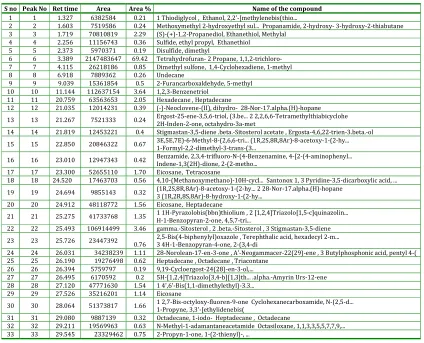
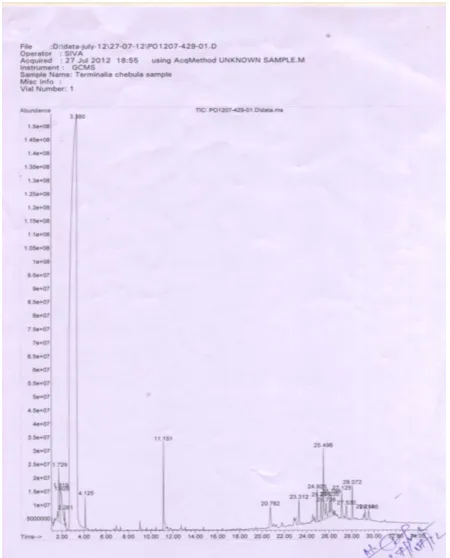
GC MS analysis was carried out on the ethanolic extract of T.Chebula and 35 different compounds were identified. The chromatogram showed 33 peaks in the retention time range 1.327min to 29.545 min. The largest peak at 3.389 min with 69.42% area was identified as Tetrahydrofuran. The second less promonent peak at 11.144 minwith 3.64%area corresponds to the compound 1, 2, 3, benzenetriol. The third prominent peak at 25.493 min with 3.46%area was due to the presence of gamma and beta sitosterol and stigmastan -3,5 diene. Other compounds identified were presented in Table 6. The IR spectral qualities of the fraction indicated the presence of ketones, aldehydes, carboxylic acids, amides, aromatic compounds alkanes alkenes alkynes and esters in their active components FTIR results were presented in Table 7.
DISCUSSION
The incidence of opportunistic fungal
infections in patients treated with
different treatments are used for fungal infections, none of them are ideal in terms of efficacy, safety or antifungal spectrum .Many of the current drugs are very toxic (Amphotericin B), lead to the development of resistance (fluconazole and 5-flucytosine) or exhibit drug-drug interactions (azoles)[11].Some Medicinal plants have therapeutic potential due to the presence of natural antioxidants functioning as reducing agents, free radical scavengers and quenchers of singlet oxygen. Majority of their antioxidant activity is due to bioactive compounds viz. phenolic and polyphenolic compound
The present investigation was undertaken to evaluate the anticryptococcal property of T.chebula fruit..Ethanolic fruit extracts were prepared and its anti cryptococcal activity was checked by disc diffusion method against clinical and environmental isolates of C .neoformans. Of all the clinical isolates C5 exhibited maximum zone of inhibition(25mm±0.5)and E3 was most susceptible(25mm±0.5) among environmental isolates at a concentration of 4mg.It was also found that clinical isolates were more susceptible than environmental isolates
Phytochemical investigation reported the presence of tannins, quinines, phenols, coumarines and carbohydrates etc The bioactive components were identified by GC- MS .analysis . Identification of components was based on comparison of their mass spectra As the compounds separated, on elution through the column, were detected in electronic signals. As individual compounds eluted from the gas chromatographic column, they entered the electron ionization detector where they were bombarded with a stream of electrons causing them to break apart into fragments. The fragments were actually charged with a certain mass. The m/z ratio obtained was calibrated from the graph obtained which was called as the mass spectrum graph which is the fingerprint of the molecule. The identification of compounds was based on the comparisons of their mass spectra with NIST library 2008, WILEY8 & FAME.
GC MS chromatogram showed 33 peaks with tetrahydrofuran showing maximum peak area 69.42%at a retention time 3.389 minutes The common properties of tetrahydrofuran is their toxicity against cell of foreign organisms. These activities have been widely studied for their potential use antiinflamatory in exhibiting anti- angionic, antibacterial, antioxidant etc. in the elimination and reduction of serious human diseases like cancer cell lines[12]The next compound is benzenetriol with peak 3.64% at retention time 11.44min is a pyrogallol with antiseptic ,antioxidant,anti-dermatic, fungicide and candidicide[13]The third prominent peak at 25.493 min with 3.46%area was due to the presence of gamma and beta sitosterol and stigmastan -3,5 diene
An aqueous extract of T. chebula exhibited antifungal activity against a number of dermatophytes and yeasts [14,15]. It is effective against the pathogenic yeast Candida albicans and dermatophytes
Epidermophyton, Floccosum, Microsporum gypseum
and Trichophyton rubrum. Its inhibitory effect on three dermatophytes (Trichophyton spp.) and three yeasts (Candida spp.) has also been documented[16]. T. chebula is one of the most versatile plants having a wide spectrum of pharmacological and medicinal activities. This versatile medicinal plant is the unique source of various types of compounds having diverse chemical structure. Though it has a number of pharmacological activities due to the presence of various types of bioactive compounds, very little work has been done on the plausible medicinal applications of this plant against the diseases particularly on fungal pathogens. Hence extensive investigation is needed to exploit their therapeutic ability to combat diseases including drug resistant infections. As the global scenario is now changing towards the use of nontoxic plant products having traditional medicinal use, a drug development programme should be undertaken to develop modern drugs with the compounds isolated from T. chebula
overcome the problem of drug resistance after extensive investigation of its bioactivity, mechanism of action, pharmacotherapeutics, toxicity and after proper standardization and clinical trials.
CONCLUSION
In the present study the ethanolic fruit extract of
Terminalia chebula exhibited significant
anticryptococcal activity against clinical isolates. The
bioactive components were analysed by GC MS studies. GC MS analysis revealed that fruits of
Terminalia chebula are rich source of tannins and polyphenolic compounds.Tetrahydrofuran and benzenetriol with typical antifungal activity were identified as predominant compounds Further analysis and fractionation of these pure compounds is needed to recommend the compounds for therapy
Table 1: Anticryptococcal activity of crude ethanolic fruit extract of Terminalia chebula against clinical isolates
S No ISOLATE Zone of inhibition in mm Amphotericin
1mg 2mg 3mg 4mg 100units/disc
1 C1 18±0.5 20±0.5 21±0.28 23±0.5 12±0.5
2 C2 19±0.5 21±0.28 22±0.5 24±0.5 12±0.5
3 C3 19±0.5 20±0.5 21±0.28 24±0.5 13±0.5
4 C4 21±0.28 21±0.28 22±0.5 23±0.5 12±0.5
5 C5 21±0.28 22±0.5 24±0.5 25±0.5 12±0.5
Mean values of triplicates (zone of inhibition) ± S.D
Table 2: Anticryptococcal activity of crude ethanolic fruit extract of Terminalia chebula against environmental isolates
S No ISOLATE Zone of inhibition in mm Amphotericin
1mg 2mg 3mg 4mg 100units/disc
1 E1 16±0.5 17±0.7 19±0.62 19±0.62 13±0.5
2 E2 21±0.28 22±0.5 24±0.5 25±0.5 12±0.5
3 E3 17±0.7 19±0.62 25±0.5 25±0.5 13±0.5
4 E4 17±0.7 17±0.7 22±0.5 23±0.5 12±0.5
5 E5 21±0.28 21±0.28 22±0.5 23±0.5 12±0.5
Mean values of triplicates (zone of inhibition) ± S . D
Table 3: Minimum inhibitory concentration of crude ethanolic fruit extract of Terminalia chebula for clinical isolates
S No ISOLATE CONCENTRATION IN µg
100 200 300 400 500 600 700 800 900 1000
1 C1 + + + + + + + -- -- --
2 C2 + + + + + + + -- -- --
3 C3 + + + + + + + -- -- --
4 C4 + + + + + -- -- -- -- --
5 C5 + + + + + -- -- -- -- --
Table 4: Minimum inhibitory concentration of crude ethanolic fruit extract of Terminalia chebula for environmental isolates
S No ISOLATE CONCENTRATION IN µg
100 200 300 400 500 600 700 800 900 1000
1 E1 + + + + + + + + -- --
2 E2 + + + + + -- -- -- -- --
3 E3 + + + + + + + -- -- --
4 E4 + + + + + + + -- -- --
5 E5 + + + + + -- -- -- -- --
+ indicates growth, -- indicates no growth Table 5: Phytochemical analysis of Terminali chebula
S. No Phytochemical test Inference
1 Carbohydrate ++
2 Tannins test ++
3 Saponin test - -
4 Flavonoid test +
5 Alkaloid test -
6 Quinones ++
7 Glycosides test +
8 Cardiac glycosides test -
9 Terpenoids test -
10 Triterpenoid -
11 Phenols ++
12 Coumarins ++
13 Proteins -
14 Steroids and Phytosteroi -
15 Phlobatannin -
16 Anthraquinones -
Table 6: Identification of compounds present in ethanolic leaf extract of Terminali chebula by GC – MS analysis
S no Peak No Ret time Area Area % Name of the compound
1 1 1.327 6382584 0.21 1 Thiodiglycol , Ethanol, 2,2'-[methylenebis(thio...
2 2 1.603 7519586 0.24 Methoxymethyl 2-hydroxyethyl sul... Propanamide, 2-hydroxy- 3-hydroxy-2-thiabutane 3 3 1.719 70810819 2.29 (S)-(+)-1,2-Propanediol, Ethanethiol, Methylal
4 4 2.256 11156743 0.36 Sulfide, ethyl propyl, Ethanethiol 5 5 2.373 5970371 0.19 Disulfide, dimethyl
6 6 3.389 2147483647 69.42 Tetrahydrofuran- 2 Propane, 1,1,2-trichloro- 7 7 4.115 26218186 0.85 Dimethyl sulfone, 1,4-Cyclohexadiene, 1-methyl 8 8 6.918 7889362 0.26 Undecane
9 9 9.039 15361854 0.5 2-Furancarboxaldehyde, 5-methyl 10 10 11.144 112637154 3.64 1,2,3-Benzenetriol
11 11 20.759 63563653 2.05 Hexadecane , Heptadecane
12 12 21.035 12014231 0.39 (-)-Neoclovene-(II), dihydro- 28-Nor-17.alpha.(H)-hopane
13 13 21.267 7521333 0.24 Ergost-25-ene-3,5,6-triol, (3.be... 2 2,2,6,6-Tetramethylthiabicyclohe 2H-Inden-2-one, octahydro-3a-met
14 14 21.819 12453221 0.4 Stigmastan-3,5-diene .beta.-Sitosterol acetate , Ergosta-4,6,22-trien-3.beta.-ol
15 15 22.850 20846322 0.67 3E,5E,7E)-6-Methyl-8-(2,6,6-tri... (1R,2S,8R,8Ar)-8-acetoxy-1-(2-hy... 1-Formyl-2,2-dimethyl-3-trans-(3...
16 16 23.010 12947343 0.42 Benzamide, 2,3,4-trifluoro-N-(4-Benzenamine, 4-[2-(4-aminophenyl... Indene-1,3(2H)-dione, 2-(2-metho...
17 17 23.300 52655110 1.70 Eicosane, Tetracosane
18 18 24.520 17463703 0.56 4,10-(Methanoxymethano)-10H-cycl... Santonox 1, 3 Pyridine-3,5-dicarboxylic acid, ...
19 19 24.694 9855143 0.32 (1R,2S,8R,8Ar)-8-acetoxy-1-(2-hy... 2 28-Nor-17.alpha.(H)-hopane 3 (1R,2R,8S,8Ar)-8-hydroxy-1-(2-hy...
20 20 24.912 48118772 1.56 Eicosane, Heptadecane
21 21 25.275 41733768 1.35 1 1H-Pyrazolobis(bbn)thiolium , 2 [1,2,4]Triazolo[1,5-c]quinazolin... H-1-Benzopyran-2-one, 4,5,7-tri...
22 22 25.493 106914499 3.46 gamma.-Sitosterol , 2 .beta.-Sitosterol , 3 Stigmastan-3,5-diene
23 23 25.726 23447392 0.76 2,5-Bis(4-biphenylyl)oxazole , Terephthalic acid, hexadecyl 2-m... 3 4H-1-Benzopyran-4-one, 2-(3,4-di
24 24 26.031 34238239 1.11 28-Norolean-17-en-3-one , A'-Neogammacer-22(29)-ene , 3 Butylphosphonic acid, pentyl 4-( 25 25 26.190 19276498 0.62 Heptadecane , Octadecane , Triacontane
26 26 26.394 5759797 0.19 9,19-Cycloergost-24(28)-en-3-ol,...
27 27 26.495 6170592 0.2 5H-[1,2,4]Triazolo[3,4-b][1,3]th... .alpha.-Amyrin Urs-12-ene 28 28 27.120 47771630 1.54 1 4',6'-Bis(1,1-dimethylethyl)-3.3...
29 29 27.526 35216201 1.14 Eicosane
30 30 28.064 51373817 1.66 1 2,7-Bis-octyloxy-fluoren-9-one Cyclohexanecarboxamide, N-(2,5-d... 1-Propyne, 3,3'-[ethylidenebis(
31 31 29.080 9887139 0.32 Octadecane, 1-iodo- Heptadecane , Octadecane
Table 7: IR spectral qualities of fractions of ethanolic extract of P.juliflora
S. No Frequency Cm-1 Nature of bond Functional Group
1 3577.05 OH stretch alcohols and phenols
2 3096.77 C-H aromatic ring Alkenes
3 2920.28 C-H stretch Alkanes
4 2132.34 –C(triple bond)C– stretch Alkynes
5 1744.64 C =O stretch Aldehydes,ketones,carboxylic acids and esters
6 1653.02 -C=C - stretch alkenes
7 1437.96 C-H stretch Alkanes
8 1351.16 C-N stretch Aromatic amines
9 1004.93 C -O stretch Aldehydes,ketones,carboxylic acids and esters
10 789.86 C-H stretch Alkenes
Fig 1 Disc diffusion assay of Terminalia chebula ethanolic extract against clinical isolates of Cryptococcus neoformans
Fig 3 TLC profile of ethanolic extract of Terminalia chebula
REFERENCES
1. Hamza O J, van den Bout-van den Beukel C J, Matee MI,
Moshi M J, Mikx FH, Selemani HO, Mbwambo ZH, Van
der Ven AJ, Verweij PE Antifungal activity of some
Tanzanian plants used traditionally for the treatment
of fungal infections.J. Ethnopharmacol. 2006
108(1):124-132.
2. Back-Brito GN, Mota AJ, Vasconcellos TC, Querido SM,
Jorge AO, Reis AS, Balducci I, Koga-Ito CY. Frequency of
Candida spp. in the Oral Cavity of Brazilian
HIV-Positive Patients and Correlation with CD4 Cell Counts
and Viral Load. Mycopathologia. 2009 (2): 81-87.
3. Traeder C, Kowoll S, Arastéh K Candida infection in
HIV positive patients 1985-2007. Mycoses. 2008 51:
58-61.
4. Ayyanar,M ,S Ignacimuthu. Pharmacological actions of
Cassia auriculata L and Cissus quadrangularis wall. A
short Review.J Pharmacol.Toxicol., 2008 3:213-221
5. Sharma ,B.,S K.Satapathi, P. Roy, Hypoglycemic and
hypolipidemic effect of Aegle marmelos (L)leaf Extract
on streptozotocin induced diabetic mice.
Int.J.Pharmacol., 2007 3:444-452
6. Boer HJ, Kool A, Broberg A, Mziray WR, Hedberg I,
Levenfors JJ Antifungal and antibacterial activity of
some herbal remedies from Tanzania. J.
Ethnopharmacol. 2005 96:461-9.
7. Aquil F, Khan MS, Owais M Ahmad I Effect of certain
bioactive plant extract on clinical isolates of
fl-lactamase producing methicillin resistant
Staphylococcus aureus J Basic Microbiol 2005. 45,2:
106-14.
8. Bauer, A W., Kirby, W M M. Sherris, J C, Turck, M
Antibiotic Susceptibility testing by a standardized
single diskmethod. American journal of clinical
Pathology. 1966 45:493-496.
9. Yadav RNS, Munin Agarwala. Phytochemical analysis
of some medicinal plants. Journal of Phytology. 2011;
3(12): 10-14.
10.Stanley A C, V Alex Ramani, A Ramachandran.
Phytochemical screening &GC MS studies on the
ethanolic extract of Cayratia pedata
.Int.J.Pharm.Phytopharmacol. Res 2011 1(3):112-116
11.White MH, Bowden RA, Sandler ES, Graham ML,
Noskin GA, Wingard JR, Goldman M van Burik J-A,
McCabe A, Lin J-S, Gurwith M, Miller CB.
Randomized,double-blind clinical trial of Amphotericin
B colloidal dispersion vs. Amphotericin B in the
empirical treatment of fever and neutropenia. Clinical
Infectious Diseases, 1998 27, 296-302.
12.Devi M N, S.R. Singh, Kh. Biren Singh ,N.C. Khatr , S.
Indira Devi Antimicrobial activity And
Tetrahydrofuran From Medicine “Sidabiyai”.
International Journal of PharmTech Research. 2012 .4,
1561-1569
13.Gopalakrishnan and vadivel. Gc-Ms Analysis Of Some
Bioactive Constituents of Mussaenda Frondosa Linn
2011, 313-320.
14.Vonshak, O. Barazani, P. Sathiyomoorthy, R. Shalev, D.
Vardy, A. Golan- goldhirsh Screening of South-Indian
medicinal plants for anti-fungal activity. Phyther Res
200317(9) 1123-1125.
15.Dutta BK, Rahman I, Das T K. Antifungal activity of
Indian plant extracts. Mycoses 1998;
41(11-12):535-536.
16.Mehmood Z, Ahmad I, Mohammad F, Ahmad S. Indian
Medicinal Plants : A potential source of anticandidal
Drugs. Pharm Biol 1999; 37 (3) : 237-242.
How to cite this article: Valli S1* & S Gokulshankar2;
Anticryptococcal activity of Terminalia chebula against
clinical and environmental isolates of Cryptococcus
neoformans; J. Adv. Pharm. Edu. & Res. 2013: 3(2): 76-84.