Dissertations Theses and Dissertations
Summer 2018
Novel image descriptors and learning methods for
image classification applications
Ajit Puthenputhussery
New Jersey Institute of Technology
Follow this and additional works at:https://digitalcommons.njit.edu/dissertations Part of theComputer Sciences Commons
This Dissertation is brought to you for free and open access by the Theses and Dissertations at Digital Commons @ NJIT. It has been accepted for inclusion in Dissertations by an authorized administrator of Digital Commons @ NJIT. For more information, please contact
[email protected]. Recommended Citation
Puthenputhussery, Ajit, "Novel image descriptors and learning methods for image classification applications" (2018).Dissertations. 1383.
Copyright Warning & Restrictions
The copyright law of the United States (Title 17, United
States Code) governs the making of photocopies or other
reproductions of copyrighted material.
Under certain conditions specified in the law, libraries and
archives are authorized to furnish a photocopy or other
reproduction. One of these specified conditions is that the
photocopy or reproduction is not to be “used for any
purpose other than private study, scholarship, or research.”
If a, user makes a request for, or later uses, a photocopy or
reproduction for purposes in excess of “fair use” that user
may be liable for copyright infringement,
This institution reserves the right to refuse to accept a
copying order if, in its judgment, fulfillment of the order
would involve violation of copyright law.
Please Note: The author retains the copyright while the
New Jersey Institute of Technology reserves the right to
distribute this thesis or dissertation
Printing note: If you do not wish to print this page, then select
“Pages from: first page # to: last page #” on the print dialog screen
The Van Houten library has removed some of the
personal information and all signatures from the
approval page and biographical sketches of theses
and dissertations in order to protect the identity of
NJIT graduates and faculty.
NOVEL IMAGE DESCRIPTORS AND LEARNING METHODS FOR IMAGE CLASSIFICATION APPLICATIONS
by
Ajit Puthenputhussery
Image classification is an active and rapidly expanding research area in computer vision and machine learning due to its broad applications. With the advent of big data, the need for robust image descriptors and learning methods to process a large number of images for different kinds of visual applications has greatly increased. Towards that end, this dissertation focuses on exploring new image descriptors and learning methods by incorporating important visual aspects and enhancing the feature representation in the discriminative space for advancing image classification.
First, an innovative sparse representation model using the complete marginal Fisher analysis (CMFA-SR) framework is proposed for improving the image classification performance. In particular, the complete marginal Fisher analysis method extracts the discriminatory features in both the column space of the local samples based within class scatter matrix and the null space of its transformed matrix. To further improve the classification capability, a discriminative sparse representation model is proposed by integrating a representation criterion such as the sparse representation and a discriminative criterion. Second, the discriminative dictionary distribution based sparse coding (DDSC) method is presented that utilizes both the discriminative and generative information to enhance the feature representation. Specifically, the dictionary distribution criterion reveals the class conditional probability of each dictionary item by using the dictionary distribution coefficients, and the discriminative criterion applies new within-class and between-class scatter matrices for discriminant analysis. Third, a fused color Fisher vector (FCFV) feature is developed by integrating the most expressive features of the DAISY Fisher vector (D-FV) feature, the WLD-SIFT Fisher vector (WS-FV) feature, and the SIFT-FV
as well as the gradient orientation information. Furthermore, a sparse kernel manifold learner (SKML) method is applied to the FCFV features for learning a discriminative sparse representation by considering the local manifold structure and the label information based on the marginal Fisher criterion. Finally, a novel multiple anthropological Fisher kernel framework (M-AFK) is presented to extract and enhance the facial genetic features for kinship verification. The proposed method is derived by applying a novel similarity enhancement approach based on SIFT flow and learning an inheritable transformation on the multiple Fisher vector features that uses the criterion of minimizing the distance among the kinship samples and maximizing the distance among the non-kinship samples.
The effectiveness of the proposed methods is assessed on numerous image classi-fication tasks, such as face recognition, kinship vericlassi-fication, scene classiclassi-fication, object classification, and computational fine art painting categorization. The experimental results on popular image datasets show the feasibility of the proposed methods.
by
Ajit Puthenputhussery
A Dissertation Submitted to the Faculty of
New Jersey Institute of Technology – Newark
in Partial Fulfillment of the Requirements for the Degree of Doctor of Philosophy in Computer Science
Department of Computer Science August 2018
NOVEL IMAGE DESCRIPTORS AND LEARNING METHODS FOR IMAGE CLASSIFICATION APPLICATIONS
Ajit Puthenputhussery
Dr. Chengjun Liu, Dissertation Advisor Date Professor of Computer Science, NJIT
Dr. Ali Mili, Committee Member Date
Professor of Computer Science, NJIT
Dr. Taro Narahara, Committee Member Date Associate Professor of Architecture and Design, NJIT
Dr. Vincent Oria, Committee Member Date Professor of Computer Science, NJIT
Dr. Senjuti Basu Roy, Committee Member Date Assistant Professor of Computer Science, NJIT
Author: Ajit Puthenputhussery
Degree: Doctor of Philosophy
Date: August 2018
Date of Birth: October 19, 1992
Place of Birth: Kerala, India
Undergraduate and Graduate Education:
• Doctor of Philosophy in Computer Science
New Jersey Institute of Technology, Newark, NJ, 2018 • Bachelor of Engineering in Computer Engineering
University of Mumbai, Mumbai, India, 2014
Major: Computer Science
Publications:
A. Puthenputhussery, Q. Liu, and C. Liu, “A Sparse Representation Model Using the Complete Marginal Fisher Analysis Framework And Its Applications to Visual Recognition”,IEEE Transactions on Multimedia, vol. 19, no. 8, pp. 1757-1770, Aug. 2017.
A. Puthenputhussery, Q. Liu and C. Liu, “Multiple Anthropological Fisher Kernel Framework and Its Application to Kinship Verification”, the IEEE Winter Conference on Applications of Computer Vision (WACV2018), Lake Tahoe, NV, USA, 2018, pp. 57-65.
A. Puthenputhussery, Q. Liu, H. Liu and C. Liu, “Generative and Discriminative Sparse Coding for Image Classification Applications”, the IEEE Winter Conference on Applications of Computer Vision (WACV2018), Lake Tahoe, NV, USA, 2018, pp. 1824-1832.
A. Puthenputhussery, Q. Liu, and C. Liu, “Sparse Representation Based Complete Kernel Marginal Fisher Analysis Framework for Computational Art Painting Categorization”, the 14th European Conference on Computer Vision (ECCV2016), October 8-16, 2016, Amsterdam, the Netherlands.
Processing (ICIP2016), September 25-28, 2016, Phoenix, Arizona, USA.
Q. Liu, A. Puthenputhussery, and C. Liu, “A Novel Inheritable Color Space with Application to Kinship Verification”, the IEEE Winter Conference on Applications of Computer Vision (WACV2016), Lake Placid, NY, 2016.
A. Puthenputhussery, Q. Liu and C. Liu, “Color Multi-Fusion Fisher Vector Feature for Computational Painting Categorization”, the IEEE Winter Conference on Applications of Computer Vision (WACV2016), Lake Placid, NY, 2016.
Q. Liu, A. Puthenputhussery, and C. Liu, “Inheritable Fisher Vector Feature for Kinship Verification”, the IEEE Seventh International Conference on Biometrics: Theory, Applications and Systems (BTAS2015), September 8-11, 2015, Arlington, VA. Q. Liu, A. Puthenputhussery, and C. Liu, “Learning the Discriminative Dictionary
for Sparse Representation by a General Fisher Regularized Model”, the IEEE International Conference on Image Processing (ICIP 2015), September 27-30, 2015, Quebec City, Canada.
Q. Liu, A. Puthenputhussery, and C. Liu, “Novel General KNN Classifier and General Nearest Mean Classifier for Visual Classification”, the IEEE International Conference on Image Processing (ICIP 2015), September 27-30, 2015, Quebec City, Canada.
A. Puthenputhussery, and C. Liu, ”Novel Sparse Kernel Manifold Learner for Image Classification Applications”, in Recent Advances in Intelligent Image Search and Video Retrieval, C. Liu, Ed., Springer, pp. 91-114, 2017.
A. Puthenputhussery, S. Chen, J. Lee, L. Spasovic, and C. Liu, ”Learning and Recognition Methods for Image Search and Video Retrieval”, in Recent Advances in Intelligent Image Search and Video Retrieval, C. Liu, Ed., Springer, pp. 21-43, 2017.
Foremost, I would like to express my heartfelt appreciation to my dissertation advisor, Dr. Chengjun Liu, for his invaluable advice, technical guidance, patience and kindness to bring this dissertation proposal to fruition. Over the past few years, Dr. Liu has been a constant source of encouragement and support which has helped me to present our research achievements in top conferences and reputed journals.
Secondly, I am extremely grateful to Dr. Ali Mili, Dr. Taro Narahara, Dr. Vincent Oria and Dr. Senjuti Basu Roy for serving on my committee. I want to thank them for the time they have spent to provide me with their valuable feedback and suggestions on my research. In addition, I would like to extend special thanks to Dr. Amiya Tripathy from Don Bosco Institute of Technology, Mumbai, India. I would also like to thank all my fellow graduate students Qingfeng Liu, Xin Zhong, Hao Liu and Shaobo Liu for their support and assistance. Specially, I would always be indebted to Qingfeng Liu, who has been a valued mentor during my doctoral study. I must also thank Ms. Angel Butler and Dr. George Olsen in the Computer Science department for providing me with valuable academic advice and helping me with different academic issues.
Most importantly, I heartly appreciate my family for standing by my side for every decision that I have taken in my life. I thank my parents, Mr. Varghese Puthenputhussery, and Mrs. Daisy Puthenputhussery, for their faith in all my ambitions. I am thankful to my sister, Ashly Thomas, and brother-in-law Soby Thomas for their affection and encouragement during the tough years of PhD study. I would also like to thank my nephew Ethan Thomas, and niece Angel Thomas for providing me endless happiness and retaining the child in me.
Finally, I would also like to thank my friends Souvik Sinha, Pragya Sardana, Animesh Dwivedi, and the e-board members of DeepCS and GSA for enriching my graduate life, outside research.
Chapter Page
1 INTRODUCTION . . . 1
2 BACKGROUND AND RELATED WORK . . . 5
2.1 Image Descriptors . . . 5
2.2 Manifold Learning and Deep Learning Methods . . . 5
2.3 Metric Learning . . . 6
2.4 Sparse Coding . . . 7
2.5 Kinship Verification . . . 9
2.6 Computational Fine Art Painting Categorization . . . 10
3 SPARSE KERNEL MANIFOLD LEARNER FOR IMAGE CLASSIFICATION 11 3.1 Introduction . . . 11
3.2 Novel Sparse Kernel Manifold Learner Framework . . . 13
3.2.1 Fisher Vector . . . 13
3.2.2 DAISY Fisher Vector (D-FV) . . . 14
3.2.3 Weber-SIFT Fisher Vector (WS-FV) . . . 14
3.2.4 Fused Color Fisher Vector (FCFV) . . . 15
3.2.5 Sparse Kernel Manifold Learner (SKML) . . . 16
3.3 Experiments . . . 19
3.3.1 Painting-91 Dataset. . . 19
3.3.2 Fifteen Scene Categories Dataset . . . 28
3.3.3 CalTech 101 Dataset . . . 31
3.4 Conclusion . . . 33
4 SPARSE REPRESENTATION BASED COMPLETE MFA FRAMEWORK . . 35
4.1 Introduction . . . 35
4.2 Sparse Representation Using the Complete Marginal Fisher Analysis . . . 37
4.2.1 Complete Marginal Fisher Analysis . . . 37
Chapter Page
4.2.2 Extraction of the Discriminatory Features in Two Subspaces . . . . 39
4.2.3 Discriminative Sparse Representation Model. . . 41
4.3 The Optimization Procedure . . . 42
4.3.1 Largest Step Size for Learning the Sparse Representation . . . 42
4.3.2 Updating the Dictionary . . . 45
4.3.3 The Dictionary Screening Rule . . . 45
4.4 Experiments . . . 47
4.4.1 Painting-91 Dataset. . . 48
4.4.2 Fifteen Scene Categories Dataset . . . 51
4.4.3 MIT-67 Indoor Scenes Dataset . . . 53
4.4.4 Caltech 101 Dataset . . . 53
4.4.5 Caltech 256 Dataset . . . 54
4.4.6 AR Face Dataset . . . 55
4.4.7 Extended Yale B Dataset . . . 56
4.4.8 Evaluation of the Size of the Dictionary . . . 57
4.4.9 Evaluation of the Size of the Training Data. . . 57
4.4.10 Evaluation of the Effect of the Proposed CMFA-SR Method . . . . 58
4.4.11 Evaluation of the Dictionary Screening Rule . . . 62
4.4.12 Comparison with the L2 Norm Regularizer . . . 62
4.5 Conclusion . . . 63
5 DISCRIMINATIVE DICTIONARY DISTRIBUTION BASED SPARSE CODING 65 5.1 Introduction . . . 65
5.2 Discriminative Dictionary Distribution based Sparse Coding (DDSC) . . . 66
5.3 Optimization Procedure . . . 69
5.4 Classification Procedure . . . 71
Chapter Page
5.5 Experiments . . . 72
5.5.1 Scene Recognition . . . 72
5.5.2 Computational Fine Art Analysis. . . 73
5.5.3 Object Recognition . . . 75
5.5.4 Face Recognition . . . 76
5.5.5 Evaluation of the Effect of the Proposed DDSC Method . . . 79
6 MULTIPLE ANTHROPOLOGICAL FISHER KERNEL LEARNING . . . 81
6.1 Introduction . . . 81
6.2 SIFT Flow based GFVF Framework . . . 82
6.2.1 SIFT Flow based Similarity Enhancement Method . . . 82
6.2.2 Inheritable Genetic Transformation. . . 84
6.3 Anthropology Inspired Feature Extraction . . . 87
6.4 Multiple Anthropological Fisher Kernel Framework . . . 90
6.5 Experiments . . . 93
6.5.1 Comparison Between the SF-GFVF and Other Popular Methods. . 94
6.5.2 Comparison Between the SF-GFVF and FV . . . 95
6.5.3 Comparison Between the M-AFK and Other Popular Methods. . . 95
6.6 Conclusion . . . 97
7 PLANNED WORK . . . 98
BIBLIOGRAPHY . . . 100
Table Page
3.1 Comparison of the Proposed SKML Feature with Popular Image Descriptors for Artist and Style Classification Task of the Painting-91 Dataset . . . 20 3.2 Comparison of the Proposed SKML Feature with State-of-the-art Deep Learning
Methods for Artist and Style Classification Task of the Painting-91 Dataset 21 3.3 Classification Performance of the FFV Feature in Different Color Spaces on
the Painting-91 Dataset . . . 22 3.4 Art Movement Associated with Different Art Styles . . . 24 3.5 Comparison Between the Proposed Method and Other Popular Methods on the
Fifteen Scene Categories Dataset . . . 29 3.6 Comparison Between the Proposed SKML Method and Other Popular Methods
on the Caltech 101 Dataset . . . 32 4.1 Different Tasks and their Associated Datasets Used for Evaluation of the
Proposed CMFA-SR Method . . . 49 4.2 Comparison Between the Proposed Method and Other Popular Methods for
Artist and Style Classification Task of the Painting-91 Dataset . . . 50 4.3 Comparison Between the Proposed Method and Other Popular Methods on the
Fifteen Scene Categories Dataset . . . 52 4.4 Comparison Between the Proposed Method and Other Popular Methods on the
MIT-67 Indoor Scenes Dataset . . . 52 4.5 Comparison Between the Proposed Method and Other Popular Methods on the
Caltech 101 Dataset . . . 54 4.6 Comparison Between the Proposed Method and Other Popular Methods on the
Caltech 256 Dataset . . . 55 4.7 Comparison Between the Proposed Method and Other Popular Methods on the
AR Face Dataset . . . 56 4.8 Comparison Between the Proposed Method and Other Popular Methods on the
Extended Yale B Dataset . . . 57 4.9 Comparison of the Proposed CMFA-SR Features and the Deep Learning
Features using the MIT-67 Indoor Scenes Dataset . . . 58 4.10 Comparative Evaluation of the Proposed CMFA-SR Features and the Hand
Crafted Features Using the Painting-91 Dataset (artist classification task) . 59
Table Page
4.11 Evaluation of the Contribution of Individual Steps in the Proposed CMFA-SR Method Using the MIT-67 Indoor Scenes Dataset . . . 61 4.12 Evaluation of the Dictionary Screening Rule on the Caltech 101 Dataset with
the Dictionary Size of 256, 512, and 1024 . . . 61 4.13 Comparative Evaluation of the Proposed CMFA-SR Method with and without
the Dictionary Screening Rule for the Dictionary Size 1024 Using the Caltech 101 Dataset . . . 62 4.14 Comparison of the Proposed Method with L1 and L2 Norm using the
Painting-91 and 15 Scenes Dataset . . . 63 5.1 Description of the Datasets Used for Evaluation of the Proposed Method . . . 71 5.2 Comparison with Other State-of-the-art Methods on the 15 Scenes Dataset . . 73 5.3 Comparison with Other State-of-the-art Methods on the MIT-67 Indoor Scenes
Dataset . . . 74 5.4 Comparison with Other Popular Methods on the Painting-91 Dataset . . . 75 5.5 Comparison Between the Proposed Method and Other Popular Methods on the
Caltech 256 Dataset . . . 76 5.6 Comparison with Other Popular Learning Methods on the Extended Yale Face
Database B . . . 77 5.7 Comparison with Other Popular Methods on the AR Face Database . . . 78 5.8 Evaluation of the Contribution of Generative and Discriminative Criterion in
DDSC Method Using the MIT-67 Scenes Dataset . . . 80 6.1 Comparison Between the SF-GFVF and Other Popular Methods on the
KinFaceW-I Dataset . . . 87 6.2 Comparison Between the SF-GFVF and Other Popular Methods on the
KinFaceW-II Dataset . . . 94 6.3 Comparison Between the SF-GFVF and Fisher Vector on the KinFaceW-I and
KinFaceW-II Dataset . . . 95 6.4 Comparison Between the M-AFK and Other Methods on the KinFaceW-I
Dataset . . . 96 6.5 Comparison Between the M-AFK and Other Methods on the KinFaceW-II
Dataset . . . 96
Figure Page
1.1 A general image classification framework with three major steps: feature extraction, feature enhancement and classification. . . 2 1.2 Some example images of different image classification datasets. . . 4 3.1 The framework of our proposed SKML method. . . 12 3.2 The color component images of a sample image from the Painting-91 dataset
in different colorspaces.. . . 15 3.3 Some sample images from different visual recognition datasets used for
evaluation of the proposed SKML method. . . 18 3.4 The confusion matrix for 13 style categories of the Painting-91 dataset using
the SKML feature. . . 23 3.5 The artist influence cluster graph for the Painting-91 dataset. . . 25 3.6 The artist influence cluster graph using k means clustering for the Painting-91
dataset. . . 26 3.7 The style influence cluster graph for the Painting-91 dataset. . . 27 3.8 The confusion matrix diagram of the 15 scene categories dataset using the
proposed SKML feature. . . 30 3.9 The t-SNE visualization of the 15 scene categories dataset using the proposed
SKML feature. . . 31 3.10 The t-SNE visualization for the CalTech 101 dataset using the proposed SKML
feature. . . 33 4.1 Some example images of the different datasets used for evaluation. . . 48 4.2 The confusion matrix for (a)13 style categories of the Painting-91 dataset (b)
15 scene categories dataset. . . 51 4.3 The performance of the proposed CMFA-SR method for different dictionary
sizes on the Caltech 101 dataset and the 15 scenes dataset. . . 58 4.4 The performance of the proposed CMFA-SR method when the size of the
training data varies on (a) Caltech 101 dataset (b) 15 scenes dataset. . . 59 4.5 The t-SNE visualization of the initial input features and the features extracted
after applying the proposed CMFA-SR method for different datasets. . . . 60
Figure Page
5.1 The t-SNE visualization of the initial input features and the features extracted after applying the proposed DDSC method. . . 79 6.1 The framework of our proposed SF-GFVF feature. . . 82 6.2 Visualization of SIFT images of different kinship relations using the top three
principal components of SIFT descriptors. . . 83
INTRODUCTION
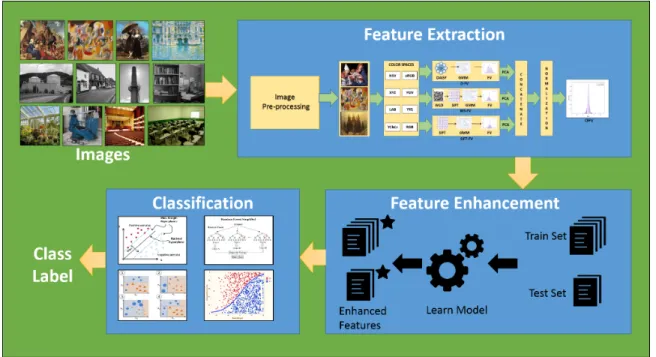
Content-based image classification applications have expanded greatly due to the advent of an image era of big data resulting in the availability of large number of color images in the internet. With the wide spread availability of digital cameras, cheap data storage and better access of Internet services around the world, millions of color images are created, shared and stored over the Internet. These large number of digital images necessitate the development of automated learning systems that can classify these images into different categories with minimal or no human intervention. Image classification is a challenging topic in the computer vision and machine learning research areas due to the complexity of different visual elements in images and the difficulty to correctly understand the semantics of images. Figure 1.1 shows a general image classification framework which contains three major steps. The first step is feature extraction from the input images to efficiently represent interesting parts of images as a compact feature vector. In some cases, the images may be pre-processed using some image pre-processing techniques to reduce the background noise. The second step is the feature enhancement process so as to ensure that the feature vectors extracted are discriminative to improve the classification performance. Note that only the images in the training set are used to learn the model for feature enhancement. The final step is classification where the enhanced features are used to learn a classifier and the labels are predicted for the images of the test set.
Recently, several machine learning methods such as sparse coding, discrimination analysis have been broadly applied for different image classification applications such as scene and object recognition [3, 27, 71, 123, 39, 58, 87, 65, 66], face recognition [71, 118, 113, 119, 129, 87, 65, 66], human action recognition [32, 58], kinship verification [77, 18, 112, 70, 85, 67, 64], and fine art painting classification [78, 104, 44, 81, 108, 87,
Figure 1.1 A general image classification framework with three major steps: feature extraction, feature enhancement and classification.
65, 66]. Studies in cognitive psychology [80, 107] show that the human visual system is more accurate and robust to find discriminative visual elements in images and a model based on the biological visual cortex is likely to achieve better performance.
This proposal, therefore, focuses on developing image descriptors and learning methods by incorporating cues from the human visual system. Specifically, first, a novel fused color Fisher vector (FCFV) feature is proposed in order to capture different visual information such as color, local, spatial, relative intensity and gradient orientation information. To handle the inconsistencies of different visual classes in images, the FCFV feature is computed by fusing the DAISY Fisher vector (D-FV) feature, Weber-SIFT Fisher vector (WS-FV) feature and the color SIFT Fisher vector features in different color spaces. Second, a sparse representation model using the complete marginal Fisher analysis (CMFA) framework is proposed to capitalize on both the representation aspect of sparse coding methods and the discrimination aspect of the enhanced marginal Fisher analysis method. A potential shortcoming of the MFA method [10] is the principal component
analysis (PCA) [25] step which may discard the null space of the local samples based within class scatter matrix containing important discriminatory information. Our proposed CMFA method extracts the discriminatory features in both the column space of the local samples based within class scatter matrix and the null space of its transformed matrix to enhance the discriminatory power. To further improve the classification capability, a discriminative sparse representation model is learned using the CMFA-SR features by integrating a representation criterion and a discriminative criterion. A variant of the above method is the sparse kernel manifold learner where the discriminative sparse representation model is learned on the FCFV features. Third, a novel discriminative dictionary distribution based sparse coding (DDSC) method is presented that provides new insights and leads to an effective representation and classification framework. Specifically, the proposed DDSC method integrates two new criteria, namely a discriminative criterion and a dictionary distribution criterion into the conventional sparse representation criterion. Finally, a new multiple anthropological Fisher kernel framework (M-AFK) is proposed for kinship verification applications. The genetic inheritable features in kinship relations are enhanced by matching densely sampled SIFT features using the SIFT flow algorithm [60]. An inheritable transformation is further applied to multiple Fisher vector features with the objective to increase the distance between the non-kinship samples and decrease the distance between the kinship samples.
The proposed methods are evaluated on several popular and publicly available image datasets associated with different image classification tasks such as scene and object classification, fine art painting classification, face recognition, kinship verification and fine grained image classification. Experimental results and analysis show the feasibility and effectiveness of the proposed methods.
This proposal is organized in the following manner. Chapter 2 discusses some related work by other researchers on image descriptors, manifold and deep learning methods, sparse coding algorithms, metric learning methods, kinship verification and painting
Figure 1.2 Some example images of different image classification datasets.
classification. Chapter 3 explains the FCFV feature and the SKML method for different image classification applications. Chapter 4 discusses CMFA-SR model and the derivation of the largest step size, optimization procedure and the screening rule. Chapter 6 introduces the SF-GFVF feature to enhance and encode the genetic features of parent and child image in kinship relations. Chapters 3, 4 and 6 also include detailed experimental results and analysis performed on various popular and publicly available image datasets. Finally, chapter 7 outlines some proposed research.
BACKGROUND AND RELATED WORK
2.1 Image Descriptors
Local, color, spatial, intensity information, and gradient orientation information are the cues based on which human beings can distinguish between images, and hence they contribute significantly in image classification applications. Van de Weijer et al. [105] showed the effectiveness of color names learned from images for texture classification and action recognition. The work of van de Sande [104] showed that SIFT descriptor incorporated with color information result in a robust local descriptor for classification purposes. Guo et al. [33] proposed the complete LBP descriptor wherein a region in an image is represented by its center pixel and a local difference sign-magnitude transform. Shechtman et al. [95] proposed the self-similarity descriptor which measures similarity of visual entities based on matching internal layout of the image. Bosch et al. [9] introduced a PHOG descriptor that represents local image shape and its spatial layout, together with a spatial pyramid kernel so that the shape correspondence between two images can be measured by the distance between their descriptors using the kernel. The GIST descriptor developed by Oliva et al. [79] is based on a very low dimensional representation of the scene known as spatial envelope that generates a multidimensional space in which scenes sharing membership in semantic categories are projected as close as possible.
2.2 Manifold Learning and Deep Learning Methods
In image classification applications, different manifold learning methods, such as the locality sensitive discriminant analysis (LSDA) [10], the locality preserving projections [35], the marginal Fisher analysis (MFA) [118], have been widely used to preserve data locality in the embedding space. The MFA method based on the graph embedding framework was presented by Yan et al. [118] by designing two graphs that characterize the
intraclass compactness and the interclass separability. Cai et al. [10] proposed the LSDA method that maximizes the margins between data points of different classes by discovering the local manifold structure. A geometric lp norm feature pooling (GLP) method was proposed by Feng et al. [23] to improve the discriminative power of pooled features by preserving their class-specific geometric information.
Popular deep learning methods, such as the convolutional neural networks (CNN), the deep autoencoders, and the recurrent neural networks, have received increasing attention in the multimedia community for challenging visual recognition tasks. Krizhevsky et al. [47] developed the AlexNet, which was the most notable deep CNN that contains 5 convolution layers followed by max-pooling layers, and 3 fully connected layers. The ZFNet proposed by Zeiler et al. [99] improved upon the AlexNet architecture by using smaller filter sizes, and developed a method to visualize the filters and weights correctly. He et al. [34] developed residual networks with a depth of upto 152 layers that contain skip connections and inter-block activation for better signal propagation between the layers.
2.3 Metric Learning
Metric learning methods have gained a lot of attention for computer vision and machine learning applications. In metric learning, an optimization objective function is developed from training images to learn the distance metric. Different metric learning methods have different objective functions designed for their specific purpose. Some representative metric learning methods include principal component analysis (PCA) [56], Laplacian eigen maps (LE) [7], linear discriminant analysis (LDA) [17], large margin nearest neighbor (LMNN) [112], information theoretic metric learning (ITML) [17] and cosine similarity metric learning (CSML) [77]. Some data samples in the training data provide more information towards learning the metric, therefore higher priority should be given to these data samples. But most existing metric learning methods do not differentiate important data samples and treat all the samples equally leading to reduction in accuracy. In [70],
Lu et al. proposed the Neighborhood Repulsed Metric Learning (NRML) in which the intraclass samples within a kinship relation are pulled as close as possible and interclass samples are pushed as far as possible. While NRML has achieved good performance in kinship verification, there are still some shortcomings. First, the NRML method derives the features and the metric learning independently, therefore theoretical relation cannot be established between them. Second, the objective function can face the issue of dominance of one term in the function over the other terms leading to inaccurate results.
2.4 Sparse Coding
Several sparse representation methods based on supervised learning methods have been developed for learning efficient sparse representations or incorporating discriminatory information by combining multiple class specific dictionary for different visual recognition applications. In particular, the sparse representation methods can be roughly categorized into three categories. The first category of sparse representation methods aims to learn a space efficient dictionary by fusing multiple atoms from the initial large dictionary. Fulkerson et al. [26] proposed an object localization framework that efficiently reduces the size of a large dictionary by constructiong small dictionaries based on the agglomerative information bottleneck. The work of Lazebnik et al. [49] present a technique for learning dictionaries by using the information-theoretic properties of sufficient statistics. Jiang et al. [41] presented an efficient greedy based optimization approach for modeling the discriminative dictionary learning by maximizing the monotonically increasing and submodular properties of a graph topology selection problem. Qiu et al. [89] developed an approach for dictionary learning of action attributes by integrating the mutual information for appearance information and class distributions between the learned dictionary and the rest of the dictionary space in the objective function.
The second category combines multiple class specific sub-dictionaries to improve the discriminatory power of the sparse representation method. Yang et al. [123] proposed a
Fisher discrimination discriminatory learning framework to learn a structured dictionary where each sub-dictionary has specific class labels. Mairal et al. [73] proposed a sparse representation based framework by jointly optimizing both the sparse reconstruction and class discrimination components for learning multiple dictionaries. Zhou et al. [132] presented a joint dictionary learning algorithm that jointly learns multiple class-specific dictionaries and a common shared dictionary by exploiting the visual correlation within a group of visually similar objects. A dictionary learning approach for positive definite matrices was proposed by Sivalingam et al. [101], where the dictionary is learned by alternating minimization of sparse coding and dictionary update stages.
The final category of sparse representation methods co-trains the sparse represen-tation and discriminative dictionary by adding a discriminant term to the objective function. Yang et al. [121] proposed supervised hierarchical sparse coding models where the dictionary is learned via back-projection where implicit differentiation is used to relate the sparse codes to the dictionary. Jiang et al. [40] presented a label consistent K-SVD algorithm where a label consistency constraint and a classification performance criteria are integrated to the objective function to learn a reconstructive and discriminative dictionary. Zhang et al. [129] developed a discriminative K-SVD algorithm to learn an over-complete dictionary by directly incorporating labels in the dictionary learning stage.
To increase the computational efficiency of the sparse representation methods and to improve the scalability to large datasets, screening rules are receiving increasing attention by researchers. Wang et al. [111] proposed a sparse logistic regression screening rule to identify the zero components in the solution vector to effectively discard features for the l1 regularized logistic regression. Xiang et al. [117, 116] presented a dictionary screening rule to select a subset of codewords to use in Lasso optimization and derived fast Lasso screening tests to find which data points and codewords are highly correlated. A new set of screening rules for the Lasso problem were developed by Wang et al. [109] that uses
non-expansiveness of the projection operator to effectively identify inactive predictors of the Lasso problem.
2.5 Kinship Verification
Facial images convey important characteristics such as identity information, kinship information, facial expressions, gender of a person, ethnicity, emotional information, mental state of a person and so on. Among these many characteristics, kinship is believed to be one of the most dominant one since children naturally inherit genetic features from their parents [115]. Subsequent studies in social sciences have confirmed that children resemble their parent more than other people and they may resemble a particular parent more at different ages [4]. Deghan et al. [18] proposed an algorithm that fuses the features and metrics using a gated autoencoders and a discriminative neural network. The hybrid framework learns the genetic features in parent-offspring relationships to improve the kinship verification performance. A neighborhood repulsed metric learning (NRML) method was proposed by Lu et al. [70] in which the distance of interclass samples are pushed as far as possible and the distance between intraclass samples within a kinship relation are pulled as close as possible for better verification accuracy. Lan et al. [48] proposed a quaternionic Weber local descriptor (QWLD) framework which uses quaternionic representation to handle all color channels of the image in a holistic way while preserving their relations, and applies Weber’s law to ensure that the derived descriptors are robust and discriminative. A hierarchial learning representation was presented by Kohli et al. [46] that develops a compact feature representation by encoding relational information present in images using filters and contractive regularization penalty. The mixed bi-subject kinship verification problem is solved using a multi-view multi-task learning proposed by Qin et. al [88] where the transformation matrices for all the relations jointly learned as well as for a single relation is fused to improve the kinship verification performance. Zhou et al. [133] proposed a multiview scalable similarity learning (SSL) method by fusing
the diagonal similarity models from multiple feature representations in a coherent online process to leverage the interactions and correlations in multiview kin data.
2.6 Computational Fine Art Painting Categorization
Recently, several research efforts have been invested for painting classification using computer vision techniques. Shamir et al. [93] described a method for automated recognition of painters and schools of art based on their signature styles. Sablating et al. [92] examined the structural signature of a painting based on the brush strokes in potrait miniatures. The work of Zujovic et al. [134] described an approach to automatically classify digital pictures of paintings by using the salient aspects of a painting such as color, texture and edges. Shamir and Tarakhovsky [94] showed that automatic computer analysis can group artists by their artistic movements, and provide a map of similarities and influential links that is largely in agreement with the analysis of art historians. Siddique et al. [97] presented an efficient approach for learning a mixture of kernels by greedily selecting exemplar data instances corresponding to each kernel using AdaBoost for painting dataset classification. A multiple visual feature based framework was proposed by Shen [96] for automatic classification of western painting image collection. The work of Culjak et al. [16] offered an approach to automatically classify paintings into their genres by extracting features based on color and texture of the painting.
SPARSE KERNEL MANIFOLD LEARNER FOR IMAGE CLASSIFICATION
3.1 Introduction
The human visual system is much more efficient and robust in classifying different visual elements in an image, therefore any image classification system based on the human visual system is likely to achieve good performance for classification tasks. Different visual aspects in an image such as color, edges, shape, intensity and orientation of objects help humans to identify and discriminate between images. Pioneer works in cognitive psychology believe that the human visual cortex represent images as sparse structures as it provides an efficient representation for later stages of visual processing [80, 107]. A sparse representation of a data-point can be represented as a linear combination of a small set of basis vectors allowing efficient storage and retrieval of data. Another advantage of sparse representation is that it adapts to varying level of information in the image since it provides a distributed representation of an image. Therefore, we introduce a hybrid feature extraction method to capture different kinds of information from the image and propose a discriminative sparse coding method based on manifold learning algorithm to learn an efficient and robust discriminative sparse representation of the image.
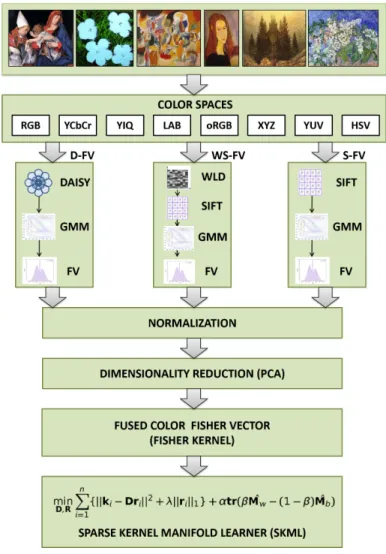
In this chapter, we first present novel DAISY Fisher vector (D-FV) and Weber-SIFT Fisher vector (WS-FV) features in order to handle the inconsistencies and variations of different visual classes in images. In particular, the D-FV feature enhances the Fisher vector feature by fitting dense DAISY descriptors [103] to a parametric generative model. We then develop the WS-FV by integrating Weber local descriptors [13] with SIFT descriptors and Fisher vectors are computed on the sampled WLD-SIFT features. An innovative fused Fisher vector (FFV) is proposed by fusing the principal components of D-FV, WS-FV and SIFT-FV (S-FV) features. We then assess our FFV feature in eight different color
Figure 3.1 The framework of our proposed SKML method.
spaces and propose several color FFV features. The descriptors that are defined in different color spaces provide stability against image variations such as rotation, viewpoint, clutter and occlusions [100] which are essential for classification of images. We further extend this concept by integrating the FFV features in eight different color spaces to form a novel fused color Fisher vector (FCFV) feature. Finally, we use a sparse kernel manifold learner (SKML) method to learn a discriminative sparse representation by integrating the discriminative marginal Fisher analysis criterion to the sparse representation criterion. In particular, new intraclass compactness and interclass separability are define based on the sparse representation criterion under the manifold learning framework. The objective of the SKML method is to increase the interclass distance between data-points belonging to
different classes and decrease the intraclass distance between data-points of the same class. The SKML method can efficiently calculate a global shared dictionary without the need for computation of sub-dictionaries and hence is suitable for large datasets. The framework of our proposed SKML method is illustrated in Figure 3.1. Experimental results show that the proposed approach achieves better results compared to other popular image descriptors and state-of-the-art deep learning methods on different image classification datasets.
The rest of this chapter is organized in the following manner. Section 3.2 describes the details of the computation of different Fisher vector features and the SKML method. We present an extensive experimental evaluation and analysis of the proposed SKML method for different classification datasets in Sections 3.3 and 3.4 concludes the paper.
3.2 Novel Sparse Kernel Manifold Learner Framework 3.2.1 Fisher Vector
We briefly review the Fisher vector which is widely applied for visual recognition problems such as face detection and recognition [98], object recognition [38], etc. Fisher vector describes an image by what makes it different from other images [38] and focuses only on the image specific features. Particularly, letX = {dt, t = 1,2, ..., T}be the set of T local descriptors extracted from the image. Letµλ be the probability density function ofXwith parameterλ, then the Fisher kernel [38] is defined as follows:
K(X,Y) = (GXλ)TF−λ1GYλ (3.1)
where GXλ = T1 5λ logµλ(X), which is the gradient vector of the log-likelihood that describes the contribution of the parameters to the generation process. AndFλis the Fisher information matrix ofµλ.
Since F−λ1 is symmetric and positive definite, it has a Cholesky decomposition as
F−λ1 = LTλLλ. Therefore, the kernel K(X,Y) can be written as a dot product between normalized vectorsGλ, obtained asGXλ =LλGXλ whereG
X
3.2.2 DAISY Fisher Vector (D-FV)
In this section, we present a new innovative DAISY Fisher vector (D-FV) feature where Fisher vectors are computed on densely sampled DAISY descriptors. DAISY descriptors are suitable for dense computation and offers precise localization and rotational robustness [103], therefore provides improved performance and better accuracy for classification. The DAISY descriptor [103]D(u0, v0)for location(u0, v0)is defined as follows:
D(u0, v0) = [˜h T Σ1(u0, v0), ˜ hTΣ1(I1(u0, v0, R1)), ...,˜h T Σ1(IT(u0, v0, R1)), ..., ˜ hTΣQ(I1(u0, v0, RQ)), ...,h˜ T ΣQ(IT(u0, v0, RQ))] T (3.2)
whereIj(u, v, R)is the location with distanceRfrom(u, v)in the direction given byj, Q represents the number of circular layers and˜hΣ(u, v)is the unit norm of vector containing
Σ-convolved orientation maps in different directions. The sampled descriptors are fitted to a Gaussian Mixture Model (GMM) with 256 parameters. The Fisher vectors are then encoded as derivatives of log-likelihood of the model.
3.2.3 Weber-SIFT Fisher Vector (WS-FV)
In this section, we propose a new Weber-SIFT Fisher vector (WS-FV) feature that computes the Fisher vector on Weber local descriptor (WLD) integrated with SIFT features so as to encode the color, local, relative intensity and gradient orientation information from an image. The WLD [13] is based on the Weber’s law which states that the ratio of increment threshold to the background intensity is a constant. The descriptor contains two components differential excitation [13] and orientation [13] which are defined as follows.
ξ(xc) = arctan[ ν00 s ν01 s ]and θ(xc) = arctan( ν11 s ν10 s ) (3.3)
whereξ(xc)is the differential excitation andθ(xc)is the orientation of the current pixelxc,
Figure 3.2 The color component images of a sample image from the Painting-91 dataset in different colorspaces.
ν00
s , νs01, νs10 and νs11 are the output of filters f00, f01, f10 and f11, respectively. The WLD descriptor extracts the relative intensity and gradient information similar to humans perceiving the environment, therefore provides stability against noise and illumination changes. A parametric generative model is trained by fitting to the WLD-SIFT features and Fisher vectors are extracted by capturing the average first order and second order differences between the computed features and each of the GMM centers.
3.2.4 Fused Color Fisher Vector (FCFV)
In this section, we first present an innovative fused Fisher vector (FFV) feature that fuses the most expressive features of the D-FV, WS-FV and SIFT-FV features. The most expressive features are extracted by means of Principal Component Analysis (PCA) [25]. Particularly, letX∈RNbe a feature vector with covariance matrixΣgiven as follows:Σ=
expectation. The covariance matrix can be factorized as follows [25]:Σ = φΛφT where
Λ= diag[λ1, λ2, λ3, ..., λN]is the diagonal eigenvalue matrix andφ = [φ1φ2φ3....φN]
is the orthogonal eigenvector matrix. The most expressive features ofXis given by a new vectorZ∈RK :Z=PTXwhereP= [φ
1φ2φ3....φK]andK < N.
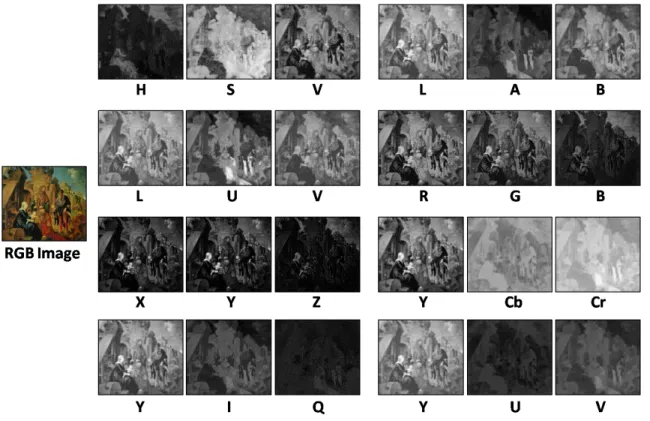
We incorporate color information to our proposed feature as the color cue provides powerful discriminating information in pattern recognition and can be very effective for face, object, scene and texture classification [100, 57]. The descriptors defined in different color spaces provide stability against illumination, clutter, viewpoint and occlusions [100]. To derive the proposed FCFV feature, we first compute the D-FV, WS-FV and SIFT-FV in the eight different color spaces namely RGB, YCbCr, YIQ, LAB, oRGB, XYZ, YUV and HSV. Figure 3.2 shows the component images of a sample image from the Painting-91 dataset in different color spaces used in this paper. For each color space, we derive the FFV by fusing the most expressive features of D-FV, WS-FV and SIFT-FV for that color space. We then reduce the dimensionality of the eight FFV features using PCA, which derives the most expressive features with respect to the minimum square error. We finally concatenate the eight FFV features and normalize to zero mean and unit standard deviation to create the novel FCFV feature.
3.2.5 Sparse Kernel Manifold Learner (SKML)
In this section, we present a sparse kernel manifold learner (SKML) to learn a compact discriminative representation by considering the local manifold structure and the label information. In particular, new within class scatter and between class scatter matrices are defined constrained by the marginal Fisher criterion [118] and the sparse criterion so as to increase the interclass separability and reduce the intraclass compactness based on a manifold learning framework. A discriminative term is then integrated to the representation criterion of the sparse model so as to improve the pattern recognition performance.
The features used as input for the SKML method are the FCFV features extracted from the image. Given the Fisher kernel matrix K = [k1,k2, ...,kn] ∈ Rm×n, which contains n samples in a m dimensional space, let D = [d1,d2, ...,db] ∈ Rm×b denote the dictionary that representsb basis vectors and R = [r1,r2, ...,rn] ∈ Rb×n denote the sparse representation matrix which represents the sparse representation formsamples. The coefficientri in the sparse representationRcorrespond to the items in the dictionaryD.
In the proposed SKML method, we jointly optimize the sparse representation criterion and the marginal Fisher analysis criterion to derive the dictionaryD and sparse representationS from the training samples. The objective of the marginal Fisher analysis criterion is to minimize the intraclass compactness and maximize the interclass separability. We define new discriminative intraclass compactnessMˆw based on the sparse criterion as follows: ˆ Mw = n X i=1 X (i,j)∈Nw k(i,j) (ri−rj)(ri−rj)T (3.4)
where(i, j) ∈ Nkw(i, j) represents the(i, j) pairs where sample ki is among the nearest neighbors of samplekj of the same class or vice versa.
And the discriminative interclass separabilityMˆb is defined as:
ˆ Mb = m X i=1 X (i,j)∈Nb k(i,j) (ri−rj)(ri−rj)T (3.5)
where (i, j) ∈ Nkb(i, j) represents nearest (i, j) pairs among all the (i, j) pairs between sampleskiandkj of different classes.
Therefore, we define the modified optimization criterion as:
min D,R n X i=1 {||ki−Dri||2+λ||ri||1}+αtr(βMˆw−(1−β) ˆMb) s.t.||dj|| ≤1,(j = 1,2, ..., b) (3.6)
Figure 3.3 Some sample images from different visual recognition datasets used for evaluation of the proposed SKML method.
wheretr(.) denotes the trace of a matrix, the parameter λ controls the sparsity term, the parameterα controls the discriminatory term, the parameterβ balances the contributions of the discriminative intraclass compactnessMˆw and interclass separabilityMˆb.
LetL=l1,l2, ...,ltare the test data matrix andtbe the number of test samples, then as the dictionaryDis already learned, the discriminative sparse representation for the test data can be derived by optimizing the following criterion:
min S t X i=1 {||li−Dsi||2}+λ||si||1 (3.7)
The discriminative sparse representation for the test data is defined asS= [s1, ...,st]∈Rb×t and has both the sparseness and discriminative information since we learn the dictionary from the the training process.
3.3 Experiments
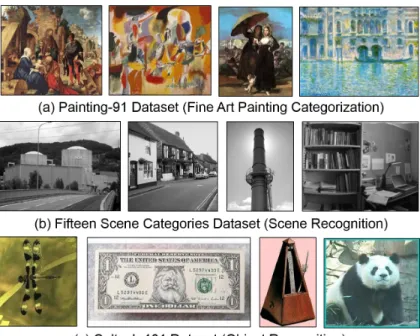
We assess the performance of our proposed SKML method on three different image classifiction datasets namely the Painting-91 dataset [44], the CalTech 101 dataset [50] and the 15 Scenes dataset [53]. Figure 3.3 shows some sample images from different visual recognition datasets used for evaluation.
3.3.1 Painting-91 Dataset
This section assesses the effectiveness of our proposed features on the challenging Painting-91 dataset [44]. The dataset contains 4266 fine art painting images by Painting-91 artists. The images are collected from the Internet and each artist has variable number of images ranging from 31 (Frida Kahlo) to 56 (Sandro Boticelli). The dataset classifies 50 painters to 13 styles with style labels as follows: abstract expressionism (1), baroque (2), constructivism (3), cubbism (4), impressionism (5), neoclassical (6), popart (7), post-impressionism (8), realism (9), renaissance (10), romanticism (11), surrealism (12) and symbolism (13).
Art painting categorization is a challenging task as the variations in subject matter, appearance, theme and styles are large in the art paintings of the same artists. Another issue is that the similarity gap between paintings of the same styles is very small due to common influence or origin. In order to effectively classify art paintings, key aspects such as texture form, brush stroke movement, color, sharpness of edges, color balance, contrast, proportion, pattern, etc. have to be captured [91]. Painting art images are different from photographic images due to the following reasons: (i) Texture, shape and color patterns of different visual classes in art images (say, a multicolored face or a disproportionate figure) are inconsistent with regular photographic images. (ii) Some artists have a very distinctive style of using specific colors (for ex: dark shades, light shades etc.) and brush strokes resulting in art images with diverse background and visual elements. The proposed SKML framework uses FCFV features which captures different kinds of information from the
painting image and the SKML method aims to improve the discrimination between classes essential for computational fine art painting categorization.
Table 3.1 Comparison of the Proposed SKML Feature with Popular Image Descriptors for Artist and Style Classification Task of the Painting-91 Dataset
No. Feature Artist CLs Style CLs 1 LBP [78, 44] 28.5 42.2 2 Color-LBP [44] 35.0 47.0 3 PHOG [9, 44] 18.6 29.5 4 Color-PHOG [44] 22.8 33.2 5 GIST [44] 23.9 31.3 6 Color-GIST [44] 27.8 36.5 7 SIFT [68, 44] 42.6 53.2 8 CLBP [33, 44] 34.7 46.4 9 CN [105, 44] 18.1 33.3 10 SSIM [44] 23.7 37.5 11 OPPSIFT [104, 44] 39.5 52.2 12 RGBSIFT [104, 44] 40.3 47.4 13 CSIFT [104, 44] 36.4 48.6 14 CN-SIFT [44] 44.1 56.7 15 Combine(1 - 14) [44] 53.1 62.2 16 SKML 63.09 71.67
Performance in Different Color Spaces This section demonstrates the performance of our proposed SKML feature in eight different color spaces namely RGB, YCbCr, YIQ, LAB, oRGB, XYZ, YUV and HSV as shown in Table 3.3. Among the single color descriptors, the YIQ-FFV feature performs the best with classification accuracy of 59.22%
Table 3.2 Comparison of the Proposed SKML Feature with State-of-the-art Deep Learning Methods for Artist and Style Classification Task of the Painting-91 Dataset
No. Feature Artist CLs Style CLs 1 MSCNN-0 [81] 55.15 67.37 2 MSCNN-1 [81] 58.11 69.69 3 MSCNN-2 [81] 57.91 70.96 4 MSCNN-3 [81] - 67.74 5 CNNF1 [108] 55.40 68.20 6 CNNF2 [108] 56.25 68.29 7 CNNF3 [108] 56.40 68.57 8 CNNF4 [108] 56.35 69.21 9 CNNF5 [108] 56.35 69.21 10 SKML 63.09 71.67
for the artist classification task whereas the RGB-FFV feature gives the best performance of 66.43% for the style classification task. The SKML feature is computed by using a sparse representation model on the fusion of the FFV features in eight different color spaces and it achieves the best performance in both artist and style classification re-emphasizing the fact that adding color information is particularly suitable for classification of art images.
Artist and Style Classification This section evaluates the performance of our proposed method on the task of artist and style classification. The artist classification is a task wherein a painting image has to be classified to its respective artist whereas the style classification task is to assign a style label to the painting image. The artist classification task contains 91 artists with 2275 train and 1991 test images. Similarly, the style classification task contains 13 style categories with 1250 train and 1088 test images. Table 3.1 shows the comparison of the proposed SKML feature with other state-of-the-art image
Table 3.3 Classification Performance of the FFV Feature in Different Color Spaces on the Painting-91 Dataset
Feature Artist CLs Style CLs RGB-FFV 59.04 66.43 YCbCr-FFV 58.41 65.82 YIQ-FFV 59.22 66.26 LAB-FFV 49.30 59.98 oRGB-FFV 57.50 65.46 XYZ-FFV 56.41 64.32 YUV-FFV 57.70 64.25 HSV-FFV 51.43 60.58 SKML 63.09 71.67
descriptors. The color LBP descriptor [44] is calculated by fusing the LBP descriptors computed on the R,G and B channels of the image. Similar strategy is used to compute the color versions of PHOG and GIST descriptor. The opponent SIFT [104] for the painting image is computed by first converting the image to the opponent color space and then fusing the SIFT descriptors calculated for every color channel. The SSIM (self similarity) descriptor [44] is computed using a correlation map to estimate the image layout. The combination of all image descriptors listed in Table 3.1 gives a classification accuracy of 53.1% and 62.2% for the artist and style classification tasks, respectively. Experimental results show that our proposed SKML feature significantly outperforms popular image descriptors and their fusion, and achieves the classification performance of 63.09% and 71.67% for artist and style classification, respectively.
Table 3.2 shows the performance of the proposed SKML features compared with state-of-the-art deep learning methods. MSCNN [81] stands for multi-scale convolutional
Figure 3.4 The confusion matrix for 13 style categories of the Painting-91 dataset using the SKML feature.
neural network which extracts features in different scales using multiple CNNs. The cross layer convolutional neural network (CNN F) [108] computes features from multiple layers of CNN to improve discriminative ability instead of only extracting from the top-most layer. The best performing CNN for the artist classification and style classification is MSCNN-1 [81] and MSCNN-2 [81], respectively. Our proposed SKML method achieves better result compared to state-of-the-art deep learning methods such as multi scale CNN and cross layer CNN.
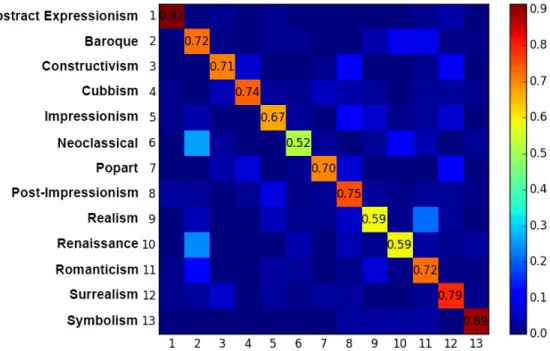
Figure 3.4 shows the confusion matrix for the 13 style categories using the SKML feature where the rows denote the actual classes while the columns denote the assigned classes. It can be observed that the best classified categories are 1 (abstract expressionism) and 13 (symbolism) with classification rates of 92% and 89%, respectively. The most difficult category to classify is category 6 (neoclassical) as there are large confusions between the styles baroque and neoclassical. Similarly, the other categories that create confusion are the styles baroque and renaissance.
Table 3.4 Art Movement Associated with Different Art Styles Art Movement Art Style
Renaissance renaissance
Post Renaissance baroque, neoclassical, romanticism, realism Modern Art popart, impressionism, post impressionism,
surrealism, cubbism, symbolism, construc-tivism, abstract expressionism
Comprehensive Analysis of Results Table 3.4 shows the art movements associated with different art styles. Interesting patterns can be observed from the confusion diagram in Figure 4.2. The art styles within an art movement show higher confusions compared to the art styles between the art movement periods. An art movement is a specific period of time wherein an artist or group of artists follow a specific common philosophy or goal. It can be seen that there are large confusions for the styles baroque and neoclassical. Similarly, the style categories romanticism and realism have confusions with style baroque. The style categories baroque, neoclassical, romanticism and realism belong to the same art movement period - post renaissance. Similarly, popart paintings have confusions with style category surrealism within the same art movement but none of the popart paintings are misclassified as baroque or neoclassical. The only exception to the above observation is the style categories renaissance and baroque as even though they belong to different art movement period, there are large confusions between them. The renaissance and baroque art paintings have high similarity as the baroque style evolved from the renaissance style resulting in few discriminating aspects between them [91].
Artist Influence In this section, we analyze the influence an artist can have over other artists. We find the influence among artists by looking at similar characteristics
Figure 3.5 The artist influence cluster graph for the Painting-91 dataset.
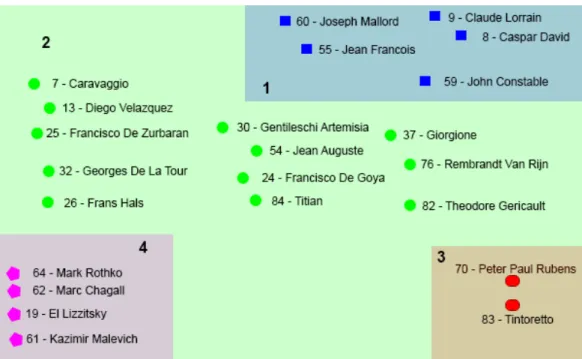
between the artist paintings. Artist influence may help us to find new connections among artists during different art movement period and also understand the influence among different art movement periods. In order to calculate the artist influence, we calculate the correlation score between the paintings of different artists. Letaik denote the feature vector representing the painting by artistkwherei= 1, .., nkand letnkbe the total number of paintings by artist k. We calculate Ak which is the average of the feature vector of all paintings by artistk. We then compute a correlation matrix by comparing the average feature vector of each artist with all other artists. Finally, clusters are defined for artists with high correlation score. Figure 3.5 show the artist influence cluster graph with correlation threshold of 0.70.
Interesting observations can be deduced from Figure 3.5. Every cluster can be associated with a particular style and time period. Cluster 1 shows artists with major contributions to the styles realism and romanticism and they belong to the post renaissance art movement period. Cluster 2 has the largest number of artists associated with the styles renaissance and baroque. Cluster 3 represents artists for the style Italian renaissance that
Figure 3.6 The artist influence cluster graph using k means clustering for the Painting-91 dataset.
took place in the16th century. And cluster 4 shows artists associated with style abstract expressionism in the modern art movement period (late18th-19thcentury).
We further show the k-means clustering graph with cosine distance to form clusters of similar artists. Figure 3.6 shows the artist influence graph clusters for paintings of all artists with k set as 8. First, the average of the feature vector of all paintings of an artist is calculated as described above. We then apply k-means clustering algorithm with k set as 8. The artist influence graph is plotted using the first two principal components of the average feature vector. The results of Figure 3.5 have high correlation with the results of the artist influence cluster graph in Figure 3.6.
Figure 3.7 The style influence cluster graph for the Painting-91 dataset.
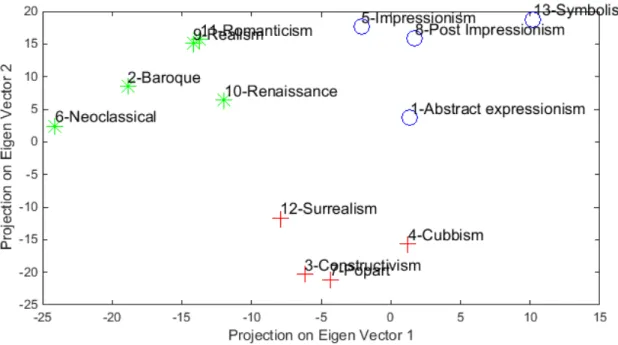
Style Influence In this section, we study the style influence so as to find similarities between different art styles and understand the evolution of art styles in different art movement periods. The style influence is calculated in a similar manner as the artist influence. First, we calculate the average of the feature vector of all paintings for a style. We then apply k-means clustering method with cosine distance to form clusters of similar styles. We set the number of clusters as 3 based on the different art movement periods. The style influence graph is plotted using the first two principal components of the average feature vector.
Figure 3.7 shows the style influence graph clusters with k set as 3. Cluster 1 contains the styles of the post renaissance art movement period with the only exception of style renaissance. The reason for this may be due the high similarity between styles baroque and renaissance as the style baroque evolved from the style renaissance [91]. The styles impressionism, post impressionism and symbolism in cluster 2 show that there are high similarities between these styles in the modern art movement period as the three styles
have a common french and belgian origin. Similarly, styles constructivism and popart in cluster 3 show high similarity in the style influence cluster graph.
We further show the results based on the correlation matrix computed by comparing the average feature vector of all paintings of each style with all other styles. We set the correlation threshold as 0.7.
Renaissance=> Baroque, N eoclassical Romanticism=> Realism
Impressionism=> P ost impressionism Constructivism => P opart
The results are in good agreement with the style influence cluster graph and support the observation that the art styles within an art movement show higher similarity compared to the art styles between the art movement periods. The styles baroque and neoclassical belong to the same art movement period and the style baroque has evolved from the style renaissance. Similarly, other styles belong to the modern art movement period. It can be observed from the style influence cluster graph that the style pairs romanticism:realism, impressionism:post impressionism and constructivism:popart are plotted close to each other in the graph indicating high similarity between these styles.
3.3.2 Fifteen Scene Categories Dataset
The fifteen scene categories dataset [50] contains 4485 images from fifteen scene categories namely, office, kitchen, living room, bedroom, store, industrial, tall building, inside cite, street, highway, coast, open country, mountain, forest, and suburb with 210 to 410 images per category. We follow the experimental protocol as described in [50] wherein 1500 images are used for training whereas the remaining 2985 images are used for testing. The train/test split is determined randomly with the criterion that 100 images are selected for every scene category as train images and the remaining images are used as test images.
Table 3.5 Comparison Between the Proposed Method and Other Popular Methods on the Fifteen Scene Categories Dataset
Method Accuracy (%) KSPM [50] 81.40 DHFVC [28] 86.40 LLC [110] 80.57 KSPM [50] 81.40 LaplacianSC [27] 89.70 DHFVC [28] 86.40 D-KSVD [129] 89.10 LC-KSVD [40] 90.40 Hybrid-CNN [131] 91.59 SKML 96.25
Table 3.5 shows the comparison of the proposed SKML features with popular learning methods. The LLC method [110] extracts a feature descriptor by using a locality constraint for projection to a local co-ordinate system. The DHFVC method [28] uses a hierarchical visual feature coding architecture based on restricted Boltzmann machines (RBM) for encoding of SIFT descriptors. A over-complete dictionary is learned by the D-KSVD algorithm [129] by integrating the classification error to the objective criterion whereas the LC-KSVD approach [40] adds a label consistency constraint combined with the classification and reconstruction error to form a single objective function. Another popular sparse coding method is LaplacianSC [27] which preserves the locality of features by using a similarity preserving criterion based on Laplacian framework. The sparse coding methods D-KSVD, LC-KSVD and LaplacianSC achieves an accuracy of 89.10%, 90.40% and 89.70%, respectively. The state-of-the-art deep learning method such as hybrid CNN
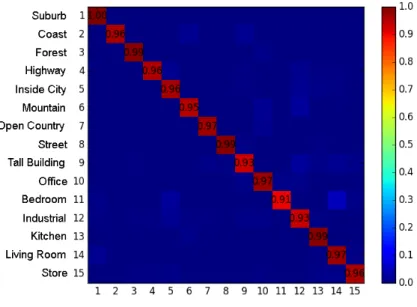
Figure 3.8 The confusion matrix diagram of the 15 scene categories dataset using the proposed SKML feature.
[131] which is trained on a combination of training set of ImageNet-CNN and Places-CNN achieves a performance of 91.59%. The experimental results in Table 3.5 show that our proposed SKML method achieves higher performance of 96.25% compared to popular sparse coding and deep learning methods.
The confusion diagram for the fifteen scene categories dataset is shown in Figure 3.8. The suburb category out of the fifteen scene categories achieves the best classification rate of 100%. The scene category with the lowest accuracy is the bedroom category with a classification rate of 91% as it has large confusions with the living room category. The living room scene category contains similar visual elements as the bedroom scene category resulting in high confusions between the two categories. The other scene categories that create confusion are tall building and industrial since both categories have some common visual semantics.
Figure 3.9 shows the t-SNE visualization for the fifteen scene categories dataset. The t-SNE method is a visualization technique used to fit high dimensional data to a plot using a non-linear dimensionality reduction technique to better understand the clusters of data of
Figure 3.9 The t-SNE visualization of the 15 scene categories dataset using the proposed SKML feature.
different categories in a dataset. It can be seen from Figure 3.9 that our proposed SKML method improves the separability between clusters of different class. Another advantage of our proposed method is that it encourages better localization of data-points belonging to the same class resulting in better performance.
3.3.3 CalTech 101 Dataset
The Caltech 101 dataset [53] contains 9144 images of objects belonging to 101 categories. Every category has about 40 to 800 images and size of each image is roughly 300 X 200 pixels. The experimental protocol used for the CalTech 101 dataset is described in [110]. In particular, the training procedure involves five sets where each set contains 30, 25, 20, 15 and 10 train images per category, respectively and for every set, the test split contains the remaining images. In order to have a fair comparison with other methods, we report the performance as the average accuracy over all the categories.
Table 3.6 Comparison Between the Proposed SKML Method and Other Popular Methods on the Caltech 101 Dataset
Method 10 15 20 25 30 LLC [110] 59.77 65.43 67.74 70.16 73.44 SPM [50] – 56.40 – – 64.60 SVM-KNN [127] 55.80 59.10 62.00 – 66.20 SRC [113] 60.10 64.90 67.70 69.20 70.70 D-KSVD [129] 59.50 65.10 68.60 71.10 73.00 LC-KSVD [40] 63.10 67.70 70.50 72.30 73.60 CNN-M + Aug [12] – – – – 87.15 SKML 82.47 84.46 85.35 86.61 87.95
The experimental results in Table 3.6 shows the detailed classification performance of the proposed SKML mathod and other popular learning methods for the CalTech 101 dataset. The SPM (spatial pyramid matching) method [50] divides an image to sub-regions and computes histogram over these sub-regions to form a spatial pyramid. The SVM-KNN method [127] finds the nearest neighbors of the query image and trains a local SVM based on the distance matrix computed on the nearest neighbors. The sparse coding method SRC [113] uses a sparse representation method computed byl1minimization and achieves classification accuracy of 70.70% for the set with training size 30 images per category. The deep learning method CNN-M + Aug [12] is similar to the architecture of ZFNet [126] but also incorporates additional augmentation techniques such as flipping and cropping to increase the training size. It can be seen from Table 3.6 that our proposed method achieves better performance compared to other learning methods. Another advantage of the SKML method is that no additional data augmentation techniques are required to improve the performance.
Figure 3.10 The t-SNE visualization for the CalTech 101 dataset using the proposed SKML feature.
The t-SNE visualization for the CalTech 101 dataset is shown in Figure 3.10. It can be seen that our proposed SKML method helps to increase the interclass separability between clusters having data-points belonging to different class categories as our method integrates a discriminative criterion to the objective function encouraging better clustering of points. Another advantage is that our method reduces the intraclass distance between data-points belonging to the same class in a cluster resulting in improved pattern recognition performance.
3.4 Conclusion
This chapter presents a sparse kernel manifold learner framework for different image classi-fication applications. First, a new hybrid feature extraction step is performed by introducing D-FV and WS-FV features to capture different aspects of image and encode important discriminatory information. We then derive an innovative FFV feature by integrating the